SIRT3: deacetylation, NAD⁺ and mitochondrial metabolism — NutriFit
SIRT3: mitochondrial deacetylation, metabolism and redox defense
How SIRT3 uses NAD⁺ to remove acetyl marks and regulate LCAD, ACSS1, HMGCS2, IDH2 and SOD2. Structure, import, respiration, mPTP, deficiency models and the limits of clinical claims about supplements and exercise.
SIRT3 links NAD⁺ availability to the state of mitochondrial proteins. It removes acetyl groups from lysine and influences fatty acid oxidation, ketogenesis, respiration and antioxidant systems. Yet widespread acetylation does not mean widespread enzyme shutdown, and a mouse knockout phenotype does not turn a supplement into a proven means of “reactivating mitochondria”. Understanding SIRT3 requires connecting the chemical possibility of modification, the fraction of modified molecules, the particular target and the level of evidence.
The mitochondrial acetylome: chemistry and stoichiometry
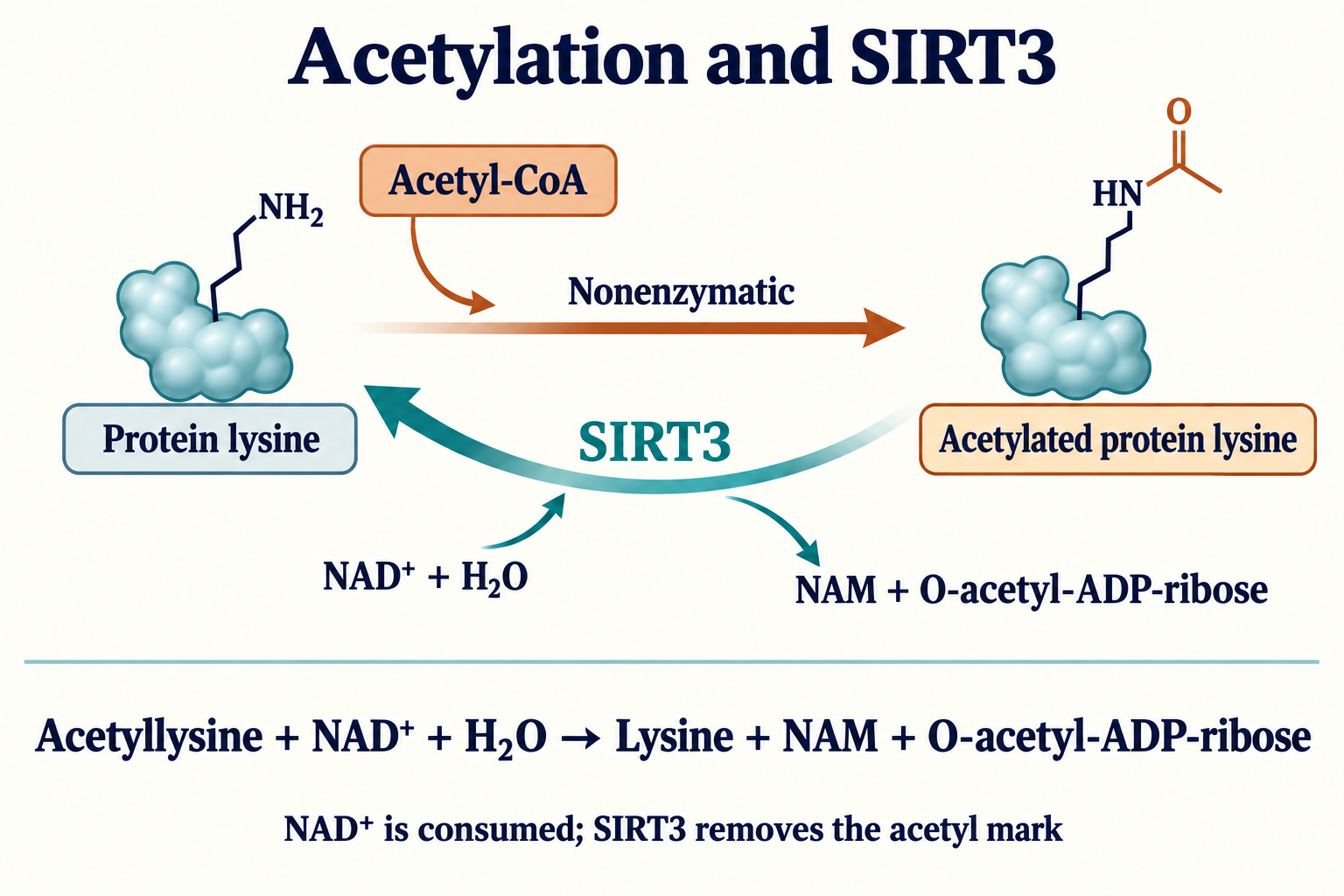
Why acetylation can occur without a dedicated enzyme
The respiratory chain exports protons from the matrix, which is therefore usually more alkaline than the cytosol. Acetyl-CoA also forms here through pyruvate and fatty acid oxidation. An unprotonated lysine ε-amino group can attack the acetyl-CoA thioester:
Wagner and Payne demonstrated dose- and time-dependent enzyme-independent protein acetylation and succinylation under conditions reproducing the matrix environment. This supports a chemical pathway without excluding enzymatic regulation of particular modifications in vivo. Values for pH, acetyl-CoA and protein concentration depend on tissue, diet and method; one fixed set of numbers does not describe every mitochondrion.
The fraction of available amino groups depends on local pKₐ:
fNH2=1+10pKa−pH1.
For free lysine with pKₐ around 10.5 at pH 8, this fraction is roughly 0.3%, rather than most molecules. Individual residues’ environments can change pKₐ and reactivity. Macromolecular crowding affects accessibility and interactions but does not demonstrate equal acceleration of all reactions.
An identified site is not a percentage of disabled proteins
Acetylation neutralizes lysine’s positive charge and can alter cofactor, substrate or membrane binding. However, identifying a site by mass spectrometry does not automatically reveal the fraction of modified molecules or the change in overall flux. Early proteomic studies found many mitochondrial targets; this does not establish universal “60–65% of proteins with stoichiometrically substantial marks” or “40–90% inhibition”.
In 2015, Weinert and colleagues measured stoichiometry in mouse liver and found low site occupancy for most mitochondrial acetylation. SIRT3 suppressed modification of its targets to particularly low levels, and many such sites changed little during fasting. This supports a repair model alongside regulation of particular functionally important residues. “Acetylome paralysis” is too categorical: the direction and scale of an effect must be established for each protein.
SIRT3 among the sirtuins: localization and maturation
The seven mammalian sirtuins share an NAD⁺-dependent catalytic principle but differ in substrates and distribution. SIRT1 and SIRT2 mainly function outside mitochondria, while SIRT6 and SIRT7 participate in nuclear processes. SIRT3 is the main mitochondrial deacetylase; loss of Sirt3 produces substantial protein hyperacetylation in many tissues. This does not make SIRT4 and SIRT5 unimportant or their functions entirely nonoverlapping.
Property
SIRT3
SIRT4
SIRT5
Main specialization
Removal of lysine acetyl groups
Several deacylation reactions, including lipoamidase activity; ADP-ribosylation regulation has been described
Desuccinylation, demalonylation and deglutarylation
Example targets
AceCS2, LCAD, IDH2, SOD2
Lipoylated DLAT component of PDH
CPS1 and other proteins carrying dicarboxylic acyl groups
Significance of modification
Charge, catalytic contacts and stability
Removing the lipoamide cofactor can reduce PDH flux
Alteration of negatively charged acyl marks
Limit of comparison
Effects depend on site and stoichiometry
Cannot be reduced to one inhibitory function
Weak deacetylation does not mean no activity
Mathias and colleagues demonstrated SIRT4 lipoamidase activity, while Du and colleagues showed SIRT5 preference for succinyl and malonyl groups. Arg105 and Tyr102 help recognize these groups in SIRT5; tyrosine should not be described as an ordinary positively charged residue. Universal Kₘ values for “acetylated lysine” without specifying the peptide and conditions are uninformative.
Gene, precursor and import
Human SIRT3 is located at 11p15.5; exon and alternative-transcript descriptions require a particular annotation. The full-length form contains 399 amino acids and has a mass around 44 kDa. Its N-terminal region carries a mitochondrial signal recognized by outer- and inner-membrane import systems. An amphipathic targeting sequence, TOM/TIM and matrix chaperones participate in a pathway requiring membrane potential and an energetically supported import process.
Schwer’s 2002 study demonstrated matrix localization, processing to a product around 28 kDa and activation after MPP treatment; mutation of Arg99/Arg100 disrupted processing. Mature-product mass, cleavage position, transcript and boundaries of a crystallized catalytic construct are different characteristics. The mature protein therefore cannot simply be equated with “residues 142–399” in every cell, nor can all short isoforms be declared functionally equivalent. Proposed pools outside mitochondria also need separate evidence, especially under overexpression.
Structure and the NAD⁺-dependent catalytic cycle
The catalytic core has a large Rossmann-like domain and a smaller zinc-binding domain. Structural Zn²⁺ is coordinated by cysteines and maintains the fold rather than catalyzing hydrolysis as a metal cofactor. Acetylated peptide and NAD⁺ bind between the domains; flexible elements move during binding. The catalytic histidine participates in proton transfers, but a detailed route cannot be inferred solely from a static structure.
The actual PDB entries differ: 3GLS is human SIRT3 at 2.70 Å resolution; 4BV3 is a complex with EX-527 and NAD at 2.00 Å; 4FVT contains an acetylated ACS peptide and carba-NAD at 2.47 Å. The last is not a complex with ordinary ADP-ribose. Carba-NAD is a binding-study analogue, and an inhibitor-bound structure does not describe an unobstructed catalytic turnover.
The net reaction transfers the acetyl group to the cofactor’s ADP-ribose portion:
NAD⁺ is consumed rather than simply converted into NADH. Cleavage of the nicotinamide–ribose bond releases nicotinamide; associated intermediates yield deacetylated protein and predominantly 2′-O-acetyl-ADP-ribose, which can rearrange to the 3′ isomer. Alkylimidate and cyclic intermediates help describe the mechanism, but a simple “ordinary strict Sₙ2 reaction” does not capture the discussed dissociative character and proton-transfer sequence. OAADPR is studied as a metabolite and possible signaling participant; its formation alone does not establish a specific systemic effect.
What controls SIRT3 abundance and activity?
PGC-1α, ERRα and energy signals
Kong and colleagues showed that PGC-1α increases mouse Sirt3 expression through an ERRα-binding promoter element. PGC-1α is a coactivator rather than an independently DNA-binding factor. In the studied myotubes and hepatocytes, reduced ERRα weakened induction, while SIRT3 participated in changes in ROS and mitochondrial biogenesis. This is stronger than expression correlation but does not establish identical architecture for every human promoter.
AMPK, SIRT1 and PGC-1α connect energy status with adaptation; PPARα coordinates lipid metabolism. Phosphorylation, deacetylation and nuclear-receptor interactions depend on tissue and stimulus. Increased SIRT3 following an intervention is therefore not equivalent to demonstrating direct PPARα binding to a particular gene region. Fasting, calorie restriction and exercise responses differ by organ and timing; there is no universal “three- to fivefold” protein increase.
Available NAD⁺, transport and nicotinamide
The reaction depends on free accessible matrix NAD⁺, acetylated-substrate concentration and nicotinamide. At a fixed peptide substrate, an approximate dependence may be written as:
v≈Km,app+[NAD+]Vmax[NAD+].
This is a conditional model rather than a description of every step of a two-substrate reaction. Kₘ depends on peptide and method; the NAD⁺/NADH ratio does not replace absolute cofactor concentration. Possible NADH inhibition in vitro must be compared with actual concentration and binding before being declared the principal physiological switch.
In 2020, Luongo and colleagues showed that SLC25A51 transports intact NAD⁺ into mammalian mitochondria. Its loss reduced mitochondrial but not total cellular NAD⁺, impaired respiration and blocked uptake by isolated organelles. Complete inner-membrane impermeability to NAD⁺ and an exclusive supply through NMNAT3 are therefore outdated claims. Precursor metabolism, transport and cellular pools need separate consideration.
Nicotinamide can return to the catalytic pocket and participate in base exchange, regenerating NAD⁺ from an intermediate and slowing the productive reaction. This is product inhibition, not necessarily classical allosteric binding far from the active site. IC₅₀ and Kᵢ are not interchangeable and depend on conditions; fixed “30–50 µM” values and one permanent matrix range cannot be generalized to all tissues. The NAMPT → NMN → NAD⁺ salvage pathway both removes NAM and replenishes the cofactor. Its relationship with NAD⁺ consumption through CD38 and PARP helps distinguish cofactor metabolism from direct SIRT3 activation.
Fatty acids, acetate and ketogenesis
LCAD: different sites and studies
In 2010, Hirschey and colleagues described LCAD Lys42 hyperacetylation in Sirt3-knockout mice, reduced fatty acid oxidation during fasting and accumulation of intermediates. Lys318 and Lys322 were examined separately by Bharathi in 2013: chemical acetylation of recombinant LCAD impaired substrate binding, and SIRT3 partly restored activity. These residues lie near elements coordinating FAD; the authors proposed a conformational mechanism. Attributing all results to two sites and the single 2010 paper is incorrect.
Fasted mice showed lower ATP and cold intolerance, but the numerical effects cannot all be combined into one fixed fourfold enzyme activation. Species differences matter too: human LCAD does not reproduce mouse LCAD’s role in every energy-demanding organ; VLCAD is particularly important for human long-chain oxidation. A VLCAD study demonstrated SIRT3/SIRT5 effects on catalytic sites and cardiolipin binding. Lists of MCAD or VLCAD sites should not be extended without data for the corresponding protein.
The CPT1–CACT–CPT2 carnitine shuttle delivers long-chain acyl groups to the matrix. Input and downstream oxidation can become mismatched, allowing acylcarnitine and lipid-intermediate accumulation. This helps explain lipotoxicity without proving that SIRT3 directly deacetylates every shuttle component. DAG, ceramides, PKC and insulin signaling involve several pathways; a universal chain through IRS-1 Ser307 with complete Akt shutdown is oversimplified and species-dependent.
AceCS2 is not modern cytosolic ACSS2
The historical mitochondrial AceCS2 name corresponds to ACSS1, whereas modern ACSS2 mainly denotes the cytosolic/nuclear enzyme. In 2006, Schwer and Hallows demonstrated acetylation-dependent regulation of acetyl-CoA synthetases. Lys642 is important for human mitochondrial AceCS2: SIRT3 removes the modification and restores enzymatic activity.
Acetate+ATP+CoA−SHACSS1Acetyl−CoA+AMP+PPi.
Acetate can support fuel metabolism, but the reaction requires energy and does not make it a universally “superefficient” nutrient. Tissue context, acetate availability and other pathways matter more than a single switch.
HMGCS2 and hepatic ketone bodies
HMGCS2 participates in a key ketogenesis step:
Acetoacetyl−CoA+Acetyl−CoA+H2O→HMG−CoA+CoA−SH.
Shimazu and colleagues demonstrated Lys310/Lys447/Lys473 hyperacetylation without SIRT3, deacetylation during fasting and increased activity after modification removal or corresponding substitutions. Knockout mice had lower β-hydroxybutyrate during fasting. This demonstrates SIRT3’s contribution rather than absolute impossibility of ketogenesis without it. Subsequent reactions produce acetoacetate and β-hydroxybutyrate; hepatic production and utilization by other tissues are distinct processes.
The tricarboxylic acid cycle and amino acids
SDH connects succinate oxidation with ubiquinone reduction: SDHA contains FAD, SDHB contains Fe–S centers, and SDHC/SDHD provide the membrane portion. Complex II itself does not pump protons. Cimen and colleagues demonstrated SIRT3-dependent changes in SDHA acetylation and activity. This does not establish one universal mechanical route through Lys179 or obligatory accumulation of oncogenic succinate in every Sirt3-deficient organ. Altered succinate can affect α-ketoglutarate-dependent dioxygenases, but the full causal chain requires separate testing.
IDH2 is a matrix NADP⁺-dependent enzyme, distinct from NAD⁺-dependent IDH3:
Isocitrate+NADP+⇌α−Ketoglutarate+CO2+NADPH+H+.
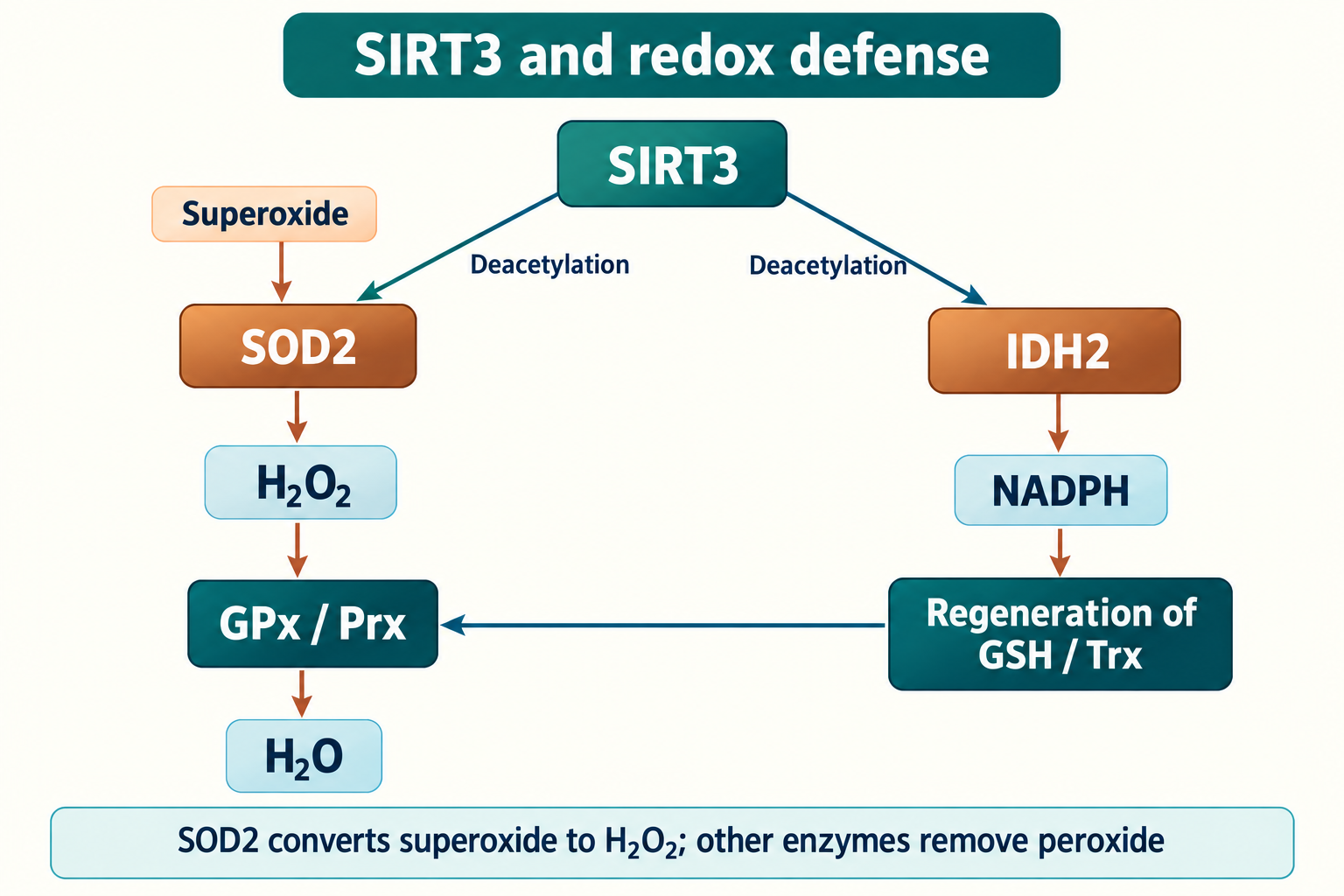
Someya linked SIRT3, IDH2 activation, NADPH/GSH and hearing protection during calorie restriction in mice. Yu examined Lys413 specifically in 2012: site-specific acetyllysine incorporation sharply reduced recombinant IDH2 activity, while SIRT3 restored it. This is a particular biochemical result, not a universal threefold NADPH increase in all mitochondria. Other NADPH sources include NNT, malic enzymes and associated metabolic pathways; NNT is a transhydrogenase rather than simply a “translocase”.
Glutamate dehydrogenase GLUD1 connects glutamate, α-ketoglutarate and ammonium:
Schlicker demonstrated SIRT3-mediated GDH deacetylation and activation. Anaplerosis, amino acid oxidation and nitrogen metabolism are connected, but released ammonium is a urea-cycle substrate; N-acetylglutamate is CPS1’s key allosteric activator. Without a specific study, one cannot claim that SIRT3 eliminates all GTP inhibition through Lys398 or that SIRT4 must be its mirror-image antagonist under every dietary condition.
Respiration, ATP synthase and coupling
In 2008, Ahn observed more than 50% lower basal ATP in particular organs of Sirt3-knockout mice, increased acetylation of complex I components and SIRT3 interaction with NDUFA9. Added enzyme could increase complex activity. This does not prove that Lys370 alone controls the hinge, eliminates all electron leakage or blocks reverse electron transport, RET. Flow direction also depends on CoQ reduction state, proton gradient and available substrate.
ATP synthase converts proton-gradient energy into ATP. Its rotor and peripheral stalk must function together; OSCP, historically ATP5O, is now commonly designated ATP5PO. Vassilopoulos’s 2014 study identified SIRT3-dependent acetyl sites in F₁ proteins and investigated OSCP Lys139 in relation to nutritional and exercise stress. Obligatory “stator looseness” and universally doubled ATP production go beyond these findings.
In 2016, Yang and colleagues demonstrated that some SIRT3 binds ATP synthase; reduced matrix pH and loss of potential accompanied release and rapid matrix-protein deacetylation. ATP5O His135 was important for the pH-dependent mechanism. This was a study of a cellular interaction network, not a claim that all enzyme is always membrane-bound.
RCR compares respiration rates in specified states, while P/O evaluates phosphorylation coupling to oxygen metabolism. Both depend on preparation, substrate, method and state definitions. Fixed values of “6–10 normally” and “2.5–3.5 with SIRT3 deficiency” cannot serve as universal diagnostic cutoffs. SIRT3 affects bioenergetics without guaranteeing absence of proton leakage: regulated uncoupling also has physiological functions.
Redox defense: SOD2, IDH2 and peroxide removal
SOD2 converts superoxide into H₂O₂ through a Mn(III)/Mn(II) cycle. The net reaction is:
2O2∙−+2H+SOD2H2O2+O2.
Tao studied Lys122, Chen studied Lys68, and Qiu examined calorie restriction and SIRT3/SOD2. These studies show functional regulation, not a universal tenfold multiplier or 80–90% activity loss in every tissue. An encounter rate constant in M⁻¹·s⁻¹ is also not kcat in s⁻¹. The details of manganese SOD2 and its catalysis matter for comparing rates correctly.
Reducing superoxide can decrease its competing reaction with NO to form ONOO⁻, but flux depends on the concentrations and localization of all participants. Comparing two bimolecular constants without enzyme abundance does not establish the “only” protection mechanism or a mandatory superoxide threshold of 10⁻¹¹ M. Protein nitration, Fe–S damage and iron-dependent lipid oxidation are possible but do not form an inevitable identical ferroptosis sequence whenever SIRT3 is lost.
SOD2 produces peroxide, so subsequent protection requires GPx and Prx. NADPH from IDH2 and other pathways supports glutathione reductase and thioredoxin reductase; regenerated GSH and Trx support peroxidases. PRDX3/PRDX5 and different GPx enzymes have their own locations and substrates, with GPx4 especially important for lipid hydroperoxides. Increased dismutation without coordinated H₂O₂ removal is not complete ROS elimination.
CypD, mPTP and FoxO3 signals
Hafner demonstrated CypD Lys166 deacetylation and age-dependent mPTP opening sensitivity in Sirt3-knockout cardiomyocyte mitochondria, suppressed by cyclosporine A. CypD regulates permeability rather than forming a self-sufficient pore. Proposed ATP synthase and ANT involvement does not establish a single final architecture. Opening can cause depolarization, swelling and death, but complete blockade of all CypD interactions and universal “60–80%” infarct enlargement are not established by these findings. Understanding mPTP and cyclosporine evidence helps separate experimental regulation from clinical cardioprotection.
Sundaresan, Jacobs and Tseng described SIRT3 interactions with FoxO3 and altered antioxidant expression. Direct transcription-factor deacetylation, movement and indirect redox signals need distinction: SIRT3’s dominant matrix localization does not imply unrestricted access to every nuclear protein. Fixed Lys271/Lys290, obligatory MDM2 blockade and fourfold FoxO3 lifetime extension cannot be assigned to the entire axis without the corresponding experiments.
What deficiency models and oncology demonstrate
Young Sirt3-knockout mice can appear normal on an ordinary diet despite hyperacetylation. More pronounced phenotypes emerge with fasting, high-fat feeding, aging and stress. Hirschey’s 2011 study showed accelerated obesity, insulin resistance, hyperlipidemia and steatohepatitis on a high-fat diet. This does not make SIRT3 deficiency the universal primary cause of human diabetes; MASLD and steatohepatitis are also not interchangeable names for every fatty infiltration.
Hafner and Sundaresan investigated cardiac hypertrophy, fibrosis and stress sensitivity. Someya demonstrated loss of calorie restriction’s hearing protection without Sirt3 in a specific mouse line. These findings cannot be assembled into a mandatory timetable for dilated cardiomyopathy in every animal or universal 80% mortality. Ischemic and neuronal injury models assess different outcomes, while human association, genetic modeling and patient treatment require different kinds of evidence.
In tumor models, SIRT3 can limit ROS/HIF-1α-dependent reprogramming and support mitochondrial resilience. Kim and Finley demonstrated tumor-suppressive mechanisms in the systems studied. In other tumors, retained oxidative metabolism and stress defense can support cell survival. Hypoxia, ROS, metabolites and prolyl hydroxylases provide several HIF-stabilization pathways; these cannot be reduced to obligatory direct iron oxidation. This duality calls for attention to tumor type and stage rather than automatic SIRT3 activation or inhibition. It also does not establish one clinical contraindication for every NAD⁺ precursor.
NAD⁺ precursors, polyphenols, exercise and biological rhythms
Increasing cofactor is not proven SIRT3-mediated treatment
NR and NMN participate in NAD⁺ synthesis; the contribution of direct transport, conversion to NR/NAM and different organs depends on context. SLC12A8 should not be declared the universally established sole human NMN transporter. CD38 consumes NAD⁺ and associated metabolites, but inhibition in a test tube does not prove that apigenin supplementation achieves appropriate tissue exposure and increases patient SIRT3 activity. Compound 78c belongs to investigational approaches rather than an established clinical supplement stack.
In Elhassan’s 2019 randomized crossover study, 12 older men received NR for 21 days. Muscle NAD⁺ metabolites and some inflammatory measures changed, but measured mitochondrial bioenergetics did not improve. This result is more useful than promised automatic reactivation: it establishes metabolic effects under a particular exposure rather than human clinical efficacy through SIRT3.
Metformin and berberine can alter energy metabolism and AMPK-associated signals but are not selective SIRT3 activators. AICAR is converted to AMP-like ZMP; calling it a direct universal allosteric SIRT3 drug is incorrect. Resveratrol, pterostilbene and hydroxytyrosol are studied as signaling modulators; altered expression does not prove direct catalytic-domain binding. Fixed animal “80% versus 1–2%” figures do not correctly compare human bioavailability. Small-molecule development requires selectivity, target engagement and clinical-outcome evidence.
Exercise, fasting and measurement time
Muscle work and dietary regimens change ATP demand, fuel flux and regulator expression. HIIT, aerobic training, TRE and FMD are not interchangeable interventions. A fixed sequence of “PGC-1α at 2–4 hours, SIRT3 at 6–12 hours” or all EPOC occurring through LCAD deacetylation needs direct evidence for the relevant regimen. Exercise benefits do not require assuming they are all mediated by SIRT3.
In 2013, Peek demonstrated links between circadian NAD⁺ synthesis oscillations, acetylation, SIRT3 and mitochondrial respiration in mice. This makes sampling time important for comparisons without establishing the optimal human hour for NMN or a requirement to take it while fasting. A fasting organism changes numerous hormones and substrates together, so ketosis alone does not measure one deacetylase’s activity.
Why a proposed supplement stack and laboratory targets are not a protocol
Combining NR/NMN, apigenin, berberine or metformin, pterostilbene, R-ALA, acetyl-L-carnitine, CoQ10, magnesium and olive extract joins different interventions. For this combination, a clinical “SIRT3 deficiency” treatment regimen, optimal doses, interactions and long-term outcomes have not been demonstrated. A nutrient’s role in normal metabolism does not prove that extra supplementation removes modifications from the relevant proteins. The manuscript’s doses and schedule are therefore not presented as prescriptions.
Measurement
What it may reflect
What it does not establish alone
Acylcarnitines
Fatty acid transport/oxidation balance, diet and metabolic disorders
Specific LCAD or SIRT3 activation
β-Hydroxybutyrate
Ketone production and utilization, dietary state
HMGCS2 deacetylation or a universal therapeutic target of 0.5–1.5 mM
Lactate/pyruvate
Cytosolic redox-pair context, with sampling and handling considerations
Direct matrix NAD⁺/NADH or one particular complex I block
8-OHdG
One measure of damage/product elimination associated with oxidation
SOD2/IDH2 restoration specifically through SIRT3
GSH/GSSG
A redox pool in a particular sample, susceptible to preparation oxidation
One state shared by all body mitochondria
Contraindication assessment concerns the particular drug and patient. Metformin restrictions with impaired kidney function, for example, cannot be transferred to all ingredients or declared a contraindication to “SIRT3 activation”. Oncology mechanisms warrant study of treatment interactions but do not replace clinical data on the specific substance. These measurements are useful in research and appropriate diagnostic settings rather than as an independent “acetylome reactivation” test.
Target map and evidence levels
Target or axis
Main finding
Limit of inference
LCAD
Lys42 in the 2010 study; Lys318/322 in the 2013 recombinant-enzyme study
Different sites, preparations and species roles
ACSS1/AceCS2
Lys642 deacetylation activates the enzyme
Must be distinguished from modern ACSS2
HMGCS2
Lys310/447/473, activity and mouse fasting ketones
Adaptation contribution, not the sole ketogenesis pathway
IDH2
Lys413, activity and NADPH support
Not the only NADPH source
SDHA and complex I
Acetylation/activity changes; NDUFA9 interaction
Does not establish every specific site or mechanical contact
ATP synthase
OSCP Lys139; pH-dependent binding through His135 in another study
Distinguish target modification from SIRT3 release
SOD2
Functional Lys68/Lys122 in different studies
No universal multiplier or H₂O₂ removal
CypD/FoxO3
Permeability regulation and model stress responses
No complete cell-death blockade or proven human therapy
How this review was prepared
This is a narrative review of the supplied manuscript, with targeted checks of disputed references, mechanisms and structural entries on October 8, 2026. Primary-study metadata and abstracts from NCBI/PubMed and RCSB PDB entries were used; necessary studies of stoichiometry, NAD⁺ transport and human NR were added for particular questions. The search was not systematic, comprehensive coverage of the newest literature is not claimed, and no formal GRADE assessment or external peer review was performed. Abstracts limit detailed verification of some mechanistic statements; unsupported precise numbers and clinical prescriptions were not carried over.
SIRT3 helps maintain mitochondrial proteins and adaptation to changing fuel, but its function emerges from localization, accessible NAD⁺ and specific substrates. Combinations of biochemistry, targeted site modification and genetic models are particularly persuasive. Translation to therapy requires human target engagement, clinical results and adverse-effect measurements; increasing NAD⁺ or changing one laboratory marker alone is insufficient.
FAQ
Does every acetyl mark inhibit a mitochondrial enzyme?
No. Its significance depends on the site, modified-molecule fraction and protein structure. Detecting many sites does not establish widespread activity loss.
Does SIRT3 consume NAD⁺ or reduce it to NADH?
Deacetylation consumes NAD⁺ and produces nicotinamide and O-acetyl-ADP-ribose. This differs from ordinary NADH-producing dehydrogenase reactions.
Can ketones or acylcarnitines measure SIRT3 activity?
These measurements reflect multiple fuel-transport and metabolic processes. Alone, they do not measure specific SIRT3 activity or one target’s deacetylation.
Is NR/NMN, apigenin and polyphenol supplementation proven to activate human SIRT3 therapeutically?
Clinical efficacy through SIRT3, optimal combination doses and long-term outcomes are not established. Raising a cofactor or model expression does not demonstrate human treatment benefit.