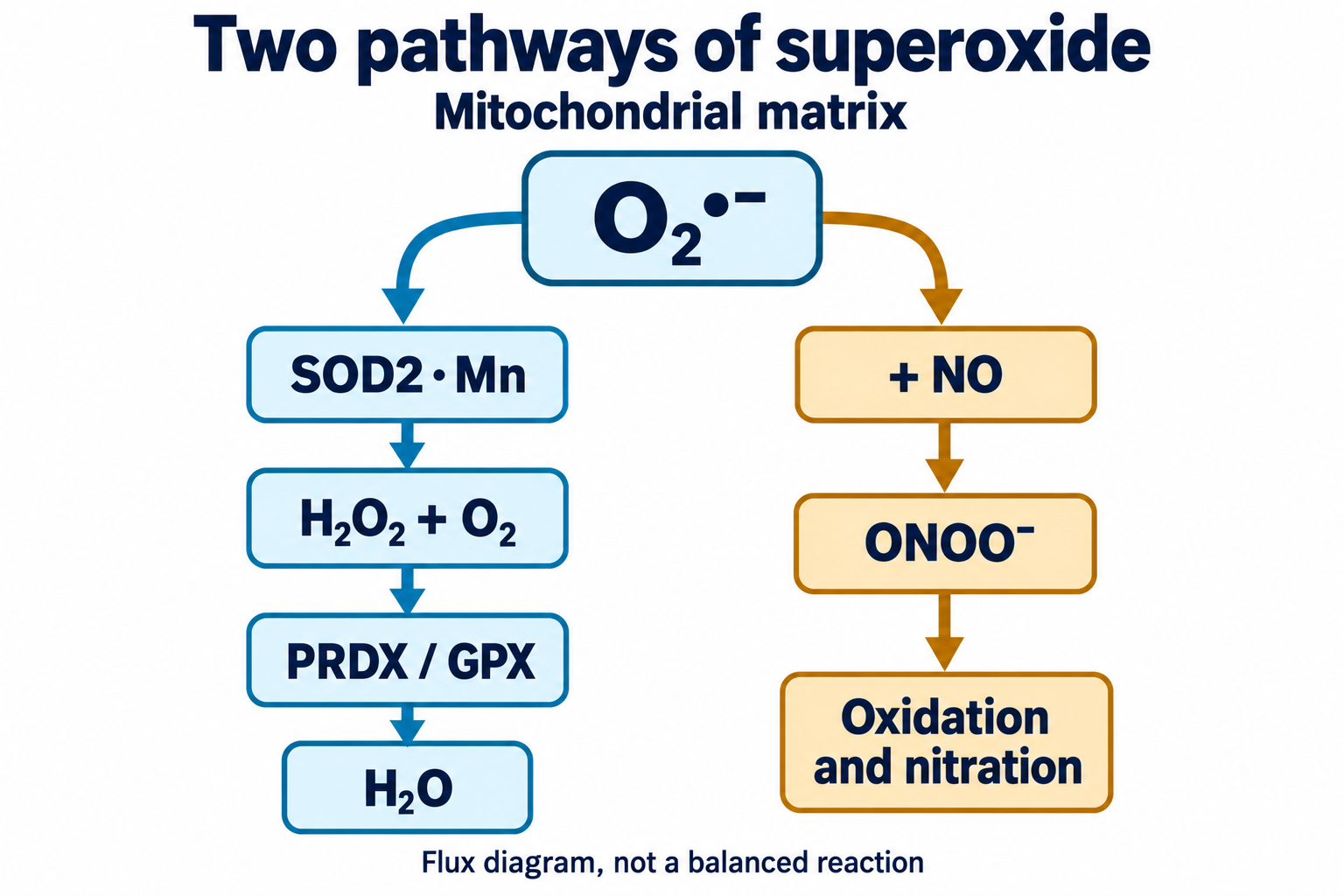
Mitochondria both reduce oxygen to water and create conditions for its incomplete reduction. When an electron leaves the normal sequence of carriers, superoxide, O2∙−, can form. Its hazards depend on more than quantity: the side of the membrane, access to iron–sulfur centres and encounters with nitric oxide matter. Manganese superoxide dismutase, MnSOD or SOD2, acts within this local environment, converting superoxide into oxygen and hydrogen peroxide.
This conversion does not eliminate the entire oxidative burden. It transfers that burden to the next stage: matrix peroxidases and reducing systems. SOD2 therefore needs to be considered alongside the respiratory chain, manganese metabolism, NADPH-dependent recycling and protein regulation. This connection explains both the severe effects of enzyme loss in mice and why raising one antioxidant activity does not yet constitute a proven human treatment.
Where superoxide forms and why different SODs are needed
Oxygen, electrons and compartments
In its ground electronic state, molecular oxygen has two unpaired electrons with parallel spins. This triplet state restricts direct interaction with several organic molecules and makes one-electron pathways important in oxygen biochemistry. The first such step is straightforward:
O2+e−→O2∙−.
Superoxide is not a universally strong oxidant of every substrate. Its reactions with particular metal centres and NO∙, and the formation of subsequent oxidants, are especially important. In the respiratory chain, flavin and quinone centres can enable one-electron oxygen reduction. Discussions of complex I distinguish flavin-associated (IF) and ubiquinone-associated (IQ) sites; the Qo site matters in complex III. Other mitochondrial sources also exist, so calling the inner membrane the only site of cellular ROS production is incorrect.
The production rate depends on respiratory substrate, carrier reduction, protonmotive force and electron-flow direction. During reverse electron transport, a reduced ubiquinone pool can drive electrons towards complex I; this is an important superoxide-producing mode, but not the continuous state of every mitochondrion. An oxygen “leak” fraction from an isolated system cannot be extrapolated to all tissues and physiological conditions. Complexes I and III also differ in the topology of ROS release: access to the matrix and intermembrane space is not identical.
The charge of O2∙− limits its unrestricted passage across the lipid bilayer. Its protonated form, the hydroperoxyl radical HO2∙, has different properties, although its proportion is small at the alkaline matrix pH. This implies locality for many superoxide reactions, rather than an absolutely sealed mitochondrion. Conversely, H2O2 can transmit signals between compartments; that exchange also depends on membrane pathways and removal systems.
Evolutionary continuity and three isoenzymes
The spread of oxygen in the biosphere exerted strong selective pressure for systems that limit its side reactions. Superoxide dismutases use different metals and belong to distinct structural families. Mn/Fe-SODs share evolutionary relationships; Cu/Zn-SODs have a different active-site architecture. Mitochondrial MnSOD is consistent with the bacterial origin of mitochondria and the later transfer of much protein-coding information to the nucleus. Exact dates and a single modern bacterial ancestral group are unnecessary to explain this functional continuity.
In humans, the distribution of three SODs creates a spatial division of labour. SOD1 mainly acts intracellularly, including the cytosol and part of the intermembrane space; SOD2 is targeted to the matrix; SOD3 follows the secretory pathway and binds extracellular structures. All three catalyse the same net reaction, but encounter different superoxide fluxes. This does not make them interchangeable or give their blood activities a shared diagnostic meaning.
Property
SOD1
SOD2
SOD3
Main designation
Cu/Zn-SOD
MnSOD
Extracellular Cu/Zn-SOD
Human genomic locus
21q22.11
6q25.3
4p15.2
Typical oligomeric organisation
Dimer
Tetramer
Tetramer of glycosylated subunits
Active-site metal
Copper; zinc supports structure
Manganese
Copper; zinc supports structure
Main functional compartment
Cytosol; also other intracellular regions
Mitochondrial matrix
Extracellular environment and matrix
Protein targeting
Intracellular distribution and maturation
N-terminal mitochondrial signal
Secretory signal and binding domain
Meaning of genetic models
Deficiency and toxic mutations have different effects
Complete knockout in mice causes severe early disease
Effects depend on tissue and injury model
SOD1 mutations in familial ALS cannot simply be explained by loss of the normal antioxidant reaction: acquired toxic protein properties are important. Similarly, viability in some SOD1- or SOD3-deficient models does not imply normal function of every organ or dispensability of those enzymes. The comparison highlights the specific matrix burden and the essential role of SOD2 in studied models, but does not establish a universal ranking for all eukaryotes.
From a nuclear gene to a manganese active centre
Synthesis, import and maturation
The SOD2 gene is nuclear, and its protein is synthesised on cytosolic ribosomes. The principal human precursor is described as 222 amino acids long, including its N-terminal targeting sequence. Removal of the 24-residue leader leaves a mature chain of 198 amino acids. Structural studies generally number catalytic residues in this mature protein; Ala16Val numbering instead refers to the precursor.
The mitochondrial targeting peptide can form an amphipathic helix. Its positively charged face and hydrophobic residues support transport-system recognition, while cytosolic chaperones prevent premature chain folding. TOM20/TOM22 receptors and the TOM40 channel mediate outer-membrane passage; TIM23 is the subsequent system for a matrix protein. The electrical component of the inner-membrane potential favours movement of the positively charged leader.
Import also requires ATP-dependent activity of the matrix PAM motor and mtHsp70. After translocation, mitochondrial processing peptidase, MPP, removes the targeting sequence, and chaperone systems including Hsp60/Hsp10 support maturation. The final events are manganese incorporation and formation of a catalytically competent oligomer. These are several connected processes: mRNA concentration, cytosolic precursor abundance and active matrix SOD2 are not the same quantity.
Stress can alter every one of these levels. Transcriptional regulation involves a GC-rich promoter, Sp1/AP-2, intragenic regulatory regions and responses involving NF-κB and C/EBP. PGC-1α/FoxO3a metabolic programmes connect antioxidant protection with mitochondrial state. However, a factor's role depends on cell type and stimulus; the presence of Nrf2 or FoxO3a does not establish identical direct SOD2 regulation in every tissue.
The tetramer, its interface and structural interpretation
Mature human MnSOD is usually described as a homotetramer of approximately 88 kDa. Each monomer contains an N-terminal, predominantly helical region and a C-terminal α/β domain, with the catalytic pocket between them. The dimer-of-dimers organisation is held by intersubunit contacts, including characteristic helical bundles. Interface stability affects activity, particularly as temperature and protein state change.
PDB structure 1VAR needs precise identification: it represents human MnSOD carrying Ile58Thr, rather than a universal model of unchanged enzyme. Borgstahl and colleagues linked this variant to tetramer-interface destabilisation and reduced activity. Threonine's polar side chain changes the environment normally occupied by isoleucine; this does not mean that all common SOD2 variants act through tetramer disassembly. In particular, Ala16Val lies in the cleaved targeting peptide and presents a different mechanistic issue.
Crystallography provides protein geometry under particular experimental conditions. Interatomic distances, solvent positions, metal oxidation state and hydrogen-network details can depend on the structure and method. Coordinates from one PDB file cannot therefore be treated as an unchanging photograph of every catalytic stage. The more useful conserved principle is that the protein environment gives manganese geometry and proton connections suited to reversible electron transfer.
First and second coordination spheres
In mature human MnSOD, His26, His74, Asp159 and His163 coordinate manganese, with a solvent molecule occupying an additional position. This geometry is often described as a distorted trigonal bipyramid. Protein ligands and water or hydroxide form the first coordination sphere; Gln143, Tyr34 and other surrounding residues form the second sphere and hydrogen-bond network. This numbering refers to the mature chain, an important distinction when comparing precursor variants.
Gln143 and Tyr34 help organise the proton network, while Phe77 and Trp161 shape the pocket environment. Substitution or chemical modification of such a residue can change catalytic activity even if the metal remains in place. The centre does not behave as a free manganese ion in water: geometry, solvent acid–base properties and the second sphere jointly tune reactivity. The convenient “metal plus scaffold” picture needs proton movement and hydrogen-bond rearrangement as well.
Manganese cycles between Mn3+ and Mn2+, corresponding to d4 and d5 electronic configurations. High-spin Mn3+ makes geometry sensitive to electronic configuration, often discussed through the Jahn–Teller effect. However, octahedral-field t2g/eg labels should not be transferred uncritically to a five-coordinate centre. “Entatic state” expresses a metal centre functionally prepared by its protein; it does not imply a zero energy barrier for every step.
Positively charged surface regions can facilitate anionic substrate access to the pocket. Electrostatic guidance, diffusion and chemical conversion together determine the observed rate. The regulatory involvement of Lys68 or Lys122 does not establish a proven map of a single “conductor” made from all surface lysines. These residues need to be discussed using structural and functional experiments, rather than charge alone.
What SOD2 actually does: dismutation and subsequent peroxide removal
Two electron transfers in one catalytic cycle
Dismutation combines oxidation of one superoxide molecule with reduction of another. Manganese accepts and donates an electron, returning to its starting state. Denoting the protein metal centre as E−Mn, the two half-reactions can be written conveniently as:
These equations balance electrons, atoms and charges, but do not enumerate every intermediate complex. In the actual centre, substrate binding, coordinated-solvent position, proton transfer and hydrogen-bond rearrangement are coupled. Writing hydroxide and aqua forms of the metal centre requires additional proton accounting; simply switching water and hydroxide labels is not a balanced mechanism.
The metal-centre redox potential must permit both halves of the cycle. Efficiency therefore cannot be reduced to maximum manganese reducing power: a centre that readily accepts an electron but transfers it poorly to the next substrate will cease to work catalytically. The protein environment tunes potential, acid–base properties and kinetics. A numerical potential depends on measurement conditions and enzyme state, rather than being a universal constant of all MnSODs.
A fast reaction does not mean unlimited throughput
Active-enzyme reactions with superoxide have bimolecular rate constants of the order of 109M−1s−1, close to the diffusion limit. Units matter: this is a second-order rate constant k, not the turnover number kcat, measured in s−1. The two cycle halves, pH ranges and enzyme variants can also differ in observed rates. A single value without experimental conditions conceals these differences.
The high rate explains why a relatively small SOD2 pool can effectively limit steady-state superoxide. Flux nevertheless also depends on available enzyme concentration, metallation, active-centre fraction and radical production. Product inhibition and less productive catalytic states at high substrate flux have been described for MnSOD. The claim that MnSOD is entirely free of peroxide or other product inhibition is therefore too categorical.
MnSOD's relative cyanide resistance compared with Cu/Zn-SOD helps distinguish isoenzyme activities in certain assays. It does not imply absolute resistance to every inhibitor: azide and other ligands can affect MnSOD. Enzyme-assay interpretation must consider buffer, pH, superoxide-generation method and possible effects of the studied compound on the analytical system itself.
Peroxide is a reaction product, a signal and a potential damaging agent
SOD2 does not convert superoxide directly to water. The resulting H2O2 needs reduction by other systems. Matrix peroxiredoxins, particularly PRDX3 and PRDX5, and the glutathione-peroxidase system are important. Their contributions depend on tissue, concentrations and the state of reducing partners; a universal “90% in all mitochondria” does not describe this diversity.
Glutathione peroxidase couples peroxide removal to glutathione oxidation:
H2O2+2GSH→2H2O+GSSG
Glutathione reductase subsequently reduces GSSG using NADPH. Peroxiredoxins receive electrons through thioredoxin-2 and thioredoxin reductase-2, likewise linked to NADPH. The supply of reducing equivalents is therefore as important as SOD2 abundance. Matrix IDH2 and nicotinamide nucleotide transhydrogenase, NNT, help maintain NADPH; NNT direction and efficiency depend on membrane bioenergetics.
Within this chain, selenium and selenoproteins belong to downstream peroxide metabolism, rather than the manganese centre of SOD2. Catalase is mainly associated with peroxisomes, so high activity in a whole lysate cannot automatically be taken as efficient peroxide removal directly in the matrix. Spatial coordination of H2O2 production, transport and reduction matters.
A moderate peroxide flux participates in redox signalling through sensitive cysteine residues and protein relays. When reducing capacity is exceeded, it contributes to damage, including reactions involving accessible iron. Raising SOD2 can therefore reduce superoxide stress while changing peroxide signalling. This explains why “more antioxidant enzyme” does not produce the same result in every cell.
Competition with nitric oxide and amplification of damage
One radical, two fast routes
Superoxide reacts with nitric oxide to form peroxynitrite:
O2∙−+∙NO→ONOO−
This reaction is also very fast. Comparing its rate constant with that of dismutation does not by itself identify the dominant route: local NO and active-SOD2 concentrations are required. In a simplified approximation, the ratio between the competing rates is:
vSOD2vNO≈kSOD2[SOD2]activekNO[NO]
This represents kinetic competition, not a ready-made patient calculation. It does not include diffusion, dynamic radical generation or every side reaction. Nevertheless, it shows why a smaller active SOD2 pool, greater NO production or closer spatial proximity can raise nitrative load even when total enzyme abundance is unchanged.
NO can originate from cellular sources involving eNOS, nNOS or iNOS and diffuse towards mitochondria. A distinct universal “mitochondrial nitric oxide synthase” is unnecessary to explain the reaction: the identity and significance of proposed mtNOS remain context-dependent. During inflammation, high NO and superoxide production can simultaneously alter respiration, redox signalling and damage.
Peroxynitrite cannot be reduced to one nitrating product
Peroxynitrite is in acid–base equilibrium with peroxynitrous acid and reacts directly with thiols and metal centres. Its reaction with carbon dioxide creates an intermediate from which carbonate and nitrogen-dioxide radicals can form. These routes help explain protein oxidation and nitration in biological environments. However, product yields depend on surroundings and do not correspond to complete conversion of all peroxynitrite into one radical pair.
Nitration of Tyr34 near the MnSOD active centre can reduce catalytic activity. This creates potential positive feedback: lower activity favours superoxide accumulation and reaction with NO, while nitrative damage further weakens the enzyme. It is a mechanism studied in particular experimental systems, rather than evidence of identical irreversible collapse in every tissue.
Detection of 3-nitrotyrosine indicates a nitrative modification, but does not establish a single source. Nitration can arise through other biochemical routes, including peroxidase-dependent pathways. Plasma 3-nitrotyrosine cannot therefore be considered a pathognomonic marker of SOD2 deficiency or a direct measurement of matrix peroxynitrite.
Iron–sulfur clusters and distinct forms of cell death
Superoxide and other oxidants can damage sensitive iron–sulfur centres. In aconitase, conversion from a functional to a damaged cluster is associated with activity loss and disrupted citrate transformations. Iron release can additionally expand the labile iron pool. In the presence of peroxide this creates conditions for the Fenton reaction:
Fe2++H2O2→Fe3++OH−+∙OH
The effects involve energy metabolism, mitochondrial DNA, proteins and membrane lipids. Damage to cardiolipin and respiratory complexes can alter electron transfer, amplifying further radical production. A universal stoichiometric chain of “peroxynitrite—destruction of every cluster—inevitable death” fails to account for competing reactions, repair and adaptation.
Permeability-transition-pore opening, cytochrome-c release and caspase-mediated apoptosis must be distinguished from ferroptosis. The latter involves iron-dependent lipid-peroxide accumulation and failure of reducing systems, including GPX4. Mitochondrial changes and SOD2 can affect sensitivity to these processes in particular models, but low SOD2 activity alone does not determine the form of cell death. Causal conclusions require suitable interventions and specific measurements.
Activity changes without a change in protein abundance
Acetylation and the NAD⁺–SIRT3 axis
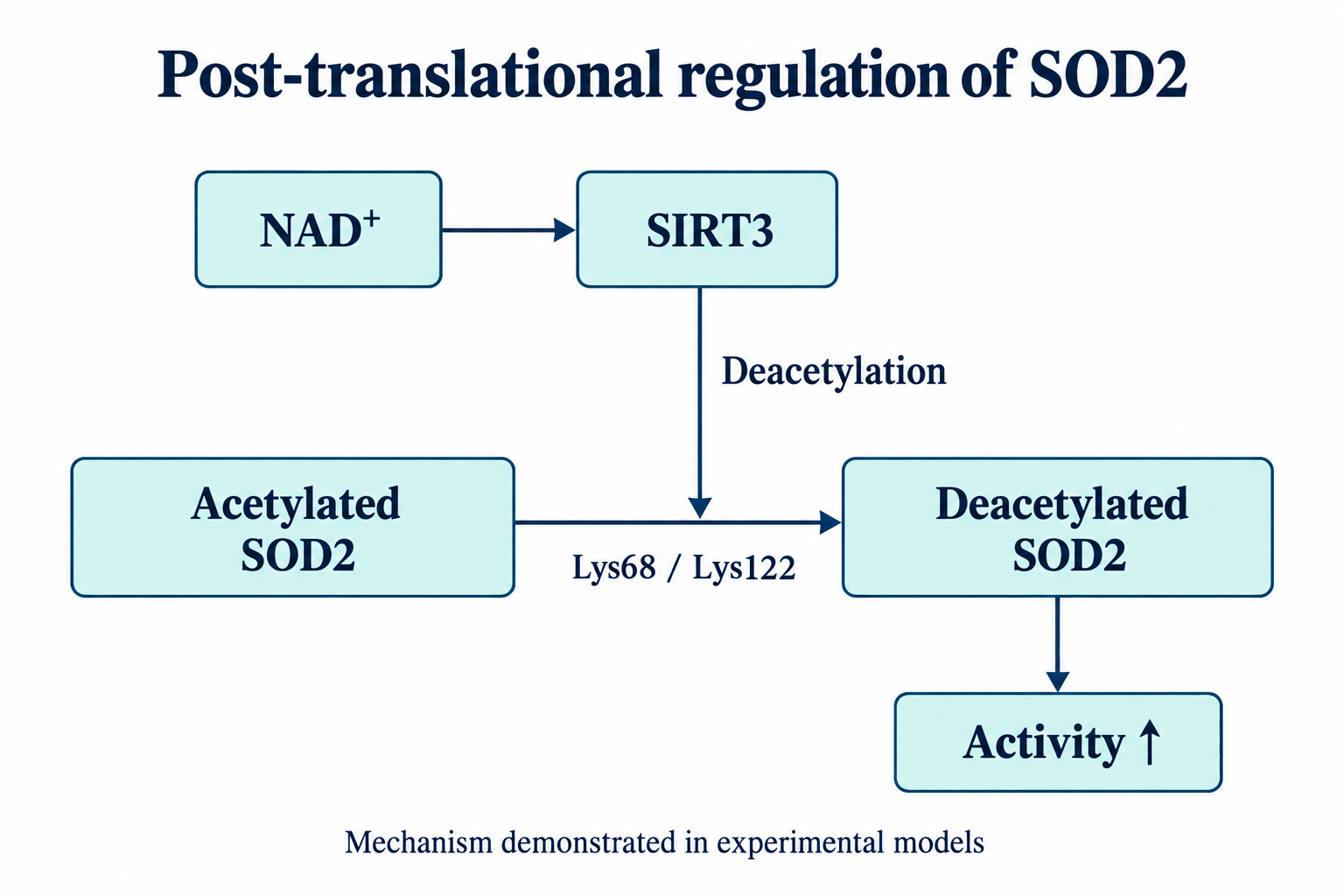
SOD2 is regulated at several levels: transcription sets potential synthesis, import and assembly determine the available matrix pool, and post-translational modifications determine its functional state. Identical SOD2-band intensity on an immunoblot does not therefore guarantee identical catalytic activity. Lysine acetylation changes side-chain charge and interactions, with functional effects depending on residue position and cellular context.
Tao and colleagues investigated the evolutionarily conserved Lys122, while Chen and colleagues showed regulation through Lys68. In these experimental systems, SIRT3 deacetylated MnSOD and raised its activity. The findings support a mechanism linking a mitochondrial deacetylase to antioxidant protection; they do not mean that every acetylated SOD2 residue is equally inhibitory or that these two sites exhaust its regulation.
SIRT3 uses NAD⁺ as a cosubstrate. The overall deacetylation scheme includes acetylated protein and NAD⁺, producing deacetylated protein, nicotinamide and O-acetyl-ADP-ribose. NAD⁺ metabolism, acetyl-CoA availability, nonenzymatic matrix acetylation and SIRT3 activity can therefore alter the modification balance. NAD⁺ required by the deacetylase must be distinguished from NADPH supporting glutathione and thioredoxin recycling.
Vitamin B3 and nicotinamide-cofactor metabolism help explain this connection, but do not demonstrate a therapeutic effect of every B3 form through SOD2. A rise in total blood or tissue NAD⁺ does not guarantee the same change in the matrix pool, SIRT3 activity and clinical outcome. Direct measurements and controlled studies are required between a biochemical premise and a therapeutic claim.
In Qiu and colleagues' experiments, calorie restriction reduced oxidative stress through SIRT3-dependent SOD2 activation. This is important support for an adaptive link between energy status and redox protection. However, animal and cell findings do not prescribe a universal fasting regimen for humans or show that all calorie-restriction effects are mediated solely by MnSOD.
Phosphorylation, oxidation and the context of adaptation
Candas and colleagues studied MnSOD phosphorylation by Cyclin B1/CDK1 during the cellular adaptive response to radiation stress, identifying Ser106. This connection shows that mitochondrial protection interacts with the cell cycle and damage responses. Applying the mechanism to every physiological state or to a ready-made clinical radioprotection regimen would go beyond the experiment.
Oxidative and nitrative modifications can reduce the functional pool even when gene expression increases. Tyr34 nitration directly related to the active centre was discussed above. Other redox modifications, assembly changes and proteolysis require assessment of a particular site and model; a fixed pathway through Cys196 S-glutathionylation and Lon protease cannot be treated as universally established from general thiol chemistry alone.
Protein acetylation and phosphorylation are post-translational regulation. “Epigenetics” usually refers to persistent regulation of genome and chromatin activity, so conflating these levels impedes understanding. They can interact, but measuring SOD2 acetylation is not equivalent to analysing the epigenetic state of the SOD2 gene.
Fraction contamination and isolation conditions influence results
Metallation
Manganese occupancy of the centre
Elemental and spectroscopic analysis
Total tissue Mn is not Mn within SOD2
Acetylation
Lys68, Lys122 and other sites
Mass spectrometry, site-specific antibodies, mutagenesis
Meaning depends on site and model
Phosphorylation
Including Ser106 in the studied model
Phosphosite analysis, kinase-pathway intervention
Cellular adaptation is not clinical efficacy
Nitrative damage
Including Tyr34
Modification and activity analysis
Overall 3-nitrotyrosine is nonspecific for SOD2
The rs4880 variant and experiments with SOD2 deficiency
Ala16Val changes the targeting sequence, not the manganese centre
The common rs4880 variant is designated c.47C>T and p.Ala16Val in the precursor sequence. The residue lies in the mitochondrial targeting peptide, which is subsequently cleaved. Its proposed functional effect therefore chiefly concerns conformation and import, rather than direct replacement of a manganese ligand in the mature enzyme. This distinguishes it from mature-MnSOD structural variant Ile58Thr, discussed in relation to the tetrameric interface.
Shimoda-Matsubayashi and colleagues considered differences in predicted targeting-sequence structure. Sutton and colleagues experimentally studied human MnSOD import into rat liver mitochondria: that design supports functional relevance of the Ala/Val difference, but does not measure import in every tissue of each carrier. A 30–40% import reduction cannot become a universal patient characteristic without identifying the experimental system.
More efficient import can potentially increase dismutation capacity, but the result depends on subsequent peroxide removal. Variants cannot therefore be classified as unconditionally “beneficial” or “harmful” regardless of environment. Protein abundance, accompanying variants, diet, inflammation, tissue expression and measurement method can modify the observed association. Population frequencies also depend on sample ancestry and should not be replaced by one averaged figure for all humanity.
Association studies linking rs4880 to cardiovascular, metabolic, cancer and neurodegenerative outcomes need careful comparison. Sample differences, multiple testing and interactions with other factors complicate interpretation. Association alone does not prove causation or determine a manganese, selenium, NMN or antioxidant dose. The cited mechanistic literature does not validate dividing patients into Val/Val and Ala/Ala treatment branches; separate claims about COVID-19 or sporting performance likewise cannot be derived from an import experiment.
Complete knockout, heterozygosity and tissue vulnerability
Li, Lebovitz and Melov demonstrated severe consequences of Sod2 deficiency in mice, including cardiomyopathy, neurological abnormalities and early death. Severity and timing depended on model and genetic background. These findings show the necessity of adequate matrix protection in the studied organisms, but do not establish that SOD2 absence is equally incompatible with life in every eukaryote.
Heterozygous Sod2(+/−) mice allow investigation of chronic partial activity reduction without complete enzyme removal. Kokoszka and colleagues observed age-related mitochondrial dysfunction and increased apoptosis in this model. However, Van Remmen and colleagues' 2003 study reported greater DNA damage and cancer incidence, but not accelerated ageing. This distinction is substantial: increases in selected damage markers do not equal shorter lifespan or universal acceleration of all age-related processes.
Tissue models and overexpression experiments reveal task-dependent outcomes. Higher MnSOD protected in particular focal cerebral-ischaemia models, while partial deficiency impaired cardiac contractile recovery after ischaemia. Radical production, peroxidase state, intervention timing and localisation determine how far these conclusions transfer. Toxic-injury models, including paraquat, further show that radical sources can involve compound redox cycling rather than ordinary respiratory-chain function alone.
Experimental approach
What it can test
What does not follow automatically
Complete Sod2 knockout
Enzyme necessity for development and tissue function in that model
A single phenotype across all species and genetic backgrounds
Heterozygous knockout
Consequences of chronic partial activity reduction
Obligatory accelerated ageing or shortened lifespan
Tissue-specific intervention
Local causal involvement of SOD2
The same role in every organ
Overexpression
Protection under a particular challenge
Benefit from unlimited SOD2 elevation
Targeting-peptide modification
Effect of precursor structure on import
A ready-made treatment regimen from one genotype
Intervention in SIRT3 or modification sites
Relationship between regulation and activity
Clinical efficacy of every “SIRT3 activator”
Manganese, metabolic adaptation and SOD mimics
An essential cofactor and the risk of excessive exposure
Manganese is required for the functional SOD2 metal centre, but its requirement cannot be assessed through one enzyme's activity alone. The element also participates in other enzyme systems; absorption, distribution and elimination maintain its homeostasis. DMT1, ZIP8/SLC39A8 and ZIP14/SLC39A14 are among manganese-related transport mechanisms, with different roles in intestine, blood and tissues. They do not form a single obligatory pipeline from food to SOD2.
Mitochondrial delivery and correct metallation also require separate consideration. The calcium uniporter MCU can participate in divalent-cation transport under certain conditions; that does not prove that all physiological Mn for SOD2 arrives exclusively through MCU. Whole-body manganese concentration, matrix abundance and active-centre occupancy are distinct measurements. Excess element does not guarantee more functional enzyme.
The NIH reference lists adult adequate manganese intakes of 2.3 mg/day for men and 1.8 mg/day for women; pregnancy and lactation values are 2.0 and 2.6 mg/day. These describe nutrition, not a therapeutic dose for raising MnSOD. The US adult tolerable upper intake level is 11 mg/day from food and supplemental sources combined, but is not an intake target or a guarantee of safety with impaired elimination or particular exposure.
Human manganese deficiency is rare, while excessive exposure can cause neurotoxicity and manganism. Occupational inhalation, certain parenteral-nutrition situations and diseases limiting biliary elimination deserve particular attention. Iron status can influence manganese metabolism, but ferritin alone cannot calculate SOD2 cofactor sufficiency. Additional Mn requires a clinical rationale, assessment of all sources and risk, rather than an rs4880 result alone.
NAD⁺ precursors and plant-derived regulators
NR and NMN are studied as NAD⁺ precursors. Their link with SIRT3 is biochemically plausible, but the chain “intake—matrix NAD⁺—SOD2 deacetylation—less damage—clinical benefit” contains separately testable transitions. The cited SIRT3 and calorie-restriction studies do not test a universal NMN 250–500 mg or NR 300–600 mg regimen for “treating SOD2”. Retaining such doses as ready-made prescriptions would substitute an experimental hypothesis for a clinical recommendation.
Sulforaphane, resveratrol, pterostilbene and astaxanthin appear in research on redox signalling, Nrf2, SIRT1/PGC-1α and adaptive protective-protein expression. Changes in SOD2 may be among the observed effects, but none of these pathways is specific to MnSOD alone. Dose, bioavailability, tissue, experimental challenge and duration strongly influence outcomes. Naming a substance in a mechanistic diagram does not demonstrate a therapeutic advantage of its supplement for an individual.
Similarly, metformin affects energy metabolism and signalling pathways rather than directly replenishing SOD2. Clinical use follows indications and contraindications, not the goal of “strengthening the mitochondrial antioxidant”. Moderate exercise and energetic adaptation can alter mitochondrial biogenesis and redox protection, but effects depend on training status and workload. Adaptive markers, enzyme activity and health outcomes need to be distinguished in this field.
An enzyme mimic does not reproduce all SOD2 biology
Small-molecule SOD mimics seek to reproduce catalytic dismutation through a redox-active centre. Studied classes include manganese porphyrins, Mn-salen complexes EUK-8/EUK-134 and other metal complexes. MnTE-2-PyP and MnTBAP cannot be treated as interchangeable simply because both contain manganese: coordination, redox potential, charge and catalytic efficiency differ. Claimed SOD-like activity of particular compounds requires assessment of purity and assay method.
These substances can participate not only in superoxide reactions, but in transformations of peroxynitrite, peroxide and cellular reductants. Lipophilicity and charge determine distribution, while mitochondrial accumulation can depend on membrane potential. Test-tube activity therefore establishes neither matrix delivery nor therapeutic index. Tempol, a redox-active nitroxide, should likewise not be equated with MnSOD protein or a manganese porphyrin.
Calmangafodipir, PledOx, illustrates the distinction between mechanism and clinical outcome. Encouraging phase II studies were followed by randomised phase III POLAR-A and POLAR-M trials during oxaliplatin chemotherapy for colorectal cancer. The trials were terminated early because of hypersensitivity with repeated administration. In the combined analysis, moderate or severe neuropathy at nine months was more frequent with 5 μmol/kg than with placebo: 54.3% versus 40.3%, relative risk 1.37. The primary endpoint did not confirm the anticipated preventive benefit. Describing PledOx as successfully completing phases II and III for neuropathy prevention is therefore incorrect.
Approach
Biological target
Remaining question
Correcting a confirmed Mn-metabolism disturbance
Cofactor availability in genuine deficiency
Does intervention improve SOD2 activity and clinical outcome without toxicity?
NR/NMN and other NAD⁺ interventions
Supporting NAD⁺-dependent processes
Does the matrix pool change, and is SOD2 a causal mediator?
Metabolic and exercise adaptation
Biogenesis, energetics, protective expression
What is SOD2's contribution among many adaptive mechanisms?
Plant-derived signalling modulators
Nrf2, PGC-1α and other networks
Does a model result transfer to achievable human exposure?
SOD mimics
Catalytic or broader redox activity
Delivery, selectivity, safety and controlled efficacy
Studying the system without substituting mechanism for diagnosis
Abundance, activity and flux need different measurements
mRNA expression, protein concentration, localisation, modifications and enzyme activity answer different questions. Activity studies benefit from controlled superoxide-generation methods and isoenzyme discrimination. A key control excludes the possibility that a substance simply inhibits the radical generator or directly affects the dye. Mitochondrial fractionation requires purity checks: cytosolic SOD1 contamination can distort conclusions about matrix protection.
Fluorescent probes, including mitochondrially targeted hydroethidine derivatives, should not be interpreted as perfectly specific measurements of one molecule. Oxidation products, loading, distribution and membrane potential influence the signal. Product separation, an independent analytical method and functional intervention strengthen evidence. An overall fluorescence rise without such controls establishes neither the superoxide source nor an SOD2 defect.
Blood elemental analysis by ICP-MS helps assess manganese exposure in the appropriate context, but does not measure enzyme active-centre occupancy. Reference intervals depend on sample, laboratory and method. Universal 7–15 μg/L limits or a single toxicity threshold proposed in the original material cannot become an SOD2 diagnostic standard. Clinical interpretation considers diet, occupational exposure, hepatic elimination and symptoms.
Why an oxidative-stress panel does not prove MnSOD deficiency
3-Nitrotyrosine, 8-OHdG, the GSH/GSSG ratio and lipid-oxidation products describe different aspects of damage and redox state. None is specific solely to SOD2 or mitochondria. Preanalytical conditions are particularly important for glutathione; nonspecific malondialdehyde assays can overstate lipid peroxidation. A causal explanation requires local measurements to agree with interventions in the pathway studied.
rs4880 genotyping can be useful in research design, but the cited literature does not establish mandatory clinical screening of SOD2, GPX1, CAT and SIRT3 for every case of fatigue or metabolic syndrome. These studies do not justify universally prescribing selenium, NAC, liposomal glutathione and NAD⁺ donors from one genotype letter. Peroxide stress during increased dismutation is an important possible mechanism, but not a ready-made diagnosis of “Ala/Ala = peroxide excess”.
A practical scientific approach begins with a specific question: is active enzyme insufficient, is import impaired, is the metal centre damaged, or is downstream peroxide reduction limited? Measurements are then selected to distinguish these hypotheses and test causality rather than correlation alone. Clinical decisions rely on disease, symptoms, exposure and validated methods; research markers do not replace that assessment.
A coordinated protective system
SOD2 occupies a precise position in the redox network: it limits matrix superoxide and redistributes flux between dismutation, NO reactions and sensitive-centre damage. Its function depends on manganese, import, assembly and post-translational state. The outcome also depends on peroxide reduction, NADPH availability, iron metabolism and mitochondrial energetics.
Functional deficiency cannot therefore be reduced to low protein abundance, nor increased abundance to guaranteed clinical benefit. Knockout models, structural studies, cellular regulation and clinical trials answer different questions. Their coordinated but non-interchangeable use explains MnSOD without turning mechanistic plausibility into an unsupported treatment protocol.
How this material was prepared
The supplied scientific text on SOD2, with its bibliography, mechanisms, comparison tables and experimental models, formed the basis. During editorial preparation on 8 October 2026, disputed details were checked selectively against primary PubMed records, the RCSB structural database, the POLAR trial publication and the NIH manganese reference. Corrections addressed kinetic units, reaction balance, conflation of ageing models with clinical conclusions, the description of 1VAR and specific bibliographic errors. Cochemé and Murphy's 2008 paper concerns paraquat, so its title and identifiers were clarified; it does not replace the general reverse-electron-transport literature.
This is a narrative scientific review and editorial examination of the supplied material, not a systematic search following a preregistered protocol or a meta-analysis. The provided bibliographic basis was retained for the remaining original references; no fresh comprehensive audit of every paper is claimed. No independent clinical validation, external peer review or GRADE assessment was performed. Limitations and negative findings are retained in every language version.
FAQ
Is increasing SOD2 enough to protect mitochondria?
No. Dismutation produces H₂O₂; outcomes depend on peroxidases, glutathione and thioredoxin recycling, NADPH, iron and energetics. Protein abundance is also distinct from activity.
Can rs4880 determine supplements?
The cited mechanistic studies do not validate therapeutic doses or Val/Val and Ala/Ala treatment branches. Genotype does not replace a clinical rationale, exposure assessment and controlled evidence.
Does extra manganese strengthen MnSOD?
Mn is an essential cofactor, but excess does not guarantee correct metallation and can be neurotoxic. Dietary reference values are not doses for treating SOD2.
Is clinical benefit established for all SOD mimics?
No. Chemical activity establishes neither delivery nor human benefit. Calmangafodipir did not confirm the anticipated preventive efficacy in POLAR, and repeated administration involved hypersensitivity.