Berberine and DHB: AMPK, PCSK9 and clinical evidence — NutriFit
Berberine and dihydroberberine: transport, AMPK, PCSK9 and clinical evidence
Berberine and DHB: chemistry and intestinal redox cycling, transport, complex I–AMPK, LDLR–PCSK9, microbiota and human glycemic and liver studies. Why greater exposure does not establish clinical superiority.
Berberine (BBR) combines intestinal pharmacology with effects on cellular energy handling and hepatic lipoprotein receptors. Dihydroberberine (DHB), its reduced derivative, crosses an epithelial barrier more readily in some experimental systems. A higher berberine concentration after DHB, however, does not establish stronger HbA1c lowering, prevention of myocardial infarction or better long-term tolerability. Those outcomes require their own comparative trials.
Three distances matter: from intestinal lumen to blood, from total tissue concentration to the free molecule at a target, and from a molecular mechanism to clinical benefit. BBR has several proposed actions rather than a single metabolic switch. Concentration, duration, tissue, microbiota, formulation and drug interactions determine the response; changing delivery with DHB does not remove these dependencies.
1. A botanical alkaloid and its reduced form
Botanical sources and the plant matrix
Berberine is a protoberberine isoquinoline alkaloid found in plants including Berberis vulgaris, B. aristata, Mahonia, Coptis chinensis, Hydrastis canadensis and Phellodendron. These belong to different botanical families, and alkaloid content varies with species, plant organ, age and extraction. The yellow roots and bark of some sources are recognizable, but colour does not establish purity or dose.
An extract, purified BBR, a berberine salt and DHB are different investigational products. Other alkaloids, excipients, solubility and delivery technology influence exposure. Traditional use of a plant therefore cannot establish the safety or efficacy of a concentrated derivative; a clinical conclusion belongs to the standardized formulation actually studied.
Biosynthesis: two tyrosine branches
Plant benzylisoquinoline biosynthesis supplies dopamine and 4-hydroxyphenylacetaldehyde through branches originating from L-tyrosine. Norcoclaurine synthase joins them into (S)-norcoclaurine. Subsequent hydroxylation and methylation produce (S)-reticuline; berberine bridge enzyme converts this intermediate to scoulerine, followed by further methylation and oxidative steps toward berberine.
This is a branched plant pathway, not a linear human sequence from tyrosine through L-DOPA to BBR. It explains the origin of the skeleton and nitrogen, without implying that human tyrosine supplementation produces berberine. The ecological function of a defensive alkaloid is also a different question from its clinical effect in a consumer.
The berberine cation, salts and electron distribution
The berberine cation has formula C20H18NO4+ and an approximate molar mass of 336.36 g/mol. A salt includes a counterion, and an anhydrous chloride differs in mass from a hydrated salt and from the cation alone. Milligram comparisons require knowing which chemical form and active content a product declares (PubChem).
Its positive charge belongs to the conjugated protoberberine system. BBR is not an ordinary tertiary amine freely alternating between neutral and charged forms. Hydration, ion pairing and interactions with membranes and proteins nevertheless depend on the medium; the word “cation” alone cannot predict quantitative solubility or tissue distribution.
What reduction to DHB changes
DHB has formula C20H19NO4 and an approximate molar mass of 337.37 g/mol. Reduction changes the iminium region and conjugation, adding one hydrogen to the skeleton. A formal half-reaction is:
BBR++H++2e−⇌DHB
This balances mass and charge; it is not a complete enzyme mechanism. Adding a hydride to carbon and a further hydrogen to nitrogen while retaining the same DHB formula would be inconsistent. The reduced compound contains a tertiary amine whose protonation depends on pH. “Neutral DHB” identifies a particular chemical form, not an absence of charge in every environment.
Changes in conjugation and the uncharged fraction can favour membrane passage. They do not abolish hydration of oxygen-containing groups, protein binding or metabolism. A universal logP or transfer free energy without a stated pH, chemical form and method would give misleading precision.
Low plasma exposure is not an absence of action
Low circulating parent BBR can reflect incomplete absorption, intestinal and hepatic metabolism, efflux, tissue distribution and metabolite conjugation. Absolute bioavailability requires an intravenous reference. An animal percentage cannot be declared the universal fraction absorbed in humans.
The lumen, enterocyte, portal blood and hepatocyte encounter different exposures. Low peripheral parent-drug concentrations may coexist with local intestinal effects and substantial tissue distribution. Conversely, a greater total AUC does not guarantee the required free concentration in a particular intracellular compartment.
P-glycoprotein and gastrointestinal tolerability
P-glycoprotein, ABCB1, uses ATP to export various substrates. Its apical location in intestinal epithelium can return a compound to the lumen. Transport experiments support a contribution of efflux to restricted BBR passage; they do not establish an atomic binding site simply because a P-gp structure is available (Pan et al., 2002; Feng et al., 2015).
An uncharged form is not automatically exempt from all exporters. DHB showed much less efflux in the Feng model, but its ratio was not one. BBR-associated gastrointestinal symptoms likewise cannot be reduced to one osmotic explanation: local exposure, motility, microbiota and formulation may contribute. Their occurrence with BBR does not prove they disappear entirely with DHB.
2. Intestinal redox conversion and DHB pharmacokinetics
Microbial reduction
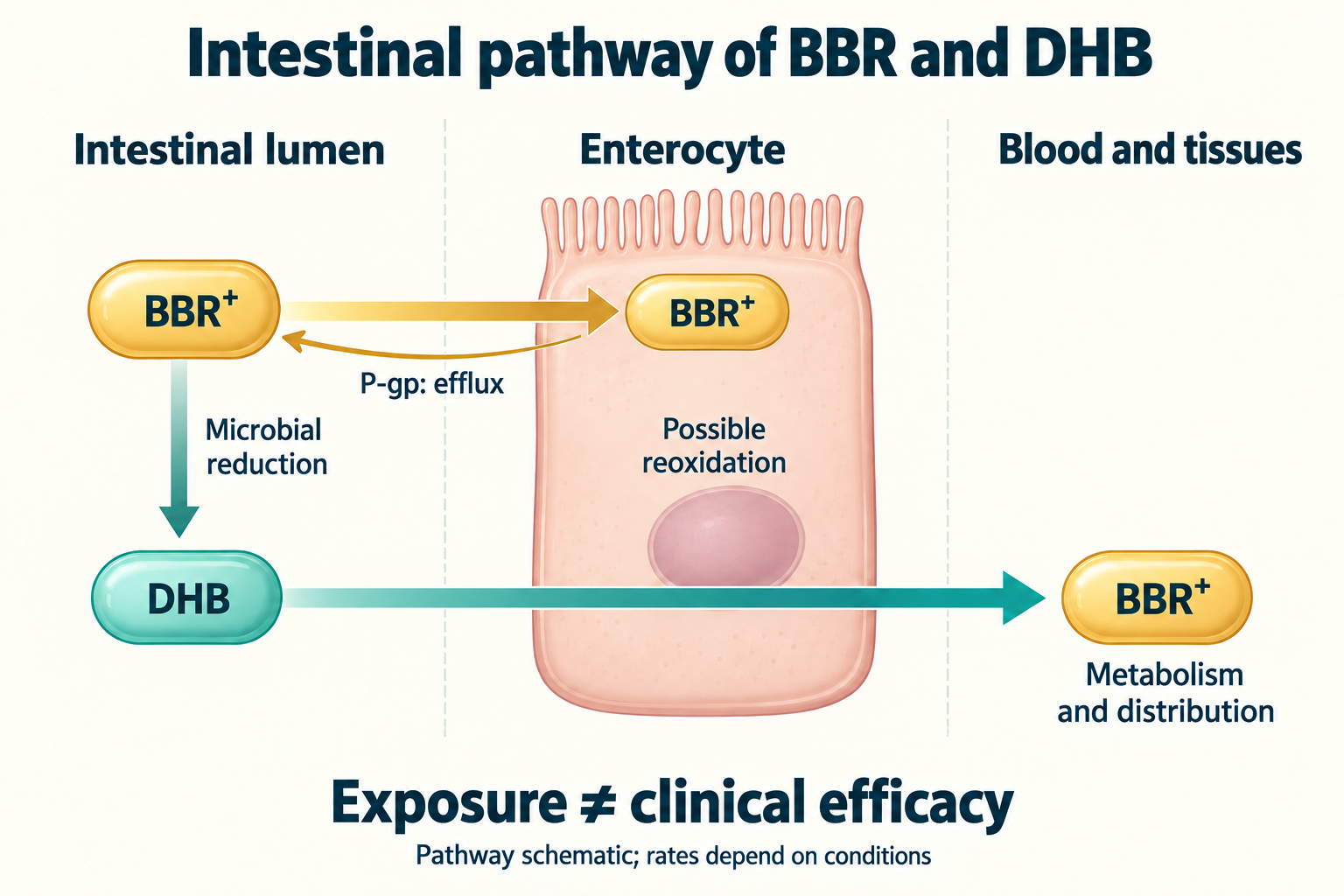
Feng and colleagues demonstrated bacterial conversion of BBR to more readily transported DHB. They linked reduction to microbial nitroreductase activity and investigated cultures, intestinal systems and animals. This establishes a possible microbiota contribution to exposure, without giving every person the same conversion rate.
Nitroreductases are a heterogeneous enzyme group. The activity name does not identify one universal enzyme, cofactor or kinetic constant, and an EC number belonging to a different reductase should not be assigned to the pathway. Community composition, reducing equivalents and competing substrates affect the net flux.
What Caco-2 transport measurements mean
In Feng's conditions, apical-to-basolateral apparent permeability was 4.51 × 10⁻⁶ cm/s for DHB and 0.38 × 10⁻⁶ cm/s for BBR, approximately an 11.9-fold difference. Efflux ratios were 1.58 and 32.39 respectively. This supports improved forward passage together with less reverse transport in that model.
Caco-2 is an epithelial model, not a measurement of human absolute bioavailability. Maturation, exposure, pH and transporter expression affect its results. Papp cannot directly yield a clinical dose or guarantee the same advantage in every intestine.
Reoxidation does not require an assumed FMO step
Reduced DHB may return to BBR after transport. In Feng's experiments, oxidation persisted after boiling the intestinal homogenate, supporting a predominantly nonenzymatic component under the tested conditions. Oxidative conditions affected the reaction; the contributions of enzymes and the chemical environment in vivo require further resolution.
The pathway should therefore not be depicted as one obligatory FMO reaction converting all DHB within a fixed number of minutes. DHB oxidation also differs from hepatic FMO3-mediated TMAO formation. Neither the occurrence of redox conversion nor its possible by-products establishes unconditional benefit or harmlessness.
Animal comparisons and the word “prodrug”
At equal oral doses in a small rat comparison, circulating BBR AUC after DHB was approximately 4.8 times higher and Cmax 3.25 times higher, with three animals per group. This is a useful delivery-development signal, while species and sample size constrain the quantitative translation.
DHB can serve as a delivery form when reduction, transport and conversion are demonstrated. Calling it a prodrug does not establish that DHB itself or all its metabolites are pharmacologically inert. Different intestinal exposure, timing and metabolite profiles may affect responses even when the same BBR is measured in blood.
The Moon pilot: four doses and five men
Moon and colleagues' paper belongs to the 2022 volume of Nutrients and was published online in December 2021. Five healthy men completed randomized crossover periods with placebo, 500 mg BBR, or 100 or 200 mg DHB. Each period involved four administrations: three the previous day and a fourth with a test meal, followed by two hours of blood sampling. These amounts describe the experiment, not an intake recommendation.
DHB produced greater circulating BBR exposure, but a convincing difference in acute glucose or insulin responses was not found. Healthy participants, brief follow-up, the very small sample and baseline concentration differences limit interpretation. This trial did not establish chronic HbA1c or LDL-C benefits, liver-fibrosis improvement, event reduction, or equivalence between smaller DHB amounts and several daily grams of BBR.
Metabolites and newer delivery systems
Chang and colleagues' 2024 pilot compared DHB with a specific micellar BBR formulation in Caco-2 and nine healthy volunteers over 24 hours. It investigated the profiles of BBR and its metabolites. The study illustrates how related products can generate different circulating mixtures.
Micelles, salts, ion pairs and reduction address exposure in different ways. An advantage in one AUC does not rank formulations across all outcomes and does not extend to every product in a category. Chronic efficacy and comparative safety need separate trials of standardized formulations in the intended population.
Interpreting a two-form comparison
Feature
Berberine
Dihydroberberine
Limit of interpretation
Chemical form
Conjugated cation, often a salt
Reduced molecule with pH-dependent protonation
Salt mass differs from active-moiety mass
Feng Caco-2
Papp 0.38 × 10⁻⁶ cm/s; efflux 32.39
Papp 4.51 × 10⁻⁶ cm/s; efflux 1.58
Cell model, not human absolute bioavailability
Equal-dose rats
Reference circulating BBR exposure
BBR AUC 4.8-fold; Cmax 3.25-fold higher
Three animals per group; conditions matter
Moon pilot
500 mg in four-dose periods
100/200 mg in corresponding periods
Five healthy men, short PK study
Chronic metabolic outcomes
Clinical studies exist with limitations
BBR outcomes cannot simply be inherited
PK superiority is not clinical superiority
Tolerability and interactions
GI symptoms and interactions documented
Own long-term comparisons required
Greater exposure may also change risk
3. From cellular entry to AMPK
OCT, MATE and tissue compartments
Cation transport is more than passive diffusion. Organic cation transporters, OCTs, and MATE exporters have been investigated for BBR. Shi and colleagues' 2018 work implicated OCT2 and MATE1 in vectorial renal transport in rats; their 2019 study demonstrated interactions with metformin transport in systems expressing rat OCT1, OCT2 and MATE1.
These results do not establish human hepatic OCT1 as the exclusive BBR route to mitochondria or show that DHB avoids transporters in every tissue. OCT isoforms differ in localization and substrate properties, while MATE and ABC transporters influence clearance. Altered transport may change both local exposure and drug-interaction potential.
Membrane potential and conditional mitochondrial accumulation
The mitochondrial inner membrane maintains a matrix-negative potential relative to cytosol. For a freely permeant, unbound monovalent cation, the electrical equilibrium contribution can be represented by the Nernst relationship:
CcytosolCmatrix=exp(−RTzFΔψ)
Here Δψ is matrix potential minus cytosolic potential, z is charge, F the Faraday constant, R the gas constant and T absolute temperature. A negative Δψ favours cation accumulation in this ideal model. The equation explains a tendency; it does not measure BBR or establish a fixed thousandfold concentration ratio.
Binding, restricted permeability, metabolism, active transport and changes in the potential itself may prevent ideal equilibrium. Total drug recovered in a mitochondrial fraction is also not automatically equivalent to the free concentration available at complex I.
Complex I: an energy effect with a cost
Complex I transfers electrons from NADH to ubiquinone and couples that process to proton translocation. Its chemical redox part can be written as:
NADH+H++Q⟶NAD++QH2
Proton movement is a further coupled component, not a function omitted from the biological process. Turner and colleagues connected experimental BBR and DHB actions to inhibition of respiratory complex I and altered cellular energy status. This does not establish one atomic binding pocket as the explanation of every BBR effect.
Complex I inhibition differs from proton uncoupling, discussed in the article on UCPs and mitochondrial uncoupling. Both can alter energetic state through different steps. Other respiratory complexes remaining present does not make inhibition automatically mild: intensity, duration and tissue ATP demand determine the consequences.
Adenylate kinase amplifies the energy signal
An imbalance between ATP generation and consumption changes the ATP, ADP and AMP pools. Adenylate kinase redistributes adenine nucleotides:
2ADP⇌ATP+AMP
AMP can consequently change proportionally more than ATP. That amplification is not a fixed number for all BBR exposures; it depends on starting pools, compartment and buffering reactions, including the creatine kinase system.
AMPK senses energetic stress rather than certifying its benefit. Compensation and energy insufficiency have different consequences, especially in high-demand tissues. Experimental concentrations may also exceed the unbound tissue exposure reached after an oral product.
AMPK architecture and Thr172 phosphorylation
AMPK comprises catalytic α, regulatory β and nucleotide-binding γ subunits. The γ-subunit CBS motifs organize adenine nucleotide binding; four motifs are not four equivalent exchangeable sites. AMP can promote allosteric activation and protect activating phosphorylation, whereas ADP has distinct, condition-dependent effects.
Thr172 phosphorylation of the α subunit raises kinase activity. The LKB1–STRAD–MO25 complex participates in energy responses, while calcium-dependent CaMKK2 provides another route. Lee, Brusq and Turner support AMPK-related BBR effects, but this does not make AMPK the only target or establish equal activation of all tissue isoforms (Hardie et al., 2012).
ACC, malonyl-CoA and the carnitine shuttle
Acetyl-CoA carboxylase, ACC, uses ATP and bicarbonate to generate malonyl-CoA. AMPK phosphorylation can reduce its activity, with phosphorylation-site numbering differing between ACC isoforms and species. One serine number should not be described as a universal human marker.
acetyl-CoA+HCO3−+ATP⟶malonyl-CoA+ADP+Pi
Malonyl-CoA serves lipid synthesis and inhibits CPT1. Lower availability can ease entry of long-chain fatty acids into the carnitine shuttle: CPT1 produces acylcarnitine, CACT transfers it across the inner membrane, and CPT2 regenerates matrix acyl-CoA. The article on CPT1 and fatty acid oxidation explains this compartmental organization.
Opening an entry gate does not guarantee greater complete oxidation. Respiratory function, oxygen and energetic demand must support the flux. Significant complex I inhibition cannot simultaneously be taken as proof of unlimited β-oxidation; delivery, synthesis, oxidation and export determine the net lipid balance.
SREBP-1c, ChREBP and lipid synthesis
SREBP-1c regulates part of the fatty acid synthesis programme. Its membrane precursor undergoes controlled processing involving SCAP, endoplasmic-reticulum export and Golgi proteolysis. AMPK can influence phosphorylation and maturation of this programme. Reduced expression of FASN, SCD1 and related genes differs from immediate shutdown of every lipogenic enzyme.
ChREBP connects carbohydrate flux to transcription through several regulatory inputs. AMPK involvement in a model does not establish that one phosphorylation site universally abolishes lipogenesis. The liver can receive, synthesize, oxidize and export fatty acids simultaneously; one changed pathway cannot determine total hepatic fat.
GLUT4, Rab regulation and insulin
In muscle and adipose cells, movement of GLUT4 to the surface increases glucose-transporter availability. TBC1D1 and TBC1D4/AS160 are Rab-GAP proteins regulating Rab GTP hydrolysis. Phosphorylation and 14-3-3 interactions alter this network; the relevant relationships depend on tissue and stimulus.
AMPK responses overlap with insulin PI3K–Akt signalling without universally replacing insulin. BBR experiments also discuss p38 MAPK, glucose use and energetic changes. GLUT4 is a transport protein, not an enzyme whose catalytic activity necessarily increases; a cellular glucose-uptake result does not establish clinical equivalence to glucose-lowering medicines.
Gluconeogenesis, CRTC2 and NAD+
CRTC2 is a CREB coactivator historically called TORC2, distinct from mTORC2. Phosphorylation and cytosolic retention involving 14-3-3 can restrict transcriptional signals linked to PCK1 and G6PC. AMPK-related SIKs and other kinases participate, so the entire pathway should not be assigned to one direct AMPK action (Koo et al., 2005).
Energy remodelling can influence NAD+ metabolism and SIRT1 activity, as Cantó and colleagues showed. This additional regulatory layer does not make SIRT1 universally suppress gluconeogenesis: FOXO and PGC-1α have fasting-related contextual functions. NAD+ salvage pathways help explain the importance of nutrition, tissue and timing; a shared pathway does not prove a beneficial supplement combination.
4. LDLR and PCSK9: receptor production and fate
Stabilizing LDLR mRNA differs from the statin response
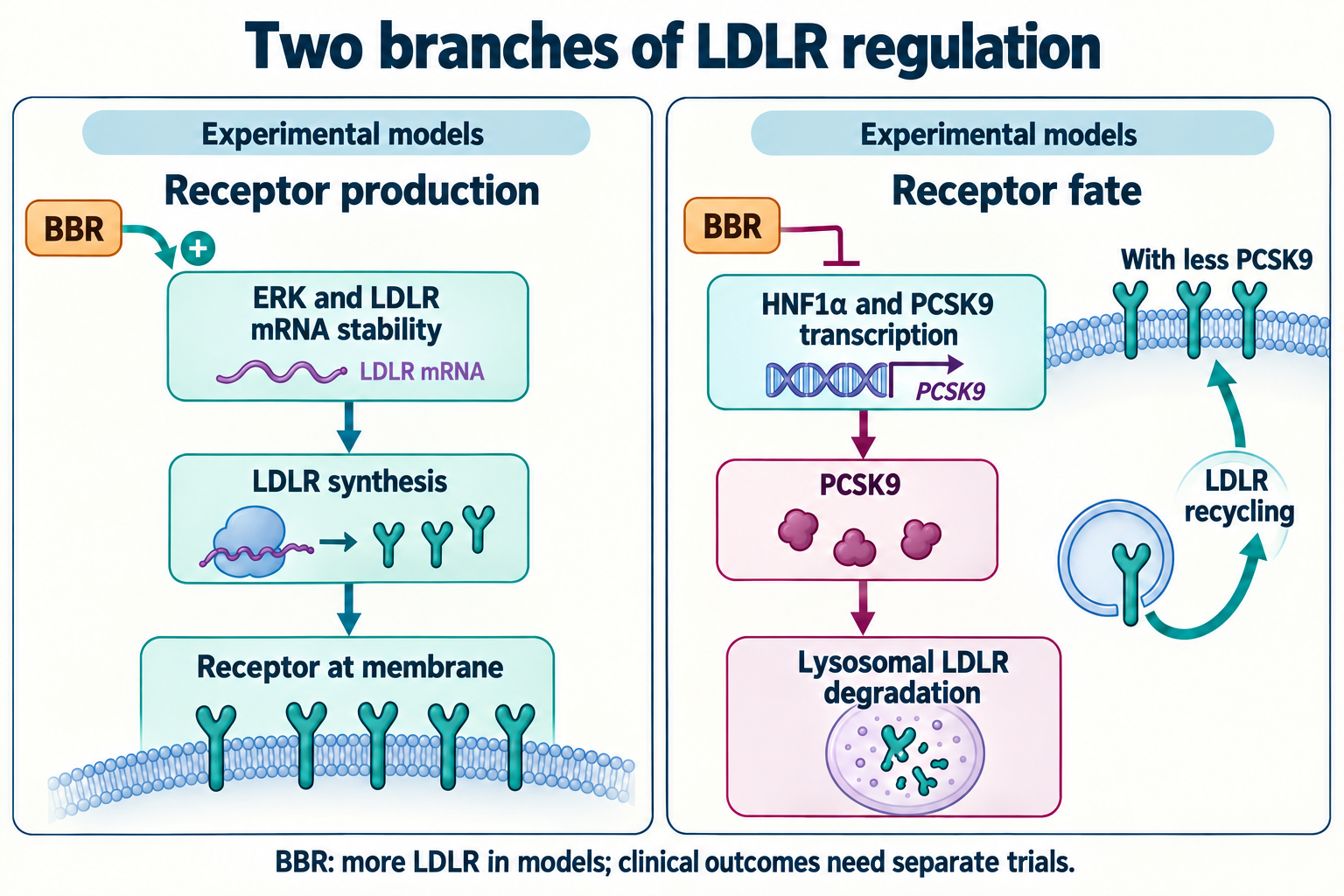
Hepatocytes remove a fraction of circulating lipoproteins through LDL receptors. More functional surface receptors, with effective return after endocytosis, can support greater LDL uptake. Kong and colleagues showed BBR-associated LDLR upregulation linked to mRNA stability, while Abidi and colleagues clarified ERK and 3′-untranslated-region involvement.
Statins reduce cholesterol synthesis through HMG-CoA reductase, eliciting SREBP2-dependent LDLR transcription. Stabilizing an existing transcript is a different control point. This provides a reason to study combinations, without proving equal potency, complete pathway independence or replacement of a medicine with demonstrated outcome benefits.
RNA-binding proteins: the direction matters
AU-rich elements in the LDLR 3′-UTR interact with proteins promoting transcript decay. Li and colleagues' 2009 work investigated hnRNP D, hnRNP I and KSRP; interference with their binding was considered a mechanism of greater mRNA stability. A diagram in which stronger binding by every such protein automatically protects LDLR would reverse the relevant effect.
Several proteins and regulatory elements govern transcript lifetime. A HepG2 mechanism is not necessarily exclusive in normal human liver. LDLR mRNA, total protein, surface receptor and actual particle clearance are distinct measurements, and each requires its own interpretation.
PCSK9 directs the receptor toward degradation
Secreted PCSK9 regulates LDLR turnover. Binding involving the receptor's EGF-A domain changes the complex's fate, favouring lysosomal degradation over effective receptor recycling. PCSK9 autocatalytic processing matters for maturation and secretion, but it need not be portrayed as directly cleaving LDLR or covalently joining receptors (Cunningham et al., 2007).
Lower PCSK9 may preserve functional receptors that are otherwise available. Severe LDLR defects can limit this strategy; more defective receptors do not guarantee normal uptake. Nor does the pathway clear every remnant-lipoprotein class through one route.
HNF1α, SREBP2 and experimental PCSK9 suppression
SREBP2 and HNF1α regulate the PCSK9 promoter. Li and colleagues identified an important HNF1-binding element and factor interactions in the HepG2 response to BBR. Dong and colleagues' 2015 experiments linked lower HNF1α protein to the ubiquitin–proteasome pathway, supported by proteasome-inhibitor experiments in the studied models.
This differs from universal cessation of HNF1α synthesis or a fixed percentage decrease in human circulating PCSK9. HNF1α controls many genes, so its alteration cannot be judged solely as a desirable lipid effect. Human exposure, tissue selectivity and safety remain separate requirements.
LDL endocytosis and lipid measurements
LDLR recognizes relevant apolipoprotein signals, including ApoB100 or ApoE in different particles. Acidic endosomes support lipoprotein separation, allowing normal receptor recycling. PCSK9 changes the balance between return and degradation; producing a receptor and preserving it are distinct processes.
LDL-C measures LDL cholesterol mass, whereas ApoB reflects a different aspect of atherogenic burden, related to particle number. A change in one does not automatically specify the other or cardiovascular risk. VLDL production, particle processing, inherited receptor function and background therapy also influence results.
Statins, ezetimibe and PCSK9 inhibitors
A statin-induced SREBP2 response can increase both LDLR and PCSK9. This is compensatory regulation, not proof of inevitable treatment escape or an absence of statin benefit. Experimental BBR suppression of PCSK9 supports an add-on hypothesis, not proven compensation for every clinical limitation (Cameron et al., 2008).
Ezetimibe targets NPC1L1-dependent cholesterol uptake; PCSK9 antibodies reduce extracellular PCSK9 action. IMPROVE-IT and FOURIER tested cardiovascular events when these treatments were added to appropriate therapy. Comparing those outcomes with a small BBR LDL-C study confuses evidence levels. Combinations require direct data, including interactions and tolerability.
5. Microbiota, barrier function and metabolic signals
Antimicrobial effects and community remodelling
BBR has antimicrobial activity, and substantial luminal exposure can alter competition, substrate exchange and microbial cross-feeding. Zhang and colleagues investigated microbiota changes in high-fat-fed rats. Relative abundance changes do not necessarily indicate absolute growth or establish a universal prebiotic effect.
Akkermansia, Bifidobacterium and butyrate producers represent different ecological groups, strains and functions. BBR cannot be expected to increase every beneficial organism while eliminating every pathogen. DHB may leave the lumen more readily, creating a different local exposure; equal plasma BBR would not establish equal ecological effects.
Short-chain fatty acids and gut hormones
Acetate, propionate and butyrate arise from microbial substrate metabolism. They support epithelial energetics and signalling, while faecal concentrations reflect production, consumption and absorption together. Butyrate can fuel colonocytes and influence deacetylases, with responses depending on cell and exposure.
FFAR2 and FFAR3 signalling can interact with L-cell, GLP-1 and PYY responses. FFAR2 can couple to Gq and Gi/o, whereas FFAR3 predominantly couples to Gi/o; an identical obligatory PLC–IP3–Ca2+ pathway for both would be incorrect. Altering endogenous gut signals is not equivalent to a pharmacological GLP-1 agonist or proof of comparable efficacy.
Tight junctions and epithelial permeability
Claudins contribute to paracellular selectivity, occludin to junction organization, and ZO-1 links the complex to intracellular structures and actin. Protein expression, electrical resistance and marker flux measure different barrier properties. None alone establishes clinical restoration of the entire intestine.
Barrier–microbiota relationships are relevant in metabolic-inflammation models. Junction composition depends on intestinal region and state, and different claudins have different functions. Increased permeability requires a specified measurement rather than serving as a standalone explanation of all obesity or diabetes.
LPS, TLR4 and inflammation
CD14–MD2–TLR4 recognition of lipopolysaccharide can activate pathways including MyD88, IKK and NF-κB and induce inflammatory mediators. Cani and colleagues provided causal evidence for metabolic endotoxaemia in particular animal experiments. This connects intestinal signals and metabolism without establishing the sole cause of human insulin resistance.
Lower inflammatory markers do not show complete TLR4 shutdown or removal of every inflammatory source. Measuring small blood LPS concentrations is methodologically difficult. Results must be considered alongside clinical outcomes and other pathways involving adipose tissue and immune cells, with substantial human heterogeneity.
Choline, carnitine and TMA–TMAO
Some microbes convert choline to trimethylamine, TMA, through CutC/CutD. CutC is a glycyl-radical enzyme and CutD contributes radical activation; acetaldehyde is also produced. L-carnitine has other microbial routes, so CutC should not be assigned all TMA-precursor breakdown.
Hepatic FMO3 oxidizes TMA to TMAO. Wang and Koeth connected these host–microbial pathways with atherosclerosis models and human observations. TMAO concentration also depends on diet, renal function and other factors; an association does not make every elevation universally toxic or establish event prevention from lowering it.
Ma's study: a mechanism and a limited human signal
Ma and colleagues' 2022 work investigated BBR and its reduced metabolite in the choline–TMA–TMAO pathway in cultures and animals. Proposed interactions involved microbial enzyme and coenzyme processes. The title's “vitamine-like effect” is the authors' interpretation, not evidence that DHB is a vitamin or that one competitive or noncompetitive inhibition mode has been established.
The human component assessed an ultrasound plaque score over four months in 21 patients. This was not a large randomized comparison with placebo, statins or DHB and did not establish fewer events. Plaque score, area, volume and clinical events are different endpoints and must retain the names actually measured.
6. Clinical evidence and unresolved outcomes
Yin's pilot: glycaemia and tolerability
Yin and colleagues' 2008 study allocated 36 adults with newly diagnosed diabetes to BBR or metformin for three months; another component added BBR in 48 inadequately controlled patients. HbA1c in the first BBR group fell from 9.5% to 7.5%. This is a result from a small group with high starting glycaemia, not the expected response of every person.
Similar observed glucose lowering does not establish formal noninferiority to metformin. Twenty BBR-exposed participants experienced transient GI symptoms, 34.5% of the corresponding analysed pool. That is neither a universal formulation rate nor a discontinuation rate. No detected short-term liver or kidney injury does not establish long-term safety in severe organ disease.
Zhang's placebo-controlled trial
Zhang and colleagues randomized 116 patients with diabetes and dyslipidaemia to BBR or placebo for three months. They studied glucose, lipids and insulin sensitivity, including a hyperinsulinaemic euglycaemic clamp. This provides more direct clinical evidence than extrapolating cellular AMPK assays.
Short-term biomarker changes do not determine years of complication risk. Formulation, baseline disease and concurrent interventions matter for replication. BBR results cannot automatically be attributed to DHB or healthy people with normal starting values.
Meta-analyses and heterogeneity
Dong's 2012 and Lan's 2015 reviews combined trials of BBR for diabetes and other metabolic outcomes. They supported glucose and lipid signals, but pooling does not repair small samples, weak blinding, variable comparators, randomization quality or publication selection. A pooled average is not an exact personal forecast.
It matters whether BBR was used alone, added to a medicine or included in a combination product. A formulation containing red yeast rice, for example, cannot isolate BBR's contribution and may contain statin-like compounds. Its results cannot prove BBR is free of drug-related risks.
Liver fat: MRS is not MASH histology
Yan and colleagues' open-label randomized study enrolled 184 patients for 16 weeks of lifestyle intervention alone or with pioglitazone or BBR. Proton magnetic resonance spectroscopy, 1H-MRS, assessed hepatic fat. Relative reduction was 52.7% with lifestyle plus BBR versus 36.4% with lifestyle alone.
These are relative changes, not a 52.7-percentage-point reduction in liver fat. MRS should not be renamed MRI-PDFF. The trial did not establish histological MASH resolution or fibrosis regression; changes in steatosis, transaminases or HOMA-IR do not replace biopsy or clinical endpoints. Open-label design and brief duration remain relevant limitations.
Weight, inflammation markers and effect size
Weight changes may accompany glycaemic or liver-fat improvement, but depend on diet, activity, starting disease and background treatment. Fixed kilogram or visceral-fat reductions cannot be promised for every BBR/DHB product. Similarly, lower hs-CRP does not identify one causal inflammatory mechanism.
NCCIH describes heterogeneous and limited weight-loss evidence. This does not exclude an effect; it defines appropriate confidence. “AMPK activator” does not substitute for a trial of actual weight, tolerability and durable results, and a small DHB PK pilot cannot supply a missing chronic comparison.
Comparing evidence strength
Question
Supporting evidence
What remains unproven
Can DHB improve BBR transfer and exposure?
Caco-2, animals and small human PK pilots
Universal availability ratio or therapeutic equivalence
Can BBR alter AMPK and LDLR/PCSK9?
Biochemical, cellular and animal mechanisms
One exclusive target or equal human tissue effects
Can patient glucose and lipids change?
Small BBR trials and limited meta-analyses
DHB superiority or long-term complication reduction
Can liver fat decline?
Open-label BBR trial using 1H-MRS
MASH resolution, fibrosis regression or zero risk
Are cardiovascular events prevented?
Outcome trials for specified drug strategies
Automatic transfer to BBR or DHB
Is DHB better tolerated chronically?
Direct long-term comparisons are required
Zero GI risk, no interactions or guaranteed adherence
7. Metabolism, interactions and safety boundaries
Phase I, conjugation and free exposure
BBR can undergo demethylation and demethylenation, producing metabolites including berberrubine, thalifendine, demethyleneberberine and jatrorrhizine. Glucuronidation and sulfation can follow. Parent drug, free metabolites and totals measured after conjugate hydrolysis represent different analytical pools.
A metabolite need not be inactive, but cellular activity cannot automatically be assigned to its circulating conjugate. Greater BBR exposure from DHB may also shift metabolite proportions. Chang's PK work addressed this dimension and explains why one plasma peak is an incomplete formulation comparison.
Human CYP interaction evidence
Guo and colleagues used probe substrates after repeated BBR administration to healthy volunteers. Reduced CYP2D6, CYP2C9 and CYP3A4 activities show that interactions can occur despite low parent-drug concentrations. Findings belong to the tested regimen rather than establishing identical suppression of every CYP by every formulation.
Intestinal enzymes, active metabolites and transporters also matter. DHB's structural relationship to BBR cannot prove an absence of interactions; greater exposure may change their likelihood. A proposed mechanism, a measured drug-concentration change and demonstrated clinical harm are distinct evidence levels.
Immunosuppressants, anticoagulants and metabolic medicines
A clinical BBR–cyclosporine interaction is documented and highlighted by NCCIH. For narrow-therapeutic-index drugs, exposure changes can matter without immediate symptoms. Cyclosporine results do not assign an identical interaction size to tacrolimus or all other immunosuppressants.
With anticoagulants or glucose-lowering medicines, metabolism, transport and combined pharmacodynamic effects require consideration. Bleeding is not inevitable, but absent large studies cannot establish safety. Shi's OCT/MATE experiments suggest a transport component to metformin interactions in models, without defining a human dosing protocol.
Better availability is not automatically lower risk
A smaller DHB mass may produce greater circulating BBR exposure under particular conditions. That can improve delivery while requiring renewed assessment of metabolism, interactions and tissue burden. Less luminal material does not establish lower systemic risk or eliminate GI effects.
Small healthy-volunteer studies cannot reliably detect rare adverse events, chronic tolerability problems or risks in polypharmacy. Comparative conclusions need matched endpoints, duration, standardized products and discontinuation data. Natural, reduced and bioavailable describe origin or chemistry rather than a completed safety assessment.
Pregnancy, breastfeeding, children and organ impairment
NCCIH identifies infant BBR exposure as potentially harmful because of its connection with bilirubin accumulation and possible neurological injury. Pregnancy and breastfeeding may also pose fetal or infant risks. A lack of direct DHB data does not establish derivative safety.
Severe hepatic or renal dysfunction can alter drug and metabolite clearance. A universal eGFR or Child–Pugh safety threshold cannot be derived for BBR/DHB without dedicated studies. Exclusion from a trial limits applicability; it does not reveal a safe dose for the excluded population.
Monitoring and decisions
Clinical monitoring depends on the target outcome, starting disease, concomitant drugs and risk. HbA1c has a different time horizon from a two-hour glucose response; LDL-C, ApoB, liver measurements and tolerability answer different questions. Repeating one AMPK-related marker would not provide a complete clinical assessment.
This article does not establish independent replacement of statins, metformin or other therapy, DHB cycles, or one laboratory-testing interval for everyone. Such advice would need patient- and product-specific evidence. The scientific task is to identify the changed step and the trial supporting the desired outcome.
8. Integrating mechanisms without replacing outcomes
Three compartments and two hepatic directions
In the lumen, BBR interacts with microbes and their substrate metabolism; enterocytes add transfer, efflux and conversion; tissue entry adds distribution and metabolism. DHB modifies this sequence without making the intestinal step irrelevant. The forms can differ in local and systemic actions simultaneously.
Hepatic AMPK pathways concern substrate use and synthesis, whereas LDLR/PCSK9 pathways concern receptor production and fate. They interact with overall metabolism without constituting one proven linear chain. Lower LDL-C does not certify human AMPK activation, and AMPK activation does not prove receptor preservation.
Lipid strategies compared
Approach
Main discussed control point
Required evidence for benefit
BBR
LDLR mRNA stability and model PCSK9 effects; multiple metabolic pathways
Standardized product, human biomarkers, sustained outcomes and safety
DHB
Transfer, redox conversion and exposure
Own PK and comparative clinical trials, rather than copied BBR outcomes
Statin
HMG-CoA reductase and SREBP2 response
Drug-specific outcomes in the relevant risk population
Ezetimibe
NPC1L1 and cholesterol entry
Combination and population trials such as IMPROVE-IT
PCSK9 antibody
Extracellular PCSK9–LDLR interaction
Event and safety trials such as FOURIER
Questions for the next clinical experiment
DHB needs direct long-term comparisons with BBR covering metabolite profiles, tolerability, interactions and clinically relevant outcomes alongside circulating parent drug. Randomization, suitable blinding and prespecified analyses distinguish successful delivery from established benefit. People with diabetes, dyslipidaemia or normal metabolism may have different responses and risk balances.
Greater exposure is a sound reason to investigate a formulation, not the completion of its efficacy assessment. AMPK/PCSK9 plausibility, local microbiota effects and short BBR trial signals form separate parts of the argument. Measurements should connect them rather than a promise of universal cardiometabolic protection.
Preparation method and limits
This article is a scientific editorial reconstruction of the complete original, with targeted checks of primary chemistry, intestinal redox, DHB PK, LDLR/PCSK9, transporter and clinically consequential evidence. It is neither a systematic review nor a new experiment. Bibliographic mismatches, RNA-binding direction, the human DHB protocol and liver-fat measurement method were corrected; unsupported atomic sites, universal kinetic numbers and therapeutic equivalences were removed.
The two explanatory diagrams show possible compartmental routes and separate receptor-turnover steps in experimental models. Their arrows do not specify quantitative rates, complete conversion or a human treatment dose. Selective verification is not exhaustive literature coverage; a missing suitable DHB comparative study remains an evidence gap, without inheriting BBR or established drug outcomes.
FAQ
Is DHB clinically better than ordinary berberine?
Short studies in healthy people support differences in exposure, but do not establish superiority in diabetes, dyslipidemia or liver disease. Longer direct trials with appropriate clinical endpoints are needed.
Can the dose be converted from a bioavailability ratio?
There is no universal conversion. Species, product, dose, metabolites and the measured endpoint affect the result; an AUC ratio does not establish equal therapeutic effects or safety.
Can it replace a statin or metformin?
Berberine mechanisms do not justify independently replacing prescribed treatment. Diagnosis, individual risk, interactions and clinical outcome evidence matter, and short DHB experiments do not provide that evidence.
Does DHB preserve the same microbiota effects?
That cannot be assumed. Different intestinal exposure may change local effects; microbiota responses depend on the starting community, diet and product. Berberine findings do not replace separate DHB testing.