UCP1, UCP2 and UCP3: brown fat and proton transport — NutriFit
UCP1, UCP2 and UCP3: proton transport, thermogenesis and limits of stimulation
How UCP1 links fatty acids, the proton gradient and heat; how UCP2/UCP3 differ, how uncoupling is measured and why cold exposure, supplements and beiging need separate clinical assessment.
Mitochondrial respiration and ATP synthesis are linked by an electrochemical gradient, but the coupling need not be rigid. Some energy can dissipate as protons return across the inner membrane. In brown and activated beige adipocytes, UCP1 turns this route into a regulated heat source. The names UCP2 and UCP3 reflect protein relatedness, rather than identical functions: their roles in substrate metabolism, redox signalling and cellular responses require separate consideration.
The clinical meaning of uncoupling depends on distinguishing membrane transport, adipocyte function and whole-body energy expenditure. Higher oxygen consumption in cultured cells does not establish weight loss; greater glucose uptake on PET does not measure tissue heat output. The discussion follows the mechanism from carrier structure to these interpretive boundaries.
1. From chemical uncoupling to physiological thermogenesis
1.1. Respiration can continue without comparable ATP synthesis
Mid-twentieth-century work on oxidative phosphorylation, including studies by Loomis and Lipmann and later Lardy and Wellman, showed that substrate oxidation and ATP formation can change differently. A lipophilic weak-acid uncoupler transports protons across the membrane, bypassing ATP synthase. The respiratory chain compensates for the lost gradient while substrates and oxygen remain available, but energetic efficiency falls.
The history of 2,4-dinitrophenol (DNP) made this principle medically tangible. Its use for weight loss in the 1930s caused severe toxicity: chemical uncoupling is not confined to a desired depot, and excessive heat production and ATP deficiency threaten organs. A biological capacity to increase energy expenditure is therefore insufficient for a treatment recommendation. Regulated UCP1 differs from uncontrolled proton conductance in location, control and scale.
1.2. Chemiosmotic coupling and thermogenin
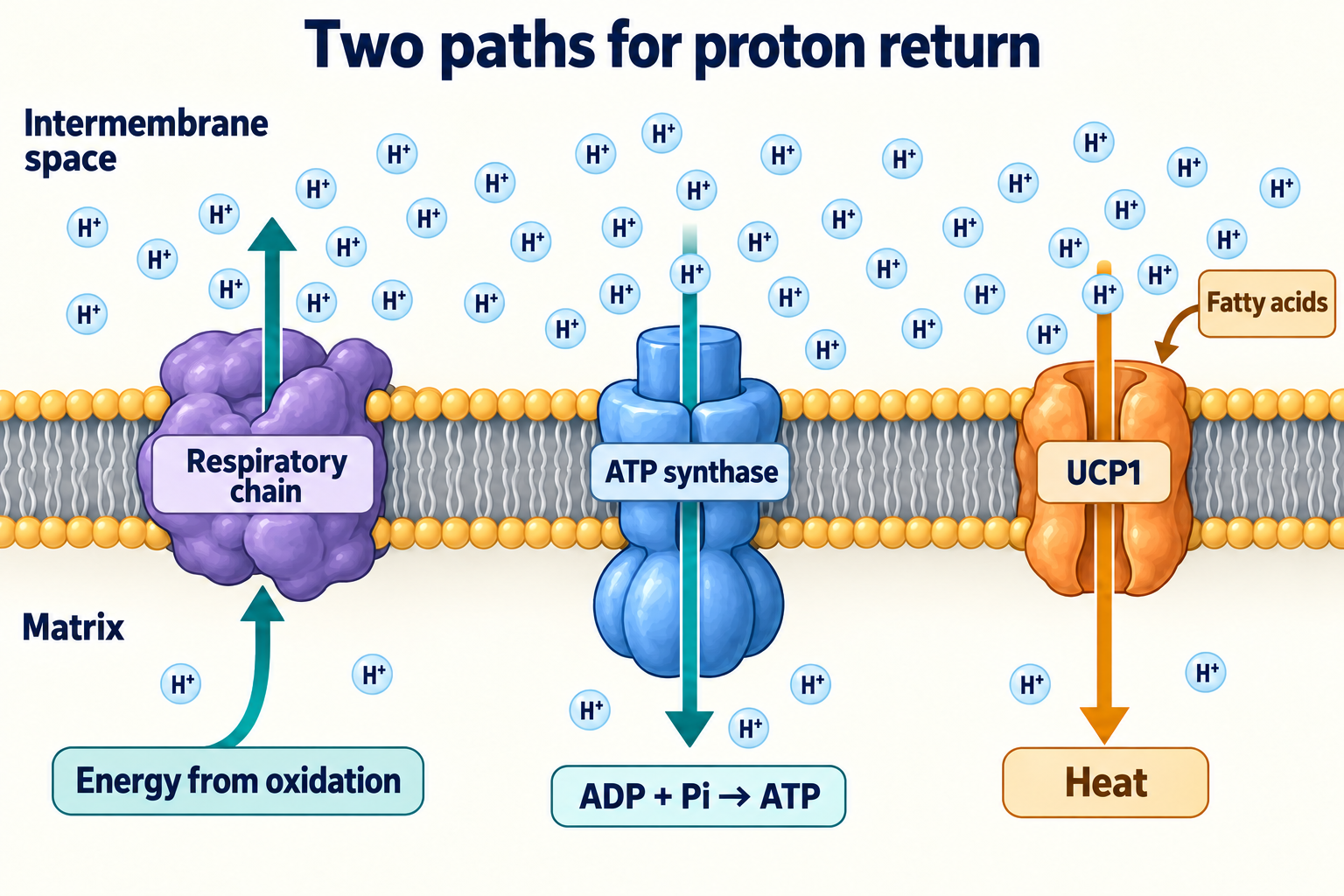
In Mitchell's chemiosmotic model, the respiratory chain creates electrical and proton-concentration differences between the matrix and intermembrane space. Proton return through ATP synthase supports ADP phosphorylation. Return through another carrier permits respiration while less energy is directed towards ATP.
Experiments on brown-fat mitochondria linked their unusual proton conductance to a protein called thermogenin, later UCP1. Purine nucleotide binding, fatty-acid effects and isolation of the carrier distinguished a specific mechanism from membrane damage. Gene cloning established its relationship to mitochondrial carriers. Nicholls and Locke's historical review and Cannon and Nedergaard's later synthesis provide context for this experimental progression [2; 3].
1.3. Adult brown fat changed the question
In 2009, three independent clinical studies by Cypess, van Marken Lichtenbelt and Virtanen and colleagues demonstrated metabolically active brown-fat depots in adults. The claim that relevant thermogenic fat exists only in infants and rodents became untenable. Those studies did not establish that cold exposure reliably produces kilograms of weight loss in everyone [4; 5; 6].
UCP2 and UCP3 had been described in 1997. Sequence similarity suggested a widespread energy-burning system, but subsequent biology proved more complex. The lack of typical loss of cold defence after deleting these genes, together with transport experiments, prevents equating them with UCP1 [14; 15; 13].
2. Carrier architecture and isoform differences
2.1. SLC25: a moving protein system
UCP1 belongs to SLC25, the inner mitochondrial membrane carrier family. It contains three related repeats and six transmembrane helices. These create a central cavity and gates accessible from the matrix or intermembrane side. The characteristic P–X–[D/E]–X–X–[K/R] motif contributes to this architecture, but sequence alone does not identify a transported substrate.
Models of mitochondrial carriers use networks of charged residues and conformational changes to explain alternating access to the cavity. This is more useful than imagining a permanently open hole: UCP1 is a regulated transport system, not a passive tear in a lipid bilayer. However, the exact proton and fatty-acid-anion routes in active UCP1 cannot be inferred solely from its relationship to other SLC25 proteins.
2.2. What the 2023 structures showed
Cryo-electron structures of human UCP1 directly revealed the six helices, central cavity and interactions with purine nucleotides. Jones and colleagues studied nucleotide inhibition; Kang and Chen examined nucleotide and DNP binding [8; 9].
The method has a boundary: a nucleotide-bound structure shows a stabilised state, rather than the full fatty-acid-dependent transport cycle in a living adipocyte. It cannot establish one definitive proton wire or prove that a fatty acid necessarily ejects a nucleotide from the cavity. Dynamic mechanisms require functional measurements alongside structural evidence.
2.3. UCP1, UCP2 and UCP3 across tissues and evolution
Protein and gene
Main context
Best-established role
What cannot be inferred automatically
UCP1 / SLC25A7
Brown and activated beige adipocytes
Regulated fatty-acid-dependent gradient dissipation and non-shivering thermogenesis
That mRNA presence guarantees substantial whole-body energy expenditure
UCP2 / SLC25A8
Immune and other cells; protein distribution depends on conditions
Metabolic involvement; experimentally demonstrated C4-metabolite transport
That it is a ubiquitous thermogenin or exclusively a proton channel
UCP3 / SLC25A9
Mainly skeletal muscle, with other tissue contexts
Association with fatty-acid metabolism and adaptation to metabolic load
That activating it is a proven weight-loss method
Transcript abundance, protein quantity and transport activity are separate measurements. Universal membrane percentages and identical metabolic amplification factors across tissues are unsupported. Post-transcriptional regulation particularly complicates conclusions drawn from UCP2 mRNA alone.
The carrier family is evolutionarily old, and the physiological specialisation of individual UCPs changed among animal lineages. Loss of functional UCP1 in pigs illustrates that cold adaptation can rely on other mechanisms. Mouse expression patterns, lineage markers and brown-fat proportions require explicit species qualification when applied to humans.
3. The proton gradient, heat and respiratory measurements
3.1. Signs matter more than an impressive number
Define differences as matrix minus intermembrane space: Δψ=ψm−ψi and ΔpH=pHm−pHi. For proton transfer from outside into the matrix:
Δp=Δψ−F2.303RTΔpH,ΔGH+,i→m=FΔp.
Here R is the gas constant, T absolute temperature and F Faraday's constant. At 37 °C, 2.303RT/F is approximately 61.5 mV per pH unit. The matrix is generally electrically negative and more alkaline, so both components favour proton return [1].
For example, Δψ=−150 mV and ΔpH=0.5 give Δp≈−181 mV. This is a teaching calculation, rather than a diagnostic limit or a compulsory state for all mitochondria. Some publications reverse the potential sign convention; numbers cannot be compared without specifying direction.
The membrane electric field is estimated as ∣Δψ∣/d, where d is membrane thickness. Substituting the entire Δp, including its chemical component, for the electrical potential is incorrect. The calculation also provides no universal breakdown threshold for a living membrane.
3.2. Basal leak and regulated UCP1 conductance
Not all returning protons pass through ATP synthase. The lipid environment and membrane proteins, including the ADP/ATP carrier, contribute, with magnitude depending on potential, tissue and experimental conditions. Leak describes an energetic effect, not necessarily damage. One universal fraction of basal metabolism cannot be assigned to it.
UCP1 adds regulated conductance to this background. Fatty acids and nucleotides modify it, while sympathetic control links its activity to heat demand. Other things being equal, greater proton return through UCP1 leaves a smaller fraction for productive coupling.
ATP synthase stoichiometry is not the cellular cost of ATP. With an eight-subunit c-ring, one revolution transfers eight protons and synthesises three ATP: 8/3 protons per catalytic ATP. Phosphate delivery and ADP/ATP exchange add energetic costs. Rounded “2.7 H⁺ per ATP” therefore cannot represent the complete cost of ATP phosphorylation and export.
The respiratory chain builds the gradient and two parallel routes consume it. Arrows indicate proton-flow direction, without fixing the ratio of ATP formation to heat. Adipocytes still require ATP for transport, synthesis and cellular maintenance.
3.3. Dissipative power and oxygen
For a molar proton flux JH in mol/s through a dissipative route:
Pdiss=JH∣FΔp∣.
With electrical current IH in amperes, the equivalent expression is Pdiss=∣IHΔp∣, with potential in volts. This describes free-energy flow; total cellular heat balance includes other reactions.
Reducing gradient backpressure often accelerates electron transport and oxygen consumption rate (OCR), provided fuel, oxygen and respiratory capacity are available. Excessive uncoupling or substrate limitation violates this condition. OCR therefore need not increase with every loss of potential, and an increase does not prove healthier mitochondria.
ATP/O falls with additional dissipation. Authors must specify whether O denotes an oxygen atom or an O₂ molecule and how ATP was measured. “ATP/O reaches zero” and “the entire brown adipocyte stops making ATP” do not describe ordinary regulated thermogenesis.
3.4. What respirometry and Seahorse actually measure
Classic Chance–Williams states describe isolated-mitochondria conditions: the initial state, substrate addition, ADP-stimulated respiration (state 3) and respiration after ADP consumption (state 4). RCR=V3/V4 helps assess coupling in a particular preparation. There is no universal healthy RCR across tissues and protocols; an experimentally uncoupled state does not precisely reproduce physiological UCP1 activity [27].
Cellular respiratory analysis step
Useful inference
Limitation
Basal OCR
Initial oxygen consumption
Includes ATP-linked respiration, leak and other contributions
ATP synthase inhibition changes potential; the residual is not UCP1-specific
Titrated FCCP
Maximal respiration under suitable conditions
Too little or too much drug, and fuel shortage, distort the result
Rotenone + antimycin A
Residual non-mitochondrial oxygen consumption
Toxicity controls, background and normalisation are required
Cell number and condition, protein or DNA normalisation, substrate availability and exposure duration must be comparable. ECAR reports extracellular acidification and, without further calculation, is not exclusively glycolysis. Attribution to UCP1 benefits from deletion and rescue, fatty-acid and nucleotide controls, potential measurements and, where possible, direct membrane-current recording. A several-fold OCR increase alone does not identify the protein.
4. Turning on UCP1
4.1. Nucleotide inhibition depends on chemical form
Purine nucleotides ATP, ADP, GTP and GDP inhibit UCP1 in biochemical systems. Binding restricts conductance. However, total cellular ATP is not the amount of available inhibitor: free versus Mg²⁺-bound forms, pH, compartment and local environment matter [8].
“Plenty of ATP means UCP1 is always closed” is therefore too crude. In an activated adipocyte, changes in lipolysis and fatty-acid availability coexist with nucleotide regulation. Capturing an inhibited structure does not remove the physiological ability to activate heat production rapidly.
4.2. Fatty acid: transported participant or retained cofactor?
Long-chain fatty acids are necessary for characteristic UCP1 activity. In the fatty-acid-cycle model, protonated RCOOH crosses the lipid phase towards the matrix and releases a proton. RCOO⁻ returns with the carrier's help. The complete cycle transfers a proton inward even if the protein directly transports the anion [10; 11].
Alternative models retain the fatty acid closely associated with the protein: its carboxyl group participates in proton transfer, while its hydrophobic tail constrains complete molecular movement. Cofactor in this context does not turn UCP1 into a conventional open aqueous pore.
Fedorenko and colleagues' electrophysiological experiments on brown-fat inner mitochondrial membranes directly linked UCP1 current to fatty acids and their anionic group. These substantially refined earlier models, but do not justify drawing an arbitrary residue chain as a definitively established route for every proton [7].
Both interpretations depend on the free, available fatty acid. Albumin and FABPs bind it and alter the active concentration; total lipid abundance does not measure this quantity. Concentrations in reconstructed membranes therefore cannot be converted directly into a dose of an oral activator.
4.3. Sympathetic signalling and lipolysis
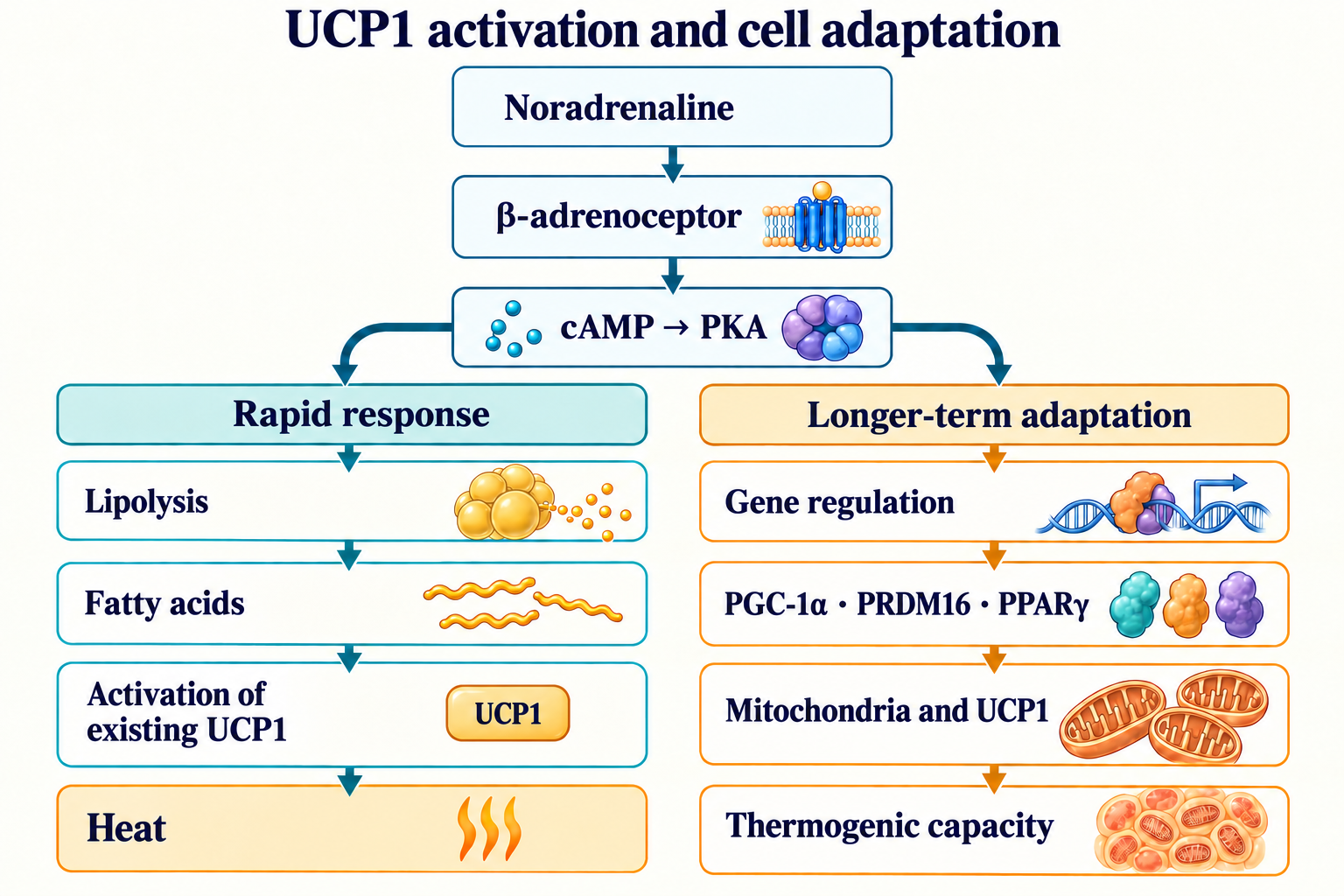
Skin cooling initiates central thermoregulatory processing and sympathetic output to adipose tissue. Noradrenaline stimulates β-adrenoceptors; Gs, adenylyl cyclase, cAMP and PKA relay the signal to lipid droplets. β3 is important in rodents, but human BAT cannot be described by that model alone: primary evidence indicates an important β2 contribution [31].
PKA modifies regulation of perilipin PLIN1 and hormone-sensitive lipase HSL. Release of the coactivator ABHD5/CGI-58 supports ATGL: triacylglycerol becomes diacylglycerol, HSL continues hydrolysis and monoglyceride lipase completes it. TG → DAG → MAG → glycerol and fatty acids conveys the sequence; individual phosphorylation-site numbers depend on protein and species.
Fatty acids provide both oxidation fuel and participants in UCP1 activation. Cells also obtain substrates from circulation; droplets are not the only source. Rapid activation of an existing carrier differs from the slower increase in carrier abundance and mitochondrial mass.
The branch separates functional activation from changes in cellular programming. PGC-1α, PRDM16 and PPARγ are cooperating regulators, rather than sequential enzymes. The diagram sets no universal adaptation duration and does not imply that every cAMP increase guarantees beiging.
5. Brown and beige cells: changing the programme
5.1. Similar functions, different origins
Brown adipocytes typically contain many small lipid droplets and mitochondria; rich blood supply delivers fuel and distributes heat. Beige cells arise in certain white-fat depots under particular stimuli. They may develop from precursors or through changes in existing cells. Removing the stimulus can weaken the phenotype while leaving elements of activation memory [20].
Myf5, Pax7 and other markers enabled mouse lineage studies, but “all brown fat is Myf5⁺ and all beige fat is Myf5⁻” is excessive. Zic1/Lhx8 and CD137/TMEM26/TBX1/CITED1 panels are useful in particular models, rather than universal clinical tests for human depots. Origin, molecular features and function together identify cells more reliably than one marker.
5.2. PRDM16, PGC-1α and EBF2 have different jobs
PRDM16 interacts with transcriptional partners, including C/EBPβ and PPARγ, helping organise thermogenic identity. Experiments switching brown-fat and skeletal-muscle programmes showed its causal role in models [17]. Altering one protein in an organism does not automatically create a functional new depot.
PGC-1α, encoded by PPARGC1A, is a coactivator, not an independently DNA-binding transcription factor. Through PPAR, ERR and nuclear respiratory factor partners, it coordinates oxidative metabolism and mitochondrial biogenesis programmes, including TFAM. Puigserver and colleagues described its cold-inducible role [18]. More transcript does not establish a fixed doubling of mitochondria or identical increases in heat.
EBF2 helps organise chromatin accessibility and interactions with remodelling complexes, including SWI/SNF. The system is a coordinated network: identity, carrier abundance, fuel supply and innervation must match. Naming a molecular target does not validate a supplement purported to control the entire network.
5.3. SIRT1 and PPARγ acetylation
In Qiang and colleagues' experiments, SIRT1-dependent PPARγ deacetylation, including Lys268 and Lys293, changed regulatory protein interactions and favoured brown-like white-fat remodelling. This is a specific link between protein modification and cellular programming, rather than evidence of irreversible beiging after activating sirtuins [23].
SIRT1 uses NAD⁺, but a cofactor's presence in the reaction does not imply that raising its blood level reproduces the result in adipose tissue. Compartments, enzyme availability and PPARγ context matter. The related issue of cofactors and clinical limits is discussed in niacin and vitamin B3 safety.
5.4. Polymorphisms do not specify a personal protocol
Research discusses UCP1 −3826A>G (rs1800592), UCP2 −866G>A (rs6593660) and UCP3 −55C>T (rs1800849). Associations with expression, obesity and glucose metabolism vary by population, conditions and design. A promoter variant can be biologically interesting without constituting an individual diagnosis or an immutable loss of thermogenic capacity.
There is no validated algorithm prescribing cooling temperature, duration or berberine from these SNPs. A UCP2–diabetes association does not establish that a particular patient should enhance or suppress the protein. UCP3 lipid-metabolism associations similarly cannot promise protection from insulin resistance. Genetics frames research questions here; it does not replace clinical risk assessment.
6. UCP2 and UCP3: metabolism beyond a universal thermogenin
6.1. Why the family name can mislead
UCP2 and UCP3 do not reproduce the physiological specialisation of abundant active UCP1 in brown fat. Their abundance, regulation and tissue roles differ; knockout phenotypes do not show a simple loss of principal non-shivering thermogenesis. Yet absence of one phenotype does not mean absence of function: compensation, diet, housing temperature and cell type affect outcomes [13].
Direct transport data are especially important for UCP2. Vozza and colleagues demonstrated transport of C4 metabolites, including malate, oxaloacetate and aspartate, linked to phosphate and proton exchange [30]. This adds a role in carbon-substrate distribution between oxidative pathways. Reducing UCP2 to a weak proton channel loses substantial biology.
6.2. Mild uncoupling and ROS production
Some reactive oxygen species formation depends on potential, carrier reduction state and electron-flow direction. With certain substrates, a high gradient favours reverse electron transport to complex I; a small decrease in driving force can markedly reduce that superoxide source. The relationship differs across respiratory sites and metabolic states [12].
Universal claims that a 10–15 mV shift removes 70–90% of radicals at no energetic cost are therefore incorrect. A number from one preparation does not define cellular normality; a negative potential sign also requires careful comparison. Oxidative stress depends on removal, localisation and target damage as well as ROS production.
Feedback models involving fatty acids and peroxidation products such as 4-HNE have been studied for UCP-dependent conductance. Conditions, specificity and physiological scale matter. ROS have signalling roles, and lower detected ROS need not mean better immune responses or longer life. Mild uncoupling is a mechanistic concept, rather than a ready prevention regimen.
6.3. Lipid anions: evidence and hypotheses
UCP3 is discussed in relation to a mismatch between fatty-acid supply and oxidative capacity. Export of fatty-acid anions and peroxidation products is proposed as protection against lipid load. Such models should not be presented as universally proven selective removal of all hydroperoxides from the matrix [13].
Lipid peroxidation involves membrane phases; not all products are free water-soluble matrix anions. The inner membrane has low permeability to many charged substances but contains specialised carriers. Each proposed substrate requires evidence of transport, direction and cellular relevance. UCP2 C4-metabolite transport must be distinguished from UCP3 lipid-anion hypotheses.
6.4. β-cells and macrophages use mitochondria differently
Mitochondrial metabolic changes can influence this sequence. Zhang and colleagues linked UCP2 to negative regulation of insulin secretion in experimental models [16]. Cell context, substrates, redox signals and chronic load prevent reducing the explanation to proton diversion alone. A single knockout study cannot justify UCP2 suppression as diabetes treatment.
In macrophages UCP2 participates in metabolic and redox changes affecting activation and pathogen defence. “More UCP2 means M2, less means M1” does not describe the diversity of immune states. The bactericidal respiratory burst also involves NADPH oxidases, rather than mitochondrial potential alone. An antioxidant effect in one experiment cannot establish a general anti-inflammatory effect in an organism.
7. Human thermogenesis and limits of stimulation
7.1. Brown-fat depots and PET interpretation
Adult thermogenic adipose tissue is often detected in the neck and supraclavicular region, with paravertebral, mediastinal and other depots also present. Composition is heterogeneous and depends on age, temperature, feeding and detection method. An anatomical map does not imply identical active tissue mass in every person [4; 6].
¹⁸F-FDG PET-CT detects uptake of a glucose analogue. It helps identify cold-activated tissue, but does not equal oxygen consumption or heat production. Insulin, perfusion and substrate availability affect uptake; fatty acids can fuel thermogenesis without proportional FDG increases. Energetic assessment needs additional methods, including indirect calorimetry and tissue oxidation studies.
Brown fat receives glucose and lipids from circulation. LPL releases fatty acids from triglyceride-rich lipoproteins; substrate transport and oxidation support heat production. Bartelt's mouse study demonstrated an important BAT contribution to triglyceride clearance, while Chondronikola's human study associated BAT activation with energy and glucose metabolism [25; 26]. Species and experimental conditions are essential.
Neither these findings nor inverse associations between BAT and body mass index establish guaranteed daily expenditure of 150–300 kcal or linear annual loss of 4–8 kg. Appetite compensation, activity changes and adaptation modify energy balance. Associations between active BAT and metabolic health also do not prove that BAT fully explains group differences.
7.2. Food compounds: a target is not a clinical outcome
Compound
Proposed mechanism
Evidence boundary
Capsaicin and capsinoids
TRPV1-dependent sensory signals and sympathetic response
Small human thermogenesis studies do not establish sustained obesity treatment; extracts are not equivalent to chilli peppers
Berberine
AMPK and oxidative programmes, PGC-1α/PRDM16
Zhang 2014 beiging and BAT effects were experimental, not proven creation of beige depots in patients
Menthol and related compounds
Cold-sensitive TRPM8
Receptor activation does not guarantee safe mimicry of cooling or human weight loss
EGCG and caffeine
Several metabolic and signalling targets
Prolonged COMT inhibition at BAT synapses and direct PDE blockade by clinical caffeine doses are unproven simplifications
Resveratrol and pterostilbene
Model interactions with AMPK/SIRT1 and transcriptional programmes
PPARγ deacetylation does not establish that a supplement equals enzyme activation or sustained beiging
Ursolic acid
Experimental IGF-1/Akt mechanisms and muscle/adipose changes
Animal findings do not establish clinical thermogenic efficacy
Human capsinoid studies examine cold-induced energy expenditure and BAT recruitment, but samples and surrogate outcomes limit extrapolation to long-term body weight [33]. The 2014 berberine study used cell and animal experiments [24]. These studies ask different questions and do not validate synergy from combined intake.
Food origin does not establish cardiovascular safety of a concentrated mixture. Caffeine can increase palpitations and disrupt sleep; green-tea extracts have their own limits, while composition and drug interactions also matter. Beverage versus concentrated-product differences are discussed in green tea, polyphenols and safety.
Mirabegron is a useful research example of adrenergic stimulation, but rodent and human results differ. Dose, receptor selectivity and cardiovascular effects constrain translation [31]. Higher thermogenesis in an experiment does not justify self-prescribing it for weight loss.
7.3. Muscle, heart and thyroid signalling
Exercise alters muscle metabolic signals. Boström's original study linked PGC-1α, FNDC5 and the released myokine irisin to brown-like programmes in experimental models [19]. This does not show that all exercise benefits arise through human-fat beiging. Enzymes cleave FNDC5, whereas PGC-1α regulates expression; a diagram showing PGC-1α directly cleaving FNDC5 would be incorrect.
ANP and BNP can activate lipolytic and thermogenic programmes through NPR-A/guanylyl cyclase, cGMP, PKG and p38 MAPK. Bordicchia and colleagues showed the pathway in mouse and human adipocytes [21]. It is another regulatory route, not a sufficient explanation of cardiac cachexia or evidence that high BNP is beneficial for a patient.
Meteorin-like (METRNL) is considered a participant in immune–adipose interactions during experimental thermogenic adaptation [22]. Such inter-tissue signals require distinguishing causal animal experiments, circulating-marker measurements and established treatment effects. Hormonal communication does not make every component a safe enhancement target.
Thyroid hormone T₃ supports thermogenic transcriptional and adrenergic responses. Local DIO2 converts T₄ to T₃, changing intracellular signal availability. This is physiological regulation, rather than a rationale for systemic thyrotoxicosis: hormone excess affects heart, bone and muscle far beyond BAT.
7.4. Diabetes, cold and bile acids
Hanssen 2015: insulin sensitivity rose by approximately 43% after cold acclimation in eight patients; changes chiefly involved muscle GLUT4, with a small BAT contribution [28]. This is not proof of a BAT GLUT4/AMPK effect: AMPK activation did not explain the result in the study itself.
A separate small 2021 study found no insulin-sensitivity improvement after ten days of mild cooling without overt shivering in nine patients [32]. Protocol and muscular-activity differences keep the research question open; neither study replaces comparative diabetes-treatment trials.
Bile acids signal beyond their digestive role. Watanabe's model linked TGR5/GPBAR1 activation to cAMP, DIO2-dependent local thyroid activity and energy expenditure [29]. Microbiota convert primary into secondary bile acids, altering the pool and receptor effects. Other receptors and tissue targets coexist, so selective BAT activation without systemic effects cannot be assumed.
This mechanism does not establish diabetes treatment with berberine or soluble fibre specifically through UCP1, and does not make self-administered bile acids a thermogenic strategy. Potential targets need separate human efficacy, distribution and adverse-effect studies.
8. Practical meaning and monitoring limits
8.1. What the mechanism can inform
UCP1 shows that lower coupling efficiency can support temperature maintenance physiologically. UCP2 and UCP3 illustrate differing carrier tasks; redox signalling and substrate use cannot be reduced to calories burned. Section 2.3 summarises the distinctions. Repeating a matrix with unsupported protein percentages and identical activators would conceal them.
Exercise, nutrition and metabolic-disease treatment are assessed through their own clinical outcomes. Training may change myokines and tissue programmes, but its benefits do not require proof of rising UCP1. Cold tolerance is likewise no test of personal thermogenic capacity: shivering, vascular responses, clothing and acclimatisation affect sensations.
8.2. Why there is no ready multimodal protocol
Neither combined capsaicin, berberine, EGCG/caffeine, resveratrol and menthol nor their combination with cooling sessions is validated as a single clinical UCP1-stimulation protocol. Doses and durations from separate mechanistic studies do not add up to a proven regimen. SHU pungency units also do not identify a capsule's capsaicin dose without compositional analysis.
Cold induces sympathetic and vascular responses. Intense exposure and cold-water immersion differ from controlled mild acclimation. With cardiovascular disease, impaired sensation and other conditions, individual risk matters more than a mechanistic promise. Chest pain, marked weakness, confusion and loss of shivering control require stopping exposure and medical assessment. Research does not establish one universal home temperature or therapeutic cooling duration.
Measure
What it helps assess
What it does not measure
Glucose, HbA1c
Glucose metabolism when clinically indicated
UCP1-specific activity
Triglycerides and ApoB
Lipid metabolism and cardiovascular risk
Isolated substrate clearance by brown fat
Fasting insulin, HOMA-IR
Indirect metabolic assessment in suitable contexts
Direct tissue insulin sensitivity or BAT power
TSH and free T₄
Thyroid function when indicated
Local DIO2 activity; broad T₃ screening is not a beiging test
Pulse and blood pressure
Haemodynamics and exposure tolerance
Mitochondrial uncoupling efficacy
PET-CT
Specialised research or clinical questions
Routine screening for weak brown fat
Weight loss and improvements in HbA1c or triglycerides have many possible causes. These tests cannot attribute change to UCP alone. Justified interventions require reproducible clinical outcomes and safety assessment; molecular detail cannot substitute for them.
Method and limitations
This narrative scientific revision of the supplied source was completed on 8 October 2026. Topics and mechanistic sequence were retained, while disputed extrapolations from cells and animals to humans were clarified. Targeted primary-study verification addressed key transport and clinical claims and corrected identified bibliographic records. This was not a systematic search of all literature, a formal GRADE assessment or external peer review. Bracketed citations refer to the shared source list; illustrations explain mechanisms without a quantitative scale.
FAQ
Does UCP1 simply stop ATP synthesis?
It provides a parallel route for consuming the gradient. Cells still need ATP; the fraction directed towards heat depends on regulation and substrate availability.
Do UCP2 and UCP3 do the same job as UCP1?
No. Their tissue roles differ: UCP2 transports C4 metabolites experimentally, while UCP3 is linked to adaptation of lipid metabolism. They are not proven universal thermogenins.
Does active BAT on PET prove high calorie expenditure?
FDG reports uptake of a glucose analogue. It is not direct heat or oxygen-metabolism measurement and does not predict individual weight loss.
Can UCP SNPs guide cold or supplement prescriptions?
No validated algorithm assigns temperature, cooling duration or nutraceuticals from these variants. Population associations are not individual prescriptions.
Is there a proven supplement combination for beiging?
Capsaicin, berberine, EGCG/caffeine, resveratrol and menthol are not validated as one clinical protocol. Mechanistic experiments and food origin do not establish mixture efficacy or safety.