
Creatine kinase and phosphocreatine: energy transfer and supplement limits
How CK and MtCK connect mitochondria with myofibrils, pumps and synapses: structure, reversible chemistry, creatine transport and the limits of sports, cardiac and neurological conclusions.
ATP is consumed where myosin, calcium pumps and synaptic machinery work, while much oxidative ATP synthesis takes place in mitochondria. The creatine kinase system connects these processes by reversibly transferring a phosphoryl group between ATP and creatine. Phosphocreatine (PCr) is both a mobile carrier and a finite reserve for rapid changes in demand.
This article continues the original CK–MtCK material, from diffusion and isoenzyme structure to the heart, brain, creatine transport and clinical limits. A system's metabolic importance does not mean that augmenting it with a supplement necessarily treats disease.
1. The spatial problem: why average ATP concentration is insufficient
Diffusion in an organized cell
Cytosol contains proteins, membranes and cytoskeleton. Concentration in a test tube does not describe availability at a particular ATPase. Mitochondria are distributed throughout cells, so energy need not travel the entire length of a muscle fibre. Nevertheless, distance, geometry and local reactions affect supply to heavily loaded regions.
A model for free one-dimensional diffusion is:
Here is the diffusion coefficient and a characteristic distance. Doubling distance quadruples the characteristic time if remains unchanged. This illustrates a relationship, rather than calculating a universal cardiomyocyte supply time: boundaries, binding and mitochondrial placement alter the problem. Claiming that ATP diffusion is physically impossible would be incorrect.
Free ADP and phosphorylation potential
Flux depends on a gradient, not simply on pool size:
Measured total ADP includes bound and free nucleotide. They are not interchangeable in kinetic calculations. A universal claim that “95% of ADP is bound to actin” is unnecessary to explain compartmentation and should not be applied to every tissue.
The energy of ATP hydrolysis also depends on inorganic phosphate, Mg and acidity. A high ATP/ADP ratio alone does not guarantee sufficient potential for SERCA or another pump. Local ATP regeneration and ADP removal therefore matter even when average ATP concentration is relatively stable.
Functional units and the phosphocreatine shuttle
Saks and colleagues' intracellular energetic unit concept links mitochondria, myofibrils, membranes and phosphotransferases. Differences in apparent respiratory sensitivity to ADP between isolated mitochondria and permeabilized fibres depend on preparation and tissue organization; they are not universal living-cell constants. VDAC regulation, including interactions with tubulin, can restrict exchange without making the outer membrane completely impermeable to ADP.
Mitochondrial CK (MtCK) in the intermembrane space uses ATP exported from the matrix through ANT to form PCr. PCr reaches cytosolic CK near an ATP consumer, where its phosphoryl group returns to ADP. Creatine (Cr) is available for the return route. This spatial coupling complements nucleotide diffusion, glycolysis and adenylate kinase networks rather than abolishing them (Wallimann et al., 1992; Dzeja & Terzic, 2003).
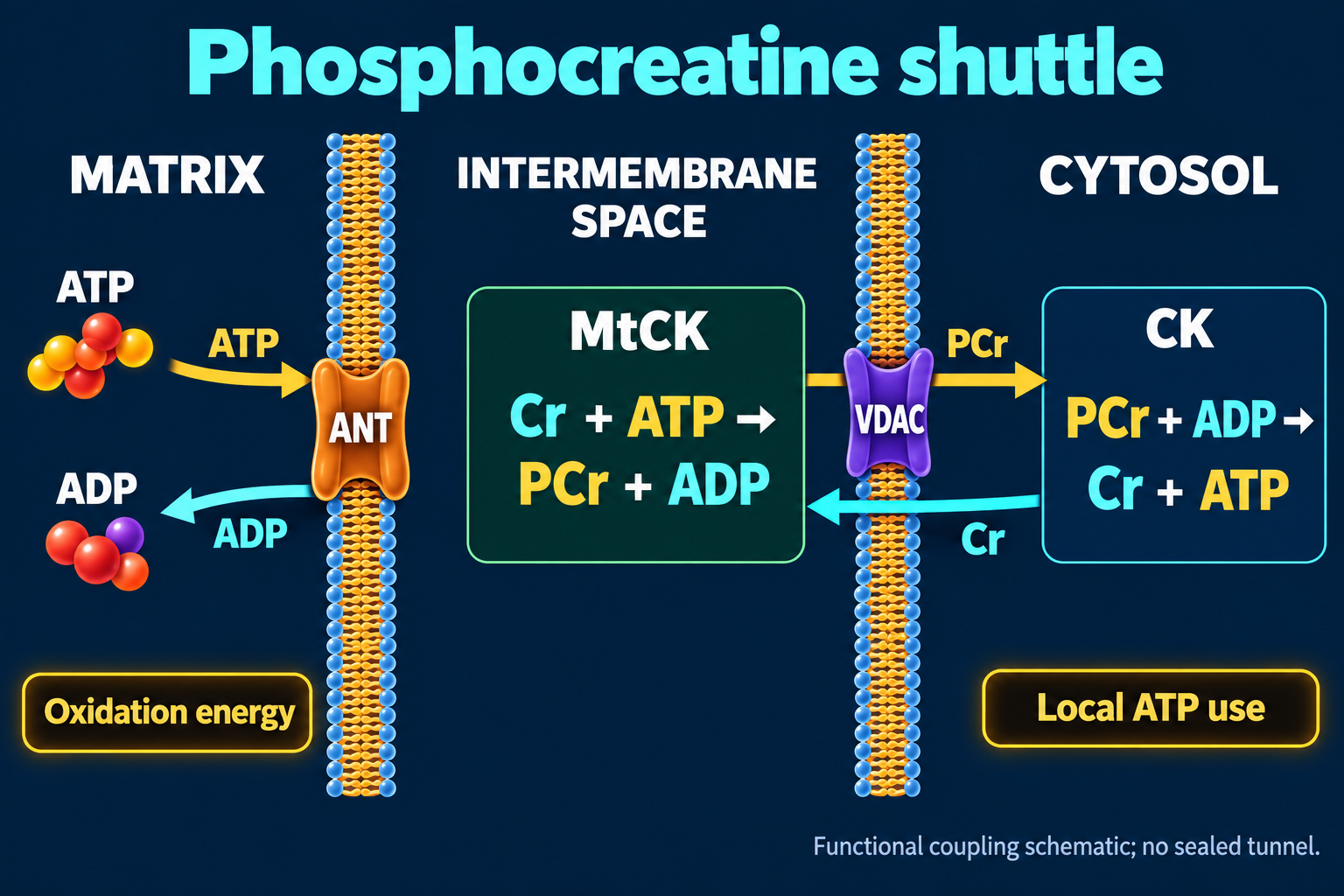
Functional schematic: ANT is in the inner membrane, VDAC in the outer membrane, and MtCK between them. Arrows indicate predominant exchange during shuttle operation; a sealed molecular tunnel is not assumed.
2. Isoenzymes: the same reaction at different workplaces
Cytosolic and mitochondrial branches
Creatine kinase belongs to the guanidino kinase family. Related invertebrate systems use substrates such as arginine; evolutionary kinship does not mean identical energetic organization in all animals. Human CKM and CKB encode cytosolic M and B subunits. Their dimers form MM, MB and BB, with distributions depending on tissue and development.
MM-CK predominates in skeletal muscle and is important in the heart; MB is not exclusively cardiac. BB-CK functions in the nervous system and other tissues. Myogenic regulators influence CKM expression, but MyoD/myogenin and MEF2 should not be described as one factor binding the same E-box.
Mitochondrial proteins are synthesized as precursors with targeting signals and imported into the organelle. Mature MtCK functions in the intermembrane space, not the matrix. The detailed import route and precursor processing must be distinguished from final localization.
| Branch | Genes / assembly | Working location | Functional emphasis |
|---|---|---|---|
| Muscle cytosolic | CKM; MM, also MB with B | Myofibrils and pump-associated regions | Local ATP regeneration during contraction |
| B cytosolic | CKB; BB, also MB with M | Neural and other cells | Supply for variable local demand |
| Sarcomeric MtCK | CKMT2; dimers and octamers | Muscle mitochondrial intermembrane space | Coupling oxidative synthesis to PCr |
| Ubiquitous MtCK | CKMT1A/CKMT1B; dimers and octamers | Intermembrane space in several tissues | Spatial organization of phosphotransfer |
“Muscle” and “ubiquitous” describe expression patterns, not absolute boundaries. , specific activity and isoenzyme proportions depend on the assay; one table of constants for all cells would imply false precision.
Blood CK versus cellular CK
Blood CK or CK-MB activity reflects enzyme release and clearance, not shuttle speed in muscle. Exercise, skeletal muscle injury and macro-CK can alter results. The modern universal definition of myocardial infarction primarily uses cardiac troponin alongside clinical context; CK-MB does not replace those criteria (Thygesen et al., 2018).
3. MtCK: octamers, membranes and a cautious view of channeling
What the structures show
The crystallographic study by Fritz-Wolf et al. (1996) and PDB entry 1CRK describe chicken sarcomeric MtCK at 3.0 Å resolution. Four dimers form an octamer; its central opening is not a proton channel. Active sites occupy clefts between each subunit's domains.
Human ubiquitous MtCK in PDB 1QK1 was studied at 2.7 Å (Eder et al., 2000, Proteins). This differs from the original's incorrectly associated “brain-type” CK reference at 2.1 Å. An isolated enzyme structure does not establish the atomic organization of the complete ANT–MtCK–VDAC system or demonstrate its continuous transport cycle.
Assembly equilibrium and cardiolipin
MtCK dimers and octamers undergo reversible exchange:
Both forms may retain catalytic activity. Octameric organization has particular importance for membrane interactions; it should not be called the sole “switched-on” enzyme form. Substrates, ionic conditions, membrane lipids and oxidative changes can influence assembly. Transition-state analogues, including ADP, creatine and nitrate combinations, are biochemical tools rather than a rationale for nitrate therapy.
Positively charged MtCK surfaces interact with negatively charged lipids, especially inner-membrane cardiolipin. Experiments support membrane apposition and contact-site stabilization models, but do not establish a universal binding constant or identical contact geometry in every tissue. Cardiolipin is part of the membrane environment, not a wire carrying phosphate.
ANT and VDAC: coupling need not imply a sealed tunnel
ANT transports adenine nucleotides across the inner membrane: ATP exits the matrix and ADP returns. VDAC forms an outer-membrane channel through which small metabolites, including Cr and PCr, are available. MtCK lies on the intermembrane side of these flows. A diagram must not place it in the matrix or connect it to the channel's cytosolic surface across an impermeable membrane.
Functional channeling means preferential use of locally available substrate and recycling of product. Protein proximity and restricted diffusion can contribute; this does not prove that every ATP molecule traverses a hermetic complex with fixed stoichiometry. Historical contact models remain useful when experimental coupling is distinguished from that literal interpretation (Schlattner et al., 2006).
4. Reversible chemistry and flux: how the reserve works
Thermodynamics without counting protons twice
At fixed pH and Mg-binding conditions, the reaction can be written in biochemical transformed form:
represents dimensionless activities, the gas constant and absolute temperature. Approximate textbook standard hydrolysis energies of PCr and ATP, around −43 and −31 kJ/mol, explain PCr's ability to phosphorylate ADP. They refer to specified standard conditions rather than actual energy in every compartment. The standard term for PCr synthesis is positive; local activities can nevertheless favour the net reaction.
An explicit ionic reaction including Mg and requires the corresponding untransformed standard energy and complete reaction quotient. Adding to on top of an already transformed counts pH twice. An equilibrium constant expressed using activities is dimensionless.
Protons, Mg and a random Bi–Bi mechanism
For selected ionic species, ATP regeneration from PCr consumes a proton. Effective proton stoichiometry depends on protonation and Mg binding; “one proton under all conditions” is not a universal rule. Buffering is finite. Exercise acidosis cannot simply be reduced to “lactic acid”: ATP turnover, transport and buffering contribute to the balance. The respiratory chain pumps protons across the inner membrane rather than merely neutralizing intermembrane protons.
In a random Bi–Bi mechanism, substrates can bind in different orders, but phosphoryl transfer occurs in an enzyme complex containing both. Mg coordinates the nucleotide, while domain and loop movements establish catalytic geometry and restrict water access. This improves transfer efficiency without implying perfect cellular efficiency or an identical for every isoenzyme.
Demand, recovery and respiratory control
When ATP use rises sharply, cytosolic CK uses PCr and ADP. When oxidative ATP production again meets demand, PCr is replenished. Temporal buffering smooths fluctuations; the spatial shuttle distributes phosphoryl potential. These functions are related but distinct.
ADP generated near ANT can stimulate mitochondrial respiration. Experimental stimulation by creatine supports functional coupling, but does not mean that the organism continuously operates at maximal State 3. PCr recovery depends on oxygen, perfusion, mitochondrial capacity, pH and workload. PCr follows gradients and reaction coupling; VDAC does not launch it as a unidirectional electric pump.
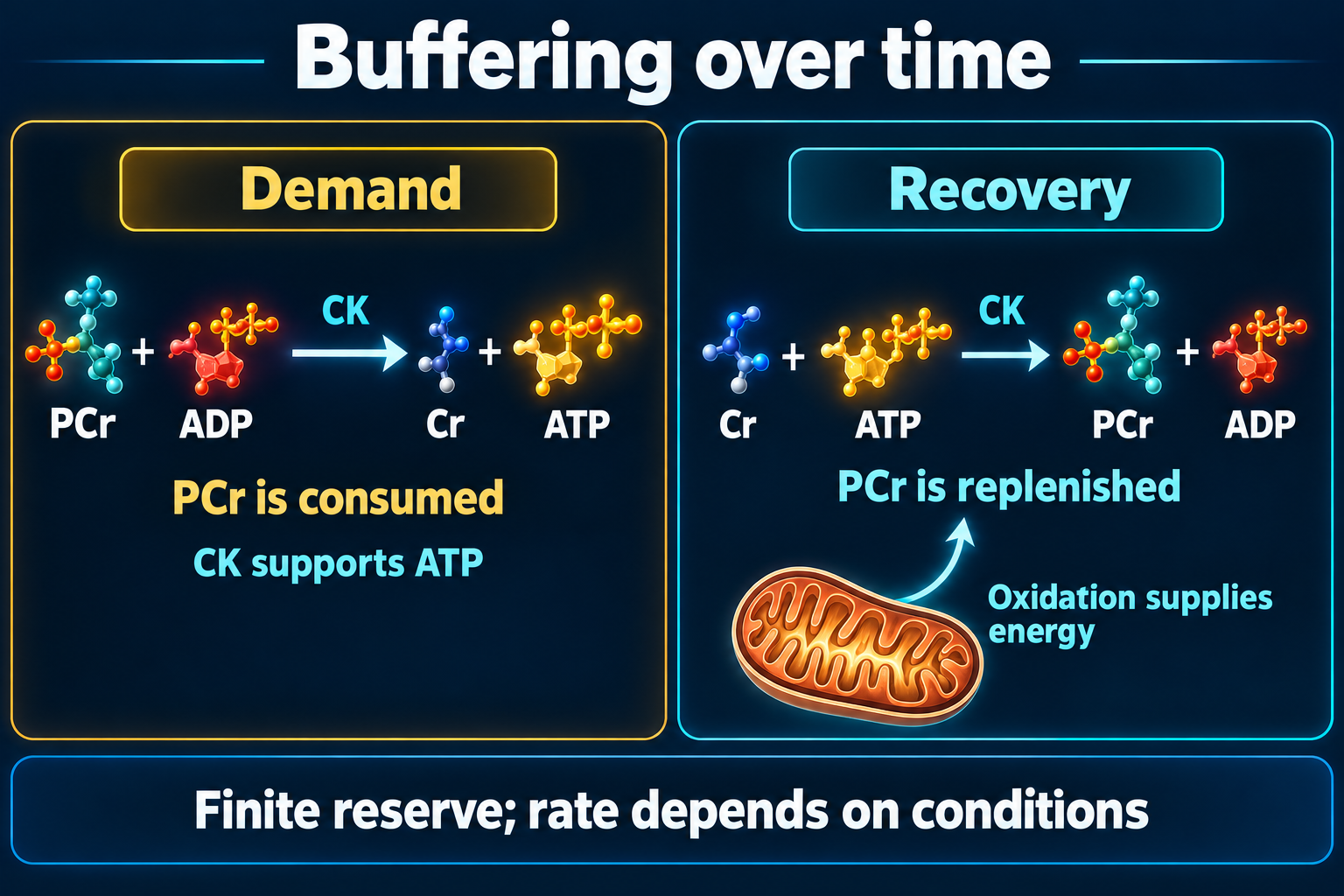
Demand consumes the reserve to regenerate ATP; recovery uses metabolic energy to return a phosphoryl group to Cr. This qualitative schematic does not prescribe an identical recovery time for every muscle. Molecule-like icons are schematic and do not depict validated atomic structures.
5. Consumers: contractile machinery, pumps and synapses
MM-CK at myofibrils
MM-CK interactions with M-line proteins, including myomesin and M-protein, help organize ATP regeneration near the contractile apparatus. ATP is needed to release myosin from actin and continue the cycle; ADP affects kinetics. CK proximity reduces local nucleotide fluctuations without guaranteeing the same ATP/ADP ratio at every myosin head.
SERCA and the sodium–potassium pump
SERCA returns Ca to the sarcoplasmic reticulum: SERCA1a is characteristic of fast muscle, SERCA2a of heart and slow muscle. Phosphotransfer supports ATP availability and the energetic potential needed to work against the calcium gradient. SERCA's share of energy expenditure and minimum free energy vary with tissue and conditions; one number cannot describe all pumps.
Na/K-ATPase maintains gradients underlying excitability, transport and Na/Ca exchange. The latter's direction depends on electrochemical conditions and can reverse. Pumps and membrane conductances jointly establish membrane potential, so it cannot be attributed to a single CK-dependent process.
BB-CK in the nervous system
Neural CK contributes to synaptic turnover, actin remodeling and pump operation. Vesicular V-ATPase creates a proton gradient used by neurotransmitter transporters. Astrocytic glutamate uptake is linked to the Na gradient and Na/K-ATPase. PCr helps cover these loads together with mitochondrial ATP and glycolysis. Plasticity and exocytosis do not depend exclusively on one shuttle.
6. The heart: energetic remodeling and limits of marker inference
Failure and oxidative injury
Heart failure alters creatine content, PCr reserve, isoenzyme activity and phosphotransfer rate. PCr may fall earlier or more markedly than ATP: the buffer is depleted while essential nucleotide concentration is partly maintained. Changes depend on disease cause and stage, not a single percentage applicable to every patient (Neubauer, 2007; Ingwall & Weiss, 2004).
Oxidative and nitrosative CK modifications, cardiolipin injury and altered MtCK assembly can impair the system. Thiols and other protein sites are sensitive to their environment; an unverified residue number should not be declared the principal cause of decompensation. Energetic remodeling interacts with overload, perfusion, calcium handling and neurohumoral regulation.
What 31P magnetic resonance spectroscopy measures
PCr/ATP is a relative pool-signal measure, not ATP synthesis rate. Saturation-transfer methods can estimate CK flux, but also require a model and measurement controls.
| Measurement | What it estimates | What it cannot establish alone |
|---|---|---|
| PCr/ATP by 31P-MRS | Relative phosphate-pool status | Exact mitochondrial capacity or disease cause |
| CK flux from exchange methods | A defined phosphotransfer rate within a model | Total useful ATP production through all routes |
| Blood CK / CK-MB | Enzyme release and injury context | Intracellular PCr reserve |
| Supplement effects on outcomes | Benefit in the studied population and regimen | Benefit from any increase in a metabolic marker |
Neubauer et al. (1997) associated lower PCr/ATP with prognosis in 39 patients with dilated cardiomyopathy. This small cohort was not a multicentre validation of a universal diagnostic threshold. Spatial resolution, blood contamination, myocardial heterogeneity and technique influence the measurement. An association does not establish that a supplement increasing the pool reduces mortality.
Ischemia, permeability and alternative routes
When oxygen is limited, PCr supports ATP only temporarily; depletion speed depends on workload and ischemia severity. Reperfusion adds oxidative stress and disturbed Ca handling. Inner-membrane permeability transition (mPTP) and Bax/Bak outer-membrane permeabilization (MOMP) are different events.
The historical ANT–MtCK–VDAC model is not an established obligatory mPTP core. Genetic VDAC experiments showed that permeability transition can persist without its proposed mandatory participation (Baines et al., 2007). Effects of CK on membrane stability do not prove that its octamer physically blocks Bax/Bak in every cell.
CK-deficient models show adaptations, including altered mitochondrial placement and other energy pathways. They establish the system's importance while contradicting a single possible ATP route. Intravenous PCr and oral creatine are different interventions; SLC6A8 transports Cr rather than equivalently PCr. Historical PCr use does not establish standard heart-failure treatment or proven infarct reduction with a supplement.
7. The brain: biological importance and different clinical questions
Local demand, plasticity and neuroprotection
The brain uses a substantial share of body energy, but not all of it supports synaptic transmission. CK and PCr help cover changing demand, maintain ion gradients and support plasticity. Mitochondrial placement, glycolysis and intercellular exchange complement this buffer; a spine without a mitochondrion does not lack every other energy route.
Experimental protection during metabolic stress can involve nucleotide support and membrane stability. It does not establish universal direct inhibition of Bax/Bak by the uMtCK octamer. Cytochrome c release and caspase pathways should be distinguished from AIF mechanisms, which can proceed independently of caspases.
Alzheimer and Huntington diseases: mechanism is not treatment
Oxidative BB-CK changes have been described in postmortem Alzheimer brain samples (Aksenov et al., 2000). They are compatible with energetic dysfunction but establish neither CK as the sole initiating cause nor oral creatine's ability to reverse dementia. Huntington disease research examines altered expression and metabolism, but these cannot be reduced to the same CKB/CKMT1 suppression percentage in every patient.
CREST-E did not confirm that creatine slows functional deterioration in early Huntington disease (Hersch et al., 2017). This matters because a compelling experimental hypothesis requires clinical-outcome testing, not merely pool or imaging changes.
Inherited creatine deficiency
AGAT/GATM and GAMT synthesis defects and SLC6A8 transporter deficiency are distinct diseases with different biochemistry. GAMT deficiency accumulates guanidinoacetate (GAA); SLC6A8 deficiency impairs Cr transport. Developmental and speech delay, seizures and movement disorders occur in varying combinations. Reduced Cr signal on proton MRS assists investigation, but diagnosis requires biochemical and genetic correlation.
| Disorder | Main treatment problem | Why sports regimens cannot be transferred |
|---|---|---|
| AGAT / GATM | Replace the missing synthesis product | Pediatric regimens and monitoring are individual |
| GAMT | Replace Cr and reduce GAA | Cr alone does not remove the toxic precursor |
| SLC6A8 | Cellular and brain transport impairment | Higher blood Cr does not guarantee brain delivery |
GeneReviews describes defect-specific treatment possibilities and the importance of early diagnosis. GAMT care includes specialist GAA-reduction measures and dietary interventions. High therapeutic doses for these diseases cannot become recommendations for healthy people, and a transport defect cannot be promised correction simply by escalating dose (Mercimek-Andrews & Salomons, updated 2025).
8. Creatine from synthesis to tissue pool
AGAT, GAMT and methyl groups
Cr synthesis connects amino-acid metabolism with methylation:
Kidneys and liver are important to interorgan synthesis but are not the only sites of these reactions; local synthesis also matters in the brain. Food supplies Cr, with diet and muscle mass influencing balance. Feedback reduces endogenous synthesis when external supply increases. SAM use does not establish that supplementation universally corrects methylation or treats related disease (Wyss & Kaddurah-Daouk, 2000).
SLC6A8: transport needs a gradient
SLC6A8 is a Na/Cl-dependent transporter. Its typical coupled stoichiometry is described as Cr with two Na and one Cl into the cell; gradients are maintained partly by Na/K-ATPase. This is secondary active transport, not passive PCr entry through the same system. The total pool must not be substituted for free transporter-substrate concentration (Christie, 2007).
An insulin response with food can influence Cr retention under studied conditions, but this does not imply a need for large sugar portions. Na dependence does not mean extra salt improves response in someone with normal electrolyte balance. Saturation and the initial tissue pool limit response.
Intestine, blood and blood–brain barrier
Oral Cr monohydrate increases substrate availability, but absorption, plasma exposure and muscle retention are different stages. Unretained Cr can be excreted; a high plasma peak does not measure CK benefit. Blood–brain barrier transport and local synthesis make brain response different from muscle response. No single regimen guarantees higher brain PCr in everyone (Béard & Braissant, 2010).
Interpreting studied loading regimens
Hultman et al. (1996) studied rapid and gradual approaches to muscle-pool enrichment. This informs kinetics rather than providing treatment instructions for cardiac, renal or inherited disease.
| Approach studied in healthy adults | Typical regimen | Interpretation and limit |
|---|---|---|
| Rapid saturation | About 20 g/day in divided portions for 5–7 days; often 3–5 g/day thereafter | Changes muscle pool faster; tolerance and retention vary |
| Gradual saturation | About 3 g/day for roughly four weeks | Does not require loading; similar average endpoints do not imply identical individual responses |
Body mass may increase through water; divided portions can aid tolerance without excluding gastrointestinal symptoms. Regimens depend on purpose and population. They cannot automatically be transferred to children with Cr synthesis deficiency, patients with chronic kidney disease or people with cardiac decompensation.
9. Sport, muscular adaptation and cognitive research
Where ergogenic benefit is best supported
Cr monohydrate has well-studied uses in repeated high-intensity efforts and training adaptation. A larger available PCr pool can support ATP regeneration during short efforts and work volume. Response depends on the task, initial pool, training status and program; neither identical power gains nor a fixed reduction in PCr recovery time can be promised to everyone (Kreider et al., 2017).
“Alactic” describes an energy pathway, not the complete absence of glycolysis in the first seconds. CK, glycolysis and oxidation operate together with changing contributions. Support for resistance training does not equal demonstrated performance enhancement in every prolonged aerobic task.
Hypertrophy: water, loading and signaling
Early increases in lean mass may partly reflect water. Longer-term adaptation depends on training stimulus and nutrition. Experiments discuss cellular hydration, IGF-1/Akt/mTORC1, myogenic factors and satellite cells. Changes in these do not prove that Cr directly and equally activates muscle protein synthesis in everyone without exercise. A signaling mechanism, short-term mass and functional outcome are distinct measures.
Cognitive stress and neurotrauma
Memory and attention studies are heterogeneous; a possible effect under particular conditions is not universal nootropic efficacy. A small controlled 2024 sleep-deprivation study observed changes in cognitive measures and cerebral high-energy phosphates. Replication is needed, and the result does not establish routine high-dose use (Gordji-Nejad et al., 2024).
Hypoxia, ischemia and traumatic injury have been studied experimentally. Protection of animal tissue does not prove prevention of human traumatic brain injury or a fixed percentage reduction in lesion size. Vegetarian diet, age and initial status may influence response without guaranteeing memory improvement for every group member (Avgerinos et al., 2018; Roschel et al., 2021). For comparison with another mitochondrial hypothesis, the discussion of CoQ10, polyphenols and safety explains why biochemical pathway support needs separate outcome testing.
10. Safety: creatinine, kidney function and combinations
Why creatinine can change
Cr and PCr spontaneously form creatinine. Pool size, muscle mass and diet influence production; some absorbed Cr is also excreted unchanged. Thus exclusive elimination through creatinine is an incorrect claim. Renal creatinine handling includes tubular secretion as well as filtration.
Creatinine may rise with Cr use, but this is neither inevitable nor a fixed increase. It can change estimated GFR without an equivalent fall in true filtration. Arbitrary creatinine values cannot imply the same GFR across ages and sexes, and every rise must not automatically be declared benign.
Cystatin C is useful, not an infallible certificate
If muscle mass or a supplement may affect interpretation, clinicians compare intake history, trends, urine findings and additional markers. KDIGO 2024 addresses creatinine-based estimation limits and appropriate use of cystatin C or combined estimates. Cystatin C is less dependent on muscle mass, but other influences include inflammation, thyroid status and glucocorticoids. One normal result does not prove an intact filtration barrier in every clinical situation.
What studies establish and what they do not cover
Poortmans & Francaux (1999) and Gualano et al. (2008) studied renal measurements in specified groups. They cannot be combined into a claim that every listed study was a five-year randomized trial. Good tolerance in studied healthy adults does not establish every dose's safety in every disease. A single observation of someone with one kidney is not a large randomized evaluation of that population.
Liver measurements also require context: AST can increase with muscle injury. Exercise, concomitant disease, medication and product composition matter when interpreting changes. Supplement quality and freedom from additional ingredients differ from the safety of the Cr molecule itself.
Combinations without false precision
Taking Cr with food can be convenient, but large carbohydrate portions, extra salt and R-alpha-lipoic acid are not mandatory for efficacy. Fixed ALA doses and transporter-translocation claims should not become a proven protocol for “nonresponders.” Caffeine–Cr findings depend on regimen and tolerance; a universal SERCA antagonism and mandatory 1–2-hour separation are not established.
Medication, dehydration and concomitant disease can alter clinical risk and laboratory interpretation. The article on niacin, lipids and safety discusses the same useful combination principle: biochemical synergy does not replace assessment of the actual combination and endpoint.
11. What the system explains and what remains open
CK connects rapidly changing demand with spatially distributed ATP synthesis. MtCK octamer organization and its membrane environment assist coupling; cytosolic isoenzymes provide local phosphotransfer. The reserve remains finite, the reaction reversible, and tissues use several energetic routes.
Research prospects include CK-flux measurement, restoration of compartmentation and ways to deliver Cr in transport defects. Octamer stabilization and Cr analogues remain research directions until specific interventions demonstrate clinical benefit and safety. Sport, inherited deficiency, heart failure and cognitive stress require different questions and evidence.
Method note
This is a targeted narrative revision of existing material. Its thematic strands were preserved and exaggerated mechanistic and clinical statements qualified. Necessary primary records were additionally checked for 1CRK/1QK1 structures, cardiac prognosis, muscle saturation regimens, permeability transition, CREST-E and the sleep-deprivation study; GeneReviews and KDIGO inform clinical limits. This is not a systematic search, meta-analysis, GRADE assessment or external peer review. The diagrams are conceptual, without quantitative scales or an atomic depiction of a complex.
FAQ
Does CK create extra energy?
No. The reaction redistributes phosphoryl groups. PCr temporarily helps maintain ATP, while replenishing the reserve requires metabolic energy.
Does blood CK measure shuttle function?
No. It reflects enzyme release and clinical context, not intracellular PCr or CK flux.
Can raising PCr treat heart failure?
A prognostic association does not establish that raising a marker improves outcomes. Oral Cr and intravenous PCr differ and need separate clinical evidence.
Is creatine loading necessary?
Gradual intake also raised muscle pools in healthy-adult studies, but more slowly. Sports doses cannot automatically be transferred to diseases or children.
Is every creatinine rise with supplementation safe?
No. Supplements may affect the marker, but genuine renal dysfunction is also possible. Clinicians consider trends, urine findings and additional assessment where needed.
Sources
- Wallimann T, Wyss M, Brdiczka D, Nicolay K, Eppenberger HM. Intracellular compartmentation, structure and function of creatine kinase isoenzymes in relation to cellular energy production and consumption: the 'creatine phosphate shuttle'. Biochem J. 1992;281(Pt 1):21-40.
- Schlattner U, Tokarska-Schlattner M, Wallimann T. Mitochondrial creatine kinase in human health and disease. Biochim Biophys Acta. 2006;1762(2):164-180.
- Fritz-Wolf K, Schnyder T, Wallimann T, Kabsch W. Structure of mitochondrial creatine kinase. Nature. 1996;381(6580):341-345.
- Bessman SP, Geiger PJ. Transport of energy in muscle: the phosphorylcreatine shuttle. Science. 1981;211(4481):448-452.
- Neubauer S, Horn M, Cramer M, Harre K, Newell JB, Peters W, Pabst T, Ertl G, Hahn D, Ingwall JS. Myocardial phosphocreatine-to-ATP ratio is a predictor of mortality in patients with dilated cardiomyopathy. Circulation. 1997;96(7):2190-2196.
- Neubauer S. The failing heart—an engine out of fuel. N Engl J Med. 2007;356(11):1140-1151.
- Ingwall JS, Weiss RG. Is the failing heart really out of fuel? Circ Res. 2004;95(2):135-145.
- Dzeja PP, Terzic A. Phosphotransfer networks and cellular energetics. J Exp Biol. 2003;206(Pt 12):2039-2047.
- Wyss M, Kaddurah-Daouk R. Creatine and creatinine metabolism. Physiol Rev. 2000;80(3):1107-1213.
- Saks VA, Ventura-Clapier R, Aliev MK. Metabolic control and transport of energy by the creatine kinase system. Biochim Biophys Acta. 1996;1274(3):81-88.
- Christie DL. Functional insights into the SLC6 family of transporters from studies of the creatine transporter (SLC6A8). FEBS Lett. 2007;581(12):2341-2348.
- Kreider RB, Kalman DS, Antonio J, Ziegenfuss TN, Wildman R, Collins R, Candow DG, Kleiner SM, Almada AL, Lopez HL. International Society of Sports Nutrition position stand: safety and efficacy of creatine supplementation in exercise, sport, and medicine. J Int Soc Sports Nutr. 2017;14:18.
- Roschel H, Gualano B, Ostojic SM, Rawson ES. Creatine Supplementation and Brain Health. Nutrients. 2021;13(2):586.
- Avgerinos KI, Spyrou N, Bougioukas KI, Kapogiannis D. Effects of creatine supplementation on cognitive function of healthy individuals: A systematic review of randomized controlled trials. Exp Gerontol. 2018;108:166-173.
- Poortmans JR, Francaux M. Long-term oral creatine supplementation does not impair renal function in healthy athletes. Med Sci Sports Exerc. 1999;31(8):1108-1110.
- Gualano B, Ugrinowitsch C, Novaes RB, Artioli GG, Shimizu MH, Seguro AC, Harris RC, Lancha AH Jr. Effects of creatine supplementation on renal function: a randomized, double-blind, placebo-controlled clinical trial. Eur J Appl Physiol. 2008;103(1):33-40.
- Aksenov MY, Aksenova MV, Butterfield DA, Markesbery WR. Oxidative modification of creatine kinase BB in Alzheimer's disease brain. J Neurochem. 2000;74(6):2520-2527.
- Béard E, Braissant O. Synthesis and transport of creatine in the CNS: importance for cerebral functions. J Neurochem. 2010;115(2):297-313.
- Eder M et al. Crystal structure of human ubiquitous mitochondrial creatine kinase. Proteins. 2000;39:216–225.
- RCSB PDB 1CRK. Mitochondrial creatine kinase (Gallus gallus), 3.0 Å.
- RCSB PDB 1QK1. Human ubiquitous mitochondrial creatine kinase, 2.7 Å.
- Baines CP et al. Voltage-dependent anion channels are dispensable for mitochondrial-dependent cell death. Nat Cell Biol. 2007;9:550–555.
- Hersch SM et al. The CREST-E study of creatine for Huntington disease: A randomized controlled trial. Neurology. 2017;89:594–601.
- Hultman E et al. Muscle creatine loading in men. J Appl Physiol. 1996;81:232–237.
- Mercimek-Andrews S, Salomons GS. Creatine Deficiency Disorders. GeneReviews. Updated 2025.
- KDIGO 2024 Clinical Practice Guideline for the Evaluation and Management of Chronic Kidney Disease.
- Gordji-Nejad A et al. Single dose creatine improves cognitive performance and induces changes in cerebral high energy phosphates during sleep deprivation. Sci Rep. 2024;14:4937.
- Thygesen K et al. Fourth Universal Definition of Myocardial Infarction (2018). J Am Coll Cardiol. 2018;72:2231–2264.