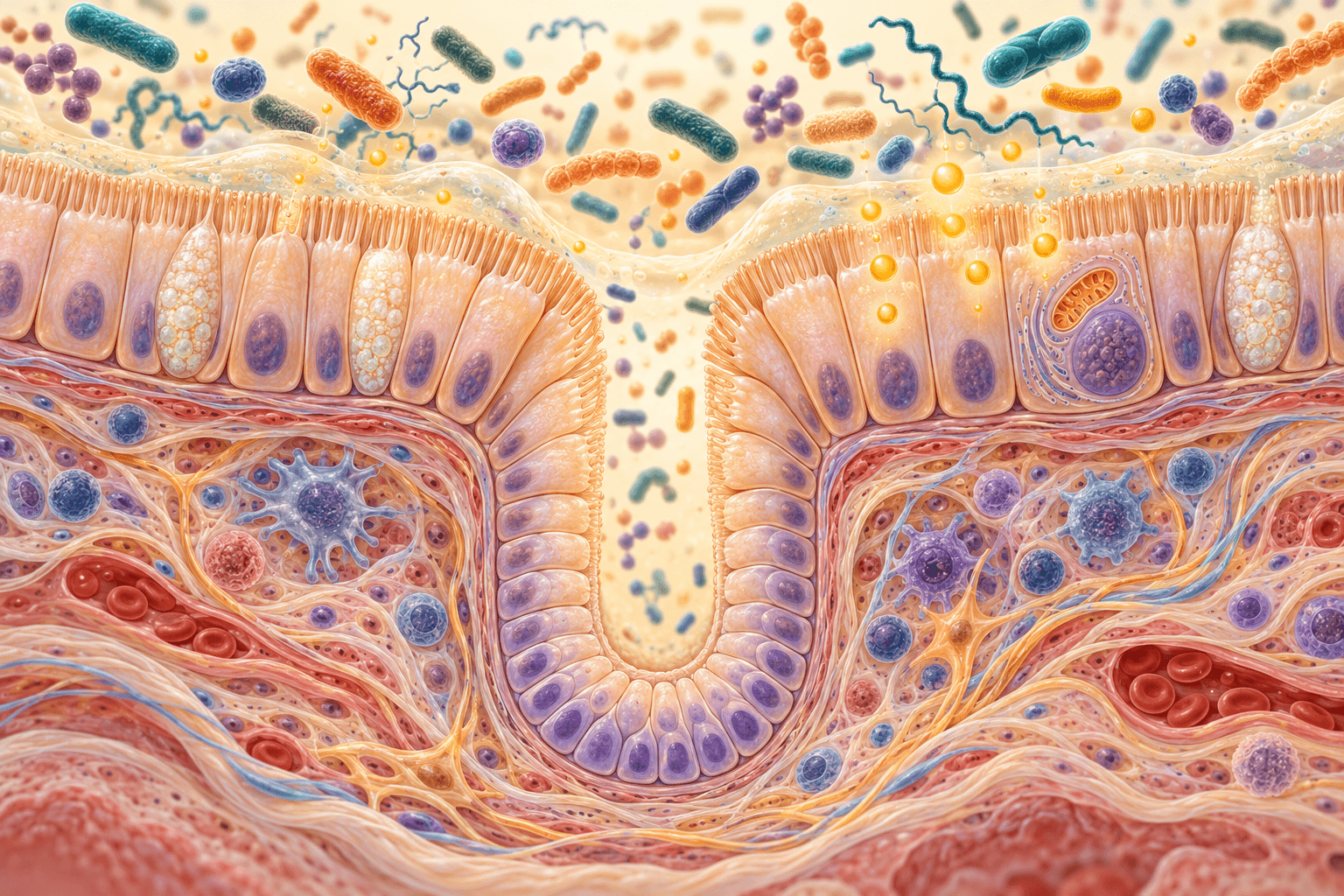
Short-chain fatty acids: butyrate, FFAR2/3 and HDACs
How gut microbes produce acetate, propionate and butyrate, how colonocytes absorb and oxidize them, and how receptor signaling differs from HDAC inhibition. Crypts, Tregs, the barrier, gut hormones and human trials, with corrected calculations and clear limits on clinical inference.
Acetate, propionate and butyrate connect microbial fermentation with intestinal epithelial energy metabolism, receptor signaling and chromatin regulation. The same metabolite can fuel a mature colonocyte yet suppress proliferation in a cell that accumulates it. Understanding these effects requires distinguishing the intestinal lumen, epithelium, immune cells, portal blood and peripheral tissues: their concentrations and metabolic capacities differ.
This article examines acid production, membrane transport, mitochondrial oxidation, FFAR2, FFAR3 and HCAR2, epigenetics and clinical research. Findings from cell and animal models are distinguished from human trials. It is an analysis of selected scientific sources, rather than a systematic review or a treatment protocol.
1. Production, chemistry and microbial communities
1.1. Acetate C2, propionate C3 and butyrate C4
Short-chain fatty acids, or SCFAs, are monocarboxylic acids with short carbon chains; definitions of the chain-length boundary vary. Acetate, propionate and straight-chain n-butyrate dominate carbohydrate fermentation in the colon. The table describes the neutral acids; substantial fractions occur as anions at physiological pH.
| Acid and anion | Acid formula | Molar mass, g/mol | Approximate pKa |
|---|---|---|---|
| Acetic acid / acetate | CH₃COOH | 60.05 | 4.76 |
| Propionic acid / propionate | CH₃CH₂COOH | 74.08 | 4.87 |
| Butyric acid / n-butyrate | CH₃CH₂CH₂COOH | 88.11 | 4.82 |
The anion fraction follows acid–base equilibrium. For a monoprotic acid HA and its anion A⁻, the Henderson–Hasselbalch equation gives:
Brackets denote concentrations and f is a dimensionless fraction. At pH 5.5, these pKa values give approximately 81–85% anion and 15–19% neutral acid. Butyrate is about 82.7% ionized at pH 5.5 and 99.3% at pH 7.0. Thus, 98–99% ionization does not apply across the entire intestinal pH range. This is an approximate solution calculation; ionic strength and the epithelial surface environment can alter the effective equilibrium.
Branched-chain acids, including isobutyrate, isovalerate and 2-methylbutyrate, are associated mainly with fermentation of valine, leucine and isoleucine. They occur in intestinal contents without a universal submicromolar concentration. Protein fermentation produces other compounds as well, so these acids alone do not measure benefit or harm.
1.2. Acetate, three propionate pathways and butyryl-CoA
Microbes obtain carbohydrates that escape small-intestinal digestion, including resistant starch, inulin, arabinoxylans, pectins and other polysaccharides. Some also use mucin O-glycans. These substrates differ in accessibility; fermentation of host mucus is not equivalent to an intake of dietary fiber.
During acetate production, pyruvate is converted to acetyl-CoA, including through pyruvate:ferredoxin oxidoreductase. Phosphotransacetylase produces acetyl phosphate, and acetate kinase transfers phosphate to ADP, supporting substrate-level phosphorylation. Acetogens can use the reductive Wood–Ljungdahl pathway, incorporating carbon from CO₂ and reducing equivalents from H₂ into acetate. Blautia hydrogenotrophica is an example of an intestinal acetogen.
Propionate has three major pathways. The succinate pathway includes oxaloacetate, malate, fumarate, succinate, succinyl-CoA and methylmalonyl-CoA; decarboxylation leads to propionyl-CoA. It is widespread in Bacteroidota and certain Negativicutes. The acrylate pathway processes lactate through lactoyl-CoA and acryloyl-CoA and occurs in a limited set of species, including Coprococcus catus. Veillonella should not automatically be assigned to this route: well-characterized members use the succinate mechanism. The propanediol pathway begins with deoxy sugars, fucose and rhamnose, and proceeds through 1,2-propanediol; it occurs in Roseburia inulinivorans and relatives of Blautia obeum. Genomic and isotope studies by Reichardt et al. (2014) demonstrated species- and substrate-dependent routes, with some species changing their end product.
Butyrate synthesis starts with condensation of two acetyl-CoA molecules into acetoacetyl-CoA. Subsequent intermediates include 3-hydroxybutyryl-CoA, crotonyl-CoA and butyryl-CoA. Butyryl-CoA:acetate CoA-transferase transfers CoA to acetate, releasing butyrate and forming acetyl-CoA. Alternatively, phosphotransbutyrylase and butyrate kinase operate through butyryl phosphate with ATP production. The transferase route is widespread among intestinal butyrate producers, but its prevalence depends on the sampled community and method.
1.3. Cross-feeding, pH and the approximate 60:20:20 profile
Many taxa produce acetate, including bifidobacteria and bacteroides. Propionate often involves Bacteroides, Prevotella and other pathway carriers. Familiar butyrate producers include Faecalibacterium, Roseburia, Eubacterium rectale and Anaerobutyricum hallii. Function depends on strain and growth conditions; abundance of a genus does not substitute for measurement of metabolite flux.
Cross-feeding connects these groups. Primary starch degraders release oligosaccharides, while other organisms consume acetate or lactate to produce butyrate. A bifidobacterium can therefore support butyrate production without being a direct butyrate producer. Acetate consumption by CoA-transferase illustrates this interdependence.
An acetate:propionate:butyrate ratio near 60:20:20 is a useful teaching approximation for colonic contents. Diet, transit, anatomical site and community composition change it. Portal and peripheral blood have different profiles because the epithelium and liver selectively consume the acids. In the postmortem study by Cummings et al. (1987), total concentrations were 131 ± 9 mmol/kg of caecal contents and 80 ± 11 mmol/kg in the descending colon, with pH approximately 5.6 to 6.6. These mass-based units should not be silently replaced by mmol/L, and a small postmortem sample does not define individual reference ranges.
Normalizing this approximate profile in acetate:propionate:butyrate order gives:
Moderately acidic pH can favor some butyrate-producing communities; stronger acidification can impair lactate use. Duncan et al. (2009) demonstrated an ecological dependence rather than a universal cessation of production below pH 5.5. A fecal concentration reflects production, absorption, water and transit together: a low residual amount does not establish low production, and a high amount does not establish adequate colonocyte supply.
2. Membrane transport and epithelial energy metabolism
2.1. MCT1, SMCT1, neutral diffusion and anion exchange
Neutral acid can cross a lipid membrane, whereas the anion requires other routes. pH therefore affects both chemical form and cellular uptake. The surface microenvironment, transporter orientation and electrolyte gradients matter alongside luminal concentration.
MCT1, encoded by SLC16A1, cotransports a monocarboxylate with H⁺ and is electroneutral in this mode. It also transports lactate; gradients determine net direction. SMCT1, encoded by SLC5A8, uses the sodium gradient for high-affinity electrogenic transport, usually described as two Na⁺ ions per anion. Basolateral Na⁺/K⁺-ATPase maintains the driving force. Km values and apical versus basolateral MCT1 distribution vary with species and experimental system, so a single range cannot characterize every colonocyte.
SCFA–bicarbonate exchange has also been described. DRA, SLC26A3, is primarily a Cl⁻/HCO₃⁻ exchanger involved in electrolyte absorption and the acid–base environment. It should not be presented as the single established carrier of all bicarbonate-dependent butyrate flux without specific evidence. The transport review by Ganapathy et al. (2013) helps distinguish transporters from receptors: a receptor senses a signal but does not deliver the fuel substrate into the cell.
Passive and transporter-dependent uptake operate together. A universal passive-diffusion contribution of 10–15% has not been established across all sites and conditions. Epigenetic silencing of SLC5A8 occurs in tumor models, but this does not mean every tumor clone loses all butyrate uptake.
2.2. Activation, one β-oxidation cycle and ATP yield
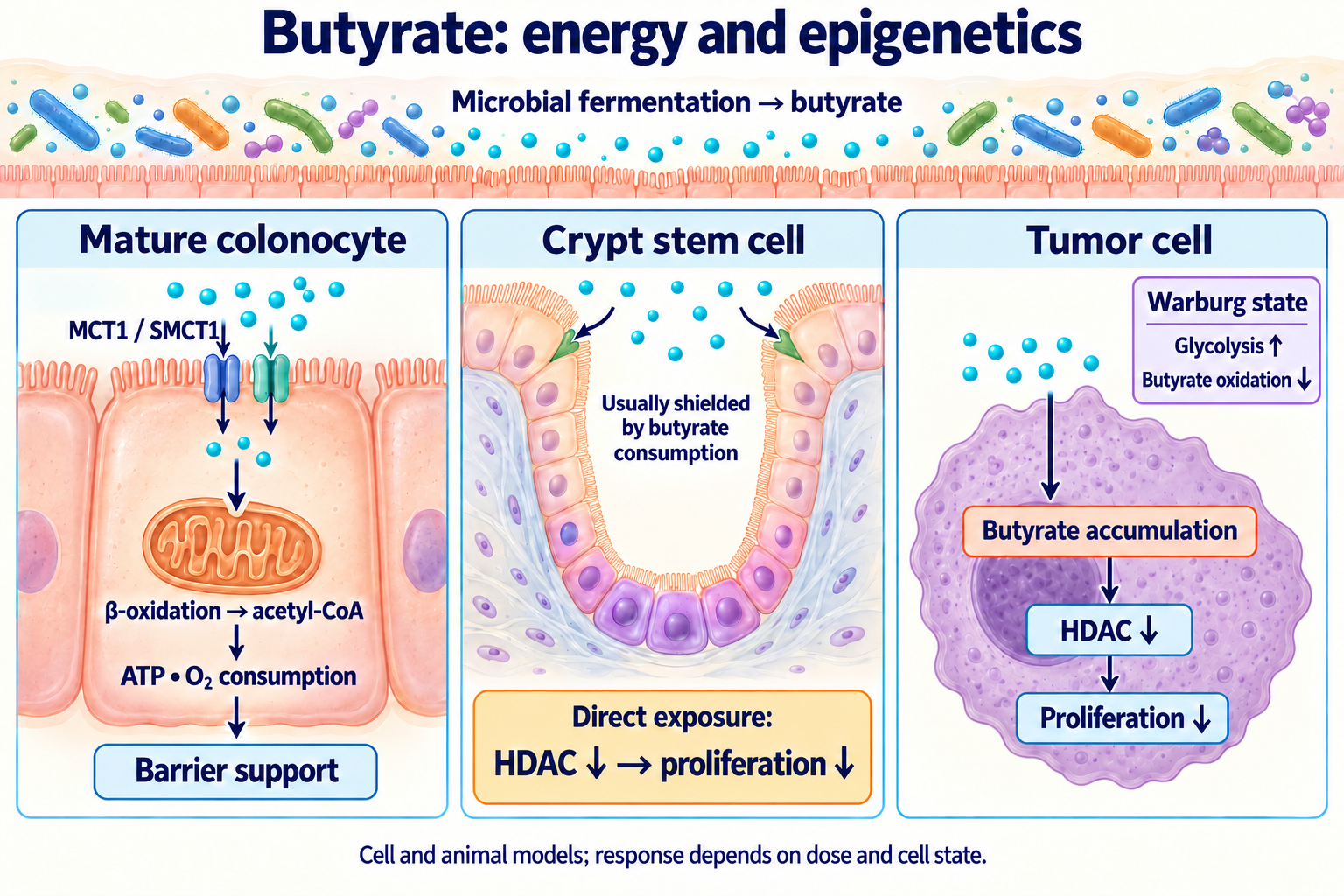
Mature surface colonocytes actively oxidize butyrate. Roediger's experiments (1980), followed by germ-free mouse work by Donohoe et al. (2011), linked microbial butyrate with epithelial respiration, ATP and autophagy. The frequently quoted 70–80% energetic contribution reflects particular experimental estimates, not a fixed ATP fraction in every crypt cell under any diet or inflammatory condition.
Free acid is activated to butyryl-CoA by acyl-CoA synthetases, consuming ATP to AMP and pyrophosphate. Isoforms and compartments differ. ACSS2 is chiefly associated with acetate use and should not automatically be assigned as the principal C4-activating enzyme. ACSM3 and ACADS have been studied in human epithelial models. Free short-chain acid does not require the usual CPT1-dependent carnitine shuttle of long-chain fatty acids; a CoA ester, however, does not freely diffuse across the inner mitochondrial membrane. This distinction clarifies comparisons with long-chain fatty-acid transport through CPT1.
One C4 β-oxidation cycle involves butyryl-CoA dehydrogenation by ACADS/SCAD, crotonyl-CoA hydration by ECHS1, NAD⁺-dependent oxidation of 3-hydroxybutyryl-CoA, and acetoacetyl-CoA thiolysis. Two acetyl-CoA molecules result. ACADS electrons pass through ETF and ETF:ubiquinone oxidoreductase into the ubiquinone pool, rather than directly through complex II. NADH feeds complex I. Respiratory-chain complexes III and IV contribute to the proton gradient used by F₁F₀-ATP synthase; oxygen is reduced to water.
Activation and one cycle can be summarized as schematic biochemical bookkeeping at fixed pH:
The first line is activation; the following two lines are one β-oxidation cycle, including water consumed by hydration. FAD is bound to ACADS here, and its reduced form is a transient state: electrons subsequently pass through ETF and ETF:ubiquinone oxidoreductase to ubiquinone. The notation does not imply consumption of a free FAD pool or entry through complex II; proton exchange with the buffer during activation is not written separately.
With standard P/O assumptions of 2.5 for NADH and 1.5 for the flavin-linked electron pathway, the teaching calculation is:
Each acetyl-CoA gives a theoretical 10 ATP through the tricarboxylic-acid cycle: three NADH, one flavin equivalent and one GTP. The additional reducing equivalents come from β-oxidation, while activation costs two ATP equivalents. This is a stoichiometric estimate rather than a fixed measured cellular output; 27 ATP does not follow from these assumptions. Proton leak, coupling and carbon diversion into biosynthesis change actual yield.
Energy supports ion pumps, protein turnover, mucus secretion and epithelial polarity. Fueling differentiated cells does not mean directly stimulating every proliferating crypt cell.
2.3. Oxygen consumption, HIF and luminal ecology
Colonocyte respiration limits oxygen availability at the mucosal surface. The epithelium experiences a gradient of physiologically low pO₂; its value depends on site and measurement method. Values below 10 mmHg describe a hypoxic zone in some work, rather than a diagnostic threshold for every person.
Low oxygen reduces HIF-α prolyl hydroxylation. VHL-dependent degradation declines, allowing association with HIF-β and regulation of barrier and adaptive genes. Kelly et al. (2015) linked butyrate metabolism, oxygen consumption, epithelial HIF stabilization and barrier function in cell and animal models. Local physiological hypoxia does not imply a benefit from reducing systemic oxygen supply.
Rivera-Chávez et al. (2016) and Byndloss et al. (2017) linked loss of butyrate producers and disrupted epithelial PPARγ signaling with greater availability of respiratory electron acceptors and expansion of facultative anaerobes, including Enterobacteriaceae. Inflammation also supplies nitrate and other acceptors. This is an ecological advantage for particular organisms, rather than immediate elimination of every obligate anaerobe whenever butyrate decreases.
2.4. The butyrate paradox and the protected crypt
In Donohoe et al. (2012), metabolic state determined the response. An oxidizing cell used butyrate as fuel and a source of acetyl-CoA for acetyltransferases. In cells showing a strong Warburg effect and aerobic glycolysis, butyrate consumption was lower: accumulation enabled HDAC inhibition, changing transcription of cell-cycle and apoptosis regulators. Tumor mitochondria are not necessarily completely inactive; dose, cell line, genetics and other substrates affect the response.
Stem cells present a separate situation. Kaiko et al. (2016) showed that differentiated cells near the crypt surface metabolize butyrate and shield deeper stem and progenitor cells from excessive exposure. When butyrate gains direct access, including after structural injury, HDAC- and FOXO3-related mechanisms can suppress their proliferation. Therefore, a universal claim that butyrate stimulates stem-cell division is incorrect: mature epithelial nutrition, tissue repair and direct progenitor responses are different processes.
2.5. Inflammation and impaired butyrate use
Active inflammatory bowel disease can involve fewer butyrate-producing taxa, altered transporter expression and reduced epithelial substrate use. Ferrer-Picón et al. (2020) studied human biopsies and differentiated organoids; TNFα altered butyrate response and consumption. This supports the possibility that simply supplying more substrate does not remove a metabolic limitation.
Early oxidation measurements and modern epithelial models differ in design and tissue state. A universal 50–70% fall, obligatory cytokine-induced hypermethylation of both transporters, or oxidation of particular ACADS cysteines in every patient is not established. The mitochondrial trifunctional protein primarily serves long-chain substrates and should not replace the short-chain enzymes of the C4 cycle. Energy deficits can impair the barrier, but inflammatory disease is multifactorial, and very high butyrate doses are not an established mitochondrial repair treatment.
3. Membrane receptors for SCFAs
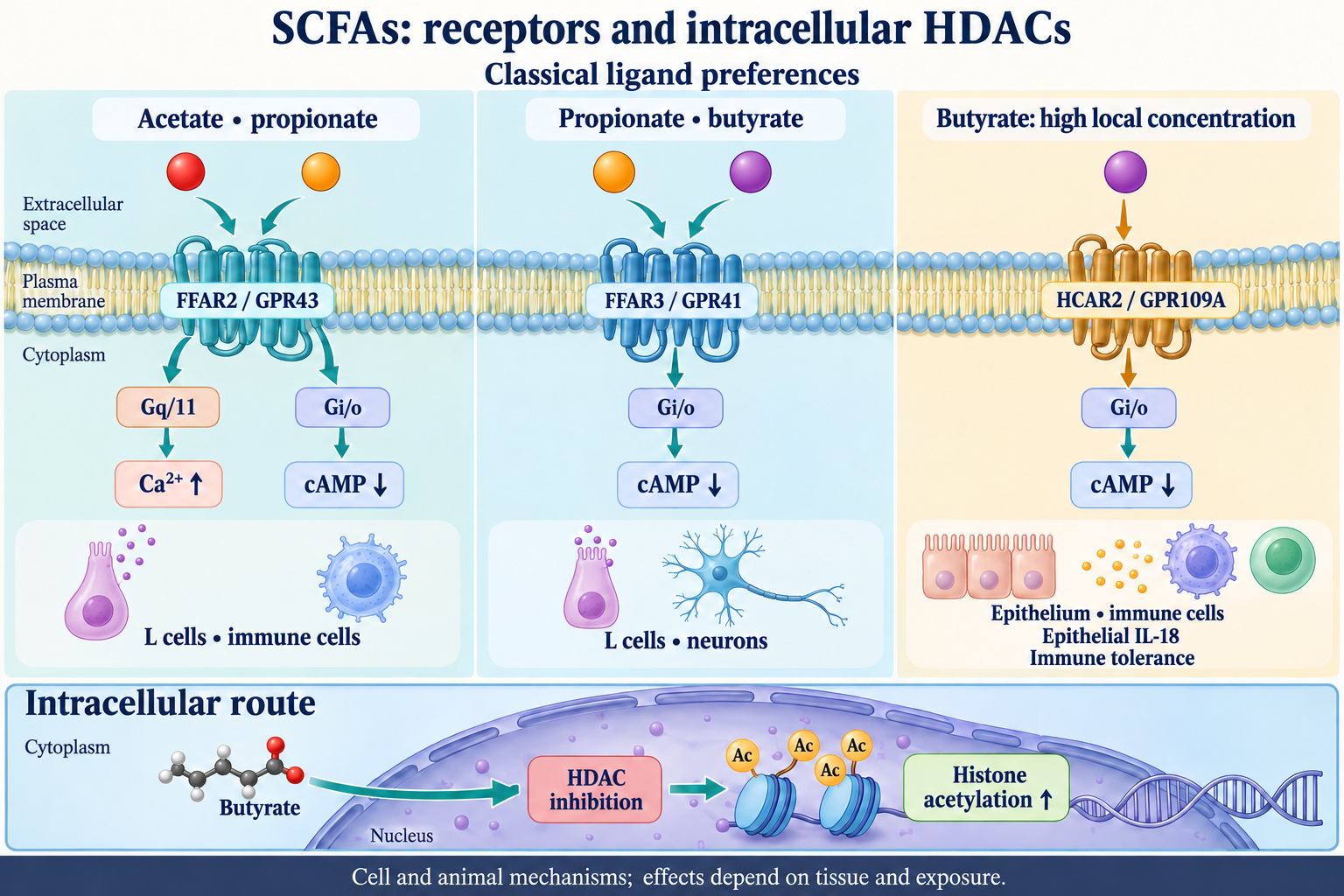
3.1. FFAR2/GPR43: Gq/11 and Gi/o
FFAR2 is a seven-transmembrane free fatty-acid receptor. Brown et al. (2003) and Le Poul et al. (2003) showed activation by acetate and propionate compared with certain longer acids. Charged regions of the binding pocket recognize the carboxylate, while activity depends on species, assay system and response measured. EC₅₀ is the half-maximal effective concentration in a particular experiment, rather than a universal affinity constant or a concentration necessarily reached in peripheral blood.
Gq/11 coupling activates PLCβ. PIP₂ cleavage produces IP₃ and DAG: IP₃ mobilizes calcium from intracellular stores, while DAG contributes to PKC activation. These signals can support secretion and cellular responses. Gi/o coupling reduces adenylyl cyclase activity and cAMP; Gβγ subunits can additionally engage kinase cascades.
FFAR2 is found in enteroendocrine and immune cells, including neutrophils. Chemotaxis, activation, inflammatory resolution and Treg regulation depend on context. It is not invariably anti-inflammatory: responding to infection and limiting chronic injury have different requirements.
3.2. FFAR3/GPR41: endocrine and neural regulation
FFAR3 predominantly couples to Gi/o and responds more readily to propionate and butyrate than acetate in classical assays. Lower cAMP is an initial signal, with additional Gβγ-mediated responses. A lower EC₅₀ in one assay does not establish greater FFAR3 sensitivity than FFAR2 in every tissue.
FFAR3 has been studied in enteroendocrine cells and peripheral and enteric neurons. Animal work links SCFAs with sympathetic tone, energy expenditure and motility. Transit effects nevertheless depend on site, concentration and direct versus hormonal pathways. A colonic brake is a physiological feedback model, rather than evidence that one receptor invariably slows all human intestinal motility.
3.3. HCAR2/GPR109A, tolerance and epithelial IL-18
HCAR2, also known as GPR109A or NIACR1, senses nicotinic acid, β-hydroxybutyrate and, at higher local concentrations, butyrate. This Gi/o-coupled receptor has been studied in epithelium and lamina propria cells. High luminal butyrate does not imply equal exposure of every systemic HCAR2 receptor.
Singh et al. (2014) showed that GPR109A supports anti-inflammatory macrophage and dendritic-cell properties, IL-10 and Treg induction in mice, while epithelial signaling involves IL-18. Retinoic acid formed by retinaldehyde dehydrogenases and TGFβ contribute to a tolerance-supporting environment. Receptor loss increased susceptibility to experimental colitis and carcinogenesis; this does not establish cancer prevention by supplementation in humans.
The direction of inflammasome signaling needs precision. Macia et al. (2015) linked dietary fiber and GPR43/GPR109A with protective epithelial inflammasome activation. For GPR43, they demonstrated K⁺ efflux, hyperpolarization and NLRP3 activation. Caspase-1 matures IL-18. Thus, describing epithelial protection simply as HCAR2 blocking NLRP3 misrepresents this work. Excessive inflammatory or pyroptotic signaling can be harmful in other settings: cell type, timing and magnitude matter.
3.4. GLP-1, PYY and energy balance
Intestinal L cells sense metabolites and secrete GLP-1 and PYY. Tolhurst et al. (2012) linked SCFA-stimulated GLP-1 secretion with FFAR2 in cellular and mouse experiments. Calcium signals and secretory machinery connect sensing with exocytosis. This does not establish identical receptor expression or strictly equimolar hormone secretion under all conditions.
GLP-1 enhances glucose-dependent insulin secretion and influences glucagon, gastric emptying and appetite. Experimental β-cell neogenesis does not demonstrate β-cell regeneration after ordinary fiber or butyrate intake in humans. PYY, especially PYY₃₋₃₆, acts through Y2 receptors and neural and endocrine satiety pathways; hypothalamic effects do not require every molecule to enter directly through the blood–brain barrier. Further hormone physiology is discussed in nutrient signals for GLP-1.
Chambers et al. (2015) used a particular inulin–propionate ester, rather than any fiber. Acute experiments and a 24-week trial in 60 adults with overweight produced signals involving hormones, energy intake and weight gain. The results cannot be transferred to every butyrate formulation or used to promise identical visceral-fat reductions for everyone.
3.5. Olfr78/OR51E2, vascular tone and the liver
Pluznick et al. (2013) demonstrated that mouse olfactory receptor Olfr78 responds to acetate and propionate and participates in renin and blood-pressure regulation. OR51E2 is its human ortholog. Experiments compared receptor pathways that can limit excessive SCFA-related hypotension. Mouse doses, thresholds and vascular responses do not establish a ready-made two-state human blood-pressure regulator.
Absorbed acids distribute differently. The epithelium consumes much butyrate, the liver extracts substantial propionate, and acetate more often reaches peripheral blood. Propionate can provide gluconeogenic carbon through propionyl-CoA, methylmalonyl-CoA and succinyl-CoA; acetate supplies acetyl-CoA for oxidation and lipogenesis. A metabolite can be both a signal and a substrate, with lipid effects depending on overall energy status. Universal direct allosteric inhibition of FAS and ACC by clinical propionate exposure is not established.
4. HDACs, acetylation and other chromatin marks
4.1. What HDAC inhibition means
Zinc-dependent HDACs remove acetyl groups from histone lysines and other proteins. Acetylation reduces lysine's positive charge and alters chromatin interactions, but gene accessibility also depends on transcription factors, remodeling complexes and other modifications. Acetylation does not invariably activate every gene.
Butyrate, and more weakly propionate, inhibits certain HDACs at adequate intracellular concentrations. Class I involvement, including HDAC1, HDAC2 and HDAC3, is well studied. Acetate is not an equivalent direct inhibitor. Butyrate should not be presented as an equally potent pan-inhibitor of every class I and IIa enzyme, with a single IC₅₀ assigned to all isoforms. Sirtuins use NAD⁺ and do not share this zinc-dependent inhibition mechanism; metabolism can affect their activity without direct blockade.
The carboxylate and catalytic pocket participate in recognition of short-chain inhibitors. However, a universally established crystal complex, an ideal C4 length and complete catalytic-water displacement across all HDACs exceed the material confirmed here. Davie's review (2003) and cellular activity studies support describing the effect without invented atomic precision. Changes in acetyl-CoA availability for acetyltransferases offer a second route to increased acetylation, distinct from blocking deacetylation.
4.2. FOXP3 and peripheral Treg cells
Furusawa et al. (2013), Arpaia et al. (2013) and Smith et al. (2013) demonstrated complementary Treg-regulating pathways in mice. Butyrate promoted Foxp3⁺ cells with suitable TGFβ and IL-2 signals; Arpaia linked extrathymic differentiation with the CNS1 enhancer. Chromatin experiments examined acetylation, including H3K27ac, at the Foxp3 promoter and regulatory regions. Effects also included acetylation and stability of Foxp3 protein.
Acetate, propionate and butyrate are not interchangeable: FFAR2-related enlargement of the colonic Treg pool differs from direct HDAC-related enhancement of differentiation. Not every effect requires HCAR2, and SMCT1 should not be assigned as the obligatory entry route for every T cell. Tregs can produce IL-10 and TGFβ and constrain excessive responses, but differentiation is not guaranteed to be irreversible through any subsequent inflammation. Food-antigen-specific tolerance in humans requires separate clinical confirmation.
4.3. Nonhistone targets: p53, NFκB and tubulin
Acetylating p53 can alter stability, MDM2 interaction and programs of cell-cycle control, repair or apoptosis. HDAC inhibitors influence these processes in cell models, but the effect depends on p53 integrity and other regulators; butyrate does not guarantee removal of every mutant clone.
Different acetylation sites on NFκB/RelA have different functions. DNA binding, nuclear retention and IκB interaction cannot be collapsed into a rule that Lys310 acetylation switches inflammation off: this residue also relates to transcriptional activity. A particular anti-inflammatory butyrate response can combine metabolic, receptor and transcriptional mechanisms.
α-Tubulin Lys40 acetylation relates to microtubule organization, and HDAC6 is an important tubulin deacetylase. This does not mean a weak short-chain inhibitor acts like a selective HDAC6 inhibitor. Vesicle transport and polarity are meaningful research topics, rather than universally established therapeutic cascades of butyrate.
4.4. Butyrylation, crotonylation and β-hydroxybutyrylation
Acyl-CoA molecules support additional histone marks. Butyryl-CoA can donate a butyryl group for lysine butyrylation, Kbu, through acyltransferases including p300/CBP. Crotonyl-CoA supplies the unsaturated Kcr mark recognized by certain YEATS domains. These are chemically different modifications, rather than automatically stronger versions of acetylation.
Fellows et al. (2018) linked intestinal microbes with histone crotonylation and identified decrotonylase activity of HDAC1, HDAC2 and HDAC3. Butyrate can therefore increase Kcr by inhibiting removal; this does not require all mark-associated carbon to come directly from ingested butyrate.
Xie et al. (2016) studied β-hydroxybutyrylation, Kbhb, in relation to the ketone body β-hydroxybutyrate and metabolic states such as fasting. It should not simply be inferred from L-3-hydroxybutyryl-CoA within C4 β-oxidation: ketone metabolism, stereochemistry, compartments and donor formation need distinction. A mark's presence or transcriptional association does not by itself establish beneficial clinical reprogramming.
4.5. Th17, Treg and B cells
SCFAs alter T-cell differentiation according to cytokine environment, concentration and timing. Park et al. (2015) showed HDAC- and mTOR–S6K-related effects on regulatory and effector cells. IL-17 is therefore not invariably pathological, and butyrate does not invariably convert Th17 to Treg through one STAT3/SMAD3 switch.
Kim et al. (2016) showed microbial metabolites supporting B-cell metabolic programs and antibody production, including IgA. Acetyl-CoA availability, glycolysis, oxidative phosphorylation and lipid synthesis can support plasma-cell differentiation. Acetate and the other acids have different utilization routes; all three cannot be listed as identical direct ACSS2 substrates. Antibody stimulation can support defense without proving suppression of every inflammatory or allergic response.
5. Barrier function, antimicrobial defense, cancer and gut–brain signaling
5.1. Tight junctions and MUC2 mucus
Tight junctions include claudins, occludin and adaptors such as ZO-1 linked to the cytoskeleton. Butyrate can alter localization and assembly in experimental models. Peng et al. (2009) linked improved barrier measures in Caco-2 monolayers with AMPK. HIF, metabolic status and inflammatory kinases also contribute; one obligatory MLCK/PKCθ mechanism does not explain every system.
Goblet cells produce polymeric MUC2 mucin. Its O-glycans, secretion and layered organization influence microbial contact. SCFAs can affect expression and release, depending on dose and cell maturation; this does not guarantee inner-layer sterility or complete correction of every glycosylation defect.
TEER measures electrical resistance across an epithelial layer. Mannitol, fluorescent dextran and other probes assess particular permeability features. A TEER increase in culture does not equal patient recovery, and percentages cannot be transferred across probes and models. Marker limitations are discussed in intestinal permeability and tight junctions.
5.2. LL-37, defensins and secretory IgA
Schauber et al. (2003) showed that SCFAs can alter cathelicidin LL-37 expression in intestinal epithelial cells. Its precursor hCAP18 and mature peptide participate in antimicrobial defense. CAMP gene expression does not replace measurement of mature active peptide, and HDAC effects do not encompass all signaling routes. β-Defensin responses likewise depend on tissue and inflammatory stimulation.
Secretory IgA combines plasma-cell and epithelial functions. Dimeric IgA with a J chain binds pIgR, crosses the epithelial cell and is released with secretory component. SCFAs can support B-cell programs and particular epithelial processes, but the entire transcytosis mechanism should not be assigned to obligatory direct FFAR2 activation by acetate and propionate. Immune exclusion of microbes and toxins also depends on antibody specificity and mucus condition.
5.3. Colorectal carcinogenesis and cellular evidence limits
In colorectal cancer lines, butyrate can increase CDKN1A/p21 and inhibit G₁/S progression. BCL2-family proteins, cytochrome c release, apoptosome formation and caspases can change; hTERT suppression has been examined in particular models. These mechanisms have differing dependence on p53 and tumor metabolism, rather than forming one guaranteed tumor-eradication program.
Protection in mouse AOM/DSS experiments, histone changes in culture and observational fiber–cancer associations represent different evidence levels. Fiber changes more than butyrate, and mutations, immune context and doses can alter outcomes. These studies do not establish colorectal cancer prevention or treatment by an isolated butyrate supplement.
5.4. Blood–brain barrier, microglia and BDNF
SCFAs may participate in gut–brain communication through circulating metabolites and endocrine, immune and neural routes. Luminal concentration differs from brain concentration; epithelium and liver particularly limit systemic butyrate exposure.
Braniste et al. (2014) linked absent microbiota in mice with greater blood–brain barrier permeability and altered occludin and claudin-5. Colonization and particular metabolite interventions changed these measures. Erny et al. (2015) demonstrated microbial and SCFA effects on microglial maturation and function. The models do not prove that every acid acts directly on a microglial receptor or that every formulation repairs the human brain barrier.
Experimental HDAC inhibition can alter BDNF, plasticity and memory, often at pharmacological exposures different from endogenous levels. Translation to human neurogenesis, cognitive disease or neuroinflammation treatment remains a separate research question.
6. Human research, formulations and delivery
6.1. Diversion colitis and inflammatory bowel disease
Fecal diversion reduces fermentable substrate and SCFA supply to the excluded segment. Harig et al. (1989) studied four patients: local acid mixtures twice daily accompanied symptom and endoscopic improvement over 4–6 weeks. Histology improved more slowly and less completely. This supported a nutritional-deficiency hypothesis but did not provide randomized proof of complete recovery in every patient within 2–3 weeks. Controlled studies of local mixtures yielded heterogeneous results; restoring the fecal stream, when possible, addresses a different causal issue.
SCFA and butyrate enemas were studied in distal ulcerative colitis, including work by Scheppach et al. (1992). Some small studies reported improvements, while others did not establish convincing benefit. Sample size, concomitant therapy, concentration, volume, pH and retention affect interpretation. The evidence does not establish universal remission in 65–75% of patients. Oral formulations have also been examined in Crohn's disease, but a small open-label series does not replace confirmatory controlled trials or standard treatment.
6.2. Irritable bowel syndrome
The randomized trial by Banasiewicz et al. (2013) included 66 patients continuing standard therapy. Microencapsulated butyrate was compared with placebo, with assessment at 4 and 12 weeks. Frequency of selected symptoms improved, including defecation-related pain and later urgency and bowel-pattern disturbances. Reductions in overall pain, flatulence and severity were not statistically significant across all outcomes. A uniform 50–65% pain reduction misrepresents the results.
Visceral sensitivity, TRPV1 and barrier mechanisms are studied separately and were not necessarily measured in every clinical trial. A human formulation trial does not automatically establish lower zonulin or restored tight junctions. Large uncontrolled series describe symptom changes but cannot separate treatment effects from placebo, concurrent therapy and natural IBS fluctuation.
6.3. Metabolic syndrome, body weight and steatosis
In cellular and animal systems, SCFAs influence adipose FFAR2, cAMP, lipolysis and other metabolic pathways. Human effects depend on formulation, delivery and initial state. Bouter et al. (2018) found different responses to oral butyrate in lean participants and participants with metabolic syndrome, contradicting a universal insulin-sensitizing promise.
The inulin–propionate ester studied by Chambers et al. (2015) supports the feasibility of targeted delivery, but does not establish a 25–35% HOMA-IR decrease, MASLD regression or diabetes prevention for every product. HOMA-IR, hyperinsulinemic euglycemic clamps, liver fat and clinical outcomes measure different things. An acute hormone response cannot stand in for long-term disease reduction.
6.4. Free acid, salts, tributyrin and coatings
Free butyric acid has an unpleasant odor and is rapidly metabolized. An unprotected oral product may be absorbed before reaching the colon, but ingestion is not physically impossible. Claims that 95% is absorbed immediately or less than 0.1% reaches the colon cannot be applied to every formulation without delivery studies.
Sodium and calcium salts differ in composition and active-anion mass. Lipid matrices, enteric polymers, bacterially degradable polysaccharides and combined coatings alter release. Eudragit L and S have different properties, so one pH threshold of 6.8–7.0 should not be assigned to every polymer. Disease-related pH and transit variability means laboratory capsule resistance does not prove complete colonic delivery.
Tributyrin is the triester of glycerol and butyric acid. Hydrolysis can release three butyrate molecules:
It is a prodrug formulation, but does not ensure exclusively colonic hydrolysis: lipases also act in the upper intestine. Sensory properties, safety and pharmacokinetics need product-specific assessment.
6.5. Resistant starch, inulin, pectins and psyllium
Resistant starch encompasses native granules such as RS2, retrograded RS3 and chemically modified RS4. Ruminococcus bromii can act as a primary degrader, releasing substrates for others. Initial community composition determines whether butyrate increases; one starch does not guarantee the same profile for everyone.
Inulin and FOS contain predominantly β-(2→1)-linked fructose units. Polymer length affects fermentation rate and location, but guaranteed arrival of any long-chain inulin at a particular distal site requires evidence. Bifidobacterial growth can change cross-feeding and acetate and other acid production. Rapidly fermentable products may increase gas in susceptible people.
Pectins are heterogeneous galacturonic-acid-containing polymers, with methylation and structure affecting microbial accessibility. Acetate and propionate profiles vary; 75–80% acetate is not constant across all pectins. Psyllium forms a viscous gel and undergoes limited, variable fermentation. Its effects on water and stool consistency are not simply uniform production of all SCFAs down to the rectum, and freedom from gas is not guaranteed. Substrate choice should reflect tolerability and the actual goal, rather than increasing one fecal marker at any cost.
6.6. Radiation injury and cancer immunotherapy
Experimental mucosal protection differs from prevention of patient radiation proctitis. Maggio et al. (2014) randomized 166 patients: daily butyrate enemas did not reduce incidence, duration or severity of acute radiation proctitis. This does not exclude every other form or therapeutic situation, but refutes a universal 40–60% preventive reduction in severe colitis. The original PMID 28228514 concerns tributyrin and ethanol injury in mice, rather than clinical radiation protection.
Cannizzaro et al. (2025) described a single-center prospective study of oral microencapsulated butyrate in 122 consecutive patients with prostate cancer. The accessible primary abstract and figure captions describe one cohort without a parallel control group. The authors' favorable interpretation of bowel symptoms does not establish a causal reduction in proctitis incidence; this formulation should not be equated with the enemas studied in 2014.
Checkpoint-inhibitor effects can also differ in direction. Nomura et al. (2020) reported SCFA associations with nivolumab or pembrolizumab responses in an observational sample. Coutzac et al. (2020) linked systemic SCFAs with limited antitumor efficacy of CTLA-4 blockade in experimental and clinical observations. Enhanced CD8⁺ metabolism, altered antigen presentation and tolerance can act in different directions. These findings do not justify independently adding butyrate to PD-1/PD-L1 or CTLA-4 therapy.
6.7. Study doses and comparable units
Early studies used local mixtures and solutions with individual acid concentrations in the tens of mmol/L; others used oral microencapsulated salts. Concentration, volume and frequency determine administered amount. A value of 80 mmol/L alone is not a dose:
Here n is amount of substance, C concentration and V volume. The 60-mL example illustrates arithmetic rather than recommending an enema. At 110.09 g/mol, 4.8 mmol of anhydrous sodium butyrate weighs approximately 528 mg; the free-acid equivalent at 88.11 g/mol is approximately 423 mg. Elemental butyrate is an unhelpful designation: labels must distinguish salt, acid and total formulation mass.
A clinical dose cannot be inferred from a mouse diet, cell-culture concentration or theoretical ATP production. Delivery and outcome differences preclude combining all studies into a universal 600–1200 mg course lasting 6–12 weeks. Treatment decisions depend on diagnosis, authorized formulations and clinical evidence.
6.8. Prematurity, necrotizing enterocolitis and food allergy
Infant microbiota, barrier and immune maturation involve metabolites, but an immature intestine differs from an adult colon. Dose-dependent SCFA effects, acidity and epithelial susceptibility prevent automatic transfer of mature-colonocyte protection to premature infants. The studies considered do not establish that isolated butyrate halves necrotizing-enterocolitis incidence or mortality.
Berni Canani et al. (2016) examined an extensively hydrolyzed formula with Lactobacillus rhamnosus GG in infants with cow's-milk allergy and described changes in butyrate-producing strains associated with tolerance development. This was a formula-and-probiotic intervention, rather than an isolated butyrate trial. Microbial or epigenetic signatures do not establish butyrate as the sole cause. FOXP3, Th2 and antigen-specific Tregs remain important research mechanisms, while formula selection and allergy treatment need their own clinical evidence.
6.9. Pharmacokinetics and targeted delivery
Colonocytes and liver extensively use SCFAs, so high local concentrations do not produce equally sustained systemic levels. Appearance and disappearance in blood depend on route, formulation and physiology. A single plasma half-life below 5–10 minutes cannot be assigned to every oral microcapsule or tributyrin product from studies of another form.
Edelman et al. (2003) studied tributyrin in 20 patients with advanced solid tumors and found variable systemic exposure, with no objective tumor responses. This pharmacokinetic work did not establish anticancer efficacy or selective colonocyte delivery. Protected salts, polymers and microbiota-cleavable carriers require assessment of release site, exposure, tolerability and outcomes, rather than reliance on the word targeted.
The practical implication is to consider compartment, cellular metabolic state and the particular formulation. Endogenous fermentation, experimental high-concentration exposure and an oral butyrate product create different interventions. Mechanistic plausibility guides clinical questions; appropriate human studies determine their answers.
FAQ
Why does butyrate fuel some cells but slow division in others?
Mature colonocytes actively oxidize it. Protected crypt cells and some tumor cells handle it differently; sufficient direct exposure increases its effects on HDACs and the cell cycle. Dose, access and metabolic state determine the response.
Are FFAR2/3 and HDACs one mechanism?
They are different pathways. FFAR2/3 are membrane receptors that alter calcium and cAMP signaling. HDACs remove acetyl groups from proteins, and intracellular butyrate can inhibit particular enzymes. Receptor activation does not demonstrate HDAC inhibition.
Can stool butyrate measure total production?
Not reliably. Stool contains the remainder after production, uptake, microbial cross-feeding and transit. A low level may coexist with active uptake, whereas a high level may reflect impaired use.
Does every fiber raise butyrate equally?
No. Resistant starch, inulin, pectins and psyllium differ in structure and fermentation. Responses depend on microbiota and dose, and some fiber effects involve viscosity and water retention. Gas and bloating can occur.
Do studies prove butyrate is effective for IBS or colitis?
Some small studies support selected symptoms or local effects, but formulations, background treatment and outcomes differ. They provide no universal remission percentage and do not establish replacement of standard treatment.
Are tributyrin, microcapsules and enemas interchangeable?
No. Release site and timing, absorption and tolerability differ. Tributyrin can yield three butyrate equivalents, but this does not mean all are released exclusively in the colon.
Is there a universal dose or course length?
No. Solution concentration is not a daily oral dose, and salt mass is not free-acid mass. Evidence must address the specific formulation, condition, outcomes and tolerability; the article's calculation is not a treatment regimen.
Can mechanisms be transferred to cancer, brain disease or infants?
Direct transfer is unsupported. Much of the evidence comes from cells and animals, oncology interactions depend on the treatment, and infant physiology differs. Clinical benefit and safety of each intervention require separate evaluation.
Sources
- Cummings JH et al. Short chain fatty acids in human large intestine, portal, hepatic and venous blood. Gut. 1987;28:1221–1227.
- Roediger WE. Role of anaerobic bacteria in the metabolic welfare of the colonic mucosa in man. Gut. 1980;21:793–798.
- Reichardt N et al. Phylogenetic distribution of three pathways for propionate production within the human gut microbiota. ISME J. 2014;8:1323–1335.
- Duncan SH et al. The role of pH in determining the species composition of the human colonic microbiota. Environ Microbiol. 2009;11:2112–2122.
- Brown AJ et al. The orphan G protein-coupled receptors GPR41 and GPR43 are activated by propionate and other short chain carboxylic acids. J Biol Chem. 2003;278:11312–11319.
- Le Poul E et al. Functional characterization of human receptors for short chain fatty acids and their role in polymorphonuclear cell activation. J Biol Chem. 2003;278:25481–25489.
- Ganapathy V et al. Transporters and receptors for short-chain fatty acids as the molecular link between colonic bacteria and the host. Curr Opin Pharmacol. 2013;13:869–874.
- Donohoe DR et al. The microbiome and butyrate regulate energy metabolism and autophagy in the mammalian colon. Cell Metab. 2011;13:517–526.
- Donohoe DR et al. The Warburg effect dictates the mechanism of butyrate-mediated histone acetylation and cell proliferation. Mol Cell. 2012;48:612–626.
- Kaiko GE et al. The Colonic Crypt Protects Stem Cells from Microbiota-Derived Metabolites. Cell. 2016;165:1708–1720.
- Ferrer Picón E et al. Intestinal Inflammation Modulates the Epithelial Response to Butyrate in Patients With Inflammatory Bowel Disease. Inflamm Bowel Dis. 2020;26:43–55.
- Kelly CJ et al. Crosstalk between Microbiota-Derived Short-Chain Fatty Acids and Intestinal Epithelial HIF Augments Tissue Barrier Function. Cell Host Microbe. 2015;17:662–671.
- Rivera-Chávez F et al. Depletion of Butyrate-Producing Clostridia from the Gut Microbiota Drives an Aerobic Luminal Expansion of Salmonella. Cell Host Microbe. 2016;19:443–454.
- Byndloss MX et al. Microbiota-activated PPAR-γ signaling inhibits dysbiotic Enterobacteriaceae expansion. Science. 2017;357:570–575.
- Singh N et al. Activation of Gpr109a, receptor for niacin and the commensal metabolite butyrate, suppresses colonic inflammation and carcinogenesis. Immunity. 2014;40:128–139.
- Macia L et al. Metabolite-sensing receptors GPR43 and GPR109A facilitate dietary fibre-induced gut homeostasis through regulation of the inflammasome. Nat Commun. 2015;6:6734.
- Tolhurst G et al. Short-chain fatty acids stimulate glucagon-like peptide-1 secretion via the G-protein-coupled receptor FFAR2. Diabetes. 2012;61:364–371.
- Pluznick JL et al. Olfactory receptor responding to gut microbiota-derived signals plays a role in renin secretion and blood pressure regulation. Proc Natl Acad Sci USA. 2013;110:4410–4415.
- Davie JR. Inhibition of histone deacetylase activity by butyrate. J Nutr. 2003;133:2485S–2493S.
- Furusawa Y et al. Commensal microbe-derived butyrate induces the differentiation of colonic regulatory T cells. Nature. 2013;504:446–450.
- Arpaia N et al. Metabolites produced by commensal bacteria promote peripheral regulatory T-cell generation. Nature. 2013;504:451–455.
- Smith PM et al. The microbial metabolites, short-chain fatty acids, regulate colonic Treg cell homeostasis. Science. 2013;341:569–573.
- Fellows R et al. Microbiota derived short chain fatty acids promote histone crotonylation in the colon through histone deacetylases. Nat Commun. 2018;9:105.
- Xie Z et al. Metabolic Regulation of Gene Expression by Histone Lysine β-Hydroxybutyrylation. Mol Cell. 2016;62:194–206.
- Park J et al. Short-chain fatty acids induce both effector and regulatory T cells by suppression of histone deacetylases and regulation of the mTOR–S6K pathway. Mucosal Immunol. 2015;8:80–93.
- Kim M et al. Gut Microbial Metabolites Fuel Host Antibody Responses. Cell Host Microbe. 2016;20:202–214.
- Peng L et al. Butyrate enhances the intestinal barrier by facilitating tight junction assembly via activation of AMP-activated protein kinase in Caco-2 cell monolayers. J Nutr. 2009;139:1619–1625.
- Schauber J et al. Expression of the cathelicidin LL-37 is modulated by short chain fatty acids in colonocytes: relevance of signalling pathways. Gut. 2003;52:735–741.
- Braniste V et al. The gut microbiota influences blood-brain barrier permeability in mice. Sci Transl Med. 2014;6:263ra158.
- Erny D et al. Host microbiota constantly control maturation and function of microglia in the CNS. Nat Neurosci. 2015;18:965–977.
- Harig JM et al. Treatment of diversion colitis with short-chain-fatty acid irrigation. N Engl J Med. 1989;320:23–28.
- Scheppach W et al. Effect of butyrate enemas on the colonic mucosa in distal ulcerative colitis. Gastroenterology. 1992;103:51–56.
- Di Sabatino A et al. Oral butyrate for mildly to moderately active Crohn's disease. Aliment Pharmacol Ther. 2005;22:789–794.
- Banasiewicz T et al. Microencapsulated sodium butyrate reduces the frequency of abdominal pain in patients with irritable bowel syndrome. Colorectal Dis. 2013;15:204–209.
- Chambers ES et al. Effects of targeted delivery of propionate to the human colon on appetite regulation, body weight maintenance and adiposity in overweight adults. Gut. 2015;64:1744–1754.
- Bouter KE et al. Differential metabolic effects of oral butyrate treatment in lean versus metabolic syndrome subjects. Clin Transl Gastroenterol. 2018;9:155.
- Maggio A et al. Daily sodium butyrate enema for the prevention of radiation proctitis in prostate cancer patients undergoing radical radiation therapy: results of a multicenter randomized placebo-controlled dose-finding phase 2 study. Int J Radiat Oncol Biol Phys. 2014;89:518–524.
- Cannizzaro R et al. Microencapsulated Sodium Butyrate in the Prevention of Acute Radiotherapy Proctitis: Single-Center Prospective Study. J Clin Med. 2025;14:4783.
- Nomura M et al. Association of Short-Chain Fatty Acids in the Gut Microbiome With Clinical Response to Treatment With Nivolumab or Pembrolizumab in Patients With Solid Cancer Tumors. JAMA Netw Open. 2020;3:e202895.
- Coutzac C et al. Systemic short chain fatty acids limit antitumor effect of CTLA-4 blockade in hosts with cancer. Nat Commun. 2020;11:2168.
- Berni Canani R et al. Lactobacillus rhamnosus GG-supplemented formula expands butyrate-producing bacterial strains that are linked to tolerance acquisition in infants with cow's milk allergy. ISME J. 2016;10:742–750.
- Edelman MJ et al. Clinical and pharmacologic study of tributyrin: an oral butyrate prodrug. Cancer Chemother Pharmacol. 2003;51:439–444.
- Schönfeld P, Wojtczak L. Short- and medium-chain fatty acids in energy metabolism: the cellular perspective. J Lipid Res. 2016;57:943–954.