Intestinal permeability: zonulin, claudins and LPS — NutriFit
Intestinal permeability: zonulin, claudins and LPS translocation
How mucus, IgA, claudins, ZO and MLCK regulate the gut barrier; distinct pore, leak and cell-loss routes. LPS transport/TLR4, limits of zonulin and L/M testing, and clinical evidence for proposed interventions.
The intestinal barrier selectively absorbs nutrients, water and electrolytes while limiting microbial contact with tissue and supporting controlled antigen sampling. Increased permeability occurs in conditions such as coeliac disease, inflammatory bowel disease, infection, ischaemia and drug injury. The popular expression “leaky gut” nevertheless does not establish a single independent explanation for every chronic disorder, nor a diagnosis based on nonspecific symptoms or one zonulin result.
Three questions must remain separate: which substance crosses, through which route and at what rate; whether cells are injured or junctional regulation has changed; and whether the measured alteration affects clinical outcomes. Ions, sugars, proteins, lipopolysaccharide and intact bacteria behave differently. Inflammation and barrier dysfunction can reinforce each other, so an association does not by itself identify the initiating cause.
A barrier with several compartments
Before, within and beneath the epithelium
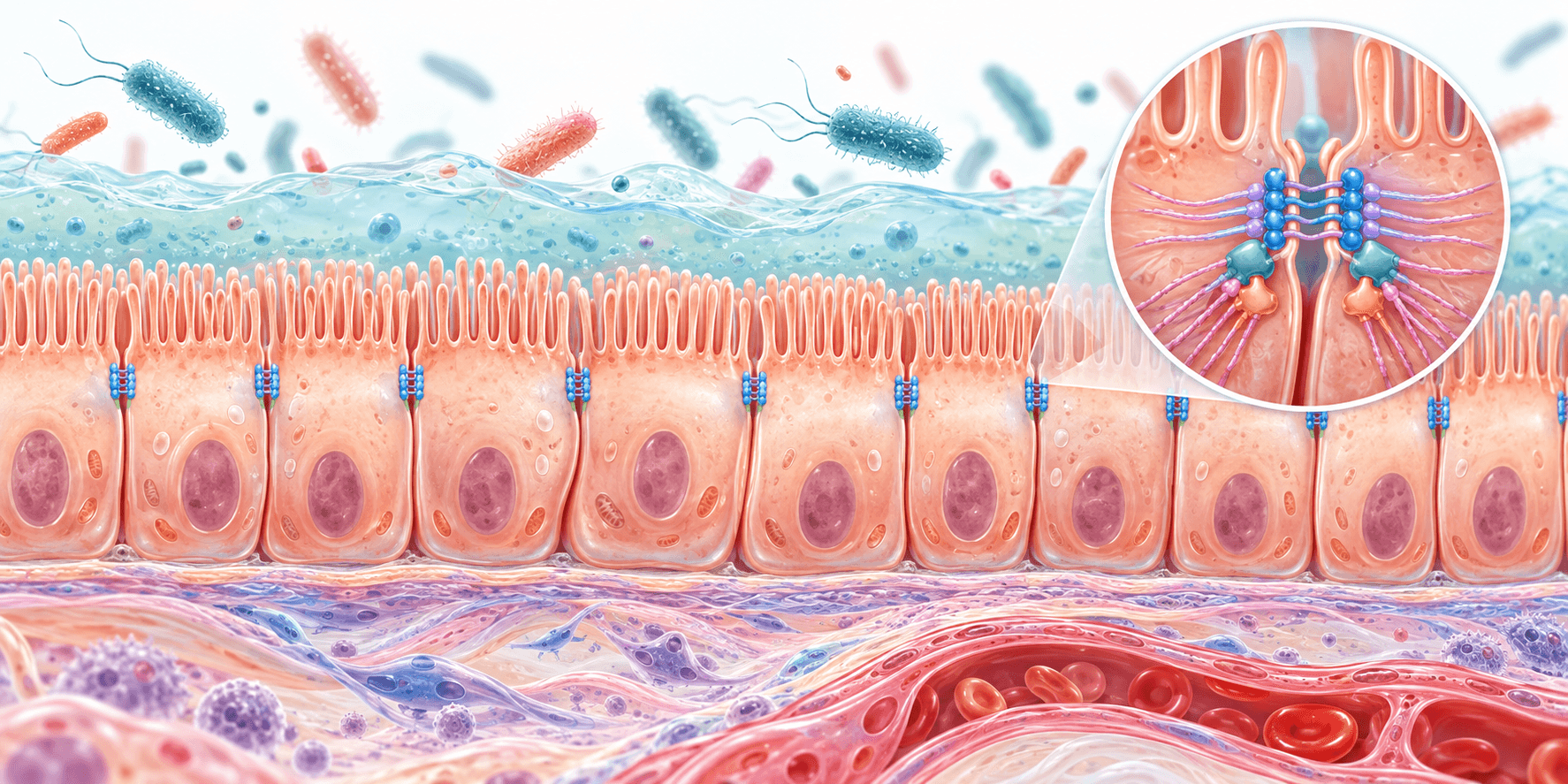
The pre-epithelial compartment includes an unstirred aqueous layer, mucus, secretory IgA, antimicrobial products and brush-border enzymes. Mucus reduces microbial access to cell membranes without being an absolutely impermeable wall. Region, hydration, composition, inflammation and microbial metabolism determine its properties.
The epithelial layer contains absorptive enterocytes, goblet and enteroendocrine cells, Paneth cells, M cells and tuft cells. Paneth cells are characteristic of small-intestinal crypts; M cells over lymphoid structures support regulated antigen transport. The colon and small intestine differ in cellular composition and architecture. An estimated mucosal surface of approximately 32 m² depends on how folds, villi and microvilli are counted and should not be treated as a universal risk constant.
The lamina propria contains extracellular matrix, capillaries, lymphatic vessels and gut-associated immune cells, including macrophages, dendritic cells, lymphocytes and plasma cells. Enteric neural and immune signals coordinate motility, secretion and defence. Portal and lymphatic drainage provide different routes for absorbed microbial products. Normal immunity requires selective antigen presentation rather than exclusion of every antigen.
MUC2 and antimicrobial protection
Goblet-cell MUC2 is a large gel-forming mucin. Proline-, threonine- and serine-rich regions carry numerous O-glycans; sialylated and sulphated chains contribute charge, hydration and microbial interactions. Cysteine-rich domains and disulphide bonds support polymerisation. C-terminal dimerisation and N-terminal assembly form a network, while calcium and pH control packaging and expansion after secretion. N-terminal trimers have been studied biochemically; a fixed tetrameric arrangement is not a general description of mature mucus.
Small-intestinal mucus is usually looser and more mobile. The colon has been described as possessing a denser inner and looser outer layer. Johansson (2008) demonstrated bacterial exclusion from the inner Muc2-dependent layer in the models studied. This does not establish absolute sterility at every human mucosal location or a universal 30–50 µm thickness. Region, disease and sample processing change the measurements. Mucin-glycan degradation is part of normal microbial ecology, but the balance can change when substrate supply or mucus production is disturbed.
Paneth-cell HD5 and HD6 complement this defence. HD5 has antimicrobial activity, whereas HD6 can assemble nanonets that limit bacterial invasion; defensins should not all be depicted as identical membrane pores. Mouse RegIIIγ and the related human REG3A are not interchangeable in every detail. Vaishnava (2011) investigated spatial separation between microbiota and epithelium, without defining a universal bacterial-distance threshold for humans. Muramyl dipeptide is sensed by NOD2 rather than directly by TLRs: NOD2 and TLR/MyD88 pathways interact but remain distinct. Lysozyme, secretory phospholipase A2 and calprotectin have different actions. Neutrophils also release abundant calprotectin during inflammation, so it is not solely a Paneth-cell product.
Secretory IgA
Lamina-propria plasma cells produce polymeric IgA containing a J chain. Basolateral polymeric immunoglobulin receptor, pIgR, binds the complex and transports it towards the apical surface. Cleavage releases the receptor ectodomain as the secretory component, which remains associated with IgA and contributes stability and mucus/microbial interactions. This directed transcytosis is physiological transport rather than junctional leakage.
Secretory IgA neutralises toxins and viruses, limits adhesion and can aggregate bacteria. Neutralisation can also occur during intracellular transport. Immune exclusion commonly avoids strong inflammation, although IgA cannot be declared incapable of every complement or inflammatory interaction. Secretory-component glycans provide additional antigen-independent binding. A fixed daily gram output or one affinity constant is not necessary to explain the pathway and is not a diagnostic threshold.
Renewal and epithelial restitution
Lgr5-positive crypt-base cells generate epithelial lineages. Wnt/β-catenin and R-spondins support the niche through epithelial and mesenchymal sources. Notch/HES1 and ATOH1 help determine absorptive versus secretory differentiation; BMP gradients restrain proliferation and support maturation. Their organisation varies with intestinal region and injury.
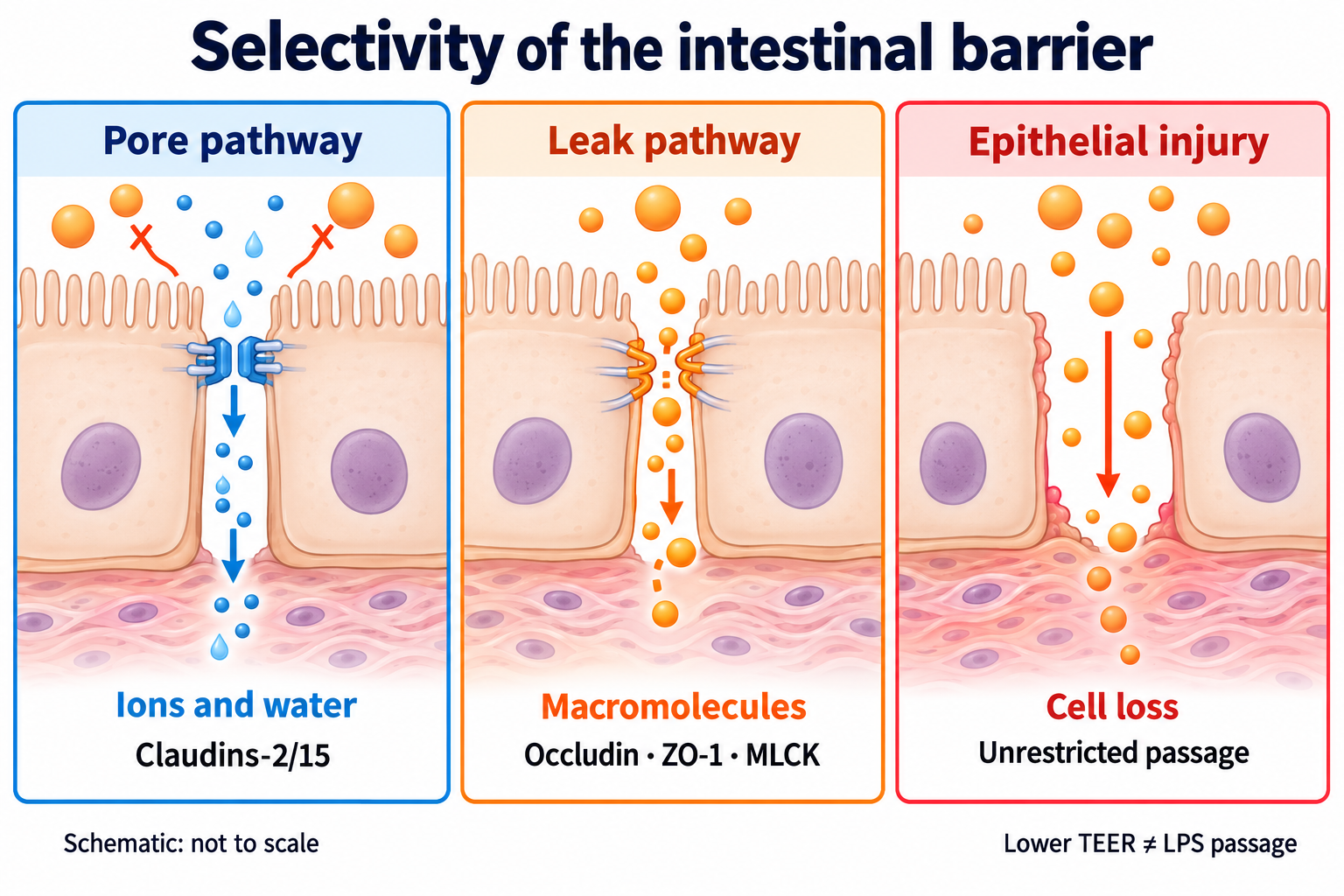
Many enterocytes turn over within several days, but Paneth cells and other populations have different lifetimes. Extrusion can involve dying or living cells. Neighbours reorganise actomyosin and junctions beneath the departing cell, allowing shedding without a persistent hole. Excess cell death or failed restitution creates an unrestricted route through epithelial defects that is different from regulated junctional leak.
Junctional architecture and distinct permeability pathways
The apical junctional complex comprises tight junctions, E-cadherin/catenin-based adherens junctions and desmosomes. Tight junctions regulate paracellular transport and help maintain polarity; adhesion and cytoskeletal organisation support the integrity of the whole layer. Overall barrier function cannot be assigned to one protein family alone.
Electron microscopy shows closely apposed membranes, not necessarily literal fusion of lipid bilayers. Freeze-fracture reveals branching strands. Strand number does not predict electrical resistance through a simple linear relation: claudin composition, organisation and dynamic regulation also matter.
Claudins and selective pores
Claudins contain four transmembrane helices, extracellular structural elements and cytoplasmic termini. Their cis and trans interactions organise strands. Extracellular charge and geometry influence permeability, while C-terminal PDZ-binding motifs connect to scaffolds. Motifs and functions differ among paralogues.
Suzuki (2014) studied mouse claudin-15, PDB 4P79. PDB 5B2G contains human claudin-4 bound to the C-terminal fragment of Clostridium perfringens enterotoxin, rather than free claudin or an entire intestinal tight junction. Such structures illuminate folds and interactions without calculating clinical permeability from one crystallographic construct.
Claudins-2 and -15 form selective cation pathways; claudin-2 is also associated with water transport. Charged residues, including experimentally examined claudin-2 Asp65, affect selectivity. Claudin-15-mediated sodium recycling supports nutrient cotransport. Expression varies with region, development and inflammation; claudin-2 is not invariably restricted to crypts. Increased claudin-2 can lower electrical resistance and alter water transport, but a small cation pore does not automatically admit LPS or bacteria.
Claudins-1, -3, -4 and -8 can restrict particular fluxes. The “sealing” label depends on cell context, partners and the substance measured. Claudin-4 is not a universal blocker of every ion and macromolecule. It and other claudins interact with CPE; full-length enterotoxin assembles damaging pore complexes. Claudin-5 is especially important in endothelial barriers, including the blood–brain barrier, and is not a substitute for intestinal claudins. The lethal dehydration of Cldn1-deficient mice in Furuse (2002) reflected an epidermal defect; that experiment does not establish an intestinal cause of death.
Occludin, tricellulin and ZO scaffolds
Occludin is a four-pass tight-junction-associated MARVEL protein. Strands can form without it, but regulated leak and signalling can change. PDB 1WPA is only the human cytoplasmic fragment 413–522, not full-length membrane occludin. Phosphorylation, ZO-1 binding and endocytosis depend on the particular site and stimulus. The rule that every Ser/Thr modification retains occludin while any Tyr modification immediately destroys it is too broad. Tyr398/Tyr402 have been examined as regulatory sites, but redistribution does not invariably end in proteasomal degradation.
Tricellulin/MARVELD2 and angulins organise sites where three cells meet and limit macromolecular transport. MarvelD3 participates in stress signalling. Central-tube dimensions and tracer mass cutoffs belong to particular models, not a universal clinical 4-kDa filter. MARVELD2 variants can produce tissue-specific consequences, including hearing impairment, without inevitably causing a general intestinal disorder.
ZO-1, ZO-2 and ZO-3 are cytoplasmic MAGUK scaffolds containing PDZ, SH3 and GUK-like domains. PDZ1 binds claudin C termini; PDZ2 supports scaffold interactions; PDZ3 associates with selected partners such as JAM. The GUK-like domain is a structural node rather than an ordinary active guanylate kinase. C-terminal regions link to actin. PDB 2H3M represents ZO-1 PDZ1, and 3SHW a PDZ3-SH3-GUK supramodule with a connexin-45 peptide, not the entire ZO junctional lattice.
Beutel (2019) demonstrated a role for phase separation of ZO proteins in junctional organisation. Condensation concentrates partners locally, with composition and mechanical conditions affecting assembly. It does not imply that all human junctions form within a fixed number of seconds or that claudin polymerisation is impossible in every system lacking PDZ1.
JAM-A/F11R contains extracellular immunoglobulin-like domains, one transmembrane segment and a cytoplasmic tail. It participates in adhesion, polarity through Par-3/Par-6/aPKC and afadin-associated interactions. PDB 1F97 contains the soluble portion of mouse JAM rather than a complete human membrane complex. Integrin partners differ across the family: JAM-A is associated with LFA-1, JAM-B with VLA-4 and JAM-C with Mac-1. These interactions should not all be attributed to JAM-A. Regulated transmigration and repair mean that every leukocyte crossing does not leave a chronic epithelial defect.
MLCK and actomyosin
MYLK encodes several isoforms. Long epithelial MLCK forms of approximately 210–215 kDa are important in the intestine; the approximately 130-kDa short smooth-muscle form is not the long epithelial kinase. MLCK1 preferentially associates with the perijunctional actomyosin ring, whereas MLCK2 differs in localisation and function. Chanez-Paredes (2024) combined mechanistic experiments with analysis of ileal biopsies from patients with Crohn’s disease.
Ca²⁺/calmodulin activates the kinase. Phosphorylation of myosin regulatory light chain at Ser19 and, under appropriate conditions, Thr18 regulates myosin II. A simplified reaction is:
MLC+ATPMLCKpMLC+ADP.
This depicts one phosphorylation step rather than complete two-site stoichiometry. RhoA/ROCK and myosin phosphatase also regulate phosphorylation; ROCK is not necessarily a direct activator of MLCK itself. Actomyosin tension influences junctional organisation and occludin endocytosis. Caveolin-dependent internalisation has been investigated in TNF-associated leak. A model in which contraction tears out every claudin and enlarges all clefts to 20 nm does not explain every stimulus.
Pore, leak and unrestricted pathways
The pore pathway has relatively high capacity for small charge-selective solutes. The leak pathway permits larger substances with lower capacity and depends on junctional dynamics. The unrestricted pathway arises from epithelial cell loss, erosion or damage. Transcellular carrier- and vesicle-mediated transport is a separate category. These routes may vary independently.
Transepithelial electrical resistance, TEER, predominantly reflects ionic conductance. For a cultured layer, area-normalised resistance is:
TEER=(Rsample−Rblank)A.
R is measured in Ω and A is layer area in cm², giving Ω·cm². Tracer permeability in a controlled experiment can be expressed as:
Papp=AC01dtdQ.
Q is the amount reaching the receiving compartment and C₀ the initial donor concentration. With mol, mol/cm³ and cm², the result is cm/s. Appropriate sink conditions, tracer stability and sampling corrections are required. Lower TEER alone does not demonstrate increased protein, LPS or live-bacterial passage; separate tracers and viability controls are necessary.
Zonulin: biology and the assay problem
Tripathi (2009) identified the studied human zonulin as uncleaved haptoglobin-2 precursor. In this context pre-HP2 means the precursor before α/β-chain cleavage; it does not require retention of the signal peptide in secreted protein. Mature haptoglobin binds free haemoglobin and has phenotype-dependent polymeric architecture. HP1 and HP2 produce Hp1-1, Hp2-1 and Hp2-2 phenotypes. A precise evolutionary date of “two million years ago exclusively in Homo sapiens” is not required to explain the mechanism and should not be presented as a molecular constant.
Vibrio cholerae Zot provided the historical setting for the search for an endogenous regulator. Functional analogy does not establish sequence homology across the whole protein. PAR2 dependence and EGFR transactivation have been described for pre-HP2 in experimental systems. This does not establish that pre-HP2 is itself a PAR2-cleaving protease, or that every step in a single PLC→Ca²⁺→PKCα→AP-2 sequence has been demonstrated in humans in vivo. PLC generates IP3 and DAG from PIP2; IP3 regulates ER calcium release, and DAG/Ca²⁺ regulate classical PKC. These shared signalling elements do not guarantee a tenfold calcium surge or universal internalisation of all junctional proteins. Membrane occludin endocytosis differs from redistribution of the cytoplasmic ZO-1 scaffold.
Lammers (2008) investigated gliadin, CXCR3 and zonulin release. Digestion-resistant gliadin peptides include the α-gliadin 33-mer and p31–43, which have distinct immune and cellular properties; they should not automatically be identified as identical CXCR3 ligands. Coeliac disease involves HLA-dependent adaptive responses to deamidated gliadin epitopes and tissue transglutaminase, rather than junction opening alone. A short gliadin response in a model does not establish chronic gluten-induced disease in every healthy individual. Bacterial contact can alter barrier signals, but a protective-flushing hypothesis does not demonstrate massive pre-HP2 secretion in every instance of dysbiosis.
Cytokines and feedback
TNF can increase long-MLCK expression and regulate actomyosin. IFNγ alters epithelial responses and protein trafficking through JAK/STAT and associated pathways. RhoA/ROCK influences myosin-phosphatase regulation, including MYPT1. IL-1β can affect MLCK transcription and junctional proteins through model-dependent NF-κB/MAPK pathways; IL-13/STAT6 regulates claudin-2 in selected systems. Pore-associated diarrhoea, junctional leak and cell death are distinct outcomes. TNF does not always cause caspase-mediated destruction, and inflammation is not invariably irreversible. Dose, duration, cell type and restitution matter.
LPS chemistry, transport and recognition
LPS is heterogeneous
LPS occupies the outer membrane of many Gram-negative bacteria. Lipid A anchors it, the core contains Kdo and other sugars, and O antigen is a variable chain; lipooligosaccharides lack a long O-antigen region. Classical E. coli lipid A contains a phosphorylated glucosamine disaccharide with six acyl chains. Chain number, length and position, phosphate groups and host species affect TLR4 responses. Tetra- or penta-acylated forms may act as weak agonists or antagonists, without permitting a universal toxicity ranking for all Gram-negative organisms.
LPS is amphiphilic, aggregating and protein-binding, with no fixed 10–20-kDa molecular mass. Intestinal alkaline phosphatase can dephosphorylate selected LPS, while lipoproteins, LBP, CD14 and tissue enzymes influence availability and inactivation. Measured quantity and biological activity are not equivalent.
Junctional and lipid-associated transport
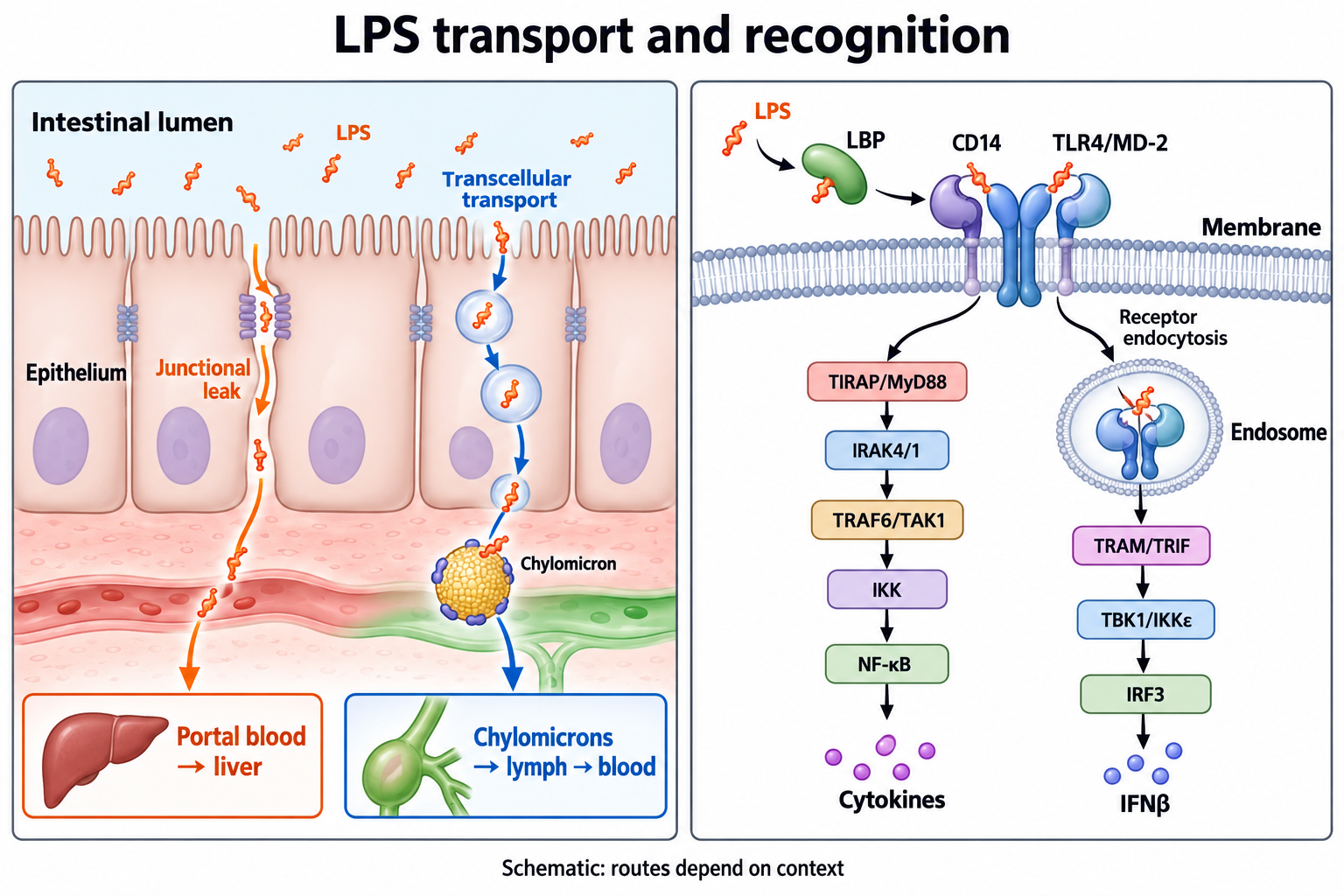
Loss of epithelial integrity may increase tissue exposure to LPS and other microbial products. However, a claudin-pore radius is not the radius of every leak route, and molecular mass alone does not predict aggregate transport. Reduced TEER cannot establish unrestricted passage of all LPS micelles.
Ghoshal (2009) used Caco-2 and animal models to connect chylomicron formation with release of cell-associated LPS. ApoB-48/MTP-dependent lipoprotein assembly and lymphatic drainage help explain this route. The work does not establish an obligatory bile-micelle→CD36→triglyceride-core sequence for every LPS in healthy humans. Amphiphilic LPS can associate with the lipoprotein surface; mandatory burial in the hydrophobic core is misleading. Lymph enters the venous system through the thoracic duct, whereas portal transport first reaches the liver. Chylomicron remnants are subsequently also taken up by the liver.
Cani (2007) principally studied mice, high-fat feeding and prolonged experimental LPS infusion. The operational “metabolic endotoxaemia” definition in that study is not a validated universal human diagnostic threshold. Postprandial results depend on food, timing, LPS binding and sample preparation. They do not demonstrate that every dietary fat is harmful or that intestinal translocation explains all insulin resistance.
LBP–CD14–TLR4/MD-2
LBP facilitates transfer of LPS to CD14 and onward to MD-2/TLR4. Membrane CD14 has a GPI anchor; soluble CD14 supports responses in cells with little intrinsic CD14. Protein and lipoprotein concentrations can amplify or restrict signalling, so LBP is not merely a toxin detector. MD-2/LY96 provides a hydrophobic pocket. Park (2009), PDB 3FXI, showed how classical hexa-acylated LPS stabilises receptor-complex dimerisation through buried chains, an exposed chain and polar contacts with the neighbouring TLR4. Different LPS species need not adopt the same signalling activity.
A schematic association is:
2(TLR4:MD−2:LPS)⟶(TLR4:MD−2:LPS)2.
This represents complex assembly rather than lipid-transfer stoichiometry or an irreversible chemical reaction.
At the plasma membrane, TIRAP/MyD88 recruits IRAK4/IRAK1 into a signalling platform. TRAF6 and K63-linked ubiquitin platforms with TAB/TAK1 regulate IKKα/IKKβ/NEMO and MAPK. IκBα phosphorylation at Ser32/Ser36 promotes ubiquitination and proteasomal degradation, allowing NF-κB, including p50/p65, to access the nucleus. This is not necessarily direct ubiquitination of TAK1 alone. TNF, IL6, CXCL8 and other transcriptional responses depend on cell type and additional signals.
Following CD14-associated receptor internalisation, endosomal TRAM/TRIF activates TBK1/IKKε and IRF3, supporting IFNβ and additional responses. TRIF also connects with NF-κB, so the two branches are not isolated. NLRP3 and pro-IL1β priming does not itself establish a complete inflammasome or mature IL-1β secretion; an additional signal is commonly required. Intracellular LPS can also engage human caspase-4/5 or mouse caspase-11, meaning TLR4 is not the only relevant sensor.
Organ effects and limits of translation
Liver and metabolic tissues
Portal blood exposes the liver to intestinal products, which Kupffer cells and other systems help clear. TLR4-associated signals can support inflammation. Seki (2007) demonstrated stellate-cell involvement, reduced BAMBI and increased TGFβ responsiveness through MyD88/NF-κB in mouse models. BAMBI is a pseudoreceptor rather than an ordinary kinase substrate. This informs fibrogenesis without proving that every raised LBP result causes irreversible MASH. Fibrosis can regress when causes are addressed, and macrophage states are not a simple M1/M2 switch. Metabolic liver disease also involves substrate excess, lipotoxicity, genetics and multiple immune mechanisms.
In adipocytes and muscle, inflammatory JNK/IKK and other kinases can influence IRS–PI3K–Akt–GLUT4. Species and site context matter: mouse IRS1 Ser307 corresponds to human Ser312. Copps (2010) found that Ser307-to-alanine mutation worsened insulin resistance in selected mouse models. This residue therefore is not a universal inhibitory switch; serine phosphorylation alone does not establish blockade of insulin-receptor signalling. Site, timing, tissue and combined modifications determine the response.
Vasculature and brain
LPS/cytokine exposure can increase VCAM-1, ICAM-1, E-selectin, leukocyte interactions and redox stress. NOX2 and NOX4 differ: NOX4 often generates H2O2-associated signals and may be protective in selected settings. NO reacts with superoxide to form peroxynitrite, while BH4 and protein-thiol changes can alter eNOS function. The mechanisms are discussed in the article on eNOS uncoupling. Atherogenesis also requires consideration of ApoB-lipoprotein retention, modification, vascular biology and immunity; LPS is not its sole necessary cause.
Experimental endotoxin challenges can affect cerebral endothelium, claudin-5/occludin, microglial responses and behaviour. Signalling through cytokines, endothelium, neural routes and circumventricular regions need not involve massive LPS entry into brain parenchyma. Microglia occupy diverse states. Model findings involving BDNF, neurogenesis, kynurenine pathways, amyloid or α-synuclein do not establish that a nonspecific human zonulin-ELISA elevation causes depression, Alzheimer’s disease or Parkinson’s disease.
Tolerance and autoimmunity
Controlled antigen presentation, dendritic cells, Foxp3-positive Treg cells, TGFβ and retinoid signals support oral tolerance. Inflammation changes immune responses; Th17 programmes can protect or injure, and IL-22 is not exclusively pathological. Molecular mimicry requires evidence for epitopes, cross-reactivity and a causal contribution. Proposed links involving casein, thyroid peroxidase, myelin or citrullinated antigens cannot establish a universal permeability→Hashimoto’s/multiple-sclerosis/rheumatoid-arthritis chain. Coeliac disease has a better-defined genetically conditioned adaptive response, but it too extends beyond a single junctional mechanism.
What laboratory measurements mean
Sugar probes
Lactulose and mannitol serve as differential tracers. Mannitol is a sugar alcohol, not a monosaccharide. Its smaller size and greater recovery do not make it an exclusively transcellular brush-border-pore marker: both probes can have paracellular components. Excretion depends on available surface, permeability, transit, dilution and renal function.
Dose-normalised recovery is:
Fx=100DxCu,xVu,L/M=FMFL.
Cᵤ is collected urine concentration, Vᵤ urine volume and D the administered dose in consistent units. L/M is dimensionless. Recovery of 0.6% lactulose and 12% mannitol gives 0.05: an arithmetic example rather than a universal abnormal cutoff. Dividing raw concentrations without accounting for different administered doses can yield a different result.
Collection timing and formulation are protocol-specific. Early and late windows, lactulose/rhamnose, sucralose and multiple-sugar tests examine different aspects of the tract. Camilleri’s healthy-volunteer work illustrates delivery and timing effects; a five-hour collection does not invariably isolate the small intestine. HPLC and LC-MS/MS measure sugars without removing preanalytical limitations. L/M cutoffs of 0.025–0.030 or 0.050 are not universal across methods. Sodium azide and other laboratory preservatives are not instructions for home testing; samples follow the laboratory’s validated procedure.
Zonulin immunoreactivity is not necessarily pre-HP2
Scheffler (2018) found that a widely used commercial ELISA did not detect recombinant pre-HP2 as expected; its antibodies recognised other proteins, with properdin among the candidates. Ajamian (2019), published in PLOS ONE, investigated two kits and identified problems detecting pre-HP2, with haptoglobin/C3 and other proteins in immunoprecipitates. An antibody-bound candidate is not necessarily the kit’s sole quantitative analyte. The results therefore do not mean that every zonulin assay definitively measures properdin.
A value in ng/mL requires the specific manufacturer, antibody, calibrator, matrix and analytical validation. An association between immunoreactivity and metabolic disease establishes neither protein identity nor junction opening. Serum and stool reference intervals are not interchangeable. Values such as 38–45 or 60–80 ng/mL are not general clinical permeability boundaries. Specific monoclonal methods can be developed, but LC-MS/MS combined with a signal-peptide antibody should not be portrayed as an established universal clinical reference. Identifying a protein by mass spectrometry and validating a quantitative clinical assay are separate tasks.
Cell injury and endotoxin markers
I-FABP/FABP2 is an enterocyte cytoplasmic protein that may enter blood during injury. Timing, renal clearance, assay and disease severity influence measurement. It cannot perfectly distinguish necrosis, ischaemia and other injury, and one 150-pg/mL cutoff does not establish a diagnosis. Citrulline relates to small-intestinal enterocyte function and mass but also to nutrition, inflammation, renal conversion to arginine and patient context. Approximately 20 µmol/L has been investigated in selected intestinal-failure settings rather than as a universal “leaky gut” threshold.
LAL uses the horseshoe-crab amebocyte-lysate cascade; EAA uses neutrophil-dependent whole-blood chemiluminescence. They are different tests. Matrix effects, lipoprotein binding, contamination and signal inhibition/enhancement affect LAL. Endotoxin units express activity relative to a standard, with no universal conversion to nanograms of every bacterial LPS. EAA has chiefly been studied in critical illness, so its values cannot automatically diagnose low-level dietary endotoxaemia.
LBP is an acute-phase protein, and soluble CD14 reflects several immune and metabolic processes. Neither is a gold standard specific to intestinal translocation. Hepatic synthesis, infection elsewhere, obesity, inflammation and clearance affect concentrations. EndoCAb-IgG/IgM reflects immune response, prior exposure and assay characteristics: low IgM does not prove one consumption scenario, and high IgG does not necessarily show current chronic leak. Anti-occludin antibodies and food-IgG panels are not universally validated barrier diagnostics.
Measurement
Potential information
Unsupported inference
TEER in culture/tissue
Ionic conductance
LPS or bacterial passage proven by itself
Tracer flux and sugar tests
Protocol-specific molecular passage
Universal cause of symptoms or unqualified localisation
Zonulin ELISA
Kit-specific immunoreactivity
Reliable pre-HP2 concentration and universal cutoff diagnosis
I-FABP
Enterocyte injury signal
Only necrosis or precise junctional-leak severity
Plasma citrulline
Enterocyte functional/mass context
Direct tight-junction measurement
LAL/EAA
Method-dependent endotoxin activity
Obligatory gut source or equivalence of methods
LBP/sCD14
Acute-phase and immune context
Specific gold standard for translocation
EndoCAb/junction antibodies
Assay-specific immune response
Universal chronic-barrier-syndrome verification
Endoscopy, biopsies and inflammatory or infectious investigations address specific diseases. Ussing chambers and cellular models help separate transport routes without becoming automatic routine diagnostic tests. Blood in stool, weight loss, anaemia, nocturnal diarrhoea and other clinical features require assessment of causes rather than an experimental biomarker panel alone.
Repair: mechanisms versus clinical evidence
Glutamine
Enterocytes use glutamine for energy and biosynthesis. Glutaminase generates glutamate; α-ketoglutarate formation supports the TCA cycle. GFAT uses glutamine nitrogen in the hexosamine pathway, UDP-GlcNAc supplies OGT, and O-GlcNAc regulation, HSF1 and chaperones influence stress responses. These pathways do not establish a universal 70% energy fraction or exclusive ZO-1 modification with guaranteed junction retention. Individual modifications and HSP effects depend on the model.
Zhou (2018/2019) conducted an eight-week randomised trial in selected adults with postinfectious IBS-D and increased permeability, using 5 g three times daily. Clinical and barrier outcomes improved relative to placebo. The finding supports further evaluation in that population, not treatment of every IBS subtype, autoimmune disease or fatigue syndrome. Fifteen grams daily is not 0.3–0.5 g/kg for every adult: at 70 kg, the latter equals 21–35 g/day. A studied regimen should not be replaced with an arithmetically inconsistent “average dose”.
Butyrate
Fermentation of accessible fibre and resistant starch generates short-chain fatty acids. Colonocytes use butyrate; oxidation consumes oxygen and supports local hypoxia important to luminal ecology. Kelly (2015) linked microbial metabolites, epithelial HIF and barrier function in experimental systems. PHD/VHL-mediated HIF regulation, HDAC inhibition and FFAR2/GPR43, FFAR3/GPR41 and HCAR2/GPR109A signalling are distinct mechanisms.
HCAR2-associated responses can regulate IL-10, Treg cells and epithelial IL-18. This is not equivalent to mandatory suppression of every NLRP3 response: inflammasome activity may protect or injure depending on context. Histone acetylation and junctional expression are also contextual. More butyrate is not inevitably better for every cell, particularly when proliferating crypt cells become exposed. Physiological production, sodium butyrate, tributyrin and encapsulated formulations differ in delivery. Mechanisms do not establish a universal 500–1000-mg twice-daily repair prescription.
Zinc carnosine
Polaprezinc complexes zinc with L-carnosine. Wounded monolayers and animal experiments describe restitution, proliferation and protective effects. Zinc has structural and regulatory functions; copper carries the catalytic redox chemistry in Cu/Zn-SOD while zinc supports structure. Supplementary zinc therefore is not a universal direct antioxidant. TGFβ/Smad and migration can contribute in selected systems without proving regeneration of every human villus.
Mahmood (2007) enrolled ten healthy volunteers in a crossover study with five days of indomethacin. Zinc carnosine was 37.5 mg twice daily, and the probe ratio was lactulose/rhamnose. This was a short drug-injury model rather than a universal-syndrome trial. Complex mass differs from elemental zinc, and prolonged excess can disrupt copper metabolism. The experiment does not establish a long-term combination regimen.
Phytochemicals and microbial products
Berberine, quercetin and curcumin have been investigated in cellular and animal systems involving AMPK, Rho/MLCK, PKC, NF-κB and junctional proteins. Their actions are not exclusive to one selective target. AMPK does not simply compete with MLCK for a single reaction, and ordinary oral curcumin exposure does not guarantee complete NF-κB blockade. Bioavailability, metabolites and experimental concentrations matter. The article on berberine and AMPK develops this distinction between mechanism and clinical benefit. Quercetin-associated mast-cell and antioxidant effects do not establish zonulin-based barrier diagnosis or treatment.
Lacticaseibacillus rhamnosus GG, formerly Lactobacillus rhamnosus GG, has strain-specific effects; p40 and p75 are studied proteins. For p40, ADAM17-mediated HB-EGF release leading to EGFR/Akt transactivation has been demonstrated in cells and mice (Yan, 2013), rather than obligatory direct p40 binding to EGFR. Purified proteins, live strains and mixed supplements are different interventions. Their findings cannot be assigned to every probiotic or automatically attributed to BB-12.
Akkermansia muciniphila utilises mucin and interacts with mucus ecology. Plovier (2017) studied pasteurised bacteria and Amuc_1100 in mouse models; TLR2-associated and metabolic effects support hypotheses without guaranteeing a thicker sterile layer in every human. Depommier (2019) was a small exploratory human study with 40 enrolled and 32 completing, using metabolic endpoints. It did not demonstrate prevention of all diseases by junction sealing. Strain, viability, pasteurisation and manufacturing conditions matter.
Larazotide
Larazotide acetate/AT-1001 is an investigational octapeptide, GGVLVQPG. It is described as a tight-junction regulator or antagonist of zonulin-associated effects, but its precise action should not be depicted as fully established competitive binding to one universal zonulin receptor. Its local pharmacology differs from a supplement stack.
Coeliac-disease studies have not produced identical symptom and permeability outcomes. Kelly (2013), with 184 participants, found no significant L/M difference versus placebo despite selected symptom/immune effects. Leffler (2015) studied 342 adults with persistent symptoms on a gluten-free diet, without a simple linear dose-response across all regimens. In 2022 the sponsor reported that an interim phase III analysis did not support trial continuation. These findings exclude a claim of universally proven sugar-excretion blockade or replacement of the gluten-free diet. Continuing research and registration require their own current verification; larazotide is not offered here as an established treatment for an independent “leaky gut” diagnosis.
In the earlier Leffler (2012) trial, 86 participants received 0.25, 1, 4 or 8 mg three times daily, with or without 2.4 g/day gluten challenge for 14 days. Highly variable L/M measurements prevented demonstration of a permeability effect, although some lower doses produced a symptom signal. The 2015 trial used a symptom primary endpoint: 0.5 mg three times daily showed benefit, whereas 1 and 2 mg did not. Dose and endpoint differences matter when evaluating the broader barrier hypothesis.
Approach
Supporting basis
Main limitation
Glutamine
Selected IBS-D trial and cellular metabolism
Not every IBS phenotype or chronic disorder
Fibre/butyrate
Luminal ecology, HIF, HDAC and SCFA receptors
Delivery differs; no universal repair dose
Zinc carnosine
Repair models and short NSAID crossover
Small trial does not establish a prolonged stack
Berberine/quercetin/curcumin
Mechanistic effects in models
Exposure and clinical outcomes require separate evidence
LGG/p40 and Akkermansia
Strain/protein mechanisms and pilot evidence
Experimental protein is not every marketed probiotic
Larazotide
Coeliac trials
Unequal endpoints and phase III discontinuation
Treatment of an established cause
Diagnosis, symptoms and clinical outcomes
Cannot be replaced by an experimental panel or supplements
Clinical interpretation without a universal protocol
Care starts with the cause: coeliac disease, IBD, infection, ischaemia, drug injury or another established condition. A strict gluten-free diet is necessary for coeliac disease; a zonulin signal does not justify applying it to everyone, and exclusion before assessment may complicate diagnosis. Emulsifiers have been studied in animals and small human experiments without establishing every permitted ingredient as a direct MUC2-dissolving toxin. Adequate nutrition, tolerated fibre, correction of deficiencies and review of injurious exposures are contextual. Antibiotics, probiotics and supplements need a specific rationale.
A six-stage sequence of glutamine, butyrate, zinc, berberine/curcumin, probiotics and broad elimination has not been validated as a complete clinical protocol. A positive result for one product does not prove the benefit of its combination, ordering or duration. Treatment goals should include patient-relevant outcomes rather than only normalisation of an experimental signal.
Method and limitations
Prepared on 8 October 2026, this narrative scientific article uses targeted verification of primary structural records, assay studies and selected mechanistic and clinical investigations. Accessible primary papers, records and abstracts were used; some full texts were unavailable. Experimental models, human associations, intervention trials and clinical-outcome evidence are distinguished. A systematic search of all literature, GRADE assessment, external peer review, new experiments and diagnostic-panel validation were not performed. Junctional biology is well supported, but it does not establish a universal molecular diagnosis or repair stack.
FAQ
Does elevated zonulin prove a leaky gut diagnosis?
No. The kit’s molecular specificity, specimen matrix and validation matter. A nonspecific immunoassay signal cannot establish a diagnosis or gut origin of LPS.
Does low TEER mean bacteria cross the epithelium?
No. TEER mainly reflects ionic conductance; macromolecular and bacterial transport require separate measurements.
Is there a universal L/M cutoff?
No. Dose, collection period, probes, transit and renal function affect results. The ratio uses fractional recovery of each administered dose.
Can glutamine, butyrate and probiotics form a mandatory protocol?
Separate studies do not establish a universal combination, order, dose or duration. The cause and clinical outcome matter more than changing one marker.
Does larazotide replace a gluten-free diet?
These experimental studies do not establish that. Symptom and L/M results differed, and larazotide should not be presented as an established dietary replacement.