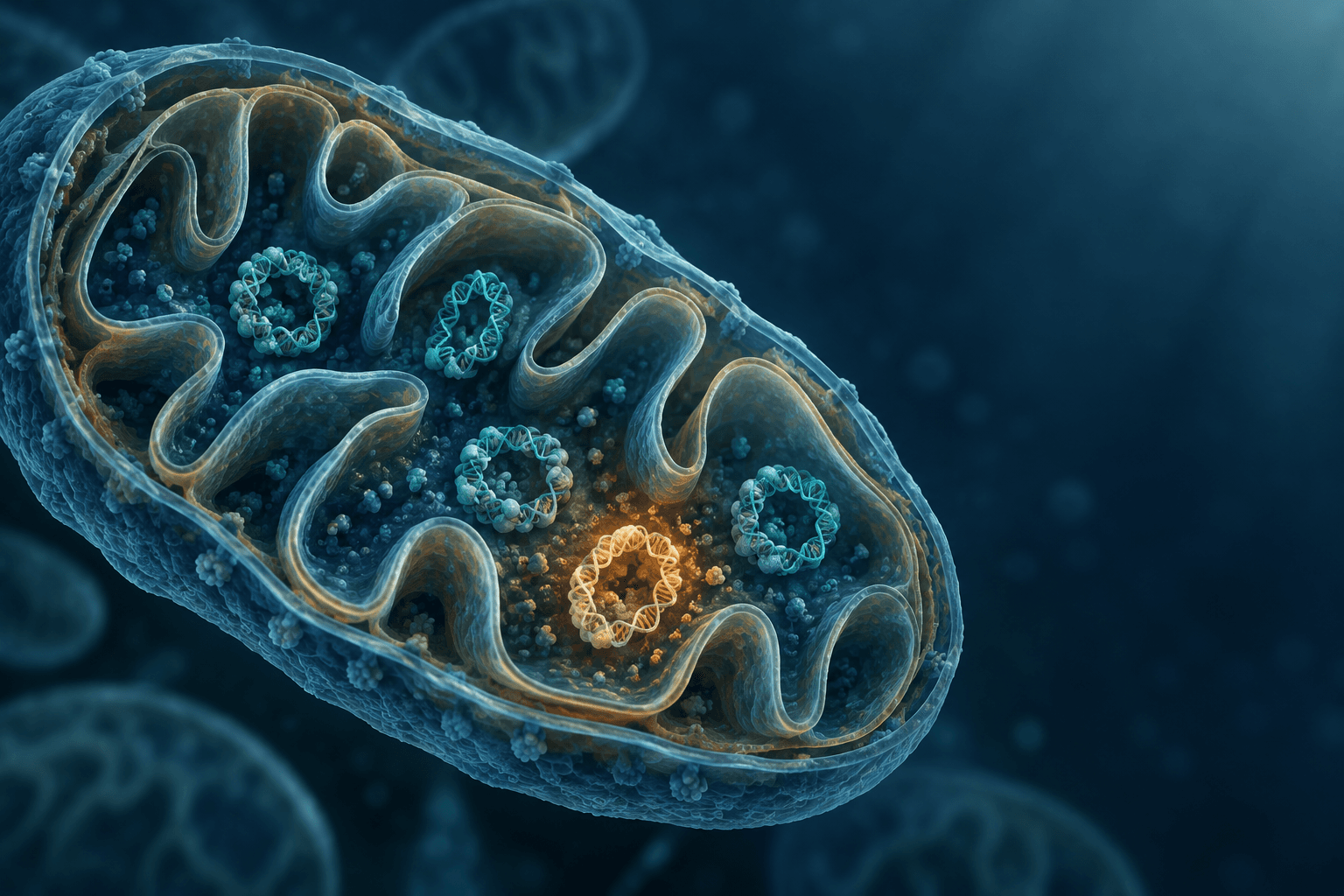
Mitochondrial DNA: damage, heteroplasmy and innate immunity
Mitochondrial-genome architecture, TFAM, mtROS, BER/POLG, deletions and tissue thresholds; ageing models, cGAS–STING/TLR9/NLRP3, mitophagy, biogenesis and the limits of mtDNA editing.
Mitochondrial-genome architecture, TFAM, mtROS, BER/POLG, deletions and tissue thresholds; ageing models, cGAS–STING/TLR9/NLRP3, mitophagy, biogenesis and the limits of mtDNA editing.
Mitochondrial DNA (mtDNA) contributes to cellular energetics as a genetic template, a population of many copies and a potential danger signal. A damaged base does not yet mean a fixed mutation; the proportion of mutant copies does not by itself determine tissue function; detecting mtDNA in blood does not prove activation of an inflammatory receptor. These distinctions connect oxidative phosphorylation with inherited disease, somatic mosaicism and ageing without turning a molecular hypothesis into a ready-made treatment protocol.
This analysis considers the human mitochondrial genome, redox damage and repair, heteroplasmy dynamics, ageing experiments, immune recognition and ways of influencing the mitochondrial pool. Structural, cellular and animal findings must be distinguished from clinical outcomes: targeted antioxidant delivery, increased mitophagy and alteration of a DNA sequence address different questions.
Mitochondria derive from a bacterial endosymbiont, whose genetic machinery was largely lost or transferred to the nucleus during evolution. Comparative biology supports an alphaproteobacterial origin of the organelle and a relationship between the eukaryotic host and an archaeal lineage. However, the particular host, sequence of events and exact date of symbiosis are reconstructed as hypotheses; they cannot be described as a directly observed engulfment of a known modern microorganism.
The great majority of human mitochondrial proteins are encoded by nuclear genes. Following synthesis in the cytosol, precursors are directed to the organelle, pass through the outer-membrane TOM complex and then use various sorting systems, including TIM23 and TIM22. Import, membrane insertion and assembly of multisubunit complexes must be coordinated with the synthesis of a small group of proteins on mitochondrial ribosomes. Retaining a genome therefore does not make the mitochondrion an autonomous organism: its function requires continuing interaction between two genetic systems (Falkenberg et al., 2007).
The CoRR hypothesis, co-location for redox regulation, links retention of local expression to the need to respond to the state of the respiratory chain. Another explanation concerns the hydrophobicity and assembly requirements of membrane subunits, which complicate transfer of their synthesis to the cytosol. These explanations complement one another and remain evolutionary models; they do not prove that import of every mitochondrially encoded polypeptide is physically impossible under all conditions.
The revised Cambridge Reference Sequence, rCRS, of human mtDNA contains 16,569 base pairs. It is a coordinate system for describing variants, rather than a claim that every individual has an identical genome sequence and length. The molecule generally consists of circular double-stranded DNA. Its heavy H strand and light L strand were historically distinguished by buoyant density under denaturing conditions; their names reflect compositional asymmetry, rather than two different chromosomes (Anderson et al., 1981; Andrews et al., 1999).
In the accepted annotation, the H strand carries 12 protein-coding genes, both rRNAs and 14 tRNAs; the L strand carries ND6 and eight tRNAs. This asymmetry matters for transcription and replication models. However, the term “coding strand” should not be confused with the complementary template that a polymerase directly reads.
The main noncoding control region crosses the conventional origin of the circular rCRS. It is associated with HSP/LSP promoters and the H-strand replication origin, ; the L-strand origin, , lies elsewhere in the genome. The control region and D-loop are not exact synonyms: D-loop denotes a three-stranded structure formed by retention of short 7S DNA, which displaces one parental strand. In structural models, transient single-stranded stretches have particular chemical vulnerabilities, but this does not mean the entire control region is permanently unprotected by proteins.
The human mitochondrial genome lacks the usual complement of introns and long intergenic intervals. Some reading frames overlap: ATP8/ATP6 by 46 nucleotides and ND4L/ND4 by seven. This compactness means that damage to a short segment may affect several functional elements. It cannot, however, be translated directly into a fixed disease probability without considering the variant and number of intact copies.
Transcription generates long polycistronic RNAs. In the tRNA punctuation model, tRNAs mark many boundaries used to process adjacent transcripts: mitochondrial RNase P, with MRPP1/2/3, helps form tRNA 5′ ends, and ELAC2 forms 3′ ends. Not all boundaries follow a single scheme, and RNA maturation involves additional proteins, modifications and stability control. Some protein-coding transcripts end in incomplete T or TA stop signals; RNA polyadenylation completes UAA. This is normal expression architecture, rather than an acquired DNA repair defect.
Human mtDNA has 37 annotated genes: 13 proteins, 22 tRNAs and two rRNAs. Mitochondrial ribosomes use 12S and 16S rRNAs in their small and large subunits; the designation 55S describes sedimentation properties of the complex, rather than the sum of 28S and 39S. A small tRNA set serves the codons through distinctive recognition rules and anticodon modifications. This does not mean any unmodified U freely pairs with any base.
| OXPHOS complex | Proteins encoded by mtDNA | Importance of the organelle's genome |
|---|---|---|
| I, NADH:ubiquinone oxidoreductase | ND1, ND2, ND3, ND4, ND4L, ND5, ND6 | Membrane elements involved in coupling electron and proton transfer |
| II, succinate dehydrogenase | None | Its subunits are nuclear encoded; a complex II defect alone does not identify an mtDNA variant |
| III, complex | CYTB | Cytochrome b forms important components of the Q cycle |
| IV, cytochrome c oxidase | CO1, CO2, CO3 | Core membrane subunits; catalytic metal centres are not distributed equally among them |
| V, ATP synthase | ATP6, ATP8 | Components of the membrane portion required for normal assembly and coupling |
The mitochondrial genetic code differs from the standard code: UGA encodes tryptophan and AUA methionine; AGA/AGG are associated with translation termination in human mitochondrial annotation. The actual termination mechanism has further features, so a codon table does not describe the entire ribosomal process. Because tRNAs support synthesis of different subunits, a pathogenic tRNA variant can affect several complexes simultaneously even when it lies outside a protein-coding gene.
mtDNA is packaged in nucleoids containing proteins involved in genome maintenance, replication and expression. TFAM has two HMG domains, a linker and a C-terminal region; minor-groove binding bends DNA, and structural studies show a U-shaped configuration in a promoter complex. Packaging influences polymerase access and transcriptional organisation, while changing the TFAM-to-DNA ratio can alter nucleoid properties (Ngo et al., 2011; Rubio-Cosials et al., 2011).
Estimates of nucleoid size, from tens to around a hundred nanometres, and the number of genomes per nucleoid depend on the method and cellular state. Many nucleoids contain a small number of molecules, often one, but this is not a universal fixed stoichiometry. Likewise, estimates of TFAM binding density from a preparation or model cannot automatically apply to every tissue and phase of metabolic activity.
Canonical nuclear nucleosomes are not the principal mtDNA packaging system. Nevertheless, absence of the usual nucleosomal array does not mean “naked DNA”: TFAM and other proteins organise and protect the genome. Nuclear histones are not an impenetrable radical barrier either. Comparing the two compartments requires considering chemical exposure, DNA topology, repair and molecular turnover, rather than histone presence alone.
Nucleoids are functionally associated with the inner membrane and organisational regions of the organelle; interactions involving ATAD3A, MICOS and other protein systems are discussed. Proximity to the respiratory chain makes the local redox environment relevant, but spatial closeness does not prove an identical oxidant dose for every DNA molecule. ROS formation depends on substrates, carrier reduction state, electron-flow direction, membrane potential and antioxidant enzymes (Murphy, 2009).
Complex I has sites associated with flavin, , and ubiquinone, ; the site matters in complex III. Complex I superoxide is predominantly associated with the matrix, whereas complex III can release it toward both the matrix and intermembrane space. All mtROS cannot be represented as a single stream from every complex exclusively toward mtDNA, and “electron leakage” is not a constant fraction.
Matrix superoxide dismutase SOD2 catalyses conversion of superoxide to hydrogen peroxide:
participates in signalling and can be removed by peroxiredoxins and glutathione peroxidases, including PRDX3 and GPX1; GPX4 is especially important for reduction of lipid hydroperoxides. In the presence of available ferrous iron, the Fenton reaction produces a highly reactive hydroxyl radical:
Because is highly reactive, damage depends on where it forms and which targets are nearby. This explains the importance of local chemistry, but does not establish a universal diffusion distance or ROS threshold shared by a cell, a tissue and a living organism.
Guanine oxidation can form 8-oxoguanine; 8-oxo-dG and 8-OHdG describe the deoxynucleoside. A base within DNA and its free product in urine are different analytical objects. 8-Oxoguanine can still pair with cytosine in the anti conformation, but in the syn conformation it can pair with adenine through Hoogsteen-type interactions. If this misincorporation is not repaired and proceeds through another replication cycle, a transversion may become fixed:
This is a possible route, rather than the inevitable fate of every oxidised guanine. BER may remove the lesion, the molecule may be degraded or an error may be corrected at another stage. Measuring 8-OHdG is not equivalent to measuring fixed substitutions.
Comparisons of oxidative adducts in nuclear and mitochondrial DNA are sensitive to isolation methods, sample oxidation during processing and normalisation. A single multiplier stating that “mtDNA is damaged so many times more” is therefore not a constant human characteristic. Similarly, a laboratory oxidation marker cannot independently diagnose mitochondrial disease or the rate of ageing.
The inner membrane is rich in specialised lipids, including cardiolipin, which supports respiratory-complex organisation. Its acyl-chain composition depends on tissue and physiological state. Oxidation of polyunsaturated fatty acids initiates chain reactions producing lipid hydroperoxides and secondary electrophiles. Malondialdehyde, MDA, has the structure ; 4-hydroxynonenal, 4-HNE, has the formula . Unlike the short-lived hydroxyl radical, these products can carry the consequences of local oxidation to other molecular targets.
MDA can form the guanine adduct ; 4-HNE modifies proteins and nucleic acids. These changes may interfere with polymerase function, cause misreading and affect membrane enzymes. The outcome depends on adduct structure and removal systems, so not every modification should be declared an inevitable complete POLG blockade. Nor does low catalase abundance imply absence of aldehyde metabolism: catalase breaks down peroxide, whereas aldehyde detoxification involves other enzymes and glutathione-dependent reactions.
Lipid damage and mtDNA damage may amplify functional disruption, but a particular adduct is not a specific sign of a single disease. The separate analysis of vitamin E and the limits of antioxidant therapy helps place nutritional antioxidants in context: lipid protection, a laboratory-marker change and prevention of clinical events require different evidence.
Large mtDNA deletions have been described in mitochondrial myopathies and occur in individual cellular clones during ageing. The well-known common deletion removes 4,977 base pairs; its rCRS boundaries are associated with approximately 8470–13447 and 13-nucleotide direct repeats, ACCTCCCTCACCA. Exact breakpoint notation depends on how the repeats are represented. The deleted molecule contains base pairs, but shorter length alone does not prove a universal replication advantage in living tissue (Holt et al., 1988).
| Common-deletion region | What is disrupted | Why the effect extends beyond one protein |
|---|---|---|
| ATP8/ATP6 | Parts of coding regions, including the overlap, are affected | Normal production of complex V components is disrupted |
| CO3 | The coding sequence is removed | A complex IV component is affected |
| ND3, ND4L, ND4 and part of ND5 | Corresponding sequences are lost or interrupted | Complex I is affected |
| Five tRNAs | Translation-machinery elements are lost | Synthesis of several mitochondrial proteins may be affected |
A simplified slippage model proposes that a repeat mistakenly aligns with a distant repeat during replication and the intervening segment is lost. Repeats, replication-fork stalling and processing of damaged molecules may contribute to deletion formation. Different deletions need not arise through one mechanism, however, and expansion of a particular clone depends on genome formation, replication, removal and distribution.
Mitochondria possess base excision repair, BER. DNA glycosylases recognise particular damaged bases: OGG1 contributes to processing 8-oxoguanine, MUTYH to adenine mispaired with oxidised guanine and UNG1 to uracil. Base removal creates an AP site processed by APE1. Repair synthesis and ligation are then required. Enzyme specificity, import efficiency and substrate state matter more than a universal numerical carried from one experiment to all tissues (Bogenhagen, 1999).
POLG synthesises in the direction and corrects errors through exonuclease activity. The catalytic POLG subunit interacts with accessory POLG2 subunits; normal genome maintenance also requires TWINKLE helicase, mitochondrial SSB and a balanced dNTP pool. LIG3 completes repair. Unlike the nuclear complex, mitochondrial ligase III function does not require XRCC1 as an obligatory scaffold partner (Simsek et al., 2011). Long-patch BER involves additional displaced-strand processing activities, including FEN1 and DNA2.
Canonical nucleotide excision repair, NER, as found in the nucleus, has not been established in mitochondria in a comparable complete form. This does not mean all damage control outside BER is absent. Break processing and possible recombination are studied in different models; damaged mtDNA can be degraded, and entire organelles can be removed by mitophagy. “Repair dead end” therefore overstates a system where individual-base repair combines with molecular and organelle replacement.
Pathogenic variants of nuclear POLG, including A467T and W748S, can impair mtDNA maintenance, but their effects depend on genotype and clinical context. This differs from local chemical damage to an existing molecule. Comparing mitochondrial and nuclear “mutation rates” also requires specifying whether the measure is inherited substitutions, somatic variants, replication errors or damaged-base fractions. No single multiplier describes these different quantities.
mtDNA copy number differs between cell types and changes with development, metabolic adaptation and disease. Energetically active tissues generally maintain a large mitochondrial pool, while oocytes contain particularly many copies. Fixed “per-cell” numbers without a measurement method or tissue state, however, create false precision. A nucleoid, mitochondrion, cell and tissue sample are distinct organisational levels, each potentially yielding a different genome-composition estimate.
Heteroplasmy means coexisting mtDNA variants. One specific case is a mixture of a particular mutant variant and the corresponding wild type. Homoplasmy means predominance of one variant and is not necessarily synonymous with a healthy sequence. For a two-component population, the fraction can be defined as:
Here is a percentage and a dimensionless fraction from 0 to 1. The number of intact copies, , contains information that the percentage alone does not provide. Two cells with identical but different total genome numbers and ATP requirements may have different functional reserves.
During cell division, random distribution of copies and mitochondria changes the composition of daughter cells: replicative segregation. mtDNA replication and turnover continue in postmitotic tissues, so clonal expansion can occur without division of the cell itself. Drift, selection, local network organisation and molecular removal rates act together. Expansion of a variant in an individual muscle fibre does not establish a general advantage across all tissues (Chinnery and Turnbull, 1999).
Fusion involving MFN1/2 and OPA1 and fission involving DRP1 alter mitochondrial-network organisation. Component exchange and functional complementation can support respiration in a mixed genome population, but do not imply complete unrestricted mixing of all nucleoids and translation products. Variants affect different parts of the system, and their effects cannot be reduced to one universal rule of recessiveness.
A threshold effect emerges when intact functional resources become insufficient for the cell's current requirements. Its position depends on the variant, absolute intact-mtDNA number, translation, complex assembly, metabolic pathways and tissue demand. Values obtained in a cell line or a particular family do not become diagnostic boundaries for every deletion, tRNA or ATP6 variant (Rossignol et al., 2003).
A phenomenological model can illustrate a nonlinear response:
denotes an illustrative functional flux, the chosen threshold position and a curve-shape parameter. The model illustrates reserve preservation followed by declining function, but is not a validated patient ATP calculator. It does not capture every form of complementation, cellular metabolism or the possibility of different curves for different tissues. A particular must be based on data from the relevant system, rather than an appealing universal number.
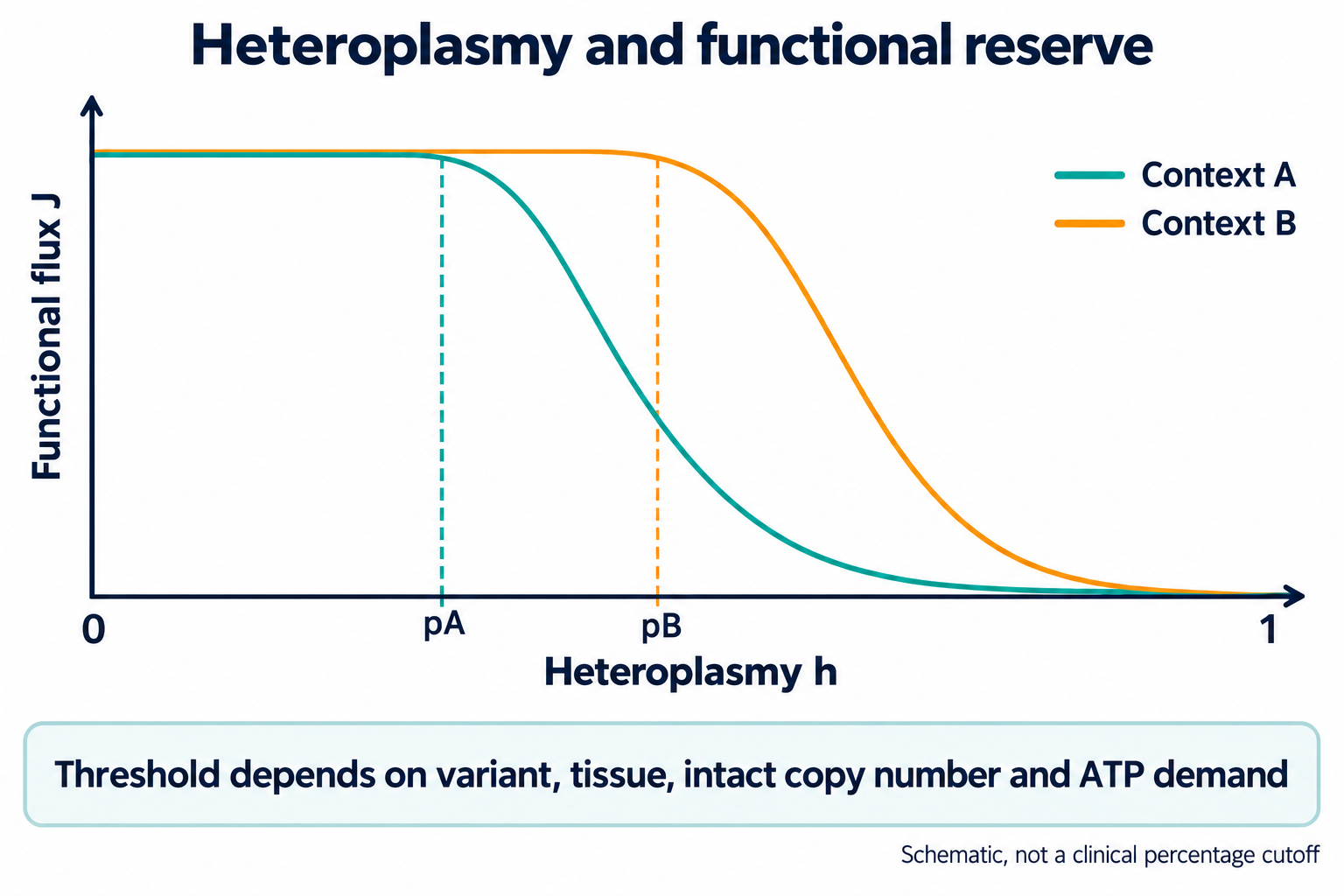
Figure 1. The same heteroplasmy can coexist with different functional reserves. The threshold depends on the variant and tissue; schematic curves do not establish clinical percentage boundaries.
The nervous system, retina, myocardium, skeletal muscle, renal tubules and endocrine cells may be sensitive to OXPHOS disruption. Vulnerability reflects energy requirements, spare capacity, ability to switch fuel and the distribution of affected cells. No universal ranking can specify that each organ always “fails” at the same heteroplasmy percentage.
In neurons, ATP deficiency affects ion gradients, Na⁺/K⁺-ATPase and neurotransmitter handling; in the heart, contraction and ion pumps supporting electrical stability. Energy-dependent transport enables reabsorption in renal tubules; in pancreatic β cells, metabolic coupling to insulin secretion makes mitochondrial state functionally important. These mechanisms explain possible manifestations but do not establish a diagnosis from a single symptom.
A tissue average may conceal individual clones with high mutant burdens. Ragged-red fibres, RRF, reflect abnormal mitochondrial accumulation in muscle, whereas COX-negative regions show local complex IV activity deficiency. These findings require morphological and molecular interpretation and do not identify one specific variant unequivocally.
The variant in MT-TL1 is associated with a broad phenotype spectrum, including MELAS and maternally inherited diabetes and deafness, MIDD. in MT-TK is often discussed in MERRF. Tissue heteroplasmy, age, nuclear background and other factors contribute to clinical diversity: a syndrome name does not specify an identical mutant fraction in every sample (Wallace, 1999; Chinnery and Turnbull, 1999).
For MT-ATP6, must be distinguished from . The former is associated with Leu156Arg and the latter with Leu156Pro; they are not the same amino-acid change. High burdens of particular variants can associate with a more severe spectrum, including NARP and maternally inherited Leigh syndrome, but textbook percentage ranges cannot replace clinical evaluation.
Kearns–Sayre syndrome and chronic progressive external ophthalmoplegia can be associated with single large deletions. The 4,977-base-pair deletion is a well-known example, rather than the obligatory cause of every case. Similar mtDNA-maintenance disorders also arise from nuclear-gene variants. “Mitochondrial disease” therefore extends beyond a disease caused by one mitochondrially inherited variant.
Harman's free-radical theory linked accumulated molecular damage to age-related dysfunction; the mitochondrial version focused on the organelle as both oxidant source and target. The classic vicious cycle can be expressed as a hypothesis: ROS damage mtDNA, mutations disrupt the respiratory chain, and the defective chain increases ROS formation. This scheme generated testable questions but does not prove that every mtDNA variant necessarily increases oxidant production (Harman, 1956; Wallace, 1999).
Testing requires independent measurements of genome sequence, OXPHOS function, ROS production, antioxidant defence and cellular turnover. An increase in one oxidative-damage measure does not establish the direction of every causal arrow. Conversely, reduced oxygen consumption can lower ROS formation in some states despite marked energy impairment. A universal self-accelerating loop is therefore too simple.
The studies by Trifunovic and Kujoth in mice with defective POLG exonuclease proofreading showed that artificially increased mtDNA mutation burdens can accompany premature age-like features. The model displayed tissue dysfunction, weight loss and other changes; Kujoth linked the phenotype to increased apoptosis. The predicted obligatory increase in oxidative stress did not explain the full phenotype (Trifunovic et al., 2004; Kujoth et al., 2005).
This strongly challenges the necessity of a ROS loop as the sole mechanism of mutation consequences. However, an animal with an artificial proofreading defect is not equivalent to a normally ageing human: mutation spectrum, accumulation rate and distribution differ. The experiment establishes that severe genome-maintenance disturbance can damage tissues, rather than the fraction of all human age-related changes caused by mtDNA.
Highly accurate sequencing distinguishes true rare variants from technical errors. In Kennedy et al., many age-related substitutions in human mtDNA were transitions rather than a predominant increase in the transversions predicted by a simple 8-oxoguanine model. This spectrum is consistent with a substantial role for replication errors and other processes, including base alterations, but cannot assign every substitution to a single chemical cause (Kennedy et al., 2013).
Mutation burdens can contribute to altered proteostasis, stress responses, apoptosis and reduced ability of individual cells to maintain tissue. Effects on stem and progenitor populations are investigated in models; they should not become the sole universal mechanism of age-related depletion of every stem-cell population. Mean organ mutation burdens can also be low while small COX-negative clones carry high local burdens.
A contemporary interpretation therefore treats variant formation, clonal expansion, function and cell removal as related but distinct processes. Redox damage remains part of biology rather than being excluded altogether. Neither a single adduct concentration nor an mtDNA variant becomes a universal biological-age clock.
When normally compartmentalised, endogenous mtDNA is not equivalent to an inflammatory stimulus. It acquires DAMP, damage-associated molecular pattern, significance when it reaches the relevant recognition systems. DNA form, oxidation, quantity, location, cellular uptake and removal all matter. The same extracellular-fluid concentration therefore does not guarantee an identical reaction in different cells (West and Shadel, 2017).
The genome's bacterial origin helps explain interest in CpG motifs and TLR9. However, it is incorrect to regard every nuclear CpG sequence as methylated and every mtDNA molecule as absolutely unmethylated: mitochondrial-modification measurements have methodological difficulties. Moreover, cGAS recognises accessible double-stranded DNA without requiring a particular CpG motif, so the CpG argument does not explain every immune pathway.
Loss of membrane integrity, permeability changes and apoptotic mechanisms can create different routes of DNA release. mPTP is associated with permeability to small molecules; it cannot be drawn as an established whole-mitogenome channel. Swelling, membrane disruption and fragment release are considered in particular models. McArthur et al. showed that BAX/BAK macropores during apoptosis allow inner-membrane herniation and mtDNA release. This is an experimentally described route, rather than an obligatory sequence in every mitochondrial dysfunction (McArthur et al., 2018).
When double-stranded DNA becomes accessible to cGAS, the enzyme catalyses formation of a cyclic dinucleotide from ATP and GTP:
denotes pyrophosphate; mixed 2′–5′ and 3′–5′ bonds distinguish this signalling product from a conventional linear oligonucleotide. cGAMP activates STING, an endoplasmic-reticulum membrane adaptor. Subsequent changes in STING localisation, including movement toward the Golgi apparatus, support signalling through TBK1 and IRF3 phosphorylation (Sun et al., 2013; West et al., 2015).
IRF3 participates in induction of type I interferons and interferon-stimulated genes, ISGs; another branch involves NF-κB. mtDNA release can thus connect mitochondrial stress to an antiviral-like programme even without a virus. Response composition, including IFN, CXCL10 and other mediators, nevertheless depends on cell type and pathway state. Cytosolic DNA does not inevitably cause the same release of every cytokine.
TLR9 acts in the endosomal compartment. Extracellular DNA must reach the relevant intracellular space through uptake; a direct “cytosolic mtDNA → TLR9” arrow without a delivery route is not a correct scheme. Recognition engages MyD88, IRAK4/IRAK1, TRAF6 and IKK signals regulating IκB and NF-κB.
In an appropriate cellular context this can increase transcription of inflammatory mediators, including TNF and IL-6. DNA chemistry, packaging, endosomal function and receptor expression alter the reaction. TLR9, cGAS and extracellular mtDNA concentration therefore represent different process levels rather than interchangeable diagnostic markers.
Shimada et al. linked oxidised mtDNA with NLRP3 activation in their experimental system. This is an important connection between mitochondrial stress and inflammation, but calling it a “universal direct ligand of the LRR domain” exceeds the evidence. NLRP3 integrates several stress events; priming, ion changes including K⁺ efflux and cellular state have independent importance (Shimada et al., 2012).
Following assembly with ASC, caspase-1 activation processes pro-IL-1β and pro-IL-18. Gasdermin D, GSDMD, cleavage can lead to membrane pores and pyroptosis. Cytokine maturation and cell death are connected but should not be drawn as inevitable consequences of any ox-mtDNA detection. TLR-dependent priming is possible, but does not require a single obligatory TLR9 input.
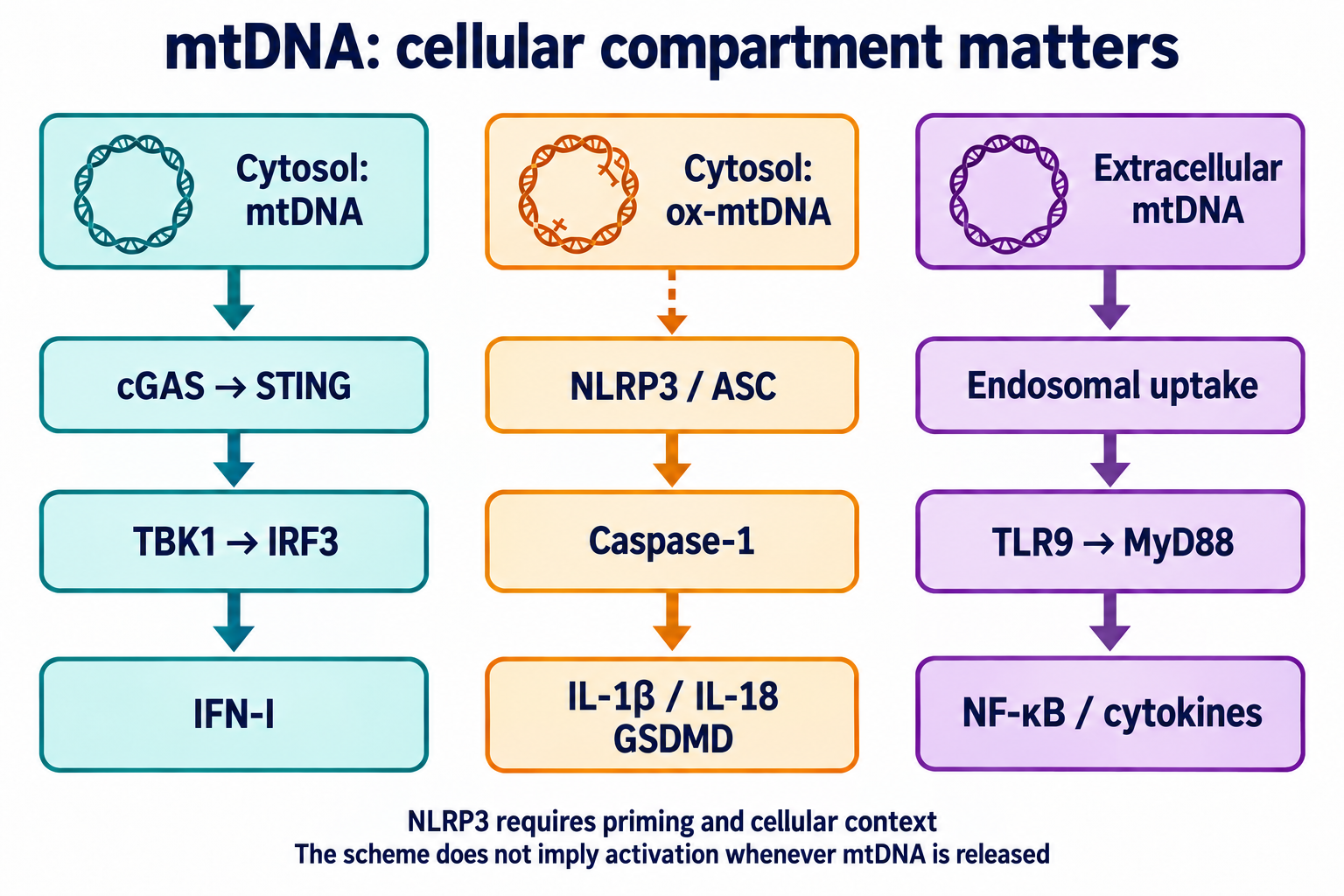
Figure 2. Cytosolic mtDNA, oxidised mtDNA and extracellular DNA taken into an endosome are linked to different pathways. The dashed arrow denotes context dependence of the NLRP3 association; the scheme does not establish universal direct recognition of every fragment.
ccf-mtDNA can occur freely and within extracellular structures. Its concentration reflects a combination of release, carriers, degradation and clearance. Plasma measurements are strongly affected by preparation, residual cells and platelets, extraction, amplification target and qPCR or ddPCR normalisation. Copy number cannot therefore be interpreted independently of the analytical protocol.
Associations of ccf-mtDNA with inflammation, cardiovascular disease and neurodegenerative conditions are being investigated, but the magnitude and even direction of differences can depend on disease and sample. Plasma and cerebrospinal fluid are different environments; an increase in one does not predict an increase in the other. Correlation with severity also does not establish that DNA itself causes every clinical manifestation.
For inflammageing, a sustained imbalance between damage, removal and immune regulation is relevant. An investigational association nevertheless does not make ccf-mtDNA a stand-alone ageing-rate test, an Alzheimer's disease diagnosis or an indication for a STING blocker. Signal abundance and confirmed operation of the relevant pathway must be assessed separately.
Attaching the lipophilic triphenylphosphonium cation, , allows membrane electrical potential to enrich a molecule within mitochondria. Charge distribution and lipophilicity facilitate passage through the lipid bilayer. This differs from claiming vitamin C, vitamin E or resveratrol cannot reach mitochondria at all: their distribution and properties differ, but absolute impermeability does not adequately explain limitations in clinical effects (Smith et al., 1999; Skulachev, 2007).
With the convention , equilibrium for an ideal monovalent cation is described by:
A negative matrix potential gives a positive accumulation exponent. At approximately 37 °C, a change of around 60 mV corresponds to an approximately tenfold change in the ideal equilibrium ratio. This explains enrichment, but actual exposure also depends on binding, membrane accessibility, kinetics and metabolism. Potentials across two sequential membranes may be combined in a model; inserting negative values into an expression with the opposite sign cannot simultaneously predict increased concentration.
MitoQ includes a ubiquinone moiety and a TPP-linked spacer; its reduced form may participate in lipid protection. SkQ1 uses a plastoquinone moiety. Antioxidant and prooxidant activity, membrane effects and tolerability depend on concentration and system. Severe depolarisation can reduce cation accumulation precisely in the most damaged organelle. Targeted delivery therefore does not equal absolute selectivity, absence of toxicity or repair of an already fixed mutation.
The numerical vascular-function effect in the supplied text, without a corresponding clinical publication in its bibliography, is not used here as evidence of mtDNA protection. Such a conclusion requires separately confirmed outcomes and genome measurements. Ubiquinone properties and clinical limitations are also discussed in the article on coenzyme Q10 and polyphenols; this provides respiratory-chain context rather than proof that MitoQ corrects heteroplasmy.
In a polarised mitochondrion, PINK1 import and processing, including PARL involvement, help maintain low outer-membrane abundance. When import is impaired, PINK1 accumulates at the surface and phosphorylates ubiquitin at Ser65, enabling Parkin recruitment and activation. Ubiquitination of membrane targets and recruitment of autophagy receptors, including OPTN and NDP52, then connect the damaged region to LC3 and the autophagosome; TBK1 contributes to regulation (Pickrell and Youle, 2015; Lazarou et al., 2015).
Lysosomal delivery can remove an organelle and its contents, but PINK1 does not sense a particular mutant-mtDNA percentage. Activation requires neither a universal heteroplasmy value nor obligatory complete potential collapse. Furthermore, mitophagy extends beyond PINK1/Parkin: BNIP3, NIX and FUNDC1 receptors provide alternative connections to autophagy, for example during hypoxic adaptation or development. Each route's importance depends on tissue and stimulus.
Urolithin A has been studied as an intervention associated with mitochondrial quality and mitophagy. Andreux et al. described tolerability and molecular response signatures in humans; Singh et al. investigated muscle function and biomarkers in middle-aged adults. These studies are not equivalent to proven selective mutant-genome removal, sustained heteroplasmy reduction in patients or MELAS treatment. In particular, altered gene expression or metabolites do not directly measure mitophagy flux in every tissue (Andreux et al., 2019; Singh et al., 2022).
Spermidine is investigated in relation to autophagy and lifespan in model systems; Eisenberg et al. support this research context. Acetylation regulation and the discussed EP300 mechanism require distinguishing publications and conditions, rather than attributing all later mechanisms to one early study. General autophagy activation also does not guarantee mtDNA genotype selection. These mechanisms do not establish human “genome rejuvenation” or a universal dose for that purpose.
Cellular energy state influences AMPK; activation involving Thr172 phosphorylation connects energy shortage with adaptation programmes. PGC-1α acts as a transcriptional coactivator, while the NAD⁺-dependent deacetylase SIRT1 links its regulation to metabolic state. Phosphorylation and acetylation alter network activity, but a simple linear chain cannot describe every feedback interaction or tissue-specific feature (Cantó and Auwerx, 2009).
Nuclear respiratory factors NRF1 and NRF2/GABP regulate mitochondrial-function genes. Here NRF2 means GABP, rather than the antioxidant factor NFE2L2, also frequently called Nrf2. Imported TFAM participates in packaging and transcription initiation with POLRMT and TFB2M; it is not an enzyme that independently doubles the genome. Replication machinery must coordinate with membrane biogenesis, protein import and complex assembly (Scarpulla, 2011).
Increasing genome number can increase the absolute number of intact copies even without changing their relative fraction. Biogenesis can nevertheless also expand the mutant pool: preferential wild-type replication needs independent evidence. Information on vitamin B3 and NAD-dependent metabolism provides cofactor context, but the existence of an NAD⁺-dependent enzyme does not prove every precursor lowers heteroplasmy or restores DNA sequence.
Aerobic and resistance exercise can alter mitochondrial biogenesis, organelle quality and muscle functional capacity. Adaptation involves energy signals, proteostasis and cellular turnover, so improved endurance does not necessarily mean a lower fraction of a particular mutant variant. Functional-reserve growth and genotype-composition changes should be measured separately.
Muscle progenitor participation in remodelling likewise does not mean these cells always contain exclusively “clean” mtDNA or invariably replace mutant copies. For someone with mitochondrial disease, exercise programming depends on their condition and clinical assessment; HIIT does not follow from a molecular scheme as a universal therapy. Direct heteroplasmy correction by training cannot be promised without variant-, tissue- and long-term-response data.
Mitochondrially targeted nucleases deliver a protein complex that recognises a specific DNA sequence. mitoZFN uses zinc fingers and mitoTALEN uses TALE domains; FokI catalytic domains cut DNA in a suitable configuration. Selective damage to mutant molecules can lead to degradation and enrichment of the remaining pool with the intact variant. This shifts population composition rather than necessarily repairing each cut molecule.
Gammage et al. used mtZFN, rather than TALEN: repeated interventions in a cellular model shifted heteroplasmy from approximately 80% to 7%. The study also discussed unwanted total-copy-number depletion and expression-dose control. This particular experiment does not establish the same correction of MELAS or MERRF in a patient (Gammage et al., 2016).
The principle requires an intact pool to restore copy number and sufficient selectivity. If a variant is homoplasmic, simply destroying the molecules carrying it does not create a new normal sequence. Delivery to different organs, unwanted cleavage, immune reactions and long-term safety limit translation of cellular findings into treatment.
DdCBE, DddA-derived cytosine base editors, use split bacterial cytidine-deaminase components directed to DNA by protein recognition; the system includes a uracil-DNA-glycosylase inhibitor. Mok et al. demonstrated CRISPR-independent mitochondrial DNA editing without a double-strand break. The original system's main change is , rather than arbitrary substitution of any base (Mok et al., 2020).
Protein delivery bypasses the guide-RNA delivery problem, but does not automatically make editing universal or safe. Sequence context, bystander changes, off-target editing and delivery matter. In particular, the ability to perform does not imply direct reversal of to A with this system. These technologies open research opportunities; claiming an established standard method of “mitogenome repair” requires separate clinical evidence.
A mechanistic marker helps define a question and measurement method rather than automatically prescribe a drug. The table retains the supplied material's key processes, replacing clinical promises with interpretive limits.
| Process / measure | Main mechanism | What can be measured | Limit of interpretation |
|---|---|---|---|
| 8-oxoG / 8-OHdG | Guanine oxidation; potential mispairing | Adduct in isolated DNA or product in a biofluid | Not equivalent to a fixed mutation and not automatically localised to mitochondria |
| and 4-HNE adducts | Secondary lipid-peroxidation products | Chemical adducts, protein and nucleic-acid modifications | Not specific to one organ or disease; sample controls are required |
| 4,977-bp deletion | Loss of genes and tRNAs | Deletion fraction and tissue distribution | No single clinical threshold; does not explain every KSS/CPEO case |
| MT-TL1 tRNA variant | Variant and its heteroplasmy in the selected sample | Blood may not reflect affected tissue; MELAS and MIDD do not reduce to one percentage | |
| MT-ATP6 variant, Leu156Arg | Molecular variant and tissue burden | Must be distinguished from , Leu156Pro | |
| POLG proofreading defect | Genome-maintenance errors | Nuclear genotype, depletion or multiple mtDNA changes | The mutator-mouse model is not a test of ordinary human ageing |
| Cytosolic mtDNA | Access to cGAS–STING | DNA localisation and signalling activation | Plasma concentration does not prove cytosolic-pathway operation |
| ox-mtDNA / NLRP3 | Context-dependent inflammatory response | Inflammasome assembly, caspase-1, mature cytokines | Priming and functional evidence are required; not a universal direct ligand |
| ccf-mtDNA | DNA release, transport and removal | Biofluid copies under a standardised protocol | Not a stand-alone diagnosis, age measure or indication for a receptor blocker |
Diagnosis begins with the phenotype, family history and distribution of affected organs. Maternal inheritance may point toward mtDNA, but nuclear causes have other inheritance patterns, and absence of family history does not exclude disease. Method selection should address a specific hypothesis rather than repeat a universal “mitochondrial age” panel.
Lactate and pyruvate depend on sampling, processing, exercise and other conditions. Their ratio has no single diagnostic cutoff applicable to every concentration and clinical circumstance. CK, AST/ALT, myoglobin and organic acids help evaluate particular processes but are not specific to mtDNA variants. An elevated result alone does not confirm diagnosis, while a normal result does not exclude every mitochondrial disease.
Genetic investigation may include mitochondrial-genome sequencing, deletion and duplication detection and indicated analysis of nuclear maintenance genes such as POLG, TWNK and DGUOK. Rare heteroplasmy requires a validated detection limit, sequencing-error control and distinction from nuclear mitochondrial inserts, NUMTs. Read depth alone does not guarantee accuracy: correct analysis and quality control are essential. ddPCR can refine a particular variant fraction or copy number, but results depend on target and normalisation.
Tissue choice is fundamental. Blood analysis can underestimate affected-organ burdens for some variants; a negative result in one medium does not exclude tissue mosaicism. Urinary epithelium or muscle sampling is selected according to the clinical question, rather than as an obligatory step for everyone. Urinary 8-OHdG, hsCRP, IL-6 and ccf-mtDNA do not replace molecular diagnosis: they neither establish the cause of every symptom nor directly identify a specific mutation.
When indicated, muscle biopsy and RRF and COX/SDH staining can complement the picture. Respirometry examines respiration under specified substrates and sample conditions; State 3/State 4 and respiratory control ratio, RCR, make sense within a defined experimental protocol. Morphology and function do not replace a genetic explanation, and invasive investigations do not become routine preventive screening merely because mtDNA participates in ageing.
Mitochondrial-system resilience depends on sequence maintenance, sufficient functional copies, network organisation and timely removal of damaged components. These processes are connected but have different measurable outcomes. Antioxidant activity does not equal repair of a fixed variant; mitophagy does not guarantee genotype selection; biogenesis does not necessarily reduce relative heteroplasmy; functional improvement does not prove a sequence change.
Ageing research has exposed limits of the universal ROS vicious cycle, while immune biology has demonstrated the importance of DNA escaping its usual compartment. Neither line nevertheless explains all age-related or inflammatory diseases alone. A sound scientific conclusion connects a molecular result to a particular model, tissue and clinical question while preserving the distinction between association, mechanism and a confirmed treatment outcome.
This is a narrative scientific analysis based on the supplied text and its bibliography. It is not a systematic review with a preregistered search, does not assign formal GRADE ratings and does not claim independent clinical expert review. During editing on 8 October 2026, ambiguous TFAM, mtZFN, Kennedy and urolithin A study records and the distinction between mitochondrial LIG3 and XRCC1 were checked selectively; no general search for new literature or comprehensive link audit was conducted. Evidence levels are described in words according to model and outcomes rather than converted into treatment recommendations.
There is no single boundary. The variant, tissue, absolute intact-copy number, energy demand and distribution of affected cells all matter.
These measures investigate damage or circulating DNA, but do not independently establish ageing rate, the source of all damage or a particular mitochondrial disease.
Changes in mitochondrial markers and function do not equal proven selective mutant-genome removal. Such a conclusion requires separate variant and tissue measurements.
No. Nucleases change pool composition, and DdCBE has limited chemical specificity; delivery, copy-number preservation and unintended changes require separate evaluation.