
Glycine, NMDA and Sleep: Thermoregulation, Synapses and Metabolism
An in-depth monograph on glycine: inhibitory GlyR and NMDA coagonism, L/D-serine, SCN thermoregulation, human sleep studies, glutathione and GlyNAC, GLYAT/GNMT, pharmacokinetics, and practical limits.
Abstract
Glycine is a small amino acid whose functions cannot be captured by the single word “calming.” It is incorporated into proteins and metabolic products, participates in rapid inhibition through glycine receptors, and also supports excitatory NMDA receptors. The direction of a neuronal response depends on the receptor, ionic gradients, and local coagonist availability. Synaptic glycine and the consequences of swallowing glycine powder therefore need separate explanations.
Interest in glycine for sleep arose from small human studies and animal experiments on thermoregulation. These findings support discussion of possible improvements in sleep initiation and selected measures of next-day well-being, but do not establish treatment of chronic insomnia, an increase in deep sleep, or brain recovery during a shortened night. Its biochemical roles in glutathione synthesis, organic-acid conjugation, and methyl-group metabolism are established more firmly than a universal benefit from supplementation. This monograph examines molecular mechanisms alongside the limits of their translation into clinical practice.
1. Molecular structure and biochemical profile
1.1. Achirality, charge, and flexibility of the protein backbone
Glycine, or aminoethanoic acid, has the formula C₂H₅NO₂ and a molar mass of approximately 75.07 g/mol. Its α-carbon carries two identical substituents, both hydrogen atoms, making it the only one of the twenty standard proteinogenic amino acids without a pair of D- and L-enantiomers. This does not make the molecule biologically “neutral”: enzymes and receptors recognize the arrangement of its amino and carboxyl groups. However, “L-glycine” and “D-glycine” do not identify different stereochemical forms of ordinary glycine.
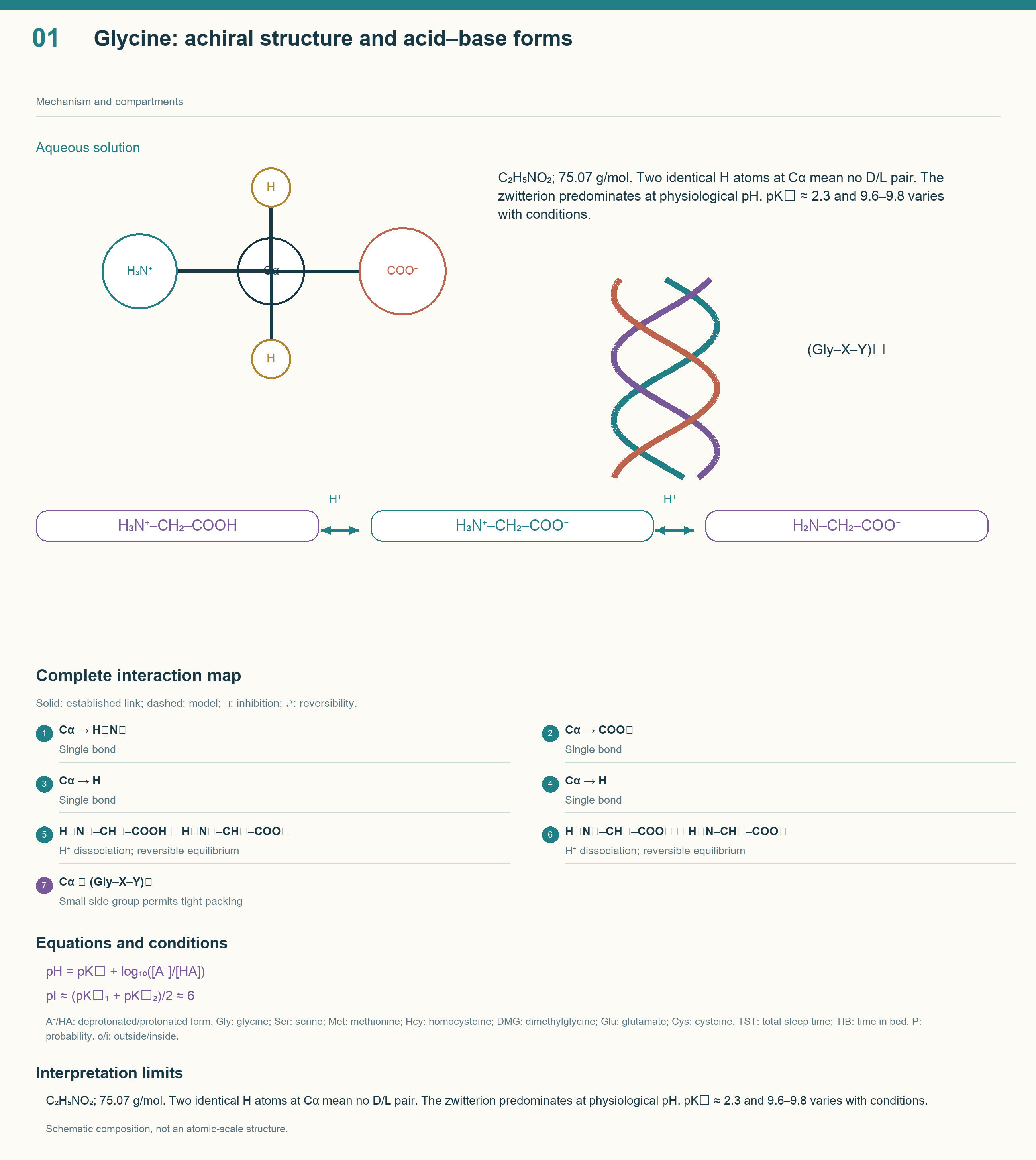
Several acid–base forms of glycine coexist in aqueous solution, with their proportions depending on pH. Near physiological pH, the zwitterion H₃N⁺–CH₂–COO⁻ predominates, carrying positive and negative charges on different groups. “Predominates” is more accurate than “exists exclusively,” because the equilibrium persists in a physiological environment. The pKₐ values also depend on temperature, ionic strength, and the conventions used to describe the solution; they are not immutable constants of blood or cerebrospinal fluid.
H₃N⁺–CH₂–COOH ⇄ H₃N⁺–CH₂–COO⁻ + H⁺
H₃N⁺–CH₂–COO⁻ ⇄ H₂N–CH₂–COO⁻ + H⁺
pH = pKₐ + log₁₀([deprotonated form]/[protonated form])
A textbook approximation places the carboxyl-group pKₐ near 2.3 and the ammonium-group pKₐ near 9.6–9.8. For a simple amino acid without an ionizable side chain, the isoelectric point is estimated as pI ≈ (pKₐ₁ + pKₐ₂)/2, giving a value near 6. This is the pH of zero average net charge, not a state in which the amino and carboxyl groups must lose their individual charges. The Henderson–Hasselbalch equation explains the distribution of forms but does not replace an account of activities in an actual biological fluid.
The small side group reduces steric constraints on the backbone torsion angles φ and ψ. Glycine has broader allowed regions on a Ramachandran plot than most amino acids, although not every conformation becomes equally probable. This facilitates some turns and close packing of chains. In collagen, the repeat (Gly–X–Y)ₙ places glycine at every third position, where a larger side group would interfere with triple-helix organization; the repeat itself does not imply that any glycine supplement accelerates collagen formation.
1.2. Synthesis, degradation, and one-carbon metabolism
Glycine is classified as a nonessential amino acid because the body can synthesize it. Its principal pathway involves serine and serine hydroxymethyltransferases: SHMT1 acts mainly in the cytosol, while SHMT2 acts in mitochondria. The reaction uses pyridoxal phosphate and transfers a one-carbon unit to tetrahydrofolate, abbreviated THF. Reversibility matters: the presence of an enzyme alone does not reveal the direction of flux in a particular tissue.
Serine + THF ⇄ glycine + 5,10-CH₂-THF + H₂O
Here, 5,10-CH₂-THF is methylenetetrahydrofolate, a carrier of a one-carbon unit for subsequent reactions. Mitochondrial and cytosolic folate pools should not be drawn as one freely mixing reservoir. Gene-editing and isotope-tracing experiments in cultured cells show that one-carbon fluxes can be redistributed when the mitochondrial pathway is disrupted. This explains cellular metabolic flexibility but does not establish a daily glycine requirement for humans.
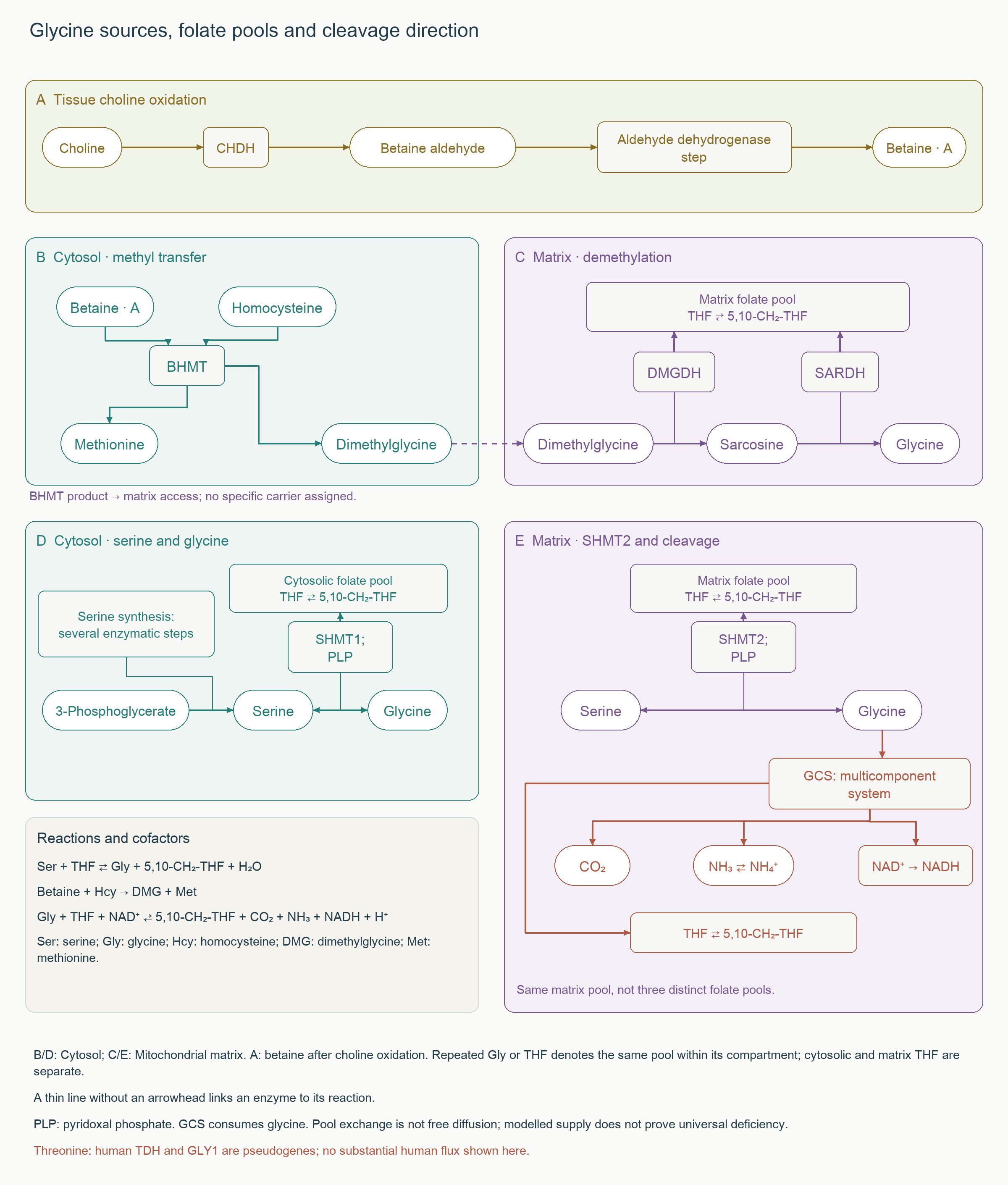
A second route links glycine to choline oxidation and methyl-group metabolism. Choline is converted successively to betaine aldehyde and betaine; BHMT then transfers a methyl group from betaine to homocysteine, producing methionine and dimethylglycine. Subsequent mitochondrial reactions involving DMGDH and SARDH produce sarcosine and then glycine, coupling oxidative demethylation to one-carbon metabolism. This route is organized by tissue and is not equally active in every neuron.
Betaine + homocysteine → dimethylglycine + methionine
The glycine cleavage system, GCS, instead consumes glycine in mitochondria. Its protein components perform decarboxylation, aminomethyl-group transfer, and restoration of the oxidized cofactor; glycine carbon enters CO₂ and the folate pool, while nitrogen is released as ammonia, which is predominantly present as NH₄⁺ in solution. The catabolic arrow must point from glycine toward these products rather than depict another source of glycine. Disorders of this complex show that inadequate removal of the amino acid can be as consequential as insufficient availability.
Glycine + THF + NAD⁺ ⇄ 5,10-CH₂-THF + CO₂ + NH₃ + NADH + H⁺
This is an overall biochemical equation for GCS, not the reaction of a single enzyme. NH₃ reflects the convention used to balance the equation; discussion of physiological solution must also account for NH₃ + H⁺ ⇄ NH₄⁺. Replacing NH₃ mechanically with NH₄⁺ without adjusting the proton balance would therefore be inaccurate. NAD⁺ and NADH denote the oxidized and reduced forms of nicotinamide adenine dinucleotide.
Threonine pathways require an explicit species qualification. Studies of human genes found that TDH, corresponding to threonine dehydrogenase, is an expressed pseudogene, while the human homolog of the independent threonine aldolase GLY1 has also lost functionality. This does not exclude incidental enzyme activities, but it does not justify assigning a universal human contribution of “less than 5%” without measurements. A functioning pathway in mice or low aldolase activity in a tissue extract is not a quantitative estimate of human glycine synthesis.
1.3. Interpreting the hypothesis of limited supply
Calculations concerning collagen synthesis raised the question of whether endogenous glycine production always meets all demands. One model compared estimated synthesis of approximately 3 g/day with dietary intake and assumed expenditure on structural and metabolic functions. This is a useful hypothesis about a potential limitation, but it depends on assumptions about protein turnover, amino-acid reutilization, and actual synthesis rates. It cannot be converted into a proven daily deficit in every 70-kg adult.
The gross use of glycine for protein assembly differs from the amount that must be supplied anew through food or synthesis. Protein breakdown returns amino acids to metabolism, and summing all fluxes without accounting for this return overestimates net demand. A low glycine concentration in a particular patient group likewise does not establish a universal supplement requirement. In practice, supply should be discussed in relation to diet, individual circumstances, and a measurable question rather than compulsory correction of the arithmetic difference between “3 and 15 g.”
2. Two receptor roles of glycine
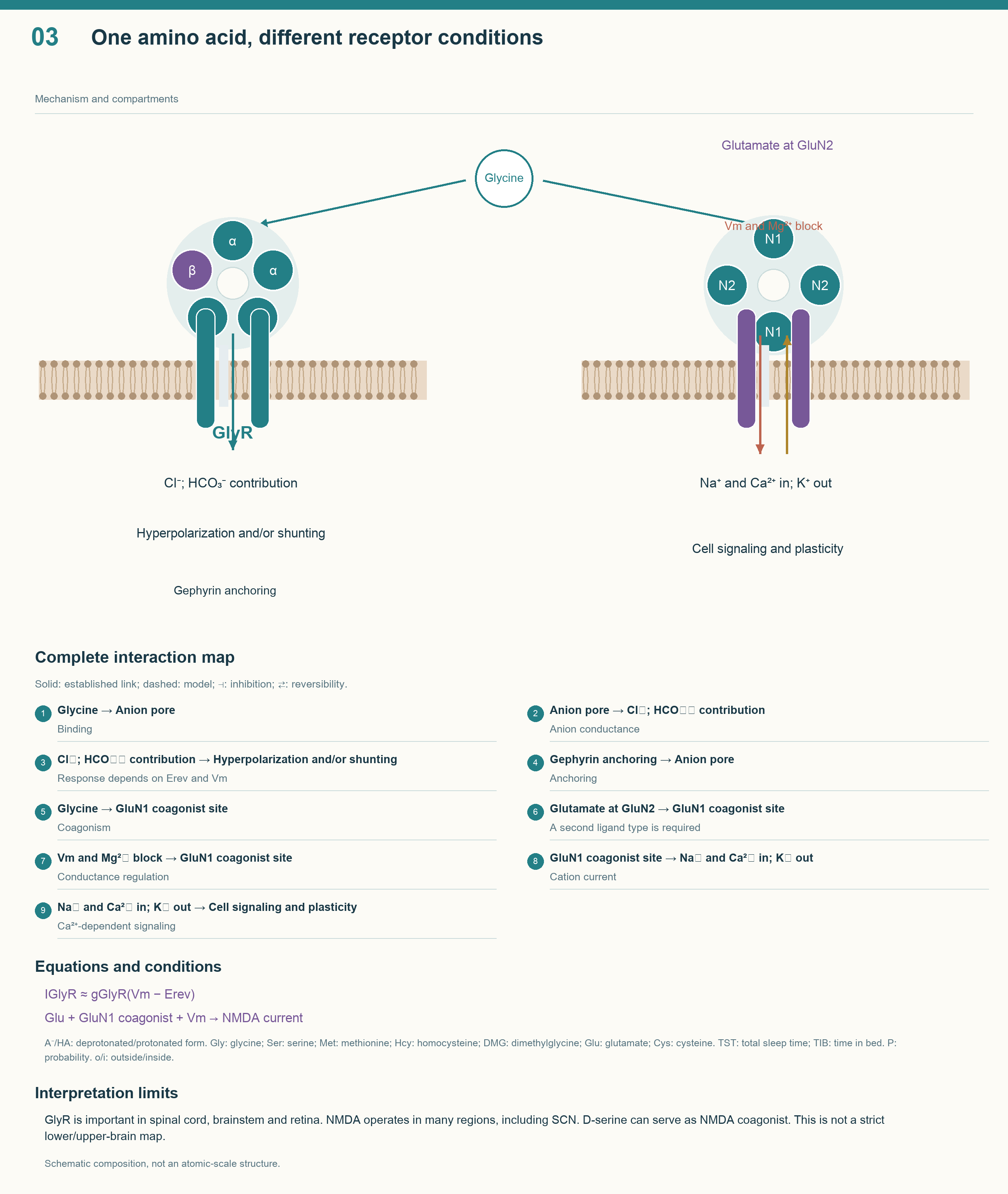
Glycine can support inhibitory and excitatory transmission because it interacts with fundamentally different receptor complexes. GlyR conducts mainly anions, whereas a conventional NMDA receptor conducts cations and requires a coagonist alongside glutamate. The spinal cord and brainstem contain abundant glycinergic inhibitory circuits, but dividing the brain into a strictly “inhibitory lower part” and “excitatory upper part” oversimplifies its anatomy. The particular synapse, age, subunit composition, and cellular state all matter.
2.1. GlyR: binding, pore function, and postsynaptic anchoring
GlyR belongs to the pentameric Cys-loop family of ligand-gated channels. Five subunits surround a central pore, and extracellular glycine binding changes the complex's conformation and opening probability. The α-subunits participate in ligand recognition and channel formation; the β-subunit is also part of the functional structure and provides an important connection to the postsynaptic scaffold. Describing it merely as a stationary support would be inaccurate.
Structural studies of native receptors and recombinant human complexes support a 4α:1β composition in the heteromeric GlyRs examined. Earlier proposals of 3α:2β should not be presented as an equally secure universal architecture of the mature receptor. The α1, α2, and α3 isoforms differ in distribution and properties; human GLRA4 is a pseudogene, so a list of four α-isoforms in other vertebrates needs a species qualification. Homomeric α-receptors also exist, particularly in experimental systems and during nervous-system development.
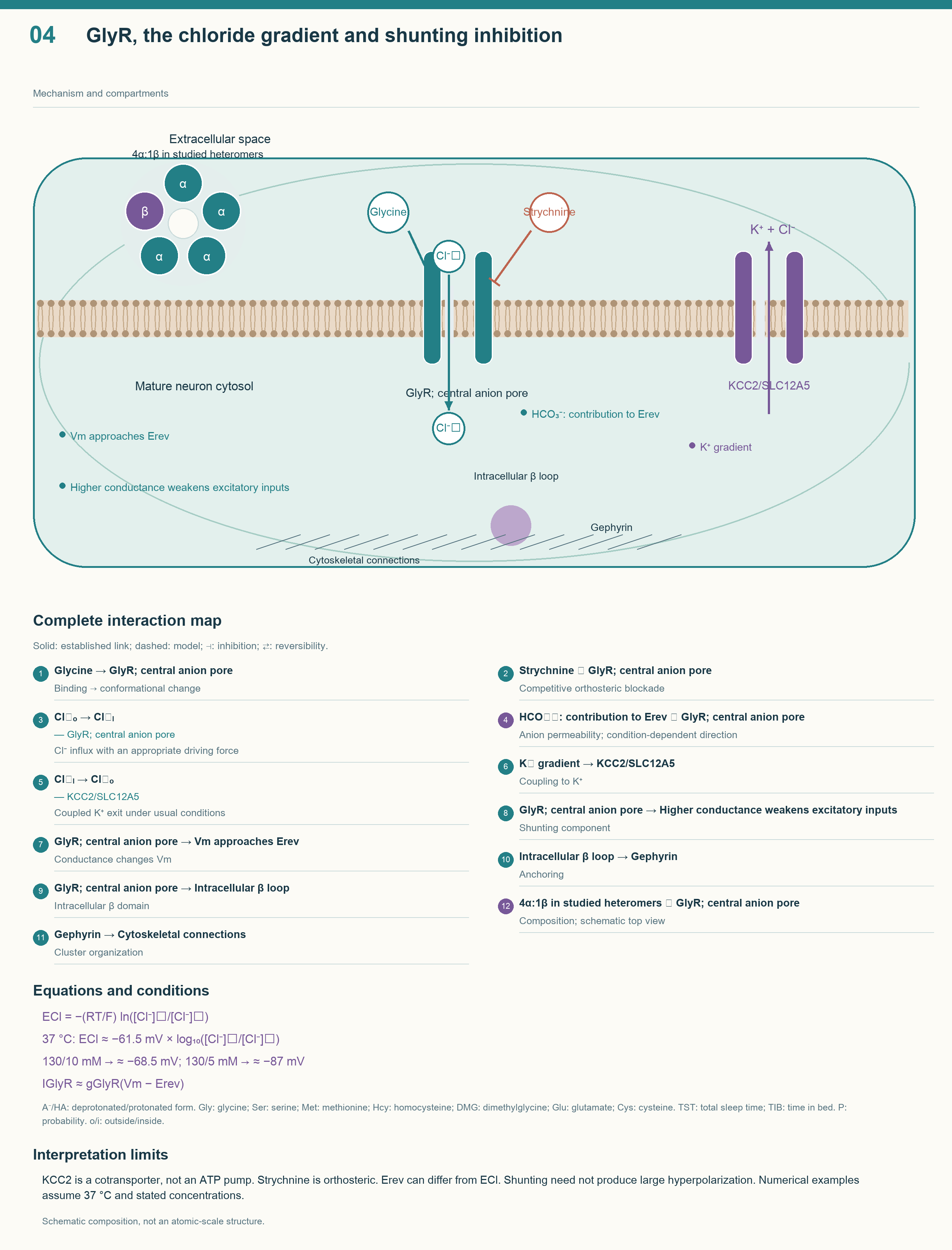
Gephyrin binds an intracellular region of the β-subunit and helps retain receptors in postsynaptic clusters. This is a dynamic organization involving molecular exchange, not a compulsory ideal hexagonal lattice with a fixed number of channels. Connections to the cytoskeleton and other proteins support spatial tuning of the inhibitory synapse. A diagram should therefore show the anchoring complex without assigning universal cluster dimensions or a particular number of attached microtubules.
Strychnine occupies the orthosteric ligand-recognition site and acts as a competitive GlyR antagonist. It cannot consistently be described as competitive while being placed in a separate obligatory “allosteric pocket.” Glycine EC₅₀ describes the concentration producing half the functional response in a particular experiment, whereas Kᵢ is an inhibition parameter determined differently; both depend on the system. Values of 20–50 µM and 5–10 nM without receptor composition and experimental conditions are not fixed specifications of every human GlyR.
Electrophysiology of the anion response
Current through an open channel depends on the electrochemical driving force. In mature neurons, KCC2, or SLC12A5, generally helps maintain low intracellular Cl⁻ by transporting K⁺ and Cl⁻ together. It is a secondary active cotransporter using ion gradients, not a chloride ATPase. Establishing the underlying gradients requires energy-dependent cellular activity, but KCC2 does not hydrolyze ATP during each transport cycle.
ECl = (RT/zF) ln([Cl⁻]ₒ/[Cl⁻]ᵢ), where z = −1
At 37 °C: ECl ≈ −61.5 mV × log₁₀([Cl⁻]ₒ/[Cl⁻]ᵢ)
IGlyR ≈ gGlyR × (Vm − Erev)
In the Nernst equation, R is the gas constant, T is absolute temperature, F is the Faraday constant, and the subscripts “o” and “i” designate extracellular and intracellular environments. Illustrative concentrations of 130 mM outside and 10 mM inside give ECl of approximately −68.5 mV; with 5 mM inside, it is approximately −87 mV. These examples explain concentration dependence and do not define a normal value for every neuron. In the current equation, gGlyR is conductance, Vm is membrane potential, and Erev is the reversal potential of the entire anion current, which may differ from ECl because HCO₃⁻ also contributes.
If the reversal potential is more negative than the current Vm, opening GlyR moves the membrane toward a more negative level. Increasing conductance also reduces the effect of excitatory inputs: this is shunting inhibition and does not require a large visible voltage shift. With different gradients the response can be depolarizing, although depolarization does not necessarily bring the cell to spike threshold. Consequently, “Cl⁻ must enter and Vm must shift from −65 to −75 mV” is appropriate only as a conditional example with stated assumptions.
Disruption of glycinergic inhibition has clear clinical significance but does not make dietary glycine a treatment for every such disorder. Pathogenic variants of GLRA1, GLRB, and SLC6A5 are associated with hereditary hyperekplexia, an excessive startle response with episodes of stiffness; this is not simply another name for epileptic seizures. Tetanus toxin disrupts release of inhibitory transmitters by cleaving synaptobrevin/VAMP and acts beyond an exclusively glycinergic Renshaw-cell circuit. These examples concern receptor function and the synaptic apparatus rather than proving an everyday benefit from increasing amino-acid intake.
2.2. NMDA receptors: coagonism and coincidence detection
A typical GluN1/GluN2 NMDA receptor contains two GluN1 and two GluN2 subunits, potentially of different isoforms. Glycine or D-serine binds the GluN1 coagonist site, while glutamate binds sites on GluN2. The sites interact functionally, but the glycine site is a coagonist-binding site rather than an arbitrary auxiliary switch. GluN3-containing complexes further limit extrapolation of this arrangement to every member of the family.
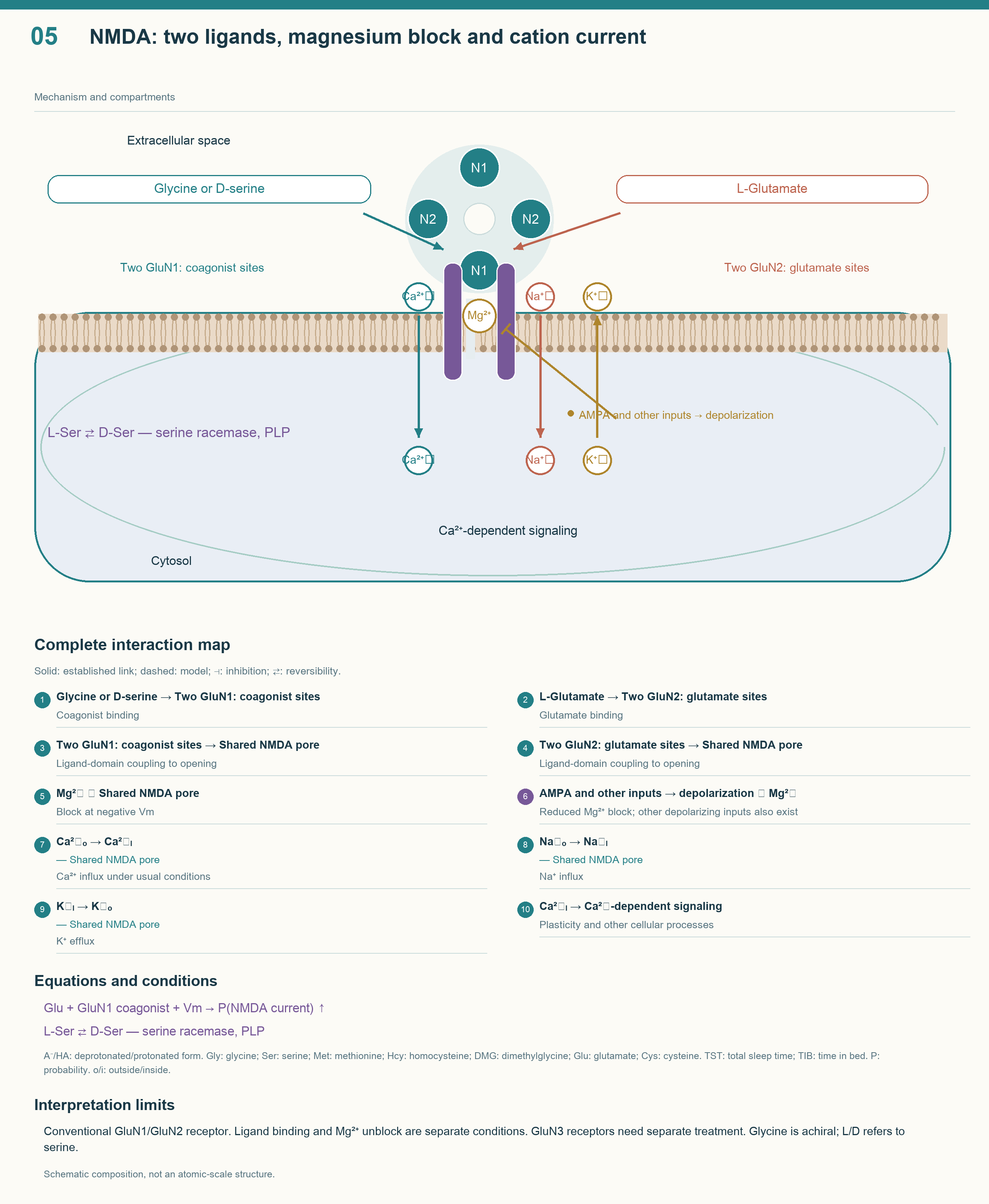
In Johnson and Ascher's classic experiments on cultured mouse neurons, glycine enhanced the NMDA response independently of strychnine-sensitive GlyRs. This helped establish the excitatory channel's own coagonist requirement. At physiological Mg²⁺ concentrations, binding both ligand types is insufficient for a large current in a resting cell because magnesium block depends on membrane potential. Depolarization, often supplied by AMPA receptors and other inputs, facilitates NMDA-channel conduction, allowing Na⁺ and Ca²⁺ to enter and K⁺ to leave.
Glutamate + GluN1 coagonist + suitable Vm → increased probability of NMDA current
This is a functional description of conditions, not a chemical reaction consuming three substrates. The coagonist does not independently determine the timing of excitation or remove the need for a glutamate signal. Ca²⁺ entry connects receptor activity to intracellular signaling and plasticity, although excessive or inappropriately localized entry can contribute to injury. Thus, “enhancing NMDA is always safe” is as inaccurate as “glycine always inhibits.”
Glycine and D-serine: local availability rather than a universal division
D-serine is an endogenous NMDA coagonist, as shown by enzymatic removal and restoration of the response after adding it back. Hippocampal preparations have also shown preferential D-serine involvement in synaptic responses and glycine involvement in certain extrasynaptic responses. These observations concern particular preparations, cellular environments, and stimulation protocols. They do not establish that every GluN2A receptor uses only D-serine and every GluN2B receptor exclusively glycine across all regions and ages.
Unlike achiral glycine, serine has L- and D-forms with different spatial configurations. Serine racemase can convert L-serine into D-serine, a reaction demonstrated by isolating the enzyme from rodent brain and characterizing it molecularly. “D-serine” therefore has biochemical meaning, while “D-glycine” and “L-glycine” do not designate two distinct standard molecules. L-serine as a metabolic precursor cannot be equated without qualification with D-serine as a local NMDA coagonist.
L-Serine ⇄ D-serine — serine racemase, pyridoxal phosphate
Serine racemase and serine metabolism link coagonist regulation to interactions between neurons and glia. The relative contribution of cellular sources, transporters, and receptor isoforms changes, so coagonist-site saturation cannot be inferred from an average tissue amino-acid concentration. Likewise, an EC₅₀ from a recombinant experiment does not determine the powder dose needed for sleep. Transport, metabolism, and local synaptic geometry intervene between plasma, interstitial fluid, and the space surrounding the receptor.
2.3. GlyT1, GlyT2, and vesicular loading
GlyT1 and GlyT2 are SLC6-family transporters coupled to Na⁺ and Cl⁻. GlyT1, encoded by SLC6A9, helps control extracellular glycine in glial and some neuronal populations. GlyT2, encoded by SLC6A5, is particularly important for glycine accumulation in presynaptic glycinergic terminals. Transmitter release subsequently depends on vesicular packaging and exocytosis, so membrane uptake should not be drawn as direct transport from blood into a synaptic vesicle.
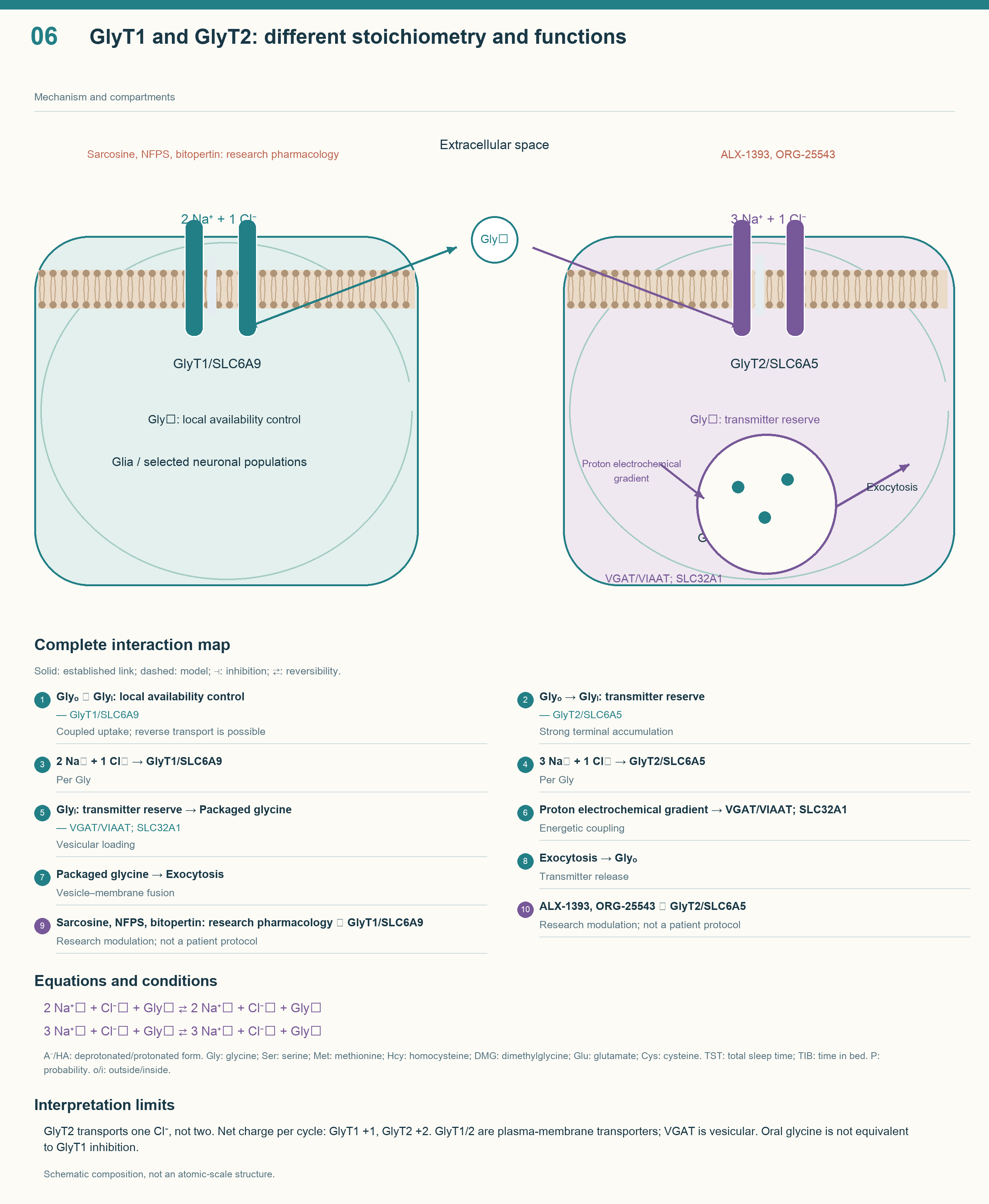
| Feature | GlyT1 | GlyT2 |
|---|---|---|
| Gene | SLC6A9 | SLC6A5 |
| Typical location | Glia and selected neuronal populations | Glycinergic presynaptic terminals |
| Coupling per glycine molecule | 2 Na⁺ : 1 Cl⁻ : 1 Gly | 3 Na⁺ : 1 Cl⁻ : 1 Gly |
| Main functional role | Control of local extracellular availability | Accumulation of an intracellular transmitter pool |
| Connection to vesicles | Indirect, through extracellular exchange | Supplies substrate to VGAT/VIAAT, SLC32A1 |
| Experimental modulation | Sarcosine, NFPS, bitopertin; research pharmacology | ALX-1393, ORG-25543, and other research compounds |
Primary transport experiments established one coupled Cl⁻ ion for GlyT2, not two. The additional Na⁺ enables a stronger accumulation gradient than that of GlyT1. Transport direction depends on combined concentration and electrical conditions, with reverse transport being particularly relevant for GlyT1. “Clearance” therefore does not mean that both proteins invariably remove glycine from the extracellular environment.
2 Na⁺ₒ + Cl⁻ₒ + Glyₒ ⇄ 2 Na⁺ᵢ + Cl⁻ᵢ + Glyᵢ — GlyT1
3 Na⁺ₒ + Cl⁻ₒ + Glyₒ ⇄ 3 Na⁺ᵢ + Cl⁻ᵢ + Glyᵢ — GlyT2
Glycine's zwitterionic form does not make transport electrically neutral: in this description, each GlyT1 cycle carries a net charge of +1 and each GlyT2 cycle +2. VGAT/VIAAT operates across a different membrane using a different energy source, the vesicular proton electrochemical gradient. This distinction explains why impaired GlyT2 can deplete transmitter stores even when glycine is present around the cell. Transporter inhibition, oral supplementation, and increased glycine immediately surrounding an NMDA receptor are three distinct interventions and cannot be treated as equivalent.
Bitopertin illustrates why a plausible receptor hypothesis is insufficient for a clinical conclusion. In the two large randomized, double-blind FlashLyte and DayLyte studies, adding this GlyT1 inhibitor to antipsychotic therapy for 24 weeks did not produce a statistically significant advantage over placebo on the primary assessment of persistent negative symptoms of schizophrenia. This result concerns a particular population and pharmacological intervention, not a trial of bedtime glycine. It helps maintain the distinction between altered coagonist availability and demonstrated patient benefit.
3. Sleep and thermoregulation: from the SCN to heat exchange
The transition to sleep involves changes in skin and internal tissue temperatures and vascular tone. The suprachiasmatic nucleus, SCN, participates in their circadian organization while interacting with other hypothalamic and brainstem systems. Heat loss can facilitate sleep initiation under suitable conditions, but sleep is not reducible to reaching one temperature threshold. Glycine is of interest as a possible participant in this regulation, while human evidence for every link remains limited.
3.1. What the SCN experiment directly demonstrated
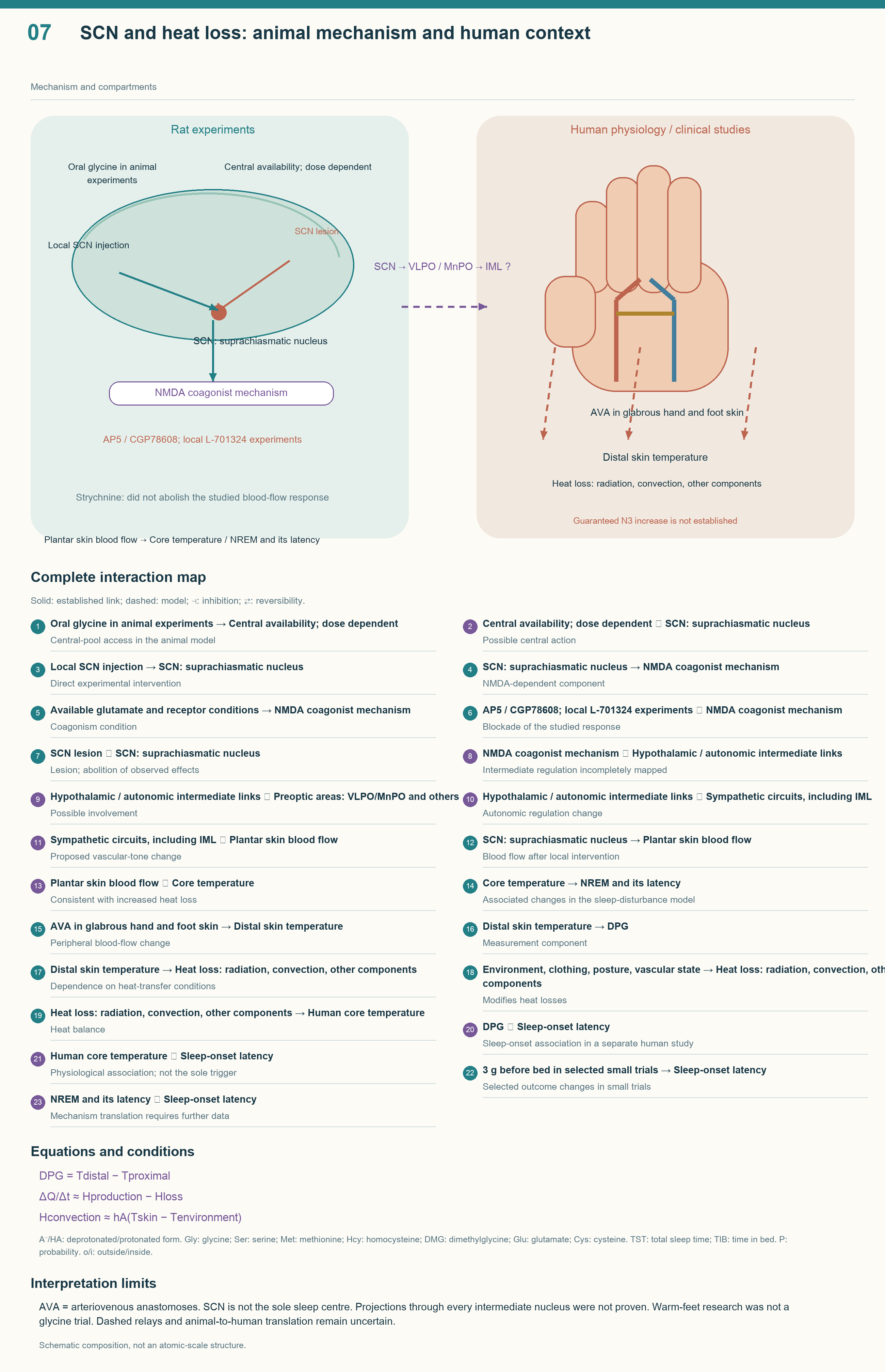
Kawai's study examined rats, including a model of acute sleep disturbance. Oral glycine was associated with changes in NREM sleep and temperature, while central administration allowed investigation of cutaneous blood flow. SCN microinjections increased blood flow at the plantar surface; SCN lesions abolished the observed sleep and temperature effects. This combination supports SCN involvement in the animal model studied but does not reveal the precise proportion of human SCN receptors occupied after 3 g.
Pharmacological experiments used AP5 and CGP78608 to assess the NMDA-dependent component, strychnine for GlyR, and L-701324 in local coagonist-site experiments. Replacing these with L-689,560 and MK-801 changes the experiment's description. Increased blood flow following D-serine was consistent with a coagonist mechanism. Even this evidence does not justify saying that all effects of glycine on human sleep pass “100%” through a single route.
The SCN can be included in a thermoregulatory map without attributing a complete anatomical pathway to the study. Changes in neuronal activity, vascular responses, and abolition of effects after lesions do not establish every intermediate projection to the VLPO, MnPO, and sympathetic IML neurons. Preoptic regions are important for sleep and temperature, but the direct sequence “glycine → a specific cell → a specific axon → AVA” requires separate evidence. The infographic therefore identifies the intermediate autonomic cascade as a model and distinguishes the directly investigated links.
3.2. Distal vessels, temperature gradients, and environmental conditions
Arteriovenous anastomoses connect arterial and venous vessels while bypassing the ordinary capillary network. In the glabrous skin of hands and feet, these pathways help alter blood-flow distribution and heat transfer. Sympathetic regulation is important, but “closed during all wakefulness and fully open before every sleep episode” is too rigid a description. Ambient temperature, posture, activity, and individual vascular responses change the pattern.
DPG = Tdistal − Tproximal
DPG is the distal–proximal skin-temperature gradient, expressed in °C or, as a temperature difference, in K. It is calculated from predefined sites, such as averaged hand and foot measurements relative to more proximal trunk regions. A shift toward less negative or more positive values can reflect distal warming. Crossing zero is not an obligatory diagnostic threshold for sleep, and results are not directly comparable without matching sensor locations.
Kräuchi's warm-feet study linked cutaneous vasodilation to rapid sleep onset in humans. It did not test 3 g of glycine or demonstrate that a supplement advances DPG by 30–45 minutes. Murphy and Campbell's work likewise concerns falling core temperature and sleep initiation rather than an amino-acid dose. These publications provide physiological context while remaining independent of the SCN experiment.
ΔQ/Δt ≈ Hproduction − Hloss
Hconvection ≈ hA(Tskin − Tambient)
These simplified equations describe heat balance and one heat-loss component, not glycine-trial results. Q is stored heat, H is the rate of heat production or loss, h is the convective heat-transfer coefficient, and A is surface area. Radiation, evaporation, clothing, and contact with surfaces contribute additional terms. Warmer skin therefore facilitates cooling of internal tissues only with a suitable temperature gradient and does not support a universal promise of a 0.2–0.5 °C fall in every person's core temperature.
3.3. Temperature and circadian rhythm are related but distinct targets
The SCN organizes daily behavior, but an acute vascular response does not necessarily shift the circadian clock's phase. A change in sleep initiation does not prove correction of jet lag, shift-work problems, or melatonin secretion. Some animal experiments also examined circadian outcomes after glycine, but they cannot be combined into a guaranteed resetting of human rhythms. The practical distinction is between making a particular evening easier and treating a persistent disorder of sleep timing.
4. Sleep architecture and next-day condition
Polysomnography measures several separate characteristics: sleep onset, stage transitions, wakefulness after sleep onset, and the distribution of sleep across the night. Subjectively easier awakening is not a substitute for EEG recording, and a change in one parameter does not mean improvement in the whole architecture. Small glycine studies warrant examining the measures individually. Comparisons with medicines likewise require a particular drug, dose, and population rather than the opposition “every hypnotic disrupts sleep, every amino acid restores it.”
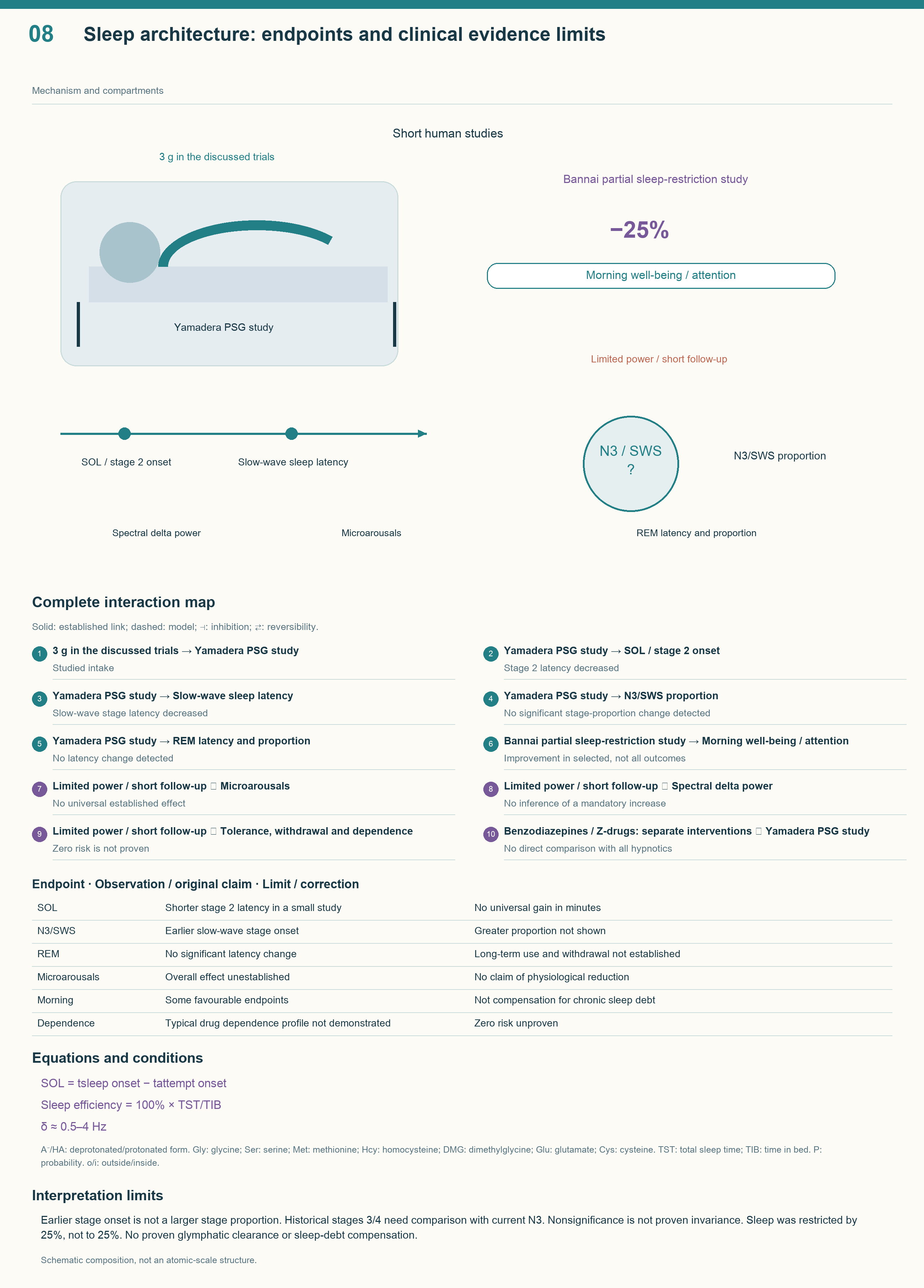
| Measure | What can be said about glycine | Limit of interpretation |
|---|---|---|
| Sleep latency, SOL | Latency to stage 2 decreased in a small PSG study | No universal reduction of 15–30 minutes is established |
| Reaching slow-wave sleep | Stage 3 appeared earlier under the classification used in that study | Earlier onset does not imply a larger total N3 proportion |
| Stage proportions | No significant change in stage distribution was detected | This does not prove complete invariance at every dose or duration |
| REM | REM latency did not change in that experiment | REM rebound after prolonged use was not separately established |
| Morning fatigue and attention | Selected small studies found improvements in certain measures | No proof of compensation for chronic sleep deprivation |
| Microarousals and delta power | The cited experiments establish no universal effect | A demonstrated glymphatic effect cannot be attributed to supplementation |
| Tolerance and dependence | The typical benzodiazepine profile was not demonstrated | Evidence is insufficient for a mathematical “zero risk” |
4.1. Latency and the first cycle: earlier arrival is not greater duration
Yamadera's study combined subjective ratings with polysomnography in a small group dissatisfied with their sleep. With 3 g of glycine, latency to the first stage 2 and to slow-wave sleep under the scoring system then used was reduced. However, the relative duration of stages across the night did not change significantly. A representative hypnogram showing deeper early sleep cannot be presented as a group-level increase in N3.
Older stages 3 and 4 require careful comparison with the modern N3 category. Latency to slow-wave sleep describes when it first appears, while percentage N3 describes its share of the entire period analyzed. Spectral delta activity, often examined around 0.5–4 Hz, is another measure and depends on the analytical method. Improvement in one does not imply the same change in the other two.
SOL = time of first sleep by the chosen criterion − start of the attempt to sleep
Sleep efficiency = 100% × total sleep time / time in bed
Both measures require predefined rules. Diary SOL can differ from latency to the first recorded stage 2, and subjective sleep efficiency is not identical to PSG-derived efficiency. This explains how someone might perceive improvement alongside only a small change in the objective record. Without comparable methods, there is no single expected gain in minutes for every user.
Connections between slow-wave sleep and restorative brain processes constitute an independent field of research. They do not establish that glycine increases β-amyloid or tau clearance in humans. The trials discussed did not measure that clinical endpoint. Claims of neurodegeneration prevention through “enhanced nocturnal clearance” therefore extend beyond their demonstrated findings.
4.2. REM and comparisons with hypnotics
Failure to detect a REM change in a small experiment is useful but does not identify which pontine neurons were unaffected. The LDT/PPT and other structures participate in sleep organization, yet their activity cannot be reconstructed from a stage-proportion table. Preservation of emotional processing, procedural memory, and ordinary dreaming also needs its own measurements. “Fully preserved REM under any regimen” is a stronger conclusion than the study supports.
Benzodiazepines and Z-drugs differ in effects on sleep stages, residual sleepiness, and adverse-outcome risks. These effects depend on the compound, elimination time, dose, and patient characteristics. The glycine studies discussed were not comprehensive head-to-head trials demonstrating superiority to all such medicines. The comparison diagram consequently preserves the clinical questions without assigning glycine a victory in every row.
4.3. Partial sleep restriction and daytime performance
In Bannai's experiment, time in bed was reduced by 25% from habitual duration, approximately from 7.3 to 5.5 hours. Sleep was not restricted to 25% of normal, as the original description could be misread. Seven men were included in the analysis, using a randomized, single-blind crossover design over several nights with 3 g given 30 minutes before bedtime. The small group and short observation period limit extrapolation to chronic insomnia or varied clinical populations.
The investigators found better psychomotor vigilance and less fatigue at selected observation times. Effects on subjective sleepiness were less clear, and not every subjective change persisted to the third day. This does not mean complete elimination of attention errors or improvement of every cognitive function. Nor does it establish a mechanism of proven “brain cooling and accelerated regeneration” or a universal short elimination half-life.
| Human study | Outcomes examined | How to interpret it |
|---|---|---|
| Inagawa crossover study | Subjective impressions after evening administration of 3 g | Better selected morning ratings are not PSG proof of more deep sleep |
| Yamadera PSG study | Onset of particular stages, sleep architecture, daytime measures | Separate significant latency changes from no detected change in stage proportions |
| Bannai partial-restriction experiment | Fatigue, sleepiness, psychomotor vigilance | A short experiment with a small sample, not a replacement for sufficient sleep |
These publications largely belong to a small research program involving an amino-acid manufacturer. That association does not invalidate the findings, but makes independent replication particularly valuable. Several papers from a closely related program are not equivalent to numerous large independent clinical trials. The practical interpretation is possible benefit for selected measures, with uncertainty about magnitude, persistence, and applicability.
5. Systemic metabolism: glutathione, conjugation, and methyl groups
Glycine is needed to synthesize structural proteins, purines, porphyrins, creatine, and several conjugates. These functions place it within overall carbon and nitrogen metabolism rather than only a neurotransmitter pool. Glutathione synthesis, acylglycine formation, and the GNMT reaction illustrate three distinct uses in detail. Their existence demonstrates glycine's biochemical necessity but does not necessarily establish benefit from supplying surplus substrate.
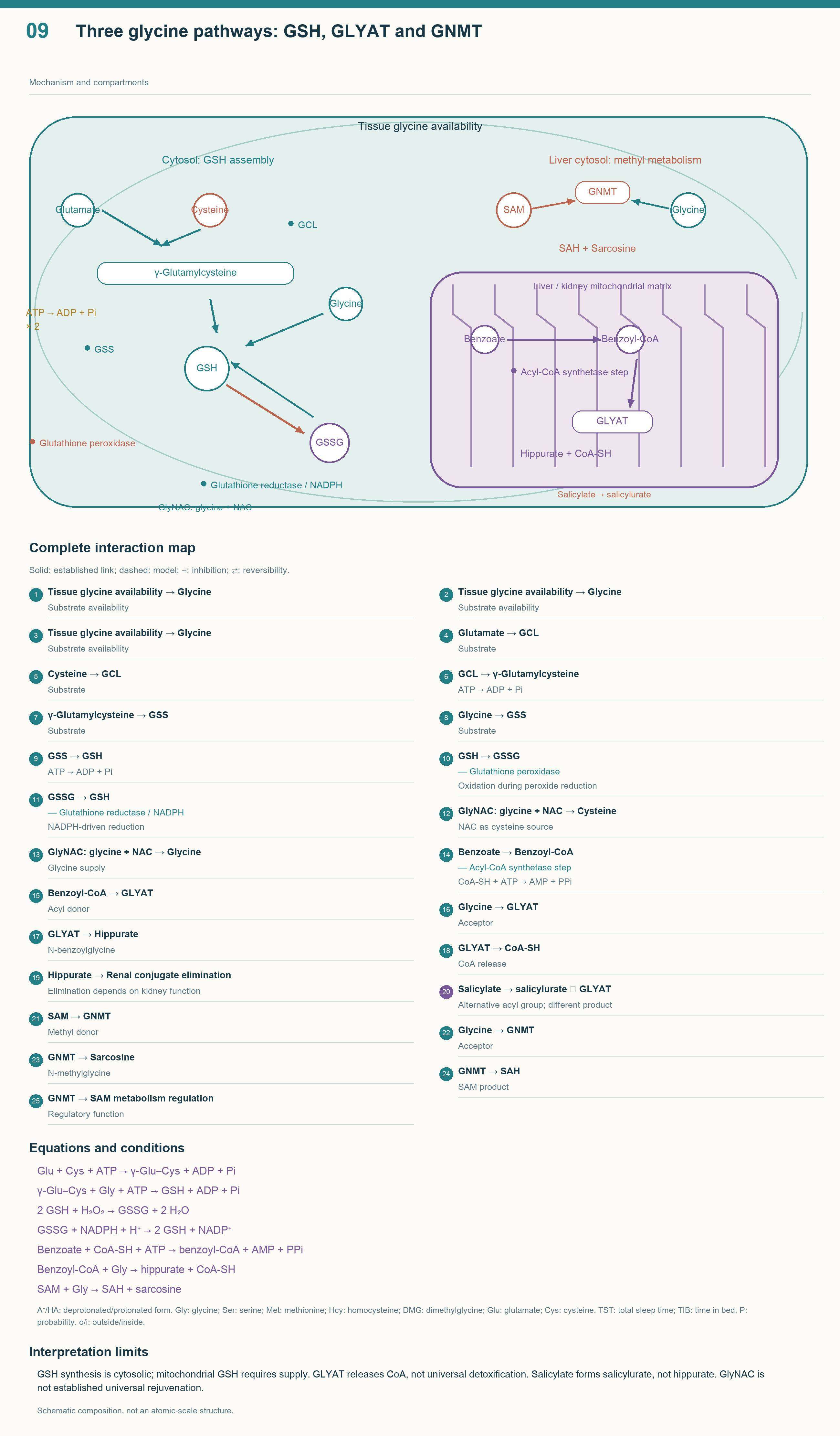
5.1. Two stages of glutathione synthesis
Reduced glutathione, GSH, is the tripeptide γ-glutamylcysteinylglycine. Synthesis starts when glutamate–cysteine ligase, GCL, joins glutamate and cysteine; glutathione synthetase, GSS, then adds glycine. Both steps consume ATP and occur mainly in the cytosol. Mitochondrial antioxidant defense needs its own pool to be supplied, so the diagram must not imply that all GSH is automatically synthesized inside mitochondria.
Glutamate + cysteine + ATP → γ-glutamylcysteine + ADP + Pi — GCL
γ-Glutamylcysteine + glycine + ATP → GSH + ADP + Pi — GSS
ATP and ADP mean adenosine triphosphate and adenosine diphosphate; Pi is inorganic phosphate. Assembly of one tripeptide therefore requires two ATP → ADP reactions. This synthesis cost must be distinguished from subsequent reduction of oxidized glutathione. All three amino acids and active enzymes remain necessary even when more glycine is supplied.
2 GSH + H₂O₂ → GSSG + 2 H₂O — glutathione peroxidase
GSSG + NADPH + H⁺ → 2 GSH + NADP⁺ — glutathione reductase
GSSG is the disulfide form produced from two glutathione units. NADPH supplies reducing equivalents to regenerate GSH; this cycle does not assemble a new tripeptide from amino acids. The reduced-to-oxidized ratio depends on the compartment and measurement conditions. Total GSH, synthesis rate, and the redox ratio therefore answer different questions.
Cysteine availability often limits synthesis, but under certain conditions glycine can also be limiting. This provides a rationale for investigating GlyNAC, a combination of glycine and N-acetylcysteine as a cysteine source. It does not demonstrate an identical double deficiency in all aging, diabetes, or inflammatory states. Combination results also cannot be assigned exclusively to glycine without a separate comparator group.
5.2. GlyNAC: a mechanistic rationale and heterogeneous clinical results
Sekhar's early study measured glutathione synthesis in older participants using isotope methods. After short-term combined precursor supplementation, erythrocyte glutathione and oxidative-stress measures changed. A later pilot extended the observation period and range of metabolic and functional outcomes. These studies support investigation of substrate insufficiency but do not prove that NAC alone necessarily fails when its isolated effect was not compared in the same design.
The Kumar group's randomized trial included 24 older participants allocated to GlyNAC or alanine placebo for 16 weeks. Favorable changes occurred in several biochemical and functional measures, with a younger group providing an additional reference. The scale was suitable for testing a concept, not proving increased lifespan or universal “reversal of aging.” Findings across numerous endpoints and additional analyses require confirmation in larger trials.
In another randomized study involving 114 healthy older volunteers, two weeks of GlyNAC did not improve the primary total-glutathione outcome compared with placebo. A possible response emerged after identifying a subgroup with unfavorable baseline measures. Doses, duration, and participants differed from the earlier trial, so this result does not refute every GlyNAC hypothesis. It does clearly limit a promise of the same effect in all healthy people.
Baseline criteria and clinical outcomes matter more in practice than the appealing word “antioxidant.” A change in a lipid-peroxidation marker is not equivalent to fewer myocardial infarctions, better sleep, or lower mortality. Adequate existing supply can constrain the response to extra substrate, and tissue pools are not necessarily represented by a single blood concentration. GlyNAC should consequently be discussed as an intervention under investigation in defined circumstances, keeping mechanism distinct from demonstrated benefit.
5.3. GLYAT: hippurate formation and CoA release
Glycine conjugation processes particular organic acids and is important in the liver and kidneys. Benzoate is first activated to benzoyl-CoA; glycine N-acyltransferase, GLYAT, then transfers the acyl group onto glycine. CoA-SH is released, and the hippurate formed can be excreted in urine. Enzyme variants and availability of both substrates affect the rate, making a fixed “detoxification capacity” for every person inappropriate.
Benzoate + CoA-SH + ATP → benzoyl-CoA + AMP + PPi — acyl-CoA synthetase step
Benzoyl-CoA + glycine → hippurate + CoA-SH — GLYAT
CoA-SH is free coenzyme A, AMP is adenosine monophosphate, and PPi is pyrophosphate. Activation cleaves ATP to AMP, so its energetic logic differs from ATP → ADP in glutathione synthesis. ACSM2B participates in activation of relevant substrates, but processing all organic acids should not be reduced to one universal isoform. Salicylate conjugation produces salicylurate, not hippurate: the product name depends on the original acyl group.
Conjugate excretion depends on kidney function, including tubular transport. Hippurate therefore cannot be described as always disappearing immediately and without consequence. Disturbed acyl-CoA metabolism and sequestration of free CoA matter in some metabolic conditions, but ordinary consumption of benzoate preservatives does not prove depletion of that pool. The pathway does not constitute advice to take glycine to “cleanse” food additives, aspirin, or arbitrary toxins.
5.4. GNMT and regulation of methyl-group metabolism
Methionine is the precursor of S-adenosylmethionine, SAM. Numerous methyltransferases use SAM's methyl group, producing S-adenosylhomocysteine, SAH. Glycine N-methyltransferase, GNMT, transfers a methyl group to glycine to form sarcosine. The reaction helps regulate the SAM pool, particularly in the liver, but cannot be interpreted as removal of surplus methyl groups without considering subsequent product metabolism.
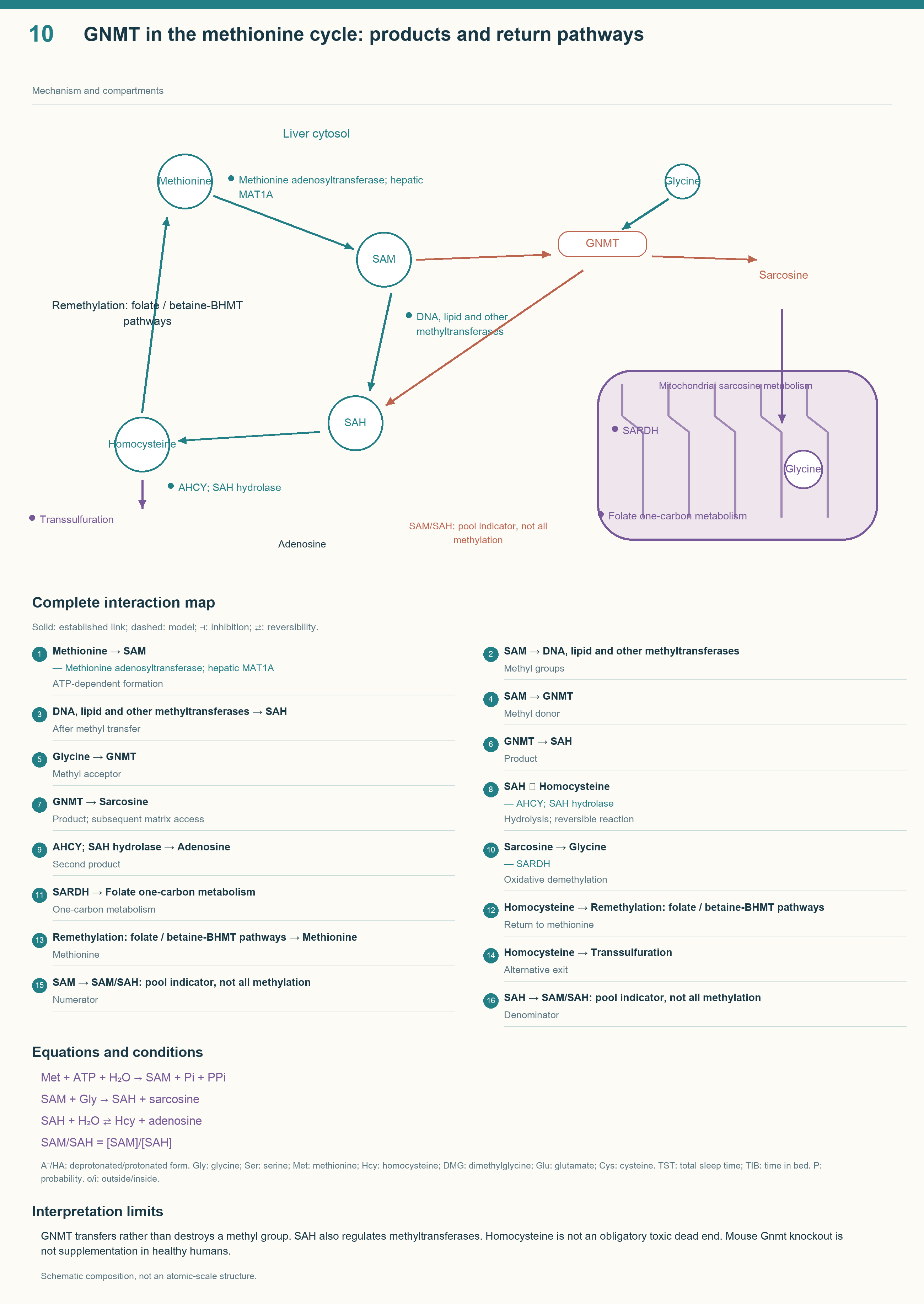
Methionine + ATP + H₂O → SAM + Pi + PPi — methionine adenosyltransferase
SAM + glycine → SAH + sarcosine — GNMT
SAH + H₂O ⇄ homocysteine + adenosine — AHCY
SAM/SAH = [SAM]/[SAH]
The SAM/SAH ratio is one indicator of methyl-group metabolism because SAH can inhibit many methyltransferases. It is not the actual methylation level at every DNA site and depends on the material examined. Sarcosine can return to glycine through SARDH, while homocysteine can undergo remethylation or transsulfuration. Showing homocysteine as the sole terminal product consequently conceals important exits from the cycle.
Mice lacking Gnmt developed abnormalities of SAM metabolism, methylation, and liver status. Genetic removal of a regulatory enzyme demonstrates its necessity but does not prove that adding glycine to a healthy person's diet prevents the same consequences. High dietary methionine does not automatically imply global genomic hypermethylation. A claim that 3–5 g of glycine neutralizes cardiovascular risks of a meat-heavy diet needs independent clinical evidence.
6. Taste, pharmacokinetics, and safety
6.1. Sweet taste and the incretin hypothesis
Glycine tastes sweet, but relative sweetness depends on concentration and the sensory comparison used. “70% as sweet as sucrose” is therefore not a universal property of every solution. Receptor studies link recognition of sweet amino acids to T1R-family complexes, including T1R2/T1R3. Species differences and cellular experimental conditions do not establish a particular glycine pose in the human receptor's Venus flytrap domain without structural data.
“Stereo-specific glycine binding” also needs care because glycine has no D- and L-enantiomers of its own. This does not negate spatial recognition by a receptor, but excludes explaining sweetness as preference for a nonexistent enantiomer. Intestinal nutrient sensing represents another regulatory level. Having a taste receptor and perceiving sweetness in the mouth does not establish clinically meaningful GLP-1 secretion after an evening dose.
In Gannon's study, nine healthy participants received glycine, glucose, their combination, or water. The amino-acid dose was 1 mmol/kg of lean body mass and the glucose dose 25 g; this was not a universal 5-g dose for people with diabetes. The combination reduced the area of the glycemic response, while insulin-response area did not increase significantly. An intestinal hormone was an interpretive hypothesis rather than proof of the sequence T1R2/T1R3 → GLP-1 → insulin.
The area under a curve over the observation period must be distinguished from its maximum height. A reduction of the former by more than half in this experiment does not mean a universal 50% reduction in peak glucose. Glycine also participates in amino-acid metabolism and is not a metabolically inert sweetener. Sweet taste and an isolated acute experiment do not justify replacing diabetes treatment or promising no hypoglycemia with every combination.
6.2. Absorption and access to the central pool
Oral glycine can rapidly increase plasma concentrations, but this observation does not establish absolute bioavailability of 95–100%. That parameter requires a suitable comparative design and accounting for the endogenous metabolic pool. Small molecular size alone does not demonstrate free passage across the blood–brain barrier. Transfer depends on barrier structures, transporter localization, concentration, and gradient direction.
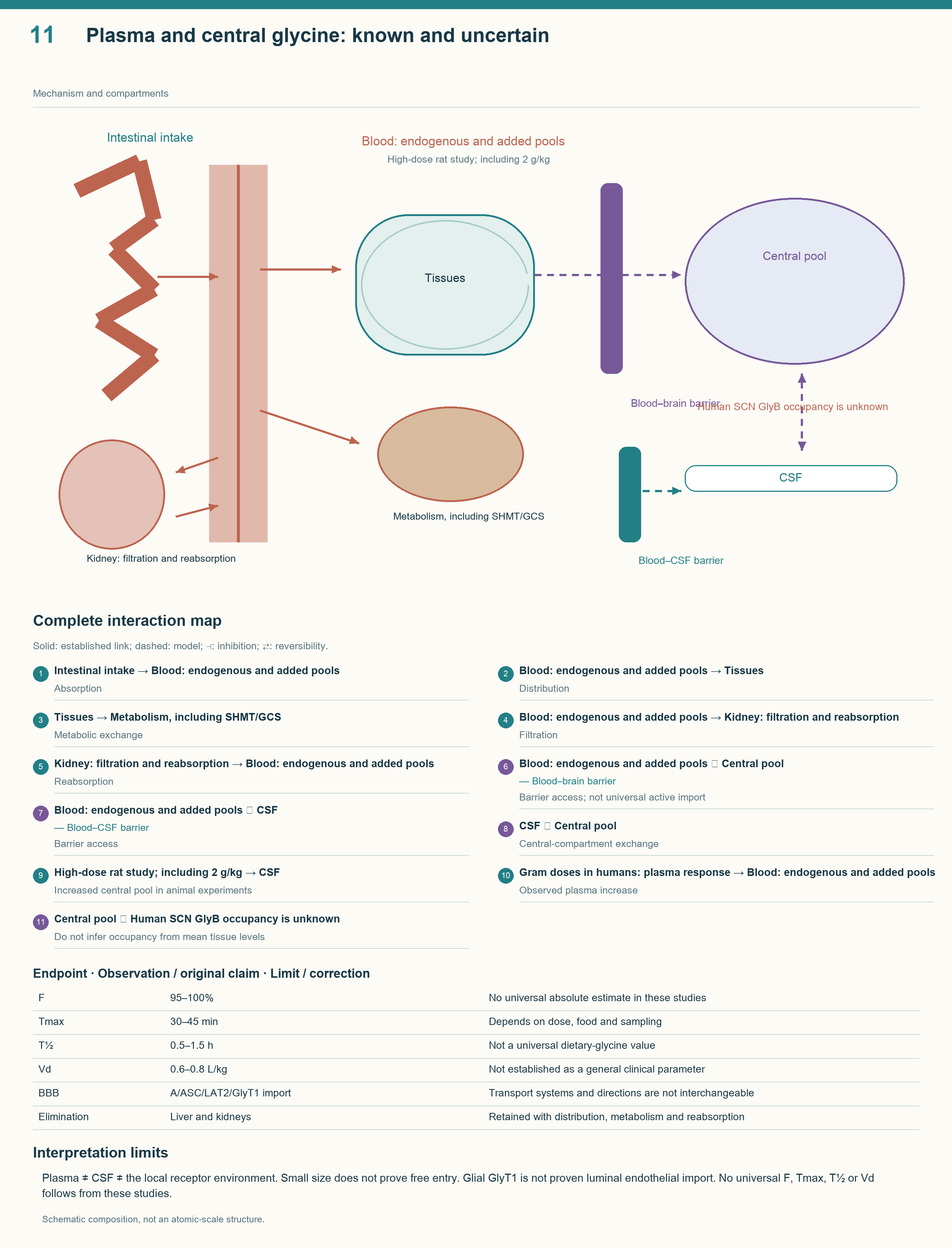
| Parameter | Supported description | What is not established |
|---|---|---|
| Oral absorption | Human experiments show increased plasma glycine after ingestion | Universal absolute F = 95–100% |
| Tmax | Depends on dose, formulation, food, and sampling schedule | The same 30–45 minutes for every regimen |
| T½ | Describes a particular concentration phase under the chosen model | Universal 0.5–1.5 hours or an explanation for no residual effects of any kind |
| Vd | Requires an appropriate pharmacokinetic model | An obligatory 0.6–0.8 L/kg for a dietary supplement |
| Brain access | High-dose rat studies show an increase in the central pool | Guaranteed human SCN GlyB occupancy after 3 g |
| Removal from plasma | Metabolism, distribution, filtration, and reabsorption contribute | Complete cessation of biological effects as soon as plasma levels fall |
Kawai's rat distribution study used much larger relative doses, including 2 g/kg. The investigators considered the blood–CSF barrier and distribution near the ventricular system rather than merely confirming rapid active entry through the transporters listed in the original text. These findings cannot be converted into a human “SCN therapeutic window” after a few grams without intermediate measurements. Glial transport through GlyT1 likewise cannot automatically be transferred to directed luminal import across brain endothelium.
For a substance with an endogenous pool, the concentration change after ingestion incorporates several simultaneous processes. Some glycine enters proteins and metabolites, some is converted to serine or degraded, and the kidney regulates filtration and reuptake. A single exponential elimination equation is consequently often inadequate for the entire trajectory. Practical discussion should identify the administration conditions actually studied rather than assign precise constants the cited human studies did not determine.
6.3. Tolerability, toxicology, and medicine combinations
Small sleep studies generally reported no serious adverse events, but their size and duration limit assessment of rare events. A separate short study of 9 g reported digestive symptoms without detected serious acute abnormalities. This provides useful information on a higher dose in a particular group. It does not prove safety of months of use across every age and condition.
Psychiatric studies did use substantially higher doses, including approximately 0.8 g/kg/day. Participants were selected, received concomitant therapy, and were monitored under a research protocol. This experience cannot authorize increasing the dose for sleep or imply absence of all liver and kidney effects. Nausea and other gastrointestinal symptoms are also not confined to one universal threshold of “20 g per dose.”
LD₅₀ describes experimental lethality in a particular animal model. Scaling a value in mg/kg proportionally to a 70-kg human does not establish a safe or lethal dose and is excluded here. Similarly, a food-regulatory status concerns conditions of substance use, not demonstrated efficacy for insomnia. US regulation of glycine's technological use in foods is not universal approval of every supplement and course.
Absence of typical drug-dependence signs in short experiments is not proof of zero risk of every withdrawal-related problem. Neither is there a general rule that additional glycine never changes receptor sensitivity or number. In cell experiments, coagonist signaling can participate in NMDA-receptor trafficking. These observations do not themselves demonstrate clinical tolerance but explain why an absolute claim of unchanging receptors is wrong.
High-dose glycine combined with clozapine was studied separately, without convincing demonstration of additional clinical benefit. Lack of improvement does not establish reduced efficacy of clozapine itself at every glycine dose. Proposed enhancement of hypnotics or attenuation of glycine effects by memantine, ketamine, and dextromethorphan rests mainly on pharmacological reasoning. It cannot be presented as a measured interaction in patients using glycine for sleep without an appropriate study.
Evidence for this application is more limited in children, pregnant or breastfeeding people, and those with substantial organ disease. Adult volunteers studied are not a universal model for these groups. Inherited disorders of glycine metabolism are particularly relevant because increasing availability need not fit a simple nutrient-replacement rationale. These limitations define applicability without replacing individual clinical assessment.
7. Practical application and limits of studied regimens
7.1. What the studied sleep dose means
The human sleep studies discussed most often used 3 g before bedtime. In one experiment restricting time in bed, administration occurred 30 minutes before sleep, but that does not prove one uniquely optimal timing window. A 5-g dose, months of continuous use, and use for jet lag cannot automatically be described as equally investigated regimens. Numerical values are useful as trial characteristics, without substituting for a recommendation for every reader.
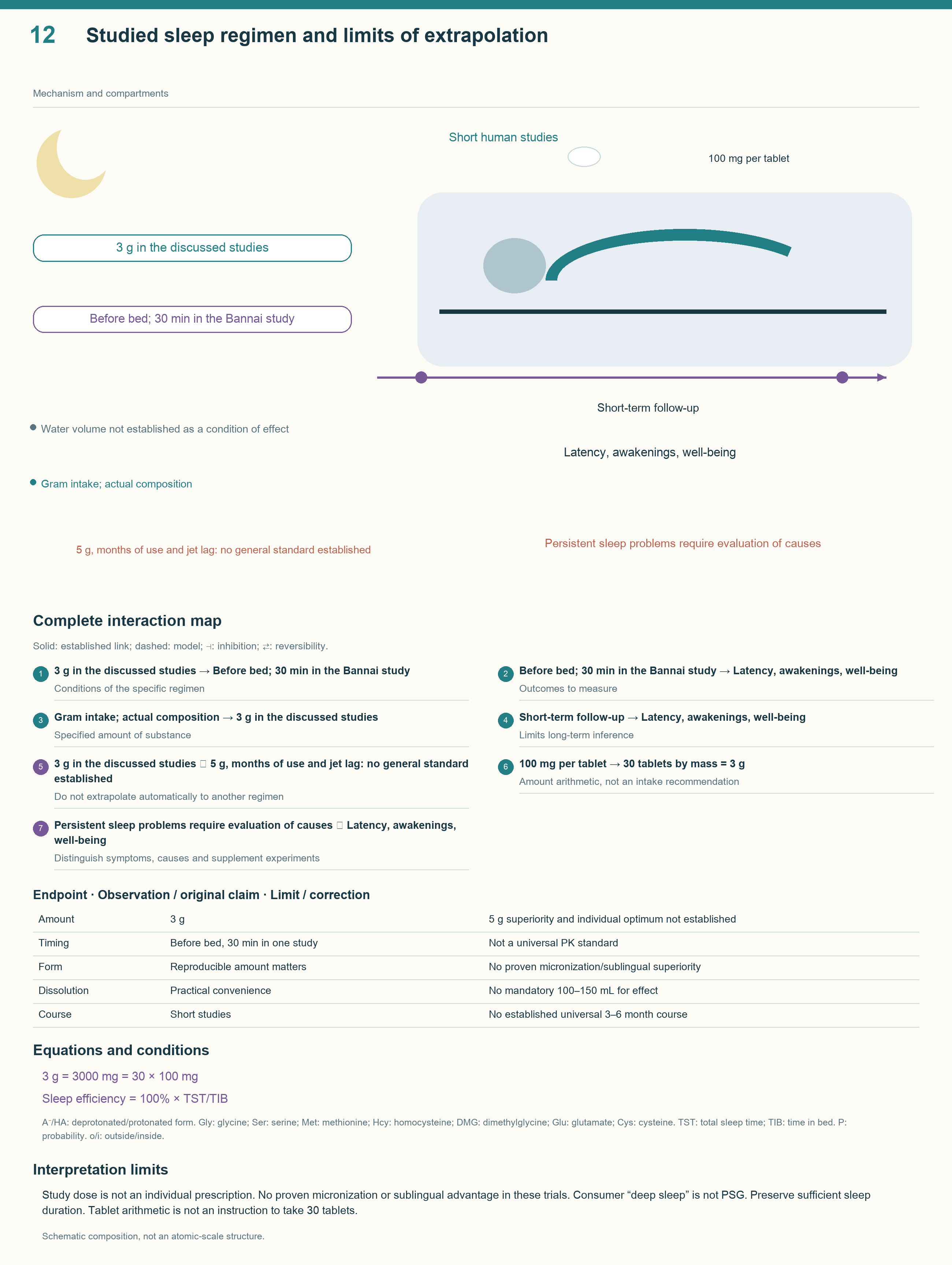
| Practical question | What follows from the studies | What remains uncertain |
|---|---|---|
| Amount | 3 g is the dose most often discussed in small sleep experiments | Individual optimal dose and any advantage of 5 g |
| Timing | Administration before bed; 30 minutes in Bannai's experiment | One 30–60-minute optimum for everyone |
| Formulation | Actual content, purity, and tolerability matter | Proven superiority of micronization or sublingual delivery |
| Dissolution | Powder permits measurement of gram quantities | Exactly 100–150 mL of water being necessary for an effect |
| Duration | Sleep data are mainly short-term | Efficacy and safety of a 3–6-month course |
| Assessment | Latency, awakenings, well-being, and sleep duration | A guaranteed N3 increase measured by a consumer device |
If a tablet contains 100 mg, 3 g equals the active-ingredient content of thirty such tablets. This arithmetic comparison explains dose differences; it is not advice to dissolve thirty tablets in the mouth simultaneously. A low dose simply does not reproduce the gram-level intake studied, while calling it a “biochemical impossibility” would require a separate comparison. Product form and additional ingredients can also alter suitability.
A personal impression is easier to interpret with clear measures recorded consistently: bedtime, estimated sleep latency, nocturnal awakenings, and daytime sleepiness. An unusually good night amid other changes does not establish the cause of improvement. Consumer estimates of “deep sleep” do not replace polysomnographic staging. The practical aim should be better sleep of sufficient duration, not replacing part of the night with a supplement.
Persistent insomnia, marked daytime sleepiness, and signs of sleep-disordered breathing require investigation of the cause. In that setting, existing glycine trials do not justify bypassing diagnosis or treatments with a more developed evidence base. Sleep depends simultaneously on timing, environment, light, behavior, and disease. Even a possible benefit for one measure does not make the amino acid a universal solution.
7.2. GlyNAC: reading research dosages
The Kumar group's randomized trial used 100 mg/kg/day each of glycine and NAC. For a body mass of 70 kg, this is 7 g of each substance, or 14 g of the combination in total. These quantities describe a monitored intervention rather than a preventive prescription for an otherwise healthy person. Cysteine doses in mmol/kg from early studies also cannot be conflated with the same numerical mass of NAC, because their molar masses differ.
Studied regimen: Dsubstance = 100 mg/kg/day × body mass
At 70 kg: Dglycine = 7 g/day; DNAC = 7 g/day
This conversion explains the published regimen without choosing a dose for the reader. In the two-week study using different doses, total GlyNAC was divided equally between the two components, which matters when interpreting a package or table quantity. Dose and duration differences complicate direct comparison of results. “2–3 g glycine plus 1200–1800 mg NAC for all healthy people” is not confirmed by these studies as a ready-made preventive standard.
The clinical target must precede selection of a combination. Glutathione level, tolerability, physical function, and sleep quality are not interchangeable outcomes. Adding a second substance changes the intervention and possible interactions. GlyNAC should therefore name the combination rather than serve as evidence for every independent glycine supplement.
7.3. High-protein diets and methionine
Glycine and methionine are metabolically linked, but the original text's obligatory supplement “methionine:glycine ratio” was not derived from a clinical trial. Protein intake of 2 g/kg does not automatically establish excess SAM or glycine deficiency. Dietary composition, overall metabolism, and the individual's condition matter. A diet cannot predict DNA methylation simply by being called “ketogenic” or “meat-based.”
Taking 3–5 g with meat has not been shown to prevent cardiovascular events or suppress pathological MAT1A activity. Studies of GNMT function and genetic models address a different question. In practice, dietary adequacy and clinical risk factors are more useful topics than promising biochemical compensation of one food by another. Glycine can be investigated as a distinct intervention but should not be prescribed as an obligatory “methionine antidote.”
8. What is established and what remains open
Glycine's receptor duality and metabolic involvement have a strong biochemical foundation. GlyR creates anion conductance whose effect depends on gradients; GluN1/GluN2 NMDA receptors use glycine or D-serine alongside glutamate and membrane depolarization. Transporters, cellular compartments, and metabolic reactions determine local amino-acid availability. This organization explains why the same molecule has no single universal neuronal action.
The sleep-related thermoregulatory mechanism has been investigated most directly in rats, while human studies support narrower conclusions about selected sleep-initiation and well-being measures. They do not establish an obligatory N3 increase, faster clearance of pathological proteins, replacement of sufficient sleep, or equal safety of every prolonged course. GlyNAC remains a separate combination under investigation, with heterogeneous findings across populations. Glycine's practical value lies in clearly specifying a research or clinical question and its limits while distinguishing a convincing mechanism from a proven therapeutic outcome.
FAQ
Does glycine inhibit the nervous system or enhance excitation?
It acts at different receptors. GlyR creates anion conductance that usually supports inhibition in mature neurons. In conventional NMDA complexes, glycine is a glutamate coagonist, so the direction of the response cannot be inferred from the substance name alone.
Is glycine proven to increase deep sleep?
A small PSG study found earlier arrival at a slow-wave stage, not a significant increase in overnight stage proportions. N3 onset, its duration, and spectral delta activity are different measures. A promised obligatory increase in deep sleep exceeds the evidence.
Is the SCN mechanism demonstrated in humans?
Detailed SCN and NMDA interventions were conducted in rats. Human thermoregulation–sleep findings provide physiological context but do not confirm every link after glycine ingestion. A fixed temperature drop in every person is not established.
Why do studies mention 3 g and 30 minutes?
These are parameters of individual short trials, not a universal prescription. The optimal dose for each person and efficacy of months of use are not established. A higher dose does not automatically have evidence of a larger effect.
Can glycine replace part of a night of sleep?
There is no such evidence. A small experiment reduced time in bed by one quarter and found improvements in selected daytime measures; it did not eliminate chronic sleep deprivation and its consequences. Sufficient sleep duration should be maintained.
Are GlyNAC and glycine for sleep the same intervention?
No. GlyNAC also contains NAC and is studied using different endpoints. Favorable findings in some studies coexist with no primary-endpoint improvement in another healthy older-adult group. Rejuvenation or equal benefit for everyone is not established.
Does glycine lower glucose through GLP-1?
An acute healthy-volunteer experiment found a lower glycemic-response area when glycine was taken with glucose. An intestinal hormone was an interpretive hypothesis; a clinical GLP-1 pathway was not demonstrated. This does not justify replacing diabetes treatment.
Does everyone who eats much meat need glycine?
A universal recommendation is not supported. GNMT involvement in methyl-group metabolism does not prove prevention of vascular events by glycine supplementation. Calculated demand estimates also do not establish deficiency in every person.
Why not provide one bioavailability and one half-life?
Glycine has an endogenous metabolic pool, and the measured curve depends on dose, distribution, and transformations. Animal findings and increased human plasma levels do not establish universal human constants or precise SCN receptor occupancy after 3 g.
Does food status mean complete safety?
It applies to defined conditions of use. Short tolerability studies do not cover every disease, medicine combination, or prolonged course. Digestive adverse effects were reported even in a small 9-g study.
Is there a difference between L-glycine and D-glycine?
Ordinary glycine has two identical hydrogen substituents on its α-carbon, making it achiral and preventing such a pair of enantiomers. Serine does have an L/D distinction: serine racemase produces D-serine from L-serine, and D-serine can occupy the NMDA coagonist site. “L-glycine” labeling alone does not identify a separate receptor-active form or supplement advantage.
Sources
- Bannai M., Kawai N. New therapeutic strategy for amino acid medicine: glycine improves the quality of sleep. Journal of Pharmacological Sciences. 2012;118(2):145–148.
- Kawai N. et al. The Sleep-Promoting and Hypothermic Effects of Glycine are Mediated by NMDA Receptors in the Suprachiasmatic Nucleus. Neuropsychopharmacology. 2015;40:1405–1416.
- Yamadera W., Inagawa K., Chiba S., Bannai M., Takahashi M., Nakayama K. Glycine ingestion improves subjective sleep quality in human volunteers, correlating with polysomnographic changes. Sleep and Biological Rhythms. 2007;5:126–131.
- Inagawa K., Hiraoka T., Kohda T., Yamadera W., Takahashi M. Subjective effects of glycine ingestion before bedtime on sleep quality. Sleep and Biological Rhythms. 2006;4:75–77.
- Bannai M., Kawai N., Ono K., Nakahara K., Murakami N. The Effects of Glycine on Subjective Daytime Performance in Partially Sleep-Restricted Healthy Volunteers. Frontiers in Neurology. 2012;3:61.
- Johnson J.W., Ascher P. Glycine potentiates the NMDA response in cultured mouse brain neurons. Nature. 1987;325:529–531.
- Betz H., Laube B. Glycine receptors: recent insights into their structural organization and functional diversity. Journal of Neurochemistry. 2006;97:1600–1610.
- Eulenburg V., Armsen W., Betz H., Gomeza J. Glycine transporters: essential regulators of neurotransmission. Trends in Biochemical Sciences. 2005;30:325–333.
- Kräuchi K., Cajochen C., Werth E., Wirz-Justice A. Warm feet promote the rapid onset of sleep. Nature. 1999;401:36–37.
- Murphy P.J., Campbell S.S. Nighttime Drop in Body Temperature: A Physiological Trigger for Sleep Onset? Sleep. 1997;20(7):505–511.
- Kumar P. et al. Supplementing Glycine and N-Acetylcysteine (GlyNAC) in Older Adults Improves Glutathione Deficiency, Oxidative Stress, Mitochondrial Dysfunction, Inflammation, Physical Function, and Aging Hallmarks: A Randomized Clinical Trial. 2023.
- Sekhar R.V. et al. Deficient synthesis of glutathione underlies oxidative stress in aging and can be corrected by dietary cysteine and glycine supplementation. American Journal of Clinical Nutrition. 2011;94:847–853.
- McCarty M.F., O’Keefe J.H., DiNicolantonio J.J. Dietary Glycine Is Rate-Limiting for Glutathione Synthesis and May Have Broad Potential for Health Protection. Ochsner Journal. 2018;18(1):81–87.
- Meléndez-Hevia E., De Paz-Lugo P., Cornish-Bowden A., Cárdenas M.L. A weak link in metabolism: the metabolic capacity for glycine biosynthesis does not satisfy the need for collagen synthesis. Journal of Biosciences. 2009;34:853–872.
- Luka Z., Mudd S.H., Wagner C. Glycine N-Methyltransferase and Regulation of S-Adenosylmethionine Levels. Journal of Biological Chemistry. 2009;284:22507–22511.
- Badenhorst C.P.S. et al. Glycine conjugation: importance in metabolism, the role of glycine N-acyltransferase, and factors that influence interindividual variation. Expert Opinion on Drug Metabolism & Toxicology. 2013;9:1139–1153.
- Gannon M.C., Nuttall J.A., Nuttall F.Q. The metabolic response to ingested glycine. American Journal of Clinical Nutrition. 2002;76(6):1302–1307.
- Mothet J.P., Parent A.T., Wolosker H., Brady R.O. Jr., Linden D.J., Ferris C.D., Rogawski M.A., Snyder S.H. D-serine is an endogenous ligand for the glycine site of the N-methyl-D-aspartate receptor. PNAS. 2000;97:4926–4931.
- Paoletti P., Bellone C., Zhou Q. NMDA receptor subunit diversity: impact on receptor properties, synaptic plasticity and disease. Nature Reviews Neuroscience. 2013;14:383–400.
- Lynch J.W. Native glycine receptor subtypes and their physiological roles. Neuropharmacology. 2009;56:303–309.
- Roux M.J., Supplisson S. Neuronal and glial glycine transporters have different stoichiometries. Neuron. 2000;25:373–383.
- Zhu H., Gouaux E. Architecture and assembly mechanism of native glycine receptors. Nature. 2021;599:513–517.
- Yu H., Bai X.C., Wang W. Characterization of the subunit composition and structure of adult human glycine receptors. Neuron. 2021.
- Huang X., Chen H., Michelsen K., Schneider S., Shaffer P.L. Crystal structure of human glycine receptor-α3 bound to antagonist strychnine. Nature. 2015;526:277–280.
- Rivera C., Voipio J., Payne J.A., Ruusuvuori E., Lahtinen H., Lamsa K., Pirvola U., Saarma M., Kaila K. The K⁺/Cl⁻ co-transporter KCC2 renders GABA hyperpolarizing during neuronal maturation. Nature. 1999;397:251–255.
- Papouin T., Ladépêche L., Ruel J., Sacchi S., Labasque M., Hanini M., Groc L., Pollegioni L., Mothet J.P., Oliet S.H.R. Synaptic and extrasynaptic NMDA receptors are gated by different endogenous coagonists. Cell. 2012;150:633–646.
- Nowak L., Bregestovski P., Ascher P., Herbet A., Prochiantz A. Magnesium gates glutamate-activated channels in mouse central neurones. Nature. 1984;307:462–465.
- Edgar A.J. The human L-threonine 3-dehydrogenase gene is an expressed pseudogene. BMC Genetics. 2002;3:18.
- Edgar A.J. Mice have a transcribed L-threonine aldolase/GLY1 gene, but the human GLY1 gene is a non-processed pseudogene. BMC Genomics. 2005;6:32.
- Ducker G.S., Chen L., Morscher R.J., Ghergurovich J.M., Esposito M., Teng X., Kang Y., Rabinowitz J.D. Reversal of Cytosolic One-Carbon Flux Compensates for Loss of the Mitochondrial Folate Pathway. Cell Metabolism. 2016;23:1140–1153.
- Ducker G.S. et al. Reversal of Cytosolic One-Carbon Flux Compensates for Loss of the Mitochondrial Folate Pathway: published erratum. Cell Metabolism. 2016;24:640–641.
- Kawai N., Bannai M., Seki S., Koizumi T., Shinkai K., Nagao K., Matsuzawa D., Takahashi M. Pharmacokinetics and cerebral distribution of glycine administered to rats. Amino Acids. 2012;42:2129–2137.
- van der Sluis R., Badenhorst C.P.S., van der Westhuizen F.H., van Dijk A.A. Characterisation of the influence of genetic variations on the enzyme activity of a recombinant human glycine N-acyltransferase. Gene. 2013;515:447–453.
- Martínez-Chantar M.L. et al. Loss of the Glycine N-Methyltransferase Gene Leads to Steatosis and Hepatocellular Carcinoma in Mice. Hepatology. 2008;47:1191–1199.
- Nelson G., Chandrashekar J., Hoon M.A., Feng L., Zhao G., Ryba N.J.P., Zuker C.S. An amino-acid taste receptor. Nature. 2002;416:199–202.
- Lizzo G. et al. A Randomized Controlled Clinical Trial in Healthy Older Adults to Determine Efficacy of Glycine and N-Acetylcysteine Supplementation on Glutathione Redox Status and Oxidative Damage. Frontiers in Aging. 2022;3:852569.
- Glycine and N-acetylcysteine (GlyNAC) supplementation in older adults improves glutathione deficiency, oxidative stress, mitochondrial dysfunction, inflammation, insulin resistance, endothelial dysfunction, genotoxicity, muscle strength, and cognition: Results of a pilot clinical trial.
- Inagawa K., Kawai N., Ono K., Sugekawa E., Tsubuku S., Takahashi M. Assessment of Acute Adverse Events of Glycine Ingestion at a High Dose in Human Volunteers. Seikatsu Eisei. 2006;50(1):27–32.
- Heresco-Levy U., Javitt D.C., Ermilov M., Mordel C., Silipo G., Lichtenstein M. Efficacy of High-Dose Glycine in the Treatment of Enduring Negative Symptoms of Schizophrenia. Archives of General Psychiatry. 1999;56:29–36.
- Evins A.E., Fitzgerald S.M., Wine L., Rosselli R., Goff D.C. Placebo-controlled trial of glycine added to clozapine in schizophrenia. American Journal of Psychiatry. 2000;157:826–828.
- Nong Y., Huang Y.Q., Ju W., Kalia L.V., Ahmadian G., Wang Y.T., Salter M.W. Glycine binding primes NMDA receptor internalization. Nature. 2003;422:302–307.
- Kirsch J., Wolters I., Triller A., Betz H. Gephyrin antisense oligonucleotides prevent glycine receptor clustering in spinal neurons. Nature. 1993;366:745–748.
- Leacock S. et al. Structure/Function Studies of the α4 Subunit Reveal Evolutionary Loss of a GlyR Subtype Involved in Startle and Escape Responses. Frontiers in Molecular Neuroscience. 2018;11:23.
- Schiavo G., Benfenati F., Poulain B., Rossetto O., Polverino de Laureto P., DasGupta B.R., Montecucco C. Tetanus and botulinum-B neurotoxins block neurotransmitter release by proteolytic cleavage of synaptobrevin. Nature. 1992;359:832–835.
- Electronic Code of Federal Regulations. 21 CFR §172.812: Glycine; условия технологического применения пищевой добавки.
- NCBI PubChem. Glycine, Compound CID 750: химическая идентификация и свойства.
- Bugarski-Kirola D. et al. Bitopertin in Negative Symptoms of Schizophrenia—Results From the Phase III FlashLyte and DayLyte Studies. Biological Psychiatry. 2017;82(1):8–16.
- Wolosker H., Sheth K.N., Takahashi M., Mothet J.-P., Brady R.O. Jr., Ferris C.D., Snyder S.H. Purification of serine racemase: Biosynthesis of the neuromodulator D-serine. Proceedings of the National Academy of Sciences of the USA. 1999;96(2):721–725.