
Xenohormesis: plant stress, cellular adaptation and the limits of longevity evidence
How plant defense chemistry interacts with Nrf2, AMPK, sirtuins and autophagy. Biosynthesis, agroecology, metabolites, pharmacokinetics and the limits of translating mechanisms into human health and lifespan.
Drought, ultraviolet radiation and pathogens alter a plant’s chemistry. Some defensive compounds subsequently interact with animal enzymes, electrophile sensors and energy pathways. Xenohormesis offers an evolutionary explanation: consumers might use changes in food chemistry as an early warning of adverse conditions. This hypothesis deserves testing, but does not establish that stressed plants or polyphenol supplements extend human life.
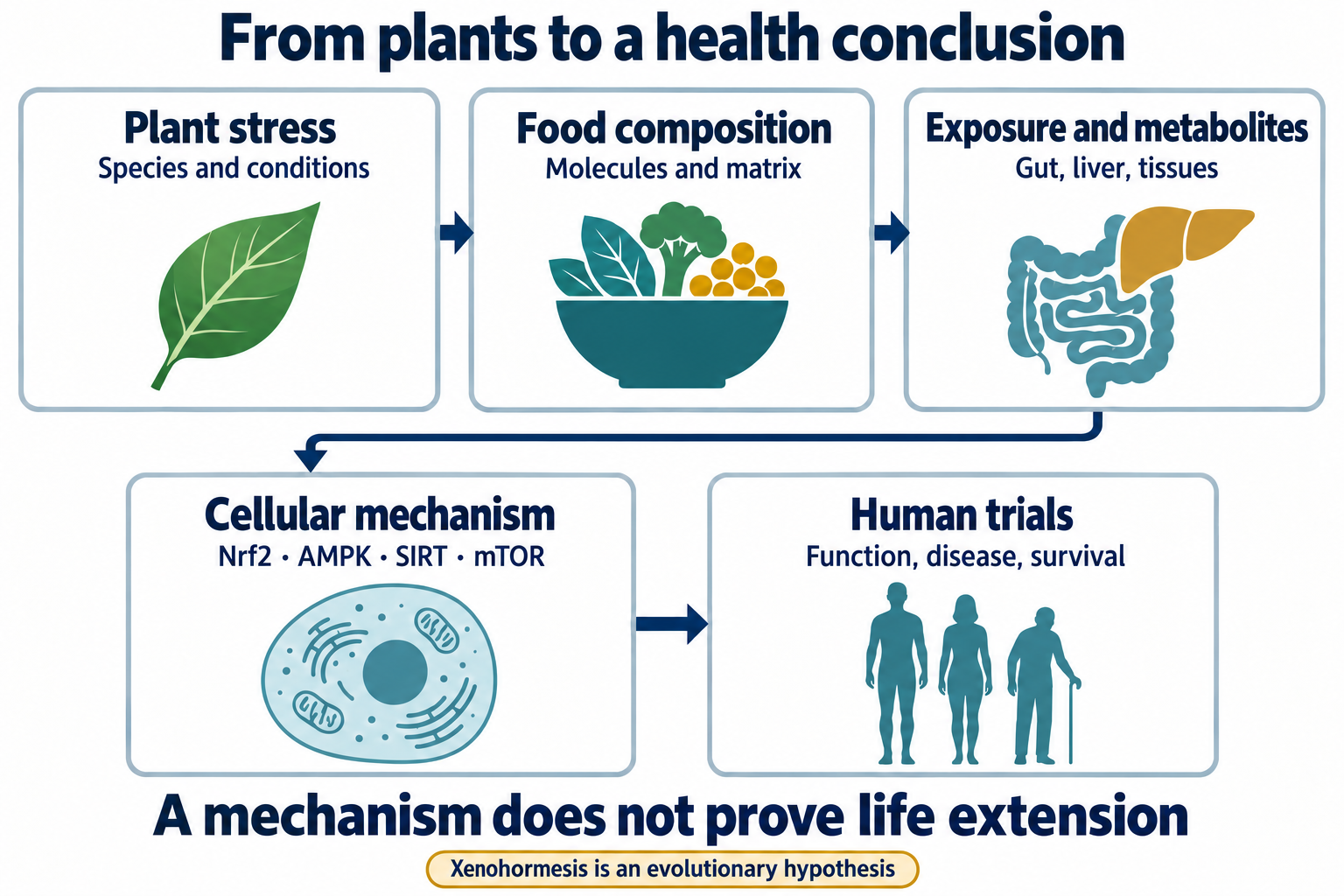
Several questions must be answered separately: what changed in the plant, which molecules and metabolites reached the consumer’s tissues, which targets responded, and whether the outcome was beneficial. Nrf2 activation, AMPK phosphorylation, altered protein acetylation and fewer senescence markers describe different events. None alone measures healthy lifespan.
1. What the xenohormesis hypothesis explains
1.1. Hormesis describes a response, not guaranteed benefit
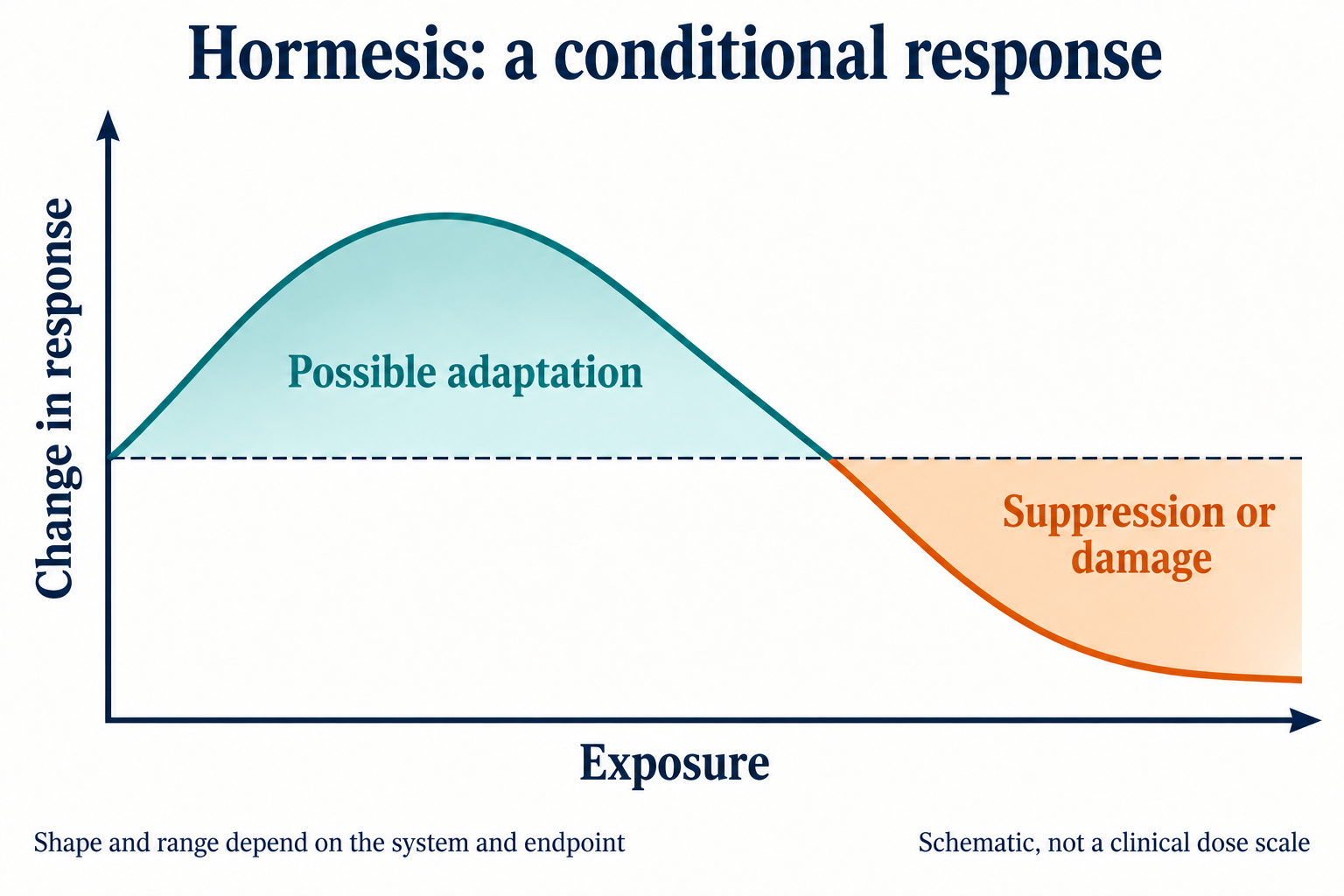
Hormesis is a biphasic relationship between exposure and a selected response: a weak stimulus may support adaptation while a stronger one suppresses function or causes injury. Depending on the endpoint, the curve can resemble a U or an inverted U. This describes a measured relationship, rather than a universal law for every molecule, tissue or disease. Pharmacology has always used several models; portraying its entire history as exclusively linear and without thresholds is inaccurate.
Adaptation can increase protective enzymes, repair and protein turnover while changing energy expenditure. A sensor can respond to electrophilic modification or transient energy changes before irreversible macromolecular injury occurs. Neither a mandatory initial injury nor a fixed severalfold amplification of every protective pathway defines hormesis. Calabrese and Baldwin, 2003.
In this illustrative model, the first term represents saturable adaptation and the second an increasing cost. It is not fitted to a study: parameters, exposure range and even the existence of a beneficial region require experiments. Duration, repeated exposure, disease and endpoint also matter. A favorable response in one measurement does not establish safety in another.
1.2. An interspecies signal and its evolutionary interpretation
Howitz and Sinclair proposed that animals might “eavesdrop” on plant stress chemistry. Defensive metabolites could signal deteriorating resources before consumers encounter scarcity. Trophic dependence and conserved cellular regulators make this plausible, but demonstrating its adaptive value requires species comparisons and ecological context. Howitz and Sinclair, 2008.
Binding between a plant molecule and a human protein does not show that the protein evolved to forecast drought. Broad chemical reactivity, ordinary xenobiotic defense and structural compatibility are alternative explanations. A xenohormetin is a candidate signal, not a pharmacologically uniform chemical class.
Howitz and colleagues linked small sirtuin activators to yeast replicative lifespan. Subsequent work clarified enzyme assays and substrate dependence. The result cannot be generalized to every sirtuin or human tissue; the article on resveratrol, pterostilbene and SIRT1 examines this distinction.
1.3. Plant defense chemistry has several biosynthetic branches
Jasmonates, salicylic and abscisic acids, ethylene and redox signals regulate growth and defense. Phenylalanine ammonia-lyase, PAL, introduces phenylalanine into phenylpropanoid metabolism. CHS and STS use acyl-CoA substrates to build flavonoid and stilbene skeletons; FLS contributes to flavonol production.
Not all defensive compounds belong to this branch. Brassica glucosinolates are sulfur-containing amino-acid derivatives; glucoraphanin is linked to methionine metabolism. Tissue injury enables their conversion into isothiocyanates. Olive secoiridoids likewise cannot be treated as ordinary products of PAL–CHS–STS.
Pigments screen radiation, phytoalexins limit pathogens, and tissue-breakdown products deter herbivores. These functions primarily benefit the plant. A greater defensive concentration does not imply a beneficial consumer dose: some defenses are toxic or reduce digestibility.
1.4. Observations that distinguish hypothesis from mechanism
Comparing an extract with a control tube is insufficient. Testing needs measured plant stress, food chemistry, consumer exposure and intervention at the proposed target. Sensor knockout, functional rescue and comparison of purified compounds with the food matrix can establish parts of a causal chain.
The evolutionary claim needs its own test: does the response improve survival in the predicted environment, and is signal recognition specific? A positive response does not necessarily exclude initial cellular stress. Xenohormesis does not certify extracts as safe substitutes for all physiological adaptive challenges.
2. Cellular nodes shared by different exposures
2.1. Keap1–Nrf2–ARE and electrophile sensing
Nrf2, encoded by NFE2L2, regulates defense against electrophiles and oxidants. Basally, a Keap1 dimer acts as the substrate adaptor for Cul3–Rbx1, promoting Nrf2 ubiquitination and proteasomal degradation. Keap1’s BTB domain supports dimerization and Cul3 binding; its intervening region contains reactive cysteines, while the Kelch domain recognizes Nrf2’s ETGE and DLG motifs.
Their different affinities help orient the substrate, although numerical constants depend on constructs and methods. Modification of Cys151 or other cysteines can impair effective ubiquitination. Dinkova-Kostova and colleagues established the importance of Keap1 sulfhydryls; this does not give every inducer one identical cysteine target.
Mandatory release of a DLG “latch” after sulforaphane is too literal an account. Baird and colleagues observed accumulation of closed complexes without obligatory release of bound Nrf2. Disrupted Keap1 recycling allowed newly synthesized Nrf2 to accumulate. Reduced effective ubiquitination, rather than universal DLG dissociation, is the defensible common conclusion. Baird and colleagues, 2013.
Nuclear Nrf2 combines with small Maf proteins at ARE elements. Responses include NQO1, glutathione-S-transferases, HMOX1, GCLC/GCLM, cystine transport through SLC7A11, and NADPH-generating G6PD, PGD and ME1. NQO1 reduces quinones by a two-electron route; heme oxygenase produces biliverdin, iron and CO; GSSG reduction uses NADPH. This is a network, so expression of one gene does not measure its overall redox performance.
Persistent Nrf2 activity can also help tumor cells survive and resist treatment. Tissue, timing and disease determine whether activation is useful. “More Nrf2” is not a general objective, and plant compounds are not all direct antioxidants.
2.2. AMPK senses energy through several activation routes
AMPK contains catalytic α, regulatory β and nucleotide-binding γ subunits. Thr172 phosphorylation is important; LKB1 and calcium-dependent CaMKK2 provide distinct activation routes. AMP-mediated allostery and protection from dephosphorylation are different regulatory events, while ADP also affects complex states.
Adenylate kinase equilibrium helps explain AMP’s sensitivity to energy depletion. Certain compounds inhibit respiration or alter ATP under particular conditions; others affect signaling enzymes. Complex-I inhibition differs from protonophore uncoupling, and neither applies to all polyphenols. Increased phospho-AMPK at a high cell-culture concentration may indicate toxic energy stress.
AMPK can inhibit ACC, lowering malonyl-CoA and its restraint on CPT1, change lipogenesis through HMGCR/SREBP, and support muscle GLUT4 trafficking through Rab-GAP regulators. PGC-1α phosphorylation links energy sensing to mitochondrial programs. Residues and activation magnitudes vary with isoform and species. Hardie and colleagues, 2012.
2.3. Sirtuins require substrates and compartment-specific NAD
Sirtuin deacetylation consumes NAD⁺ as a cosubstrate:
OAcADPR is O-acetyl-ADP-ribose. SIRT1–SIRT7 differ in localization and preferred deacylation reactions; one equation does not describe every family member’s function. Available NAD⁺, NAM and protein substrate influence activity. The NAD⁺/NADH ratio cannot replace measurement of NAD⁺ in the relevant compartment.
Early STAC assays used fluorescent peptides, prompting debate about direct activation. Hubbard and colleagues showed that some hydrophobic motifs in native substrates also support allostery, with Glu230 important for the tested activators. This supports a direct mechanism under suitable conditions, not activation of all substrates. PDB 4I5I contains the SIRT1 catalytic domain, NAD and an EX527 inhibitor analogue; it is not a resveratrol-bound STAC-pocket structure.
Cantó and colleagues linked AMPK to NAD metabolism and SIRT1 activity. NAMPT salvages NAM, while cofactor consumption also shapes the network. The NR/NMN and NAD salvage pathway provides context; this connection does not mean one polyphenol uniformly activates SIRT1, mitochondrial SIRT3 and nuclear SIRT6.
SIRT1 modifies acetylation of PGC-1α, FOXO and RelA/p65; SIRT3 regulates mitochondrial proteins including SOD2 and IDH2; SIRT6 contributes to chromatin and genome maintenance. PGC-1α, nuclear respiratory factors and TFAM govern a mitochondrial program distinct from NFE2L2/Nrf2. SOD2 regulation does not abolish all mtROS, and SIRT6 cannot be reduced to one generic form of DNA-break repair.
2.4. mTORC1, autophagic flux and selective mitophagy
mTORC1, including Raptor and mLST8, coordinates growth and protein synthesis through S6K and 4E-BP1. AMPK can limit it through TSC2–Rheb and Raptor. Both regulate ULK1, connecting nutrients to autophagy initiation. Kim and colleagues demonstrated direct ULK1 phosphorylation in their systems; specific sites do not establish a universal activation protocol.
ULK1–ATG13–FIP200–ATG101, Beclin-1/VPS34 and PI3P formation support phagophore assembly. ATG12–ATG5–ATG16L1 and ATG7/ATG3 support membrane development and LC3 lipidation with phosphatidylethanolamine. Cargo adaptors such as p62 connect selected material to disposal. Lysosomal fusion and degradation are needed to finish the process.
More LC3-II or autophagosomes can reflect increased formation or blocked completion. Flux requires dynamic measurements, and one marker does not show complete clearance of lipofuscin, persistent aggregates or organelles. During mitochondrial depolarization, PINK1 can stabilize on the outer membrane, phosphorylate ubiquitin and recruit Parkin-dependent tagging; NDP52 and optineurin help capture cargo. Other mitophagy pathways exist. Urolithin A and muscle function illustrate model-specific findings; stronger mitophagy does not prove selective removal of mutant mtDNA.
3. Chemical diversity cannot be reduced to one target
3.1. Resveratrol and pterostilbene
Stilbenes contain two aromatic rings linked through an ethylene unit. Trans-resveratrol has hydroxyl groups at 3, 5 and 4′; pterostilbene replaces two with methoxy groups. Light changes geometrical isomer proportions, and methylation affects lipophilicity, conjugation and distribution. Structure does not establish that one isomer is wholly inactive or that another reaches the human brain better.
Grapes and Japanese knotweed provide resveratrol; pterostilbene occurs in some berries and Pterocarpus wood. Food concentrations differ from standardized extracts. High pterostilbene bioavailability figures often come from particular animal experiments, not universal human pharmacokinetics. Riche and colleagues’ short-term safety trial did not measure lifespan.
3.2. Quercetin and fisetin
Flavonols have a C₆–C₃–C₆ skeleton with 3-hydroxyl and 4-oxo groups. Quercetin has five hydroxyls including a 3′/4′ catechol pair; fisetin lacks the 5-hydroxyl. This affects hydrogen bonding and metabolism, but cannot by itself predict senolytic selectivity or a decisive ring rotation.
Hydroxyl and carbonyl groups participate in metal binding and redox chemistry. Quercetin also interacts with proteins, including kinases, depending on concentration. Chelation does not invariably prevent oxidation: complex composition and medium matter, as the Fenton reaction illustrates.
Capers, onions and buckwheat contain quercetin; strawberries and some fruits contain fisetin. Variety, plant part and sample preparation affect amounts. Dietary quantities are not equivalent to concentrations used to eliminate senescent cells in culture.
3.3. Sulforaphane forms after tissue disruption
Sulforaphane is an aliphatic isothiocyanate, not a polyphenol. Glucoraphanin and myrosinase become able to interact after chopping or chewing. Thioglucoside hydrolysis and rearrangement can yield sulforaphane, while pH, specifier proteins and processing alter the product mix. Sinigrin belongs to a different isothiocyanate branch and is not its precursor.
The N=C=S group forms dithiocarbamate adducts with thiols. This contributes to Keap1 modification and glutathione metabolism, but reversibility does not ensure safety at any concentration or restrict reactions to Cys151. Zhang and colleagues isolated sulforaphane as an enzyme inducer; Fahey and colleagues investigated precursor-rich sprouts. Experimental induction is not proof of preventing all human cancers.
3.4. Curcumin and assay difficulties
Curcumin is a diphenylheptanoid with phenolic groups and a conjugated diketone region. Keto–enol proportions depend on solvent and conditions. Solubility, degradation, protein binding and oxidation further affect the available compound; there is no universally correct tautomer description for every aqueous setting.
Electrophilic regions can react with nucleophiles, including cysteine. Changes in Nrf2, IKK/NF-κB or STAT3 require checks of specificity, stability and assay interference. Multiple changed signals do not establish a highly specific information ligand. Delivery changes exposure, but useful delivery must still improve a clinical endpoint.
3.5. EGCG: beverage and extract are different exposures
Epigallocatechin-3-gallate is a galloylated flavan-3-ol from green tea. Phenolic groups govern redox behavior, while stereochemistry and flexibility affect protein interactions. Cell studies investigate the 67-kDa laminin receptor, signaling enzymes and epigenetic targets; these findings do not imply simultaneous clinical action on all proposed pathways.
Catechin oxidation in culture medium can produce hydrogen peroxide and affect assays. Parent-compound effects must be separated from medium and oxidation products. Concentrated extracts differ from tea: Dostal and colleagues observed ALT elevations, limiting claims that natural electrophilic stimulation is always safe.
3.6. Olive secoiridoids and hydroxytyrosol
Oleuropein is a glycosylated secoiridoid containing a hydroxytyrosol moiety. Removing glucose produces an aglycone; free hydroxytyrosol requires further transformations, including hydrolysis. One β-glucosidase step therefore does not directly convert the whole molecule to free hydroxytyrosol.
Hydroxytyrosol is a catechol-containing phenylethanoid. Olive-oil composition varies with cultivar, ripeness, processing and storage. Free compounds, derivatives and food matrices are not interchangeable with isolated products. ORAC measures a chemical assay, not units of vascular protection or longevity. Olive-oil dietary evidence also cannot isolate one phenolic molecule.
| Compound | Formula | Molar mass, g/mol | Structural feature |
|---|---|---|---|
| Resveratrol | C₁₄H₁₂O₃ | 228.25 | Trihydroxystilbene |
| Pterostilbene | C₁₆H₁₆O₃ | 256.30 | Two methoxy substituents |
| Quercetin | C₁₅H₁₀O₇ | 302.24 | Pentahydroxyflavonol |
| Fisetin | C₁₅H₁₀O₆ | 286.24 | Tetrahydroxyflavonol |
| Sulforaphane | C₆H₁₁NOS₂ | 177.29 | Isothiocyanate and sulfoxide |
| Curcumin | C₂₁H₂₀O₆ | 368.38 | Conjugated diketone region |
| EGCG | C₂₂H₁₈O₁₁ | 458.37 | Galloylated catechin |
| Oleuropein | C₂₅H₃₂O₁₃ | 540.51 | Secoiridoid glycoside |
| Hydroxytyrosol | C₈H₁₀O₃ | 154.16 | Catechol phenylethanoid |
Formula and mass characterize identity, not effective dose. Comparing activity requires purity, isomer composition, free concentration and an identified experimental system.
4. Agroecology and food composition
4.1. Growth and defense are not a simple switch
Carbon–nutrient balance and growth–differentiation models address plant resource allocation. Nitrogen, light and water can change defensive metabolites, but species, organ, development and stress intensity modify the response. Carbon is not allocated exclusively to either biomass or defense. Bryant and colleagues, 1983.
Pesticides do not eliminate every stress signal or necessarily suppress all phenylpropanoids. Barański and colleagues’ meta-analysis found average differences between cultivation systems; it does not show that every industrially grown plant contains severalfold less beneficial chemistry. Composition differences are not direct measurements of consumer health or xenohormesis.
4.2. Water, UVR8 and elicitors involve trade-offs
Deficit irrigation can alter hormonal signals and fruit chemistry, while severe drought reduces photosynthesis and yield. Increased concentration per fresh weight can partly reflect less water. Comparisons need dry mass, content per fruit and total product yield; increases of hundreds of percent are not a general rule.
UV-B is sensed through UVR8–COP1–HY5 and can promote protective pigmentation. Biological elicitors, including some cell-wall components, affect plant immune networks. These approaches require crop-specific measurements of yield, composition and injury; they do not establish a universally safe stress regimen that improves food.
4.3. Wild plants, cultivars and food-source safety
Wild berries and mountain plants may have interesting metabolite profiles. Comparing wild and cultivated samples, however, mixes genetics, soil, maturity, organ and measurement methods. Universal superiority of every wild plant for every xenohormetin is unproven.
Chemical richness cannot replace correct identification or contamination assessment. A molecule’s defensive role in plants and benefit to humans are separate questions. Agroecological origin is a research variable, not an independent clinical property.
5. Exposure from food to target tissue
5.1. Absorption and first-pass metabolism
An isolated molecule’s activity matters only at achievable exposure. Resveratrol is well absorbed but rapidly conjugated, leaving much less free parent compound than total derivatives. Walle and colleagues, 2004. Low parent bioavailability does not mean absent absorption; high absorption does not ensure access to every tissue.
UGT produces glucuronides, SULT sulfates, and COMT methylates certain catechols. These reactions alter solubility, transport and targeting. Conjugates are neither automatically inactive waste nor guaranteed active prodrugs.
This schematic shows a reaction type. Enzyme location, conjugate isomer and clearance determine exposure. Capsule dose, plasma concentration and intracellular concentration are separate quantities.
5.2. Microbiota transforms the substrate
Unabsorbed compounds reach the colon, where microbial enzymes cleave glycosides and ring structures into phenolic acids and other products. Ellagitannins can pass through ellagic acid to urolithins, including urolithin A, a dibenzo-α-pyrone derivative. Production depends on microbial metabotype and is not universal.
Equol production from daidzein likewise requires a suitable community. Equal portions do not guarantee equal exposure, and not every metabolite crosses the blood–brain barrier. Giving urolithin A experimentally and eating a plant precursor need separate comparisons. Ryu and colleagues, 2016; Andreux and colleagues, 2019.
5.3. Local deconjugation and membrane partitioning
β-Glucuronidase can release aglycones from certain glucuronides under specific conditions. Ishisaka and colleagues demonstrated processing of quercetin derivatives in macrophage models. This supports local metabolism, not therapeutic delivery of every polyphenol to every inflamed organ.
Lipophilic compounds can partition into membranes and interact differently with proteins there. This does not prove a universal hundredfold increase in active concentration. Free fractions, intracellular distribution and target engagement need measurement.
5.4. The gap between cell culture and people
Cell experiments often use micromolar concentrations while dietary free-parent exposure may be much lower. Translation must account for duration, protein binding, metabolites and toxicity. Microbiota, membranes and deconjugation cannot automatically close this gap.
A useful program links analytical pharmacokinetics, target engagement and outcomes. Nrf2 changes only at cell-damaging concentrations do not demonstrate beneficial dietary adaptation. A metabolite reaching a tissue needs its own activity test rather than inherited claims about its parent aglycone.
6. Evidence for health and lifespan
6.1. Simple organisms and mammalian context
Yeast and invertebrates help test genes and nutritional conditions. Survival effects depend on strain, food, solvent and mortality analysis. Howitz and colleagues, 2003; Wood and colleagues, 2004. Mammalian experiments must additionally consider sex, starting age and underlying disease.
Baur and colleagues, 2006, found improved health and survival in mice receiving a high-calorie diet. Pearson and colleagues, 2008, found some functional improvements without longer life on a standard diet. Improvement of diet-associated pathology is not equivalent to extending normal lifespan or universally mimicking calorie restriction.
6.2. Cardiometabolic outcomes and dietary interventions
PREDIMED studied a Mediterranean diet supplemented with olive oil or nuts in 7447 high-risk participants. The 2018 reanalysis addressed departures from randomization procedures. Reduced major cardiovascular events support the tested dietary intervention, but do not isolate hydroxytyrosol or prove evolutionary xenohormesis. Estruch and colleagues, 2018.
Isolated resveratrol trials differ. Poulsen and colleagues, 2013, studied 24 men with obesity for four weeks and found no improvement in clamp-measured insulin sensitivity or several other outcomes. AMPK, SIRT1 and FOXO mechanisms cannot guarantee benefit; hepatic FOXO1, for example, may support gluconeogenesis. Tissue and state determine direction.
6.3. Nervous-system mechanisms and clinical gaps
Experiments link some phytochemicals to inflammatory signaling, mitochondria and CREB–BDNF regulation; FNDC5 and APP processing through ADAM10 are also discussed. A neuronal-culture pathway does not demonstrate dementia prevention or improved human memory. Brain exposure and appropriate clinical endpoints remain necessary.
An M1/M2 microglial division simplifies diverse cellular states. Lowering one inflammatory marker does not establish restoration of a neural network. Parent compounds, their metabolites and effects on immune cells must be distinguished from cognitive outcomes.
6.4. Senolytics, senomorphics and selectivity
Senescent cells can sustain SASP, but not every p16-positive cell is irreversibly senescent, and SASP components have context-dependent roles. Senolytics reduce selected cells; senomorphics alter secretion. Quercetin and fisetin sensitivity depends on cell type and stress model. Zhu and colleagues, 2015; Yousefzadeh and colleagues, 2018.
Hickson and colleagues, 2019, tested dasatinib plus quercetin openly in nine patients with diabetic kidney disease, assessing tissue markers after a brief course. This was not a lifespan trial or a quercetin-only experiment. Fisetin, SASP and senolytic selectivity discuss these distinctions. Mouse doses and cycles do not define self-administered human protocols.
6.5. Different endpoints require different conclusions
Antioxidant responses, muscle strength, myocardial infarction and all-cause mortality measure different outcomes. A significant change in one cannot be called slowing of all aging. Controls, sample size, duration, baseline risk and adverse effects determine interpretation.
| Study and model | Observation or measurement | Unsupported inference |
|---|---|---|
| Baur, 2006: high-calorie-fed mice | Resveratrol-associated survival and metabolic outcomes | Longer life on every diet |
| Pearson, 2008: standard-fed mice | Some health changes without longer lifespan | Functional improvement equals longevity |
| Estruch, 2018: PREDIMED, 7447 people | Major cardiovascular events after dietary change | Isolated hydroxytyrosol effect or proof of xenohormesis |
| Poulsen, 2013: 24 men, four weeks | No established improvement in insulin sensitivity and several measures | Obligatory metabolic benefit of resveratrol |
| Hickson, 2019: nine patients, open label | Senescent-cell markers after D+Q | Quercetin-alone benefit, lower mortality or a preventive protocol |
| Andreux, 2019: early urolithin A trial | Safety and selected molecular measurements | Longer human lifespan or equivalent ellagitannin action |
7. Food, delivery and conditions of use
7.1. Diet is a multicomponent intervention
Vegetables, berries, nuts and olive oil supply fiber, fatty acids, micronutrients and phytochemicals together. Their effects cannot be reduced to one stress signal. Dietary diversity supports discussion of food sources without establishing a necessary daily amount of each polyphenol.
Chopping and heating alter matrices and enzymatic products, particularly myrosinase-dependent broccoli chemistry. Hydrolysis matters for olive compounds and other glycosides. Raw or more concentrated does not universally mean better.
7.2. Formulation changes exposure
Liposomes, micelles, particles and accompanying fats can alter particular compounds’ dissolution and absorption. Specific formulations, metabolites and outcomes require comparison; a technology label does not guarantee brain delivery. Greater exposure may increase adverse effects as well as desired effects.
Piperine and other mixture ingredients can change metabolism and transport, with consequences for medicines. “Bioenhancer” does not substitute for interaction testing. One formulation’s findings do not generalize to all curcumin or resveratrol products.
7.3. Timing and recovery
Energy and stress pathways interact with circadian regulation. Experimental administration time should be documented alongside feeding and activity. No general clinical morning or evening window has been established for these phytochemicals.
Response depends on duration and recovery, but this does not validate arbitrary supplement cycles. Fisetin pulses or nighttime urolithin cannot be prescribed from a pathway diagram. Chronopharmacology requires direct comparison in the target population.
7.4. Shared pathways do not establish synergy
Nrf2, AMPK, sirtuin and mTOR effects make combinations plausible research subjects. Convergence may produce synergy, antagonism or excessive stress. Different proposed targets alone do not prove combined benefit.
D+Q is a distinct investigational intervention containing a drug. It is not equivalent to eating onions and berries, nor evidence for any longevity stack. Comparisons need each component, the mixture and suitable controls.
7.5. Safety depends on the product and person
Foods and concentrated extracts create different exposures. In a one-year randomized green-tea-extract trial involving 1075 women, ALT elevations were recorded. Dostal and colleagues, 2015. Natural origin excludes neither liver injury, interactions nor intolerance.
Liver and kidney function, pregnancy, medicines and planned procedures alter risk assessment. Polyphenols do not share one CYP interaction mechanism or a universal preoperative stopping interval. Monitoring requires clinical context; this article establishes neither mandatory laboratory panels nor a treatment regimen.
8. Comparing mechanisms without a potency ranking
8.1. Chemical class and evidence level
Reactivity, metabolism and experimental targets differ. The table describes these differences and translation barriers, rather than ranking supplements by promised life-years. Binding constants, cellular EC50 and clinical doses are not interchangeable.
| Compound | Investigated feature | Main interpretive limit |
|---|---|---|
| Resveratrol | Stilbene; context-dependent SIRT1 and energy regulation | Substrate dependence and low free-parent exposure |
| Pterostilbene | Methoxylated stilbene with different distribution | Animal pharmacokinetics do not establish clinical superiority |
| Quercetin | Flavonol; metabolites, inflammation and some senolytic models | Tissue, conjugation and distinction from D+Q |
| Fisetin | Flavonol; senotherapeutic experiments | Cell/model dependence; no established human longevity |
| Sulforaphane | Isothiocyanate; thiol reactivity and Nrf2 | Precursor conversion and electrophilic-stress context |
| Curcumin | Polyphenolic diarylheptanoid | Solubility, stability and assay artifacts |
| EGCG | Galloylated catechin | Culture oxidation and concentrated-extract safety |
| Oleuropein | Secoiridoid glycoside and hydrolysis products | Food matrix; PREDIMED cannot isolate its effect |
| Hydroxytyrosol | Catechol-containing phenolic alcohol | Chemical antioxidant activity is not clinical benefit |
8.2. Convergence on cellular resilience
Redox control, energy sensing and damaged-component turnover are connected, explaining interest in phytochemicals. Similar convergence also occurs with non-dietary interventions. It does not establish evolved recognition of plant stress: plant signals, consumer availability and adaptive outcomes need evidence.
Resilience has limits. Protecting tumor cells, suppressing necessary growth or changing autophagy excessively can be undesirable. Research must define conditions, costs and duration of useful responses, rather than maximize every proposed longevity pathway simultaneously.
9. Conclusion and methodological note
Xenohormesis links plant ecology to consumer adaptation in a testable hypothesis. Individual compounds provide biochemical tools for studying Nrf2, AMPK, sirtuins, mTOR and autophagy. Conclusions are strongest when molecules, exposure, targets and outcomes are measured, and weakest when a mechanism is extrapolated to longer human life.
Dietary benefit, isolated-compound activity and evolutionary validation need different studies. None automatically establishes the others. Keeping these levels separate preserves the hypothesis’s scientific value without universal promises or self-prescribed protocols.
How this article was prepared
The full original was read, retaining plant biochemistry, agroecology, pharmacokinetics, cellular pathways, functional outcomes and safety. Targeted primary checks addressed SIRT1 activation and PDB 4I5I, Keap1–Nrf2 dynamics, standard-diet lifespan, macrophage deconjugation, a negative resveratrol trial, early D+Q research and green-tea-extract safety. Ishisaka authorship and Hubbard’s PMID were corrected.
Some primary pages exposed only abstracts or indexed material because full text was inaccessible. This is not a claim to have read every source in full, and the selective verification was not a systematic review. Tables distinguish systems and endpoints. Figures are conceptual, with no clinical dose scale; arrows mark stages requiring evidence, not demonstrated causality. No new experiment or individual supplement protocol is presented.
FAQ
Does Nrf2 or AMPK activation prove longer life?
No. A cellular pathway is a separate endpoint. Health or survival claims require appropriate outcomes, exposure measurements and safety evidence.
Are stressed plants always healthier foods?
No. Species, conditions and stress intensity matter, and fresh-weight concentration can change because of water content. More defensive chemistry does not guarantee a beneficial human dose.
Why does cell culture not establish supplement doses?
Culture concentration differs from free tissue exposure after absorption, conjugation and clearance. Metabolites and matrices also affect responses; a clinical regimen requires its own trial.
Can this establish a universal stack or dosing time?
Shared pathways do not demonstrate synergy. Combinations, cycles and timing require direct comparisons in the target population; the article does not establish a self-administered treatment protocol.
Sources
- Howitz KT, Sinclair DA. Xenohormesis: Sensing the Chemical Cues of Other Species. Cell. 2008;133:387–391.
- Howitz KT et al. Small molecule activators of sirtuins extend Saccharomyces cerevisiae lifespan. Nature. 2003;425:191–196.
- Calabrese EJ, Baldwin LA. Hormesis: the dose-response revolution. Annu Rev Pharmacol Toxicol. 2003;43:175–197.
- Dinkova-Kostova AT et al. Direct evidence that sulfhydryl groups of Keap1 are the sensors regulating induction of phase 2 enzymes that protect against carcinogens and oxidants. PNAS. 2002;99:11908–11913.
- Baird L et al. Regulatory flexibility in the Nrf2-mediated stress response is conferred by conformational cycling of the Keap1-Nrf2 protein complex. PNAS. 2013;110:15259–15264.
- Hardie DG, Ross FA, Hawley SA. AMPK: a nutrient and energy sensor that maintains energy homeostasis. Nat Rev Mol Cell Biol. 2012;13:251–262.
- Cantó C et al. AMPK regulates energy expenditure by modulating NAD+ metabolism and SIRT1 activity. Nature. 2009;458:1056–1060.
- Hubbard BP et al. Evidence for a common mechanism of SIRT1 regulation by allosteric activators. Science. 2013;339:1216–1219.
- Kim J et al. AMPK and mTOR regulate autophagy through direct phosphorylation of Ulk1. Nat Cell Biol. 2011;13:132–141.
- Baur JA et al. Resveratrol improves health and survival of mice on a high-calorie diet. Nature. 2006;444:337–342.
- Pearson KJ et al. Resveratrol delays age-related deterioration and mimics transcriptional aspects of dietary restriction without extending life span. Cell Metab. 2008;8:157–168.
- Wood JG et al. Sirtuin activators mimic caloric restriction and delay ageing in metazoans. Nature. 2004;430:686–689.
- Yousefzadeh MJ et al. Fisetin is a senolytic that extends health and lifespan. EBioMedicine. 2018;36:18–28.
- Zhu Y et al. The Achilles’ heel of senescent cells: from transcriptome to senolytic drugs. Aging Cell. 2015;14:644–658.
- Hickson LJ et al. Senolytics decrease senescent cells in humans: Preliminary report from a clinical trial of Dasatinib plus Quercetin in individuals with diabetic kidney disease. EBioMedicine. 2019;47:446–456.
- Ryu D et al. Urolithin A induces mitophagy and prolongs lifespan in C. elegans and increases muscle function in rodents. Nat Med. 2016;22:879–888.
- Andreux PA et al. The mitophagy activator urolithin A is safe and induces a molecular signature of improved mitochondrial and cellular health in humans. Nat Metab. 2019;1:595–603.
- Zhang Y et al. A major inducer of anticarcinogenic protective enzymes from broccoli: isolation and elucidation of structure. PNAS. 1992;89:2399–2403.
- Fahey JW, Zhang Y, Talalay P. Broccoli sprouts: an exceptionally rich source of inducers of enzymes that protect against chemical carcinogens. PNAS. 1997;94:10367–10372.
- Walle T et al. High absorption but very low bioavailability of oral resveratrol in humans. Drug Metab Dispos. 2004;32:1377–1382.
- Ishisaka A et al. Mitochondrial dysfunction leads to deconjugation of quercetin glucuronides in inflammatory macrophages. PLoS ONE. 2013;8:e80843.
- Estruch R et al. Primary Prevention of Cardiovascular Disease with a Mediterranean Diet Supplemented with Extra-Virgin Olive Oil or Nuts. N Engl J Med. 2018;378:e34.
- Poulsen MM et al. High-dose resveratrol supplementation in obese men: an investigator-initiated, randomized, placebo-controlled clinical trial of substrate metabolism, insulin sensitivity, and body composition. Diabetes. 2013;62:1186–1195.
- Dostal AM et al. The safety of green tea extract supplementation in postmenopausal women at risk for breast cancer: results of the Minnesota Green Tea Trial. Food Chem Toxicol. 2015;83:26–35.
- Riche DM et al. Analysis of safety from a human clinical trial with pterostilbene. J Toxicol. 2013;2013:463595.
- Bryant JP, Chapin FS, Klein DR. Carbon/Nutrient Balance of Boreal Plants in Relation to Plant Defenses. Oikos. 1983;40:357–368.
- Barański M et al. Higher antioxidant and lower cadmium concentrations and lower incidence of pesticide residues in organically grown crops: a systematic meta-analysis of the literature. Br J Nutr. 2014;112:794–811.
- RCSB PDB 4I5I: SIRT1 catalytic domain bound to NAD and an EX527 inhibitor analogue.
Related materials
- Resveratrol and pterostilbene: stilbene chemistry, SIRT1, and the limits of bioavailability
- Urolithin A: PINK1/Parkin mitophagy, muscle function, and limits of the evidence
- Fisetin, senolytics, and SASP: mechanisms, preclinical evidence, and limits of clinical data
- NR and NMN: the NAD⁺ pathway, cellular transport, and clinical limits