Resveratrol and immune signalling: STAT3, NF-κB and the contradictions of SIRT1
STAT3, NF-κB and NAD⁺-dependent deacetylation; conflicting Th17/Treg findings, pharmacokinetics and positive and negative clinical trials.
STAT3, NF-κB and NAD⁺-dependent deacetylation; conflicting Th17/Treg findings, pharmacokinetics and positive and negative clinical trials.
Resveratrol attracts interest in immunology because it changes several processes in experimental systems: cytokine signalling, protein acetylation, energy metabolism and the production of inflammatory mediators. Yet the phrase “suppresses inflammation” conceals substantial uncertainty. The same enzyme can reduce inflammatory gene transcription in a macrophage while supporting the Th17 programme in a T lymphocyte. A change in a cell-culture marker also does not establish that taking capsules reduces autoimmune disease activity.
Resveratrol should therefore be considered a research molecule with context-dependent effects, rather than a selective STAT3 inhibitor or a universal activator of an anti-inflammatory programme. Understanding its potential requires three separate lines of evidence: which reaction actually changes, whether the relevant exposure is achieved in the body, and whether an outcome that matters to patients improves. These lines do not yet converge across all diseases.
Resveratrol is 3,5,4′-trihydroxystilbene, with the formula C₁₄H₁₂O₃ and a molecular mass of approximately 228.24 g/mol. Two aromatic rings are joined by an ethylene bridge; the geometry of the double bond distinguishes the trans and cis forms. Most biomedical experiments use trans-resveratrol. Light can alter the isomer composition, so product composition, solvent and storage conditions matter for reproducibility. The name of the substance alone does not guarantee identical experimental material.
In plants, it contributes to a defence response rather than being a regulator specifically designed for human immunity. Stilbene synthase, a type III polyketide synthase, uses p-coumaroyl-CoA and three molecules of malonyl-CoA. Successive decarboxylative condensations extend the carbon chain; subsequent cyclisation and an additional loss of a carboxyl group produce the stilbene scaffold. CoA carries activated acyl groups, while malonyl groups supply carbon fragments. The related chalcone synthase uses similar starting substrates but directs cyclisation towards a different product class. This illustrates how the completion of an enzymatic reaction determines biologically distinct molecules.
The phenolic hydroxyl groups participate in hydrogen-transfer chemistry and influence interactions with proteins, but radical scavenging in a test tube does not establish a systemic antioxidant effect. In living cells, the result depends on concentration, medium, metabolism and exposure time. At high concentrations, a reduction in inflammatory signalling may accompany energy stress, cell-cycle arrest or reduced viability. Without controlling these processes, beneficial regulation cannot confidently be distinguished from general toxicity.
STAT3 is a transcription factor. It does not transfer phosphate from ATP to other proteins and is not a kinase. In the classical pathway, a cytokine such as IL-6 binds to a receptor complex that includes gp130. Associated JAK kinases use ATP as the phosphate donor, phosphorylate receptor sites and create docking sites for signalling proteins. The STAT3 SH2 domain recognises phosphotyrosine-containing sites; phosphorylation of Tyr705 then promotes dimer formation and accumulation of the active factor in the nucleus.
The dimer interacts with regulatory DNA regions and changes transcription in cooperation with other proteins. Consequently, the same degree of STAT3 phosphorylation can have different consequences in an epithelial cell, a tumour cell and a T lymphocyte. Ser727 phosphorylation also influences STAT3 function, but its contribution depends on the signal and cellular compartment. Some STAT3 functions involve mitochondria and cannot be reduced to this nuclear sequence. A single phospho-STAT3 immunoblot cannot reconstruct all these processes.
Receptor dynamics, SOCS proteins and phosphatases limit the signal. Tyrosine phosphatases genuinely catalyse phosphotyrosine hydrolysis; describing them as “non-catalytic brakes” is incorrect. SHP2 also participates in signal transmission, including through MAPK, so its presence does not invariably mean simple pathway termination. Even a negative-feedback component has a function that depends on timing and the particular receptor complex.
In several cell models, resveratrol reduces STAT3 phosphorylation or the expression of STAT3-dependent genes. This observation admits multiple explanations: altered receptor signalling, kinase or phosphatase activity, cellular energy status, or protein acetylation. It does not automatically demonstrate that resveratrol directly occupies the SH2 pocket. Such a claim requires independent binding experiments, quantitative biophysics, competition studies and functional validation. Precise affinity constants and lists of contacting amino acids cannot be transferred from computational docking into a description of an established mechanism.
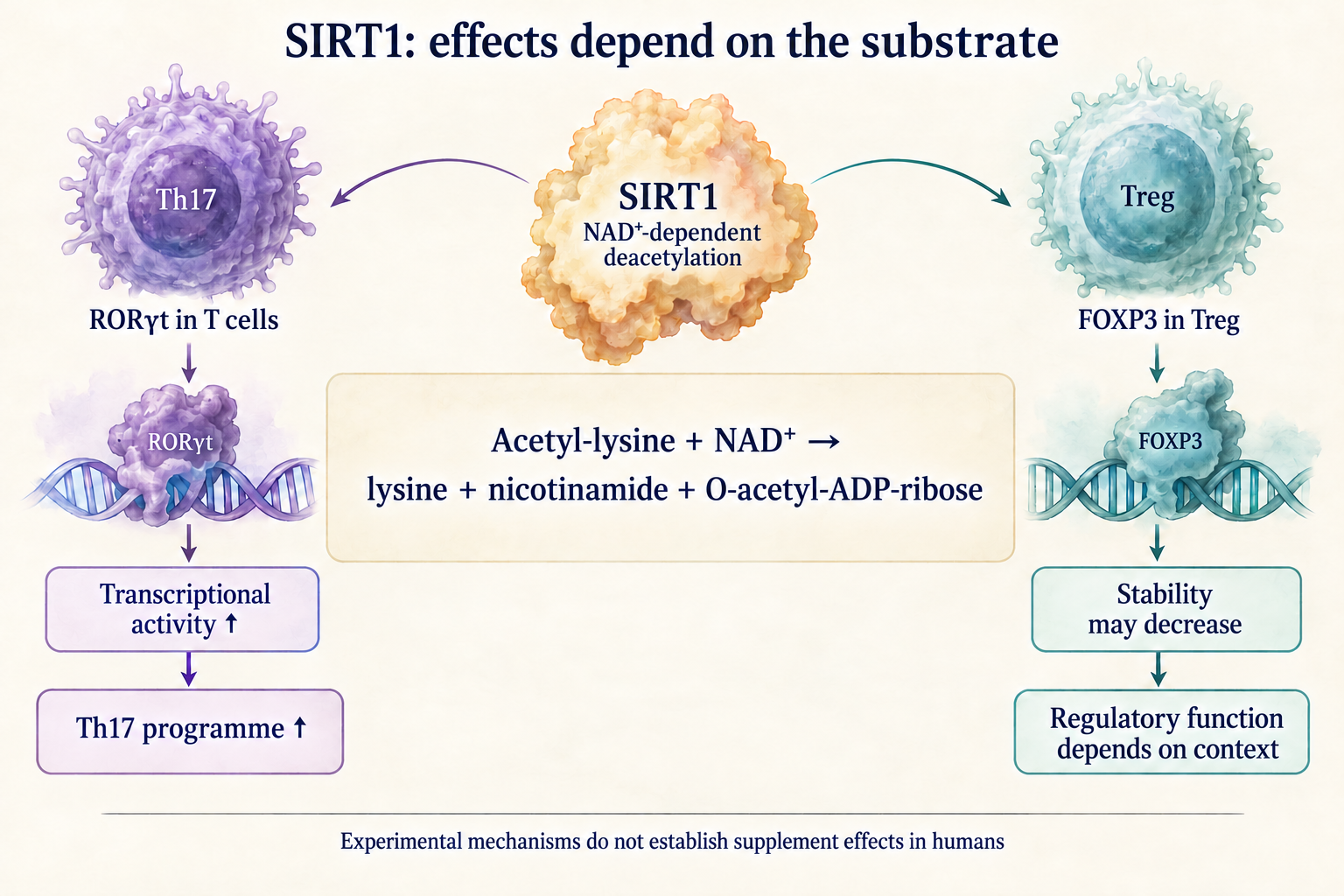
Acetyltransferases, including p300, transfer an acetyl group from acetyl-CoA to protein lysine residues. This changes charge, interactions and sometimes protein stability. SIRT1 is an NAD⁺-dependent deacetylase: its reaction converts acetylated lysine and NAD⁺ into deacetylated lysine, nicotinamide and O-acetyl-ADP-ribose. NAD⁺ is a consumed cosubstrate here, rather than merely an abstract “longevity cofactor”. Activity depends on substrate availability, reaction products and cellular conditions.
SIRT1 acts mainly in nuclear and cytoplasmic regulatory processes. It should not be confused with mitochondrial SIRT3, nor should a change in one sirtuin be taken to describe all cellular deacetylation. Possible deacetylation of STAT3, NF-κB, FOXO or other proteins also cannot be added together as an invariably beneficial effect: each substrate has its own partners and functions.
The history of resveratrol as a “direct SIRT1 activator” illustrates the importance of measurement. Early enzyme assays used labelled peptides. Subsequent studies found that stimulation disappeared when some artificial substrates were replaced with unlabelled ones, challenging universal direct activation. Later biochemical and structural studies demonstrated the possibility of allosteric, substrate-dependent stimulation: particular hydrophobic elements of a substrate can help form a suitable interaction. These findings do not completely cancel one another, but they constrain generalisation. Resveratrol does not increase deacetylation of every physiological protein equally, and the effect on one test peptide is not a property of the whole organism.
Lakshminarasimhan and colleagues tested 6,802 physiological acetylation sites on peptide microarrays. They used 200 μM resveratrol and 1 mM NAD⁺ during a two-hour incubation; some reactions increased, others decreased, and most changed little. Tests of selected unlabelled peptides in solution supported sequence dependence. These conditions are useful for enzymology but do not describe the usual free-resveratrol concentration after taking a supplement.
RORγt, a transcriptional regulator of Th17, is particularly important. In the primary study by Lim and colleagues, SIRT1 deacetylated RORγt and increased its transcriptional activity and Th17 generation. T-cell Sirt1 deletion or pharmacological inhibition reduced this programme and protected mice in experimental autoimmune encephalomyelitis. Thus, the chain “resveratrol activates SIRT1, therefore it suppresses Th17” conflicts with the established mechanism in this system.
Limagne and colleagues reported a different result in another experimental setting in 2017: pharmacological SIRT1 agonists, including resveratrol, reduced mouse and human Th17 differentiation. The effect was linked to STAT3 deacetylation, reduced nuclear translocation and reduced binding to the Rorc promoter. This accompanied restricted tumour growth in mouse tumour models. The clinical component concerned metformin in cancer patients, so it cannot be presented as a resveratrol trial. Together with the RORγt study, this result demonstrates differences between basal SIRT1 activity, pharmacological intervention and the particular substrate. Selecting just one study as a universal rule would be misleading.
FOXP3 provides another example. Acetylation can stabilise this protein and reduce its ubiquitination and proteasomal degradation. In relevant models, SIRT1-dependent deacetylation can weaken FOXP3 stability and T-cell regulatory function. It is therefore incorrect to claim that FOXP3 deacetylation always enhances Treg. These findings do not mean that resveratrol invariably worsens immune regulation; they mean that the direction of the effect must be measured in the specific system.
CD4⁺ lymphocyte differentiation depends on combinations of signals, antigen stimulation and the tissue environment. IL-6 and STAT3 contribute to the Th17 programme alongside RORγt; IL-23 supports particular states of these cells. TGF-β signalling has different consequences depending on accompanying cytokines. FOXP3 and support through IL-2/STAT5 are important for Treg. Describing each molecule as exclusively inflammatory or exclusively protective simplifies the system beyond usefulness.
Th17 contribute to mucosal defence and responses against certain extracellular microorganisms. Their reduction is not a universal therapeutic advantage. Treg restrain excessive reactions, but excessive suppression can also have undesirable consequences. Cellular states are additionally plastic: expression of a single marker does not always represent a stable functional lineage.
In resveratrol experiments, cell proportions, absolute cell counts, cytokine production and actual suppressive function must be distinguished. A lower percentage of IL-17⁺ cells resulting from death of activated lymphocytes is not equivalent to restored immune tolerance. A change in the blood Treg/Th17 ratio need not reflect conditions in the intestine, joint or central nervous system. Clinical conclusions require evidence about the relevant tissue and disease outcomes.
In canonical NF-κB signalling, IκB proteins retain the transcription factor. Activation of the IKK complex directs phosphorylated IκB towards ubiquitination and proteasomal degradation, allowing NF-κB components to accumulate in the nucleus. Transcription then depends not only on factor abundance but also on modifications and coactivators. Deacetylation of p65/RelA, particularly Lys310, can reduce certain transcriptional responses. This is one possible SIRT1-dependent node, rather than proof that every resveratrol effect passes exclusively through it.
Models stimulated with LPS or amyloid have been used to investigate changes in microglial TLR4/NF-κB/STAT signalling. These experiments help explain inflammatory cell responses but cannot be equated with treating neurodegeneration or systemic autoimmunity. Compound concentration, exposure time, culture conditions and viability assessment determine whether the result specifically reflects signal regulation.
Another branch involves cAMP and AMPK. Phosphodiesterases hydrolyse cAMP to 5′-AMP; reduced activity can alter signalling through PKA and Epac. Park and colleagues linked some metabolic effects of resveratrol to inhibition of cAMP phosphodiesterases and downstream signalling changes. AMPK is a complex sensitive to energy status, and phosphorylation of its catalytic subunit at Thr172 is regulated by upstream kinases, including LKB1 and CaMKK. This is a multistep network, rather than evidence of direct, selective AMPK activation by a resveratrol capsule.
Mitochondrial changes and ATP, ADP and AMP relationships can influence this network independently of direct SIRT1 binding. Thus, coincident AMPK activation and lower inflammatory markers do not establish the causal sequence. Useful approaches include genetic disruption of the proposed node, independent inhibitors, measurements of energy metabolites and assessment of the temporal order of events. Each method has limitations, so agreement between several approaches is most persuasive.
Production of mature IL-1β also requires distinguishing transcriptional priming from subsequent inflammasome activation. NF-κB can increase the availability of the cytokine precursor and NLRP3 components, but lower expression is not equivalent to directly blocking inflammasome assembly or caspase-1 activity. Conflating these stages attributes a more precise mechanism to the molecule than the experiment demonstrates.
In the study by Walle and colleagues, six volunteers received 25 mg of labelled resveratrol; comparison of administration routes showed high absorption but very low availability of the unchanged molecule. Absorption was at least 70%, whereas unchanged resveratrol concentrations were below 5 ng/ml. Most measured material consisted of metabolites. These findings explain why “well absorbed” and “little free compound in blood” are compatible statements.
Glucuronidation is performed by UDP-glucuronosyltransferases associated with the endoplasmic reticulum. UDP-glucuronic acid donates the glucuronic group, producing UDP alongside the conjugate. Cytosolic sulfotransferases use PAPS as the sulfate donor and form PAP. These reactions in the intestine and liver alter resveratrol distribution, solubility and elimination. Free-molecule concentrations cannot be added to all conjugate concentrations and then compared with a dose added to cell-culture medium.
Gut microbiota also modify the molecule, including reduction of its double bond to form dihydroresveratrol. This is different from producing dimers such as viniferins and does not justify treating all metabolites as interchangeable. Possible release of resveratrol from particular conjugates has been investigated in selected tissue and cell models. It does not yet establish targeted delivery of the active molecule to an inflamed human joint or brain.
A new formulation may increase exposure, but that is a pharmacokinetic result. Treatment claims require separate evidence of clinical benefit and tolerability for that specific formulation. Transferring animal findings concerning nanoparticles, piperine combinations or parenteral administration to a conventional oral supplement is inappropriate. Additional steps remain between the amount in a capsule, its blood concentration and exposure at an intracellular target.
In individual colitis and arthritis models, resveratrol reduced inflammatory changes and associated signalling markers. However, chemically induced intestinal injury, collagen-induced arthritis and human chronic diseases have different causes and immune-response structures. Preventive dosing before an experimental injury is especially poorly suited to answering whether an established disease can be treated. The starting time, administration route and outcome criterion must remain attached to each experiment when interpreting it.
The study by Sato and colleagues is particularly important: resveratrol aggravated both autoimmune and viral mouse models resembling selected aspects of multiple sclerosis. In experimental autoimmune encephalomyelitis, administration during different phases did not provide the expected protection; worsening was particularly apparent with exposure during induction. This result cannot be concealed by selecting positive models. It also does not prove that every dose harms every person, but it refutes the universal formula that immunomodulation always reduces autoimmunity.
Considered alongside RORγt and FOXP3 mechanisms, these findings explain why one signal cannot predict the whole organism. A molecule can modify several immune and metabolic processes simultaneously. A useful effect in one tissue does not exclude an adverse effect elsewhere. Translation into clinical practice requires confirmation in the specific disease, rather than grouping all models under the single word “inflammation”.
Khojah and colleagues studied 100 patients with rheumatoid arthritis, including 68 women and 32 men. They were allocated to two groups of 50: one received 1 g of resveratrol in capsules daily alongside regular treatment for three months; the other continued regular treatment. The authors reported lower DAS28, tender and swollen joint counts, and several inflammatory markers in the supplement group. However, the control description does not include matched placebo, and the published abstract does not provide a numerical between-group treatment estimate with a confidence interval. This limits assessment of benefit magnitude and potential bias.
The result is a clinical signal but does not demonstrate an effect on structural joint damage, persistence after discontinuation, or long-term safety alongside different antirheumatic regimens. It also does not establish that improvement resulted specifically from STAT3 deacetylation or a change in Treg/Th17. Independent well-controlled trials and clinically meaningful outcomes are needed for confirmation.
In the double-blind, placebo-controlled pilot by Samsami-Kor and colleagues, 50 patients with active mild-to-moderate ulcerative colitis received 500 mg resveratrol daily or placebo for six weeks. Inflammatory measures, NF-κB activity in blood mononuclear cells and quality of life were assessed; the authors reported favourable changes. The short duration and pilot scale do not equate these findings with proven long-term disease control or endoscopic healing. The difference between within-group changes and comparisons between groups also matters when assessing effectiveness.
The 2024 multicentre trial by Erol Doğan and colleagues compared a Mediterranean diet, the same diet with curcumin, and the same diet with resveratrol 500 mg daily for eight weeks in adults with mild-to-moderately active ulcerative colitis receiving medication. Methods and tables describe 48 participants, with 16 per group, whereas the opening Results text states 46; the publication also contains inconsistent numbers of women. These discrepancies cannot be repaired by assumption. The main result relevant here is that no convincing additional resveratrol advantage over diet was identified across the investigated measures. Improvement in several groups does not establish a supplement-specific effect.
The negative ARTHROL trial is especially useful for testing the transition from mechanism to symptoms. Three French centres randomised 142 adults with painful knee osteoarthritis, 71 each to a new patented resveratrol formulation or matched placebo. This double-blind trial lasted six months: 40 mg twice daily for the first week, then 20 mg twice daily. The primary outcome was change in pain on a 0–100 scale at three months. The between-group difference was −0.6 points, with a 95% confidence interval from −8.0 to 6.9; p = 0.88. No pain advantage was demonstrated.
ARTHROL investigators noted insufficient statistical power and an overly optimistic anticipated effect size during planning. Thus, the trial does not exclude every small effect under every condition. Nevertheless, it does not support a promise of substantial pain relief with this regimen, despite plausible experimental anti-inflammatory mechanisms. Osteoarthritis also cannot serve as a direct effectiveness test for rheumatoid arthritis: these are different diseases. Its relevance here is to show that an improved formulation and a persuasive laboratory mechanism do not guarantee clinical benefit.
Study doses describe experimental regimens rather than establishing a universal recommendation. Available evidence does not identify one dose for “suppressing STAT3”, “increasing Treg” or preventing all autoimmune diseases. Such a recommendation would require information about target exposure, the particular disease, formulation, interactions and clinical outcomes. Replacing prescribed treatment with a supplement on the basis of cell mechanisms is unjustified.
In the repeated-dose study by Brown and colleagues, 40 healthy volunteers took 0.5, 1, 2.5 or 5 g daily for 29 days. Mild-to-moderate gastrointestinal symptoms occurred at 2.5 and 5 g; short observation in healthy participants does not determine the safety of prolonged chronic-disease treatment. Chow and colleagues studied 42 volunteers taking 1 g daily for four weeks. Phenotypic indices of CYP3A4, CYP2D6, CYP2C9 and CYP1A2 activity, measured using probe-drug metabolism, changed after the intervention. This provides human evidence relevant to potential interactions, although it cannot quantify the risk of every drug combination.
Gastrointestinal symptoms, accompanying medicines and liver and kidney status matter when assessing tolerability. Potential interactions involving metabolic enzymes and platelet function require careful interpretation: a laboratory observation does not automatically establish the size of a human risk, but missing information does not establish combination safety either. Discussion with the treating clinician is particularly important with anticoagulants, immunomodulators and other medicines requiring careful exposure control. Evidence from one short study cannot be extended to pregnancy, children or prolonged high-dose use.
Grapes and other food sources contain resveratrol within a complex food matrix. Their effects are not equivalent to a capsule containing an experimental dose. Alcohol is not a rational way to reproduce research exposure. For questions about the intestinal environment and diet, the separate discussion of dietary fibre, prebiotics and gut safety is useful: dietary effects cannot be reduced to one molecule and one cytokine.
Resveratrol remains a useful tool for investigating immune signalling. The most reliable explanation of its effects preserves distinctions between a kinase and a transcription factor, free compound and metabolites, and a cell marker and a disease outcome. It also recognises that SIRT1 can support different, sometimes opposing immune programmes. These distinctions allow promising hypotheses to be recognised without turning them into premature treatment promises.
No. Lower phosphorylation in cell models allows several mechanisms and does not by itself demonstrate direct SH2-domain binding.
No. RORγt and STAT3 studies show different directions in different systems; the result depends on substrate, cell state and intervention.
No. Rapid conjugate formation means absorption and availability of unchanged compound are different measurements.
No. Reported doses belong to specific experimental regimens; the evidence does not establish a dose for all autoimmune diseases or justify replacing prescribed treatment.