
Specialized pro-resolving mediators: the biochemistry of resolvins, protectins and maresins
EPA/DHA enzymatic pathways, stereochemistry, receptors and efferocytosis. Analytical limits of SPM measurements and findings from small studies, REDUCE-IT, STRENGTH and GAUDI.
Inflammation does not end simply because the initiating stimulus disappears. Tissue recovery requires limiting further neutrophil recruitment, removing dead cells, processing their contents and restoring epithelial barrier function. These tasks need receptors, enzymes, energy and coordination between several cell populations. Lipid signaling molecules known collectively as specialized pro-resolving mediators, or SPMs, have become extensively studied participants in this process.
Resolvins, protectins and maresins arise through described enzymatic pathways from long-chain omega-3 fatty acids; lipoxins are associated with arachidonic acid. Chemically defined molecules show biological activity in cell and animal models. However, a biological concept, detection of an endogenous substance, activity of an administered analogue and effectiveness of an oral supplement represent different levels of evidence. Very low SPM concentrations in human blood and promises to “bypass a resolution defect” with a prepared fish oil require particular care.
Resolution as a sequence of cellular tasks
During an acute response, vascular permeability and chemotactic signals help deliver cells to the injured site. Neutrophils use integrins, reorganize their actin cytoskeleton, phagocytose and release reactive oxygen species. These actions are useful within a limited location and time, but prolonged persistence of activated granulocytes damages surrounding tissue. Stopping recruitment and clearing the site therefore form a distinct part of host defense.
Classic experimental models describe lipid mediator class switching: an early profile dominated by prostaglandins and leukotrienes gives way to a different oxylipin profile. PGE2 and PGD2 can help prepare this transition by affecting lipoxygenase expression and cyclic AMP signaling. This is not a switch that simultaneously stops production of every pro-inflammatory molecule. Different cells retain different enzymatic programs, while vascular, immune and repair processes partly overlap.
There is no universal timetable in which inflammation ends at 24 hours and resolution begins thereafter. Experiments can define the time of maximal neutrophil numbers and the subsequent interval over which those numbers decline; this describes a particular model. Chronic infection, repeated injury, hypoxia and fibrosis alter the dynamics. Time intervals from mouse peritonitis cannot simply be transferred to human arthritis or atherosclerosis.
SPMs also do not encompass all resolution biology. Annexin A1, adenosine, cytokines, neural signals and receptors recognizing dead cells form an interacting network. Active resolution does not mean that every failure is caused by a shortage of one resolvin. Persistent stimulation, defective efferocytosis, substrate unavailability or cellular insensitivity to a signal may be responsible.
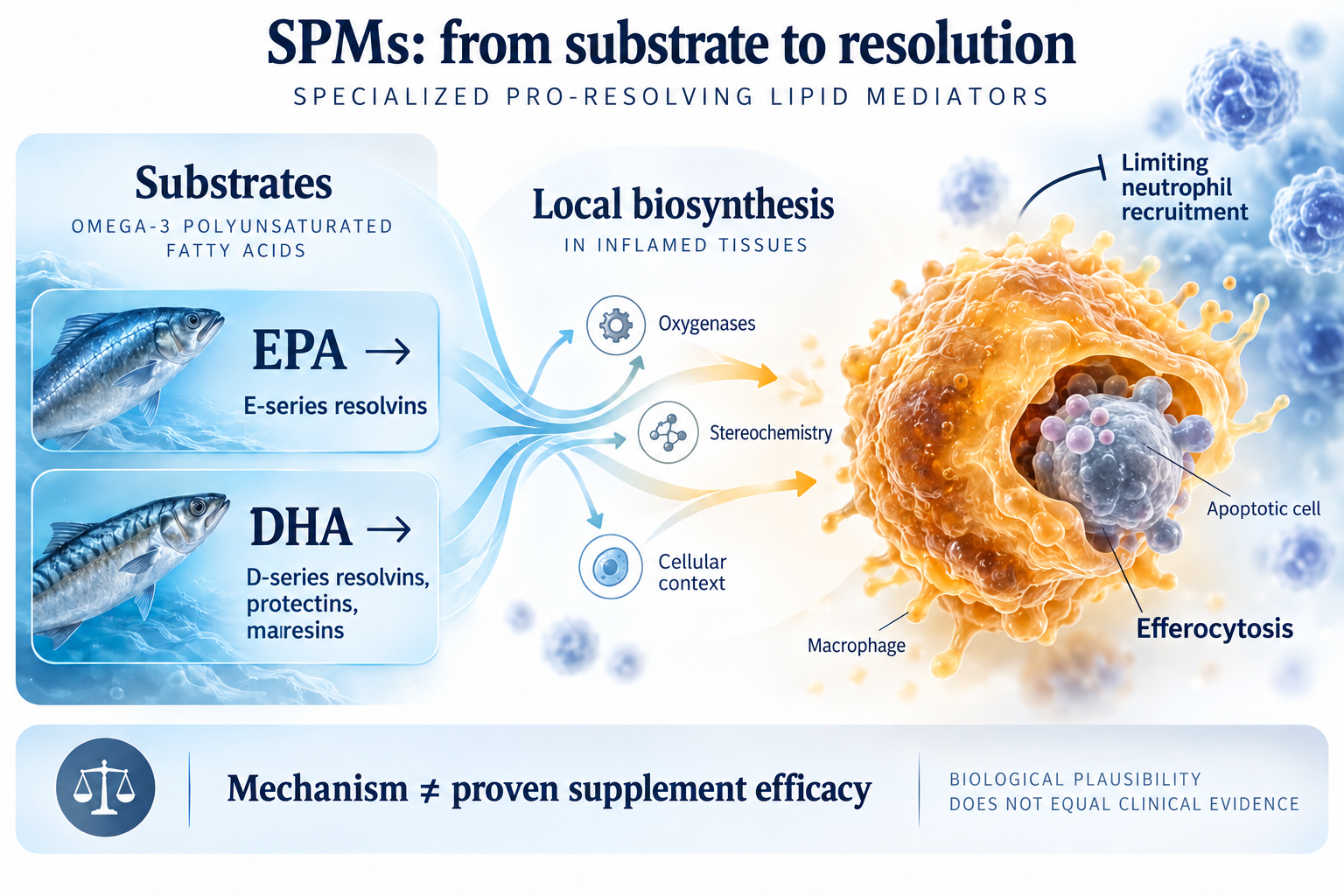
Substrate, stereochemistry and reaction location
EPA has 20 carbon atoms and five double bonds, whereas DHA has 22 carbons and six double bonds. Their membrane pools usually reside in complex lipids. Phospholipase A2 releases a fatty acid, which can then become an oxygenase substrate, be re-esterified or undergo oxidation. Consequently, erythrocyte EPA content does not equal the rate of RvE1 production in an inflamed tissue.
Lipoxygenases are iron-containing enzymes. They abstract hydrogen from a polyunsaturated substrate and facilitate addition of molecular oxygen to produce a hydroperoxide. The oxygen position, configuration of the chiral center and double-bond geometry matter. The names 17S-HpDHA and 17S-HDHA distinguish a hydroperoxide from its reduced hydroxy product; these are chemically different compounds and cannot be exchanged without explanation.
Peroxidase systems can reduce a lipid hydroperoxide to a hydroxyl group. A glutathione-dependent reaction requires reduced glutathione and subsequent regeneration of oxidized glutathione using NADPH. Nonenzymatic lipid peroxidation also produces oxygenated lipids, usually as a more complex isomer mixture. The appearance of “hydroxy-DHA” alone does not establish formation of a particular biologically active SPM.
Cellular location affects substrate availability. 5-lipoxygenase can relocate to the nuclear envelope, and FLAP helps organize its interaction with fatty acid substrate. Calcium, phosphorylation, redox status and neighboring cells alter the outcome. Transcellular biosynthesis means that one cell's intermediate is used by another, rather than every reaction necessarily occurring within one freely mixed cytosolic compartment.
Cytochrome P450 enzymes belong to another system: monooxygenation requires electron transfer, usually from NADPH through a reductase, and oxygen. COX-2 has cyclooxygenase and peroxidase functions. Aspirin acetylation changes its product profile and, in certain models, promotes epimeric pro-resolving mediators. None of these pathways establishes that everybody should take aspirin to generate SPMs.
The E series: EPA, 18-HEPE and branching pathways
The classic RvE1 pathway begins with oxygenation of EPA at C18 to generate 18-HEPE. Subsequent 5-lipoxygenase processing and an epoxide intermediate lead to a trihydroxylated product. RvE1 has the established structure 5S,12R,18R-trihydroxy-6Z,8E,10E,14Z,16E-EPA. This notation identifies a specific molecule, not every compound carrying three hydroxyl groups on EPA.
In the original study by Arita and colleagues, chemical synthesis allowed physical properties and biological effects of synthetic RvE1 to be matched to the lipid under investigation. This is considerably stronger than identification from one mass and one fragment. A dihydroxylated branch is described for RvE2, and the E series includes additional products with different oxygenation positions. RvE3 and RvE4 should not be reduced to one universal reaction or automatically assigned RvE1's receptor pharmacology.
R and S configurations at C18 depend on the enzyme and conditions. Aspirin-dependent and independent pathways have been described, but saying that native COX-2 always produces an exactly equimolar 18R/18S-HEPE mixture is too strong. Stereochemical composition needs measurement, particularly for commercial concentrates. Total 18-HEPE without isomer separation does not fully characterize a product.
18-HEPE is useful as a marker of a particular EPA metabolic branch. However, an intermediate may accumulate precisely because the next reaction is limited. An increase after oil consumption does not establish proportional RvE1 production, receptor activation or plaque stabilization. Each downstream step requires its own measurements.
The D series: DHA and the 17-oxygenated branch
For the D series, the starting point is formation of 17S-hydroperoxy-DHA through a lipoxygenase pathway. Further oxygenations and transformations of epoxide intermediates generate different products. RvD1 carries hydroxyl configurations 7S,8R,17S, whereas RvD2 carries 7S,16R,17S. Moving the third group changes molecular shape and pharmacological behavior.
RvD3 and RvD4 are associated with another oxygenation branch, while RvD5 and RvD6 are dihydroxylated compounds. The list RvD1–RvD6 therefore denotes a family, not six interchangeable names for one activity. Epoxide intermediates are labile; nonenzymatic opening can produce similar masses with different configurations and actions.
Aspirin-triggered D resolvins have a different C17 configuration, usually designated 17R. This can change susceptibility to particular inactivation routes. However, all epimers cannot be assigned the same extension of half-life or a shared clinical effect. Stability of each analogue must be established in the relevant system.
17-HDHA is often measured alongside the D series as a marker of DHA oxygenation. It is not RvD1 and does not replace the hydroperoxide intermediate in every reaction. The claim that “17-HDHA becomes any D resolvin in one step” hides additional oxygenations, epoxide transformations and stereospecific opening. Simplifying a package diagram does not simplify intracellular biochemistry.
Protectins, neuroprotectin and maresins
Protectin D1 and neuroprotectin D1 name the same structurally defined molecule in different tissue contexts. Its described configuration is 10R,17S, with a conjugated triene system. DHA oxygenation and an epoxide intermediate underpin this pathway. A similar dihydroxy product cannot automatically be called NPD1: protectin DX and other isomers must be analytically distinguished.
Cell and animal studies investigate NPD1 in retinal cell survival, neural tissue responses and macrophage activity. Its conjugated double bonds provide characteristic spectral properties that complement mass-spectrometric identification. Neuroprotective activity of administered material in a model does not establish prevention of Alzheimer's disease by a dietary supplement.
The maresin pathway involves DHA oxygenation at C14 to form a 14-hydroperoxide. A 13,14-epoxide intermediate and stereospecific transformation then produce MaR1 with configuration 7R,14S. Studies of macrophages and human 12-lipoxygenase treat this as a separate branch. Species and cellular specificity matter: the mouse designation “12/15-LOX” cannot be mechanically transferred to human isoforms.
MaR2 and MCTR conjugates extend the maresin family. Formation of peptide-lipid conjugates involved in tissue repair includes glutathione addition and sequential processing of the peptide portion; related RCTR and PCTR groups have been described in resolvin and protectin pathways. These are distinct chemical products, not merely “maresin in a capsule.” Their study links lipid signaling with regeneration without establishing a universal human treatment protocol.
n-3 DPA, a long-chain omega-3 acid with 22 carbons and five double bonds, can also generate pro-resolving lipid products. Similar names do not make them identical to DHA derivatives. Differences in double bonds affect enzymatic conversion, chromatography and spectra. Studies of EPA, DHA and DPA mixtures must consider each substrate's contribution.
Lipoxins: arachidonic acid in resolution
Arachidonic acid supplies more than pro-inflammatory prostaglandins and leukotrienes. Transcellular pathways involving 5- and 12/15-lipoxygenases produce lipoxins. Neutrophil–platelet interaction exemplifies distribution of reactions across cells. Aspirin-acetylated COX-2 can contribute 15R products from which aspirin-triggered lipoxin epimers arise.
This illustrates why the simple division “omega-6 is inflammatory, omega-3 is anti-inflammatory” is biochemically inadequate. Enzymes, cellular state, timing and receptors determine the outcome. Complete displacement of arachidonic acid is not the goal of physiological resolution. The body needs different lipid signals, including those that initiate a normal protective response.
Receptors: experimental support and remaining questions
RvE1 interactions have been described with ChemR23, also called CMKLR1, and BLT1. ChemR23 has another known ligand, chemerin; BLT1 participates in LTB4 responses. These receptors therefore do not belong exclusively to one resolvin. Specific RvE1 binding in human neutrophil membrane experiments had a Kd of 48.3 nM. This characterizes a particular experiment, not a universal minimum therapeutic concentration.
FPR2/ALX and GPR32 are frequently listed for RvD1, and GPR18 for RvD2. FPR2 recognizes chemically different ligands, with outcomes depending on cell type and signaling context. Human GPR32 expression and the absence of a direct functional counterpart in conventional mouse models complicate translation. The receptor map is a useful working hypothesis, not a permanently closed catalogue of all interactions.
In Chiang and colleagues' study, MaR1 activated LGR6 in recombinant systems; radiolabeled ligand, overexpression and gene silencing complemented functional measurements. MaR1 at 0.01–10 nM enhanced phagocytosis and efferocytosis in human and mouse phagocyte experiments. This is an experimental concentration range, not support for an oral dose. GPR37 has been proposed for NPD1, including evidence from transfected cells and Gpr37-deficient mice.
GPCR signaling can involve G proteins, intracellular calcium, ERK, PI3K–AKT and other pathways. A uniform arrow from “receptor” to “NF-κB off” oversimplifies SPM biology. These pathways also regulate migration, survival and particle uptake, with effects depending on timing and cell state. Establishing a receptor requires reproducible binding, functional responses and changes after genetic or pharmacological intervention.
Disagreement remains over reproducibility of some receptor assignments and physiologically attainable ligand concentrations. A negative result in one system does not invalidate all resolution biology, but a positive signal in a cell with artificially high expression does not establish the same action in human tissue. The gap between chemical activity and endogenous physiology is a substantive part of the question.
[[figure:resolution]]
Neutrophils and efferocytosis: stop recruitment, then clear cells
In several models, resolvins reduce neutrophil transendothelial or transepithelial migration. Possible mechanisms include altered integrin activation, LTB4 responses and actin polarization. This does not imply paralysis of all cellular movement. Neutrophils need to retain infection responsiveness, and the precise outcome depends on stimulus and concentration.
NETs are extracellular structures composed of chromatin and granule proteins. Their formation can support defense but also sustain injury and thromboinflammation. In certain models, SPMs alter NET formation and associated signaling. It cannot be claimed that every resolvin directly inhibits PAD4 or reliably prevents sepsis: such conclusions require a specified molecule, model and clinical confirmation.
An apoptotic cell exposes phosphatidylserine on its outer membrane surface. Bridging proteins Gas6 and protein S, together with TAM-family receptors including MerTK, help a macrophage recognize this cargo. Receptor activation triggers cytoskeletal rearrangement involving small GTPases and formation of a phagocytic cup. The phagosome then matures and interacts with lysosomes; uptake and digestion are separate stages.
SPMs can enhance efferocytosis in experimental systems, while successful uptake itself changes macrophage lipid and cytokine signaling. This creates feedback rather than a strictly one-way instruction. If apoptotic cells remain uncleared, secondary necrosis releases damaging contents. Clearance quality matters regardless of which signal initiated it.
The metabolic cost of clearance and limits of M1/M2
Following efferocytosis, a macrophage receives substantial quantities of lipids, proteins and nucleic acids. Lysosomal hydrolases process this material, while cholesterol must be safely redistributed or exported. LXR and PPAR nuclear receptors, ABCA1/ABCG1 transporters and lipoprotein acceptors help the cell adapt to lipid loading. Energetic or lysosomal insufficiency can impair repeated uptake even when an external signal is present.
Mitochondria provide metabolic signals as well as ATP. Glycolysis, the tricarboxylic acid cycle and fatty acid oxidation change with stimulus and oxygen supply. Saying that every inflammatory macrophage uses only glycolysis and every resolving macrophage only β-oxidation is too rigid. Tissue macrophages occupy numerous states that cannot fit two categories.
M1 and M2 terminology helps describe certain laboratory conditions but does not provide a complete cellular identity in vivo. CD206, CD163 or Arg1 alone does not establish a universal repair phenotype, particularly when transferring mouse markers to humans. Tissue repair can also become pathological fibrosis. Efferocytosis, cytokine profile, metabolism and actual tissue outcomes should be measured separately.
Pain, infection defense and barrier restoration
Animal and cellular models examine SPMs as regulators of neuroimmune interactions. Altered macrophage signals may reduce nociceptor sensitization; effects on pathways involving TRPV1 and TRPA1 have also been reported. In the GPR37 study, receptor deficiency prolonged inflammatory pain in mice, and macrophage phagocytic function was among the investigated mechanisms. This is not equivalent to established analgesia in patients.
The generalization “SPMs are stronger than morphine and have no adverse effects” is incorrect. Different pain models, administration routes and endpoints do not support that comparison. Similarly, maintained or enhanced microbial clearance under certain experimental conditions does not guarantee freedom from infection risk during every prolonged therapy. The attractive immunoresolvent concept needs the same clinical safety evaluation as other pharmacological approaches.
In the intestine, ending inflammation must accompany restoration of tight junctions and control of microbiota contact. Intestinal alkaline phosphatase illustrates another way to reduce inflammatory pressure on the barrier: processing phosphorylated substrates, including lipid A. SPMs operate in a different signaling system; a shared ultimate goal does not make these mechanisms interchangeable.
Secretory IgA helps limit pathogen contact with mucosa without necessarily provoking destructive inflammation. Barrier protection and resolution are connected but perform different tasks. A successful outcome requires stimulus control, immune exclusion, damaged-cell clearance and tissue restoration. Increasing one signal does not replace the other components.
“Resolution deficits” in chronic disease
In atherosclerosis, impaired efferocytosis promotes accumulation of dead foam cells and expansion of the necrotic core. Plaque studies and animal models examine ratios of pro- and anti-inflammatory lipid products, MerTK cleavage and administered mediators. These provide mechanistic grounds for new approaches. However, no universal human diagnostic threshold for RvD1/LTB4 has been established, and its value depends on tissue and analytical quality.
Rheumatoid synovium contains neutrophils, macrophages and fibroblast-like synoviocytes. RANKL contributes to osteoclastogenesis, while persistent cytokine signals sustain damage. RvD1 experiments in cultured human synoviocytes may show changes in p38, NF-κB or AKT, but are not randomized arthritis treatment trials. They cannot yield percentages of pain reduction or NSAID withdrawal.
Related hypotheses are discussed in inflammatory bowel disease, periodontitis, metabolic disorders and neurodegeneration. A low mediator level may result from disease, its stage, medication or analytical error. In some settings, an increased level reflects compensation. “Resolution deficit” describes a functional problem and research concept; it is not a standard diagnosis obtained from an optional laboratory panel.
Measuring SPMs and understanding disagreement
Reliable determination uses liquid chromatography–tandem mass spectrometry with authentic and internal standards. Retention time, several diagnostic ions, peak shape and separation of close isomers matter. Validation must address extraction, matrix effects, carryover and stability. A weak signal below the limit of quantification does not justify reporting an exact concentration.
Plasma, serum and stimulated cell culture are different matrices. During clotting, platelets and leukocytes may change oxylipin composition. Processing delays, temperature and storage also affect profiles. Differences between studies may reflect what was measured and sample preparation as well as participant biology.
Immunoassays are convenient, but structurally similar lipids can cross-react. For molecules with several stereoisomers, an ELISA value should not automatically be equated to structurally verified RvD1. High sensitivity does not compensate for insufficient specificity. Research panels lack universal clinical reference ranges that would permit treatment decisions from one result.
A validated study of primary cell systems confirmed formation of some SPMs in stimulated human neutrophil–platelet cocultures, specifically differentiated macrophages and mouse spleen tissue. Other tested systems showed no specific formation; SPMs were also not observed in unstimulated cells or stimulated human blood under those conditions. This supports individual biosynthetic pathways while limiting claims that they always yield measurable blood concentrations.
Thus, a negative measurement does not mean “SPMs never exist,” and a positive one does not mean “SPMs always circulate at therapeutic concentrations.” Consistent analytical criteria and links between local exposure and function are needed. This particularly matters in supplement research: an increased combined oxylipin list does not establish enhanced endogenous resolution in a patient.
Inactivation and analogue development
Lipid autacoids act locally and can be rapidly metabolized. Dehydrogenases oxidize particular hydroxyl groups with electron transfer to NAD+, reductases use reducing cofactors to modify double bonds, and ω-oxidation and subsequent reactions alter the chain. Specific enzymes and attack positions differ across lipoxins, resolvins and other products. There is no single “5–15 minute half-life” for all SPMs.
Oxo products have been described for RvD1, and not every transformation necessarily abolishes every biological activity. Stereochemistry and environment affect stability. Medicinal chemistry therefore investigates epimers, protected derivatives, aromatic substitutions and prodrugs. Stabilization may also change distribution, receptor selectivity and toxicity, which require separate study.
Ophthalmic RvE1 analogues, including RX-10045, have been investigated in clinical development. Registration or conduct of a trial does not establish success for all claimed ocular endpoints or justify extrapolation to an oral supplement. Intraocular, topical and systemic exposure differ substantially. Effectiveness requires accessible results from the specific study.
Fish oil, hydroxy products and the “precursor” problem
EPA and DHA provide substrates, but consumption changes many processes: membrane composition, lipoproteins, enzyme competition and other oxylipins. Enriched marine oils may also contain 18-HEPE, 17-HDHA and 14-HDHA. The commercial name “SPM complex” does not state how much finished RvE1 or MaR1 is present, which isomers occur or whether stability has been verified.
A monohydroxy product cannot be guaranteed to bypass every enzymatic limitation. Production of the final mediator still requires downstream reactions and the appropriate cellular context. Esterification, catabolism, distribution to other tissues and alternative products remain possible. Testing “on-demand delivery” requires tracer studies and target-tissue measurements, not just an increase in a plasma marker.
Lipid digestion involves bile-mediated emulsification, enzymatic hydrolysis and enterocyte uptake. Long-chain fatty acids may be incorporated again into complex lipids and transported in chylomicrons. This provides a general physiological framework, not a demonstrated detailed route for every commercial 17-HDHA product. Free acids, ethyl esters, triglycerides and phospholipids need different descriptions, and bioavailability depends on formulation and food.
Claims of a pharmacopoeial standard for all PRM concentrates, guaranteed optical purity and instantaneous conversion in inflamed tissue require product-specific support. Grams of oil do not equal micrograms of hydroxy products, much less a dose of active resolvin. Studies and label interpretation must state these quantities separately.
Small human studies: biomarkers versus clinical outcomes
Souza and colleagues' randomized double-blind placebo-controlled study involved 22 healthy volunteers. It examined acute responses to enriched marine oil at 1.5, 3 and 4.5 g and lipid profiles and leukocyte functions at 2, 4, 6 and 24 hours. The authors reported dose-dependent increases in measured pro-resolving mediators, most pronounced at early time points. This healthy-volunteer experiment used biochemical and cellular endpoints; it did not test prevention of myocardial infarction, arthritis treatment or long-term safety.
Mixture composition and short observation are particularly important. Multiple fatty acids and hydroxy products prevent attribution of the whole effect to 18-HEPE alone. Even a positive ex vivo leukocyte test does not establish disease improvement. Analytical disagreement about low plasma SPM concentrations must also be considered in independent replication.
An uncontrolled study analyzed 23 adults with obesity receiving 2 g/day enriched marine oil for 28–30 days. The main question concerned selected oxylipin changes from baseline; measured RvE1 and n-3 DPA-derived MaR1 rose 3.5-fold and 4.7-fold, respectively. D-resolvin concentrations and numbers of the investigated immune cells did not increase. Before-and-after comparison limits causal interpretation, and the small sample and multiple analytical outcomes increase the importance of multiplicity adjustments. The study does not establish treatment of obesity, diabetes or a functional resolution deficit.
The open-label OMEGA-SPM-DOSE study included 10 healthy volunteers and 10 patients with stable symptomatic peripheral artery disease. Enriched oil emulsion was administered sequentially at 15, 30 and 60 mL/day, corresponding to 1.5, 3 and 6 g oil; each period lasted five days with nine days off product between periods. The primary endpoint was the change in total measured plasma SPMs; the authors reported increases in several mediators and phagocytic activity. Lack of blinding or placebo, small sample size and sequential escalation limit conclusions. Changes in phagocytosis or activation markers do not substitute for walking ability, amputations, vascular events or quality of life. Clinical use requires a defined product and a controlled trial of the relevant outcome.
REDUCE-IT: an EPA drug result and the limits of mechanistic inference
REDUCE-IT randomized 8,179 statin-treated patients with cardiovascular disease or diabetes plus additional risk factors. Baseline triglycerides ranged from 135 to 499 mg/dL and LDL cholesterol from 41 to 100 mg/dL. Icosapent ethyl, a highly purified EPA ethyl ester, was given at 2 g twice daily, totaling 4 g/day; controls received placebo. Median follow-up was 4.9 years.
The primary composite included cardiovascular death, nonfatal myocardial infarction, nonfatal stroke, coronary revascularization and unstable angina. Events occurred in 17.2% of the drug group and 22.0% of controls; the hazard ratio was 0.75, with a 95% confidence interval of 0.68–0.83. Observed proportions differed by 4.8 percentage points, while the time-to-event model indicated an approximately one-quarter relative reduction. A difference in proportions should not be confused with a hazard ratio.
Hospitalization for atrial fibrillation or flutter was more frequent with icosapent ethyl: 3.1% versus 2.1%. Serious bleeding occurred in 2.7% versus 2.1%, with p=0.06 for that comparison. The cardiovascular benefit must therefore be discussed alongside safety. This was not a trial of ordinary fish oil or finished SPMs and does not justify prescribing 4 g omega-3 to everybody.
Randomization establishes an intervention effect in the tested population, not a unique molecular mediator. REDUCE-IT does not show that RvE1/RvE2 specifically caused event reduction. Such a conclusion would require measurements, temporal relationships, mediation testing and exclusion of alternatives. Attributing the result to proven tissue resolvin generation without those data is inappropriate.
STRENGTH: why the negative result matters
STRENGTH enrolled 13,078 high-risk statin-treated patients with elevated triglycerides and low HDL cholesterol. The double-blind trial compared 4 g/day omega-3 carboxylic acids with corn oil. Its primary composite included cardiovascular death, nonfatal myocardial infarction, nonfatal stroke, revascularization and hospitalization for unstable angina. Median primary-endpoint observation was 41.3 months in the active group and 41.4 months in controls. The trial stopped early for futility.
Primary events occurred in 12.0% of the omega-3 group and 12.2% of controls; the hazard ratio was 0.99, with a 95% confidence interval of 0.90–1.09. Gastrointestinal adverse events were more frequent with active treatment. This is a negative result for a specific EPA/DHA formulation in the tested population. It limits generalization of REDUCE-IT to all oils.
Differences between trials may involve composition, formulation, comparator oil, exposure and design. The claim that DHA “reduced 18-HEPE synthesis by 40%, eliminating benefit” is not established by these trials. A secondary STRENGTH analysis also found no benefit among participants with the highest achieved EPA levels. This does not prove one explanation for disagreement, but argues against a simple insufficient-dose account.
GAUDI: a pain signal and negative functional findings
GAUDI was a double-blind randomized pilot in adults aged 18–68 with symptomatic knee osteoarthritis. Of 100 recruited patients, 85 entered the ITT population, but the main analysis used only 51 per-protocol participants: 23 received enriched oil and 28 olive-oil placebo. Four 500 mg softgels daily were prescribed for six weeks, then two daily for six weeks; follow-up continued to week 24. The primary endpoint was change in VAS pain.
At week 12, mean VAS was 3.4 versus 4.6, p=0.031. However, the difference in percentage reduction from baseline, 44.8% versus 28.4%, did not reach the accepted significance threshold, p=0.066. WOMAC did not differ significantly, and the VAS difference was absent at week 24. A small PP analysis and retrospective registration limit confidence. The study provides a preliminary clinical signal, not confirmation of a 38% WOMAC improvement, established NSAID withdrawal or efficacy in rheumatoid arthritis.
Clinical limits and the research outlook
SPMs and hydroxy-product mixtures do not support a universal “resolve inflammation in 12 weeks” protocol. Percentages for pain relief, WOMAC improvement and reduced NSAID use require a specific controlled study describing composition, dose, sample and primary endpoint. A synoviocyte experiment or mechanism review cannot replace that source. Unsupported precise treatment figures must be excluded.
The same applies to periodontal pockets, dry eye, neurodegeneration and intestinal inflammation. Topical compounds, systemic analogues and dietary mixtures are different interventions. Lower CRP or altered oxylipins may accompany a biological effect without establishing tissue recovery or freedom from infection or bleeding. Safety with aspirin or anticoagulants must be evaluated for the actual product and clinical situation.
The most informative direction is to connect rigorous chemical identification with local exposure, confirmed receptor pharmacology and clinical outcomes. This requires reproducible analytics, doses for individual components, controlled designs and publication of negative findings. SPM biochemistry deserves study precisely because it is more complex than the slogan “omega-3 switches inflammation off.” Active resolution is a real physiological task; reliable pharmacological implementation requires sequential evidence for every link.
FAQ
Is fish oil the same as finished SPMs?
No. Substrates, hydroxy products and final resolvins are different substances; a complex name does not establish composition or efficacy.
Did REDUCE-IT prove resolvin action?
It established the tested EPA drug effect in that population, not RvE1/RvE2 as its unique causal mechanism.
Can one panel diagnose a resolution deficit?
Universal clinical reference ranges are absent; validated analytics, tissue context and functional links are needed.
Sources
- Lipid mediator class switching during acute inflammation: signals in resolution
- Stereochemical assignment, antiinflammatory properties, and receptor for the omega-3 lipid mediator resolvin E1
- Resolvin E1 selectively interacts with leukotriene B4 receptor BLT1 and ChemR23 to regulate inflammation
- Protectins and maresins: New pro-resolving families of mediators in acute inflammation and resolution bioactive metabolome
- Structural elucidation and physiologic functions of specialized pro-resolving mediators and their receptors
- Maresin 1 activates LGR6 receptor promoting phagocyte immunoresolvent functions
- GPR37 regulates macrophage phagocytosis and resolution of inflammatory pain
- Validated bioanalysis of oxylipins confirms specialized pro-resolving mediator formation in vitro and in vivo
- Enriched Marine Oil Supplements Increase Peripheral Blood Specialized Pro-Resolving Mediators Concentrations and Reprogram Host Immune Responses: A Randomized Double-Blind Placebo-Controlled Study
- Enriched Marine Oil Supplement Increases Specific Plasma Specialized Pro-Resolving Mediators in Adults with Obesity
- Treatment With a Marine Oil Supplement Alters Lipid Mediators and Leukocyte Phenotype in Healthy Patients and Those With Peripheral Artery Disease
- Cardiovascular Risk Reduction with Icosapent Ethyl for Hypertriglyceridemia
- Effect of High-Dose Omega-3 Fatty Acids vs Corn Oil on Major Adverse Cardiovascular Events in Patients at High Cardiovascular Risk: The STRENGTH Randomized Clinical Trial
- Association Between Achieved ω-3 Fatty Acid Levels and Major Adverse Cardiovascular Outcomes in Patients With High Cardiovascular Risk: A Secondary Analysis of the STRENGTH Trial
- GAUDI: randomized, double-blind, placebo-controlled pilot study of SPM-enriched oil in symptomatic knee osteoarthritis
- Resolvin D1 suppresses inflammation in human fibroblast-like synoviocytes via the p-38, NF-κB, and AKT signaling pathways
- E-series resolvin metabolome, biosynthesis and critical role of stereochemistry of specialized pro-resolving mediators
- Novel proresolving and tissue-regenerative resolvin and protectin sulfido-conjugated pathways