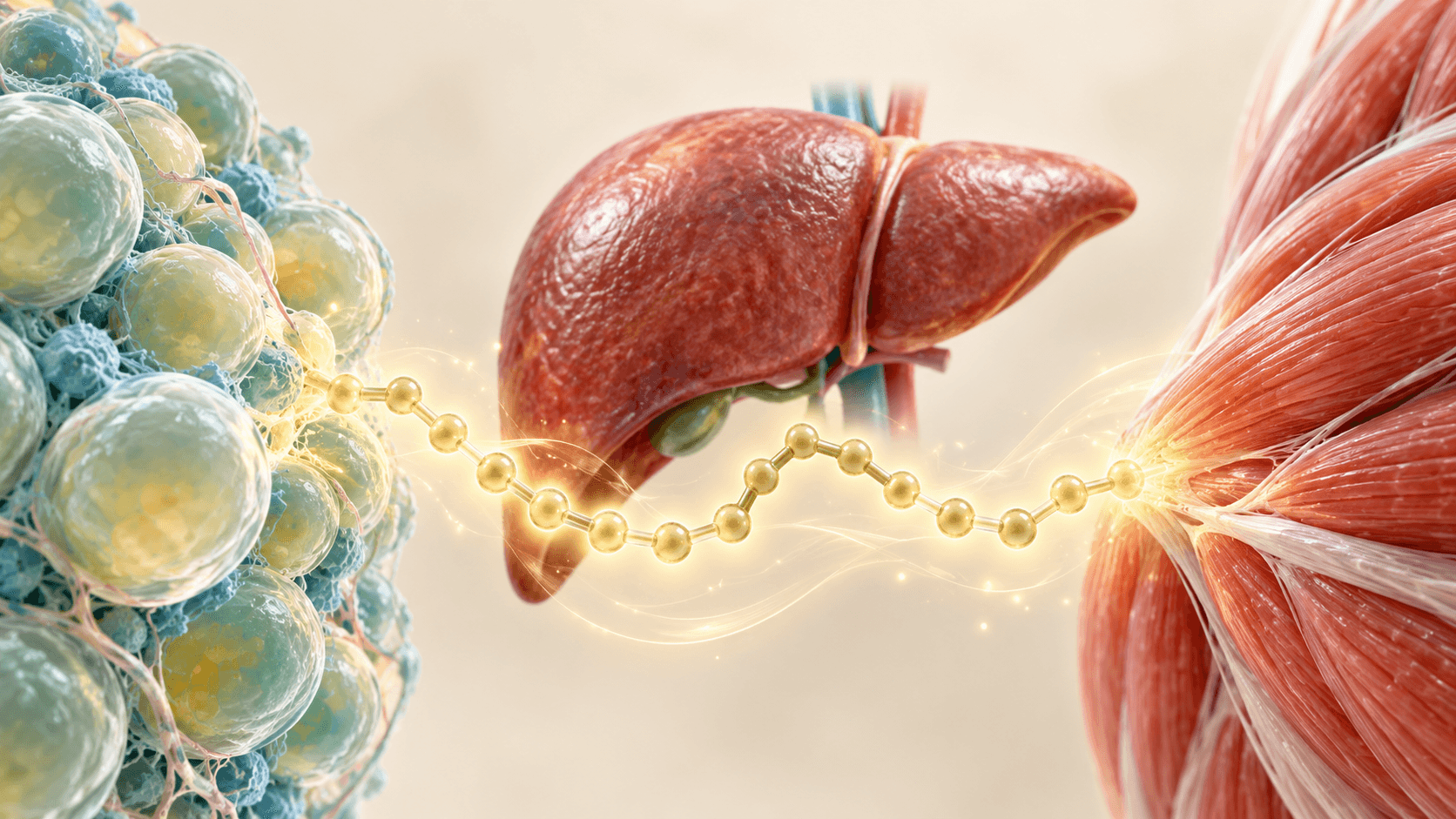
Omega-7 and palmitoleate: a lipokine, liver fat and insulin
SCD1, lipid pools and palmitoleate signaling between organs. Conflicting mouse models, cis/trans biomarkers, a newer null metabolic RCT and limits of supplement use.
SCD1, lipid pools and palmitoleate signaling between organs. Conflicting mouse models, cis/trans biomarkers, a newer null metabolic RCT and limits of supplement use.
Palmitoleic acid is both a normal lipid constituent and a candidate signal between organs. That combination makes it scientifically interesting and vulnerable to exaggerated claims. In cell and mouse models, cis-palmitoleate altered insulin signaling, lipogenesis and inflammation. In humans, its blood concentration depends on the tissue of origin, diet and lipid fraction measured. A favorable biomarker association does not establish a capsule's benefit, and less inflammation does not necessarily mean less liver fat.
Cis-palmitoleic acid, (9Z)-hexadec-9-enoic acid, is designated 16:1n-7: sixteen carbons, one double bond between C9 and C10 counted from the carboxyl group, or n-7 counted from the methyl end. C₁₆H₃₀O₂ has a molar mass of approximately 254.41 g/mol. HOOC–(CH₂)₇–CH=CH–(CH₂)₅–CH₃ makes both counting systems visible. Omega-7 names a fatty-acid family rather than one molecule.
The cis configuration bends the hydrocarbon chain, whereas the trans configuration permits straighter packing. This affects lipid properties, but a fixed bend angle is not a constant property of the entire flexible molecule. A free acid, an albumin-bound anion and a phospholipid acyl chain also occupy different environments. Precise pKa values, partition coefficients and phase-transition temperatures without a stated method and environment therefore do not predict clinical effects.
| Compound | Notation | Relevant distinction |
|---|---|---|
| Cis-palmitoleate | 16:1n-7, 9Z | Endogenous desaturation product studied as a lipokine |
| Trans-palmitoleate | trans-16:1n-7, 9E | Different geometric isomer; dietary biomarker in cohorts |
| Palmitate | 16:0 | Saturated metabolic substrate; excess causes lipotoxicity in some models |
| Oleate | 18:1n-9, 9Z | Longer monounsaturated acid with its own effects; also a comparator substrate |
Cis unsaturation generally reduces acyl-chain packing. Membrane fluidity also depends on cholesterol, other chains, headgroups and temperature. Incorporation of palmitoleate into phosphatidylcholine, phosphatidylethanolamine or other lipids does not establish a specific loosening of lipid rafts, improved insulin-receptor function or a fixed reduction in bilayer thickness. The general biophysical principle must be distinguished from an experimentally demonstrated intervention effect.
Trans-palmitoleate occurs in ruminant foods and can come from other fat sources. Endogenous SCD1 introduces a cis bond, so that enzyme does not directly synthesize the trans isomer. Nevertheless, trans-16:1 is not an exclusive marker of milk: in MESA it also correlated with margarine and baked desserts. Findings about the trans isomer cannot be transferred to purified cis supplements (Mozaffarian et al., 2013).
Before desaturation, an acyl-CoA synthetase activates palmitate to palmitoyl-CoA using ATP. SCD1 is an endoplasmic-reticulum membrane enzyme acting on acyl-CoA rather than the free acid. Four transmembrane helices anchor the protein; a dimetal center and substrate-binding channel provide positional and stereochemical selectivity. The substrate-bound human SCD1 structure supports this organization (Wang et al., 2015). Electrons pass through NADH–cytochrome-b₅ reductase–cytochrome b₅, and molecular oxygen is required.
This is the overall coupled reaction, not a claim that NADH directly binds SCD1. Desaturation of stearoyl-CoA similarly produces oleoyl-CoA. Palmitoleoyl-CoA can enter triacylglycerols (TAG), phospholipids and other lipids; hydrolysis can subsequently release nonesterified palmitoleate. The entire SCD1 product should not be portrayed as an immediately secreted hormone.
The same reaction serves different fluxes in liver and adipose tissue. During carbohydrate loading, hepatic SREBP-1c and ChREBP support a lipogenic program encompassing saturated-fat synthesis and desaturation. High palmitoleate in TAG or phospholipids can therefore reflect substantial endogenous lipid synthesis. Adipocyte synthesis and release into the free fraction can have a different interpretation. The 16:1/16:0 ratio is sometimes used as an indirect desaturation index, but diet, transport and turnover of both components affect it; it does not directly measure SCD1 activity.
Cao et al. (2008) studied mice lacking the fatty-acid-binding proteins FABP4/aP2 and FABP5/mal1. Lipidomics revealed increased adipose lipogenesis and altered lipid exchange between organs. Cis-16:1n-7 emerged as a candidate signal linking adipose tissue with liver and muscle. Cell experiments, regulation of hepatic SCD1 and lipid infusion supported effects on insulin action and steatosis in these models.
The term lipokine emphasizes a lipid's signaling role alongside peptide adipokines. It does not establish one specific palmitoleate receptor or a diagnosable human hormone-deficiency syndrome. Deleting FABP4/5 changes many lipids and cellular processes; administering one acid is not equivalent to the entire knockout phenotype. Claims of complete protection against every obesity complication or reversal of MASH exceed these data.
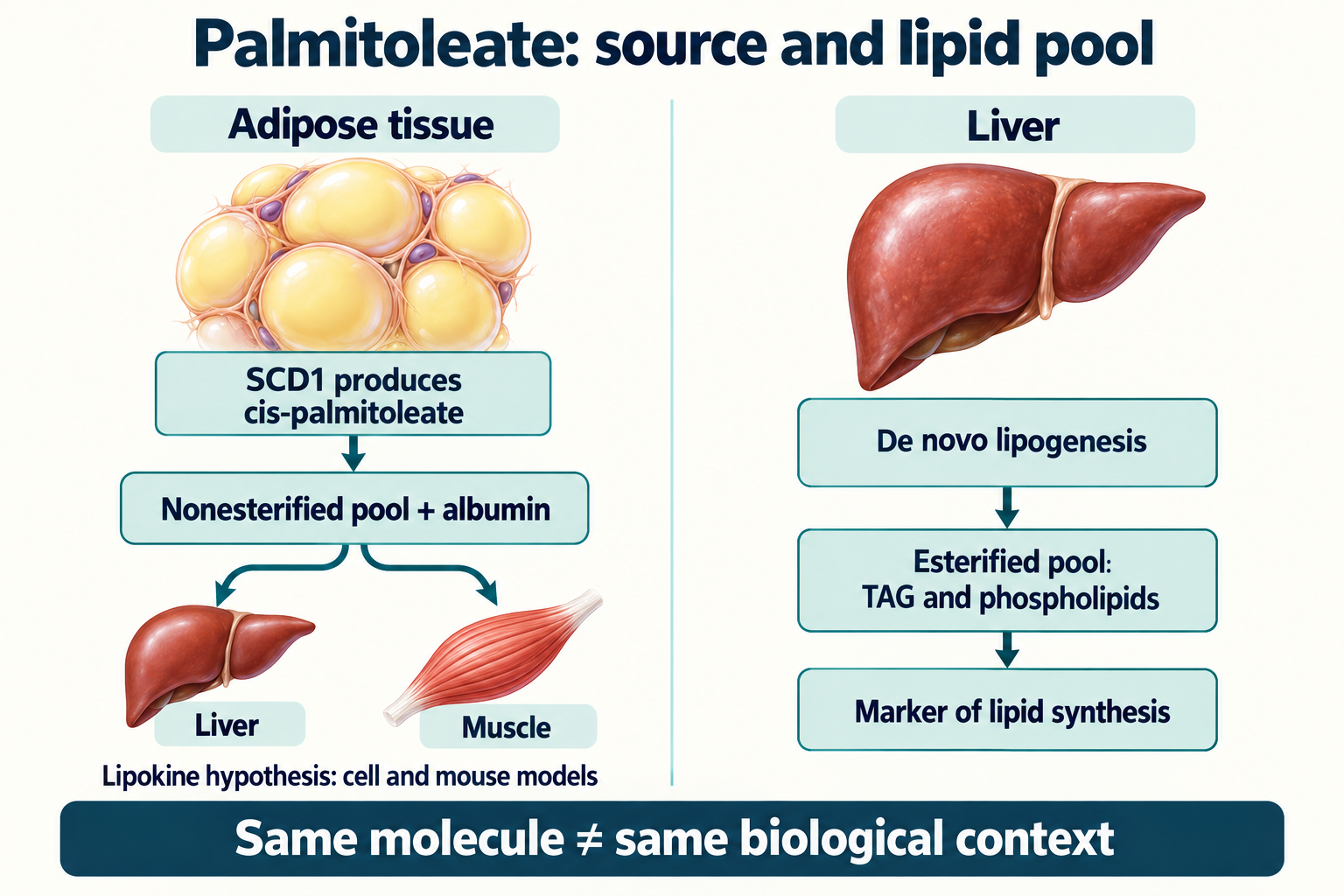
Plasma nonesterified fatty acids are largely albumin-bound. Esterified acids travel in lipoproteins and cellular lipids. Free-fraction concentration, phospholipid percentage and TAG concentration are different measurements. Studies must specify the fraction, units, fasting conditions and analytical separation of isomers. Specific albumin pockets, a universal 4–8-minute half-life and one exclusive source organ should not be presented as established supplement pharmacokinetics.
Liver fat reflects the balance of fatty-acid uptake, de novo lipogenesis (DNL), oxidation and TAG export in VLDL. The contribution of DNL varies with diet and metabolic state; there is no universal fraction for all healthy individuals or all MASLD cases. TAG is a storage form, not a synonym for every lipotoxic intermediate. For diacylglycerols (DAG), stereoisomer, localization and PKC interactions matter; ceramide species and cellular context also matter.
SREBP-1c begins as a membrane precursor. SCAP and INSIG regulate its movement from the endoplasmic reticulum to the Golgi, where proteolysis releases a nuclear transcriptional domain. ChREBP and its partner MLX respond to carbohydrate signals. Both coordinate lipogenic genes, but this does not automatically attribute direct blockade of every trafficking step or phosphorylation site to palmitoleate.
| Node | Biochemical function | Interpreting palmitoleate findings |
|---|---|---|
| ACLY | Citrate → cytosolic acetyl-CoA | One gene's expression is not measured DNL flux |
| ACC1/ACACA | ATP-dependent acetyl-CoA → malonyl-CoA | AMPK can inhibit ACC; test this in the particular model |
| FASN | Acetyl starter and seven malonyl units, with NADPH → palmitate | Expression can decrease or increase depending on conditions |
| SCD1 | Acyl-CoA desaturation | Source of monounsaturated lipids and a regulated target |
| CPT1A | Carnitine transport of long-chain acyl groups | Malonyl-CoA inhibits entry into mitochondrial oxidation |
| PPARα/RXR, ACOX1 | Oxidative transcriptional program, including peroxisomes | PPARα dependence does not prove ligand specificity or clinical efficacy |
Malonyl-CoA regulation of the carnitine shuttle and CPT1 explains why fat synthesis and oxidation must be considered together. ACOX1 participates in peroxisomal rather than mitochondrial oxidation. AMPK energy regulation connects with berberine mechanisms, but a shared target does not demonstrate supplement synergy.
In KK-Ay mice, Yang et al. (2011) administered palmitoleic acid at 300 mg/kg/day for four weeks and reported less liver lipid accumulation and expression of several lipogenic genes. De Souza et al. (2017) found PPARα-dependent increases in AMPK phosphorylation and changes in glucokinase, FGF21 and SREBP-1. Hepatic AKT/IRS did not improve even after insulin stimulation. Altered glucose utilization is therefore distinct from obligatory restoration of the entire insulin cascade.
Conversely, Guo et al. (2012) found increased liver fat, SREBP-1c and FAS alongside reduced inflammatory responses and improvement in some insulin-action measures. This result cannot be dismissed by asserting 20–30% palmitate contamination: that explanation is not established here. Genotype, diet, administration route, dose and exposure time may affect outcomes, but direct comparisons are needed. The contradiction demonstrates that anti-inflammatory and antisteatotic effects are not interchangeable.
Normally, the insulin receptor phosphorylates IRS; PI3K produces PIP₃ from PI(4,5)P₂, recruiting PDK1 and AKT. PDK1 and mTORC2 participate in AKT activation; TBC1D4/AS160, Rab proteins and SNAREs subsequently regulate GLUT4-vesicle movement to the membrane. This explains increased glucose transport rather than an inevitable effect of every unsaturated fatty acid.
Excess lipid flux can interfere with signaling through DAG and novel PKC isoforms: PKCθ is often discussed in muscle and PKCε in liver. These are not atypical isoforms; atypical PKCζ belongs to another class. The relationship between a particular IRS serine phosphorylation and resistance depends on species and context, so Ser 307/human Ser 312 is not a universal off switch. The IRS–PI3K–AKT–GLUT4 sequence helps explain the hypothesis but does not demonstrate that oral palmitoleate blocks Ser 1101 in humans or reduces DAG by a fixed percentage.
In cultured human islets, Maedler et al. (2003) found that palmitoleate and oleate reduced palmitate- and high-glucose-induced impairment of survival and secretion. These are valuable findings in human tissue outside the body, not a diabetes-prevention trial. Ceramides, mitochondrial apoptosis and endoplasmic-reticulum stress help interpret lipotoxicity. PERK–eIF2α–ATF4–CHOP and IRE1–XBP1/JNK are different stress-response branches with partly adaptive functions. Universal SERCA2b protection, elimination of all UPR branches and restoration of β-cell mass after capsules have not been established.
Adipose and liver inflammation influence metabolism. In mouse and cell studies, palmitoleate altered inflammatory markers and macrophage states. M1/M2 categories are useful experimental shorthand but do not encompass all human tissue-cell states. Souza et al. (2017) examined LPS-stimulated primary mouse macrophages: reductions in certain inflammatory signals persisted without PPARα, and the authors considered the exact mechanism incompletely understood. This does not support one mandatory PPARα–AMPK pathway for every effect.
The classical IKK–IκB–NF-κB pathway explains transcription of inflammatory mediators. Its attenuation does not demonstrate palmitoleate binding directly to IKKβ's active site. Similarly, saturated fatty acids should not unconditionally be described as direct TLR4 ligands. NO, eNOS, its cofactors and ICAM-1/VCAM-1 matter for endothelial function, but the sequence palmitoleate → Ser 1177 → lower blood pressure → prevention of myocardial infarction is not an established clinical outcome. These nodes identify research questions rather than promised vascular protection.
| Study | Design and measurement | Finding and interpretive limit |
|---|---|---|
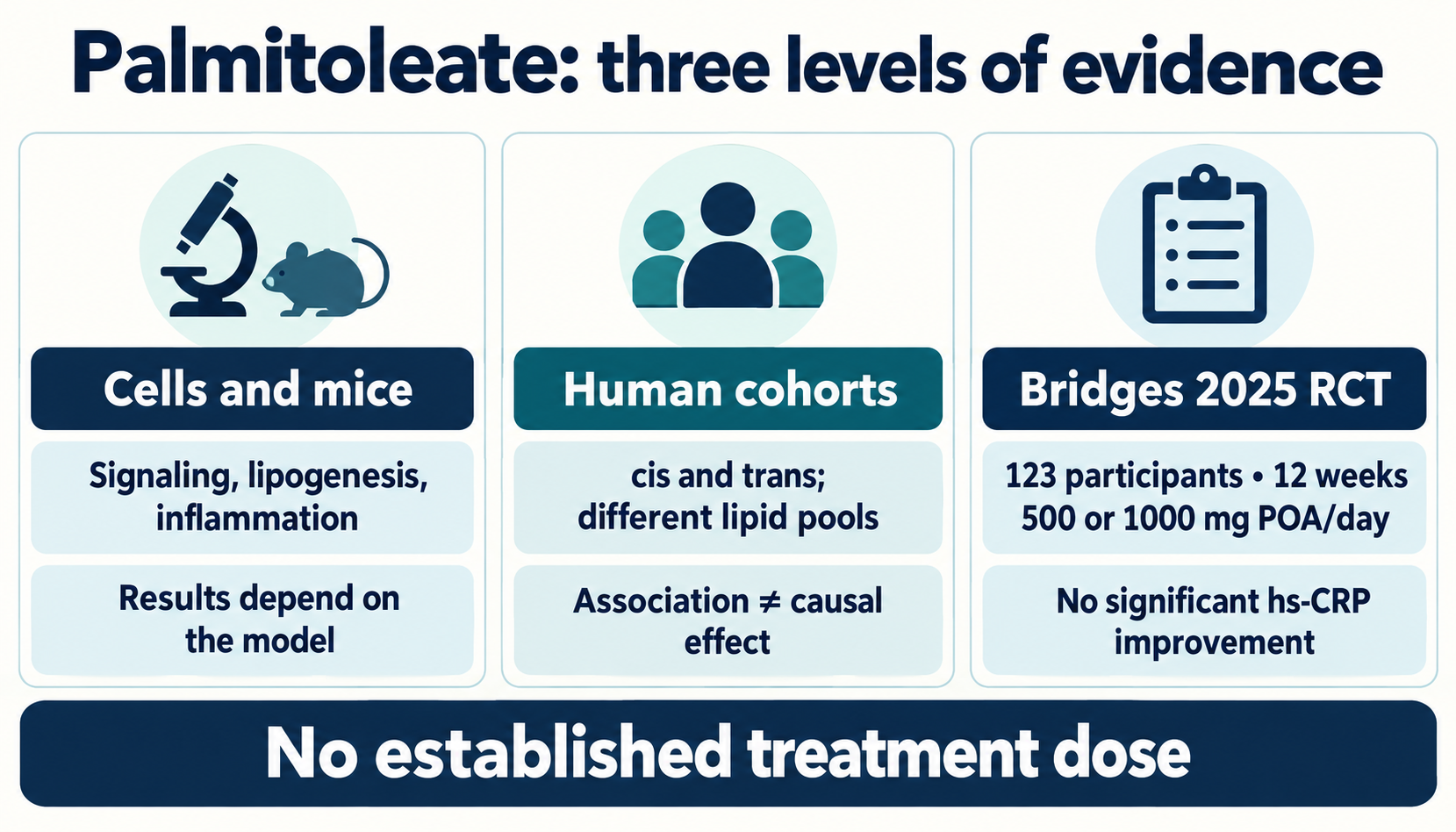
| CHS, Mozaffarian 2010 | 3736 adults; phospholipid trans-16:1; follow-up 1992–2006 | Highest versus lowest quintile: diabetes HR 0.38, 95% CI 0.24–0.62. Association, not supplement efficacy |
| MESA, Mozaffarian 2013 | 2617 baseline measurements; 2281 without diabetes for incidence analysis; 205 cases | HR 0.52, 95% CI 0.32–0.85. Higher LDL alongside some favorable markers |
| Stefan 2010 | Free fraction in 100 participants; clamp in 79; nine months of lifestyle intervention | Positive association of cis-palmitoleate with sensitivity; intervention was not POA supplementation |
| Fabbrini 2011 | Insulin-sensitive versus resistant people with obesity; clamp, FFA and VLDL | Lower palmitoleate availability did not explain organ-sensitivity differences |
| Bernstein 2014 | Publication describing 60 participants over 30 days | Marked WITHDRAWN; findings are not used as efficacy evidence |
| Bridges 2025 | Double-blind RCT, 123 participants enrolled with hs-CRP ≥ 2 mg/L; 500 or 1000 mg POA/day for 12 weeks | No significant hs-CRP reduction or change in other studied metabolic biomarkers versus placebo |
The newer RCT changed some blood fatty-acid measurements, so absent metabolic effects cannot simply be attributed to absent exposure. A null result does not rule out every possible effect in every population, but it contradicts guaranteed benefit in people with elevated hs-CRP and the claim that adequate duration alone is needed. Investigated doses describe experimental conditions rather than an established therapeutic window (Bridges et al., 2025).
Forouhi et al.'s EPIC-InterAct study (2014) examined individual saturated fatty acids and incident diabetes. It should not be listed as evidence linking trans-palmitoleate to myocardial-infarction or stroke mortality. Differences between cis and trans, free and esterified fractions, absolute concentrations and compositional percentages help explain heterogeneity in human findings, but do not eliminate confounding or reverse causation.
Sea-buckthorn pulp, macadamia nuts and some marine lipids contain palmitoleic acid in varying proportions. Sea-buckthorn seed oil differs from pulp oil, and cultivar, origin and processing affect the profile. Other saturated and unsaturated acids, antioxidants and additional constituents accompany POA. Testing a whole oil or a nut-rich diet does not isolate one 16:1n-7 molecule's causal effect.
| Matrix | Details to establish | What composition alone cannot establish |
|---|---|---|
| Sea-buckthorn oil | Pulp versus seeds; actual batch profile | Palmitate automatically cancels benefits or makes the food toxic |
| Macadamia | Whole nuts versus oil; total diet and energy | Every lipid-profile effect is caused by POA |
| Marine lipids | Source species, EPA/DHA, allergens, oxidation | Any fish oil is equivalent to purified POA |
| POA concentrate | Acid mass, isomer, chemical form, composition and quality | Greater purity guarantees MASLD treatment or safety |
Fractionation and transesterification can alter a concentrate's composition. Ethyl esters and TAG differ in digestion; esters require hydrolysis before absorption. Evidence is insufficient for a unique ideal dosing time of 12:00–19:00 or a universal 70% fall in fasting POA bioavailability. Fatty-acid purity does not establish complete absence of contaminants or oxidation products, which require separate analyses.
A simple label calculation is:
Masses use the same units; w is a mass fraction such as 0.40, not the number 40. If 500 mg of product contains 40% POA under an appropriate specification, the calculation yields 200 mg POA. The manufacturer must specify the percentage basis and any conversion from ester mass to acid mass. Similarly, 1 g POA at 35% requires approximately 2.86 g oil rather than automatically 30–40 mL. These are arithmetic examples, not intake recommendations.
These studies do not establish a generally accepted palmitoleate treatment dose for MASLD/MASH, diabetes or dyslipidemia. The 400–1000 mg range should not be presented as a clinical protocol with a proven plateau, nor milligram limits on accompanying palmitate as verified safety thresholds. Decompensated diabetes or suspected liver disease calls for diagnosis and established treatment, not escalating supplementation.
EPA/DHA, berberine, dihydroberberine, silibinin and phosphatidylcholine combinations each have separate biochemical rationales. Shared AMPK, PPARα or membrane pathways do not demonstrate synergy, a specified TAG reduction, antifibrotic efficacy or superiority over monotherapy. Those conclusions require trials of the combination with suitable endpoints.
Short trials do not establish safety during long-term use, pregnancy, breastfeeding or all comorbid conditions. Source allergens, product composition, quality and medications matter. FDA GRAS status and universal safety up to 1500 mg should not automatically be attributed to every POA preparation. Regulatory assessment of a particular ingredient and safety for a particular person are different questions.
ALT, AST and GGT reflect aspects of injury and metabolism, but a decrease alone does not establish disappearance of steatosis or fibrosis. MRI-PDFF assesses fat content, whereas elastography measures properties associated with fibrosis; these measurements are not interchangeable. HOMA-IR is calculated from fasting glucose and insulin:
I₀ is insulin in μU/mL and G₀ glucose in mmol/L. With glucose in mg/dL the denominator is 405. This surrogate has methodological limitations; it is neither a direct clamp measurement nor a universal diagnostic cutoff. Tests and follow-up intervals depend on the disease. There is no established POA monitoring algorithm requiring hs-CRP improvement above 30% and TAG improvement above 15%.
Palmitoleate illustrates how a lipid can be both substrate and signal. Reliable interpretation requires distinguishing source tissue, chemical form, lipid pool and endpoint. Mouse mechanisms support further investigation; conflicting liver findings and a human RCT without metabolic benefit constrain clinical translation. A treatment role for POA needs to be determined experimentally rather than inferred from the word lipokine.
A convincing clinical benefit is not established. Mouse findings conflict, and changes in liver enzymes do not establish resolution of steatosis or fibrosis.
No. They are different isomers; a dietary biomarker association is not the effect of taking purified acid.
There is no generally accepted treatment dose. 500 and 1000 mg/day in the newer 12-week RCT were investigated doses with null metabolic biomarker results.
Purity changes composition but does not by itself establish benefit or safety. Matrix, POA mass, isomer, chemical form and quality must be distinguished.