
NETs: PAD4, immune thrombosis and autoimmune risks
PAD4, NOX2, myeloperoxidase and elastase enzymology; NETs in thrombosis and autoimmunity, chromatin clearance and negative DNase trials.
PAD4, NOX2, myeloperoxidase and elastase enzymology; NETs in thrombosis and autoimmunity, chromatin clearance and negative DNase trials.
A neutrophil can destroy engulfed material within a phagosome, release granule contents and form extracellular structures made of chromatin and proteins. The latter are called neutrophil extracellular traps, or NETs. In Brinkmann and colleagues’ original 2004 study, these structures bound microorganisms and concentrated antimicrobial components. Yet the same spatial organisation can retain platelets, damage the vascular barrier and expose the immune system to self nuclear antigens. The question is therefore where these structures occur, under which inflammatory conditions and how long they persist.
NETs are a composite object. DNA provides a scaffold, histones participate in chromatin packaging, and neutrophil elastase, myeloperoxidase and other granule proteins confer additional properties. Measuring free DNA alone cannot establish the origin of all the material, integrity of the complex or its enzymatic activity. An association between a marker and disease severity likewise does not establish that suppressing the marker improves clinical outcomes.
Historically, “NETosis” referred to a programme in which chromatin decondenses, the nuclear envelope breaks down and contents emerge following plasma membrane damage. Thiam and colleagues demonstrated such a sequence, with rearrangement of the cytoskeleton and intracellular membranes, in the cellular systems they studied. PAD4 activity and nuclear localisation were important for chromatin decondensation and nuclear envelope rupture. This describes a particular mechanism rather than an identical sequence in every human tissue.
The literature also describes extracellular DNA release without immediate cell death. Classification depends on whether membrane integrity, neutrophil fate and DNA origin were measured. The neutral expression “NET formation” is consequently often more accurate than inferring cell death from a single image. DNA outside nuclei from other damaged cells, conventional necrosis and NETs may coexist in inflamed tissue; they should not be collapsed into one quantity.
In 2017, Kenny and colleagues compared different NET formation pathways in human neutrophils, including cells from patients with NADPH oxidase defects and myeloperoxidase deficiency. Dependence on oxidative reactions and granule enzymes differed across the conditions studied. A claim that an enzyme is necessary must therefore specify the cellular system and context rather than become a universal diagram.
PAD4 is a peptidylarginine deiminase. It hydrolytically converts an arginine residue in a protein to citrulline: protein arginine + H₂O → protein citrulline + ammonia, present predominantly as ammonium under physiological conditions. The positively charged guanidinium group of arginine is replaced by a neutral citrulline group. This modifies one side chain; it does not remove a histone or cleave DNA.
Calcium participates in establishing PAD4’s active conformation. The enzyme uses a catalytic cysteine and water; NAD⁺ is not consumed as a cofactor in this reaction. Within the nucleus, histone citrullination can weaken electrostatic interactions with negatively charged DNA and help chromatin decondense. Packaging also depends on proteolysis, other histone modifications and structural rearrangement. Citrullinated histone H3 is therefore one useful sign of particular pathways, rather than an equivalent of every NET complex.
This reaction must be distinguished from transformations of free arginine in nitrogen metabolism. Nitric oxide synthase uses free arginine and a different enzymatic system; citrulline appearing as a product does not make the reactions interchangeable. Dietary citrulline similarly does not demonstrate histone citrullination or justify targeting NETs with an amino acid supplement.
NOX2 is a multicomponent NADPH oxidase complex. In the assembled complex, electrons from NADPH pass through FAD and haem centres to oxygen, generating superoxide. Membrane and cytosolic components organise the process spatially; subsequent reactive oxygen species transformations include hydrogen peroxide formation. These reactions can participate in signalling and antimicrobial function, but a rise in total oxidation does not establish NET formation.
Myeloperoxidase is a granule haem enzyme. It uses hydrogen peroxide and, with chloride present, contributes to hypochlorous acid formation: H₂O₂ + Cl⁻ + H⁺ → HOCl + H₂O. Unlike PAD4, this changes substrate oxidation states. Myeloperoxidase abundance, its location alongside DNA and catalytic activity are three different measurements. The local chemical environment and substrate availability affect which reactions actually occur within an extracellular complex.
Neutrophil elastase is a serine protease rather than a calcium-dependent deiminase. In some human cellular models, movement from granules towards the nucleus and histone cleavage help decondensation. Papayannopoulos and colleagues demonstrated elastase and myeloperoxidase involvement in the mechanism they examined. In Martinod and colleagues’ 2016 study, however, elastase-deficient mice still formed NETs in the sterile inflammatory settings studied, and enzyme deficiency did not prevent experimental venous thrombosis. These findings limit universality without eliminating elastase’s role in other circumstances.
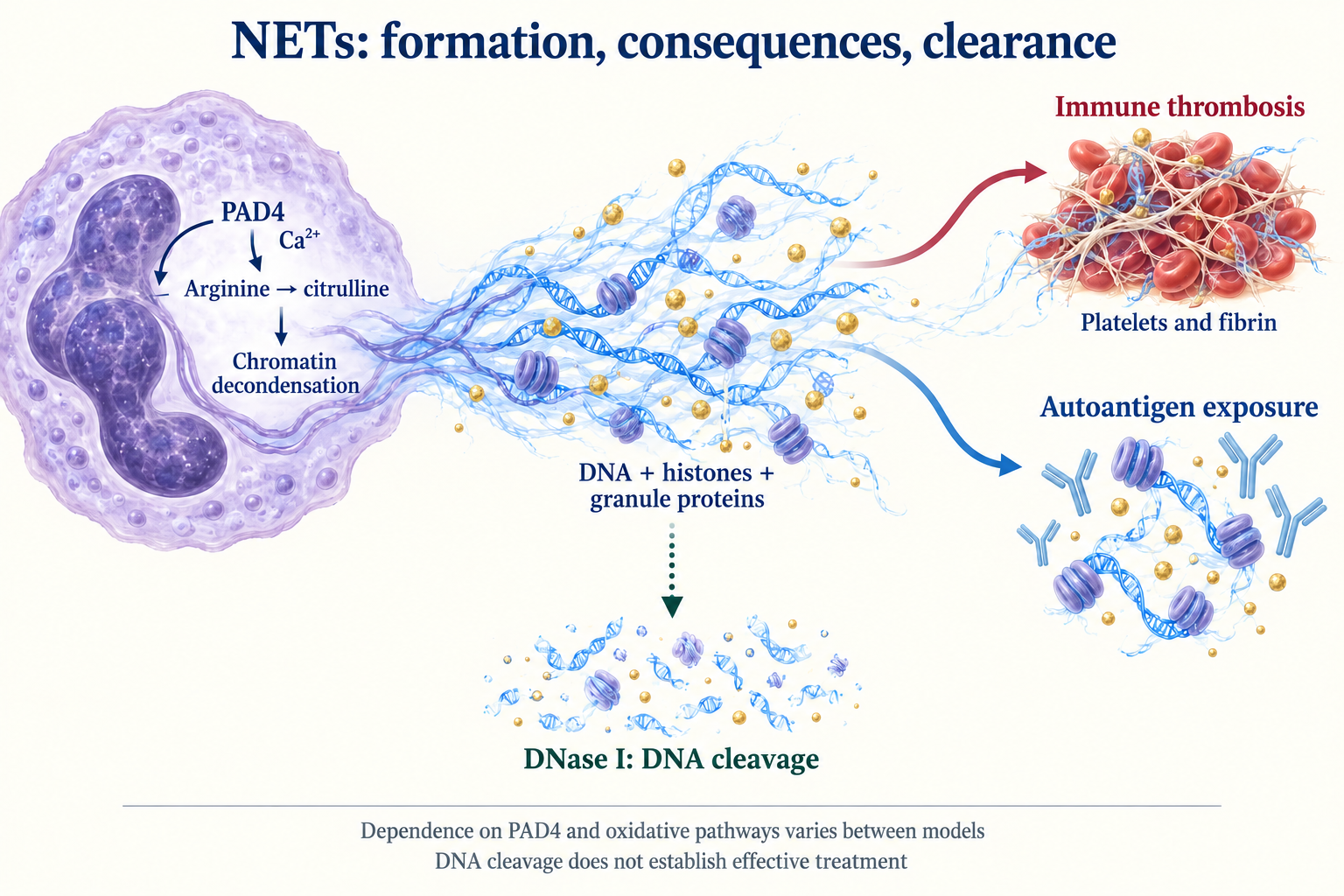
NETs can provide a surface for interactions among platelets, red cells, coagulation proteins and vascular endothelium. In Fuchs and colleagues’ 2010 study, extracellular traps supported platelet adhesion and activation and fibrin deposition in experimental systems. Histones alone also produced platelet effects. This explains a possible connection between inflammation and thrombosis, but does not turn all extracellular DNA into a complete thrombus.
Coagulation retains its own enzymology. Activated factors XII and XI are serine proteases; factor XIIa should not be described as a zinc-dependent metalloproteinase. Sequential generation of active proteases IXa and Xa, cofactors VIIIa and Va working on phospholipid surfaces, and calcium participation enable thrombin generation. Thrombin cleaves fibrinogen, while factor XIIIa stabilises fibrin through crosslinks. A DNA scaffold and a fibrin network can interact, but remain different molecular structures.
The contact pathway, cellular surfaces, tissue factor and endothelial damage contribute differently across diseases. NET presence cannot establish that neutrophils synthesised tissue factor or that all natural anticoagulant mechanisms have been entirely switched off. Some proteins can bind to a surface from outside; a plasma measurement does not identify their cellular source.
In Martinod’s 2013 mouse study, following experimental restriction of venous blood flow, a thrombus was detected at 48 hours in fewer than 10% of PAD4-deficient animals versus 90% of wild-type animals. This substantial effect in a particular model is consistent with neutrophil PAD4 involvement. Genetic deficiency in a mouse nevertheless differs from drug inhibition in an adult human, and a venous model does not establish an identical NET role in every microthrombotic event, arterial event and infection.
In rheumatoid arthritis, Khandpur and colleagues found enhanced NET formation in the blood and synovial fluid neutrophils studied, associated with antibodies to citrullinated proteins. Such structures can expose modified self proteins to the immune system and sustain inflammatory responses in synovial cells. Conversely, antibodies and inflammatory signals can enhance neutrophil activity. This is a possible disease-maintenance loop, rather than proof that NETs are the sole original autoantigen source or that every arthritis patient shares the same mechanism.
Clearance also matters in systemic lupus erythematosus. Hakkim and colleagues identified a subgroup of patient sera that degraded NETs poorly, associated with renal involvement. Mechanisms included DNase I inhibition and antibodies restricting enzyme access to the structure. The association concerned a subgroup and cannot be extended to every patient or presented as a standalone diagnostic test for lupus nephritis.
DNASE1L3 adds another layer. In Sisirak and colleagues’ work, impaired removal of chromatin in apoptotic cell microparticles contributed to autoimmunity. The study included genetic models and patient material. It demonstrates that extracellular self antigens have several sources; the entire chromatin-clearance problem cannot be reduced to NETs. In ANCA-associated inflammation, myeloperoxidase and proteinase-3 can participate in autoantigen interactions, but an individual NET marker likewise does not replace clinical diagnosis.
DNase I hydrolyses DNA phosphodiester bonds. Divalent ions support structure and catalysis: calcium and magnesium have different functions, and actual activity depends on the environment and chromatin accessibility. Cleaving the scaffold does not automatically neutralise histones and proteases, remove the cause of inflammation or restore the vascular barrier. Suppressing NET formation and accelerating clearance are distinct interventions with different potential consequences for host defence.
Davis and colleagues conducted a 40-day randomised, double-masked, placebo-controlled phase Ib trial in 17 patients with lupus nephritis. Groups received recombinant human DNase I at 25 µg/kg (8 patients), 125 µg/kg (6 patients) or placebo (3 patients): an initial single intravenous dose followed by ten subcutaneous doses. Safety and pharmacokinetics were the objectives, with disease activity markers also assessed. Serum concentrations capable of hydrolytic activity were achieved after intravenous but not subcutaneous administration; the estimated half-life was 3–4 hours. Anti-DNA antibodies, complement and other measured markers did not change appreciably. Small groups and short exposure preclude a confident clinical efficacy estimate, but this trial certainly does not establish nephritis treatment through extracellular DNA breakdown alone.
A negative result in another population is particularly important. O’Donnell and colleagues randomised 349 adults with stable idiopathic bronchiectasis at 23 centres in a double-blind, placebo-controlled trial. Inhaled recombinant DNase I was given at 2.5 mg twice daily for 24 weeks. Primary endpoints included pulmonary exacerbation frequency and FEV₁ change. Active treatment produced more exacerbations and greater FEV₁ decline. Mean FEV₁ change was −3.6% versus −1.7% with placebo (p < 0.05); the authors considered the clinical relevance of this small difference limited. In the discussion, the increase in overall exacerbation frequency did not reach statistical significance. This study did not test selective removal of vascular NETs, but clearly demonstrates why DNase effects in one disease cannot be extrapolated to another merely because the molecular target resembles it. These regimens describe trials rather than instructions for self-treatment.
PAD4 inhibitors and gasdermin-targeting strategies remain research directions; pore-forming protein involvement is also model-dependent. Heparin primarily affects coagulation and can interact with NET components, but this does not establish an “anti-NETosis” self-treatment dose. Mechanistic findings on curcumin, polyphenols, omega-3 or vitamin D do not establish universal thrombosis prevention through NET suppression. Such a conclusion requires clinical outcomes and harm assessment in a defined population.
Free DNA reflects several processes of cell material injury and clearance. MPO–DNA complexes are closer to a neutrophil context, but depend on analytical method and sample composition. Citrullinated H3 supports involvement of a particular chromatin rearrangement pathway; its absence does not exclude all NET forms. Combining morphology with DNA and neutrophil protein colocalisation is more informative than one concentration, yet still requires distinguishing formation, accumulation and delayed clearance.
Material type, timing relative to illness, concurrent treatment and sample handling influence interpretation. A marker increase may result from severe inflammation, help maintain injury, or reflect both. A clinically useful test must consequently demonstrate what it adds to conventional risk assessment and whether the information changes decisions and outcomes.
Nutrition belongs to a broader health context but cannot directly replace investigation of NETs. The relationship between dietary substrates, microbial metabolites and immune responses is explored in the article on dietary fibre and short-chain fatty acids. It helps distinguish systemic metabolic connections from established treatment of a particular enzyme pathway. NETs require the same discipline: biochemical plausibility, experimental causality and patient benefit are successive, separate levels of evidence.
No. Death requires evidence on membrane integrity and cell fate; one extracellular DNA image does not establish it.
No. It can originate from various injured cells; other features and analytical method must be considered.
No. Scaffold breakdown does not automatically neutralise proteins, and negative clinical trials limit therapeutic extrapolation.