
MitoQ and SkQ1: mitochondrial delivery, redox cycles and clinical limits
How TPP⁺ uses membrane potential, how MitoQ and SkQ1 differ, and why dose-dependent prooxidant effects matter. Cardiolipin, alternative carriers, vascular and ocular trials, pharmacokinetics and proposed combinations.
A mitochondrial antioxidant must reach the relevant compartment, retain its active form and react with radicals without disrupting the organelle’s energy supply. Attaching a redox-active group to the lipophilic triphenylphosphonium cation, TPP⁺, uses the negative matrix potential to favor accumulation. MitoQ and SkQ1 follow this principle. Delivery, lipid protection and clinical benefit nevertheless require distinct evidence: a Nernst calculation does not measure tissue exposure, and improvement in a vascular or ocular surrogate does not establish longer life.
What conventional antioxidant trials showed
Harman’s free-radical theory of aging connected accumulated damage with radical reactions. It often encouraged the expectation that high-dose vitamins would automatically prevent cancer and cardiovascular events. Large randomized trials tested particular compounds, doses and populations without supporting universal prevention. Their findings cannot be transferred indiscriminately to correcting vitamin deficiency, ordinary food or every antioxidant molecule.
| Trial | Population and intervention | Result and interpretation |
|---|---|---|
| ATBC, 1994 | 29,133 male smokers aged 50–69; α-tocopherol 50 mg/day, β-carotene 20 mg/day, both or control; 5–8 years | β-Carotene increased lung cancer by 18% (95% CI for change 3–36%) and overall mortality by 8% (1–16%). α-Tocopherol did not reduce lung cancer; a tocopherol mechanism alone cannot explain β-carotene harm |
| CARET, 1996 | 18,314 smokers, former smokers and asbestos-exposed workers; β-carotene 30 mg/day plus retinyl palmitate 25,000 IU/day | Lung cancer RR 1.28 (95% CI 1.04–1.57); overall mortality RR 1.17 (1.03–1.33). Stopped early; the finding concerns this combination in an at-risk population |
| HOPE, 2000 | 9,541 people with vascular disease or diabetes plus another risk factor; vitamin E 400 IU/day for approximately 4.5 years | Myocardial infarction/stroke/cardiovascular death RR 1.05 (95% CI 0.95–1.16); no preventive benefit detected |
| HOPE-TOO, 2005 | Extended HOPE follow-up, median 7 years; participation in the extension was incomplete | No advantage in main cardiovascular or cancer outcomes; heart failure RR 1.13 (1.01–1.26), hospitalization for heart failure RR 1.21 (1.00–1.47) |
| SELECT, 2011 | 35,533 randomized men; 34,887 in the main analysis; vitamin E 400 IU/day, selenium 200 µg/day, both or placebo | Vitamin E increased prostate cancer risk: HR 1.17 (99% CI 1.004–1.36), absolute increase 1.6 cases per 1,000 person-years. This specific formulation/regimen does not establish harm from dietary vitamin E |
Negative findings from GISSI-Prevenzione and Physicians’ Health Study II also contributed to abandoning indiscriminate antioxidant prevention. Yet these trials do not establish failed mitochondrial delivery as the sole cause. Target selection, baseline nutrient status, exposure, disease stage and interference with signaling can matter. Targeting addresses part of the pharmacological problem without automatically resolving every cause of clinical failure.
Compartments and redox signaling
Complexes I and III can generate superoxide, but mitochondria do not invariably produce “90–95% of all cellular ROS”. Contributions from NADPH oxidases, endoplasmic reticulum, peroxisomes and other sources depend on the cell and its state. Electron leak measured in isolated organelles is likewise not a fixed in vivo fraction. High NADH/NAD⁺, a reduced CoQ pool and proton-motive force influence ROS generation; active ATP synthesis can differ substantially from resting, nonphosphorylating conditions.
Complex I has flavin-associated ROS production and processes linked to reverse electron transport, RET. Reduced CoQ and high potential favor RET; the mechanism cannot be reduced to electron loss from terminal cluster N2. Complex III’s Qₒ region can produce superoxide on both sides of the inner membrane. Charged superoxide poorly traverses the lipid core, while SOD2-mediated dismutation yields H₂O₂ capable of transmitting signals between compartments. The site of generation and the site of consequences therefore need not coincide.
The inner membrane limits free diffusion of many hydrophilic compounds but contains specialized transport systems. Ascorbate is predominantly anionic at physiological pH; ascorbate and dehydroascorbate delivery require tissue- and transporter-specific interpretation. Neither one universal GLUT1/GLUT3 route nor complete absence of mitochondrial vitamin C is established. Lipophilic vitamin E partitions among membranes; lacking a TPP vector does not mean zero mitochondrial concentration. There is no fixed thousandfold concentration deficit for all conventional antioxidants.
H₂O₂ can reversibly modify cysteine thiols, for example by forming sulfenic acid:
Disulfides and S-glutathionylation, Cys–SSG, are different states; the latter is not sulfenylation. Oxidation of sensitive PTP1B/PTEN sites can alter phosphatase activity, while changes in the KEAP1–NRF2 sensor system influence protective-gene expression through ARE elements. The effect depends on the residue, modifying agent and local reducing system. One fixed H₂O₂ concentration does not define normal signaling in every cell.
Ristow’s 2009 study of 39 young men found that vitamin C 1,000 mg/day plus E 400 IU/day during four weeks of training prevented improvement in measured insulin sensitivity and part of the adaptive expression response. This supports mitohormesis in that setting without showing cancellation of every training benefit or an exclusive mitochondrial origin of the relevant ROS. Excessive reducing pressure can be unfavorable; “reductive paralysis” is not a universal clinical diagnosis.
Why an antioxidant can sustain oxidation
Tocopherol terminates a lipid chain by donating a hydrogen atom to a peroxyl radical:
If the tocopheroxyl radical is insufficiently reduced, propagation to a neighboring lipid and renewed oxygen reaction are possible:
Bowry, Ingold and Stocker studied this mechanism in LDL particles; ascorbate and ubiquinol suppressed it by regenerating the radical. This chemical possibility does not fully explain ATBC, CARET or SELECT outcomes. Explaining β-carotene outcomes through vitamin E alone is particularly inappropriate. Targeted quinones also require evaluation of regeneration, semiquinone states and respiratory function alongside chain termination.
How lipophilic cations use membrane potential
Liberman, Topaly, Tsofina, Jasaitis and Skulachev’s 1969 work connected penetrating organic ions with potential measurements and oxidative-phosphorylation coupling. Hydrophobic cations and anions can cross bilayers and distribute according to the electric field; a negative matrix favors cations. The historical term “Skulachev ions” describes this concept rather than therapeutic efficacy of every derivative.
In TPP⁺ conjugates, phosphorus is bonded to three phenyl groups and a fourth substituent carrying the linker and functional group. The bulky lipophilic shell and electronic distribution make membrane entry less unfavorable than for a small inorganic ion. Uniform charge distribution over 18 carbons through vacant d orbitals is an oversimplified quantum-chemical account. Radius, hydration, lipophilicity and linker length vary among derivatives.
The Born continuum model gives the molar transfer energy of a spherical ion from water to a low-dielectric medium:
Nₐ converts single-particle energy to molar energy; z is charge, e elementary charge, r effective radius, ε₀ vacuum permittivity, and εₘ/εw relative dielectric constants. Increasing r lowers the electrostatic barrier, but real membranes and nonspherical molecules involve additional interactions. Universal “15–25 kJ/mol”, no hydration water and one logP for all conjugates do not follow from this equation. Passive crossing does not directly consume ATP, although maintaining potential requires energy and tissue transport can be limited by efflux and metabolism.
Nernst: free concentration differs from total amount
Electrochemical-potential equilibrium for a permeating ion gives:
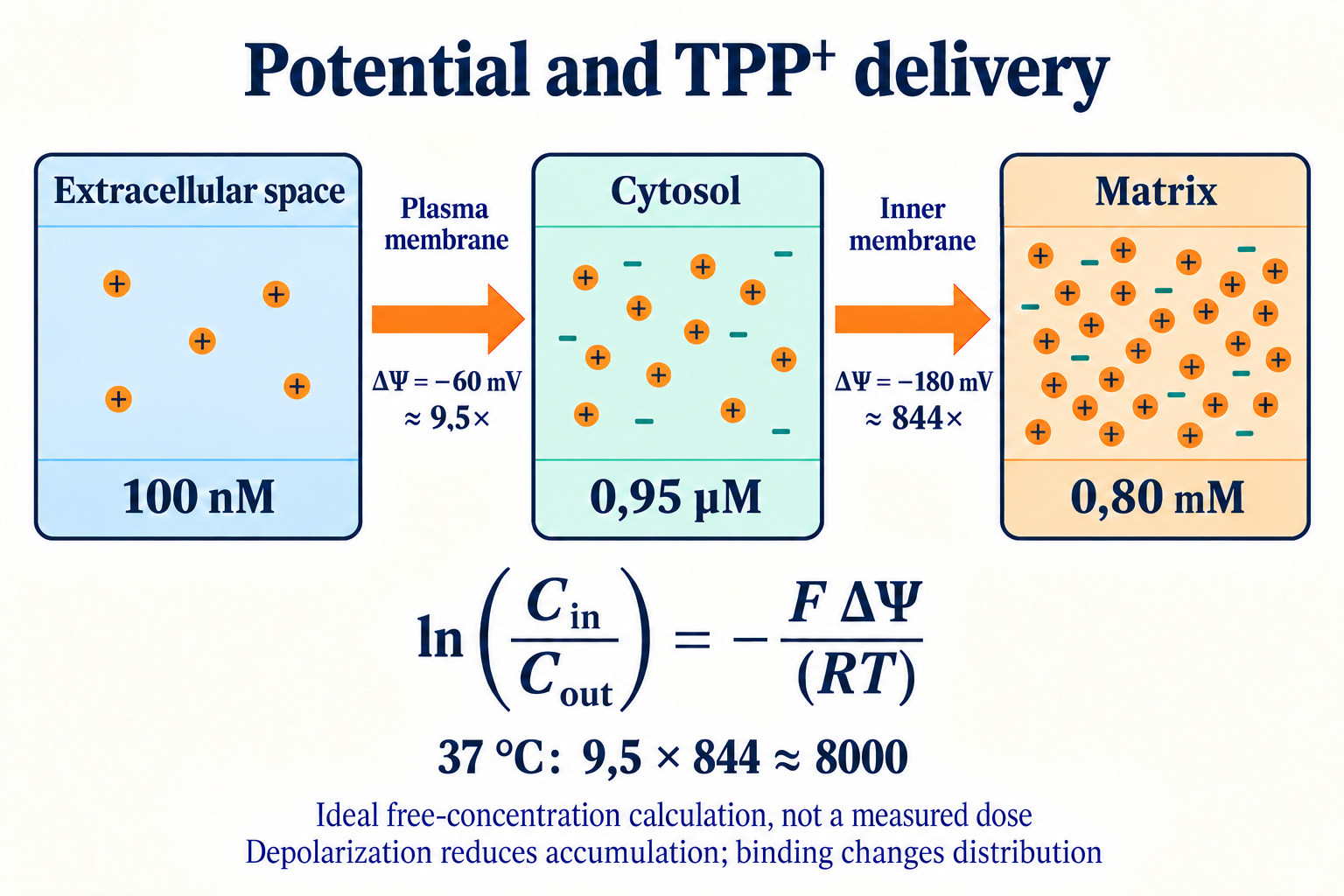
ΔΨ means inside potential minus outside potential. Negative ΔΨ favors accumulation of a monovalent cation. With equal activity coefficients, the activity ratio approximates the free-concentration ratio. At 37 °C, a tenfold step corresponds to approximately 61.5 mV:
Using −60 mV for the plasma membrane and −180 mV for the inner mitochondrial membrane as a teaching example gives approximately 9.5-fold and 844-fold enrichment. The product is around 8,000 rather than exactly 10,000. In that ideal calculation, 100 nM outside corresponds to about 0.95 µM in the cytosol and 0.80 mM in the matrix. These are hypothetical concentrations, not measured patient exposure or evidence of safety at those intracellular levels.
Membrane binding can increase total content without a proportional increase in free concentration; lipid/water partitioning is another equilibrium. Protein binding, accessible volume, incomplete equilibration, metabolism and effects on ΔΨ also matter. Cellular potentials are heterogeneous. Depolarization lowers TPP-conjugate accumulation: a severely damaged mitochondrion does not necessarily receive more drug. “100–1,000-fold” can indicate magnitude in particular experimental systems, but does not guarantee selectivity or a tissue dose.
MitoQ, SkQ1 and nitroxides use different redox mechanisms
The MitoQ quinone group and regeneration
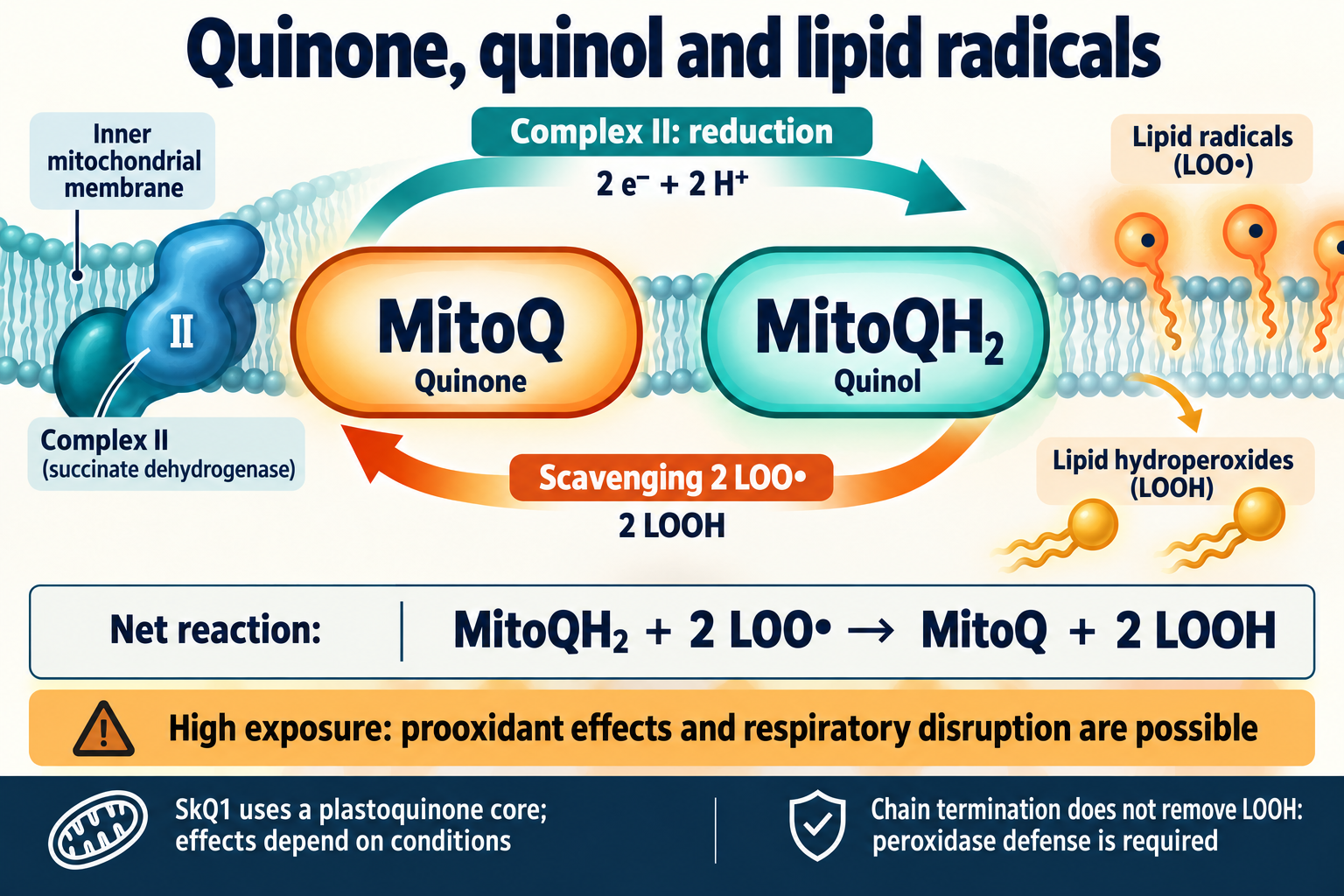
MitoQ joins a ubiquinone head to TPP⁺ through a ten-carbon linker. Reduced mitoquinol, MitoQH₂, terminates lipid radical chains. The linker and charged-group position affect membrane partitioning and enzyme access rather than imposing one rigid orientation 15–20 Å deep in every bilayer. Smith’s 1999 prototype was a targeted tocopherol derivative; Kelso’s 2001 work examined MitoQ. These molecules should be distinguished.
James’s 2007 study found efficient MitoQ reduction by complex II and poor substrate behavior for complexes I, III and ETF:quinone oxidoreductase. The bulky TPP moiety and membrane-surface position restrict access to some sites. Poor substrate behavior is more accurate than absolute impossibility of complex I reduction. Slow oxidation by complex III also means MitoQ cannot fully replace natural CoQ10 in electron transfer, a distinction explored in the article on CoQ10 ubiquinone and ubiquinol.
Two peroxyl-radical reactions can be represented through a semiquinone intermediate:
The net reaction is:
The respiratory chain can regenerate quinol using reducing equivalents, notably from complex II-mediated succinate oxidation. Recycling is not unlimited: it depends on substrate, enzyme state and exposure. The resulting LOOH still requires peroxidase removal, including GPx4; terminating radical propagation does not eliminate hydroperoxide. Competition with lipids depends on local concentrations and conditions, so one rate constant alone cannot establish orders-of-magnitude superiority.
Semiquinone can undergo redox cycling with oxygen. A formal reaction for the protonated form includes a proton:
The dominant route depends on environment and radical state. A “2–5 µM matrix threshold” is not universal: extracellular culture concentration, free matrix concentration and membrane-bound exposure are different quantities.
SkQ1: plastoquinone does not eliminate prooxidant behavior
SkQ1 connects a plastoquinone head to a lipophilic cation through a decyl linker. Plastoquinone and ubiquinone cores differ in substituents, including methyl and methoxy groups, affecting redox properties and intermediate reactions. A photosynthetic origin motivates the chemical design without proving zero oxygen reactivity. Potentials depend on the couple, protonation and environment; fixed natural-quinone values cannot be assigned unconditionally to the whole conjugate.
Antonenko’s 2008 primary study reported antioxidant effects of SkQ derivatives at low concentrations and pronounced prooxidant effects at higher, micromolar concentrations. It found a wider interval between these effects than for MitoQ under the tested conditions, along with respiratory-chain regeneration. This contradicts an absence of SkQ1 prooxidant behavior. Nanomolar cardiolipin protection and extremely low concentrations affecting cellular H₂O₂-induced apoptosis do not define a human systemic dose. A relative advantage in one assay does not establish a universal “100–1,000-fold” therapeutic index.
MitoTEMPO and MitoTEMPOL
Nitroxide TPP conjugates use another redox motif. Nitroxide, oxoammonium and hydroxylamine forms interconvert according to their environment; the compounds are studied as antioxidants and SOD mimetics. A formal dismutation cycle is:
N represents the nitroxide redox motif. The equations express stage balance rather than universal direct-reaction rates at physiological pH. Superoxide protonation and reactions with reductants alter kinetics. H₂O₂ generation again requires a subsequent defensive step.
Trnka’s 2008 work examined MitoTEMPOL, which is distinct from MitoTEMPO: ubiquinol reduced the nitroxide to hydroxylamine. Absolute independence from the respiratory chain and its reducing pool is therefore inappropriate. Dikalova’s 2010 MitoTEMPO study reported lower mitochondrial superoxide, restored NO availability and attenuated hypertension in cellular and mouse models. This is a separate preclinical line, rather than established human hypertension treatment.
Other delivery platforms: peptides and liposomes
TPP is one platform rather than a requirement for mitochondrial action. SS-31, or elamipretide, is an aromatic cationic tetrapeptide, D-Arg–Dmt–Lys–Phe–NH₂; Dmt means dimethyltyrosine. Birk’s 2013 study found that cardiolipin interaction inhibited cytochrome c–cardiolipin peroxidase activity and protected rat kidneys during ischemia/reperfusion. This membrane interaction cannot be calculated using the same TPP accumulation factor or reduced to direct scavenging of every ROS species.
By October 2026, current FDA labeling for Forzinity (elamipretide) includes a narrow indication: improving muscle strength in adults and children with Barth syndrome weighing at least 30 kg. Accelerated approval uses an intermediate knee-extensor strength measure; confirmation of clinical benefit remains a condition of continued approval. In the randomized crossover study of 12 participants, the primary six-minute walk and fatigue endpoints showed no superiority over 12 weeks. Subsequent open-label follow-up, including eight participants at week 168, does not replace randomized comparison. One peptide’s specific indication does not establish MitoQ, SkQ1 or the category as life-extension treatments.
Mitochondria-penetrating peptides, mtCPPs, combine cationic and lipophilic residues. Horton’s 2008 work demonstrated targeted delivery through sequence design; neither alternating residues nor permeability in every cell is universal. Yamada’s 2008 MITO-Porter used octaarginine-containing liposomes, cellular uptake and membrane fusion for cargo delivery. This differs from passive partitioning of a small TPP cation: endocytosis, vesicular escape and mitochondrial contact matter. Packaging alone does not establish safe human brain delivery or clinical efficacy.
Cardiolipin: the membrane matters beyond one ROS measurement
Cardiolipin has two phosphate groups and four acyl chains and is enriched in the inner mitochondrial membrane. Synthesis involves CRLS1 on the matrix-facing membrane surface, rather than a freely soluble matrix product. Tafazzin-dependent remodeling produces tissue-specific composition. Tetralinoleoyl cardiolipin is prominent in certain tissues, including the heart; brain chains are more heterogeneous. TAZ defects disrupt this process in Barth syndrome, but do not justify attributing every age-related symptom to “cardiolipin deficiency”.
Cardiolipin supports protein complexes, crista architecture and respiratory-chain organization. Its geometry favors curvature, but proteins and ATP-synthase rows also shape membranes. Stabilizing supercomplexes does not establish obligatory transfer of every substrate through a closed channel: separate complexes can retain function. Oxidation of polyunsaturated chains alters lipid–protein interactions, making protection from chain peroxidation meaningful even if total ROS changes little.
Cytochrome c ordinarily transfers electrons between complexes III and IV. Kagan’s 2005 work showed peroxidase activity of cardiolipin-bound cytochrome c and involvement of cardiolipin oxidation in early apoptosis. Binding changes the heme environment and coordination, including Met80; no universal sequence requires lipid oxidation before peroxidase activation. A formal peroxidase reaction is:
AH denotes a reducing-equivalent donor rather than necessarily one cardiolipin form. Lipid-radical formation can initiate propagation. MitoQ/SkQ1 lipid protection and elamipretide effects on protein–lipid interactions are different experimental approaches to this vulnerability.
Membrane injury, increased Ca²⁺ and potential loss can interact with opening of the mitochondrial permeability transition pore, mPTP. Inner-membrane mPTP and BAX/BAK-associated outer-membrane permeabilization are different processes. Cytochrome c release, Apaf-1 apoptosome assembly and caspase activation do not make mPTP the sole apoptotic opening. Protection in one model does not establish complete blockade of all cell-death routes by an antioxidant.
Vascular and cardiac evidence
Rossman’s 2018 study included 20 healthy adults aged 60–79 with brachial flow-mediated dilation below 6%. In a crossover comparison, 20 mg/day MitoQ for six weeks increased this measure by approximately 42% relative to placebo. This is a relative surrogate change, not 42 percentage points or demonstrated restoration to youthful vessels. Pulse-wave velocity decreased in 11 participants with baseline values above 7.60 m/s; a “ten-year reduction in vascular age” does not follow. A small acute substudy using another exposure investigated mechanism rather than a recommended dose.
Gioscia-Ryan’s 2014 study improved age-related endothelial dysfunction in mice. Together, models and small human trials justify further testing without establishing fewer heart attacks, strokes or deaths. Improved NO availability may involve less superoxide-mediated inactivation and signaling changes; one dilation test does not measure each pathway separately.
Adlam’s 2005 oral MitoQ study protected rat hearts during subsequent ischemia/reperfusion. Reperfusion abruptly changes oxygen, substrates and electron flux, making timing and model relevant. This study cannot be combined with SkQ1 research into one guaranteed infarct-reduction percentage, and animal pretreatment does not establish treatment of acute human myocardial infarction.
Ophthalmic SkQ1: local effects and endpoints
Visomitin eye drops containing SkQ1 have been studied in dry eye. Brzheski’s 2015 multicenter study included 240 people, with six weeks of treatment and subsequent follow-up assessing tear-film stability, corneal staining and symptoms. Petrov’s separate 2016 US phase II trial included 91 participants, two concentrations and vehicle control; a controlled adverse environment provided reproducible ocular-surface stress. Favorable differences in selected corneal regions and time points do not establish success on every primary endpoint.
| ClinicalTrials.gov study | Population and assessment | Interpretation |
|---|---|---|
| VISTA-1, NCT03764735, phase III | 452 randomized participants; primary assessments at day 57 | Mean central corneal staining changes: −0.28 vehicle, −0.30 low concentration, −0.20 high concentration; grittiness −0.42, −0.36 and −0.43 |
| VISTA-2, NCT04206020, phase III | 610 participants; SkQ1 1.55 µg/mL versus vehicle, day 57 | Ocular discomfort changed by −0.6 in both groups; conjunctival staining by −0.63 and −0.69 |
These descriptive means come from posted registry results checked October 8, 2026. The registry provides no statistical analyses for these outcomes establishing superiority from the listed values. They do not substantiate the manuscript’s claim of highly significant improvement in both outcomes at day 29; absence of a posted p value also does not permit inventing a negative p value. Phase, enrollment, concentration, assessment day and endpoint selection matter. Local tolerability does not guarantee long-term systemic safety.
Dry eye principally concerns the ocular surface and differs from age-related macular degeneration. OXYS rat studies examined SkQ1 in relation to retinal pigment epithelium, photoreceptors and αB-crystallin, as well as age-dependent VEGF/PEDF changes. This is a model-based neuroretinal line without demonstrated human AMD treatment. It cannot become a clinical claim of VEGF suppression or replacement for established therapy.
Kidney disease, neurodegeneration and translation limits
In diabetic Akita mice, 12 weeks of MitoQ reduced albuminuria, fibrosis and certain signaling changes, including Smad2/3 phosphorylation and β-catenin. Plasma creatinine and measured mitochondrial function did not change in the same study. Kidney protection therefore encompasses different outcomes without establishing a universal filtration-recovery percentage or chronic kidney disease regimen.
McManus’s 2011 3xTg-AD mouse study protected spatial memory, reduced early abnormalities including Aβ and astrogliosis, and preserved synaptic proteins. It does not establish correction of every tau process in every APP/PS1 line. Miquel’s 2014 SOD1-G93A ALS model linked MitoQ to reduced nitro-oxidative stress, improved strength and longer mouse survival. Drinking-water concentration and treatment-start age belong to that experiment rather than human prescribing.
Clinical testing matters more than mechanistic expectation: Snow’s 2010 trial followed 128 newly diagnosed Parkinson’s patients for 12 months and found no effect on progression using the assessed measures. Disease stage, delivery and endpoint limitations remain hypotheses for further research. A negative trial does not prove efficacy in prodromal disease or establish one neuronal-loss percentage for every patient at diagnosis.
Gane’s 2010 study assessed 28 days of MitoQ in 30 chronic hepatitis C patients. ALT decreased from baseline in active groups, but ordinary comparisons of changes for both doses versus placebo were not significant; one integrated analysis differed for one dose. Viral load did not decrease. This was a liver-injury study rather than demonstrated antiviral treatment.
Pharmacokinetics: accumulation calculations require measurements
A TPP conjugate must undergo intestinal absorption, distribution, cellular entry and inner-membrane crossing. Lipophilicity assists some transitions, while protein binding, membrane sorption and tissue access alter the free fraction. Smith’s 2003 work showed oral delivery of TPP compounds to mitochondrial compartments of mouse tissues, including heart, liver, muscle and brain. It does not measure therapeutic human brain MitoQ exposure or guarantee blood–brain barrier passage of every conjugate.
Absolute bioavailability requires route comparisons and correct measurement of the parent molecule. Plasma concentration, total tissue content and free matrix concentration are not interchangeable. Distribution volume is a calculated parameter rather than physical matrix volume. Clearance, half-life, metabolites and elimination depend on structure and species. Verified sources do not establish universal human bioavailability of 10–12%, distribution volume of 15 L/kg, half-life of 12–24 hours or 80% biliary elimination for this category.
Oxidation and conjugation are possible metabolic routes, but assigning CYP2C19/CYP3A4, UGT1A1/UGT1A9 and SULT1A1 to MitoQ requires direct evidence. TPP does not make every conjugate an identical transporter substrate or ensure complete linker stability. Eye drops, oral supplements and injected peptides produce different exposures; doses and intervals cannot be converted using molecular mass or Nernst alone.
Dose dependence and carrier safety
A lipophilic cation can affect respiration and potential itself. Trnka’s 2015 work showed TPP-derivative effects depending partly on alkyl length and hydrophobicity. Mechanistic experiments need an appropriate carrier control to distinguish the quinone head from charge/linker effects. Mild uncoupling can sometimes reduce ROS, whereas stronger disruption impairs energy supply; greater accumulation does not automatically mean greater benefit.
More polarized mitochondria can accumulate more cation, while depolarized organelles accumulate less. Delivery to some damaged mitochondria is therefore limited. High membrane exposure, redox cycling, proton-gradient changes and effects on enzyme complexes are distinct potential sources of harm. They do not define one universal millimolar threshold or prove physical blockade of a specific complex I atomic tunnel by every TPP conjugate.
Tolerability in a small adult sample does not establish safety in pregnancy, children or severe renal/hepatic disease. Assessment concerns the product, route, concomitant medicines and indication. This is especially relevant with cancer treatment: laboratory ROS effects do not replace compatibility studies of the specific therapy. These limits do not imply identical risk for every molecule, but preclude prescribing a research mitochondrial stack from an accumulation calculation.
| Approach | Delivery and mechanism | Evidence | Limit |
|---|---|---|---|
| CoQ10 / ubiquinol | Natural quinone pool, lipid distribution | Biochemistry and studies of particular conditions | Oral increases do not establish measured TPP-like matrix accumulation |
| MitoQ | TPP-dependent distribution, quinone/quinol lipid defense | Models; small vascular trial; negative Parkinson’s progression trial | General human life extension is unproven |
| SkQ1 | TPP plus plastoquinone core, redox cycling | Models and local dry-eye trials | Ophthalmic results do not establish systemic geroprotection |
| MitoTEMPO / MitoTEMPOL | Nitroxide motif plus lipophilic cation | Cellular and animal studies; distinct molecules | These studies do not establish human hypertension treatment |
| SS-31 / elamipretide | Aromatic cationic peptide, cardiolipin interaction | Models; narrow accelerated approval for Barth syndrome | No category-wide approval or general aging treatment |
| mtCPP / MITO-Porter | Peptide design or liposomal cargo delivery | Experimental delivery systems | Cargo delivery does not establish clinical efficacy |
Rhythms, cofactors and proposed combinations
Mitochondrial respiration, feeding and redox state change throughout the day. Sampling and administration times matter for exposure studies without establishing a universal morning potential peak, optimal fasting dose 30–40 minutes before food, or benefit of one interval. Product-specific food effects on absorption and tolerability need evaluation; a physiological rhythm does not replace comparative scheduling studies.
NR/NMN can alter NAD⁺ metabolism, but increasing a cofactor does not guarantee enhanced MitoQ regeneration through every pathway. SIRT3 regulates particular enzymes and antioxidant defenses, including SOD2 and NADPH-related pathways, depending on substrate and cell state. SOD2 converts superoxide to H₂O₂; GPx4 and other systems need reducing resources for peroxide removal. NAC supplies a glutathione precursor without establishing clinical benefit from combining NAC, MitoQ and SkQ1.
Covalent pyruvate-dehydrogenase lipoamide and free R-alpha-lipoic acid have different metabolic roles. Supplemental R-ALA does not necessarily accelerate PDH, nor does acetyl-L-carnitine restore energy supply in every mitochondrion. Chemical compatibility, complementary mechanisms and clinical combination efficacy are different questions. NR/NMN, NAC, R-ALA, ALCAR, CoQ10 and a targeted antioxidant have no established combined regimen, target matrix concentration or long-term benefit; the manuscript’s dose schedules are consequently not recommendations.
How this review was prepared
This is a narrative review of the supplied manuscript, with targeted checks of disputed primary studies, bibliography, trial registries and drug labeling on October 8, 2026. It uses NCBI/PubMed metadata and abstracts, posted ClinicalTrials.gov results and current FDA/openFDA elamipretide labeling. Systematic full-text extraction was not performed for every study; no exhaustive latest-literature search, formal GRADE evaluation or external peer review is claimed. Detailed molecular conclusions are limited by model conditions and accessible descriptions. Unsupported precise numbers, incorrect references and clinical prescriptions were corrected.
MitoQ and SkQ1 illustrate how chemical delivery can change a local redox reaction. Membrane potential, quinone regeneration and lipid preservation explain experimental interest without guaranteeing benefit in every disease. Human interpretation requires measured exposure, specific endpoints, duration and adverse effects. Local ophthalmic findings, a small vascular signal, a negative neurological trial and a peptide’s narrow indication must retain their individual evidentiary boundaries.
FAQ
Does the Nernst equation give a therapeutic MitoQ dose?
No. It describes an ideal equilibrium ratio of activities or free concentrations. Binding, pharmacokinetics and potential changes require measurements; the ratio does not prescribe a patient dose.
Is SkQ1 never prooxidant?
Primary experiments detected prooxidant effects at high exposure. A wider interval between effects in one system does not guarantee universal safety.
Do SkQ1 eye drops establish life extension?
Dry-eye studies concern local administration and ocular outcomes. They do not establish systemic geroprotection or treatment efficacy for human macular degeneration.
How does MitoQ differ from CoQ10?
MitoQ has a TPP vector and different membrane distribution. Its enzymatic reduction and oxidation differ from natural CoQ10, so it cannot fully replace the respiratory quinone pool.
Is NR/NMN, NAC, R-ALA and MitoQ an established protocol?
Complementary biochemical roles do not establish effective doses, compatibility or long-term human benefit. No confirmed regimen exists for this combination.
Sources
- Alpha-Tocopherol, Beta Carotene Cancer Prevention Study Group The effect of vitamin E and beta carotene on the incidence of lung cancer and other cancers in male smokers. N Engl J Med. 1994;330:1029-35.
- Omenn GS et al. Effects of a combination of beta carotene and vitamin A on lung cancer and cardiovascular disease. N Engl J Med. 1996;334:1150-5.
- Heart Outcomes Prevention Evaluation Study Investigators et al. Vitamin E supplementation and cardiovascular events in high-risk patients. N Engl J Med. 2000;342:154-60.
- Lonn E et al. Effects of long-term vitamin E supplementation on cardiovascular events and cancer: a randomized controlled trial. JAMA. 2005;293:1338-47.
- Klein EA et al. Vitamin E and the risk of prostate cancer: the Selenium and Vitamin E Cancer Prevention Trial (SELECT). JAMA. 2011;306:1549-56.
- Ristow M et al. Antioxidants prevent health-promoting effects of physical exercise in humans. Proc Natl Acad Sci U S A. 2009;106:8665-70.
- Bowry VW et al. Vitamin E in human low-density lipoprotein. When and how this antioxidant becomes a pro-oxidant. Biochem J. 1992;288 ( Pt 2):341-4.
- Liberman EA et al. Mechanism of coupling of oxidative phosphorylation and the membrane potential of mitochondria. Nature. 1969;222:1076-8.
- Smith RA et al. Selective targeting of an antioxidant to mitochondria. Eur J Biochem. 1999;263:709-16.
- Kelso GF et al. Selective targeting of a redox-active ubiquinone to mitochondria within cells: antioxidant and antiapoptotic properties. J Biol Chem. 2001;276:4588-96.
- James AM et al. Interaction of the mitochondria-targeted antioxidant MitoQ with phospholipid bilayers and ubiquinone oxidoreductases. J Biol Chem. 2007;282:14708-18.
- Antonenko YN et al. Mitochondria-targeted plastoquinone derivatives as tools to interrupt execution of the aging program. 1. Cationic plastoquinone derivatives: synthesis and in vitro studies. Biochemistry (Mosc). 2008;73:1273-87.
- Trnka J et al. A mitochondria-targeted nitroxide is reduced to its hydroxylamine by ubiquinol in mitochondria. Free Radic Biol Med. 2008;44:1406-19.
- Dikalova AE et al. Therapeutic targeting of mitochondrial superoxide in hypertension. Circ Res. 2010;107:106-16.
- Birk AV et al. The mitochondrial-targeted compound SS-31 re-energizes ischemic mitochondria by interacting with cardiolipin. J Am Soc Nephrol. 2013;24:1250-61.
- Horton KL et al. Mitochondria-penetrating peptides. Chem Biol. 2008;15:375-82.
- Yamada Y et al. MITO-Porter: A liposome-based carrier system for delivery of macromolecules into mitochondria via membrane fusion. Biochim Biophys Acta. 2008;1778:423-32.
- Kagan VE et al. Cytochrome c acts as a cardiolipin oxygenase required for release of proapoptotic factors. Nat Chem Biol. 2005;1:223-32.
- Rossman MJ et al. Chronic Supplementation With a Mitochondrial Antioxidant (MitoQ) Improves Vascular Function in Healthy Older Adults. Hypertension. 2018;71:1056-1063.
- Gioscia-Ryan RA et al. Mitochondria-targeted antioxidant (MitoQ) ameliorates age-related arterial endothelial dysfunction in mice. J Physiol. 2014;592:2549-61.
- Adlam VJ et al. Targeting an antioxidant to mitochondria decreases cardiac ischemia-reperfusion injury. FASEB J. 2005;19:1088-95.
- Brzheskiy VV et al. Results of a Multicenter, Randomized, Double-Masked, Placebo-Controlled Clinical Study of the Efficacy and Safety of Visomitin Eye Drops in Patients with Dry Eye Syndrome. Adv Ther. 2015;32:1263-79.
- Petrov A et al. SkQ1 Ophthalmic Solution for Dry Eye Treatment: Results of a Phase 2 Safety and Efficacy Clinical Study in the Environment and During Challenge in the Controlled Adverse Environment Model. Adv Ther. 2016;33:96-115.
- Markovets AM et al. Therapeutic action of the mitochondria-targeted antioxidant SkQ1 on retinopathy in OXYS rats linked with improvement of VEGF and PEDF gene expression. PLoS One. 2011;6:e21682.
- Muraleva NA et al. The mitochondria-targeted antioxidant SkQ1 restores αB-crystallin expression and protects against AMD-like retinopathy in OXYS rats. Cell Cycle. 2014;13:3499-505.
- Chacko BK et al. Prevention of diabetic nephropathy in Ins2(+/)⁻(AkitaJ) mice by the mitochondria-targeted therapy MitoQ. Biochem J. 2010;432:9-19.
- McManus MJ et al. The mitochondria-targeted antioxidant MitoQ prevents loss of spatial memory retention and early neuropathology in a transgenic mouse model of Alzheimer's disease. J Neurosci. 2011;31:15703-15.
- Miquel E et al. Neuroprotective effects of the mitochondria-targeted antioxidant MitoQ in a model of inherited amyotrophic lateral sclerosis. Free Radic Biol Med. 2014;70:204-13.
- Snow BJ et al. A double-blind, placebo-controlled study to assess the mitochondria-targeted antioxidant MitoQ as a disease-modifying therapy in Parkinson's disease. Mov Disord. 2010;25:1670-4.
- Gane EJ et al. The mitochondria-targeted anti-oxidant mitoquinone decreases liver damage in a phase II study of hepatitis C patients. Liver Int. 2010;30:1019-26.
- Smith RA et al. Delivery of bioactive molecules to mitochondria in vivo. Proc Natl Acad Sci U S A. 2003;100:5407-12.
- Trnka J et al. Lipophilic triphenylphosphonium cations inhibit mitochondrial electron transport chain and induce mitochondrial proton leak. PLoS One. 2015;10:e0121837.
- Murphy MP How mitochondria produce reactive oxygen species. Biochem J. 2009;417:1-13.
- Harman D Aging: a theory based on free radical and radiation chemistry. J Gerontol. 1956;11:298-300.
- Mitchell P Coupling of phosphorylation to electron and hydrogen transfer by a chemi-osmotic type of mechanism. Nature. 1961;191:144-8.
- ClinicalTrials.gov. VISTA-1, NCT03764735. Phase 3 SkQ1 ophthalmic solution trial; posted results checked October 8, 2026.
- ClinicalTrials.gov. VISTA-2, NCT04206020. Phase 3 SkQ1 ophthalmic solution trial; posted results checked October 8, 2026.
- FDA-approved labeling via DailyMed/openFDA. Forzinity (elamipretide). Barth syndrome indication, accelerated approval and clinical-study limits; checked October 8, 2026.