
Curcuminoids: IKK, NF-κB, TNF-α, and the limits of evidence in rheumatoid arthritis
How structural differences between curcumin, DMC, and BDMC affect redox chemistry and IKK/NF-κB signaling; what positive and negative RA trials show, and where evidence of efficacy and safety ends.
Curcumin, demethoxycurcumin (DMC), and bisdemethoxycurcumin (BDMC) are structurally related pigments from Curcuma longa rhizomes. In experiments they can alter inflammatory signaling, but a similar final effect does not imply an identical molecular mechanism. It is particularly important to distinguish reduced cytokine expression, interference with a cellular signaling network, and clinically demonstrated disease suppression: these are three different levels of evidence.
Rheumatoid arthritis (RA) illustrates this distinction. It has recognizable molecular targets: TNF, IKK, NF-κB, the prostaglandin cascade, activated macrophages, and synovial fibroblasts. However, a positive result in cell culture does not establish whether a particular curcuminoid formulation reaches the required concentration in a joint, improves outcomes when added to standard treatment, or prevents erosions. Small positive trials coexist with negative findings, preventing confident positioning of an extract as a replacement for disease-modifying drugs.
Three molecules, not one interchangeable ingredient
Turmeric rhizome is a botanical raw material; a curcuminoid extract is an isolated chemical fraction. Essential oil containing turmerones, starch, proteins, and other constituents are not identical to curcuminoids. A culinary spice, standardized extract, pure BDMC, and nanomicellar curcumin therefore represent different interventions. Even “500 mg” remains ambiguous until it is clear whether the number denotes the entire formulation or its active compounds.
Curcumin contains two aromatic rings with phenolic hydroxyl and methoxy groups, linked by a conjugated seven-carbon bridge containing a β-diketone fragment. DMC lacks one methoxy group and BDMC lacks both. Their formulas are C₂₁H₂₀O₆, C₂₀H₁₈O₅, and C₁₉H₁₆O₄, respectively, with molecular weights of approximately 368.38, 338.35, and 308.33 g/mol. This small structural change affects oxidation of the phenolic fragment, formation of electrophilic products, and interaction with protein thiols.
The composition of a natural mixture depends on its raw material and isolation. In the comparative study by Edwards and colleagues, the commercial extract contained curcumin, DMC, and BDMC in an approximately 80:15:5 ratio. This describes the studied material, rather than a compulsory composition for every product. “95% curcuminoids” standardization describes the total fraction and does not itself disclose the internal ratio, impurities, dissolution, or systemic exposure.
The central β-diketone participates in keto–enol equilibrium. Its position depends on solvent, pH, and interactions with the surroundings, making a universal claim of “more than 95% enol form at physiological pH” inappropriate without measurement conditions. Phenolic groups and the conjugated system determine optical properties and reactivity. Likewise, coordinating a metal in solution cannot automatically be interpreted as clinical iron removal or protection against every oxidative disorder.
Oxidative activation: instability can contribute to activity
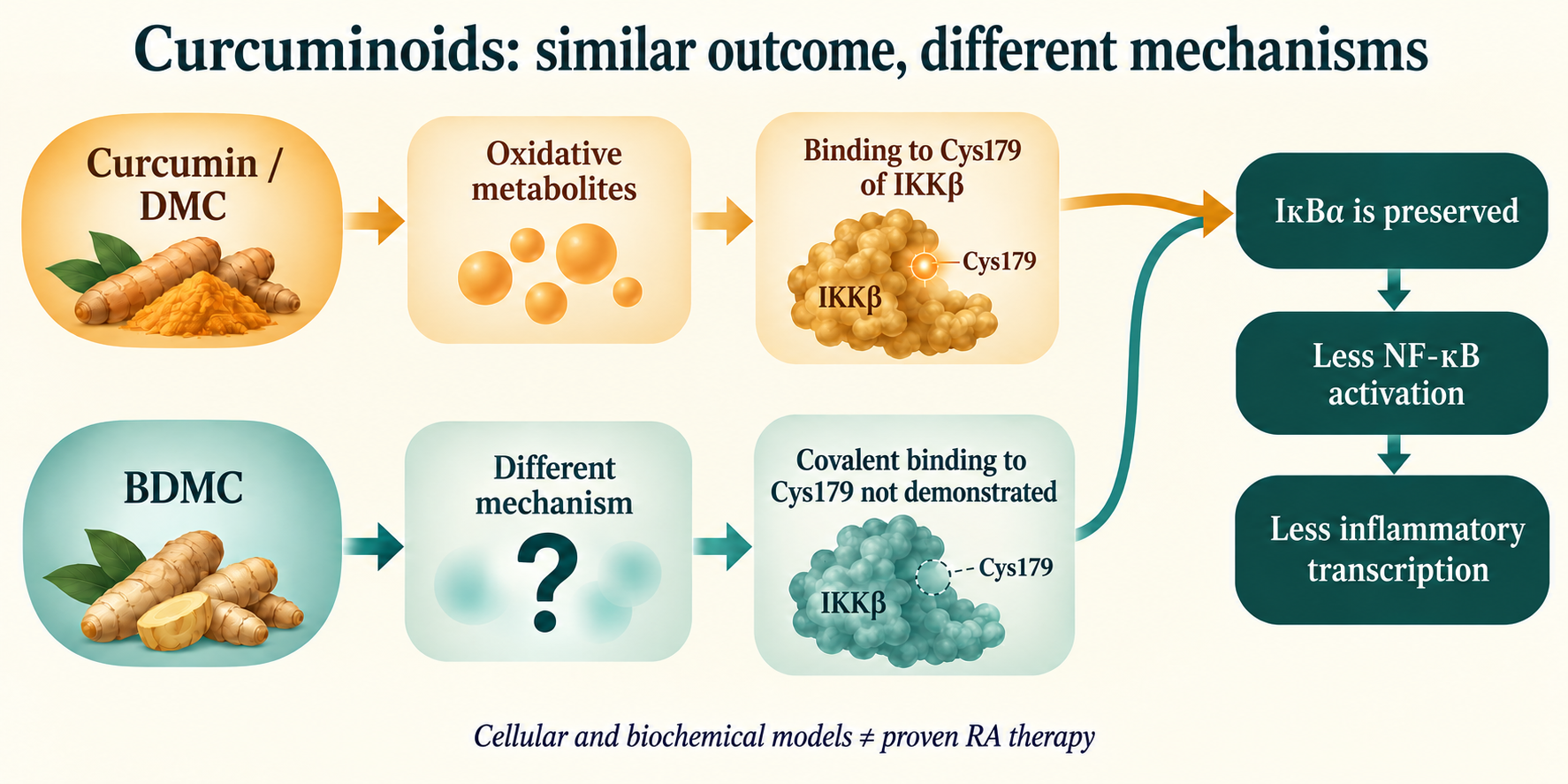
For curcumin, chemical instability is more than a formulation drawback. Autoxidation produces reactive intermediates capable of forming adducts with nucleophilic thiols. In the 2017 primary study by Edwards and colleagues, the tendency of analogs to undergo oxidative transformation was associated with NF-κB inhibition; more stable, nonoxidizable analogs were less active in the corresponding experiments. The authors proposed treating curcumin as a compound requiring bioactivation in certain models, rather than solely as a ready-made selective inhibitor.
Glutathione (GSH) matters here as a low-molecular-weight cellular thiol. It can intercept electrophilic products and compete with protein cysteines. Reducing GSH biosynthesis intensified curcumin activity in the experimental system. This demonstrates dependence on the redox environment, not a benefit of depleting glutathione in humans. GSH concentration, binding to medium proteins, oxygen, incubation time, and solvent can substantially alter the result of the same nominal amount of compound.
DMC can also undergo oxidative activation, but losing one methoxy group changes the rate and profile of this process. BDMC is more resistant to spontaneous oxidation, which is not evidence of universal superiority. It means that the molecule may follow another sequence of interactions. Reduced metabolites—tetrahydro-, hexahydro-, and octahydrocurcumin—also differ from the original triad: hydrogenation changes the conjugated system and reactivity. Their biological properties require separate study.
What the IKK complex actually does
In a resting cell, an NF-κB dimer, often p65/RelA and p50, is retained in the cytoplasm by IκBα. Signals from TNF, IL-1, or Toll-like receptors can activate the IKK complex through their own adapters and upstream kinases. The complex includes the catalytic serine/threonine kinases IKKα and IKKβ and the regulatory component NEMO/IKKγ. It is not a cysteine protease: a cysteine in the activation region can be a redox-sensitive site without replacing the mechanism of phosphate transfer from ATP.
IKKβ phosphorylates IκBα at Ser32 and Ser36. The kinase reaction requires ATP and the appropriate ionic environment, including Mg²⁺, and produces ADP and phosphorylated protein. Phosphorylation creates a recognition signal for SCF–β-TrCP, followed by ubiquitination and proteasomal degradation of IκBα. Released NF-κB enters the nucleus and helps regulate genes involved in inflammation, survival, and feedback. This chain includes distinct enzymes and compartments; measuring one component does not automatically establish inhibition of every other component.
Curcumin oxidation products can modify a peptide containing Cys179 from the IKKβ activation region. This supports a hypothesis of thiol-dependent interference with signaling. However, a peptide adduct, phosphorylation immunoblot, reporter activity, and binding to full-length kinase inside a cell are different measurements. Without specific structural data, it is inappropriate to claim a demonstrated “collapse of the ATP pocket” for the entire triad. A universal IC₅₀ also cannot be assigned across different cellular and enzyme systems.
In the 2020 study by Edwards and colleagues, NF-κB was assessed using LPS-induced reporter activity in RAW264.7 cells. Curcumin, DMC, and BDMC yielded different numerical IC₅₀ estimates, but the differences between them were not statistically significant. Thus even the smaller numerical estimate for BDMC in that assay does not establish superiority. The central observation was mechanistic: BDMC reduced IKKβ phosphorylation, but its activity did not involve detectable covalent binding to Cys179 in the studied system. The blanket assertion that “all three compounds alkylate Cys179 identically” contradicts that work.
TNF-α: expression, shedding, and degradation are different processes
TNF is formed as a membrane-bound precursor. The metalloprotease ADAM17, also known as TACE, can release its soluble form through proteolytic shedding. Binding to TNFR1 and TNFR2 initiates context-dependent programs involving inflammatory transcription, cell survival, and, under certain conditions, cell death. A decrease in TNF concentration in culture medium can therefore reflect changes in transcription, cell number, mRNA stability, shedding, or secretion.
NF-κB and AP-1 participate in regulating inflammatory expression. Tristetraprolin (TTP) binds AU-rich regions in various mRNAs and promotes their decay; its activity depends, among other factors, on phosphorylation and interactions with RNA-degradation proteins. This describes a physiological regulatory layer, not proof that every curcuminoid acts clinically through TTP. Similarly, ADAM17 is a biologically justified point for distinguishing membrane and soluble TNF, but a lower cytokine concentration does not itself demonstrate direct inhibition of that enzyme.
The study by Sun and colleagues on BDMC included adjuvant-induced arthritis in rats and LPS-stimulated RAW264.7 cells. The investigators observed reduced inflammatory manifestations and several cytokine measures, changes in IκBα/NF-κB and COX-2, and reduced migration of the macrophage cell line. This useful preclinical observation does not justify declaring BDMC a proven means of directly “degrading TNF-α” in patients or an equivalent of a monoclonal anti-TNF drug. Reduced signal production and neutralization of an existing cytokine require different evidence.
The prostaglandin cascade and the limits of “COX-2 inhibitor”
After arachidonic acid is released from membrane phospholipids, cyclooxygenases form PGG₂ and then PGH₂. COX combines cyclooxygenase and peroxidase activities, with heme important for its function. Separate synthases then direct PGH₂ toward different prostanoids. Membrane-associated mPGES-1 catalyzes PGE₂ formation and depends on GSH. Altering its expression, directly inhibiting its enzyme activity, and reducing COX-2 expression are distinct ways of lowering the same final product.
Koeberle and colleagues investigated direct curcumin interference with mPGES-1. A separate A549 study described suppression of IL-1β-induced mPGES-1 and COX-2 expression. These findings make the prostaglandin pathway a substantive research target. They do not, however, confer the properties of a selective clinical COX-2 inhibitor on every oral formulation or guarantee gastrointestinal, renal, and cardiovascular safety. Selectivity requires comparison of enzyme activities at relevant exposure, while safety requires independent clinical data.
The leukotriene pathway through 5-lipoxygenase is another branch of arachidonic acid metabolism. Combining compounds that affect different branches in vitro does not establish synergy in humans. A claim of synergy requires formal interaction analysis, and therapeutic superiority of a curcumin–boswellia combination requires a trial of the particular composition in the particular population. “Complete COX-2/5-LOX blockade” and “total shutdown of inflammation” do not reflect the available level of evidence.
Synovium, macrophages, and joint destruction
In RA, synovial inflammation is sustained by interactions between innate and adaptive immune cells and fibroblast-like synoviocytes. Activated fibroblasts can release cytokines, chemokines, and matrix metalloproteinases, alter extracellular matrix, and contribute to invasive tissue formation. Macrophages add TNF, IL-1, and other signals to this network. The network cannot be reduced to one enzyme, so lower NF-κB activity in a cell line does not equal restoration of normal synovium.
Mitochondrial apoptosis involves changes in BCL-2-family protein balance, outer mitochondrial membrane permeability, and cytochrome c release. The apoptosome containing APAF1 and procaspase-9 then initiates the caspase cascade; caspase-3 is an executioner and caspase-9 an initiator. This sequence matters when describing cytotoxic effects in culture. Reduced cell viability can decrease cytokine secretion, but a therapeutic conclusion requires selectivity for pathological tissue and an acceptable pattern of injury to other cells.
Osteoclastogenesis depends on M-CSF and RANKL–RANK signaling, involving NF-κB and NFATc1. MMP-1, MMP-3, and MMP-13 contribute to proteolytic matrix remodeling. Reductions in these measures help explain research interest in curcuminoids but do not replace joint imaging and long-term erosion follow-up in randomized trials. A study measuring only DAS28 for several weeks cannot demonstrate cartilage preservation or prevention of bone damage.
The same limitation applies to NLRP3, IL-6–JAK–STAT3, and Th17/Treg. The NLRP3-dependent inflammasome participates in IL-1β maturation through caspase-1, a step distinct from NF-κB-dependent priming. IL-6 activates receptor complexes and JAK/STAT signaling, while T-cell differentiation depends on combinations of cytokines. A change in one marker does not establish “switching the entire immune balance.” These mechanisms require identification of the model and specific measurement, rather than being listed as established clinical effects. The distinction between priming and complex assembly is explained further in the article on the NLRP3 inflammasome.
Absorption, metabolism, and why AUC is not an effect
After oral administration, curcuminoids encounter limited dissolution, absorption, and rapid metabolic transformations. Conjugating systems operate in the intestine and liver: UGT enzymes use UDP-glucuronic acid for glucuronidation, and sulfotransferases use PAPS for sulfation. Reductive transformations produce hydrogenated metabolites but should not unconditionally be attributed to a single “alcohol dehydrogenase.” Plasma measurements must distinguish free parent compound, conjugates, reduced forms, and total concentration after laboratory deconjugation.
Phospholipid complexes, micelles, colloidal particles, lipid systems, and piperine combinations address different technological problems. They can alter dissolution, transport, metabolism, and measured exposure. Results therefore cannot be transferred between technology labels or commercial products without comparing active compounds and analytical methods. A larger AUC describes the amount of measured analyte over the observation period; it does not itself establish occupancy of IKKβ in synovium or confirm a clinical response.
In the human crossover study by Cuomo and colleagues, a lecithin formulation increased total curcuminoid absorption approximately 29-fold relative to the studied unformulated mixture. Nevertheless, phase-II metabolites were detected, and concentrations remained below those required for many anti-inflammatory targets in vitro. This is an important limitation stated by the primary source itself. “29” cannot be used as an efficacy multiplier, evidence of joint penetration, or a reason to independently reduce the dose of another medication.
Shoba and colleagues investigated curcumin combined with piperine in animals and healthy volunteers. The work supports the possibility of pharmacokinetic changes but does not establish treatment of RA with that combination. The frequently repeated “2000%” refers to the conditions of a specific study and is not a guarantee for every product. Piperine can alter the processing of other compounds too; increased bioavailability should not be presented as a cost-free enhancement of beneficial activity alone.
Clinical trials: a positive pilot and a negative result
RA curcuminoid trials differ in composition, dose, duration, background treatment, and endpoints. DAS28 is a composite index depending on joint assessment and other components of the version used. ACR20/50/70 are response categories, not percentages of “cured joints.” Statistically significant within-group improvement can occur because of standard treatment, regression to the mean, and nonspecific changes. Assessing an additional effect requires a between-group comparison.
The randomized pilot by Chandran and Goel included 45 patients with active RA and compared curcumin, diclofenac, and their combination. It lasted eight weeks, using the BCM-95 formulation, curcumin 500 mg and diclofenac 50 mg twice daily. The primary endpoint was DAS28 reduction; secondary endpoints involved ACR responses. The authors reported improvement in all groups and greater improvement in several measures in the curcumin group. Small size, short duration, lack of placebo, and limitations of blinding restrict interpretation. This was not a noninferiority trial with a prespecified margin and does not demonstrate equivalence to standard treatment.
Amalraj and colleagues investigated a bioavailable formulation in a double-blind placebo-controlled trial involving 36 participants and three groups. The product was administered at 250 or 500 mg twice daily for 90 days, with assessment of disease activity and related diagnostic measures. Positive results were reported, but 12 participants per group cannot reliably evaluate rare adverse events, reproducibility of a large effect, or long-term disease control. The mass of the studied product cannot automatically be interpreted as pure curcumin mass or the dose of another formulation.
The trial of hydrogenated curcuminoids, CuroWhite, included 24 patients, with eight allocated to each of the 250 mg product, 500 mg product, and placebo groups, once daily for three months. This was a distinct intervention containing hydrogenated compounds and a carrier. The authors reported improved symptoms and diagnostic measures. The pilot size and links between development and the manufacturer require independent replication; results cannot be attributed to pure BDMC. If the protocol does not unambiguously designate one primary endpoint, editorial text should not assign one retrospectively.
The double-blind randomized trial by Javadi and colleagues included 65 patients: 30 received nanomicellar curcumin and 35 placebo. The dose was 40 mg three times daily for 12 weeks, as an addition to medication. DAS28 and erythrocyte sedimentation rate (ESR), as well as tender and swollen joints, were assessed. Between-group differences in changes in DAS28 and joint measures were not statistically significant; there was also no significant between-group effect on ESR. This negative result cannot be relabeled confirmed efficacy on the basis of within-group improvement.
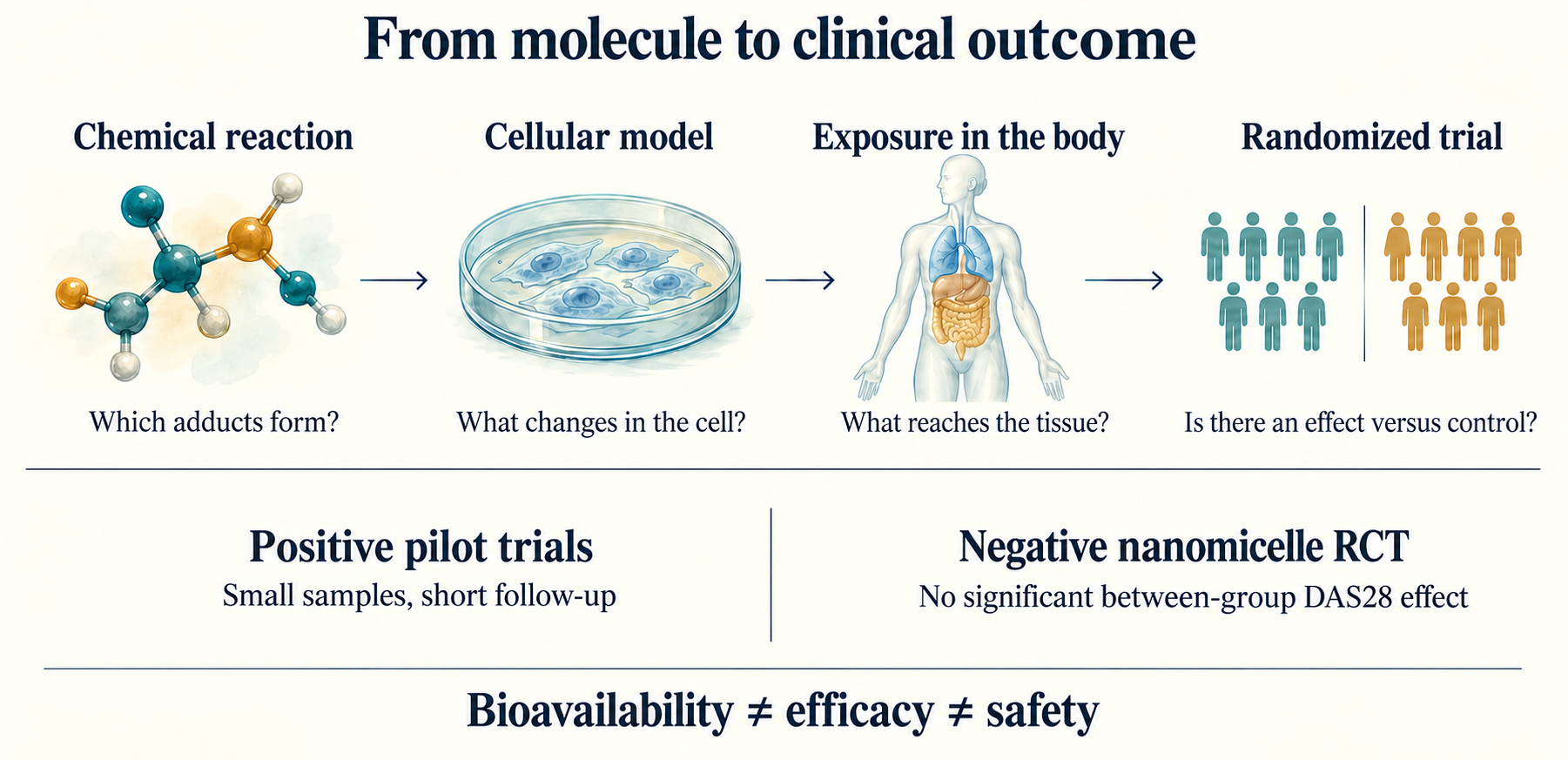
Together, positive and negative trials indicate uncertainty, rather than permission to select only a convenient conclusion. Meta-analysis can increase statistical power but cannot remove differences between interventions, small samples, blinding problems, or selective outcome publication. Combining RA with osteoarthritis deserves particular caution because they are different diseases. Evidence for less pain in osteoarthritis does not establish control of autoimmune synovitis, and animal studies must not inflate the number of clinical participants.
Safety: a short trial does not exclude rare liver injury
No recorded adverse events in a small trial does not mean an absence of gastrointestinal, cardiovascular, renal, or hepatic toxicity in all users. Rare reactions cannot be quantified using a few dozen participants. Culinary turmeric is also not direct evidence of safety for a concentrated extract with different exposure. Dose, composition, duration, and concomitant medication all matter for tolerability.
The DILIN series described ten cases of liver injury associated with turmeric products following expert causality assessment. Five patients were hospitalized and one died from acute liver failure; the pattern was predominantly hepatocellular. Piperine was found in three of seven analyzed products. The series neither establishes risk frequency among all supplement users nor proves piperine explains every case, but directly contradicts unconditional claims of hepatic safety. Association with HLA-B*35:01 does not turn a research observation into a generally accepted screening test before use.
Jaundice, dark urine, pronounced weakness, nausea, or right-upper-abdominal pain after starting a supplement require medical assessment. The suspected product should be reported to the clinician along with its packaging and composition. These symptoms should not automatically be called “detoxification.” Attributing serious cases solely to uncertified solvents or contamination is also inappropriate: the series did not provide such a universal explanation. Verified product purity is useful but does not exclude an idiosyncratic reaction.
Drug interactions need separate assessment. In-vitro CYP or transporter inhibition does not automatically define the size of a clinical effect, yet a low average concentration cannot exclude every interaction with every formulation. Particular attention is warranted for drugs with narrow therapeutic ranges, anticoagulants, and piperine combinations. A proven safe dose cannot be invented for pregnancy, breastfeeding, or biliary disease. A universal rule to discontinue seven days before surgery also requires linkage to the particular clinical situation.
Place in treatment and questions for the next study
Curcuminoids remain investigational compounds with interesting biochemistry and heterogeneous clinical evidence. The ACR guideline on integrative interventions conditionally favors established dietary recommendations without adding dietary supplements for RA management. This does not prohibit treating a confirmed deficiency or evaluate every other medical indication. It does not support presenting curcumin as a standard natural DMARD or mandatory treatment component.
The cited pilots cannot establish a scientifically sound universal protocol of “high dose for a flare, year-long maintenance for remission.” It is inappropriate to promise a predetermined reduction in pain, CRP, or DAS28 by a specific week, recommend independently replacing methotrexate, or claim protection against its liver toxicity. If someone already takes a supplement, the clinician needs its exact name, active-compound content, presence of piperine, and start date. This information helps assess tolerability and interactions without replacing disease control.
A convincing next trial requires a chemically characterized product, stable background treatment, protocol registration, a prespecified primary endpoint, an adequate sample, and analysis of all randomized participants. Measuring free compounds and metabolites could connect dose with exposure. A disease-modification claim requires long-term structural and functional outcomes; BDMC needs its own human data rather than extrapolation from a mixture. Independent replication of a positive effect matters more than lengthening the list of molecular targets. The similar problem of translating cellular polyphenol effects into clinical outcomes is discussed in the article on quercetin and luteolin.
The overall conclusion remains substantive: structural differences between curcumin, DMC, and BDMC help explain how redox chemistry can change inflammatory signaling. At the same time, they reveal the limitations of simple explanations such as “a natural selective blocker.” Between a chemical reaction, a change in a cellular marker, and a reliable clinical intervention lies a chain of questions, each requiring its own experiment.
FAQ
Do curcumin, DMC, and BDMC act identically?
No. Structural differences alter oxidation and thiol interactions. In the comparative study, BDMC activity on NF-κB did not involve detectable covalent binding to Cys179 IKKβ.
Does the Chandran and Goel pilot establish equivalence to RA treatment?
No. The small eight-week study with 45 participants was not a noninferiority trial and does not demonstrate long-term disease control.
Were all RA trials positive?
No. In the double-blind Javadi trial, nanomicellar curcumin did not produce a statistically significant between-group improvement in changes in DAS28 or joint measures.
Does higher bioavailability guarantee safety?
No. Increased exposure neither establishes clinical efficacy nor excludes adverse reactions. Severe liver injury associated with turmeric products has been reported.
Sources
- Edwards RL et al. The anti-inflammatory activity of curcumin is mediated by its oxidative metabolites. J Biol Chem. 2017.
- Edwards RL et al. Mechanistic differences in the inhibition of NF-κB by turmeric and its curcuminoid constituents. J Agric Food Chem. 2020.
- Sun X et al. Bisdemethoxycurcumin, a curcumin derivative, ameliorates adjuvant-induced arthritis by suppressing inflammatory reactions and macrophage migration. Chem Biol Interact. 2024.
- Chandran B, Goel A. A randomized, pilot study to assess the efficacy and safety of curcumin in patients with active rheumatoid arthritis. Phytother Res. 2012.
- Amalraj A et al. A Novel Highly Bioavailable Curcumin Formulation Improves Symptoms and Diagnostic Indicators in Rheumatoid Arthritis Patients: A Randomized, Double-Blind, Placebo-Controlled, Two-Dose, Three-Arm, and Parallel-Group Study. J Med Food. 2017.
- Jacob J et al. A novel bioavailable hydrogenated curcuminoids formulation (CuroWhite™) improves symptoms and diagnostic indicators in rheumatoid arthritis patients - A randomized, double blind and placebo controlled study. J Tradit Complement Med. 2019.
- Javadi M et al. Effect of curcumin nanomicelle on the clinical symptoms of patients with rheumatoid arthritis: A randomized, double-blind, controlled trial. Int J Rheum Dis. 2019.
- Cuomo J et al. Comparative absorption of a standardized curcuminoid mixture and its lecithin formulation. J Nat Prod. 2011.
- Shoba G et al. Influence of piperine on the pharmacokinetics of curcumin in animals and human volunteers. Planta Med. 1998.
- Liver Injury Associated with Turmeric--a Growing Problem: Ten Cases from the Drug-Induced Liver Injury Network [DILIN]. Am J Med. 2023.
- Koeberle A, Northoff H, Werz O. Curcumin blocks prostaglandin E2 biosynthesis through direct inhibition of the microsomal prostaglandin E2 synthase-1. Mol Cancer Ther. 2009.
- Curcumin suppresses interleukin 1beta-mediated microsomal prostaglandin E synthase 1 by altering early growth response gene 1 and other signaling pathways. 2005.
- England BR et al. 2022 American College of Rheumatology Guideline for Exercise, Rehabilitation, Diet, and Additional Integrative Interventions for Rheumatoid Arthritis. Arthritis Rheumatol. 2023.