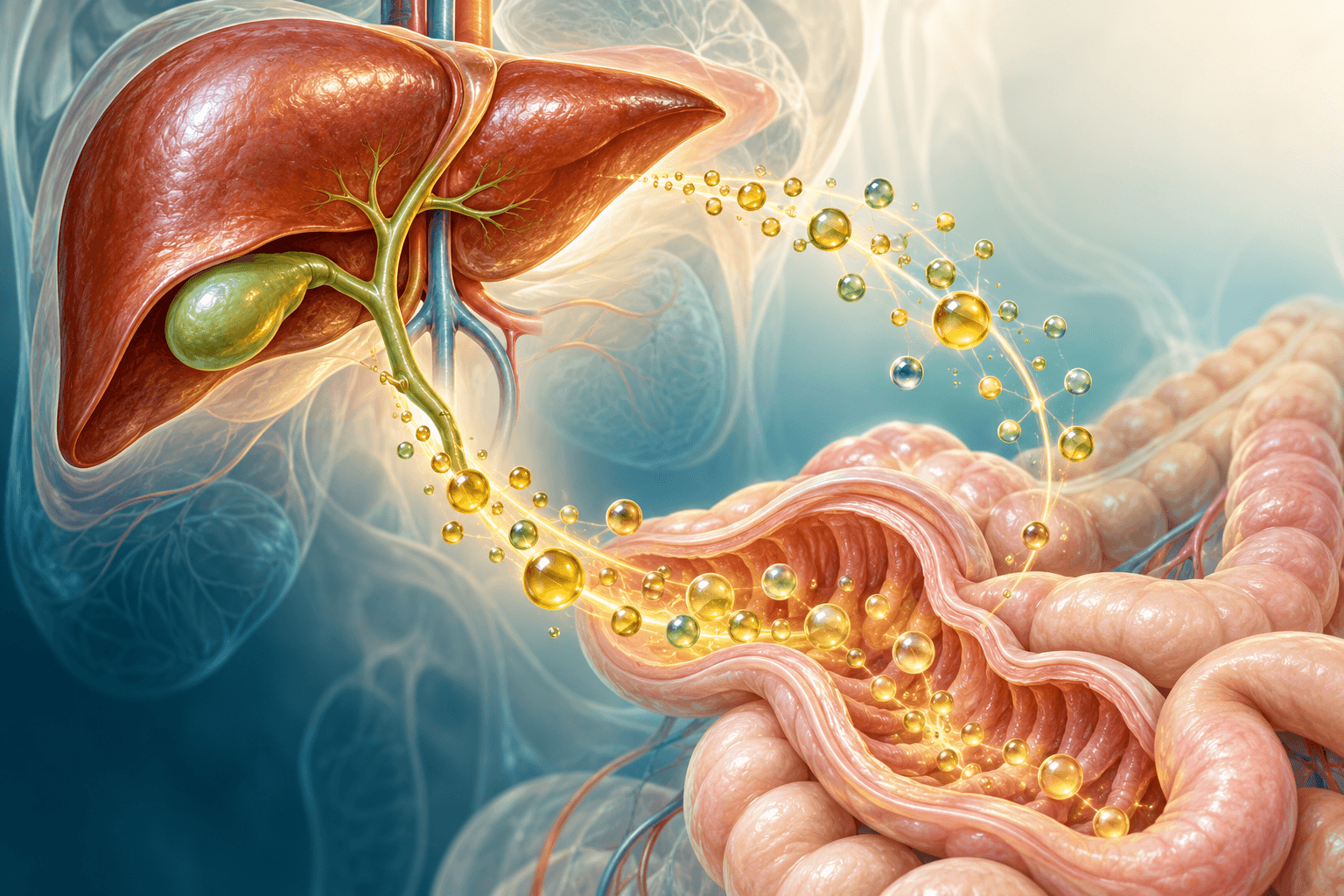
Bile acids, FXR and TGR5: the gut–liver axis
Bile-acid synthesis and conjugation, BSH/bai, enterohepatic transport, FXR–FGF19 and TGR5. Lipids, GLP-1, thermogenesis, MASH trials and evidence limits.
Bile-acid synthesis and conjugation, BSH/bai, enterohepatic transport, FXR–FGF19 and TGR5. Lipids, GLP-1, thermogenesis, MASH trials and evidence limits.
Bile acids connect three processes that are easily confused: dietary fat digestion, cholesterol disposal, and cellular signaling. In the intestinal lumen they contribute to mixed micelles; inside cells some activate the nuclear receptor FXR; at the surface of particular cells they activate TGR5. Each process depends on a different chemical species, concentration and location. “More bile means better metabolism” is therefore an inadequate physiological rule. Too little bile acid in the lumen impairs fat absorption, whereas excessive exposure to hydrophobic acids in the wrong compartment can injure membranes.
The system explains why microbial metabolism, ileal transport and hepatic feedback can change a bile-acid pool without producing a single uniformly beneficial outcome. Increased GLP-1 secretion in a cell experiment or lower expression of a lipogenic gene does not itself establish a treatment for obesity or metabolic dysfunction-associated steatohepatitis, MASH.
The principal human primary bile acids are cholic acid, CA, and chenodeoxycholic acid, CDCA. The classical pathway starts in the hepatocyte endoplasmic reticulum with cholesterol 7α-hydroxylase, CYP7A1. This P450 monooxygenase incorporates one oxygen atom into its substrate and reduces the other to water, using reducing equivalents supplied through NADPH and P450 reductase.
HSD3B7 then oxidizes the 3β-hydroxyl group and moves the double bond, producing 7α-hydroxy-4-cholesten-3-one, commonly abbreviated C4. Circulating C4 is used in particular research and diagnostic settings as an indirect indicator of bile-acid synthesis. Sampling time, disease and assay matter; it does not directly measure the entire pathway's flux.
CYP8B1 introduces a 12α-hydroxyl group and directs intermediates toward CA. Without this step, CDCA predominates. AKR1D1 reduces the double bond to establish the 5β configuration, and enzymes including AKR1C4 reduce the 3-keto group to a 3α-hydroxyl. CYP27A1 oxidizes the side chain, which is subsequently shortened in peroxisomes. AMACR, ACOX2, HSD17B4 and SCPx participate in processing C27 intermediates into C24 acids. ACOX2 should not be replaced by ACOX1 in this description: their substrate specializations differ.
The alternative pathway begins with mitochondrial CYP27A1, followed by oxysterol 7α-hydroxylation by CYP7B1 in the endoplasmic reticulum. The historical name “27-hydroxylase” persists, although systematic terminology accounts for the stereochemistry of terminal 26-hydroxylation. This route is particularly associated with CDCA formation, but its contribution varies with age, liver condition and substrate availability. Fixed proportions such as “exactly 90% versus 10%” do not describe all humans.
The bent 5β steroid skeleton has a hydroxyl-bearing hydrophilic face and a more hydrophobic opposite surface. CA has hydroxyls at 3α, 7α and 12α; CDCA at 3α and 7α. Microbial removal of the 7α-hydroxyl produces DCA and LCA, respectively. Fewer hydroxyls often increase hydrophobicity, but orientation also matters: UDCA has a 7β-hydroxyl and differs from CDCA despite having the same number of oxygen atoms.
| Acid | Principal hydroxyls | Origin and relevant distinction |
|---|---|---|
| CA | 3α, 7α, 12α | Primary; precursor of DCA |
| CDCA | 3α, 7α | Primary; substantial FXR activity in several assays |
| DCA | 3α, 12α | Secondary, derived from CA |
| LCA | 3α | Secondary, derived from CDCA; metabolism and elimination limit damaging exposure |
| UDCA | 3α, 7β | Epimerization product and a medicine with its own indications; not equivalent to a potent FXR agonist |
A hydrophobicity index is an analytical comparison under specified conditions, not a universal toxicity score. In Heuman's 1989 system for taurine conjugates, tauro-CA was assigned 0 and tauro-LCA 1; tauro-UDCA was −0.47, tauro-CDCA +0.46 and tauro-DCA +0.59. These numbers should not be transferred to unconjugated acids, arbitrary pH or receptor potency. A weighted index can describe a mixture:
where (x_i) denotes molar fractions measured under comparable conditions. Even this index does not replace information about monomer concentrations, micelles and cellular exposure.
Hepatic SLC27A5, also called BACS/FATP5, activates a bile acid by forming its CoA thioester. BAAT transfers the acyl group to glycine or taurine, generating an amide bond:
is the steroid-containing bile-acid residue attached to the carbonyl; is for glycine or for taurine. The notation shows connectivity; protonation at biological pH is considered separately. ATP is converted to AMP here, rather than only to ADP. Conjugation lowers pKa: approximate values are around 4 for glycine conjugates and 1–2 for taurine conjugates, compared with around 5 for many free acids, with exact values depending on the environment.
For a monoprotic acid, the Henderson–Hasselbalch relationship gives the neutral HA fraction:
At pH 7.4 and pKa 5, approximately 0.4% is HA; at pKa 4 the fraction is about 0.04%. This illustrates an equilibrium rather than predicting membrane injury precisely. Free acids in blood are not necessarily predominantly uncharged, and conjugates are not literally “100% ionized” at every pH. An acidic microenvironment increases neutral glycine-conjugate fractions, a relevant issue for cholangiocytes.
Conjugates support lipid solubilization and remain in the lumen until transporter-mediated uptake. Mixed micelles also contain phospholipids, cholesterol, monoglycerides and fatty acids. Their critical micellar concentration depends on composition, ions and pH. Bile acids facilitate access to lipid interfaces and removal of digestion products, while pancreatic lipase and colipase remain a distinct enzymatic system. Digestion cannot be reduced to one receptor directly “switching on lipase.”
BSEP, encoded by ABCB11, exports bile salts from hepatocytes into canalicular bile. This ABC transporter contains two transmembrane halves and two nucleotide-binding domains. ATP-dependent conformational changes alter access to the substrate cavity. Its two ATP-binding sites should not automatically be portrayed as equally active catalytic centers: asymmetric ABC transporters can have functionally different sites.
MDR3/ABCB4 transfers phosphatidylcholine toward the outer leaflet of the canalicular membrane, from which it enters bile; floppase activity is the appropriate directional description. ABCG5/ABCG8 participate in sterol export. Phospholipids reduce the effects of free detergent monomers on biliary epithelium. Flow volume and flow composition are therefore separate properties.
ABCB11 and ABCB4 defects cause forms of inherited cholestasis, including PFIC2 and PFIC3. Inhibition of BSEP by particular medicines is one possible contributor to drug-induced liver injury, but it neither explains every case nor invariably follows simple competitive kinetics. Bile-acid accumulation, adaptive transport and immune responses interact.
A structure can inform a mechanism only when its object is identified correctly. PDB 3V8D contains CYP7A1 with 7-ketocholesterol; it is not a direct visualization of cholesterol reacting through Compound I. The heme center and thiolate ligand support general P450 chemistry, but a distance measured with a different ligand cannot be declared the reactive distance in every catalytic state.
Likewise, the TGR5 structure 7CFM contains the synthetic agonist P395; Yang and colleagues' 2020 study also examined INT-777. These structures inform ligand recognition and G-protein coupling without making every contact identical for LCA. PDB 5W21 represents FGF23–FGFR1c–α-Klotho, rather than FGF19–FGFR4–β-Klotho. Confusing α- and β-Klotho substitutes a different signaling system. None of these explanations needs invented atomic distances, dissociation constants or oligomeric counts.
Bile salt hydrolases, BSH, cleave conjugate amide bonds, releasing glycine or taurine and a free acid. Their substrates can include both primary conjugates and previously transformed conjugated acids. Activity occurs across multiple bacterial groups and depends on the enzyme and substrate; more BSH does not automatically mean a healthier microbiota.
Deconjugation changes solubility, transport and access to downstream enzymes. It is necessary for the canonical bacterial 7α-dehydroxylation route, but not an obligatory initial step in every conceivable microbial alteration of every bile acid. If it occurs prematurely in the small intestine, micellar composition and fat absorption may be affected. This connects with SIBO, motility and breath-test limitations, while a DCA concentration alone does not establish bacterial overgrowth.
Specialized anaerobes, including Clostridium scindens, can convert CA to DCA and CDCA to LCA. Sequential bai reactions involve activation, A-ring oxidation, dehydration and reduction. Oxidation of the 3-hydroxyl and formation of unsaturated intermediates provide the context; BaiE catalyzes the dehydration step associated with loss of the 7α-hydroxyl. Describing the whole process as “first oxidize 7α-OH to a 7-keto group, then simply remove that oxygen” is incorrect.
Funabashi and colleagues in 2020 reconstructed the multistep conversion with six enzymes in vitro and transferred functions into an experimental bacterial system. This establishes enzyme-set sufficiency rather than a therapeutic probiotic. Organism abundance, gene expression, substrate supply and transit time jointly determine metabolic flux; a small relative abundance does not imply a proportionately small metabolic contribution.
A different route uses reversible 7-hydroxyl epimerization through a 7-oxo intermediate, involving 7α- and 7β-hydroxysteroid dehydrogenases. It can convert CDCA to UDCA, sometimes through interspecies exchange of intermediates. The 7-oxo stage belongs in this explanation. Direction depends on substrates and redox conditions, rather than the enzyme's name alone.
An adult human pool commonly contains several grams and undergoes repeated cycles during a day. Efficient recovery allows the same molecule to be used repeatedly. “Approximately 95% recovered” refers to recovery over a passage; it does not mean exactly 5% of the entire pool is lost daily regardless of the number of cycles.
P is pool mass, S new synthesis and L loss, with S and L typically expressed in g/day. In a simple model of identical repeated cycles:
where N is daily turnover count and r recovery per cycle. For example, P = 3 g, N = 4 and r = 0.95 give approximately 0.6 g/day. This is an educational calculation, not a universal physiological reference value. Composition, meals, transit and absorption are heterogeneous; diarrhea or ileal resection can increase loss and alter feedback.
| Location | Main participants | Direction and energy source |
|---|---|---|
| Hepatic canalicular membrane | BSEP | Hepatocyte → bile; ATP-dependent export |
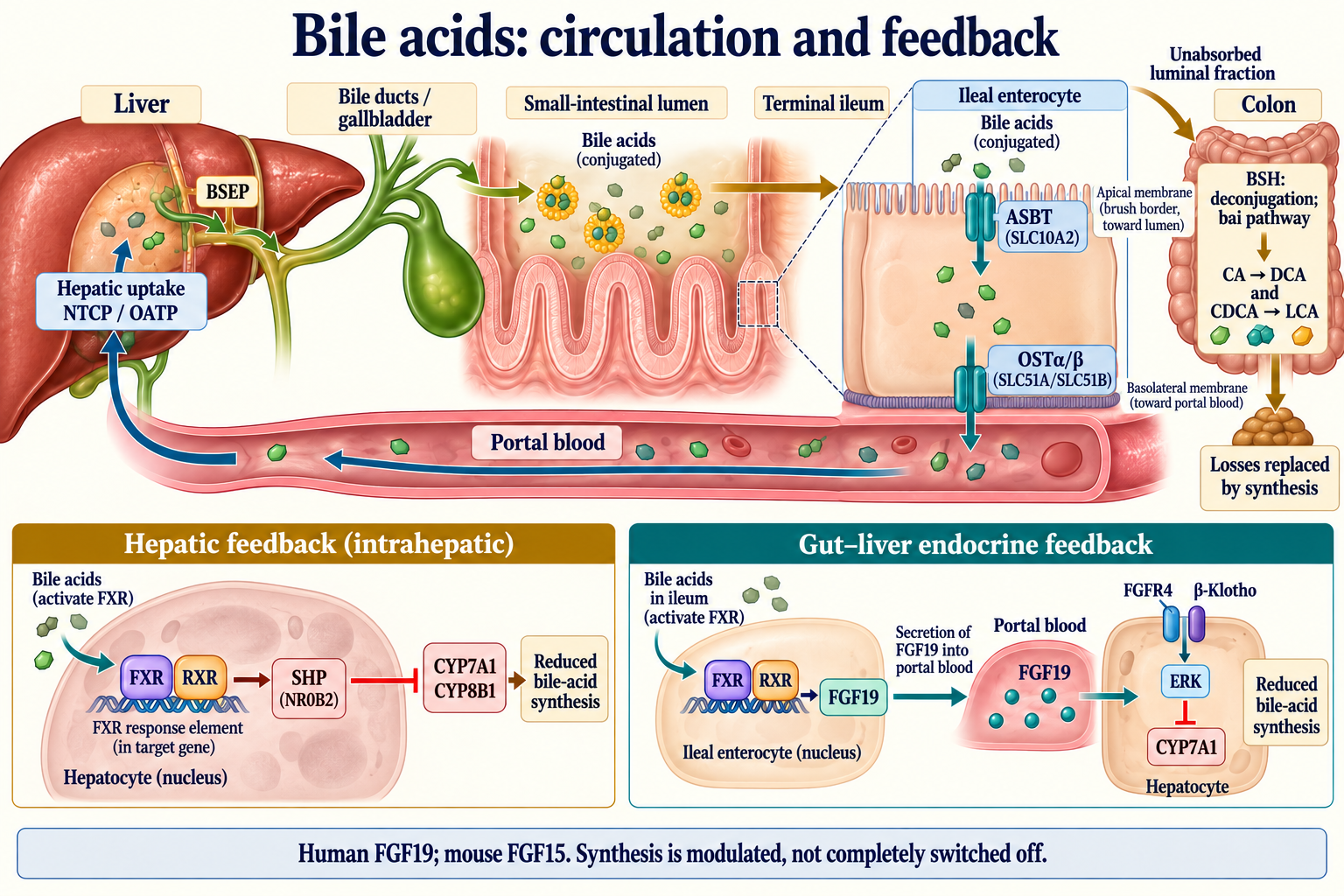
| Apical ileal enterocyte membrane | ASBT/SLC10A2 | Lumen → cell; Na⁺-coupled uptake |
| Within the enterocyte | FABP6/IBABP | Binding and intracellular distribution |
| Basolateral enterocyte membrane | OSTα/OSTβ | Cell → portal blood; facilitated transport |
| Hepatocyte sinusoidal membrane | NTCP and OATP | Blood → liver; different mechanisms and overlapping selectivity |
OSTα/β should not be placed in the apical brush border beside ASBT. NTCP is particularly important for Na⁺-dependent uptake of conjugated salts, whereas OATP substrate ranges overlap; “only conjugated versus only unconjugated” is too rigid. LCA undergoes sulfation, including through SULT2A1, and other detoxification reactions. These reduce recovery and favor elimination without making absorption absolutely zero.
FXR/NR1H4 is a nuclear receptor whose physiological ligands were established by Makishima and Parks in 1999. TGR5/GPBAR1 is a membrane G-protein-coupled receptor studied by Maruyama in 2002 and Kawamata in 2003. They differ in ligand access and cellular consequences.
CDCA is a strong endogenous FXR activator in many functional assays. LCA, DCA and their conjugates often show greater TGR5 potency; including tauro-LCA changes the ranking compared with a table restricted to free acids. There is no universal rule that hydrophobicity predicts equivalent potency at every receptor. LCA also interacts with systems such as VDR and PXR associated with metabolic protection.
EC50 is the concentration producing half the maximal functional response in a particular assay; Kd is an equilibrium binding constant. They need not be equal. Receptor reserve, transport and signal amplification affect EC50. A schematic response curve is:
Here E₀ is the baseline response, Emax the maximal increase above baseline, and EC₅₀ has the same concentration units as C.
where C is available ligand concentration and n the Hill coefficient. It does not turn a total plasma bile-acid measurement into the activation level of every receptor. Albumin binding, individual chemical species, portal versus peripheral sampling and post-meal timing matter.
FXR contains an N-terminal activation region, a zinc-finger DNA-binding domain, a hinge and a ligand-binding domain containing AF-2. It often forms a heterodimer with RXR at regulatory elements such as IR-1. Ligand binding alters interactions with corepressors and coactivators, including SRC, p300 and CBP, affecting chromatin and transcription. A single promoter does not describe every receptor action: direct binding and indirect repression are distinct processes.
In liver, FXR induces SHP/NR0B2, an atypical nuclear receptor without its own DNA-binding domain. Interactions with LRH-1, HNF4α and regulatory complexes reduce CYP7A1 and CYP8B1 expression. This is negative feedback, not complete irreversible shutdown of synthesis. Chromatin enzymes such as G9a contribute in particular experimental systems, without identical involvement at every gene in every tissue (Goodwin et al., 2000).
Ileal FXR promotes human FGF19 production; the corresponding mouse signal is FGF15. The protein enters blood and acts on hepatic FGFR4 together with the β-Klotho coreceptor. This is a portal-circulatory route, not FGF19 transport through a bile-duct lumen. Kinase cascades, including ERK, suppress CYP7A1 transcription (Inagaki et al., 2005).
β-Klotho helps recognize endocrine FGFs and provides tissue selectivity together with the appropriate FGFR. Its extracellular KL1 and KL2 domains organize ligand interactions. C-terminal regions of FGF19/FGF21 operate differently from FGF23 recognition by α-Klotho. Reduced heparan-sulfate affinity favors endocrine circulation, but this should not be described simply as deletion of a “heparin domain.” A universal Kd or obligatory hexameric assembly cannot be assigned without examining the corresponding complex.
FGF19 also affects carbohydrate and energy metabolism. Nevertheless, pharmacological FGFR4 stimulation, prolonged exposure and safety are separate issues. A physiological feedback pathway does not establish the safety of unlimited signal amplification.
p300 and the NAD⁺-dependent deacetylase SIRT1 regulate FXR acetylation. Kemper and colleagues' 2009 experiments identified Lys217 as the main examined site, with a smaller contribution from Lys157. Acetylation can increase protein stability while impairing RXR interaction and transcriptional function. More receptor protein therefore does not necessarily mean greater beneficial activity.
Deacetylation is not a permanent switch to “maximum activity.” Cycling between states, coactivators, nutrition and metabolic conditions matter. Cell and mouse experiments involving resveratrol do not establish that resveratrol, NMN or NR supplements clinically normalize FXR in every patient. NAD⁺ availability is one component of the system rather than a measured universal deficiency in all hepatic steatosis.
FXR/SHP can repress SREBP-1c programs and reduce ACC, FASN and SCD1 expression in relevant models. Insulin, Akt/mTOR signaling and substrate availability continue to regulate lipogenesis. Claims of a fixed “60–80% suppression in humans,” or complete cessation of fat synthesis, require specific clinical evidence that this mechanism alone does not supply.
Pineda Torra and colleagues in 2003 investigated links between FXR and PPARα in human cellular and promoter systems. PPARα regulates a collection of fatty-acid oxidation genes. CPT1A forms acylcarnitine for entry of long-chain acyl groups into the mitochondrial transport system; CACT carries acylcarnitine across the inner membrane, and CPT2 regenerates acyl-CoA. CPT1A is a carnitine acyltransferase, not the entire inner-membrane transport channel. Malonyl-CoA inhibits entry; reducing it does not remove every constraint on oxidation. The FXR-responsive sequence in this human PPARα promoter was not conserved in the mouse promoter; species cannot be omitted from the mechanistic conclusion.
CD36 affects fatty-acid uptake and can increase substrate delivery to liver. Its elevation is not an unequivocal marker of protection against steatosis. ACOX1 participates in peroxisomal fatty-acid oxidation, whereas ACOX2 also processes bile-acid side-chain intermediates. Gene expression changes do not measure energy flux without further data (Watanabe et al., 2004).
APOC2 is a lipoprotein-lipase cofactor, while APOC3 restricts clearance of triglyceride-rich particles through several mechanisms. Primary work by Kast in 2001 and Claudel in 2003 demonstrated FXR-dependent transcriptional regulation. This helps explain possible triglyceride changes without turning every bile acid into a lipid-lowering medicine.
FXR can reduce PCSK9 expression in human hepatocytes. Yet a small human LDL-kinetics study found that CDCA reduced LDL clearance despite lower circulating PCSK9. This result (Ghosh Laskar et al., 2017) illustrates the difference between one marker and the net response. Obeticholic-acid trials also observed increased LDL. Particle composition, receptors and cholesterol synthesis change together. ApoB and atherogenic particle number explain why a cellular diagram cannot replace assessment of circulating lipoproteins and cardiovascular outcomes.
Experimental FXR/SHP and FGF15/19 interventions affect gluconeogenesis, PEPCK and G6PC expression, glycogen formation and insulin sensitivity. Outcomes depend on feeding state, tissue and the particular intervention. GSK3 regulation depends on functional modification of the enzyme; phosphorylation cannot be described indiscriminately as “activation of glycogen synthesis.”
Excess hepatic diacylglycerol, DAG, can activate PKCε and impair signaling from the insulin receptor. Reducing pathological DAG accumulation may weaken this mechanism. It is incorrect to describe that as “removing a block on PKCε,” since its activation contributes to the proposed impairment. These relationships do not establish a universal percentage reduction in glucose after FXR stimulation (Ma et al., 2006).
Ketohexokinase directs fructose through a pathway bypassing the principal PFK-dependent control step of glycolysis. This facilitates formation of triose precursors without making flux entirely unregulated: substrate supply, ATP, transport and downstream reactions remain constraints. ChREBP and MLX regulate carbohydrate-responsive elements and lipogenic programs.
Caron and colleagues in 2013 examined FXR-mediated repression of ChREBP transcriptional activity in human hepatocytes, including altered interactions with p300/CBP and SMRT. This should not be replaced by an unsupported universal chain in which SHP binds MLX, SIRT1 removes one obligatory acetyl group and lipogenesis shuts down. The experiment supports interaction between regulatory programs rather than protection against any fructose intake. The substrate pathway is explained further in fructose, ketohexokinase and lipogenesis.
TGR5 is a seven-transmembrane GPCR. In many investigated cells it couples to Gs, stimulates adenylyl cyclase and increases cAMP, followed by PKA, Epac and other effector systems:
The response depends on receptor location, G-protein expression, phosphodiesterases and ligand access. “TGR5 always raises cAMP in every tissue” is incorrect. Ciliated and nonciliated cholangiocytes provide a well-studied counterexample.
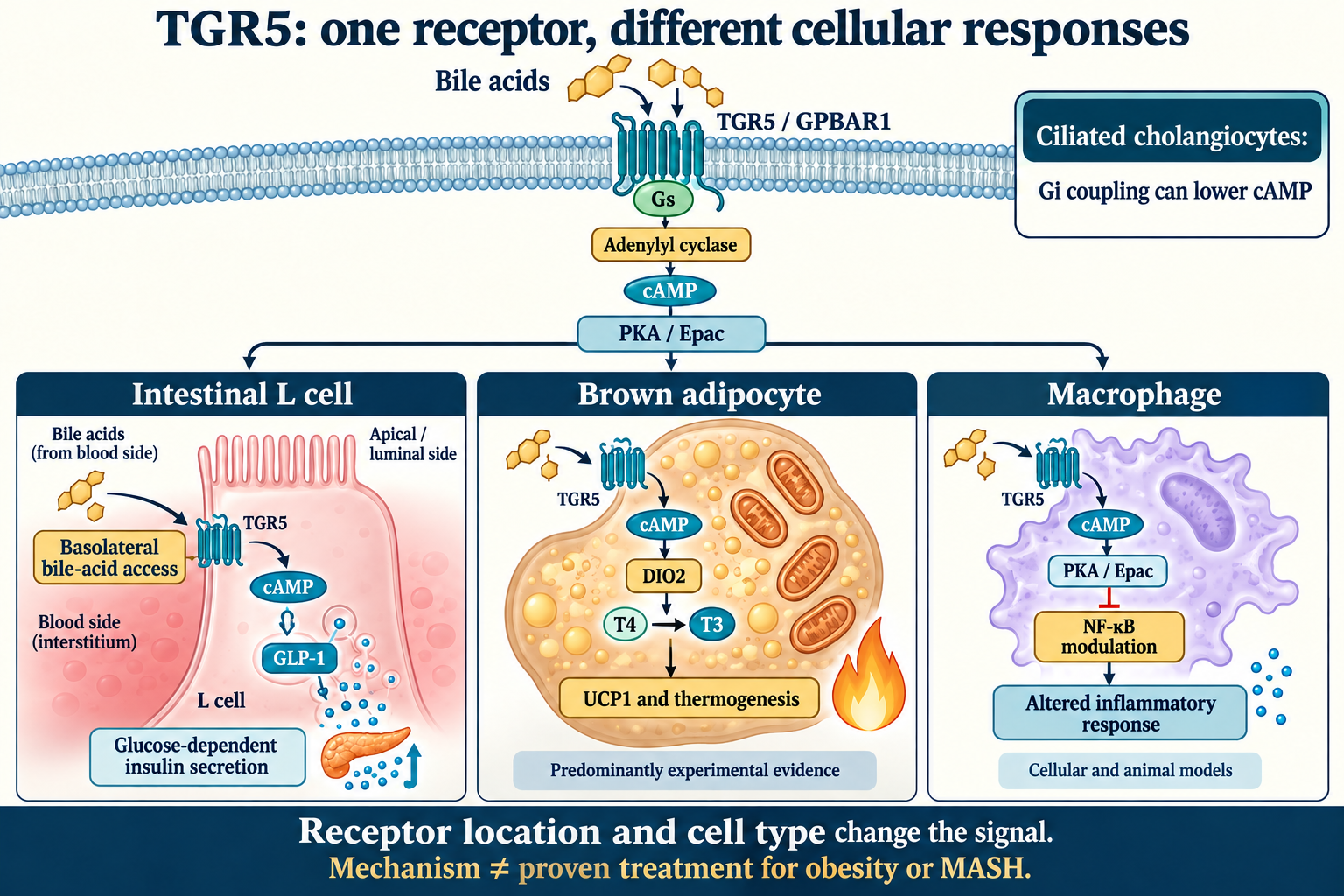
Mouse models and cellular experiments link TGR5 to increased DIO2 activity. This type 2 deiodinase converts T4 to T3. Local T3 interacts with thyroid receptors and supports brown or beige adipocyte thermogenic programs, including UCP1. UCP1 dissipates the mitochondrial inner-membrane proton gradient as heat rather than directly synthesizing extra ATP (Watanabe et al., 2006).
UCP1 cannot automatically be assigned to ordinary skeletal myocytes. Results in human muscle cells and brown fat need different explanations. Broeders and colleagues' 2015 short study involved 12 healthy women receiving CDCA for two days, with changes in brown-fat activity and energy expenditure. This does not demonstrate sustained weight loss, establish a universal 15–20% expenditure increase, or guarantee freedom from thyroid and other adverse effects during prolonged intervention.
TGR5 can enhance GLP-1 release from L cells through cAMP-dependent mechanisms and changes in Ca²⁺. Brighton and colleagues in 2015 demonstrated the importance of basolateral bile-acid access in experimental intestinal systems. Luminal concentration and receptor exposure are therefore not interchangeable.
GLP-1 increases glucose-dependent insulin secretion and contributes to regulation of satiety and gastric emptying. PYY can be released from the same cells, but it is a different peptide rather than a second incretin with identical actions. Detailed KATP or individual Ca²⁺-channel responses depend on the model. Endogenous GLP-1 is rapidly degraded, whereas medicinal GLP-1 receptor agonists have different pharmacokinetics. Dietary stimulation of TGR5 is not equivalent to a clinically established GLP-1R agonist treatment.
TGR5 is expressed in monocyte–macrophage systems. Cellular and mouse studies, including Pols and colleagues' 2011 work, linked stimulation to cAMP-dependent modulation of NF-κB and inflammatory responses. This supports a mechanism without demonstrating complete suppression of human inflammation or obligatory conversion of every macrophage from “M1” to “M2.” Those simplified categories do not encompass all cellular states.
Phosphorylation of one p65 residue cannot automatically be interpreted as prevention of nuclear entry: effects depend on the site and molecular complex. Kupffer cells, intestinal immune cells and circulating monocytes experience different environments. Lowering an individual cytokine does not establish outcomes for infection, fibrosis or cardiovascular disease.
Alemi and colleagues' 2013 mouse experiments linked TGR5 to sensory mechanisms involving 5-HT and CGRP and to peristaltic responses. Contraction oral to a stimulus and relaxation caudal to it support propulsion. This does not establish TGR5 deficiency as the principal cause of every case of human constipation. Bile acids also affect secretion and can promote diarrhea when excessive amounts reach the colon.
In cholangiocytes, CFTR-associated chloride transport and the AE2 exchanger participate in bicarbonate secretion. An alkaline apical microenvironment and glycocalyx reduce protonation of particular bile acids and their entry into cells. Hohenester and colleagues' 2012 cellular work supports the “bicarbonate umbrella” concept without implying absolute protection against every form of cholestasis.
Masyuk and colleagues in 2013 showed that primary-cilium localization changes TGR5 coupling: ciliated cholangiocytes can use Gi with reduced cAMP, whereas nonciliated cells use Gs with increased cAMP. Cell type must therefore be specified. A general TGR5 → Gs diagram cannot predict one identical response throughout the biliary tree.
Metabolic dysfunction-associated steatotic liver disease, MASLD, and its inflammatory form, MASH, involve excessive substrate delivery, insulin resistance, cellular injury, immunity and fibrogenesis. Bile-acid pool changes can be participants and consequences. Neither a presumed shortage of C. scindens nor reduced FXR explains or diagnoses every case.
Activated hepatic stellate cells produce extracellular matrix components. FXR-directed interventions have shown antifibrotic effects in models, but direct receptor expression and action in human stellate cells are context-dependent questions. Paracrine effects through hepatocytes and immune cells should not be replaced by claims of equally high FXR expression in every cell type.
| Node | Supported mechanism | What this alone does not establish |
|---|---|---|
| FXR–SHP and FXR–FGF19 | Feedback regulation of bile-acid synthesis | Complete CYP7A1 shutdown or safety of unlimited amplification |
| Lipogenic regulators | Transcriptional changes in models | A fixed percentage reduction of human liver fat |
| TGR5–DIO2 | Local thyroid and thermogenic connections | Sustained risk-free weight loss |
| TGR5–L cell | Potential GLP-1 release | Equivalence to GLP-1R medicines |
| Microbial BSH/bai | Altered chemical composition | A universally beneficial probiotic or a diagnosis of dysbiosis |
| Histological endpoint | A biopsy change in a trial | Established reductions in death and decompensation |
Obeticholic acid, OCA, is a 6α-ethyl CDCA derivative with substantial experimental FXR activity. A functional potency difference should not be turned into one precise Kd or an identical “hundredfold increase” in every tissue. Trials and regulatory status determine clinical use rather than chemistry alone.
| Trial | Design and examined outcome | Main interpretive boundary |
|---|---|---|
| FLINT, Neuschwander-Tetri et al., 2015 | 283 randomized; among those assessed for the principal biopsy outcome, improved NAS without fibrosis worsening occurred in 50/110 versus 23/109 at 72 weeks | A biopsy surrogate, not 45% of all randomized participants or established mortality reduction |
| REGENERATE, Younossi et al., 2019 | Principal analysis in 931 participants with F2–F3 fibrosis; fibrosis improvement without NASH worsening: 71/308 with OCA 25 mg versus 37/311 with placebo at 18 months | The other principal endpoint, NASH resolution without fibrosis worsening, was not met |
| FLIGHT-FXR, Sanyal et al., 2023 | Phase 2 tropifexor study: changes in ALT and liver fat, with dose-dependent pruritus | Biochemical and imaging changes do not establish clinical benefit or a universal treatment regimen |
NAS sums histological activity features in the corresponding scoring system. REGENERATE's safety population was larger than its principal F2–F3 analysis; these denominators should not be mixed. A trial dose describes the experiment rather than prescribing treatment. OCA caused pruritus and increased LDL, so one favorable biopsy endpoint cannot define the entire benefit–risk balance.
At the 8 October 2026 evidence check, Ocaliva should not be presented as a currently approved US PBC medicine: the FDA withdrew the corresponding approvals effective 24 November 2025. The EU authorization was revoked in 2024, with a temporary judicial suspension subsequently lifted. These are jurisdiction-specific findings rather than a statement of identical worldwide status. OCA should not be described as an approved universal MASH treatment either.
Tropifexor and cilofexor are nonsteroidal FXR agonists; INT-777 and INT-767 are experimental compounds with different receptor profiles. They are not interchangeable established medicines with one common regimen. FXR selectivity does not automatically eliminate itching. Human MRGPRX4 research, including Yu and colleagues' 2019 study, supports another bile-acid-responsive mechanism. Mouse TGR5 itch findings do not establish direct TGR5 cross-activation by every FXR agonist in humans.
Guggulsterones interact with multiple receptor systems and are not exclusively selective, beneficial FXR antagonists (Burris et al., 2005). Szapary and colleagues' 2003 randomized trial did not confirm the expected LDL reduction with guggul extract. A receptor hypothesis does not override human results and adverse reactions.
Annaba and colleagues in 2010 found that EGCG reduced ASBT-dependent transport in cellular systems, including transfected HEK293 cells and Caco-2 cells, with membrane lipid rafts implicated. This is neither a validated therapeutic green-tea dose nor proof of MASH treatment. Beverage composition, free concentration, metabolism and concentrated-extract safety differ from a culture dish.
Viscous dietary fibers alter luminal component availability and can increase bile-acid losses. Ellegård and Andersson's 2007 small short crossover study examined oat β-glucans and bile-acid excretion in nine people with ileostomies. That model informs mechanism rather than predicting every response with an intact intestine. Viscosity, microbial processing and meal composition act together; every fiber does not directly block ASBT.
Adhikari and colleagues' 2020 covalent BSH inhibitors are experimental chemical tools. They should not be equated with tauro-β-muricholic acid, TβMCA, an intestinal FXR antagonist relevant to mouse systems. Mouse Cyp2c70 produces a substantially different muricholic-acid-containing pool; this composition cannot automatically be assigned to humans.
GlyMCA is a BSH-resistant derivative used for intestine-selective FXR modulation in mouse metabolic experiments (Jiang et al., 2015). This illustrates why intestinal inhibition in a particular setting can differ from hepatic FXR stimulation. BSH blockade does not invariably enhance “beneficial FXR”: its direction depends on which agonists and antagonists are preserved.
Engineering the bai pathway helps test causal relationships between microbial enzymes and metabolites. It does not confirm clinical safety of deliberately raising DCA or LCA. Concentration, location, epithelial protection and potential injury remain relevant. Microbiome or bile-acid pool testing does not currently supply a universal personalized protocol for obesity, MASH, constipation or dyslipidemia.
This is a thematic scientific discussion with targeted verification of primary studies, structural records and current regulatory documents as of 8 October 2026. Accessible abstracts and primary indexed records were used where some full texts were unavailable. It is not a systematic review, a GRADE assessment or external peer review, and the mechanistic model is not a clinically validated algorithm.
A useful reading sequence asks which chemical form, anatomical compartment, cell type and endpoint are involved. Conjugation does not mean secondary origin; microbial transformation does not ensure benefit; functional EC50 is not Kd; transcription is not metabolic flux; and a biopsy response does not establish reduced mortality. These distinctions allow the rich biochemistry of the gut–liver axis to be connected to an honest appraisal of human evidence.
Effects depend on species and compartment: intestinal micelles support digestion, while excessive hydrophobic exposure can injure cells.
No. Endogenous secretion, degradation and medicinal pharmacokinetics differ; a cell result does not establish equivalent clinical benefit.
No. Muricholic acids and Cyp2c70 create a different mouse pool; FXR signal direction depends on composition.
No. Lower PCSK9 does not ensure greater LDL clearance; human CDCA and OCA findings require separate lipid assessment.