
SIBO: the MMC, microbial metabolism, and breath tests
Small-intestinal defenses, motility, H₂/CH₄/H₂S, bile deconjugation, and nutritional effects. How aspirates and breath tests are interpreted, and what primary studies establish about antibiotics, diets, and recurrence prevention.
Small intestinal bacterial overgrowth (SIBO) is a clinical syndrome in which changes in bacterial burden and activity in the small intestine are associated with symptoms, sometimes including impaired digestion and absorption. Bloating alone does not establish it. Classical disease in a blind loop, marked stasis, or scleroderma has a different pretest probability from an attempt to explain every case of irritable bowel syndrome (IBS) as misplaced bacteria. A positive breath result is also not a direct bacterial count from the small intestine (Pimentel et al., 2020; Kashyap et al., 2024).
Understanding SIBO requires connecting the intestinal environment, movement of luminal contents, microbial metabolism, and the diagnostic measurement. These levels interact, but several steps separate an experimental mechanism from an appropriate treatment decision. Intestinal methanogen overgrowth (IMO), hydrogen sulfide, nutritional consequences, and limitations of antibiotics, diets, and prokinetics belong in that explanation.
The small intestine is not sterile: location, function, and measurement matter
Proximal small-bowel contents generally have a lower microbial density than the terminal ileum and colon. This is a gradient rather than a sealed division between a sterile and an infected organ. Composition changes with food, transit, secretion, and sampling. Organisms in the lumen need not permanently colonize the mucosa; DNA copies do not equal viable colonies.
Published orders of magnitude range from hundreds or thousands of organisms in proximal contents to much higher densities distally and approximately 10¹¹–10¹² per gram of colonic contents. However, CFU/mL of aspirate, cells/g, and sequencing measurements cannot be directly subtracted or converted into a universal nine-order gradient. Colony-forming units depend on media and growth conditions. Bifidobacterium is a Gram-positive genus, despite variable staining in some circumstances; it is not a group of Gram-negative enteric rods.
| Measurement | What it describes | Main limitation |
|---|---|---|
| Aspirate culture | Growth of viable organisms on selected media | Not all organisms grow; contamination and transport conditions matter |
| Sequencing | Composition and relative abundance of microbial DNA | Does not establish viability, absolute burden, or causality |
| Breath gas | Net production, consumption, transport, and elimination of gas | Does not identify its exact intestinal origin |
| Symptoms and nutrition | Clinical consequences | Bloating, diarrhea, and deficiencies have other causes |
Acid, secretions, and the ileocecal junction
Gastric parietal cells secrete acid through H⁺/K⁺-ATPase. Acid limits survival of some swallowed organisms, but species, food, and contact time modify its effect; one pH or duration cannot define complete killing. Achlorhydria and acid suppression can alter microbial ecology. Associations involving proton-pump inhibitors (PPIs) do not mean every user develops SIBO or should discontinue an indicated medicine independently.
Pancreatic juice supplies bicarbonate and digestive enzymes, rather than simply disinfecting the lumen. Enteropeptidase activates trypsinogen, and trypsin helps activate other proteases; lipase and associated factors support fat digestion. Exocrine insufficiency leaves more substrate available to luminal organisms. Antimicrobial properties of individual secretions do not replace assessment of digestion and motility.
Bile acids are amphiphilic, participate in micelles, and influence membranes and signaling receptors. FXR regulates epithelial defense programs: Inagaki et al. (2006) linked this receptor to restraint of bacterial growth and injury in experimental models. Angiogenin-1 and syndecan-1 should not indiscriminately be called interchangeable antimicrobial peptides; receptor effects include barrier organization. Cholestasis changes this defense system, but a mechanism does not demonstrate efficacy of every choleretic product for SIBO.
The ileocecal junction restricts retrograde movement through anatomy, pressure, and coordinated motility. Valve resection, bypass anastomoses, diverticula, and blind loops can favor stasis or retrograde microbial entry. A universal pressure of 40–60 mmHg and a narrative of persistent valve spasm are not independent diagnoses. Postoperative symptoms require assessment of actual anatomy rather than assuming obstruction behind every episode of bloating.
Paneth cells, mucus, and immune exclusion
Paneth cells in crypts release lysozyme, defensins, and other protective molecules. Lysozyme cleaves the β-1,4 bond between N-acetylmuramic acid and N-acetylglucosamine in peptidoglycan. Secretory phospholipase A₂ and individual defensins use different mechanisms. HD5 and HD6 are not interchangeable: HD6 forms self-assembled nanonets that entrap microbes; Chu et al. (2012) demonstrated protection without appreciable direct bactericidal activity under the studied conditions.
Mouse RegIIIγ and human REG3A are related but not identical labels or experimental systems. Secretory IgA supports microbial binding and immune exclusion, while mucus provides a regulated spatial environment. These defenses cooperate with a microbial ecosystem; they do not create an absolute sterile zone of invariant thickness. Impairment of one component does not automatically prove SIBO.
The migrating motor complex: moving contents without sterilizing the bowel
The migrating motor complex (MMC) is a recurring interdigestive motor pattern. Szurszewski's classic 1969 description concerned electrical complexes in canine small intestine; human physiology was investigated subsequently. Phase I has relatively little activity, phase II irregular contractions, and phase III an organized front of vigorous contractions progressing aborally. A brief transition back to relative quiescence is sometimes termed phase IV.
Cycles often occur approximately every 90–120 minutes but vary. A front can originate in the stomach or small bowel; it need not traverse the entire organ as an invariant wave. Fixed cycle percentages, propagation speeds, and contraction pressures do not apply to every individual. The MMC helps advance residual material and limit stasis, but does not sterilize the intestine and is not measured by an ordinary breath test.
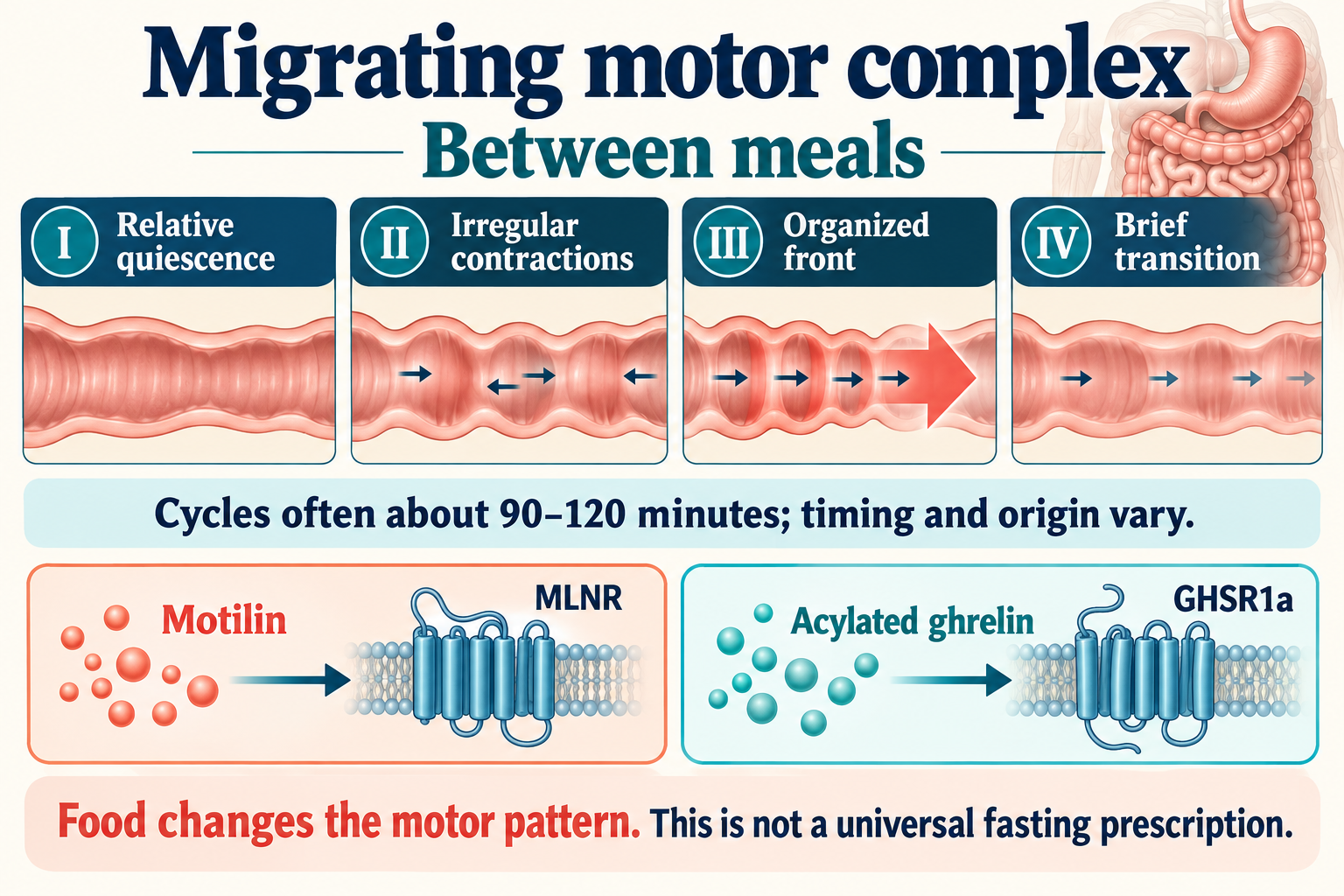
Interstitial cells of Cajal contribute to electrical organization; calcium-activated chloride channels ANO1/TMEM16A participate in slow waves. Smooth muscle coordinates with Cajal cells, PDGFRα-positive cells, and the enteric nervous system. Acetylcholine and tachykinins contribute to excitation, whereas NO, VIP, and purinergic signals contribute to inhibitory coordination. Stronger local contractions do not necessarily accelerate transit: propulsion requires a coordinated spatial sequence.
Motilin and ghrelin have related, distinct receptors
Motilin is a 22-amino-acid peptide acting through MLNR, formerly GPR38, a receptor distinct from ghrelin's GHSR1a. GHSR1b is not the motilin receptor. Feighner et al. (1999) cloned the human motilin receptor and demonstrated interaction with erythromycin. Endogenous motilin peaks are particularly associated with gastric phase III rather than every intestinal front.
Acylated ghrelin acts through GHSR1a and influences hunger and motility. In a small crossover experiment, Tack et al. (2006) found that administered ghrelin triggered premature gastric phase III in nine healthy volunteers without raising motilin. This was physiology, not a SIBO treatment trial. Tack et al. (2016) further distinguished motilin, gastric contractions, and subjective hunger. The article on ghrelin and obestatin explains active forms, receptors, and circadian relationships in more detail.
Food switches motility into a fed pattern rather than simply resetting phase I. Its duration depends on meal size, composition, and other conditions. Physiology cannot establish that any caloric intake invariably blocks the MMC for exactly four hours, or that everyone needs identical meal intervals and overnight fasting to prevent recurrence.
Stasis and the postinfectious hypothesis
Anatomical loops, strictures, systemic sclerosis, diabetic autonomic neuropathy, some neuromuscular disorders, and medicines that slow motility, including opioids, increase suspicion. Hypothyroidism can accompany slow transit, but does not establish a universal percentage reduction in MMC activity. Stress influences autonomic and enteric pathways; sympathetic activation or one α₂ receptor mechanism cannot diagnose SIBO.
CdtB is a component of cytolethal distending toxin produced by certain bacterial strains. A postinfectious model proposes immune cross-reactivity involving vinculin, a cell-adhesion protein, with subsequent intestinal functional changes. Antibodies do not transform from one specificity into another, and vinculin is not a nerve-conduction wire. Enteric pathogens do not all produce identical toxins; typhoid toxin has a distinct architecture.
Morales et al. (2020) demonstrated anti-vinculin antibodies, intestinal vinculin changes, and bacterial changes after CdtB immunization in rats. This supports a research model, but does not establish the leading cause of all human recurrences or complete Cajal-cell destruction in every patient. Infection, immunity, motility, and symptoms require separately demonstrated links in humans.
Fermentation and hydrogen sharing
Unabsorbed carbohydrates and other substrates can be fermented to organic acids and H₂. Capabilities depend on species and strain; a genus name does not guarantee hydrogen production. One pathway involves pyruvate-formate lyase and formate-hydrogen lyase. A simplified net reaction for the second step is:
This is an example rather than the only fermentation route. Some gas diffuses across the intestinal wall, enters blood, and leaves through the lungs; some is consumed by neighboring organisms or expelled rectally. Low H₂ can therefore reflect consumption rather than absent fermentation. Hydrogen gas does not retain water osmotically in the same way as unabsorbed dissolved sugars; diarrhea involves substrates, acids, secretion, and motility.
Methane and IMO: archaea, location, and constipation
Methanogens are archaea, not bacteria. Methanobrevibacter smithii uses hydrogen and CO₂; Methanosphaera has different substrate requirements, including methanol. Ether-linked membrane lipids characterize archaea, while pseudomurein occurs only in particular groups. Neither one cell-wall architecture nor a bacterial 30S neomycin target should be assigned to all archaea.
Hydrogenotrophic methanogenesis can be represented as:
The terminal pathway includes methyl-coenzyme-M reductase and its nickel-containing F₄₃₀ cofactor. This explains biochemistry, not a reason to supplement nickel or claim selective enzyme inhibition by a garlic product. Hydrogen consumption supports syntrophy between gas-producing and gas-consuming organisms.
IMO can involve both small and large intestine: breath CH₄ does not localize its source. Methane is associated with constipation and slower transit, but does not predict an exact constipation severity. Pimentel et al. (2006) reported an average 59% slowing during methane infusion into canine intestine; this is not a universal human value. Increased contractions in that work illustrate the distinction between motor force and effective propulsion rather than complete intestinal paralysis.
Hydrogen sulfide: microbial pathways and exposure-dependent biology
Sulfate-reducing bacteria can use hydrogen in this reaction:
Not every H₂S producer reduces sulfate. Bilophila wadsworthia uses sulfur-containing compounds, including taurine-derived substrates, with sulfite involvement; cysteine breakdown can also release sulfide. Sulfur in dietary protein, dietary sulfate, and metabolism of bile conjugates cannot be collapsed into one pathway or a universal sulfur-free diet.
The host also generates H₂S through CBS, CSE, and 3-MST systems. Low local exposures have signaling functions; mitochondrial sulfide oxidation involving SQR contributes to disposal. At sufficiently high exposure, H₂S can inhibit respiratory complex IV. Effects depend on concentration, oxygen, compartment, and time, while breath ppm is not a mitochondrial concentration. Interactions with MUC2 disulfide bonds and sensory TRP channels are mechanistically relevant but do not demonstrate barrier destruction or mitochondrial poisoning in every person with diarrhea.
D-lactate and cognitive symptoms
D- and L-lactate are different stereoisomers. Microbial D-lactate production is particularly important in short-bowel syndrome when substantial carbohydrate reaches fermenting communities, often in a retained colon. Neurological episodes with metabolic acidosis require specific evaluation. Routine lactate assays primarily measure the L form; a separate D-lactate assay may be needed when clinically justified.
Humans do metabolize D-lactate: Monroe et al. (2019) linked LDHD mutations to impaired disposal. The assertion that humans entirely lack a D-lactate enzyme is incorrect. Nonspecific brain fog does not establish D-lactic acidosis, SIBO, or harm from every probiotic. Acid–base findings, the anion gap, and the clinical setting are more informative than that automatic attribution.
Bile deconjugation and fat digestion
Bacterial bile salt hydrolase, BSH, cleaves the linkage of a bile acid to glycine or taurine. For glycocholate:
The products are cholate and glycine: hydrolysis of a conjugate rather than destruction of all bile acids. Deconjugation modifies solubility, passive absorption, and participation in micelles. Marked proximal overgrowth can reduce the effective bile-salt concentration available for fat digestion. Secondary transformations and enterohepatic circulation further complicate the relationship.
For a weak acid, the protonated fraction depends on pH and pKa:
With an illustrative pKa of 5 and pH of 6.5, the fraction is about 3.1%, not nearly 100%. This is a Henderson–Hasselbalch illustration rather than a patient measurement. Deconjugated acids do not all become fully protonated and precipitate at ordinary intestinal pH. Critical micelle concentration depends on mixture and environment; one number cannot characterize the entire lumen.
Steatorrhea, weight loss, and fat-soluble-vitamin deficiencies can occur with substantial malabsorption, but are not inevitable with any positive breath test. Pancreatic insufficiency, celiac disease, cholestasis, and other causes also require consideration.
Vitamins A, D, E, K, B₁₂, and folate
| Nutrient | Potential consequence of malabsorption | Limit of symptom-based inference |
|---|---|---|
| A | Visual, epithelial, and retinoid functions | Dry skin does not prove SIBO or deficiency |
| D | Calcium handling and bone | TRPV6 is a channel; calbindin is a separate binding protein |
| E | Antioxidant functions; severe deficiency can affect nerves and erythrocytes | Paresthesia is not specific |
| K | γ-Carboxylation of clotting factors | Microbial menaquinones do not guarantee compensation; INR has other determinants |
| B₁₂ | Microbial competition for cobalamin and possible disruption of uptake | A low concentration does not localize its cause |
| Folate | Some microbes produce folates | High folate plus low B₁₂ is not pathognomonic for SIBO |
B₁₂ is released from dietary proteins and binds haptocorrin; pancreatic proteases facilitate transfer to intrinsic factor. The complex is absorbed in the ileum through cubam, comprising cubilin and amnionless. Microbial consumption and cobalamin analogues may alter availability, but identical binding of every analogue and obligatory blockade of every complex cannot be assumed. Deficiency affects methionine synthase and methylmalonyl-CoA mutase and can have hematological and neurological consequences. Folate uptake includes proton-coupled folate transporter PCFT rather than exclusively passive absorption. Diet, medicines, autoimmune causes, and anatomy belong in the evaluation.
Brush-border digestion, osmotic effects, and barrier function
Mucosal injury in substantial disease may reduce lactase and other disaccharidase activities, including sucrase-isomaltase. Unabsorbed sugars retain water and feed fermentation. Primary lactase deficiency, congenital sucrase-isomaltase deficiency, and celiac disease are distinct alternatives that may coexist with SIBO.
LPS is recognized through TLR4 and flagellin through TLR5. In experimental systems, inflammatory signaling, NF-κB, and MLCK can alter tight junctions and permeability. This does not establish endotoxemia in everyone with bloating. Histamine-associated complaints, eosinophilia, and extraintestinal symptoms need their own explanation; nonspecific leaky-gut terminology cannot replace a demonstrated diagnosis. Barrier biology supports hypotheses rather than indefinite antimicrobial stacking.
Aspirate culture: closer to the site, but an imperfect reference
Duodenal or jejunal aspirate culture directly assesses growth at a sampled location. Contemporary literature often uses ≥10³ CFU/mL; the historical ≥10⁵ threshold relates partly to marked overgrowth in blind-loop settings. Site and methodology affect the threshold, and clinical context remains necessary (Pimentel et al., 2020).
Ordinary upper endoscopy generally samples the duodenum rather than automatically reaching well beyond the ligament of Treitz. Oropharyngeal contamination, transport, aerobic and anaerobic conditions, media choice, and patchiness limit interpretation. A dedicated sterile catheter reduces some problems without eliminating all. A negative proximal specimen cannot exclude distal disease; no fixed percentage of missed disease applies universally. Metagenomics complements culture rather than converting relative DNA abundance into CFU.
Breath testing measures the output of a complex system
After a substrate is ingested, microbial gases pass through intestine and blood to the lungs. Breath concentration reflects production, microbial consumption, transit, absorption, and sampling quality. It is measured in ppm, parts per million by volume, rather than units of microbial burden.
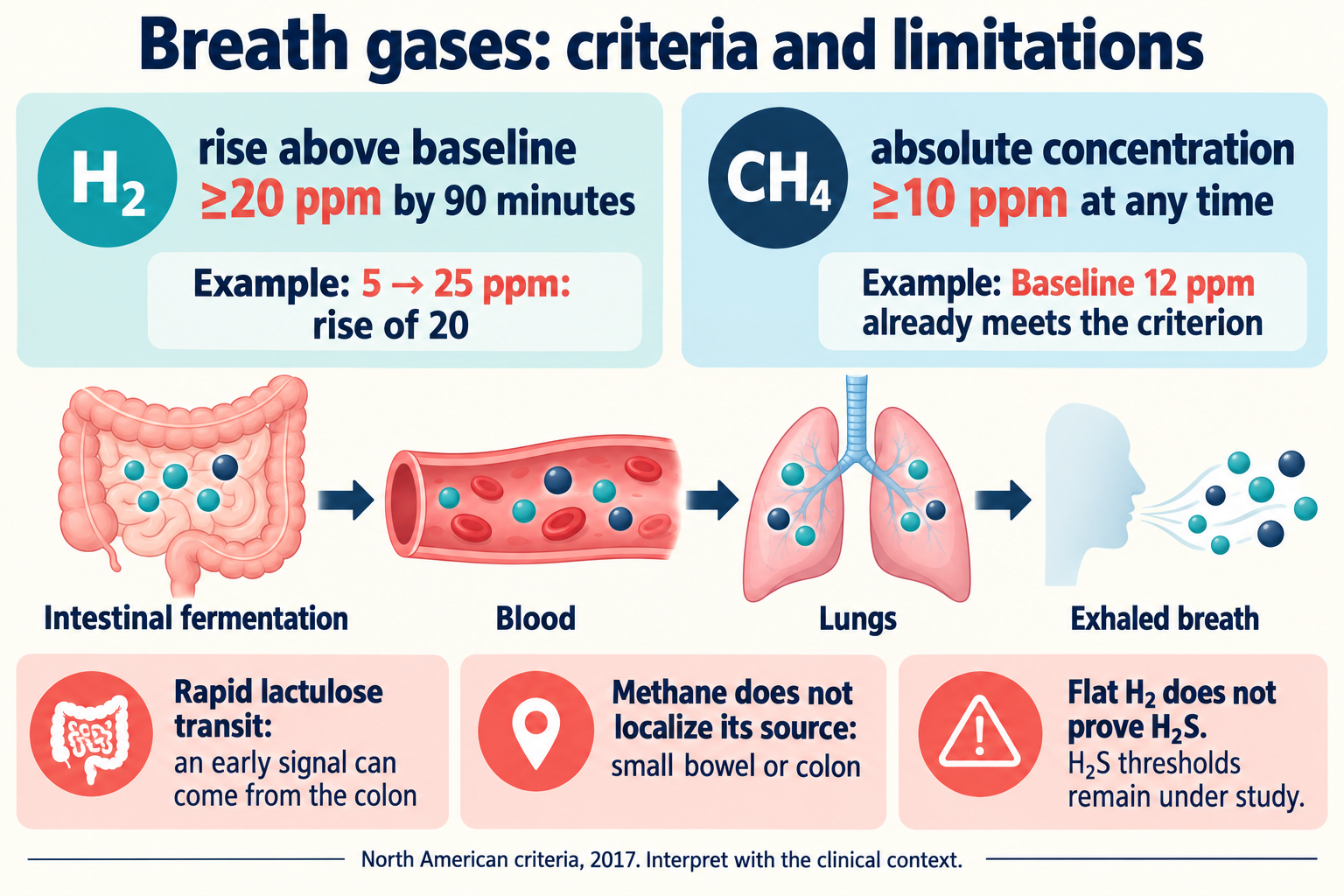
The North American consensus, Rezaie et al. (2017), interprets hydrogen as a rise of at least 20 ppm above baseline by 90 minutes after glucose or lactulose. Methane uses an absolute concentration of at least 10 ppm at any time, including baseline:
At baseline H₂ of 5 ppm, the hydrogen criterion is reached at 25 ppm rather than an absolute 20. Baseline methane of 12 ppm needs no additional 10-ppm rise. Both patterns can coexist. These are consensus interpretation criteria, not demonstrations of perfect sensitivity and specificity.
Glucose is absorbed mainly proximally and may fail to reach a distal source. Lactulose is not absorbed and reaches the colon, where fermentation is normal. Rapid orocecal transit can produce an early rise mistakenly attributed to the small bowel. Yu et al. (2011) compared lactulose testing with scintigraphy in IBS and demonstrated this confounding mechanism. One peak cannot map its precise intestinal source. The North American proposal uses 75 g glucose or 10 g lactulose, whereas 50 g glucose appears in European protocols (Hammer et al., 2022); substrate dose and methodology must accompany comparisons.
Preparation and disagreement between recommendations
The 2017 consensus suggests four weeks after antibiotics, limiting fermentable foods the preceding day, and an 8–12-hour fast. Promotility drugs and laxatives are withheld for at least a week if tolerated; necessary treatment should not be independently stopped. No smoking on the test day, limited physical activity, and appropriate breath collection matter. Evidence was insufficient for a universal probiotic washout rule. The same consensus explicitly states that stopping PPIs is not necessary. Timing after bowel cleansing and other details vary between documents and should not automatically be equated with the antibiotic interval.
High baseline hydrogen may reflect preparation, oral fermentation, or other circumstances and needs interpretation. A flat H₂ curve does not establish a 90% probability of H₂S overproduction; gas consumption, poor substrate fermentation, sampling problems, and microbiome characteristics are alternatives.
Recommendations differ about IBS testing. ACG 2020 discusses testing in selected groups with limited certainty. The ESNM/ANMS update of 2024 strongly criticizes lactulose testing to diagnose SIBO in IBS while preserving classical SIBO in stasis and malabsorption. A numerical threshold without pretest probability and transit assessment creates unwarranted certainty. Home gas readings after ordinary meals do not substitute for a validated clinical diagnostic pathway.
The Asian association monograph by Xiao et al. (2026) also emphasizes variability in protocols, gas measurement, and interpretation across centers.
H₂S and antibodies: promising measurements with separate limitations
H₂S is absent from the diagnostic thresholds of the 2017 two-gas consensus. Commercial and research definitions differ; 3 ppm is not a universal accepted boundary. Villanueva-Millan et al. (2025) studied a single fasting breath sample and duodenal microbial profiles in 110 participants, with H₂S data available for 109. Subjects with H₂S ≥1.5 ppm differed in some sulfide-producing organisms. This is an informative site–function association, not validation of every serial substrate-provoked curve or bismuth regimen. Gas chromatography in that study does not establish a gold-nanoparticle mechanism for all commercial devices.
Pimentel et al. (2015) investigated anti-CdtB and anti-vinculin antibodies as diarrhea-predominant IBS markers, including discrimination from inflammatory bowel disease. At selected optical-density thresholds, anti-CdtB specificity and sensitivity were 91.6% and 43.7%; anti-vinculin values were 83.8% and 32.6%. These concern that population and discrimination task, not direct SIBO diagnosis. Positivity does not quantify ongoing Cajal-cell loss, negativity does not exclude IBS, and a titer cannot establish a need for prolonged prokinetics.
Rifaximin: specify the clinical endpoint
Rifaximin binds the β-subunit of bacterial DNA-dependent RNA polymerase and suppresses transcription. Systemic absorption is usually low rather than zero; risks and interactions remain relevant. Bile can alter solubility and activity, but does not restrict all action to the small bowel or guarantee preservation of the entire colonic community.
Clinicians may consider antibiotics for appropriately supported symptomatic SIBO alongside stasis and nutritional problems. Studies vary in definitions, populations, doses, and endpoints. In TARGET 1/2, Pimentel et al. (2011) used 550 mg three times daily for two weeks in IBS without constipation; pooled adequate global symptom relief was 40.7% versus 31.7% with placebo. This measured IBS symptoms rather than eradication of culture-confirmed SIBO in everyone. A study regimen cannot become an automatic prescription based on a gas curve or be independently adjusted at an arbitrary 60-kg body-weight boundary.
IMO: small combination studies do not establish a universal regimen
Low et al. (2010) retrospectively compared rifaximin, neomycin, and their combination in patients producing methane on lactulose testing. A high reported proportion of methane clearance in the combination group is not a large randomized-trial result and is not synonymous with complete clinical cure.
Pimentel et al. (2014) randomized 31 people with constipation-predominant IBS and CH₄ >3 ppm under the older definition to neomycin plus rifaximin or neomycin plus placebo for 14 days. Combination treatment improved some constipation, straining, and bloating outcomes but not pain. Sample size, the historical methane threshold, and short follow-up limit generalization. Metronidazole cannot be presumed an equivalent replacement without direct evidence.
An explanation based on obligatory direct targeting of archaeal 30S ribosomes is incorrect: archaeal ribosomes and antimicrobial susceptibility differ from bacterial systems, while the clinical effect may include changes in syntrophic communities. Oral neomycin can cause nephrotoxicity and ototoxicity, particularly with increased absorption or renal impairment. Combinations require evaluation of indications, contraindications, and resistance risk rather than methane concentration alone.
Elemental feeding: test normalization and adequate nutrition
A nutritionally complete elemental formula supplies free amino acids, readily assimilable energy, fats, electrolytes, and micronutrients. It reduces some digestive requirements, but does not mean every carbohydrate or MCT is absorbed without enzymes within the first 40–60 cm while the remaining intestine receives no substrate. Elemental formulas are not compositionally identical.
Pimentel et al. (2004) retrospectively described 93 patients with available post-treatment results: lactulose testing normalized in 74 by day 15, and five more after extension to day 21. The total 79/93, approximately 85%, belongs to a selected series and a breath-test endpoint. Without a parallel control it is not a universal cure probability or proof of intestinal sterilization. Marked restriction, weight loss, and intolerance require medical and dietetic supervision.
Rezaie et al. (2025) prospectively studied 30 participants without a parallel control: two-week elemental feeding normalized tests in 73%. Long-term durability remains unknown.
Herbal antimicrobials and bismuth
Despite “equivalent” in its title, Chedid et al. (2014) was not a randomized equivalence trial. Patients selected four-week rifaximin or multicomponent herbal formulas; among those with follow-up, negative repeat lactulose tests occurred in 17/37 and 23/67, respectively, P = 0.24. Failure to detect a significant difference does not demonstrate equal effectiveness. Results cannot be attributed individually to berberine, oregano, or allicin and then applied to a new self-designed combination as a validated protocol.
Berberine affects multiple cellular pathways; host-cell AMPK effects are not the same mechanism as microbial inhibition. Carvacrol can affect membranes and allicin thiol groups experimentally, but these properties do not establish selective clinical inhibition of methanogen MCR. Pau d'arco and similar supplements lack demonstrated SIBO eradication. Composition, interactions, and tolerability of multicomponent products also matter.
Bismuth can capture sulfide; an idealized ionic precipitation reaction is:
Actual formulations, solubility, and luminal chemistry are more complicated. Suarez et al. (1998) demonstrated reduced H₂S release from fecal samples after bismuth subsalicylate in ten healthy volunteers. This was neither a H₂S-SIBO eradication trial nor proof of restored mitochondria. Milligrams of different bismuth salts are not interchangeable; subsalicylate requires consideration of salicylate risks, and dark stool or tongue can complicate symptom assessment. A breath threshold alone does not establish an indication for an unsupervised course.
Recurrence, prokinetics, and meal timing
Recurrent symptoms may indicate an unresolved cause, a different diagnosis, or recurrent overgrowth rather than necessarily resistant bacteria. Lauritano et al. (2008) followed 80 patients after glucose-test normalization: repeat positivity was 12.6% at three, 27.5% at six, and 43.7% at nine months. These figures do not support universal 50–60% recurrence by three months or establish one preventive medicine for everyone.
Prucalopride is a 5-HT₄ agonist with established use in particular constipation settings; that does not prove obligatory restoration of gastric phase III or prevention of SIBO with a nighttime dose. Erythromycin activates MLNR, but low dosing remains antibiotic exposure; tachyphylaxis, interactions, and QT prolongation matter. Automatic rotation every few months does not follow from MMC physiology.
Low-dose naltrexone has been examined in limited gastrointestinal series. The open-label IBS pilot by Kariv et al. (2006) did not test SIBO eradication or post-antibiotic MMC preservation. Experimental TLR4 or glial findings do not establish obligatory 2.5–4.5-mg nighttime dosing; enteric glia are not identical to brain microglia.
Ginger and artichoke also require endpoint distinctions. In a crossover pilot involving 11 healthy volunteers, Lazzini et al. (2016) reported a smaller ultrasonographic gastric area one hour after a meal with combined extracts. This is not demonstrated 24% faster intestinal clearance or reduced SIBO recurrence. Giacosa et al. (2015) evaluated symptoms of functional dyspepsia, a different disorder. The article on artichoke extract and cynarin distinguishes bile secretion, motility, and lipid effects; those mechanisms do not establish antimicrobial treatment.
Interdigestive motility makes meal timing worth studying, but does not validate universal four-to-five-hour intervals or a guaranteed five to six nighttime waves. Energy needs, diabetes, pregnancy, age, and nutritional impairment change the acceptability of fasting. A limited low-FODMAP trial with subsequent food reintroduction can improve some IBS symptoms; it is not demonstrated SIBO eradication or obligatory lifelong prevention.
Clinical sequence and review boundaries
| Step | Clinical question | Protection against misinterpretation |
|---|---|---|
| Symptoms and risk | Is classical SIBO, IMO, or another disorder plausible? | Consider anatomy, medicines, motility, celiac, pancreatic, and inflammatory disease |
| Investigation | Will its result change management? | Specify substrate, preparation, transit, and measurement limits |
| Interpretation | Does the result fit the clinical situation? | Distinguish H₂ rise, absolute CH₄, and research-stage H₂S criteria |
| Treatment | Does growth, stasis, deficiency, constipation, or another process need attention? | Use specific indications and endpoints rather than a universal gas-driven regimen |
| Follow-up | Have symptoms, nutrition, and function improved? | Do not replace clinical outcomes with a normalized curve |
Marked weight loss, bleeding, anemia, persistent nocturnal diarrhea, dehydration, or neurological episodes warrant timely investigation. Repeated antimicrobials without diagnostic reassessment can delay appropriate care. Addressing anatomical and motor factors, replacing demonstrated deficiencies, and assessing food tolerance are independent parts of management rather than afterthoughts to eradication.
This is a scientific narrative review with targeted checking of disputed mechanisms, identifiers, and primary results on 8 October 2026. Accessible primary publications, abstracts and records, and consensus documents were used; some full texts were unavailable. No systematic search, independent GRADE assessment, formal external peer review, or treatment-protocol validation was performed. Experimental mechanisms, associations, consensus criteria, and clinical trial outcomes are distinguished. Breath gases provide a limited measurement of microbial metabolism; diagnosis and treatment require comparison with the person and the conditions of measurement.
FAQ
Does bloating prove SIBO?
No. It has many causes; clinical context, risk factors, and measurement limits matter.
Why are hydrogen and methane interpreted differently?
H₂ uses change from baseline; CH₄ uses an absolute concentration. H₂ 5→25 ppm is a rise of 20; baseline CH₄ 12 already meets its criterion.
Does a flat hydrogen curve diagnose H₂S?
No. Gas consumption, fermentation characteristics, and sampling problems can also lower H₂. Direct H₂S thresholds remain under investigation.
Are herbs proven equivalent to antibiotics?
No. Retrospective selection of multicomponent formulas was not a randomized equivalence trial.
Does everyone need long gaps between meals?
MMC physiology does not establish one preventive regimen. Nutritional needs and fasting risks require individual assessment.
Does a normalized repeat test mean complete recovery?
Not necessarily. Symptoms, nutrition, function, and the underlying cause matter; a test endpoint is limited.
Sources
- Pimentel M, Saad RJ, Long MD, Rao SSC. ACG Clinical Guideline: Small Intestinal Bacterial Overgrowth. Am J Gastroenterol. 2020;115:165–178.
- Rezaie A et al. Hydrogen and Methane-Based Breath Testing in Gastrointestinal Disorders: The North American Consensus. Am J Gastroenterol. 2017;112:775–784.
- Hammer HF et al. European guideline on indications, performance, and clinical impact of hydrogen and methane breath tests in adult and pediatric patients. United European Gastroenterol J. 2022;10:15–40.
- Kashyap P, Moayyedi P, Quigley EMM, Simren M, Vanner S. Critical appraisal of the SIBO hypothesis and breath testing: a clinical practice update endorsed by ESNM and ANMS. Neurogastroenterol Motil. 2024;36:e14817.
- Yu D, Cheeseman F, Vanner S. Combined oro-caecal scintigraphy and lactulose hydrogen breath testing demonstrate that breath testing detects oro-caecal transit, not small intestinal bacterial overgrowth in patients with IBS. Gut. 2011;60:334–340.
- Inagaki T et al. Regulation of antibacterial defense in the small intestine by the nuclear bile acid receptor. Proc Natl Acad Sci USA. 2006;103:3920–3925.
- Chu H et al. Human α-defensin 6 promotes mucosal innate immunity through self-assembled peptide nanonets. Science. 2012;337:477–481.
- Szurszewski JH. A migrating electric complex of canine small intestine. Am J Physiol. 1969;217:1757–1763.
- Feighner SD et al. Receptor for motilin identified in the human gastrointestinal system. Science. 1999;284:2184–2188.
- Tack J et al. Influence of ghrelin on interdigestive gastrointestinal motility in humans. Gut. 2006;55:327–333.
- Tack J et al. Motilin-induced gastric contractions signal hunger in man. Gut. 2016;65:214–224.
- Morales W et al. Immunization with cytolethal distending toxin B produces autoantibodies to vinculin and small bowel bacterial changes in a rat model of postinfectious irritable bowel syndrome. Neurogastroenterol Motil. 2020;32:e13875.
- Pimentel M et al. Development and validation of a biomarker for diarrhea-predominant irritable bowel syndrome in human subjects. PLoS One. 2015;10:e0126438.
- Pimentel M et al. Methane, a gas produced by enteric bacteria, slows intestinal transit and augments small intestinal contractile activity. Am J Physiol Gastrointest Liver Physiol. 2006;290:G1089–G1095.
- Monroe GR et al. Identification of human D lactate dehydrogenase deficiency. Nat Commun. 2019;10:1477.
- Villanueva-Millan MJ et al. Hydrogen Sulfide and Methane on Breath Test Correlate with Human Small Intestinal Hydrogen Sulfide Producers and Methanogens. Dig Dis Sci. 2025;70:3846–3856.
- Pimentel M et al. Rifaximin therapy for patients with irritable bowel syndrome without constipation. N Engl J Med. 2011;364:22–32.
- Low K et al. A combination of rifaximin and neomycin is most effective in treating irritable bowel syndrome patients with methane on lactulose breath test. J Clin Gastroenterol. 2010;44:547–550.
- Pimentel M et al. Antibiotic treatment of constipation-predominant irritable bowel syndrome. Dig Dis Sci. 2014;59:1278–1285.
- Pimentel M et al. A 14-day elemental diet is highly effective in normalizing the lactulose breath test. Dig Dis Sci. 2004;49:73–77.
- Rezaie A et al. Effect, Tolerability, and Safety of Exclusive Palatable Elemental Diet in Patients With Intestinal Microbial Overgrowth. Clin Gastroenterol Hepatol. 2025;23:2306–2317.e7.
- Chedid V et al. Herbal therapy is equivalent to rifaximin for the treatment of small intestinal bacterial overgrowth. Glob Adv Health Med. 2014;3:16–24.
- Suarez FL, Furne JK, Springfield J, Levitt MD. Bismuth subsalicylate markedly decreases hydrogen sulfide release in the human colon. Gastroenterology. 1998;114:923–929.
- Lauritano EC et al. Small intestinal bacterial overgrowth recurrence after antibiotic therapy. Am J Gastroenterol. 2008;103:2031–2035.
- Kariv R et al. Low-dose naltreoxone for the treatment of irritable bowel syndrome: a pilot study. Dig Dis Sci. 2006;51:2128–2133.
- Lazzini S et al. The effect of ginger (Zingiber officinalis) and artichoke (Cynara cardunculus) extract supplementation on gastric motility: a pilot randomized study in healthy volunteers. Eur Rev Med Pharmacol Sci. 2016;20:146–149.
- Giacosa A et al. The Effect of Ginger and Artichoke Extract Supplementation on Functional Dyspepsia: A Randomised, Double-Blind, and Placebo-Controlled Clinical Trial. Evid Based Complement Alternat Med. 2015:915087.
- Xiao Y et al. Hydrogen and Methane Breath Test: The Asian Neurogastroenterology and Motility Association Monograph. J Neurogastroenterol Motil. 2026;32:150–171.