
Th1, Th2, Th17, and Treg: how context shapes CD4+ T-cell responses
Four CD4+ T-cell programs: receptors, transcription, epigenetics and metabolism, clinical trials, and limits of supplement claims.
Four CD4+ T-cell programs: receptors, transcription, epigenetics and metabolism, clinical trials, and limits of supplement claims.
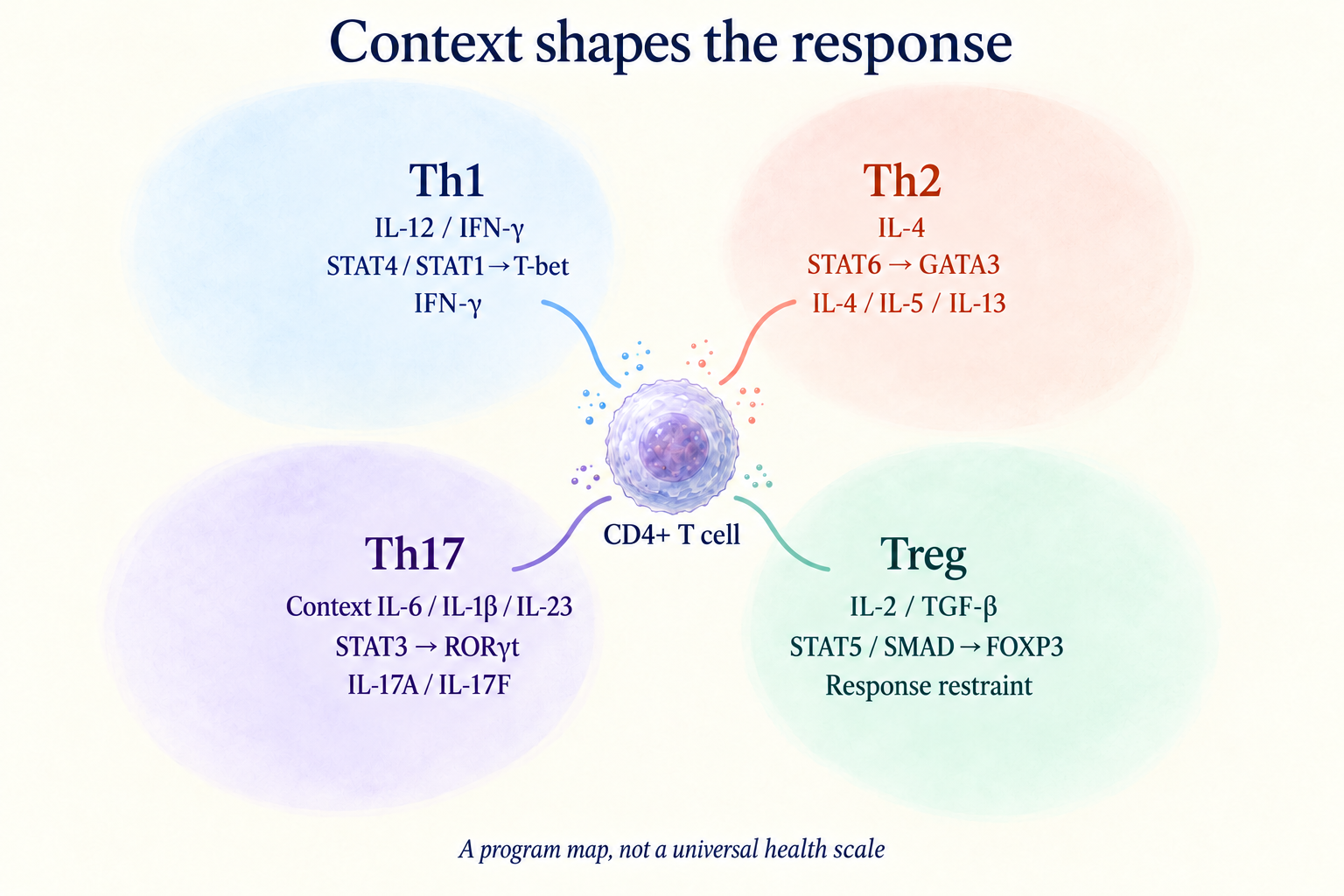
CD4+ T lymphocytes connect antigen recognition with the organization of tissue responses. Th1, Th2, Th17, and regulatory T cells, or Treg, denote four extensively studied functional programs within this family. They differ in combinations of receptors, transcription factors, cytokine production, and effects on other cells. These names help explain mechanisms, but do not exhaust CD4+ diversity: follicular helpers, memory cells, tissue states, and mixed phenotypes also exist.
Th1 support defense against intracellular pathogens, Th2 participate in antihelminth defense and allergic inflammation, Th17 support neutrophil responses and barrier tissues, and Treg restrain immune aggression. Depending on the organ and disease stage, each program can be beneficial or contribute to pathology. “Immune rebalancing” therefore has meaning only alongside a particular disease, tissue, and measurable clinical outcome. No universal healthy Th1/Th2 or Th17/Treg ratio has been established for everyone.
Polarization reflects antigen signaling, costimulation, cytokine surroundings, metabolism, and cellular history acting together. The master regulators T-bet, GATA3, RORγt, and FOXP3 organize the respective programs, but are not four mutually exclusive switches. Epigenetic memory stabilizes function, while tissue signals can sometimes change it. More cells carrying a particular marker do not by themselves prove restored function or better health.
Developing T cells undergo thymic selection that both enables recognition of self major histocompatibility molecules and limits strong self-reactivity. Some acquire a regulatory program in the thymus. Naive peripheral CD4+ cells circulate between blood and lymphoid organs; CD45RA together with CCR7 is often used to identify their human phenotype. These markers describe a state, not an immutable fate.
The first signal arises when the T-cell receptor TCR contacts a peptide presented by MHC-II on an antigen-presenting cell. The CD4 coreceptor helps organize contact and associates with the tyrosine kinase Lck. Lck phosphorylates ITAM motifs in the CD3 complex, followed by activation of ZAP-70, LAT, and SLP-76. Contact duration and organization influence the outcome, but universal affinity, half-life, or synapse-size values cannot substitute for measurements of a particular complex.
The second signal includes costimulation, notably CD28 interacting with CD80/CD86. It supports survival, metabolic remodeling, and IL-2 production; inhibitory receptors and insufficient costimulation alter the response. The third signal is the cytokine environment. The same antigen can accompany different functional programs when presented by different dendritic cells in different tissues.
Phospholipase PLCγ1 cleaves membrane phosphatidylinositol-4,5-bisphosphate into IP3 and diacylglycerol. IP3 promotes calcium release from the endoplasmic reticulum; calcium–calmodulin activates the phosphatase calcineurin, which dephosphorylates NFAT and facilitates its entry into the nucleus. Diacylglycerol supports PKCθ–NF-κB and Ras–MAPK–AP-1 branches. Their cooperation explains why one cytokine cannot reproduce complete cellular activation.
Many polarizing cytokine receptors use associated Janus kinases. These enzymes transfer phosphate from ATP onto protein tyrosine residues; catalysis requires a complex organized with divalent ions, usually Mg²⁺. Phosphorylated STAT proteins form dimers and regulate nuclear transcription. TGF-β uses a different arrangement: its receptor serine/threonine kinases signal through SMAD. All four programs therefore cannot be represented as one linear JAK–STAT chain.
IL-12 comprises p35 and p40 subunits. Its receptor combines IL-12Rβ1 and IL-12Rβ2, associated predominantly with TYK2 and JAK2, followed by an important role for STAT4. Interferon-γ signals through IFNGR1/IFNGR2, JAK1/JAK2, and STAT1, supporting expression of T-bet encoded by TBX21. These inputs complement each other, while cellular sensitivity depends on receptor expression and negative feedback.
T-bet promotes accessibility of IFNG regulatory elements, interacts with other transcription factors, and organizes a migration program including CXCR3. Its ligands CXCL9, CXCL10, and CXCL11 connect local inflammation with cell recruitment. Interferon-γ activates macrophage microbicidal functions and alters antigen presentation. Th1 are therefore particularly important against intracellular infections, but excessive or misdirected activity can injure self tissues.
Antagonism between T-bet, GATA3, and RORγt depends on protein interactions and chromatin state. It does not mean Th1 are always pathological or that suppressing T-bet is safe in every autoimmune disease. In experimental systems, T-bet can also restrain particular Th17 programs. A broad clinical label such as “Th1-dominant disease” cannot replace identification of the relevant pathogenic mechanism.
In T cells, IL-4 mainly uses the type I receptor containing IL-4Rα and the common γ-chain CD132. These chains associate with JAK1 and JAK3; STAT6 becomes an important nuclear mediator supporting GATA3. The type II receptor combines IL-4Rα with IL-13Rα1 and transmits IL-4 and IL-13 signals in many tissue cells. This distinction helps explain why IL-4Rα blockade affects both immune cells and epithelial effector reactions.
GATA3 organizes accessibility of the type 2 cytokine locus and supports IL-4, IL-5, and IL-13 production. IL-4 promotes antibody class switching in B cells, IL-5 supports eosinophils, and IL-13 changes mucus secretion, airway reactivity, and tissue remodeling. Epithelial alarmins IL-25, IL-33, and TSLP amplify this response through several cell populations. Type 2 innate lymphoid cells, in particular, can produce similar cytokines without belonging to CD4+ helper cells.
Antihelminth defense, tissue repair, allergy, and fibrosis use partially overlapping mechanisms. Thus “Th2” and “allergy” are not synonyms, and elevated eosinophils do not directly measure Th2 numbers. Reduced inflammatory markers during treatment may confirm an effect on the relevant network, but do not prove conversion of Th2 into Treg.
IL-6 and IL-21 support a STAT3-dependent program associated with RORγt, an isoform of the nuclear receptor encoded by RORC. IL-1β and IL-23 substantially alter development, survival, and effector properties. IL-23 combines p19 and p40 and acts through IL-23R/IL-12Rβ1. Sharing p40 with IL-12 explains the distinction between anti-p40 drugs and more selective anti-p19 antibodies.
The role of TGF-β depends on species, differentiation stage, and other signals. The classical mouse model contrasts TGF-β plus IL-2 favoring regulation with TGF-β plus IL-6 favoring Th17. Yet experimental studies have demonstrated pathogenic Th17 generation without TGF-β signaling; human findings likewise cannot be reduced to one obligatory cytokine combination. Cell-culture conditions cannot be turned into a universal algorithm for human immunity.
IL-17A and IL-17F act primarily on tissue cells, triggering chemokines, growth factors, and antimicrobial molecules. Through their receptor complex and the ACT1 adaptor, they support neutrophil recruitment and barrier defense. IL-22 acts mainly on nonhematopoietic cells and can support epithelial repair, but in another context contributes to inflammation or abnormal proliferation. Other lymphocytes also produce these cytokines; an IL-17 concentration is not equivalent to a Th17 count.
Th17 programs are heterogeneous. They differ in IL-10, GM-CSF, or interferon-γ production, responsiveness to local signals, and tissue migration. “Pathogenic Th17” describes function in a particular model, rather than any presence of RORγt. A separate discussion of IL-6 receptor context and trans-signaling helps clarify its role.
Regulatory cells arise in the thymus and the periphery. FOXP3 organizes their transcriptional program through interactions with other factors and a pre-existing regulatory-element landscape. IL-2 supports survival and function through the high-affinity CD25/CD122/CD132 receptor and STAT5. Treg efficiently use IL-2 but generally produce little themselves; dependence on an external source connects regulation with effector-cell activity.
TGF-β through SMAD2/3 supports peripheral FOXP3 induction, but FOXP3 expression at one observation point does not establish a stable regulatory state. Ordinary activated human T cells can transiently express this factor. Phenotyping often combines CD4, high CD25, and low CD127 with intracellular FOXP3. Functional characteristics and epigenetic features add information.
The FOXP3 CNS2 region, including the Treg-specific demethylated region TSDR, is associated with program stability. DNMT enzymes use S-adenosylmethionine as a methyl donor. TET enzymes oxidize 5-methylcytosine and belong to Fe²⁺- and 2-oxoglutarate-dependent dioxygenases; molecular oxygen participates in the reaction, and ascorbate can support enzyme activity. These biochemical dependencies do not prove that a vitamin supplement automatically demethylates the required region in a patient.
Treg CTLA-4 interacts with CD80/CD86 and can reduce available costimulation on antigen-presenting cells. IL-2 consumption changes availability for other lymphocytes. IL-10 and TGF-β participate in inflammatory regulation, but are not exclusive Treg products. The importance of IL-35 in humans and the contribution of individual mechanisms vary across tissues and experimental conditions.
The ectonucleotidases CD39 and CD73 sequentially convert extracellular ATP/ADP into AMP and then adenosine. Adenosine acting through its receptors can restrain effector responses. Not every human Treg simultaneously expresses the entire enzyme set. Suppression is a distributed system of contacts, metabolites, and cytokines rather than one soluble brake.
Mapping H3K4me3 and H3K27me3 in differentiated mouse CD4+ cells showed different chromatin organization at functional loci and key regulator genes. Active and repressive marks coexisting at some regions are consistent with retained reprogramming potential. This does not mean every mature cell freely changes identity in response to one dietary component.
Cells with a Th17 history can acquire interferon-γ production and other properties; “ex-Th17” is particularly informative when origin has actually been traced. Detecting IL-17 and interferon-γ together in blood does not establish the direction of transition. Similarly, reduced FOXP3 during inflammation does not always indicate mass conversion of stable thymic Treg into pathogenic cells: activated conventional lymphocytes and phenotyping differences can contribute.
T-bet or RORγt coexisting with FOXP3 may reflect regulatory adaptation to a particular tissue response. Preserved suppressive function, program stability, and context determine the meaning of that mixed state. Strictly assigning every cell to four nonoverlapping categories loses this information.
In psoriasis, IL-23/IL-17 is an important therapeutic axis. In inflammatory bowel disease, individual components of the same network can protect the epithelium. Multiple sclerosis, rheumatoid arthritis, and type 1 diabetes involve CD4+ interactions with B cells, CD8+ lymphocytes, innate immunity, and tissue elements. They cannot be diagnosed or treated solely from a blood Th17/Treg ratio.
Rare FOXP3 defects demonstrate the fundamental necessity of regulation for systemic tolerance. Common autoimmune diseases involve more complex changes in cell location, effector sensitivity to suppression, and tissue-environment signaling. Normal circulating Treg numbers do not exclude insufficient regulation in an inflamed organ.
IL-4/IL-13, eosinophils, epithelial alarmins, and IgE antibodies are important in allergic inflammation. Clinical severity, however, is not determined by one subset. Tissue remodeling, infections, and responses to background treatment alter each mechanism’s importance. Improvement with IL-4Rα blockade confirms a useful target in a selected population, rather than a universal benefit of suppressing Th2.
Regulatory cells can restrain antitumor responses within the tumor microenvironment. At the same time, controlling inflammation can reduce tissue injury and certain carcinogenic mechanisms. The meaning of Treg infiltration depends on tumor type, location, and other cells. Systemically increasing Treg is therefore not a general preventive goal, and decreasing them is not a general cancer-treatment goal.
Age changes naive-cell production, memory composition, chronic antigen exposure, and tissue regulation. Sleep, circadian signals, and hormones influence lymphocyte migration and activation. This does not establish a validated supplement schedule for switching Th17 into Treg. Sampling time and concurrent infection matter primarily as conditions for interpreting results.
A double-blind randomized trial enrolled 59 patients with active Crohn’s disease and CDAI scores of 220–450. Secukinumab, an anti-IL-17A antibody, was given intravenously twice at 10 mg/kg; 39 patients received the drug and 20 placebo. The week-six primary assessment tested the probability of an additional CDAI reduction of at least 50 points over placebo. That probability was below 0.1%; a secondary CDAI area-under-the-curve analysis over weeks 4–10 favored placebo.
There were 20 infections on secukinumab, including four local fungal infections, versus none on placebo. This small study does not determine risk for everyone, but its negative finding is fundamental: a successful target in one disease can be ineffective or unfavorable in another organ. Suppression of a Th17 marker cannot itself be considered clinical success.
QUEST enrolled 1902 patients aged at least 12 years with uncontrolled moderate-to-severe asthma. In addition to background treatment, they received subcutaneous dupilumab 200 or 300 mg every two weeks or matched placebo for 52 weeks. Coprimary outcomes included annual severe exacerbation rate and FEV1 change at week 12. With 200 mg, exacerbations were 0.46 versus 0.87 per year, a 47.7% reduction; the FEV1 advantage over placebo was 0.14 L.
Benefit was greater with higher baseline eosinophils; some participants developed eosinophilia during treatment. This result concerns add-on treatment in a selected population, not healthy people or every respiratory symptom. Dupilumab blocks the shared IL-4/IL-13 receptor component, but the trial did not aim to establish cellular conversion of Th2 into Treg.
A double-blind trial randomized 60 patients with active systemic lupus erythematosus, 30 each to IL-2 or placebo with standard treatment. Subcutaneous IL-2 was administered at 1 million international units every other day for two weeks followed by a two-week break; cycles continued for 12 weeks, with another 12 weeks of follow-up. The primary outcome was SRI-4 response at week 12. Response was 55.17% versus 30.00%, but p=0.052: the prespecified primary endpoint was not met.
At week 24, response was 65.52% versus 36.67%, p=0.027, and regulatory cells increased. This supports research interest, but the later finding does not negate the negative primary assessment. Small numbers, subgroup analyses, and limited follow-up prevent describing the approach as universal tolerance restoration or proof that rare complications do not occur.
Anti-IL-23p19, anti-IL-12/23p40, and anti-IL-17 antibodies act at different network points. JAK inhibitors interfere with multiple receptor signals, while allosteric TYK2 inhibitors use a different binding principle. Molecular selectivity, concentration, and cellular context determine the resulting spectrum. Laboratory suppression of STAT phosphorylation cannot be directly translated into relative clinical drug efficacy.
Infection and other risks are assessed for the particular drug, indication, and patient. Regulatory-cell therapies investigate more directed intervention, but an engineered construct does not itself guarantee stability, tissue specificity, or safety. Their discussion requires clinical evidence and remains a separate research direction; a conceptual description is not a cell-product manufacturing instruction.
After activation, cells need ATP, nucleotides, amino acids, and lipids for growth. PI3K–Akt–mTOR links growth signals to nutrient transport and macromolecular synthesis. Cytosolic glycolysis converts glucose to pyruvate, while lactate formation regenerates NAD⁺ to maintain flux. The pentose phosphate pathway supplies ribose precursors and NADPH. Mitochondrial reactions provide both energy and metabolites for biosynthesis and chromatin regulation.
HIF-1α connects oxygen availability and metabolic state with part of the Th17 program. Glycolysis contributing to differentiation does not mean eating sugar directly creates pathogenic Th17. Blood glucose, membrane transport, activation signals, and intracellular flux are distinct regulatory levels. Effector cells also use mitochondria, and activated Treg may require glycolysis for proliferation, migration, and function.
Mitochondrial fatty-acid β-oxidation generates acetyl-CoA, NADH, and FADH₂. Carnitine transport contributes to long-chain acyl-group delivery, while malonyl-CoA regulates CPT1. Genetic studies nevertheless showed that CPT1A-dependent long-chain fatty-acid oxidation is not indispensable for Treg formation in every model. High etomoxir concentrations exert effects beyond CPT1A. The scheme “effectors live on glycolysis, Treg only on fat” is therefore too rigid and can produce incorrect dietary conclusions.
Acetyl-CoA donates acetyl groups to histone acetyltransferases, S-adenosylmethionine supplies methyltransferases, NAD⁺ is a sirtuin substrate, and 2-oxoglutarate supports several dioxygenases. Their availability connects metabolism with gene expression. However, effect direction depends on enzyme, compartment, and timing; changing one metabolite does not determine the entire lymphocyte fate.
Fermentation of some dietary fibers in the colon produces acetate, propionate, and butyrate. In mouse experiments, butyrate enhanced colonic regulatory-cell differentiation and histone H3 acetylation at Foxp3 regulatory regions. Inhibiting particular histone deacetylases and interacting with fatty-acid receptors are distinct mechanisms whose contributions depend on concentration and cell type. A universal inhibition constant for all HDAC enzymes and all short-chain fatty acids is inappropriate.
FFAR2, FFAR3, and HCAR2 connect microbial metabolites with immune and epithelial responses, but have different distributions. Butyrate also provides an epithelial metabolic substrate. Concentrations differ substantially between the intestinal lumen, mucosa, portal blood, and peripheral blood; a fecal measurement reflects production, absorption, and transit rather than the direct dose reaching T cells. These features limit extrapolation from adding a metabolite to culture to human dietary interventions.
Segmented filamentous bacteria induced intestinal Th17 accumulation in mouse studies. This highlights a local microbiota–barrier-defense connection, but does not turn one bacterium into a universal human autoimmune biomarker. Different microbial products and antigen contacts can also support regulatory responses. Total bacterial numbers or a commercial diversity index do not measure the functional Th17/Treg axis.
Calcitriol binds VDR, which regulates transcription together with RXR. Dietary cholecalciferol must undergo metabolic conversion; serum 25(OH)D, active hormone, and receptor response are different quantities. Retinoic acid forms from retinol through retinal, with ALDH oxidizing retinal using NAD⁺. RAR/RXR receptors connect it with tissue differentiation and particular regulatory immune programs. These mechanisms do not justify self-administered high doses of vitamins A or D.
Curcumin, EGCG, and resveratrol alter signaling and epigenetic measurements in particular experimental systems. Concentrations, exposure, and availability often differ from oral intake. Such experiments do not establish that EGCG guarantees fully demethylated TSDR in patients; a resveratrol–SIRT1 pathway likewise does not imply unequivocal FOXP3 stabilization. An effect or marker change cannot be replaced by the general claim “restores immune balance.”
Specialized pro-resolving mediators form from polyunsaturated fatty acids through enzymatic processes. Taking EPA/DHA is not equivalent to delivering a particular mediator at a defined tissue concentration. Similarly, recommending a varied diet is not a clinically established dosing program for changing Th1/Th2/Th17/Treg. Dietary interventions require studies with clinical outcomes and control of concurrent treatment.
In a single-center double-blind randomized pilot, 40 patients with relapsing-remitting multiple sclerosis received cholecalciferol 10,400 or 800 international units daily for six months. Primary objectives concerned safety and immunological changes. Higher-dose treatment reduced IL-17 production by CD4+ cells and changed memory-cell composition. Each group had one relapse; the study lacked sufficient power to establish prevention of clinical relapses.
This work cannot establish exact universal Treg-increase percentages or an “immune” 25(OH)D target range. The high research dose is not a general recommendation. Tolerability in a small controlled sample does not exclude hypercalcemia or other complications under different use conditions.
The double-blind D-Lay MS trial randomized 316 participants with a recent clinically isolated syndrome typical of multiple sclerosis to oral cholecalciferol 100,000 international units every two weeks or placebo. Follow-up lasted up to 24 months; the primary analysis included 303 people receiving at least one dose. The primary composite combined clinical relapse and/or MRI activity. It occurred in 60.3% versus 74.1%, hazard ratio 0.66 with a 95% confidence interval of 0.50–0.87.
MRI findings primarily supported the effect; clinical secondary outcomes did not show convincing separate benefit. An early demyelinating-event trial does not establish treatment of every multiple-sclerosis form or measure normalized Th17/Treg as the cause of its result. These findings strengthen research interest, but do not replace specialist discussion of disease-modifying therapy.
Two multicenter double-blind placebo-controlled EPIC trials evaluated 363 and 375 patients with Crohn’s disease in remission. Participants received 4 g of omega-3 free fatty acids daily or placebo for up to 52 weeks in EPIC-1 and 58 weeks in EPIC-2. Clinical relapse was the primary outcome. Annual relapse rates were 31.6% versus 35.7% in the first trial and 47.8% versus 48.8% in the second, without statistically significant benefit.
Research formulation, background-treatment rules, and disease stages limit extrapolation to other indications. The negative result, however, cannot be hidden behind a biochemical account of resolvins or individual cytokine changes. It shows why clinical assessment is necessary even for a plausible mechanism.
Flow cytometry describes cells using combinations of surface and intracellular features. Results depend on gating strategy, viability, sample handling, stimulation method, and the chosen panel. Cell percentages and absolute counts answer different questions. Cytokine production after laboratory stimulation reflects response potential under those conditions, rather than continuous secretion in the body.
Blood does not reproduce the cell composition of mucosa, skin, synovium, or tumors. A changed Th17 proportion can reflect migration, denominator changes, or a drug effect rather than disappearance of pathogenic function. FOXP3, CD25, CD127, and TSDR demethylation provide complementary information; none alone establishes complete suppression. Without standardized methodology and clinical validation, a Th17/Treg ratio cannot be considered a universal diagnostic test.
Clinical decisions require a confirmed diagnosis, disease activity, organ injury, infections, concurrent medicines, and validated outcomes. Dietary habits, deficiencies, and intervention tolerability are assessed in that context. Correcting an established deficiency and selecting a targeted drug are different tasks; normalizing a laboratory marker does not guarantee either has been accomplished.
Mechanistic work asks whether a signal can change a cellular program in a specified system. An observational study demonstrates association, often without establishing its direction. A randomized trial evaluates a particular intervention in a particular population against a defined primary outcome. These evidence levels complement one another but are not interchangeable.
It is useful to follow the whole chain: receptor and enzyme, cellular function, tissue consequence, clinical outcome, and limitations. Negative findings must be retained, and a prespecified primary endpoint distinguished from later or subgroup signals. This sequence enables discussion of immune-response management without promising universal “rebalancing.”
No. Method, tissue, disease, and patient state change its meaning.
No. Activated conventional human T cells can transiently express it; additional features and function are needed.
No. Experimental markers do not replace clinical outcomes, and negative trials must be considered.