
Interleukin-6: receptor context, trans-signaling, and the limits of selective therapy
How IL-6 receptors, ADAM10/17 proteolysis, and JAK–STAT3 shape tissue responses, what olamkicept trials found, and why selectivity has limits.
How IL-6 receptors, ADAM10/17 proteolysis, and JAK–STAT3 shape tissue responses, what olamkicept trials found, and why selectivity has limits.
The same interleukin-6 can participate in tissue repair, the acute-phase response, iron metabolism, and maintenance of chronic inflammation. These effects depend on more than cytokine concentration. Its source and duration, the receptors on a cell, soluble extracellular proteins, and intracellular brakes all matter. Distinguishing classic signaling, trans-signaling, and contact-dependent trans-presentation explains how one ligand reaches different cell populations.
The popular formula “classic signaling is beneficial, trans-signaling harmful” is nevertheless too rigid. The hepatic acute-phase response can protect during infection while contributing to anemia during chronic inflammation. STAT3 can support injured epithelial survival and tumor-cell survival. Receptor biology therefore explains opportunities for intervention, while clinical indications, efficacy, and safety require separate evidence.
IL-6 belongs to the four-helix-bundle cytokines. Its precursor enters the secretory pathway: a signal sequence directs the polypeptide into the endoplasmic reticulum, after which the protein matures and is released extracellularly. Disulfide bonds and post-translational modifications support the secreted molecule’s properties. Glycosylated size and the activity of a particular recombinant construct cannot be treated as constants across all experimental preparations.
Functionally, one surface binds IL-6R and two participate in gp130 contacts. These are not three independent switches: their spatial relationship enables cooperative receptor-complex assembly. Boulanger and colleagues resolved an extracellular assembly containing two molecules each of IL-6, IL-6R, and gp130. The 3.65 Å structure shows interaction geometry, but is not a complete model of membrane-complex behavior in every cell.
Membrane IL-6R, also called CD126, has an extracellular immunoglobulin-like domain and cytokine-binding module, a transmembrane segment, and a cytoplasmic region. Its principal function is to recognize IL-6 and present it to the signaling subunit. IL-6R itself is not a receptor tyrosine kinase and cannot replace gp130 in signal transmission.
gp130, the IL6ST product also called CD130, contains six extracellular domains and an intracellular tail with Janus-kinase-binding regions. Distal domains recognize the complex, while membrane-proximal domains establish its spatial orientation. Intracellular Box1/Box2 motifs and phosphorylatable tyrosines connect the receptor to enzymes and adaptors. Broad gp130 expression expands the potential responding population, but free IL-6 does not activate it in the same way as a complex with the receptor α-subunit.
Several cytokines, including IL-11, LIF, OSM, and CNTF, use gp130, but their receptor partners and assemblies differ. IL-6 involves gp130 homodimerization, whereas other family members can employ additional signaling subunits. Interfering with gp130 may therefore affect more processes than neutralizing IL-6 alone.
This distinction matters when evaluating drug selectivity. Reduced STAT3 phosphorylation after adding a compound does not identify which cytokine was blocked. Separate stimuli, an appropriate receptor repertoire, and comparison of responses are needed. The name “trans-signaling inhibitor” does not remove that requirement.
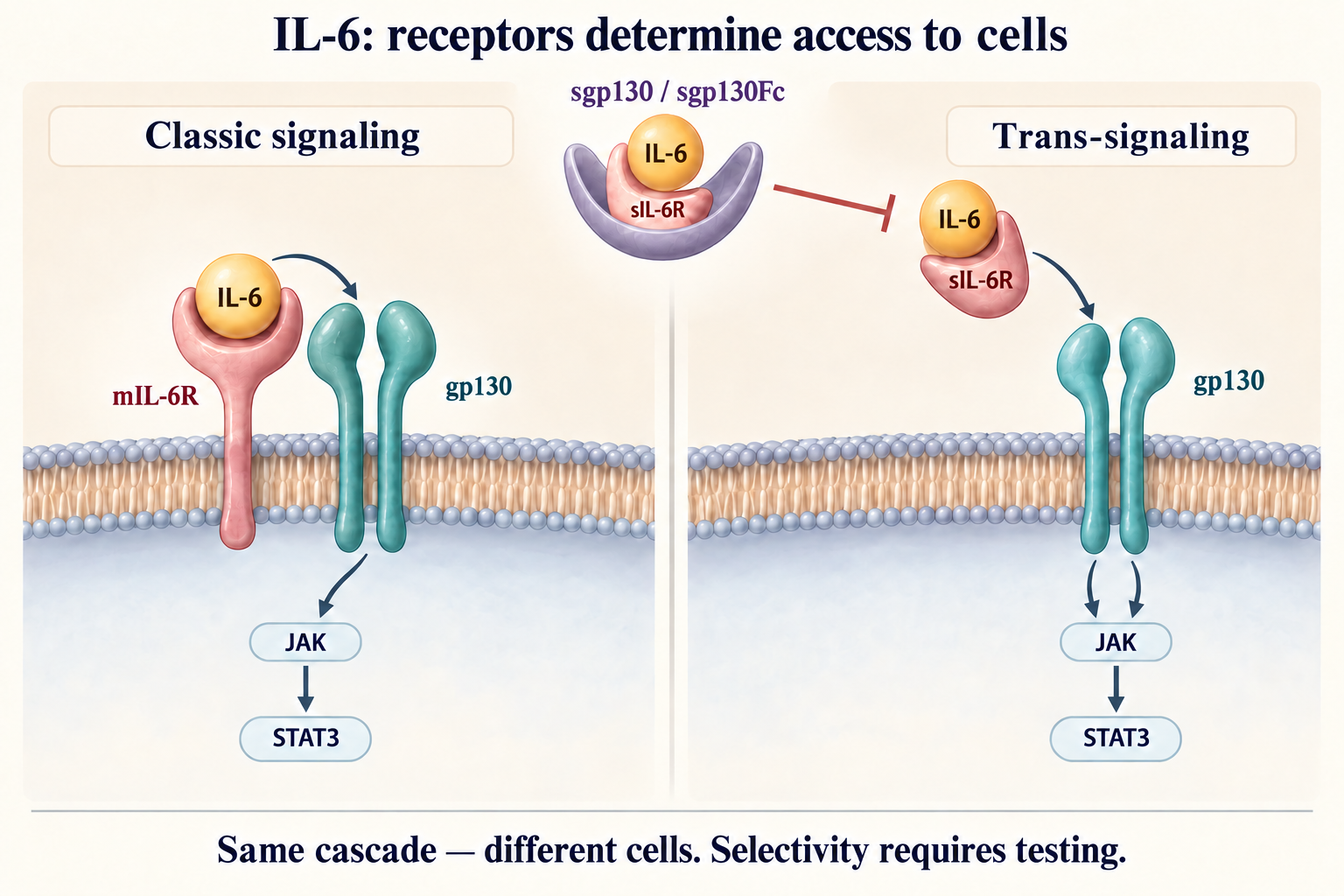
In classic, or cis-signaling, IL-6 binds membrane IL-6R and the assembled complex recruits gp130 on the same cell. Hepatocytes and several leukocyte populations can respond this way. Receptor expression depends on cellular state; a whole tissue cannot be described as permanently devoid of IL-6R on the basis of one cell type or measurement method.
In the liver this arrangement connects a local inflammatory signal with systemic protein synthesis. In immune cells it affects differentiation, survival, and interaction with other cytokines. In both cases consequences depend on stimulation duration and cell state. Classic signaling is not a universal synonym for safe or exclusively regenerative responses.
Soluble IL-6R retains cytokine-binding capacity. An IL-6/sIL-6R complex can interact with membrane gp130 on a cell whose own IL-6R is insufficient for a classic response. Here the soluble receptor is an agonistic partner rather than an ordinary ligand-neutralizing trap. It expands the accessible cell population and changes signal distribution between compartments.
Endothelium, stromal cells, and other gp130-positive populations can respond to this combination. However, circulating sIL-6R does not mean that all such cells are simultaneously activated. IL-6 availability, local delivery, soluble gp130, receptor density, and interaction time matter. Trans-signaling is a molecular arrangement, not a diagnosis of chronic inflammation.
During trans-presentation, IL-6 binds membrane IL-6R on one cell and is presented to gp130 on another at a contact site. This differs from diffusion of a soluble complex through tissue. Heink and colleagues demonstrated a role for dendritic-cell trans-presentation in priming pathogenic Th17 responses in experimental systems. Contact organization can direct the signal to a particular partner during immune interaction.
“Cluster signaling” and “trans-presentation” describe this spatial mode, but do not make every T-cell activation event trans-presentation. Evidence must establish where IL-6R is located and how gp130 is recruited on the responding cell. Results from soluble stimulation cannot automatically be transferred to cell contact.
ADAM10 and ADAM17 are membrane-bound zinc-dependent metalloproteases. During shedding they hydrolyze a peptide bond in an accessible receptor region, releasing its extracellular portion. Unlike phosphorylation, this breaks the polypeptide chain: a fragment remains membrane-associated and a protein with new spatial accessibility enters the medium. Catalytic zinc and activated water belong to this proteolytic mechanism, rather than IL-6 binding to gp130.
ADAM17 participates in stimulated IL-6R release; ADAM10 can also contribute depending on stimulus, species, and cell system. Experiments with TLR2-activated human mononuclear cells and THP-1 detected IL-6 production and sIL-6R generation involving both proteases. Monocytes were an important source of these components. ADAM17 should therefore not be called the sole generator of soluble receptor under every condition.
Substrate accessibility, protease maturation, membrane environment, and regulatory proteins alter shedding intensity. iRhom proteins are important for ADAM17; activation of growth-factor receptors and inflammatory pathways can connect extracellular signals to receptor-ectodomain release. A single phosphorylatable protease position is not a universally obligatory explanation for every stimulus.
Alternative transcript splicing is another route to sIL-6R, producing a secreted form. The contribution of each mechanism depends on conditions. Total sIL-6R measurement does not identify the origin of every molecule. ADAM17 also cleaves other substrates, including components of TNF and EGFR systems; inhibiting it is not an isolated adjustment of one IL-6 branch.
gp130 has no intrinsic tyrosine-kinase activity. Its tail associates with JAK1, JAK2, and TYK2, whose individual contributions depend on the cell system. Receptor-subunit proximity and rearrangement enable associated kinase activation. These enzymes use ATP as a phosphate donor, with magnesium helping organize the nucleotide during kinase catalysis.
Phosphorylated receptor-tail tyrosines create docking sites for SH2-domain proteins. YXXQ motifs are particularly important for STAT3 recruitment. IL-6 concentration, receptor occupancy, and phosphorylation intensity must be distinguished: there is no invariant linear relationship between them. Receptor reserve, phosphatases, and endocytosis modify the measured response.
STAT3 phosphorylation at Tyr705 supports dimerization through SH2-domain–phosphotyrosine interaction. Activated STAT3 moves to the nucleus and regulates genes together with other transcription factors and chromatin state. STAT1 can also be activated. The same gp130 input can therefore create different transcriptional profiles in hepatocytes, lymphocytes, and stromal cells.
Survival, cell-cycle, and acute-phase genes belong to different functional groups. A particular tumor or inflammatory program cannot be inferred solely from positive pSTAT3 staining. Signal strength and duration, other cytokines, epigenetic accessibility, and cell type matter. pSTAT3 is useful evidence of pathway engagement, but is not a specific marker of IL-6 trans-signaling alone.
Phosphorylated Tyr759 of human gp130 is linked to SHP2 recruitment and signal regulation. SHP2 is a tyrosine phosphatase that participates through adaptor interactions in Ras–Raf–MEK–ERK activation. A phosphatase can limit some phosphorylated nodes while supporting another branch. The term “phosphatase” therefore does not mean that the entire response is necessarily switched off.
PI3K creates phosphoinositide docking sites in membranes, while Akt connects this signal with survival and metabolism. PI3K–Akt–mTOR involvement depends on cell context and receptor cross-talk. Every branch should not be drawn as inevitably equally active in every experiment. Inhibitor experiments require attention to compound specificity and possible bypass routes.
IL-6 can induce SOCS3, creating negative feedback. SOCS3 binds the receptor–kinase complex and limits JAK activity; gp130 Tyr759 participates in its receptor recruitment. Experiments using altered receptors and protein-binding measurements support this arrangement. Activating the pathway thus also initiates a brake.
Response duration additionally depends on dephosphorylation, receptor internalization, and component degradation. When restraint is impaired, signaling can persist longer than extracellular concentrations would suggest. Feedback is not complete protection from chronic inflammation, but explains why a single pulse and sustained IL-6 production have different consequences.
Cressman and colleagues found defective regeneration after partial hepatectomy in mice with disrupted IL6, along with altered STAT3 activation and cell-cycle gene expression. Preoperative IL-6 administration brought several measures closer to normal and prevented liver damage. This supports an important role for IL-6 in the regenerative response studied.
However, deleting an entire cytokine does not isolate classic signaling or establish absolute indispensability in every injury model. Many growth factors, immune cells, and metabolic signals influence liver recovery. A genetic experiment cannot be translated directly into the safety of a particular receptor-antibody dose in humans.
Hepatocytes increase synthesis of CRP, serum amyloid A, fibrinogen, and other acute-phase proteins. High-sensitivity CRP refers to a method of measuring the same protein, not a distinct synthetic product. IL-6R inhibition can reduce CRP, so a low value during treatment does not rule out infection. Clinical assessment must consider symptoms and other findings.
The IL-6–hepcidin axis connects inflammation with restricted iron availability. Nemeth and colleagues studied cell systems, mice, and volunteers; IL-6 administration increased hepcidin and reduced serum iron. Hepcidin binds ferroportin and limits cellular iron export. During prolonged inflammation this can contribute to iron-restricted erythropoiesis even without depleted overall stores. An adaptive acute response can thus become problematic when sustained.
In the intestine, gp130/STAT3 signals can support epithelial survival and repair while also contributing to persistence of inflammatory lymphocytes and changes in their tissue environment. All epithelial effects cannot be assigned in advance exclusively to membrane IL-6R. Receptor repertoires, local soluble components, and other family cytokines require separate analysis.
Barrier outcomes include proliferation, mucin, tight junctions, cell migration, and microbial interactions. A reduction in one inflammatory marker does not demonstrate restoration of every function. Likewise, absence of intestinal perforation in a small, short trial does not demonstrate that the drug mechanism eliminates that risk.
IL-6 influences T-cell differentiation together with TGF-β, IL-1, IL-23, and other signals. STAT3 and RORγt are linked to the Th17 program; FoxP3 to regulatory T cells. Their population balance cannot be inferred from one serum-cytokine concentration. Activation stage, tissue, antigen, and additional-factor availability matter.
IL-6 can also contribute to Tfh responses and B-cell help. This does not mean that every IL-6 rise produces autoantibodies. Contact-dependent trans-presentation adds a spatial dimension, and soluble signaling permits paracrine expansion. Both arrangements belong within an immune network, rather than a standalone formula for peripheral tolerance.
In an inflamed joint IL-6 is linked to stromal and immune-cell activation, protease expression, and bone remodeling. RANKL supports osteoclast differentiation through RANK, while OPG restricts ligand availability. Research in human osteoarthritic chondrocytes investigated autocrine IL-6 and trans-signaling contributions to metabolic responses. These cellular findings are not equivalent to demonstrated slowing of osteoarthritis in patients.
Rheumatoid arthritis and osteoarthritis provide different clinical grounds for intervention. IL-6R-blocker efficacy in rheumatoid arthritis does not automatically apply to any joint pain. For natural enzyme modulators, the article on boswellic acids and lipoxygenases illustrates this boundary: molecular plausibility, symptom relief, and structural preservation require different measurements.
Trans-signaling can alter endothelial responses, chemokines, adhesion, and tissue matrix. Yet the direction of a particular migration effect depends on the model: a study of a laminin-composition change found reduced transendothelial migration of granulocytic cells. “IL-6 always increases every form of leukocyte migration” is therefore incorrect.
Atherosclerosis involves lipoproteins, immune cells, smooth-muscle cells, and endothelium. A cellular vascular effect does not establish reduced myocardial infarction or stroke after intervention. Cardiovascular conclusions require clinical events, sufficient participants, and follow-up; CRP reduction cannot replace those outcomes.
Acute IL-6 production during muscle activity differs from sustained production in an inflammatory environment in timing and accompanying signals. Diabetes and fatty-liver studies find associations between trans-signaling components, metabolic state, and liver stiffness, but an association neither determines causality nor creates an individual treatment threshold.
In tumor models gp130/STAT3 can support survival and stromal interaction. In neural tissue consequences differ with injury, sex, timing, and intervention route. Blockade cannot be called universally neuroprotective or antitumor. Even inflammatory models include negative findings: research on renal scarring after urinary-tract infection did not support a trans-signaling role in the outcome studied.
Soluble gp130 forms can bind IL-6/sIL-6R and limit engagement of membrane gp130. Together with soluble receptor they create an extracellular buffer system. Measured protein concentration, binding capacity, and availability at a lesion are not identical. The overall sIL-6R/sgp130 ratio is not a ready-made universal disease-activity test.
Different soluble gp130 forms exist, involving transcript mechanisms and proteolysis. Experimental work demonstrated gp130 shedding by ADAM10 and ADAM17, but gp130 was a weaker substrate than IL-6R. Such differences must not be ignored when depicting the system as a linear “protease–cytokine–pathology” switch.
Olamkicept, sgp130Fc, consists of a soluble receptor component joined to an immunoglobulin Fc fragment. Fc supports dimeric organization and changes pharmacokinetics. Development is based on trapping IL-6/sIL-6R with the intention of limiting trans-signaling while preserving some other responses. This differs from IL-6R antibodies, which engage membrane and soluble receptor forms.
Strict absolute selectivity, however, remains experimentally debated. Widjaja and Cook reported that sgp130Fc inhibited not only IL-6 trans-signaling but also several cytokine-family cis-responses in human cell systems. This does not establish that all olamkicept clinical activity is explained by nonspecificity. It requires attention to construct, concentration, and system, and precludes promising guaranteed preservation of every classic pathway.
Schreiber and colleagues’ FUTURE study included 16 patients with active inflammatory bowel disease. It was a prospective, open-label, 12-week phase 2a study, not a randomized placebo comparison. Olamkicept was infused intravenously at 600 mg every two weeks. Clinical response occurred in 44% and remission in 19%; molecular analyses showed reduced pSTAT3 and transcriptional changes in inflamed mucosa.
This design assesses tolerability, target engagement, and a research signal, but does not reliably quantify benefit against a control. A small mixed IBD population cannot establish equal efficacy in Crohn’s disease and ulcerative colitis. Clinical-index improvement and molecular response are different observations, each with limitations.
A double-blind, placebo-controlled study at 22 East Asian centers randomized 91 adults with active ulcerative colitis and inadequate response to conventional therapy. Full Mayo score was at least 5, rectal bleeding at least 1, and endoscopic score at least 2. Groups of 30, 31, and 30 received intravenous olamkicept 600 mg, 300 mg, or placebo every two weeks for 12 weeks; 79 completed the trial.
The primary outcome was clinical response based on Mayo reduction with a rectal-bleeding component. In the analysis populations, response occurred in 17/29 (58.6%) at 600 mg, 13/30 (43.3%) at 300 mg, and 10/29 (34.5%) on placebo. The adjusted 600-mg versus placebo difference was 26.6 percentage points, 90% CI 6.2–47.1; p=0.03. At 300 mg it was 8.3 points, 90% CI −12.6–29.1; p=0.52. The lower dose did not demonstrate a statistically confirmed advantage.
Treatment-related adverse events occurred in 53.3%, 58.1%, and 50%, respectively. Reported events included urine bilirubin, hyperuricemia, and increased AST. A small, short trial cannot exclude rare infections or perforations or establish safety superiority to another biologic: no direct comparison was performed. Week-12 clinical response also does not equal sustained remission over many years.
OPTION randomized 623 patients with moderate or severe active rheumatoid arthritis to intravenous tocilizumab 8 mg/kg, 4 mg/kg, or placebo every four weeks with stable methotrexate 10–25 mg weekly. This was a double-blind, randomized, 24-week phase III trial. The primary outcome was ACR20; efficacy analysis included 622 participants.
ACR20 responses were 59%, 48%, and 26%. For 8 mg/kg, the odds ratio versus placebo was 4.0, 95% CI 2.6–6.1. This demonstrates clinical efficacy in a defined methotrexate-treated population, rather than isolating trans-signaling. Serious infections occurred in six, three, and two patients, respectively. The trial does not support receptor blockade being free of immune risks.
MONARCH enrolled 369 patients with active rheumatoid arthritis for whom continuing methotrexate was inappropriate because of intolerance or inadequate response. They received subcutaneous sarilumab 200 mg or adalimumab 40 mg every two weeks for 24 weeks. The study was randomized, double-blind, and active-controlled. Change in DAS28-ESR was the primary outcome.
Mean changes were −3.28 versus −2.20; the between-group difference was −1.08, 95% CI −1.36 to −0.79. ACR measures and function provided additional information. However, ESR is part of the index and responds to acute-phase changes; interpretation must include joint and functional outcomes. This compares two specific monotherapies rather than establishing a universal ranking of all biologics.
A randomized trial in 36 adults with refractory polymyositis or dermatomyositis compared intravenous tocilizumab 8 mg/kg every four weeks with placebo for 24 weeks. The primary outcome evaluated total improvement using myositis criteria. No advantage was found in primary or secondary outcomes.
This does not invalidate rheumatoid-arthritis efficacy. It shows that IL-6 participation in pathophysiology does not guarantee treatment benefit in another disease. Likewise, a positive ulcerative-colitis signal for olamkicept cannot automatically be transferred to neurodegeneration, cancer, atherosclerosis, or Crohn’s disease.
The randomized open-label ENTRACTE trial enrolled 3080 patients with active seropositive rheumatoid arthritis, inadequate conventional disease-modifying-drug response, and at least one cardiovascular risk factor. They received tocilizumab 8 mg/kg monthly or etanercept 50 mg weekly. Mean follow-up was 3.2 years; time to first MACE was primary. There were 83 versus 78 events, HR 1.05, 95% CI 0.77–1.43.
LDL, HDL, and triglycerides were higher with tocilizumab by week four. No significant event difference does not prove that reduced inflammation necessarily offset lipids or establish complete equivalence. The confidence interval limits inference; serious infections and perforations were more frequent with tocilizumab.
For IL-6R antibodies, infections and changes in neutrophils, transaminases, and lipids are clinically relevant; intestinal perforation is a rare serious risk. Frequency depends on population, comorbidity, and concomitant treatment. All events cannot be explained by one disabled epithelial cascade, nor can another construct guarantee their absence.
CRP reduction can complicate use of a familiar inflammatory marker. Failure to rise should therefore not automatically be interpreted as absence of infection. Doses in this article describe research protocols, not individual prescriptions. Biological-treatment decisions depend on disease, previous response, contraindications, and monitoring.
Curcuminoids, EGCG, resveratrol, and other compounds are studied as modulators of inflammatory transcription, proteases, and cellular metabolism. Reduced IL-6 in cultured cells does not prove selective inhibition of IL-6/sIL-6R in humans. Compound form, free concentration, exposure duration, cell viability, and achievable oral exposure must be known.
There is no basis for assigning an ordinary supplement fixed 45–65% shedding inhibition or 60–80% IL-6-production suppression without an appropriate protocol and source. Direct ADAM17 binding, altered expression, and reduced inflammatory stimulus are different mechanisms. Broad protease inhibition may also affect many substrates. Listing nutraceuticals does not resolve these questions.
Physical activity, diet, and weight change can affect overall metabolic and inflammatory conditions. They are not equivalent to a pharmacological receptor-complex trap. An acute muscle-derived IL-6 pulse after exercise should not be read as chronic pathology merely because the same cytokine was measured.
Personalization requires distinguishing serum IL-6, soluble receptors, tissue pSTAT3, and clinical outcomes. None is a universal standalone decision. Until a research index has undergone clinical validation, it does not define a drug-treatment threshold. Receptor biology’s most useful lesson is to consider the cell, compartment, time, and demonstrated outcome together.
No. Tissue, duration, and context matter; sustained acute-phase activity can contribute to anemia.
No. Experimental findings show broader inhibition; construct, concentration, and system must be considered.
No. Small samples and 12 weeks cannot exclude rare infection or perforation or replace direct safety comparisons.