Boswellic acids: AKBA, lipoxygenases, and the limits of clinical cartilage protection
How AKBA modulates lipoxygenases, why exposure limits mechanistic translation, and what positive and negative Boswellia trials show.
Frankincense interests modern pharmacology as more than an aromatic resin. Its boswellic acids interact with proteins that determine which lipid signals emerge in inflamed tissue. One particularly well studied compound is 3-O-acetyl-11-keto-β-boswellic acid, or AKBA: a structural study showed it binding between two domains of human 5-lipoxygenase. Yet several independent evidentiary steps separate that interaction from pain reduction, cartilage preservation, or control of chronic disease. None can substitute for the next.
This article considers extract chemistry, iron-dependent catalysis, cellular compartments, lipid mediator switching, and clinical trials as connected but distinct levels. Small positive trials of specific extracts exist for osteoarthritis, but negative findings exist too. A longer multicentre trial of maintenance treatment for Crohn’s disease did not show superiority over placebo. An enzyme name on a label therefore does not automatically become a proven indication.
From resin to an individual compound
Why frankincense, essential oil, and extract are not interchangeable
Boswellia serrata resin is a complex natural material containing lipophilic resin components alongside polysaccharides and volatile substances. Boswellic acids are nonvolatile pentacyclic triterpenes. Distilled essential oil has a different chemical profile and cannot be treated as equivalent to an extract standardized for these acids. The plant’s name alone, without the plant part and preparation method, is insufficient to transfer an experimental finding to a product.
Even among extracts, the same mass does not imply the same composition. The percentage of “total boswellic acids” depends on the analytical method, while individual AKBA requires separate measurement. Total acid titration and chromatographic separation of specific triterpenes answer different questions. A claim of 65% total acids does not mean 65% AKBA, and a trial of one enriched extract does not apply to every frankincense resin.
Ursane and oleanane skeletons
Pentacyclic triterpenes arise from isoprenoid precursors through squalene, 2,3-oxidosqualene, and enzymatic cyclization. Boswellic acids have ursane or oleanane frameworks, which differ in the arrangement of methyl substituents in the terminal part of the five-ring system. β-Boswellic acids belong to the ursane series and α-boswellic acids to the oleanane series. That distinction persists through subsequent oxidation and acetylation and influences how a molecule fits into a protein.
The family includes α- and β-boswellic acids, their acetylated forms, 11-keto-β-boswellic acid KBA, and its 3-O-acetylated derivative AKBA. “Boswellic acids” means a mixture of related compounds rather than a single target and inhibition constant. The keto group, acetyl substituent, and carboxyl group alter polarity, hydrogen bonding, and distribution among aqueous media, membranes, and proteins. Lipophilicity may favour membrane partitioning while making intestinal dissolution more difficult.
What standardization means
A useful analytical certificate should identify individual components and the method used. Chromatography separates compounds; mass spectrometry and spectral comparison help establish their identity. Raw-material origin, extraction solvent, added carriers, and compositional stability matter across batches. A high AKBA content may improve reproducibility, but it does not by itself establish the mixture’s optimal clinical efficacy.
Enrichment of an active compound, improved dissolution, and increased systemic exposure should not be treated as a single measure. The first changes dose composition, the second physical availability, and the third is assessed by pharmacokinetics. An extract with less of one triterpene may contain other active components. Evaluating the complete preparation requires its own chemical profile and its own study.
How the leukotriene pathway works
Two domains and nonheme iron
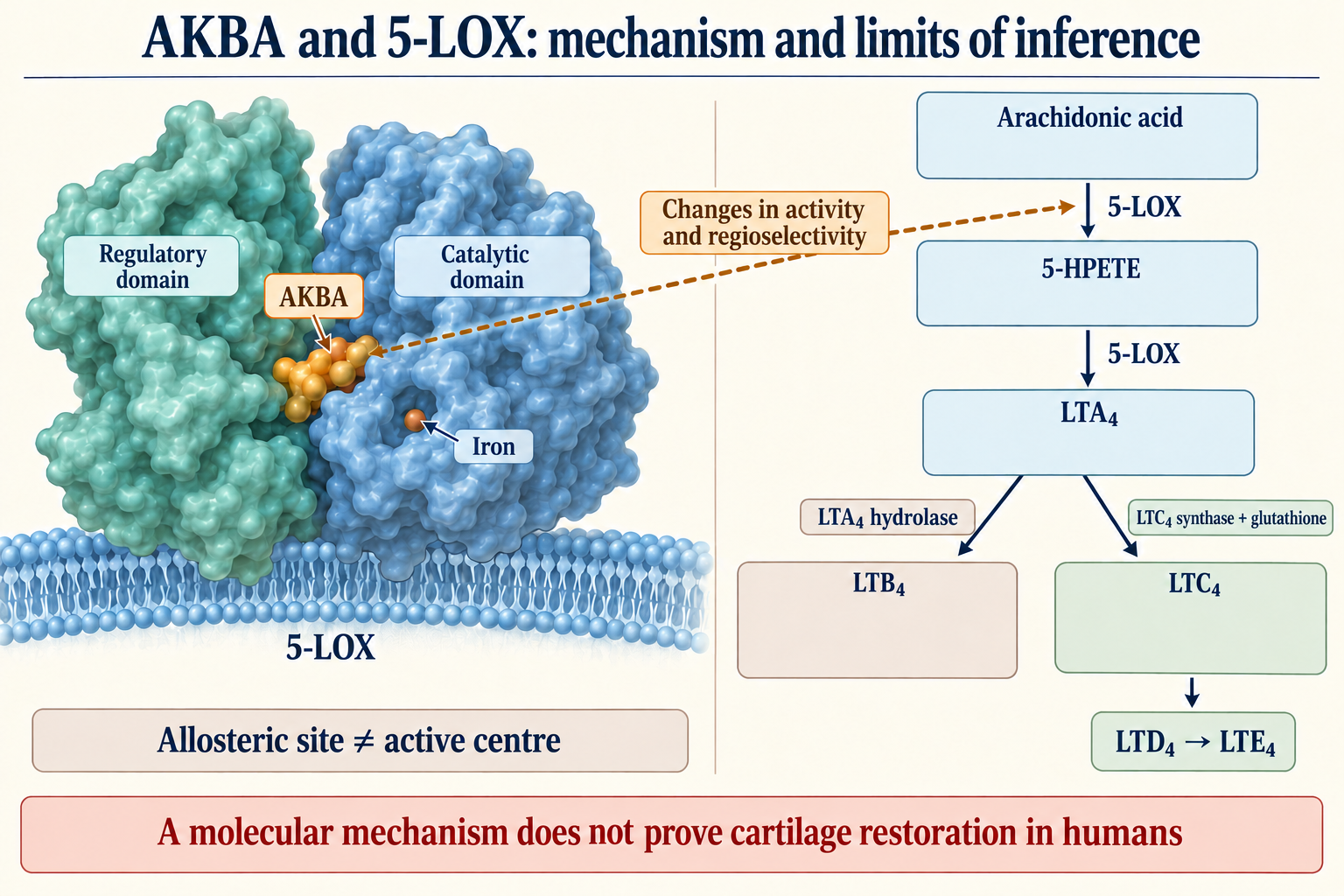
Human 5-lipoxygenase, encoded by ALOX5, contains an N-terminal membrane-binding domain and a much larger catalytic domain. The first helps the enzyme interact with lipid surfaces; the second positions the fatty-acid substrate near nonheme iron. Unlike iron in haemoglobin or peroxidases, this iron is not enclosed in a heme group. Amino-acid ligands coordinate it, and it participates in the redox cycle required to abstract hydrogen from the substrate.
Lipoxygenase catalysis depends on geometry: which part of the polyunsaturated chain approaches the iron and from which side oxygen can enter. A conformational change can therefore alter both reaction rate and the position of oxygen incorporation. Regulation involves more than closing a substrate-entry opening. It includes domain orientation, membrane access, and the ability to adopt a catalytically productive conformation.
Calcium, the nuclear envelope, and FLAP
In activated leukocytes, increased intracellular calcium promotes 5-LOX interaction with membranes, including the nuclear envelope. Cytosolic phospholipase A₂ releases arachidonic acid from membrane phospholipids. FLAP, the membrane-associated 5-lipoxygenase-activating protein, helps organize substrate use. It does not replace the catalytic centre: 5-LOX itself performs the enzymatic oxygenation.
This spatial coupling helps explain why purified enzyme, isolated neutrophils, and whole blood may respond differently to the same compound. Protein binding, membrane partitioning, substrate delivery, and activation signals operate in cells; some of these constraints are absent in a test tube. One published IC₅₀ therefore cannot be declared the universal concentration for an effect in the body.
Two reactions leading to LTA₄
5-LOX sequentially catalyses formation of 5-hydroperoxyeicosatetraenoic acid, 5-HPETE, from arachidonic acid and conversion of this intermediate into the unstable epoxide leukotriene A₄. The first reaction incorporates molecular oxygen into the fatty-acid chain; the second further transforms the hydroperoxide intermediate. The catalytic cycle requires iron and an appropriate enzyme oxidation state. This differs from prostaglandin synthesis by cyclooxygenases.
LTA₄’s subsequent fate depends on the cell’s enzyme repertoire. LTA₄ hydrolase forms LTB₄, which recruits and activates neutrophils through BLT receptors. LTC₄ synthase attaches glutathione to produce LTC₄. Sequential removal of glutamate and glycine residues yields LTD₄ and LTE₄. These cysteinyl leukotrienes contribute to bronchoconstriction, mucus secretion, and vascular permeability. Pathway involvement explains interest in a target but does not demonstrate efficacy of a particular herbal preparation.
AKBA: allostery rather than a simple “blockade”
What the structure directly demonstrated
Gilbert and colleagues located AKBA at the interdomain region of 5-LOX, approximately 30 Å from the catalytic iron. That position supports allosteric action: binding outside the principal catalytic centre changes the protein’s behaviour. The structure was obtained using an experimentally stabilized enzyme construct. It must be interpreted alongside functional experiments, rather than as an image of the enzyme in a living joint.
The functional result was more complex than complete enzyme shutdown. AKBA restricted conformations productive for leukotriene formation and altered the regioselectivity of arachidonic-acid oxygenation. Allosteric modulation and a change in the product spectrum are therefore more accurate descriptions. Interdomain binding alone does not prove that an orally administered preparation completely prevents membrane translocation or disrupts FLAP interaction in a person.
Why IC₅₀ is not a dose
IC₅₀ is the concentration that halves a measured response under specified experimental conditions. It depends on substrate concentration, enzyme construct, incubation time, and the measurement method. A binding constant, a kinetic inhibition constant, and IC₅₀ are not interchangeable. Even a substantial effect at a micromolar concentration does not establish whether that free concentration is reached after a capsule is swallowed.
AKBA’s structural position supports action away from the iron, but it does not justify describing every mixture as a strictly noncompetitive inhibitor with an unchanged Km. Other constituents may behave differently. Comparison with zileuton also does not establish comparative safety: enzyme interaction and the risk of liver injury are different evidentiary questions.
Inflammation resolution and 15-LOX-1
From reducing a signal to changing the mediator profile
Inflammation resolution is an active programme involving restraint of excessive neutrophil influx, macrophage removal of dead cells, and restoration of tissue balance. Certain lipid mediators participate in it. Reducing one proinflammatory product and increasing proresolving products are consequently different observations that need separate measurement. The second cannot be inferred merely from the first.
Börner and colleagues investigated AKBA’s effects on 15-lipoxygenase-1 in cellular systems, including macrophages, and in a mouse peritonitis model. Their findings support allosteric activation of 15-LOX-1 and increased formation of several specialized proresolving mediators. Substitution of arginine R98 disrupted the response in an experimental system, adding functional support to the binding model. These remain mechanistic and preclinical findings; they do not establish the clinical rate of inflammation resolution after oral extract use in humans.
No single enzyme produces every resolvin
Arachidonic acid, EPA, and DHA supply different mediator families. D-series resolvin pathways involve oxygenated DHA derivatives and subsequent enzymatic steps. Lipoxins arise from arachidonate through sequential lipoxygenase activity, sometimes involving multiple cells. Maresins follow their own route through macrophage DHA metabolism. E-series biosynthesis likewise cannot universally be reduced to “15-LOX-1 converts EPA to 18-HEPE.”
Analytically, hydroperoxide intermediates, their reduced hydroxy derivatives, and final bioactive mediators must be distinguished. An increase in one pathway marker does not demonstrate an increase in every resolvin. Mass-spectrometric lipid measurement needs to address identification, stereochemistry, and cellular stimulation conditions. “Class switching” describes the measured profile, rather than guaranteed tissue regeneration.
Other targets: prostaglandins, proteases, and transcription
mPGES-1 and glutathione
Microsomal prostaglandin E synthase-1 acts downstream of cyclooxygenases and converts PGH₂ to PGE₂. It is a membrane-associated enzyme whose function depends on glutathione. Siemoneit and colleagues demonstrated inhibition of this step by boswellic acids in experimental systems. An extract may therefore affect the prostaglandin profile without fitting a simple model of direct COX inhibition.
However, reduced experimental PGE₂ production does not mean cardiovascular or gastrointestinal risks are absent. That conclusion requires clinical data on specific events, comorbidities, and treatment duration. The effect of individual AKBA must also be distinguished from effects of other boswellic acids. The activity spectrum of a complete extract depends on composition, exposure, and environment, not only its most familiar molecule.
Cathepsin G is a specific type of cathepsin
Cathepsin G is a neutrophil serine protease stored in granules and involved in extracellular proteolysis and processing of signalling molecules. Its name does not make it interchangeable with lysosomal cysteine cathepsins. Tausch and colleagues isolated it using a boswellic-acid affinity matrix and identified it as a functional target. This is a separate line of mechanistic evidence from the lipoxygenase pathway.
Laboratory inhibition of a protease may limit damaging proteolysis, but it does not establish “complete protection of basement membranes” in the body. The available concentration at the inflammatory site, exposure time, and effects on other neutrophil functions must be known. Binding, inhibition of purified protein, and clinical benefit again occupy different evidentiary levels.
NF-κB and the IKK–IκB signalling chain
In canonical inflammatory signalling, the IKK complex phosphorylates IκB, after which ubiquitination and proteasomal degradation release NF-κB for movement into the nucleus. NF-κB regulates numerous cytokine and enzyme genes. Cellular studies of boswellic acids have described changes in this chain and reductions in particular inflammatory responses. Reduced nuclear signalling does not necessarily prove direct occupation of the ATP-binding pocket of every IKK subunit.
Effects may depend on cell type, stimulus, and cytotoxicity at the concentration tested. Lower expression of one gene cannot be called complete suppression of inflammation. In particular, synthesis of the IL-1β precursor and its subsequent maturation are separate stages, as explained in the article on the NLRP3 inflammasome. This distinction prevents a transcriptional change from being presented automatically as proven inhibition of mature cytokine secretion.
The joint: from matrix biology to clinical outcomes
Collagen, aggrecan, and proteases
Articular cartilage withstands loading through a collagen network combined with a hydrated proteoglycan matrix. Type II collagen provides structural coherence; aggrecan retains water through its glycosaminoglycan chains. MMP-13 participates in collagen cleavage, while ADAMTS-4 and ADAMTS-5 contribute to aggrecan degradation. Inflammatory signals can shift chondrocytes toward catabolism, but osteoarthritis also involves mechanical loading, age, subchondral bone, and other factors.
Reduced MMP levels or inflammatory markers in cultured cells constitute a plausible mechanism, rather than established clinical cartilage protection. Changes in SOX9, COL2A1, or hyaluronan-synthesizing enzymes require interpretation within the particular model. Claims of cartilage preservation in humans require appropriately controlled structural outcomes and follow-up. Pain reduction, synovial MMP-3 concentration, and joint-space change are not interchangeable.
RANKL, OPG, and subchondral bone
RANKL interacts with RANK on osteoclast precursors and supports their differentiation. Osteoprotegerin, OPG, binds RANKL as a decoy receptor, restricting its access to RANK. This axis connects immune signals to bone remodelling. Preclinical changes in its components may justify further investigation, but do not establish prevention of subchondral cysts, fractures, or joint replacement through Boswellia use.
“Cartilage protection” is informative only when the measured outcome is specified. A study measuring pain and function should be reported in those terms. Matrix analysis in an animal model should identify the model. The strongest claim—slower structural progression—cannot be inferred from a short symptom trial.
Bioavailability: the essential bridge from test tube to person
Dissolution, absorption, and free concentration
An orally administered triterpene must dissolve, cross the intestinal barrier, and undergo presystemic distribution and metabolism. Some circulating compound binds to proteins; total measured plasma concentration differs from the free concentration at a target. Lipophilic compounds may also partition into membranes and exhibit substantial variability between people. Poor aqueous solubility therefore cannot be reduced to one universal absorption percentage.
Human pharmacokinetic studies have described limitations in systemic exposure to KBA and AKBA. This challenges transfer of micromolar experimental effects to an ordinary oral preparation. Other mixture constituents and local effects may matter, but they need investigation rather than being invoked retrospectively to explain every positive result.
Food and formulation
In Sterk and colleagues’ randomized open crossover study, healthy men received a single BSE-018 dose equivalent to 786 mg of dry extract, either fasting or with a standardized high-fat meal. Individual boswellic-acid concentrations were measured for up to 60 hours. Food increased exposure to several constituents. This characterizes a particular formulation, not proof that added fat improves every capsule or its clinical outcome equally.
Phospholipid complexes, micellar preparations, and other delivery systems aim to alter dissolution and transport. Their assessment requires actual pharmacokinetics followed by clinical comparison. An increased concentration–time area under the curve does not imply a proportional increase in pain relief. A finding for one formulation cannot be transferred to another merely because both contain Boswellia serrata.
What clinical trials found
The positive 5-Loxin trial
Sengupta and colleagues randomized 75 patients with knee osteoarthritis in a double-blind placebo-controlled trial, with 25 participants per group. Two groups received 5-Loxin, an extract containing 30% AKBA, at 100 or 250 mg daily; the third received placebo for 90 days. Pain and function were assessed using VAS, WOMAC, and the Lequesne index. Seventy participants completed the study. Both doses improved symptom measures relative to placebo, and early improvement by day seven was reported for 250 mg.
MMP-3 measurement added an exploratory biomarker, but did not turn the trial into evidence of cartilage restoration. The sample was small, follow-up short, and conclusions concerned a specific enriched preparation. The study supports a possible symptomatic effect and the need for replication, rather than equal efficacy of all extracts or superiority over contemporary standard care.
Negative ATLAS findings: the combination was not better than placebo
The Australian ATLAS trial enrolled 84 adults with symptomatic, radiographically confirmed knee osteoarthritis. This double-blind randomized trial compared placebo with a daily combination of Boswellia extract 250 mg, pine bark extract 100 mg, MSM 1500 mg, curcumin 500 mg, and piperine 5 mg over 12 weeks. The primary outcome was pain change on a 100-mm VAS. The between-group difference was 0.16 mm, with a 95% confidence interval from −6.81 to 7.12 mm, showing no advantage for the combination.
Pain declined in both groups, demonstrating why between-group comparisons matter more than change from a group’s own baseline alone. The result does not isolate Boswellia’s contribution, but directly contradicts a claim of proven superiority for this combination. Molecular synergy cannot replace a negative primary outcome. A similar adverse-event profile over a short trial also does not establish absolute safety during prolonged use.
Crohn’s disease: negative remission-maintenance findings
A multicentre double-blind placebo-controlled Boswelan trial randomized 82 people with Crohn’s disease: 42 to extract and 40 to placebo. The regimen was two 400-mg capsules three times daily, with 52 weeks of planned treatment. The primary objective was remission maintenance throughout that period. Sixty-six patients were available for efficacy analysis; remission persisted in 59.9% versus 55.3%, without a significant advantage for active treatment.
The trial ended prematurely because separation on the primary endpoint was insufficient. Other measures did not show a convincing advantage, although tolerability was acceptable. Maintenance treatment differs from treatment of a flare, and every indication requires its own study. These findings nevertheless rule out a blanket claim that the evidence consistently supports Boswellia across all inflammatory bowel diseases.
Asthma and other indications
In Gupta and colleagues’ older double-blind placebo-controlled trial, 80 patients were divided into groups of 40. A gum-resin preparation was given at 300 mg three times daily for six weeks. The authors reported improvement in a combination of symptoms and functional measures in 70% of treated patients versus 27% of controls. This combined response should not automatically be called a prospectively specified modern primary endpoint; the short duration and design features limit interpretation.
The study provides a research signal, rather than grounds to replace inhaled anti-inflammatory treatment or rescue medication. Rheumatoid arthritis, allergic rhinitis, particular colitides, and other conditions each require their own clinical evidence. Inflammation and leukotriene involvement do not justify transferring a positive osteoarthritis finding to those diseases. Preclinical cytokine suppression does not establish a clinical reduction in autoimmune disease activity.
Safety and practical interpretation
Natural origin does not remove risk
Extracts were often reasonably tolerated in trials, but gastrointestinal symptoms and individual reactions are possible. Small trials detect rare events poorly and do not cover every drug combination, treatment duration, or kidney and liver condition. Commercial-product composition adds uncertainty. Failure to inhibit one enzyme does not exclude risks through other mechanisms.
Reliable evidence for pregnancy, breastfeeding, and many drug combinations is limited. Laboratory effects on metabolizing enzymes or transporters require cautious interpretation: they do not establish the frequency of clinical interactions. For someone taking anticoagulants, immunomodulators, or multiple medicines, assessment of a particular product and regimen is an individual medical decision.
A study dose is not a universal prescription
The doses above describe trials and allow their findings to be interpreted reproducibly. They do not form a single treatment regimen for osteoarthritis, asthma, or intestinal disease. The masses of enriched extract, resin, and delivery complex are not directly comparable; composition, outcome, and timing matter. There is no basis for requiring a fixed percentage WOMAC reduction or declaring one minimum course for every product.
A useful first step is to identify the intended outcome: pain symptoms, function, flares, or structural progression. The product can then be compared with the studied formulation and the research population with the relevant situation. Combinations with curcumin, MSM, collagen, or omega-3 require their own comparative studies. Biochemical complementarity is not equivalent to clinically demonstrated synergy.
Prospects without substituting mechanism for outcome
Boswellic acids illustrate how a natural compound can influence a protein far from its catalytic iron and change its lipid-product spectrum. That mechanistic depth merits attention in its own right. Further work should include reproducible formulation comparisons, exposure measurement, prespecified clinical outcomes, and adequate follow-up for safety and structural effects.
Current interpretation should retain two points together: AKBA’s molecular biology provides a compelling research rationale, while clinical effects depend on the disease and the particular preparation. Positive short trials do not justify ignoring negative ones. Possible symptom improvement should not become a promise of cartilage regeneration, Crohn’s disease control, or replacement of asthma treatment.
FAQ
Does AKBA binding prove cartilage restoration?
No. Binding and lipid-product changes suggest a mechanism. Human cartilage preservation or restoration requires separate structural clinical outcomes; pain relief cannot substitute for them.
Do findings for one extract apply to every Boswellia product?
No. Resin, essential oil, enriched extracts, and delivery systems differ in composition and exposure. A study dose describes its formulation, rather than a universal prescription.
Are there negative clinical findings?
Yes. The ATLAS combination did not outperform placebo for pain over 12 weeks. Boswelan did not show an advantage in maintaining Crohn’s disease remission.
Can Boswellia replace asthma treatment?
The older short trial provides a research signal, but does not justify replacing inhaled anti-inflammatory treatment or rescue medicines.
Sources
- Gilbert et al. Structural and mechanistic insights into 5-lipoxygenase inhibition by natural products. Nature Chemical Biology, 2020.
- Börner et al. Allosteric Activation of 15-Lipoxygenase-1 by Boswellic Acid Induces the Lipid Mediator Class Switch to Promote Resolution of Inflammation. Advanced Science, 2023.
- Sengupta et al. A double blind, randomized, placebo controlled study of the efficacy and safety of 5-Loxin for treatment of osteoarthritis of the knee. Arthritis Research & Therapy, 2008.
- Yuan et al. Effect of an oral complementary medicine combination for symptomatic knee osteoarthritis: A double-blind, randomized, placebo-controlled trial. Osteoarthritis and Cartilage, 2026.
- Randomized, placebo-controlled, double-blind trial of Boswellia serrata in maintaining remission of Crohn’s disease: good safety profile but lack of efficacy.
- Sterk et al. Effect of food intake on the bioavailability of boswellic acids from a herbal preparation in healthy volunteers. Planta Medica, 2004.
- Siemoneit et al. Inhibition of microsomal prostaglandin E2 synthase-1 as a molecular basis for the anti-inflammatory actions of boswellic acids from frankincense. British Journal of Pharmacology, 2011.
- Tausch et al. Identification of human cathepsin G as a functional target of boswellic acids from the anti-inflammatory remedy frankincense. Journal of Immunology, 2009.
- Gupta et al. Effects of Boswellia serrata gum resin in patients with bronchial asthma: results of a double-blind, placebo-controlled, 6-week clinical study. European Journal of Medical Research, 1998.
- Permeation of Boswellia extract in the Caco-2 model and possible interactions of its constituents KBA and AKBA with OATP1B3 and MRP2.