Salt is so familiar that its impact is easy to oversimplify. Some see it only as a source of high blood pressure, while others point to the indispensability of sodium and conclude that no restrictions are necessary. Physiology supports both initial observations: sodium is essential for life, and its excessive intake can increase blood pressure. There is no contradiction between these statements if one distinguishes between the body's requirements, the standard diet, and clinical situations involving fluid loss.
For a professional, the conversation about salt begins with clarifying values and ends with an assessment of a specific patient. For an individual looking to change their diet, that same path helps navigate labels, choose several healthy alternatives, and avoid confusing dietary prevention with the treatment of electrolyte imbalances. What is needed is not an endless battle against every grain, but an understanding of where the main burden comes from and which changes have proven significance. This is precisely why the story of sodium unites the function of the kidneys, blood vessels, and hormones with everyday decisions in the kitchen.
Sodium and salt: different values in the same conversation
Sodium is a chemical element that exists in bodily fluids primarily as a positively charged Na⁺ ion. Common table salt is sodium chloride, NaCl, which is a compound of sodium and chloride. The mass of sodium is approximately 40% of the mass of pure sodium chloride: 1 g of salt contains about 400 mg of sodium. Therefore, the figure of "2 g of sodium" corresponds to approximately 5 g of salt, not two grams of shaker contents. This arithmetic difference is especially important when comparing national recommendations and food labels.
Outside of cells, sodium is the primary cation and, together with the anions that accompany it, participates in maintaining osmotic equilibrium. Cells do not simply float passively in salt water: they maintain a difference between their internal composition and the external environment. The sodium-potassium pump uses ATP energy to move ions against their concentration gradients. These gradients are necessary for electrical signals and the operation of a number of transport systems, including those involved in the absorption of nutrients. The biological necessity for sodium explains its role, but it does not in itself dictate a desirable level of salt intake.
The amount of sodium in the body and its concentration in the blood answer different questions. Total body content is related to extracellular fluid volume, whereas concentration reflects the ratio of dissolved substances to water. A person can have a normal sodium concentration with significant fluid retention, or a low concentration under various water balance scenarios. Therefore, a blood test does not function as a tracker for consumed salt, and dietary advice is not a substitute for diagnosing hyponatremia.
This difference also changes the meaning of the common expression "needing salt." In the case of weakness after exercise, the cause may be dehydration, overheating, sleep deprivation, and a multitude of other states, rather than necessarily low sodium. In cases of laboratory-confirmed low sodium, the problem is often related to an excess of water relative to available dissolved substances and a failure in its excretion. Trying to correct both cases with a single salty drink means substituting distinct mechanisms with a general guess. In everyday life, it is sufficient to remember the boundary: dietary recommendations refer to nutrition, while blood sodium abnormalities require a separate medical evaluation.
How kidneys and hormones maintain balance
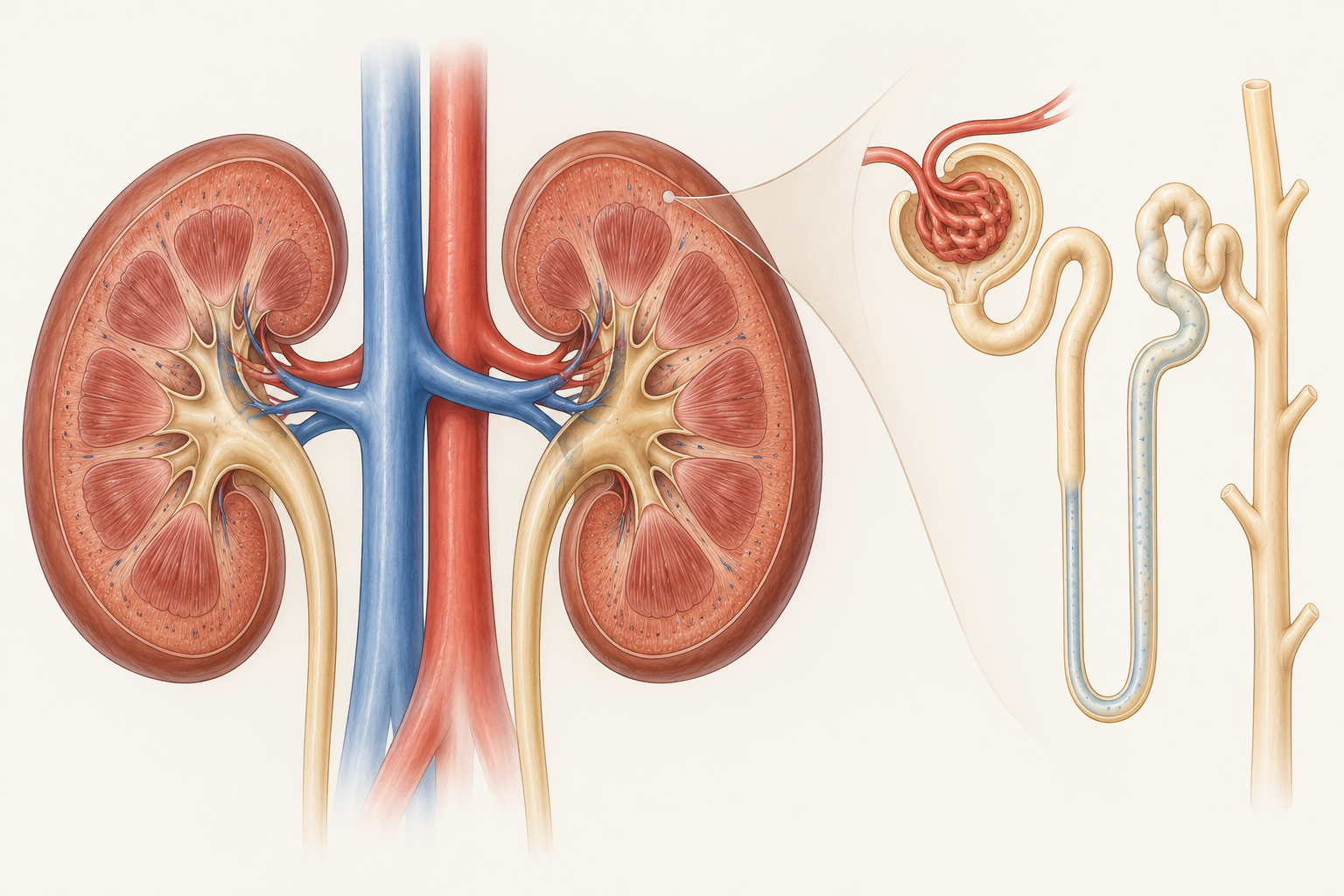
After absorption, sodium is distributed in the extracellular fluid, and its subsequent balance is largely determined by the kidneys. A large amount of sodium passes through the renal filters daily, but the majority is returned to the blood as fluid moves through the tubules. To change the final excretion, it is sufficient to alter a small fraction of reabsorption. Therefore, the kidneys are capable of adapting to varying intake, although the limits and speed of adaptation depend on the state of the organism. Consumption and excretion do not have to match after every individual meal.
One of the regulators is the renin-angiotensin-aldosterone system, or RAAS. Given specific signals of reduced renal blood flow, delivery of salt to sensitive areas of the nephron, or increased sympathetic activity, the kidneys release renin. A cascade follows in which angiotensin II is formed, and the adrenal glands increase aldosterone secretion. This system helps retain sodium and maintain blood circulation; it is particularly important when the effective circulating blood volume is reduced.
Angiotensin II influences both vascular tone and renal sodium handling. Aldosterone acts primarily on the distal segments of the nephron, enhancing processes that promote sodium reabsorption and potassium excretion. Aldosterone secretion is regulated not only by angiotensin: potassium concentration also holds independent significance. This relationship explains why pharmacological interventions in the RAAS can simultaneously alter pressure, kidney function, and potassium levels.
However, increased salt intake should not be described as an obligatory "activation of the RAAS." With excess sodium, circulating renin and aldosterone are typically suppressed, and may rise as part of compensation when intake is reduced. Regulation within individual tissues and during disease states is more complex, but this does not negate the basic direction of the reaction. Furthermore, a change in a hormonal indicator by itself does not report whether a person's health has improved or worsened. For evaluating dietary intervention, pressure, tolerability, and clinical context are important, rather than choosing one convenient arrow in a biochemical diagram.
The kidneys link sodium balance to pressure through a mechanism called pressure natriuresis. An increase in perfusion pressure can increase sodium excretion, helping to restore the balance between intake and output. If higher pressure is required to excrete the habitual load, the system reaches equilibrium at a less favorable level. Such a model explains an important part of salt sensitivity but does not cover all its vascular, nervous, and genetic components.
Salt sensitivity and pressure: what happens in humans

Salt sensitivity means that pressure changes noticeably with changes in sodium intake. This property does not categorize people into two forever unchangeable groups: the reaction depends on measurement conditions, baseline diet, and duration of the intervention. Research has used different protocols for salt loading and restriction, so the proportion of "salt-sensitive" individuals cannot be transferred between studies without clarification. Age, baseline pressure, and the specifics of the renal and vascular response help explain variability, but do not provide an accurate personal prognosis based on a single trait.
One of the key experiments was DASH-Sodium. In it, 412 adults received a controlled diet with varying sodium content; a standard diet model was compared separately against the DASH diet, which is rich in vegetables, fruit, and low-fat dairy products. Each sodium period lasted 30 days, and participants were provided with food, which reduced uncertainty regarding actual intake. Both reducing sodium and changing the overall dietary pattern reduced pressure. This showed that salt has independent significance, but does not exhaust the influence of the diet.
When comparing the DASH diet with low sodium to the control diet with high sodium, the mean systolic pressure differed by approximately 7.1 mm Hg in participants without hypertension and by 11.5 mm Hg in participants with hypertension. These numbers refer to the combined change of two factors and are not the effect of the salt shaker alone. The distinction between a combined approach and a single component is important for counseling: one should not promise a patient a reduction of 11 mm Hg simply because they stopped adding salt to their dinner. At the same time, the result supports working with the general structure of nutrition, not just with one nutrient.
A more recent cross-over study from 2023 included 213 adults aged 50–75 with varying hypertensive status. Participants alternately underwent one-week periods of high and low sodium, and pressure was assessed using ambulatory monitoring. After the first week, the mean difference in systolic pressure between the assigned regimens was 8 mm Hg, with a 95% confidence interval of 4 to 11. The effect was observed in various subgroups, including among people receiving antihypertensive therapy.
The low-sodium regimen in this experiment was significantly stricter than the usual WHO recommendation. Therefore, the short protocol is useful as a demonstration of physiological response, but it does not translate into a universal household prescription. A one-week change in pressure does not establish the long-term safety of such a degree of restriction for every patient. To translate the result into practice, it is necessary to consider dietary sustainability, medications, and the possibility of observation. The study shows that the reaction can be quite rapid; it does not require everyone to repeat the experimental diet.
Systematic reviews of RCTs confirm the general direction of the effect and its heterogeneity. In the 2020 BMJ review, the magnitude of blood pressure reduction was associated with changes in sodium excretion and participant characteristics, and the duration of the intervention influenced the assessment of the response. The effect in studies lasting longer than two weeks differed from the results of very short protocols. Therefore, a one-day weighing after a salty meal or a few random home measurements do not allow for assessing the long-term benefit of changes.
From a Laboratory Marker to Stroke Risk
Blood pressure is a well-studied cardiovascular risk factor, but results regarding it and data on heart attacks, strokes, or mortality still need to be distinguished. A direct study of clinical events usually requires more participants and longer follow-up than an experiment on blood pressure. Changing an intermediate marker supports a physiological hypothesis, while clinical events answer a different level of question. For salt, this difference is especially important when discussing potassium-enriched substitutes: the intervention simultaneously reduces sodium and increases potassium.
In SSaSS, published in 2021, 20,995 people from 600 Chinese villages participated. The study included people with a history of stroke or participants aged 60 and older with high blood pressure. Villages were randomly assigned to use either regular salt or a mixture containing 75% sodium chloride and 25% potassium chloride by weight. The average duration of follow-up was approximately 4.74 years. This was a study of real-life household use, rather than just a change in a single laboratory analysis.
The stroke rate was 29.14 versus 33.65 cases per 1000 person-years in the salt substitute group and the regular salt group, respectively. The relative rate was approximately 14% lower; the rates of major cardiovascular events and death from any cause were also lower. It should be noted that this concerns a group with high baseline risk and an environment where home cooking provided a significant portion of the sodium load. The comparison does not report that the same absolute effect would be seen in a young person without hypertension or in a population receiving the bulk of their salt from industrial products.
The trial did not find a significant increase in clinically recorded severe hyperkalemia. However, people with known high-risk circumstances, including serious kidney disease and specific medication situations, were excluded. The absence of a signal in the selected population does not prove the safety of potassium salt for those who were not included in the study. This limitation becomes part of a practical decision, rather than a footnote that can be discarded after an attractive percentage.
In 2025, the WHO issued a conditional recommendation to use potassium-enriched substitutes if an adult chooses to add table salt. It is addressed to the general adult population and does not automatically extend to children, pregnant women, and people with impaired potassium excretion. The subject of the replacement is also important: it concerns added salt, not permission to increase its quantity. Individuals with kidney disease or taking relevant medications require an individual decision.
Recommendations and Labels Without Confusion

WHO recommends that adults consume less than 2000 mg of sodium per day, which corresponds to less than 5 g of salt. This is the total intake from all sources, not a separate quota for adding salt. It includes bread, cheese, prepared sauces, processed meat, soups, and other products, even if they do not seem particularly salty. Different national documents may use a slightly different reference point, so when providing counseling, it is useful to name the specific source and unit. An average recommendation also does not replace an individual regimen during illness or unusual fluid losses.
Labels sometimes indicate sodium and sometimes the salt equivalent. If it says "sodium 600 mg per 100 g," this corresponds to approximately 1.5 g of salt per the same 100 g. But the actual serving size matters: consuming 50 g of such a product will provide about 300 mg of sodium, or 0.75 g of salt. It is more convenient to compare products by the same mass, but to evaluate your day — by the portion actually eaten. These two operations solve different tasks and should not replace each other.
Numbers quickly take on meaning through the example of an ordinary sandwich. If the bread, cheese, and meat filling each contain salt, their contributions add up even when nothing extra is added on top. Removing the salt shaker can be a useful first step, but it does not guarantee low intake. In another diet, where most food is prepared from naturally unsalted products, it is the added salt that may prove to be the main source. Before choosing a strategy, it is useful to identify your largest and most regularly recurring contributor.
Sea, rock, and pink salt do not lose sodium due to their color or origin. Crystals of different sizes may fill a teaspoon differently, but this is a matter of volume, not a new physiological effect. Therefore, weight is more accurate than the common comparison of "one spoonful of one salt versus one spoonful of another." Trace amounts of other minerals do not turn a significant intake of sodium chloride into a way to meet requirements for these elements. For limiting sodium, mass and composition are more important than a marketing name.
Iodization solves a separate problem and does not require consuming more salt. The WHO supports the use of iodized salt when salt is part of the diet, while simultaneously recommending a reduction in sodium load. The compatibility of these goals depends both on the iodization program and the availability of other sources of iodine. One should not independently compensate for a suspected deficiency by increasing salt, especially if blood pressure is elevated. Iodine requirements and sodium intake can be discussed separately without turning a single dietary habit into a treatment for two different issues.
How to change a diet and evaluate the result

Practical salt reduction is best started with frequently consumed foods rather than a rare holiday dish. One can compare several types of bread or sauce, reduce the portion of processed meat, cook more often from basic ingredients, and use spices, herbs, or acid for flavor. Such a substitution works if it can be sustained, so it is useful to consider availability, price, and family habits. A single perfectly unsalted plate will not change the average load if the rest of the meals remain the same.
An abrupt change may prove difficult in terms of taste, while a gradual reduction is usually easier to integrate into daily life. There is no obligation to make every dish completely bland: the goal is to lower the total contribution while maintaining a nutritious diet. If a person has replaced one product, it makes sense to understand what happened to the rest of the diet rather than evaluating success solely by the presence of the word "low-salt" on a package. In a consultation, a specific list of habitual purchases often helps more than an abstract ban on salt. It shows where a change would be most noticeable and realistic.
In hypertension, the result is evaluated by a series of blood pressure measurements performed in a manner familiar to the patient and discussed with the treating specialist. It is important not to change medications simultaneously without coordination; otherwise, the source of the response becomes unclear. If pressure has decreased, the need for a review of therapy is determined by the physician, especially in the presence of dizziness and symptoms of hypotension. Dietary intervention complements treatment but does not provide grounds for discontinuing prescribed drugs based on one good morning measurement.
For research purposes, 24-hour urinary sodium excretion is a useful approximation of intake. However, a single 24-hour sample depends on the day's diet and the completeness of collection, and a single spot urine sample has additional limitations. Formulas that convert it into an accurate "daily intake" can yield systematic errors, especially at extreme levels. Therefore, the result should not be used as a moral assessment of dietary compliance or an infallible characterization of habits.
A diet with less salt makes sense even without an immediate subjective effect. High blood pressure often causes no sensations, and its change may only be visible through measurement. At the same time, the absence of a noticeable response does not mean that restrictions should be endlessly intensified: one should assess the baseline load, the regularity of changes, and other factors. Individual variability does not negate the general direction of the data but limits promises of a specific result. For a specialist, this is an opportunity to select a sustainable approach, not a reason to seek a single "correct" dose for everyone.
When standard recommendations require an individual solution

In cases of heart failure, chronic kidney disease, and several other conditions, sodium management is linked to fluid volume, medications, and laboratory parameters. A general preventive guideline does not automatically translate into a therapeutic prescription. The degree of restriction, the necessity for weight monitoring, and the fluid regimen are determined by the clinical situation. Here, it is especially important not to combine a strict diet, a change in diuretic, and a potassium-based salt substitute on one's own: each component can alter the balance. Instead of several independent pieces of advice, a coordinated plan is required.
Potassium-containing salt requires separate attention when the kidneys' ability to excrete potassium is reduced. The risk may also increase when combined with medications that affect this process, for example, certain drugs acting on the RAAS or potassium-sparing diuretics. The mere fact that a medication is prescribed does not mean that a substitute is always forbidden, but it does exclude making a decision based on general advertising. It is necessary to know kidney function, potassium concentration, and the specific drug. A conditional WHO recommendation does not replace this individual analysis.
Heat, prolonged exertion, vomiting, and diarrhea create different challenges related to water and electrolyte losses. A rehydration plan depends on the nature of the losses; everyday prevention of excess salt and recovery after significant fluid loss are not the same regimen. In dehydration due to diarrhea, specially formulated oral rehydration solutions have a different purpose than simple salt water or an energy drink. It is important not to apply sports advice to a sick child or a person with impaired consciousness. Certain situations require urgent care, not dietary experimentation.
Hyponatremia is also not equivalent to insufficient salt intake. Among its causes are disturbances in water excretion, medications, and various forms of fluid loss; treatment depends on the cause and the rate of development. A severe condition may be accompanied by confusion, seizures, and other neurological manifestations. Independent rapid "sodium correction" is dangerous, and simply increasing salt does not resolve all underlying mechanisms.
Sodium does not have a single role as a villain or a savior. The body uses it for basic functions, the kidneys maintain the balance, and modern diets often provide more than what is required for reasonable prevention. A high-quality recommendation begins with correct units, relies on human studies, and takes into account diseases and medications. For most people, a few sustainable changes in the diet are more beneficial than anxious monitoring of every crystal. For a patient with a complex clinical situation, a coordinated treatment plan is more important than a universal rule from an article.