Saccharomyces boulardii: diarrhea, toxins and safety
How probiotic yeast affects bacterial toxins, what trials show about antibiotic-associated diarrhea, why current CDI guidance differs, and when fungemia risk rules out use.
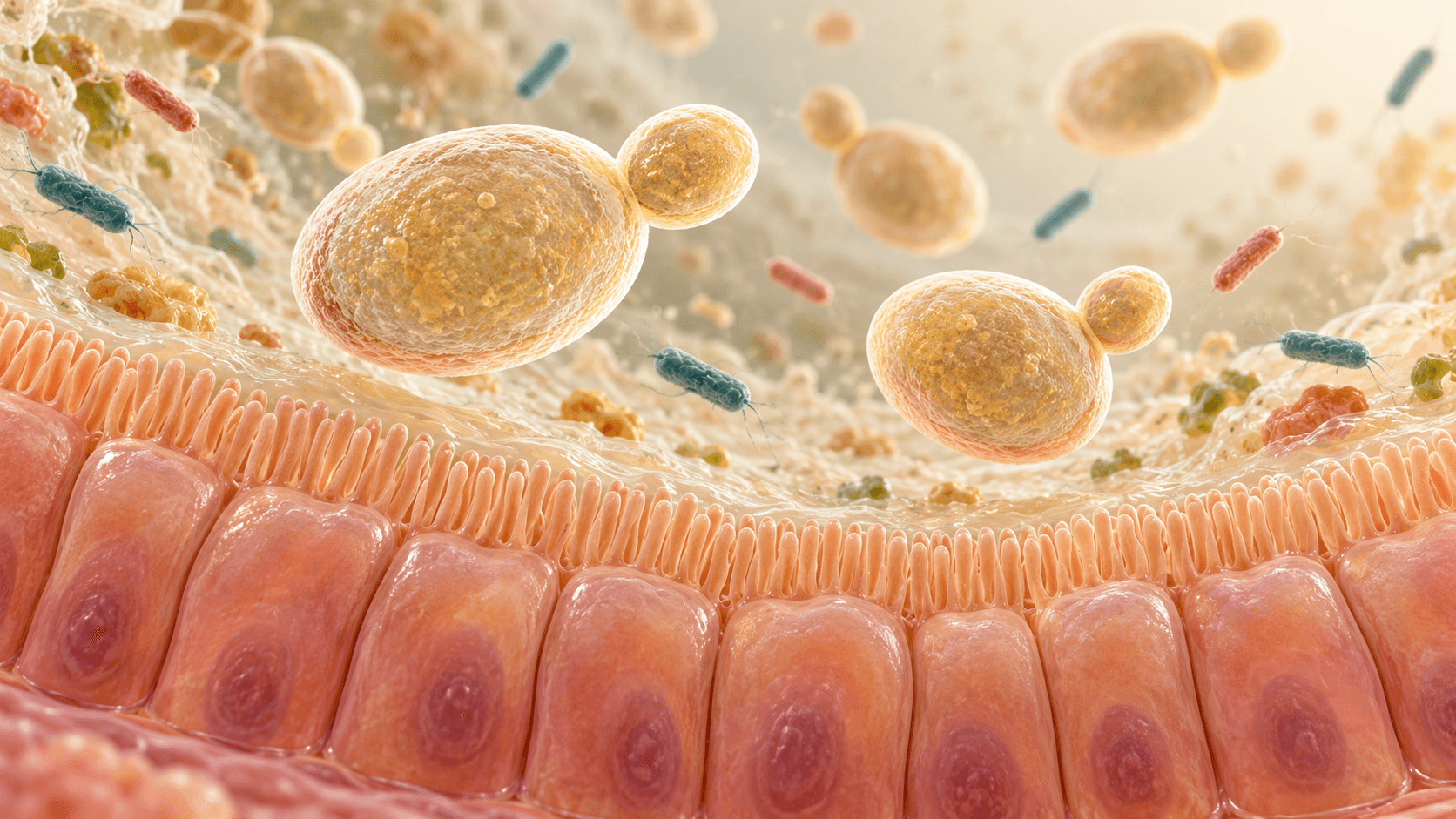
Saccharomyces boulardii is a probiotic yeast, commonly described as S. cerevisiae var. boulardii. CNCM I-745 is a well-studied strain, but neither the name of the species nor a capsule containing “yeast” establishes equivalence to a tested product. Its biology explains why it can remain active during many antibacterial treatments. Clinical usefulness still depends on the indication, preparation, patient and outcome measured.
The clearest clinical signal concerns prevention of antibiotic-associated diarrhea (AAD). That category includes several causes and is not synonymous with Clostridioides difficile infection (CDI). Experimental toxin degradation, a reduction in ordinary AAD and prevention of recurrent CDI are three different claims. The AGA’s 2026 expert update advises against probiotics for prevention of initial or recurrent CDI (Fischer et al., 2026).
Identity, stress tolerance and passage through the intestine
Genetic studies place these yeasts within S. cerevisiae, with variation among isolates in genome structure, gene copy number and stress responses. A historical account of isolation by Henri Boulard in Indochina in the 1920s does not identify every present-day commercial strain. Karyotypes and microsatellite markers can help characterize isolates; they do not predict efficacy by themselves. Comparative genomics reported differences in Ty retrotransposon families, not a demonstrated “Ty9 duplication” responsible for probiotic action (Edwards-Ingram et al., 2007; Khatri et al., 2017).
Growth at approximately and acid tolerance are relevant phenotypes, but performance depends on the strain, medium, exposure time and formulation. Survival in an artificial acidic solution cannot be converted into a guaranteed percentage surviving every stomach. Nor are all baker’s yeasts incapable of growth at body temperature or all bacterial probiotics uniformly acid-sensitive. Bile and digestive-enzyme exposure also require product-specific measurements.
Yeast cells have eukaryotic 80S cytosolic ribosomes, an ergosterol-containing membrane and a wall rich in mannoproteins, β-glucans and chitin. Many antibacterials target bacterial structures absent from yeast, such as peptidoglycan or 70S ribosomes. This supports concurrent use in relevant trials, without requiring the usual bacterial-probiotic spacing rule. It does not establish absolute resistance to every antimicrobial or every concentration. Antifungals can suppress the organism; the French product information advises against concurrent oral or systemic antifungals (ANSM, product information).
Oral use produces temporary intestinal exposure rather than a reliably permanent microbial resident. Fecal recovery varies with dose, intestinal transit, concurrent treatment and the culture method (Bléhaut et al., 1989). A conceptual washout model, , describes decline only under simplifying assumptions; it is not a validated universal clearance rule. Culture negativity and PCR negativity are different endpoints because DNA can outlast viable cells. Fixed claims of complete disappearance within a particular number of days are therefore inappropriate.
What C. difficile toxins do
TcdA and TcdB are large, multidomain proteins of roughly 300 and 270 kDa, with sequence and receptor differences between toxin variants. Binding, uptake, translocation and intracellular enzyme activity are distinct stages. The C-terminal repeat region contributes to some interactions, but does not explain every receptor interaction.
Their glucosyltransferase activity disrupts small Rho-family GTPases and the actin cytoskeleton. A representative reaction is:
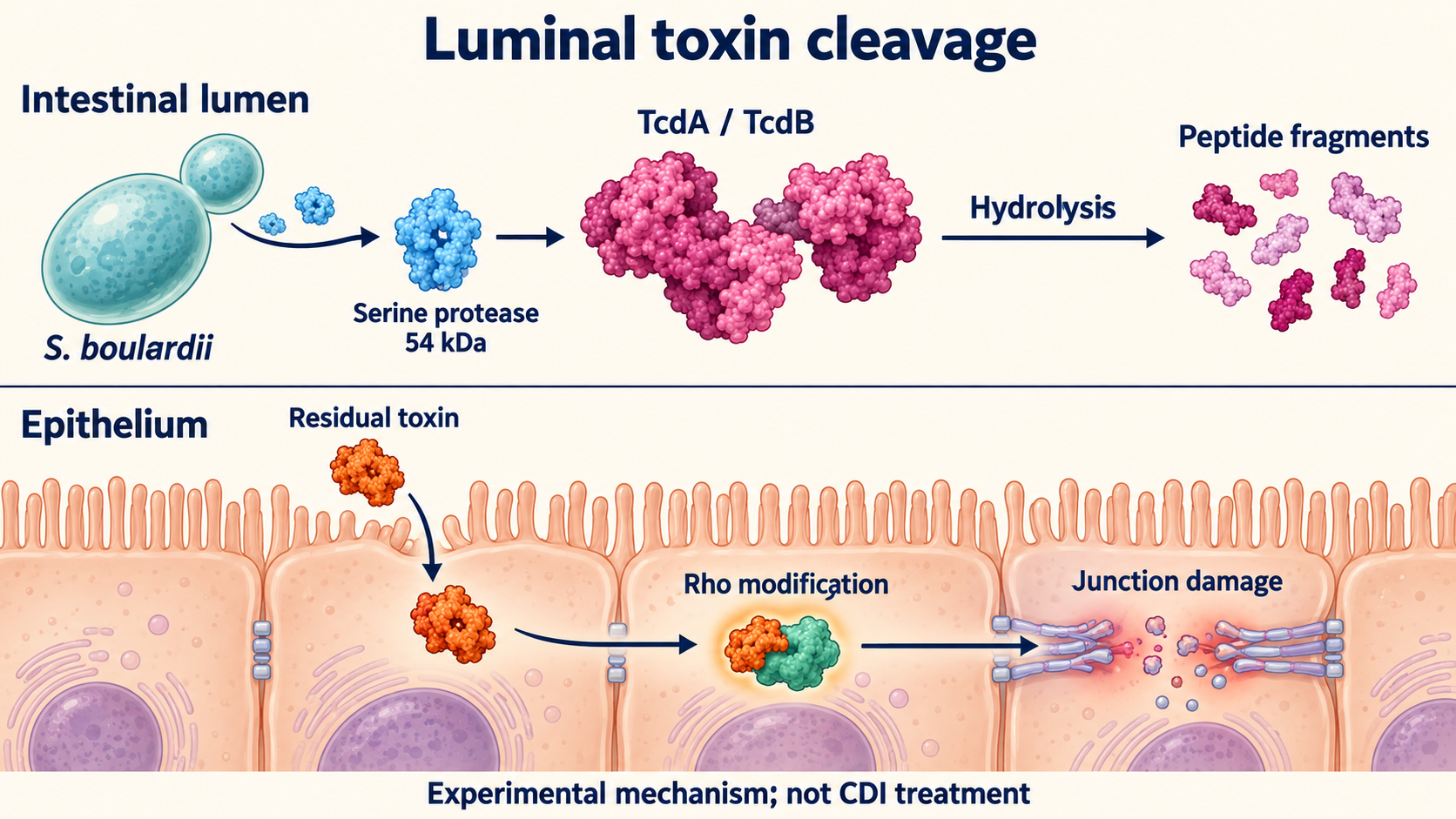
Just et al. (1995) localized toxin-B-induced glucosylation to RhoA Thr37. Related substrates include Rac1 and Cdc42, with corresponding acceptor positions that depend on the substrate. Cytoskeletal damage can disturb junctions, increase permeability and provoke inflammatory injury. This is an intracellular toxic process, not simply bacterial adhesion to an intestinal surface.
The 54 kDa protease: a real experimental mechanism with limits
Castagliuolo et al. studied a secreted serine protease associated with an apparent mass of 54 kDa. Rodent studies and experiments with human colonic tissue showed degradation of TcdA/TcdB, reduced toxin binding and attenuation of toxin effects (Castagliuolo et al., 1996, 1999). Human tissue studied outside the body is valuable mechanistic evidence; it is not a human therapeutic trial. The protection was partial and depended on experimental conditions.
The appropriate schematic reaction is peptide-bond hydrolysis: . The cited work does not establish the precise clinical cleavage map, a universal set of fragment masses or kinetic constants for each intestinal patient. Proteolysis of toxin and effects on toxin-binding structures must also be distinguished. The gp96 binding protein was characterized for toxin A in colonocyte models (Na et al., 2008); that does not demonstrate its cleavage by the yeast protease.
Calling this enzyme a zinc-dependent metalloprotease confuses different enzymes. The antitoxin work concerns a serine protease. A separate yeast-associated zinc-binding M1 aminopeptidase was described in young rats (Buts et al., 2002). Adding zinc has not thereby been shown to amplify antitoxin protection in patients. Ordinary S. boulardii is not a proven eradicator of C. difficile bacteria or spores, and luminal enzyme activity does not demonstrate elimination of all intracellular toxin injury.
Other secreted factors and epithelial signaling
| Experimental factor | What was observed | Boundary of interpretation |
|---|---|---|
| Approximately 63 kDa phosphatase | Partial dephosphorylation of E. coli LPS and reduced inflammatory effects in rat experiments | No proof of treatment of human endotoxemia or sepsis |
| Activity associated with a 120 kDa protein | Reduced secretagogue-induced cAMP in intestinal cell models | Not demonstrated cholera-toxin proteolysis or a clinical cholera treatment |
| Soluble anti-inflammatory activity | NF-κB-associated IL-8 signaling investigated in cultured cells | Does not establish a systemic anti-inflammatory drug effect |
| MAPK modulation | ERK1/2 and JNK/SAPK inhibition in the studied toxin model | Chen et al. did not find p38 inhibition in that model |
LPS dephosphorylation can be represented as . The exact reaction depends on the substrate. A reduction in phosphate content does not make every resulting lipid-A species biologically inert; monophosphoryl lipid A can retain TLR4 activity. Buts et al. (2006) provide an experimental phosphatase rationale, not permission to replace sepsis treatment.
Czerucka et al. (1994) found heat- and trypsin-sensitive activity associated with a 120 kDa protein and proposed negative coupling to adenylate cyclase. Reduced responses to cholera toxin, heat-labile enterotoxin and forskolin did not show direct toxin destruction. A precisely established human receptor, uniform cGMP blockade or prevention of cholera shock cannot be inferred.
NF-κB and MAPKs regulate inflammatory transcription, but effects differ by cell type and stimulus. The NF-κB/IL-8 work of Sougioultzis et al. (2006) and the ERK/JNK observations of Chen et al. (2006) should not be combined into a claim that the yeast blocks all inflammatory pathways, including p38, MKK3/6, COX-2 and iNOS, in every illness.
Brush-border enzymes, polyamines and mucosal immunity
Experiments in young rats linked luminal spermine and spermidine to changes in brush-border enzyme expression (Buts et al., 1994). Lactase, sucrase, maltase, alkaline phosphatase and aminopeptidases belong to different functional systems; effects on one assay do not establish a fixed increase in all human digestive enzymes. These data suggest a trophic mechanism, but do not prove treatment of every secondary lactose intolerance or intestinal atrophy.
Secretory IgA and its secretory component increased in another rat experiment (Buts et al., 1990). In normal mucosal physiology, dimeric IgA binds basolateral pIgR, is transported through an epithelial cell and is released apically with the cleaved secretory component. That physiological route is better established than a complete yeast-specific chain through Dectin-1, TLR2/TLR4, IL-6 and TGF-β in humans. An animal change in sIgA is not a quantified clinical “immune boost.”
In EPEC-infected T84 cell monolayers, the yeast helped preserve electrical resistance, inulin permeability and ZO-1 distribution (Czerucka et al., 2000). TEER is an experimental barrier measurement, not a diagnostic test proving that an individual’s “leaky gut” has been repaired. The roles of occludin, claudins, E-cadherin and catenins depend on the model; phosphorylation is not invariably beneficial. The intestinal-barrier article explains why molecular junction changes and clinical outcomes require separate evidence.
Adhesion, Candida and microbial recovery
Mannose-rich yeast surfaces can bind bacteria with appropriate adhesins, providing a possible decoy mechanism. That interaction is pathogen-specific: the T84 EPEC study did not universally reduce bacterial adhesion. Claims that every pathogen binds yeast more strongly than epithelium, or that binding guarantees removal of infection, go beyond the data (Czerucka et al., 2000).
Murzyn et al. (2010) identified capric acid, C10:0, as the chief compound inhibiting Candida albicans filamentation in their culture work. Caprylic acid, C8:0, is a different molecule. Adhesion and biofilm formation were also examined in vitro, with contributions from other extract components. This is not proof that a live yeast supplement treats candidiasis or small intestinal fungal overgrowth. The SIFO and Candida discussion addresses the diagnostic and therapeutic gap between a biofilm experiment and a patient.
Microbiome recovery concerns composition and function, including metabolites produced by bacterial communities. S. boulardii is not itself a standard butyrate-producing bacterium. Changes in short-chain fatty acids, oxygen availability or bacterial abundance may offer hypotheses for ecological effects; they do not justify a universal restoration deadline or a promise to reconstitute the pre-antibiotic microbiome. Strain-specific bacterial probiotics also have diverse mechanisms. A mandatory sequence of yeast, LGG, bifidobacteria and human-milk oligosaccharides has not been established.
AAD: useful pooled evidence and a negative trial
The yeast-specific 2015 meta-analysis included 21 randomized trials and 4,780 participants. Pooled AAD occurred in 18.7% of controls and 8.5% receiving S. boulardii; the pooled relative risk was 0.47, with a 95% confidence interval of 0.38–0.57. The review reported an NNT of 10, with interval 9–13 (Szajewska and Kołodziej, 2015). These are heterogeneous study populations and definitions, not a personal probability or proof of preventing one case of severe diarrhea for every ten users.
For those pooled event proportions:
Absolute benefit changes with baseline risk. Applying a relative effect from one setting to another requires an explicit assumption; a low-risk patient may have a much larger NNT. Relative risk calculated from the displayed pooled percentages need not exactly equal the review’s weighted relative risk.
A subsequent German multicenter trial stopped for futility after 477 participants: AAD occurred in 21 yeast recipients and 19 placebo recipients; the hazard ratio was 1.02 (95% CI 0.55–1.90) (Ehrhardt et al., 2016). This trial found no detectable benefit in its setting. It does not erase every earlier trial, but prevents describing the effect as inevitable.
ESPGHAN’s 2023 position paper allows consideration of S. boulardii or LGG for children with AAD risk factors, starting with antibacterial treatment. Its recommendation and certainty ratings belong to that guideline. Product identification, safety exclusions and the child’s situation still matter; the recommendation is not a universal regimen for infants or adults.
CDI: historical results and current practice
| Evidence | Actual scope | What it supports |
|---|---|---|
| McFarland et al., 1994 | 124 adults receiving standard antibiotics; 60 had recurrent disease | Recurrence in that subgroup was 34.6% versus 64.7%; initial-episode subgroup did not show a significant benefit |
| Surawicz et al., 2000 | Historical study of a particular antibiotic/yeast combination for recurrent disease | A regimen-specific research question; inaccessible primary subgroup numbers are not reproduced here |
| AAD meta-analysis, 2015 | Adult CDI-associated diarrhea subgroup | No statistically clear benefit in that subgroup; AAD result cannot be relabeled as CDI protection |
| AGA expert update, 2026 | Contemporary adult CDI management | Probiotics are not advised for prevention of initial or recurrent CDI |
The 1994 trial excluded important immunosuppressed groups. Its historical 1 g/day for four weeks is a description of an experiment, not an instruction for today’s patient. The recurrence comparison was a subgroup finding, and safety in severe immunodeficiency was not established (McFarland et al., 1994).
CDI diagnosis requires compatible symptoms and appropriate testing; detection alone may represent colonization. The 2026 AGA update favors fidaxomicin for nonfulminant CDI where feasible, with vancomycin an acceptable alternative, and discusses microbiota-based approaches for selected recurrent cases. These choices belong in clinical management. A yeast supplement is not a substitute, and routine testing to prove cure after symptom resolution is not recommended (Fischer et al., 2026).
Other indications: how far the findings travel
| Topic | Interpretation suitable for clinical discussion |
|---|---|
| Acute gastroenteritis in children | ESPGHAN 2023 gives a weak recommendation with low certainty for a possible shorter duration; oral rehydration remains central |
| H. pylori therapy | An adjunct may improve tolerability or eradication outcomes in some studies; ESPGHAN’s pediatric recommendation is weak with very low certainty; yeast does not eradicate the organism alone |
| Traveler’s or persistent diarrhea | Historical small studies do not establish routine prevention or a guaranteed recovery time; persistent diarrhea needs an etiologic assessment |
| Irritable bowel syndrome | Limited, outcome-specific evidence cannot promise correction of stool form, pain and quality of life in every subtype |
| Crohn’s disease | The 165-person, 52-week trial did not significantly prevent relapse; small favorable pilots cannot override that result (Bourreille et al., 2013) |
| SIBO in systemic sclerosis | A 40-person open pilot tested metronidazole, yeast or both for two months; it was not a rifaximin trial in general SIBO (García-Collinot et al., 2020) |
| Enteral nutrition and intensive care | Older efficacy observations must be weighed against current infection-risk restrictions; tube feeding is not itself proof of an indication |
| Prematurity and NEC | ESPGHAN 2023 does not recommend this yeast for NEC prevention; findings for other probiotic strains do not establish its safety or benefit |
In the systemic-sclerosis pilot, reported eradication proportions were 33% with yeast, 25% with metronidazole and 55% with the combination. The small open design and selected disease population limit inference, and breath-test normalization is not a universal definition of lasting cure. See the SIBO and breath-test article for the effects of transit and test methodology.
Small adjunct studies involving giardiasis or amoebiasis cannot replace organism-directed therapy (Beşirbellioğlu et al., 2006; Mansour-Ghanaei et al., 2003). Experimental cryptosporidial work does not establish use in advanced HIV, where live-microbe safety is particularly important. Newborn, pregnant and severely immunocompromised populations require direct safety evidence; tolerability in healthy adults is insufficient.
Oncology, the gut–liver axis and research applications
Giralt et al. (2008) studied Lactobacillus casei DN-114001, not S. boulardii. Its radiotherapy trial cannot substantiate a yeast claim. The intestinal conversion of irinotecan’s conjugated metabolite SN-38G back to SN-38 by bacterial β-glucuronidases is a plausible toxicity pathway, but does not show that ordinary yeast reliably prevents FOLFIRI/FOLFOX complications. Live-microbe use during neutropenia has a separate safety problem.
The gut–liver axis links barrier function, portal microbial products and hepatic immune signaling. Villar-García et al. (2015) studied HIV-treated patients, not a cirrhosis population. That citation cannot establish prevention of spontaneous bacterial peritonitis, inhibition of fibrosis or treatment of metabolic liver disease.
Yeast walls can adsorb some compounds under laboratory conditions. Mycotoxin and metal binding depends on the strain, matrix, pH, dose and whether cells are live or inactivated. Food or agricultural biosorption data do not establish an oral human detoxification treatment or a universal 85–92% reduction in absorbed toxin.
Viral immune hypotheses also require precise receptor biology. Dectin-1 recognizes β-glucans; TLR3 recognizes double-stranded RNA. They cannot be treated as interchangeable yeast-wall receptors. Type III interferons signal through IFNLR rather than IFNAR. A clinically established yeast-to-TLR3–TRIF–IRF3 pathway, viral VP4 decoy or guaranteed antiviral effect has not been demonstrated by the evidence assessed here.
Engineered strains are a separate research platform. Chen et al. (2020) produced yeast secreting a tetraspecific antibody against TcdA and TcdB and tested it in mouse CDI models. Delivery of anti-TNF molecules, IL-10 or IL-22 raises additional engineering, exposure and safety questions. Such constructs must not be attributed to an ordinary supplement or described as clinically approved treatment.
Fungemia changes the benefit–risk assessment
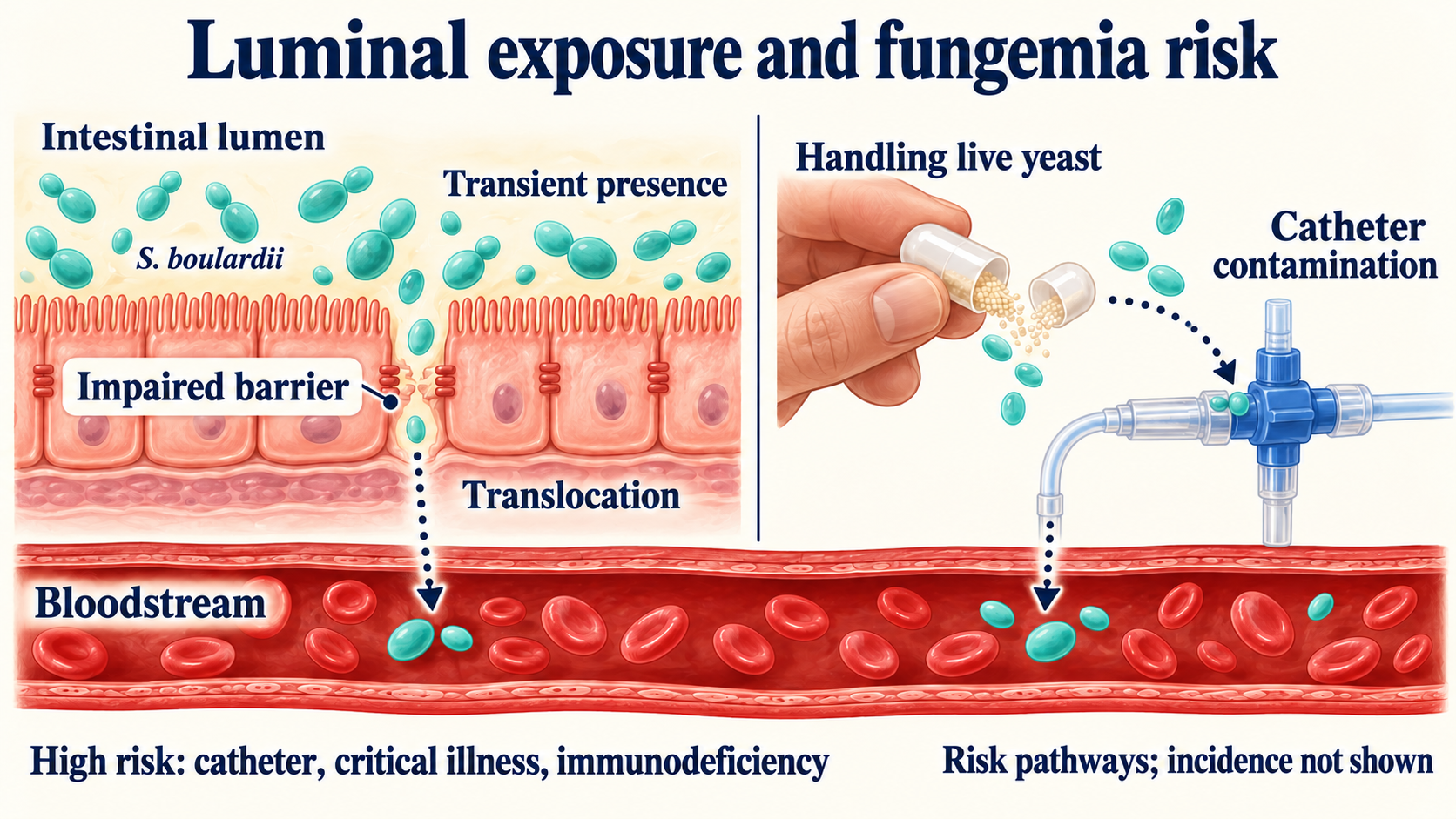
“Probiotic” does not mean incapable of invasive infection. Saccharomyces fungemia can occur through intestinal translocation or contamination associated with handling live yeast near vascular catheters. Environmental exposure can affect nearby patients, not only the person swallowing the product. A fungal bloodstream infection needs clinical management; an antifungal is not a simple home “antidote.”
Rannikko et al. (2021) identified 46 Saccharomyces fungemia cases across five Finnish hospitals; 20 had used the probiotic. The reported association versus selected bloodstream-infection controls was OR 14 (95% CI 4–44). These figures are not the probability of infection among all users: that denominator was unavailable.
The cited ANSM product information contraindicates use in patients with a central venous catheter, critical illness or immunodeficiency, and warns about handling-related contamination. Opening capsules in a patient’s room is specifically discouraged. Hospital safety rules may therefore override an apparently plausible digestive benefit. Gastrointestinal disease and impaired barriers also deserve attention rather than an assumption of harmless transit.
Formulation, quantities and quality control
Lyophilization is a manufacturing method, not a guarantee of three-year viability or superiority over every other drying process. Stability depends on formulation, packaging, humidity, temperature and shelf life. Follow the actual label. The cited French capsule product warns against mixtures hotter than , icy mixtures and alcohol; these details should not be generalized to every preparation. Its capsule age restriction below six years concerns choking, not proof that any powder is suitable for every infant (ANSM).
Milligrams measure product mass; CFU measure colonies recovered under specified culture conditions. There is no universal conversion from 250 mg to a fixed viable-cell count. DNA assays can confirm identity but do not establish viability by themselves. Flow cytometry with membrane-integrity stains, culture and genetic identification answer related but different questions. Membrane integrity is not identical to metabolic activity or the capacity to form colonies.
A useful label identifies the strain, viable amount through expiry, lot, storage requirements and excipients; quality assessment requires validated batch methods and contaminant limits. Neither a universal moisture interval nor a claim that 30–50% of all products are fake follows from the assessed evidence. A commercial brand or probiotic species is not a substitute for documented product quality.
Published doses and durations vary. Starting alongside antibacterials was studied for AAD prevention; a universal rule to take the yeast fasting one hour before meals was not established. Dose selection for children, prolonged use, concurrent illness and allergy to yeast or excipients belong to the specific product and clinical context.
Supplements and economics
Zinc treatment for relevant pediatric diarrhea settings or deficiency has its own evidence; it should not be justified by calling the 54 kDa serine protease zinc-dependent. Glutamine, inulin, FOS and oligosaccharides are separate interventions. Biochemical compatibility does not prove that a combination heals junctions faster or reduces illness duration by a fixed multiplier. Prebiotics can also change symptoms such as bloating.
Economic value depends on the absolute benefit, product cost, adverse events and the setting. A transparent simplified model is . An incremental cost-effectiveness ratio is ; if denotes QALYs, the unit is cost per QALY gained. No automatic hospital saving of a fixed dollar amount can be inferred from pooled AAD data, particularly by substituting CDI costs for ordinary diarrhea costs.
Reading this evidence responsibly
This article is a narrative assessment checked against selected primary publications and official guidance on 8 October 2026. Full text or relevant excerpts were available for some sources, abstracts for others, and only publication metadata for several historical references. Unavailable numerical claims were not treated as confirmed. No exhaustive search, independent GRADE assessment or external peer review is claimed.
The practical distinction is the indication and the patient: there is a pooled AAD prevention signal with important heterogeneity, experimental antitoxin biology, and a real invasive-infection risk in susceptible people. New diarrhea with dehydration, blood, fever, severe abdominal pain or recent hospitalization deserves prompt assessment. Suspected CDI requires appropriate diagnosis and treatment rather than a trial of yeast alone.
FAQ
Can it be taken during antibiotics?
Many antibacterials do not target yeast structures, and concurrent use was studied for AAD prevention. This is not absolute resistance to every antimicrobial; antifungals can inhibit the yeast, and contraindications still apply.
Does it treat C. difficile infection?
Experimental toxin effects and older recurrence trials do not establish a replacement for CDI treatment. The 2026 AGA update advises against probiotics for prevention of initial or recurrent CDI.
Is it the same as baker’s yeast?
It belongs to the S. cerevisiae group, but a tested probiotic strain and preparation cannot be replaced by ordinary baker’s yeast on that basis.
Are milligrams equivalent to CFU?
No. Milligrams measure product mass, while CFU reflect colony recovery under specified conditions; the conversion is preparation specific.
Who should avoid it?
The cited product excludes patients with central venous catheters, critical illness or immunodeficiency because invasive Saccharomyces infection can occur.
Can it eradicate Candida or SIBO?
Laboratory Candida findings and a small SIBO pilot in systemic sclerosis do not establish routine eradication therapy for either condition.
Sources
- Edwards-Ingram L et al. Genotypic and physiological characterization of Saccharomyces boulardii, the probiotic strain of Saccharomyces cerevisiae. Appl Environ Microbiol. 2007;73:2458–2467.
- Khatri I et al. Complete genome sequence and comparative genomics of the probiotic yeast Saccharomyces boulardii. Sci Rep. 2017;7:371.
- Just I et al. Glucosylation of Rho proteins by Clostridium difficile toxin B. Nature. 1995;375:500–503.
- Castagliuolo I et al. Saccharomyces boulardii protease inhibits Clostridium difficile toxin A effects in the rat ileum. Infect Immun. 1996;64:5225–5232.
- Castagliuolo I et al. Saccharomyces boulardii protease inhibits the effects of Clostridium difficile toxins A and B in human colonic mucosa. Infect Immun. 1999;67:302–307.
- Buts JP et al. Saccharomyces boulardii produces in rat small intestine a novel protein phosphatase that inhibits Escherichia coli endotoxin by dephosphorylation. Pediatr Res. 2006;60:24–29.
- Czerucka D et al. Saccharomyces boulardii inhibits secretagogue-mediated adenosine 3′,5′-cyclic monophosphate induction in intestinal cells. Gastroenterology. 1994;106:65–72.
- Sougioultzis S et al. Saccharomyces boulardii produces a soluble anti-inflammatory factor that inhibits NF-κB-mediated IL-8 gene expression. Biochem Biophys Res Commun. 2006;343:69–76.
- Chen X et al. Saccharomyces boulardii inhibits ERK1/2 mitogen-activated protein kinase activation both in vitro and in vivo and protects against Clostridium difficile toxin A-induced enteritis. J Biol Chem. 2006;281:24449–24454.
- Buts JP et al. Saccharomyces boulardii enhances rat intestinal enzyme expression by endoluminal release of polyamines. Pediatr Res. 1994;36:522–527.
- Buts JP et al. Stimulation of secretory IgA and secretory component of immunoglobulin in small intestine of rats treated with Saccharomyces boulardii. Dig Dis Sci. 1990;35:251–256.
- Buts JP et al. Saccharomyces boulardii enhances N-terminal peptide hydrolysis in suckling rat small intestine by endoluminal release of a zinc-binding metalloprotease. Pediatr Res. 2002;51:528–534.
- Czerucka D et al. Saccharomyces boulardii preserves the barrier function and modulates the signal transduction pathway induced in enteropathogenic Escherichia coli-infected T84 cells. Infect Immun. 2000;68:5998–6004.
- Murzyn A et al. Capric acid secreted by S. boulardii inhibits C. albicans filamentous growth, adhesion and biofilm formation. PLoS One. 2010;5:e12050.
- Szajewska H, Kołodziej M. Systematic review with meta-analysis: Saccharomyces boulardii in the prevention of antibiotic-associated diarrhoea. Aliment Pharmacol Ther. 2015;42:793–801.
- Ehrhardt S et al. Saccharomyces boulardii to prevent antibiotic-associated diarrhea: a randomized, double-masked, placebo-controlled trial. Open Forum Infect Dis. 2016;3:ofw011.
- McFarland LV et al. A randomized placebo-controlled trial of Saccharomyces boulardii in combination with standard antibiotics for Clostridium difficile disease. JAMA. 1994;271:1913–1918.
- Surawicz CM et al. The search for a better treatment for recurrent Clostridium difficile disease: use of high-dose vancomycin combined with Saccharomyces boulardii. Clin Infect Dis. 2000;31:1012–1017.
- Szajewska H et al. Probiotics for the management of pediatric gastrointestinal disorders: position paper of the ESPGHAN Special Interest Group on Gut Microbiota and Modifications. JPGN. 2023;76:232–247.
- Fischer M, Vaughn BP, Peery AF, Kelly CR. AGA Clinical Practice Update on Management of Clostridioides difficile Infection in Adults: Expert Review. Clin Gastroenterol Hepatol. 2026;24:2359–2369.
- Rannikko J et al. Fungemia and other fungal infections associated with use of Saccharomyces boulardii probiotic supplements. Emerg Infect Dis. 2021;27:2043–2051.
- ANSM. ULTRA-LEVURE200mg, gélule: résumé des caractéristiques du produit. French public medicines database; accessed8October2026.
- García-Collinot G et al. Effectiveness of Saccharomyces boulardii and metronidazole for small intestinal bacterial overgrowth in systemic sclerosis. Dig Dis Sci. 2020;65:1134–1143.
- Bourreille A et al. Saccharomyces boulardii does not prevent relapse of Crohn’s disease. Clin Gastroenterol Hepatol. 2013;11:982–987.
- Giralt J et al. Effects of probiotic Lactobacillus casei DN-114001 in prevention of radiation-induced diarrhea: results from multicenter, randomized, placebo-controlled nutritional trial. Int J Radiat Oncol Biol Phys. 2008;71:1213–1219.
- Villar-García J et al. Effect of probiotics (Saccharomyces boulardii) on microbial translocation and inflammation in HIV-treated patients: a double-blind, randomized, placebo-controlled trial. JAIDS. 2015;68:256–263.
- Chen K et al. A probiotic yeast-based immunotherapy against Clostridioides difficile infection. Sci Transl Med. 2020;12:eaax4905.
- Bléhaut H et al. Disposition kinetics of Saccharomyces boulardii in man and rat. Biopharm Drug Dispos. 1989;10:353–364.
- Na X et al. gp96 is a human colonocyte plasma membrane binding protein for Clostridium difficile toxin A. Infect Immun. 2008;76:2862–2871.
- Beşirbellioğlu BA et al. Saccharomyces boulardii and infection due to Giardia lamblia. Scand J Infect Dis. 2006;38(6–7):479–481.
- Mansour-Ghanaei F et al. Efficacy of saccharomyces boulardii with antibiotics in acute amoebiasis. World J Gastroenterol. 2003;9:1832–1833.