
SIFO: Candida, biofilms and the limits of clinical evidence
How small-intestinal fungal growth is investigated, what SAP, candidalysin and Candida biofilms can explain, and why experimental mechanisms do not establish a universal treatment protocol.
How small-intestinal fungal growth is investigated, what SAP, candidalysin and Candida biofilms can explain, and why experimental mechanisms do not establish a universal treatment protocol.
Small intestinal fungal overgrowth, or SIFO, describes suspected excessive fungal growth in the small intestine associated with gastrointestinal symptoms. Research usually investigates it through culture of a small-bowel aspirate. Candida in stool, bloating after carbohydrates or brain fog alone does not establish the diagnosis. Ordinary colonization, symptomatic growth in the lumen and invasive candidiasis are distinct clinical situations with different standards of evidence and treatment decisions.
Candida albicans has well-characterized morphological transitions, adhesins, secreted aspartyl proteases, candidalysin and biofilm programs. These mechanisms explain aspects of fungal pathogenicity. Much of the evidence, however, comes from cell cultures, artificial surfaces, catheters and animals. It does not prove that every person with suspected SIFO has tissue invasion, a mature mucosal biofilm or a response to a combination of supplements marketed as biofilm disruptors.
The intestinal mycobiome encompasses fungal organisms and their genetic material. Studies detect Candida, Saccharomyces, Malassezia and other genera, including fungi associated with food and the environment. ITS1/ITS2 sequencing describes composition, but results depend on primers, DNA extraction, reference databases and how relative abundance is calculated. DNA from food or a nonviable cell does not establish persistent mucosal colonization.
Fungal reads generally make up a small part of microbial DNA, but no single percentage applies to everyone. Sequence abundance, cell counts and biomass measure different things. A yeast cell is larger than a typical bacterium; that difference cannot be converted into a fixed fungal burden. Even in a simplified spherical model, volume depends on the cube of radius. Actual shape, genome characteristics and marker-copy numbers further affect measurements.
This illustrates geometry, not a method for diagnosing SIFO from a microbiome report. C. albicans can coexist with its host without symptoms. C. glabrata, C. tropicalis, C. parapsilosis and C. krusei differ in morphology, pathogenic traits and drug susceptibility; findings from one C. albicans laboratory strain do not automatically apply to them. Saccharomyces boulardii refers to probiotic strains of S. cerevisiae, rather than an organism that is intrinsically incapable of causing disease.
Colonization resistance combines competition for nutrients and attachment sites with bacterial metabolites, mucus, epithelial integrity, motility and immune defenses. Short-chain fatty acids, including butyrate and propionate, can restrict Candida growth or morphogenesis experimentally. Concentration, pH, strain and culture conditions matter; their effects cannot all be reduced to a universal histone-deacetylase mechanism.
In particular models, lactobacilli act through acidification, competition and secreted products. Hydrogen-peroxide production depends on environmental conditions, including oxygen, so an aerobic culture does not automatically represent the intestinal lumen. Antibiotics can alter bacterial communities and open ecological niches, but SIFO does not necessarily follow every antibiotic course.
Dendritic cells and other innate cells recognize fungal wall components. A cytokine environment involving IL-1β, IL-6, IL-23 and context-dependent TGF-β supports Th17 responses. IL-17A/IL-17F and IL-22 contribute to epithelial defenses and neutrophil recruitment, including through CXCL1, CXCL2 and CXCL8. Defensins and other antimicrobial products work alongside cellular immunity.
The molecular distinctions matter: lactoferrin binds iron, whereas calprotectin predominantly limits zinc and manganese availability. Fe³⁺ is trivalent iron. Mouse RegIIIγ and human REG3A are not interchangeable universal antifungal peptides; their best-established functions involve bacterial control. Protective mucosal Th17 activity also does not mean that increasing IL-17 is beneficial in every inflammatory disease.
Jacobs and colleagues studied 150 referred patients with unexplained gastrointestinal symptoms in 2013, using manometry and duodenal aspirate cultures. Ninety-four had bacterial and/or fungal overgrowth: 38 bacterial only, 24 fungal only and 32 mixed. This was a selected symptomatic cohort, not a population-prevalence survey.
The denominator changes the interpretation. Fungal-only growth represented 24/94, approximately 26% of those with any overgrowth, but 24/150, or 16% of the entire group. Including mixed cultures, fungi were detected in 56/150, approximately 37%. Percentages calculated with different denominators cannot be combined as if they described mutually exclusive population groups (Jacobs, 2013).
That study used bacterial growth ≥10³ CFU/mL or fungal growth as its operational definition. Attributing the same numerical fungal threshold to its methods is inaccurate. Later literature sometimes uses ≥10³ fungal CFU/mL as a working cutoff, but this is not a universally validated boundary between healthy colonization and symptomatic disease. Normal counts in different small-bowel segments remain insufficiently established.
Dysmotility and proton-pump-inhibitor use were associated with the combined bacterial and/or fungal culture outcome. An observational association does not prove that a drug caused fungal disease in an individual. PPIs can alter acid defense and microbial conditions; diabetes, antibiotics, steroids and immunodeficiency can affect risk in different clinical contexts. Bloating, dyspepsia, nausea, gas and diarrhea nonetheless poorly distinguished patients with positive and negative cultures.
With the bacterial threshold of ≥10³ CFU/mL, the significant dysmotility and PPI associations concerned combined bacterial and/or fungal overgrowth. For fungal-only SIFO, neither was statistically significant: dysmotility p=0.14 and PPI p=0.197. These findings therefore do not establish a fungal-specific association.
The migrating motor complex helps move intestinal contents between meals. Disturbance may promote retention of organisms. This does not establish that every normal phase III washes away a biofilm or that restoring motility alone guarantees Candida elimination.
Erdogan and Rao's 2015 review discussed two clinical series and suggested two to three weeks of antifungal treatment, while explicitly noting uncertainty about eradication and symptom resolution. It was a review, not a randomized comparison of nystatin and fluconazole. It does not substantiate cure rates of 78%, 74% or 82%, or a reduction in recurrence from 52% to 14% with NAC and S. boulardii (Erdogan & Rao, 2015).
C. albicans forms budding yeast, pseudohyphae and true hyphae. Pseudohyphae are elongated cells with constrictions at their junctions; true hyphae have more parallel walls and a different pattern of polarized growth. Hyphal growth contributes to attachment and injury in several models. Yeast is not synonymous with harmlessness: yeast cells contribute to dissemination, and species without typical true hyphae can still cause invasive disease.
Temperature, pH, CO₂/bicarbonate, serum components, N-acetylglucosamine and nutrient availability influence morphogenesis. They are contextual signals, not a rule that all cells remain yeast below 30 °C and become hyphae at 37 °C. Genetic background, cell density and exposure duration also matter.
Cyr1, also called Cdc35, is a fungal adenylyl cyclase integrating several inputs; it should not be drawn as a transmembrane receptor. Bicarbonate can directly influence its catalytic activity. Ras1 and pathways involving Gpr1/Gpa2 transmit particular signals. cAMP acts through protein kinase A, with regulatory Bcy1 and catalytic Tpk1/Tpk2 subunits, followed by Efg1 and other regulators.
Under relevant conditions, the MAPK network includes Cst20 → Ste11 → Hst7 → Cek1 → Cph1. It interacts with cAMP-dependent and other pathways rather than replacing them. Rim101 participates in pH responses. Reduced Nrg1/Tup1 repression, chromatin changes and Hda1, Brg1 and Ume6 help initiate or maintain the hyphal program. A single direct sequence in which Efg1 phosphorylates and destroys Nrg1 cannot explain all conditions. Tec1 and Bcr1 are particularly important for adhesion and biofilm programs (Klengel, 2005).
Als-family proteins have extracellular binding domains and become attached to the fungal wall through GPI-dependent processes. Als3 contributes to adhesion and interactions with host proteins. PDB 4LE8 describes its N-terminal fragment, not the complete long cell-wall protein, and was determined by X-ray diffraction at 1.75 Å. A binding-domain structure does not demonstrate that a compound docking to it computationally treats SIFO (RCSB PDB 4LE8).
Hyphal Hwp1 can serve as a substrate for host transglutaminase. Experiments with oral mucosal cells show that this can stabilize attachment through covalent crosslinks between glutamine and lysine residues. Enzyme activity, substrate accessibility and tissue context determine the outcome; this is not a universally unbreakable intestinal anchor.
Induced endocytosis and active penetration are different processes. Adhesin–host-receptor interactions matter in oral and endothelial models. In Allert and colleagues' 2018 intestinal epithelial model, active penetration, hyphae and candidalysin were important; a simple cadherin-mediated endocytosis diagram did not explain all translocation.
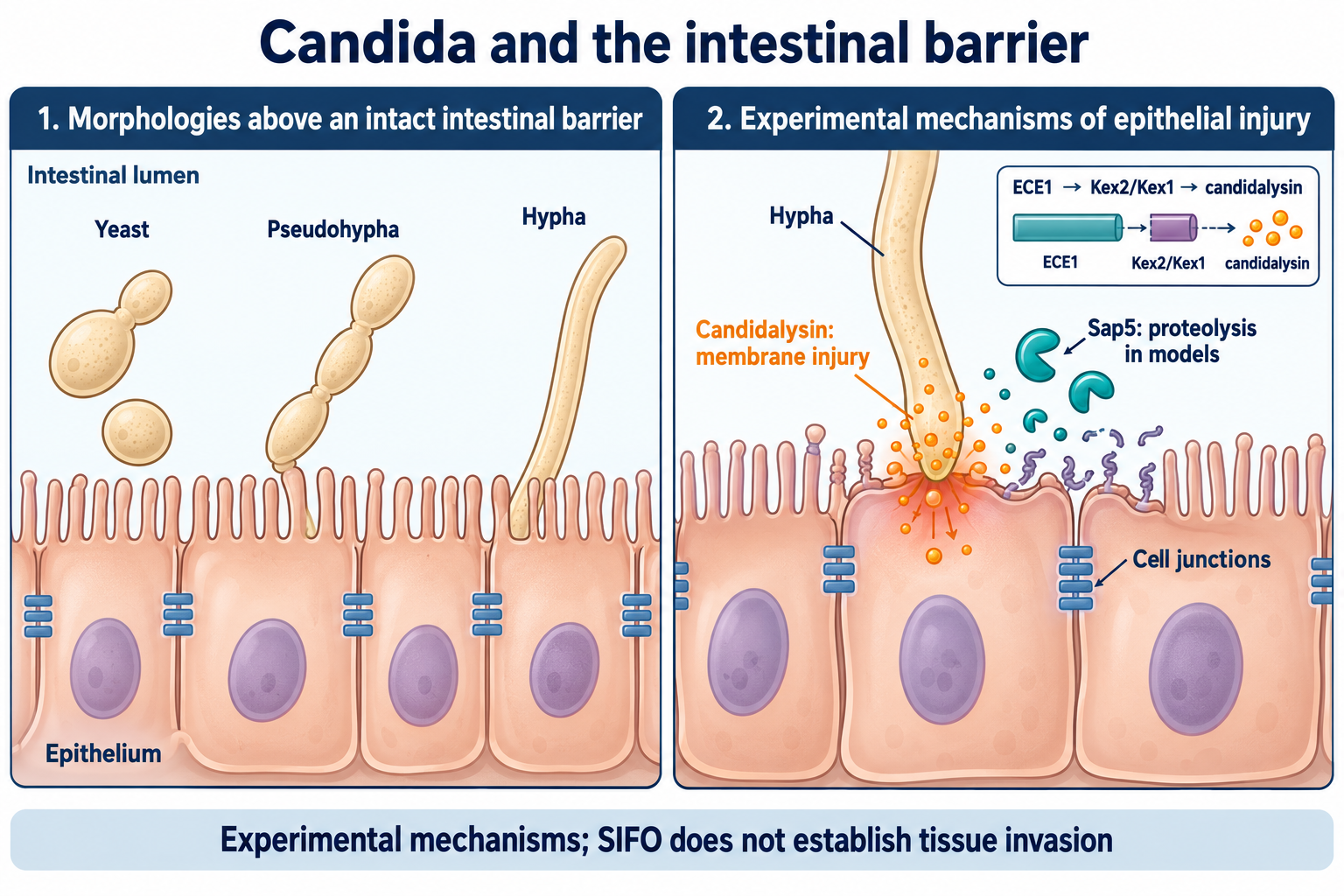
The C. albicans SAP1–SAP10 family contains enzymes with distinct expression profiles, pH dependence and functions. Sap1–Sap3 are often discussed in relation to yeast growth and Sap4–Sap6 to hyphae, but this is not an absolute division. Sap9 and Sap10 are associated with the cell surface and wall remodeling; fungi do not have the bacterial outer membrane sometimes attributed to them.
Aspartyl proteases have a two-lobed architecture with catalytic aspartate residues involved in water activation and acid–base catalysis. Peptide-bond cleavage is hydrolysis, rather than a protein being physically cut by a sharp enzyme tip.
This is a symbolic chemical reaction: product ionization depends on pH, and activity depends on access to the specific substrate. PDB 1EAG contains Sap2 complexed with A70450 at 2.10 Å, whereas 2QZX contains Sap5 with pepstatin at 2.50 Å. They cannot both be described as Sap2 structures at 1.8 Å (RCSB PDB 1EAG; RCSB PDB 2QZX).
In experimental systems, SAP can act on accessible host proteins, including certain immune and extracellular substrates. Villar and colleagues linked Sap5 and Rim101 to E-cadherin degradation in an oral mucosal model. This does not establish simultaneous direct cleavage of intestinal MUC2, every claudin, occludin and ZO-1 in patients with SIFO. ZO-1 is on the cytoplasmic side of junctions; an extracellular protease cannot reach it through an intact plasma membrane. Junctional redistribution, host-enzyme activation and cell death must be distinguished from direct proteolysis of each protein (Villar, 2007).
Phospholipase B activities associated with PLB1/PLB2 can hydrolyze phospholipid acyl bonds and contribute to virulence experimentally. Idealized complete deacylation of phosphatidylcholine yields glycerophosphocholine and fatty acids. Actual intermediates, membrane access and the contribution of individual enzymes depend on the model. This does not mean that detecting Candida in an aspirate demonstrates widespread dissolution of the epithelium.
Candidalysin is a secreted cytolytic C. albicans peptide. ECE1 encodes the Ece1 precursor, processed by Kex2/Kex1 into several peptides; mature candidalysin contains 31 amino acids. The precursor generates eight peptide fragments including candidalysin, rather than seven identical toxin repeats.
Its amphipathic properties allow interactions with lipid membranes and increased permeability. Moyes and colleagues demonstrated epithelial injury, calcium entry and immune signaling in 2016, with altered phenotypes in toxin-deficient mutants. The size, subunit number and conductance of membrane lesions should not be treated as immutable universal constants. PDB 6U33 is the bacterial Staphylococcus aureus leukocidin LukD, not candidalysin. A functional peptide schematic is therefore appropriate; a claimed fixed-octamer cryo-EM structure is not supported by that identifier (Moyes, 2016; Richardson, 2018).
Epithelial responses involve p38, ERK, c-Fos, MKP-1 and EGFR-linked pathways. Moderate exposure can induce danger signaling and membrane repair; greater exposure can produce injury with LDH release. Ca²⁺ entry, K⁺ loss and LDH release are distinct measurements and do not establish the same mode of death in every tissue. NLRP3, caspases and gasdermin-dependent pyroptosis depend on cell type and conditions; findings in immune cells cannot simply be assigned to every enterocyte.
Allert and colleagues demonstrated candidalysin's contribution to intestinal epithelial injury and translocation experimentally. This supports a biologically possible route. It does not establish its prevalence in human SIFO or turn a positive luminal culture into evidence of candidemia (Allert, 2018). The article on zonulin, claudins and intestinal permeability explains junctional organization and the distinction between cellular injury and paracellular permeability.
A biofilm is an attached community embedded in extracellular matrix. C. albicans models commonly describe attachment, proliferation, hyphal architecture, maturation and dispersion. The number of hours and thickness in micrometers depend on surfaces, medium, flow and strain. They are not a diagnostic timetable for the human small intestine.
Candida biofilms have been studied convincingly on medical devices and in certain mucosal models. A positive aspirate culture does not reveal their spatial architecture. SIFO itself does not mean that a mature multilayer fungal matrix coats the mucosa; separate spatial and morphological evidence would be required.
The matrix contains proteins, carbohydrates, lipids and extracellular DNA. In the system analyzed by Zarnowski and colleagues in 2014, approximate mass fractions were 55% protein, 25% carbohydrate, 15% lipid and 5% nucleic acid. These values describe a particular extraction and model, not every intestinal biofilm.
A mannan–glucan complex is important: branched α-mannans interact with β-1,6-glucan. β-1,3-glucan represented a small portion of total matrix carbohydrate despite its functional contribution to drug protection. The statement that 85% of the whole matrix is β-1,3-glucan is incompatible with these findings. Extracellular DNA can arise through lysis and other processes; one obligatory death program cannot explain all eDNA. Hydrophobins prominent in many filamentous fungi should not be declared the main C. albicans matrix component without direct evidence (Zarnowski, 2014).
Fks1 contributes to β-1,3-glucan synthesis. Bgl2, Phr1 and Xog1 modify or organize delivery into the matrix. Taff and colleagues used genetic interventions, fluconazole-binding measurements and a rat-catheter model, among other experiments, to investigate this pathway. These enzymes have different activities; calling all of them one class of glycosyltransferases is inaccurate (Taff, 2012).
Matrix can bind part of a drug and reduce access to its cellular target. It is not an absolutely impermeable wall; diffusion and sequestration depend on the molecule. Cdr1/Cdr2 efflux pumps use ATP, whereas Mdr1 belongs to the major facilitator superfamily and depends on the proton gradient. Sterol changes, Hsp90/calcineurin stress responses, cell states and community-development stage contribute further.
Planktonic MIC and measurements of reduced biofilm metabolic activity are different endpoints. A higher concentration in a laboratory biofilm assay cannot be translated into multiplying a patient's dose by 500–1000. Nor do all antifungals work only against dividing cells: polyenes affect membrane sterols, echinocandins glucan synthesis in the wall, and azoles sterol metabolism.
Persisters are a proposed phenotypic surviving subpopulation without necessarily heritable resistance. Their frequency and reproducibility in Candida remain disputed. Denega and colleagues' 2019 work, using an improved protocol and many isolates, did not support persisters as a consistent C. albicans biofilm trait. A fixed claim that 1–2% of dormant cells explains every SIFO recurrence is therefore unjustified (Denega, 2019).
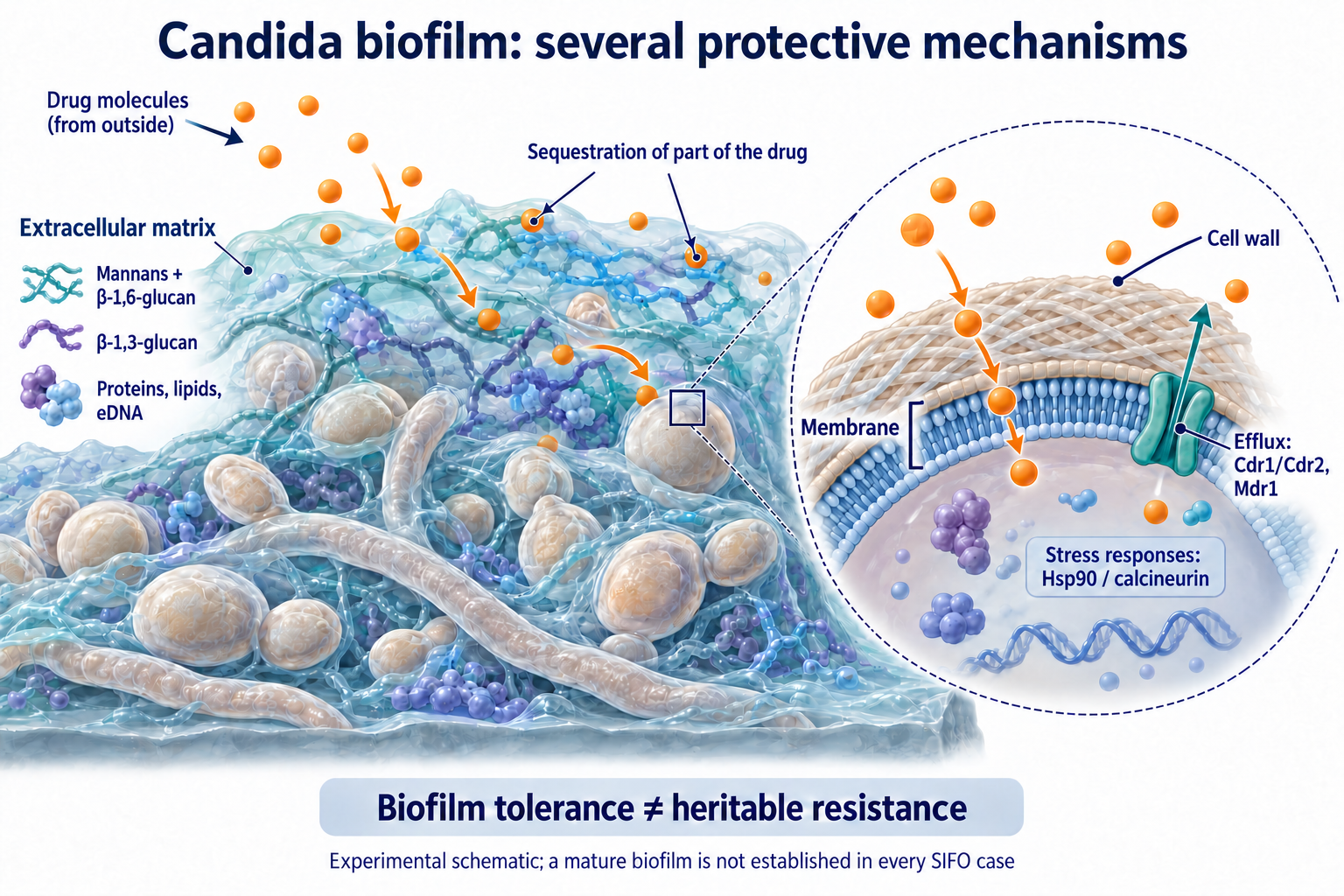
Candida interacts with bacteria, including streptococci and staphylococci, on different surfaces. Hyphae can provide a scaffold for certain partners, and oxygen consumption can change local conditions. Interactions can also be antagonistic. S. aureus and E. coli are not strictly anaerobic organisms, and oral or catheter models do not establish the usual composition of small-intestinal biofilms.
Farnesol is a sesquiterpene signal related to farnesyl-pyrophosphate metabolism. It can restrict early hyphal transitions under certain conditions, including through effects on Cyr1. Tyrosol can accelerate particular growth or morphological stages. Timing, concentration and medium determine these effects. Farnesol is not a universal clinical dispersal drug, and the two molecules do not form a simple on/off switch with a single threshold for patients.
Yeasts can ferment carbohydrates. Pyruvate decarboxylase generates acetaldehyde and CO₂; alcohol dehydrogenase can reduce acetaldehyde to ethanol while regenerating NAD⁺. The overall fermentation reaction does not mean that all glucose ingested by a person follows this pathway.
Energy yield and carbon distribution depend on metabolic conditions. Rare auto-brewery syndrome requires objective evidence of endogenous ethanol production, control of possible alcohol intake and clinical evaluation. Published cases used controlled carbohydrate challenges and serial ethanol measurements. Ordinary fatigue or a subjective drunken feeling after food without measured ethanol does not establish the syndrome (Malik, 2019).
Acetaldehyde can form protein and DNA adducts and affect redox balance at sufficient exposure. A statement that it is universally 30 times more toxic than ethanol is meaningless without a defined assay and dose. Mitochondrial ALDH2 uses NAD⁺ to oxidize acetaldehyde to acetate; obligatory glutathione conjugation is not part of this reaction.
The equation uses ionized acetate. ALDH2 is not a molybdenum-containing aldehyde oxidase. The existence of molybdenum-dependent enzymes does not establish benefits of molybdenum supplements for Candida detoxification. Likewise, the chemical possibility of forming salsolinol from dopamine and acetaldehyde does not show that SIFO causes Parkinson's disease or destroys dopamine receptors.
D-arabinitol is a five-carbon polyol produced by some Candida species. Concentrations depend on species, metabolism and renal excretion. D-/L-arabinitol ratios and creatinine-normalized measurements were studied chiefly in disseminated candidiasis among high-risk patients. These are different measurements and do not inherit the same diagnostic performance in isolated luminal overgrowth (D/L-arabinitol study, 1996).
D-arabinitol in a commercial organic-acid panel does not localize fungi or establish SIFO. Tartaric acid, C₄H₆O₆, also comes from food, including grapes and wine. It must not be confused with malic acid, C₄H₆O₅, or regarded as a Candida-specific marker. Proposed interactions with tricarboxylic-acid-cycle enzymes do not provide a validated test of the cause of brain fog.
Fatigue, concentration difficulties and mood changes have many possible explanations, including sleep disturbance, anemia, medication and metabolic disease. Establishing a fungal cause requires further evidence. A metabolite hypothesis cannot replace measurements of exposure and causal assessment.
Dectin-1, encoded by CLEC7A, recognizes accessible β-glucans and signals through hemITAM/Syk. Human Dectin-2, associated with CLEC6A, recognizes particular mannan structures and uses the FcRγ ITAM adaptor. CARD9–BCL10–MALT1 and NF-κB are important downstream components. Ligand accessibility changes with mannan masking, morphology and fungal metabolism.
Mincle/CLEC4E should not simply be labeled the Candida α-mannan receptor. Primary models demonstrate Malassezia recognition, while Candida findings depend on strain and experimental system. Shared signaling adaptors do not make receptors interchangeable.
Iliev and colleagues connected intestinal fungi and Dectin-1 to experimental colitis severity in mice and investigated a human genetic association. This supports a role for the mycobiome in immune ecology. It does not establish that SIFO causes rheumatoid arthritis or autoimmunity generally, or that treating any fungal culture improves inflammatory bowel disease (Iliev, 2012).
Small-bowel aspiration samples a particular segment for quantitative bacterial and fungal culture. Sampling technique, minimization of oral or endoscope-channel contamination, volume, transport, media and incubation conditions matter. Duodenal and jejunal samples are not equivalent. A negative sample does not exclude every spatially heterogeneous process, but that uncertainty does not justify ignoring the quality of a positive result.
CFU means colony-forming units, not an exact cell count: an aggregate or hyphal fragment can generate one colony. For a diluted sample, the calculation principle is:
Here d is the fraction of original sample remaining after dilution: for 1:100 it is 0.01. Interpretation requires the laboratory method and an assessment of the working threshold. CHROMagar can provide presumptive differentiation of certain species, but identification may need confirmation such as MALDI-TOF. Hyphae in aspirate describe fungal morphology, not tissue invasion; invasion needs separate clinical and, when indicated, histological evidence.
| Condition or method | What it can indicate | Main limitation |
|---|---|---|
| SIFO: aspirate fungal culture | Viable fungi in the sampled segment, species and approximate quantity | Contamination, method differences and limited validation of symptom-associated thresholds |
| SIBO: aspirate or breath test | Bacterial growth or a relevant H₂ profile | Performance depends on method, transit and preparation |
| IMO: breath methane | Methanogenic archaeal activity | Does not localize exclusively to the small bowel or measure Candida |
| Stool Candida or ITS sequencing | An organism or its DNA in intestinal material | Does not establish SIFO, invasion or symptom causation |
| Invasive candidiasis | Tissue or bloodstream infection in the appropriate clinical setting | Needs separate assessment; luminal culture does not replace it |
| β-D-glucan, mannan or antibodies | Adjunctive evidence in particular fungal infections | Not validated standalone SIFO tests |
Standard H₂/CH₄ tests measure bacterial and archaeal metabolic products after a substrate, not fungal burden. The North American Consensus uses an H₂ rise of ≥20 ppm above baseline by 90 minutes and CH₄ ≥10 ppm at any point in the relevant interpretations. These are not SIFO criteria. Calling a negative result a false-negative fungal test misrepresents the test's purpose. Coexisting bacterial overgrowth or methanogenic activity can also yield a positive breath test in someone with fungal growth (Rezaie, 2017).
The classic Fungitell serum β-D-glucan assay supports assessment of invasive fungal infection. Its relevant instructions classify <60 pg/mL as negative, 60–79 as indeterminate and ≥80 as positive. Fungitell STAT uses an index system; thresholds from different assays cannot be mixed. The marker is not Candida-specific and does not locate a source in the intestine. Preanalytical contamination and particular medical exposures can cause false positives. A negative result has not been validated to exclude isolated luminal growth (Fungitell, PN001268 Rev13).
Mannan antigens and antibodies are assessed in specific infectious contexts. Candida IgG or IgA does not independently establish lost intestinal tolerance or a need for treatment. Immune status, assay characteristics and pretest probability affect interpretation.
Suspected SIFO requires attention to diagnostic reliability, fungal species and susceptibility, associated conditions and other explanations for symptoms. Stool or urine organic-acid findings alone are insufficient grounds for antifungal decisions. Signs of invasive infection pose a different clinical problem: candidiasis guidelines use systemic agents and condition-specific pathways rather than colonization-treatment schemes (IDSA, 2016).
Nystatin binds fungal membrane sterols and changes permeability. Gastrointestinal absorption is insignificant, but not absolutely zero under all conditions: its label describes possible significant plasma concentrations in renal insufficiency. It is not intended for systemic mycoses. A label indication for nonesophageal gastrointestinal mucosal candidiasis does not establish efficacy for every empirically labeled SIFO case (nystatin prescribing information, DailyMed).
Fluconazole inhibits fungal sterol 14α-demethylase CYP51/Erg11 and disrupts ergosterol synthesis. Approximately 80% of a dose is excreted unchanged in urine: elimination is predominantly renal, rather than hepatic CYP3A4 metabolism. The drug itself inhibits human CYP2C19, CYP2C9 and CYP3A4, creating interaction risks. Renal function, QT risk, hepatic reactions, pregnancy and other circumstances require consideration. C. krusei has characteristic fluconazole resistance; C. glabrata susceptibility is often reduced or variable (fluconazole prescribing information, DailyMed).
Itraconazole differs in absorption, formulations and interactions; acidity is particularly relevant to some formulations. Substituting one azole for another is not a universally established second SIFO step. Echinocandins and systemic polyenes have different indications, pharmacokinetics and evidence. Candidemia-duration rules cannot be applied to every positive intestinal aspirate.
The following approaches represent different ideas and uncertainties, not a prescribed six-step sequence. Reduced bloating, a lower culture metabolic signal and a negative repeat aspirate are different outcomes. A useful regimen needs human evidence on symptoms, microbiological endpoints, recurrence and adverse events.
| Approach | Biological rationale | What remains unestablished for SIFO |
|---|---|---|
| Diagnostic and risk-factor assessment | Aspirate, motility, medication and metabolic evaluation | A universal diagnosis from symptoms or stool |
| Antifungal therapy | Known fungal targets and species susceptibility | A single optimal regimen and guaranteed luminal eradication |
| NAC and enzyme products | Particular laboratory effects; NAC is a thiol and glutathione precursor | Clinical sequence, dose and recurrence prevention |
| Fatty acids and botanical compounds | Growth, adhesion or membrane effects at specified concentrations | Safe attainment of these conditions in the intestine and clinical benefit |
| S. boulardii | Strain-specific effects and secreted metabolites in models | Proven SIFO treatment or unconditional safety |
| Nutrition and follow-up | Adequate nutrition, diabetes control and individual food tolerance | Candida starvation as a demonstrated eradication strategy |
N-acetylcysteine has a thiol group, affects disulfide bonds and is used as a mucolytic and glutathione precursor. It is not a β-glucanase; direct cleavage of β-glucan chains does not follow from its chemistry. Primary Candida biofilm experiments found concentration-dependent effects, including results at some low concentrations that differed from straightforward suppression. Laboratory exposure does not define an effective oral dose (N-acetylcysteine experiment, 2020).
Serrapeptase is a bacterial protease historically associated with Serratia from a silkworm environment, rather than a therapeutic enzyme made by the silkworm itself. Nattokinase is a protease associated with Bacillus in natto production. Proteolytic or fibrinolytic activity does not imply fungal β-glucan hydrolysis. SPU and FU describe different activity assays, not interchangeable antibiofilm doses. Clinical efficacy of this combination in SIFO is unestablished; interactions and bleeding risk also require context-specific assessment.
Caprylic acid C8:0, capric acid C10:0 and undecylenic acid C11:1 are different molecules. Murzyn's 2010 study identified capric C10:0 as the principal hyphal-growth inhibitor in S. boulardii filtrate. This was not a human trial of caprylic-acid capsules. McLain's 2000 work studied undecylenic-acid morphogenesis inhibition in a denture-material-related system; topical or laboratory use does not validate an oral SIFO regimen (Murzyn, 2010; McLain, 2000).
Allicin reacts with thiols but is unstable; garlic-extract mass does not equal active-allicin mass. Berberine and carvacrol have varied experimental effects, yet concentrations in a dish do not establish clinical exposure or intestinal selectivity. Data on metabolic effects of berberine and dihydroberberine likewise do not demonstrate SIFO treatment. Botanical products cannot be assumed incapable of resistance, adverse effects or interactions.
S. boulardii and its filtrate can alter C. albicans filamentation, adhesion and biofilm development experimentally. This is not equivalent to removing a mature human small-intestinal biofilm. Antifungals can affect probiotic yeast too; compatibility with some antibiotics does not mean resistance to every drug. Saccharomyces fungemia associated with probiotic use has been reported, especially in hospital settings and vulnerable patients. Retrospective data do not estimate risk for every healthy user, but they rule out unconditional safety claims (Rannikko, 2021).
Eliminating all fruit, carbohydrates, fermented foods or dietary yeast has not been shown to eradicate SIFO. Baker's yeast in food does not automatically become Candida. Individual food tolerance, adequate nutrition and diabetes-related hyperglycemia are reasonable clinical considerations; excessive restriction can introduce new problems. Diet for objectively confirmed auto-brewery syndrome is a separate clinical issue, not a universal anti-Candida diet.
Prepared on 8 October 2026. This article is a scientific explanation with targeted checks of primary records, accessible abstracts and selected full texts. It is not a systematic review, GRADE process or external peer review. Sections identify where full-text access was limited or an effect belongs to an experimental model.
Four questions must remain distinct: are viable fungi present in the sampled segment; do they explain symptoms; is there tissue injury or invasion; and does a particular intervention improve a clinical outcome? Answering one does not answer the others. This distinction preserves the detailed biology of SAP, candidalysin and matrix without turning experimental science into an unsupported treatment protocol.
No. Stool analysis does not establish fungal growth in a sampled small-bowel segment or explain symptoms.
No. It measures bacterial and methanogenic activity rather than fungal burden.
No. Luminal growth, colonization and tissue or bloodstream infection have different criteria.
No. Laboratory findings for NAC, enzymes, fatty acids and probiotic yeast do not establish a universal clinical sequence for SIFO.