Can diet lower Lp(a)?
The value usually changes little, but diet, exercise, and smoking cessation matter for overall cardiovascular risk.

Apo(a) architecture, KIV-2 variation, mg/dL versus nmol/L, and the OxPL–autotaxin valve pathway. Genetic evidence, emerging drugs, and limitations of the 2026 HORIZON announcement.
Lipoprotein(a), Lp(a), combines an LDL-like lipid particle with apolipoprotein(a), apo(a). Its concentration is predominantly inherited, and epidemiology and human genetics support its relationship with coronary disease and calcific aortic stenosis. Structural resemblance to plasminogen, a cellular calcification pathway, and a drug's ability to lower a laboratory value nevertheless represent different levels of evidence. They neither make an event inevitable nor guarantee that every intervention improves outcomes.
Kåre Berg described the Lp system in 1963 as an inherited serum antigen characteristic. In 1987, McLean and colleagues cloned apo(a) and demonstrated its homology to plasminogen, connecting lipid biology with fibrinolysis. Modern quantitative testing should not be reduced to the historical presence or absence of an antigen.
LPA arose through duplication and remodeling of ancestral PLG. The human chromosome 6 locus is commonly described as 6q25.3–q26. Its kringle repertoire changed: apo(a) includes KIV types, KV, and a protease-like domain, rather than all the domains of plasminogen. Functional human LPA is not a whole pseudogene: it encodes a secreted protein with an inactive protease-like domain. Apo(a) retains its own signal peptide. Hedgehog apo(a) illustrates independent evolution; it does not prove an identical function or a precise adaptive date in primates (McLean, 1987; Utermann, 1989).
Proposed advantages include limiting bleeding, wound repair, binding damaged molecules, and participation in immune responses. These remain hypotheses about physiological function. Experimental antifibrinolysis does not demonstrate reduced maternal mortality in evolutionary history. Antiangiogenic effects of apo(a) fragments also cannot automatically be assigned to the intact circulating particle.
Rath and Pauling's 1990 hypothesis connected Lp(a) with loss of endogenous ascorbate synthesis through GULO and proposed compensation for collagen damage. Vitamin C is required for collagen hydroxylation, but this does not establish Lp(a) as a vitamin substitute or show that supplementation eliminates inherited risk. An evolutionary hypothesis and early immunological observations are not a clinical trial of atherosclerosis regression (Rath and Pauling, 1990).
The LDL-like component contains a cholesteryl-ester and triglyceride core, a surface monolayer of phospholipids and free cholesterol, and one apoB-100 molecule. Mature apoB-100 has 4536 amino acids; its numbering differs from the precursor's. Apo(a) is extensively N- and O-glycosylated, including sialylated linkers. Adding it changes particle mass and behavior. Approximately 280–800 kDa describes apo(a) isoforms, not the complete Lp(a) particle; fixed lipid percentages for the whole particle are misleading when apo(a) size varies.
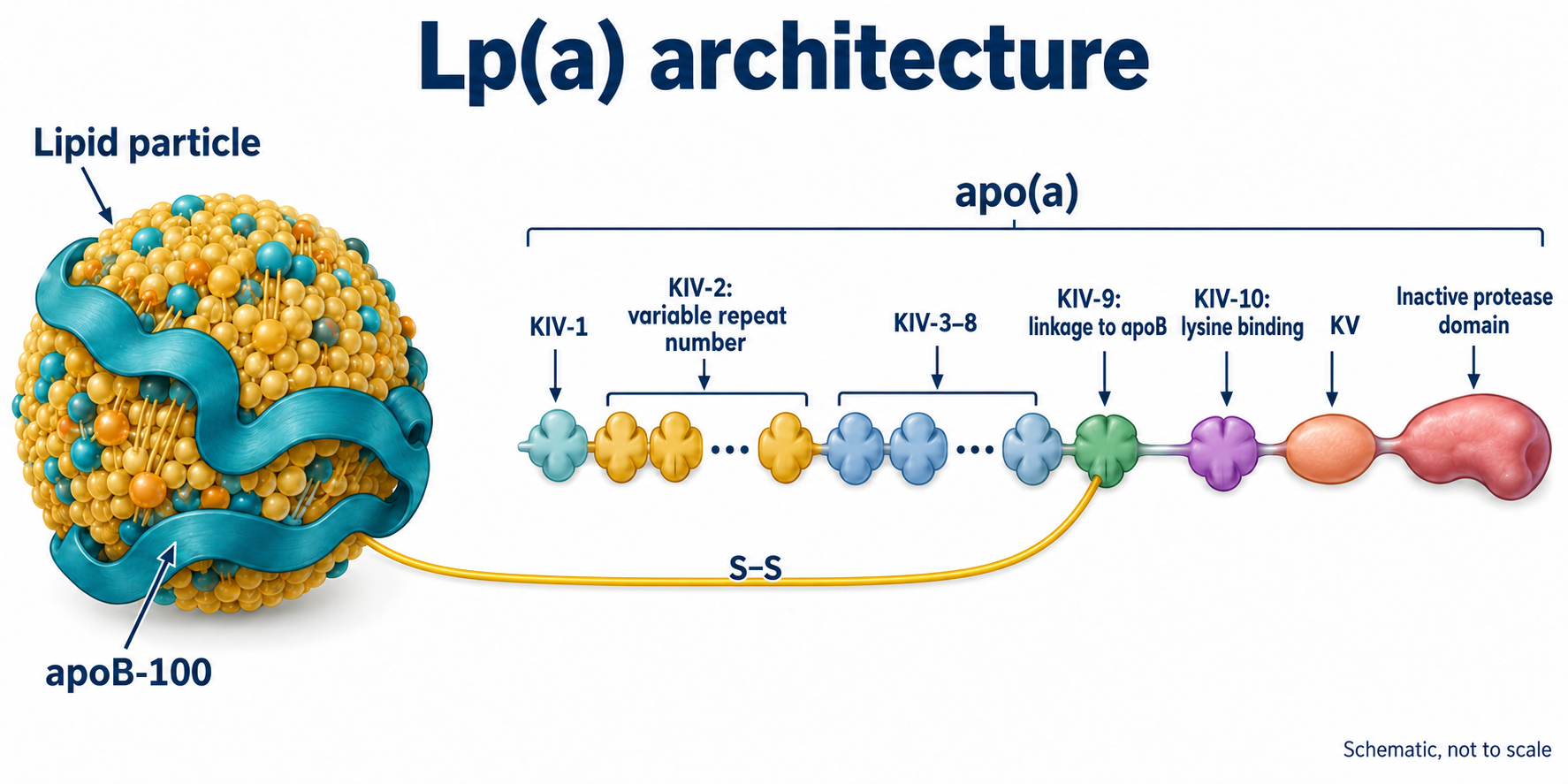
A kringle is a compact protein domain stabilized by three disulfides, traditionally pairing cysteines 1–6, 2–4, and 3–5. These intradomain bridges differ from the single interprotein apo(a)–apoB linkage.
| Apo(a) segment | Organization and role |
|---|---|
| KIV-1 | One copy; part of the N-terminal architecture |
| KIV-2 | A variable tandem repeat array determining isoform size |
| KIV-3–8 | One copy of each type; weaker lysine-binding sites in some types, particularly KIV-7/8, contribute to assembly |
| KIV-9 | An additional unpaired cysteine forms the apoB-100 linkage |
| KIV-10 | A strong lysine-binding site involved in lysine-containing ligand interactions |
| KV | One copy homologous to plasminogen kringle V |
| Protease-like domain | A retained scaffold without established plasmin-like catalytic activity |
The bridge involves Cys4326 of mature apoB-100 and the additional KIV-9 cysteine. Apo(a) Cys4057 refers to a particular historical isoform, not universal numbering across different KIV-2 lengths. Mutagenesis supports these residues' role in covalent assembly; it does not establish that every person with an altered site must secrete only free “monomers.” (Brunner et al., 1993; Callow and Rubin, 1995).
Reversible noncovalent recognition precedes covalent stabilization. A simplified kinetic model is:
The constants k₁ and k₋₁ describe association and dissociation of the intermediate, while k₂ describes formation of the linked product; no numerical constants are assigned. Lysine analogues modify experimental binding, but this alone does not make them Lp(a) treatments. The liver synthesizes apo(a); the relative contributions of intracellular, cell-surface, and extracellular assembly in humans remain debated. The precise assembly location and obligatory involvement of a particular PDI should not be presented as settled.
KIV-10's strong site contains aromatic and charged regions forming a lysine-recognition pocket. Crystallography and purified-domain binding inform the interaction without establishing a universal tissue dissociation constant. A crucial correction concerns the inactive domain: apo(a)'s catalytic serine has not simply been replaced by Arg/Thr. The catalytic triad is retained, while the activation site and protease-like architecture differ. Recombinant experiments restoring the cleavage site do not turn native apo(a) into plasmin (Hervio et al., 1999).
Each KIV-2 genomic repeat spans approximately 5.5 kb and contains two exons. High sequence homology and unequal recombination contribute to copy-number variation. Alleles range from a few to more than 40 repeats, depending on population and method. KIV-2 count differs from total kringle count: 35 KIV-2 copies plus nine other KIV types and one KV give 45 kringles and 135 intrakringle disulfides. This calculation does not count every disulfide in the whole protein.
Both parental alleles may produce different isoforms, but expression is unequal and low-secretion or nonexpressing variants occur. Two immunoblot bands are not obligatory in every heterozygote. Smaller isoforms generally accompany higher Lp(a), but the relationship is statistical rather than deterministic. SNPs, variants inside repeats, and expression differences explain substantial remaining variation. rs10455872 and rs3798220 associate with higher Lp(a) and coronary risk; their linkage and informativeness vary across populations.
Endoplasmic-reticulum folding, disulfide formation, glycosylation, chaperones, and quality control affect secretion. Larger isoforms may be retained longer and undergo more intracellular degradation. This does not establish a universal 40–60-minute residence time, 80–90% degradation fraction, or exact inverse proportionality between repeat count and concentration. Heritability estimates commonly range from approximately 70% to 90% or higher; percentages assigned to individual genetic components cannot simply be added.
Lp(a) distributions are often higher in populations of African ancestry than European ancestry, but explaining this exclusively by fewer KIV-2 repeats is incorrect. Ancestry does not replace an individual's measurement. Adult concentrations are relatively stable rather than immutable: renal disease, inflammation, hormonal changes, and some drugs can alter them. Diet and exercise usually do little to lower Lp(a) itself while remaining valuable for overall cardiovascular risk.
mg/dL expresses mass; nmol/L expresses particle amount concentration. With variable apo(a) mass, a fixed conversion factor is unreliable. For a homogeneous substance the physical relationship is:
M denotes the molar mass of the complete measured entity. Lp(a) is heterogeneous and this mass is not known beforehand; substituting apo(a)'s mass for the whole particle's is wrong. The equation explains the analytical problem rather than supplying a clinical conversion.
Antibodies recognizing repeated KIV-2 epitopes can produce an isoform- and calibrator-dependent signal. Larger isoforms may be overestimated and smaller ones underestimated relative to calibration. However, polyclonal assays are not all equivalent, and a method's name alone does not establish its error. Isoform-insensitive methods traceable to WHO/IFCC SRM-2B and reporting nmol/L are preferred. Well-validated mg/dL results retain clinical utility and should not all be dismissed (Marcovina and Albers, 2016).
| Practical category | nmol/L | Separate mg/dL threshold |
|---|---|---|
| Lower Lp(a) contribution | <75 | <30 |
| Intermediate zone | 75–125 | 30–50 |
| Elevated concentration | ≥125 | ≥50 |
These are parallel practical EAS thresholds, not a conversion table or proof of zero risk below a boundary. Risk is continuous; absolute risk also depends on age, LDL, blood pressure, smoking, and history. The historical comparison with lifetime risk in heterozygous familial hypercholesterolemia concerns extremely high concentrations around >180 mg/dL, not >180 nmol/L or >50 mg/dL (Kronenberg et al., 2022).
Arterial-wall entry, retention of particle components in extracellular matrix, and macrophage uptake of modified lipoproteins connect Lp(a) with foam cells and atherosclerosis. ApoB and apo(a) provide different binding opportunities. Universal claims of many-fold faster transcytosis or fixed arterial retention times require direct measurements and are not assumed here.
Apo(a) competes with plasminogen for lysine-containing surfaces experimentally. Investigators have examined tPA-dependent activation, PAI-1, TFPI, and platelet responses. These findings do not establish an identical effect in every thrombus. Clinical and genetic evidence is stronger for atherosclerotic events and aortic stenosis than for an independent universal role in venous thrombosis; elevated Lp(a) alone is not an anticoagulant indication.
Lp(a) importantly carries oxidized phospholipids, including oxidized phosphatidylcholine products such as POVPC, PGPC, and PEIPC. Oxidized fragments may project from the lipid phase and become accessible to antibodies and receptors. “85% of all plasma OxPL” cannot be generalized: results depend on molecular class and assay. OxPL-apoB and OxPL-apo(a) quantify immunoreactive epitopes associated with those carriers rather than every oxidation product. E06 recognizes particular oxidized phosphocholine epitopes; IK17 is not simply its human equivalent.
OxPL can be lipid-associated or covalently linked to protein, and its domain distribution cannot be reduced to an invariant map. Cell models connect CD36/TLR receptors, NF-κB, and inflammatory responses with pathology. NLRP3 is an intracellular complex, not a “mitochondrial inflammasome.” OxPL trafficking differs from membrane phospholipid protection discussed in GPX4 and lipid peroxidation: a shared oxidation theme does not make immunoreactive epitopes and ferroptosis interchangeable (Tsimikas et al., 2005).
A valve leaflet contains collagen-rich fibrosa, proteoglycan-rich spongiosa, and elastic ventricularis. Mechanical loading, endothelial dysfunction, lipid infiltration, and inflammation interact; calcification is more than passive wear. Nevertheless, Lp(a) is one contributor, not the sole cause of every case of stenosis.
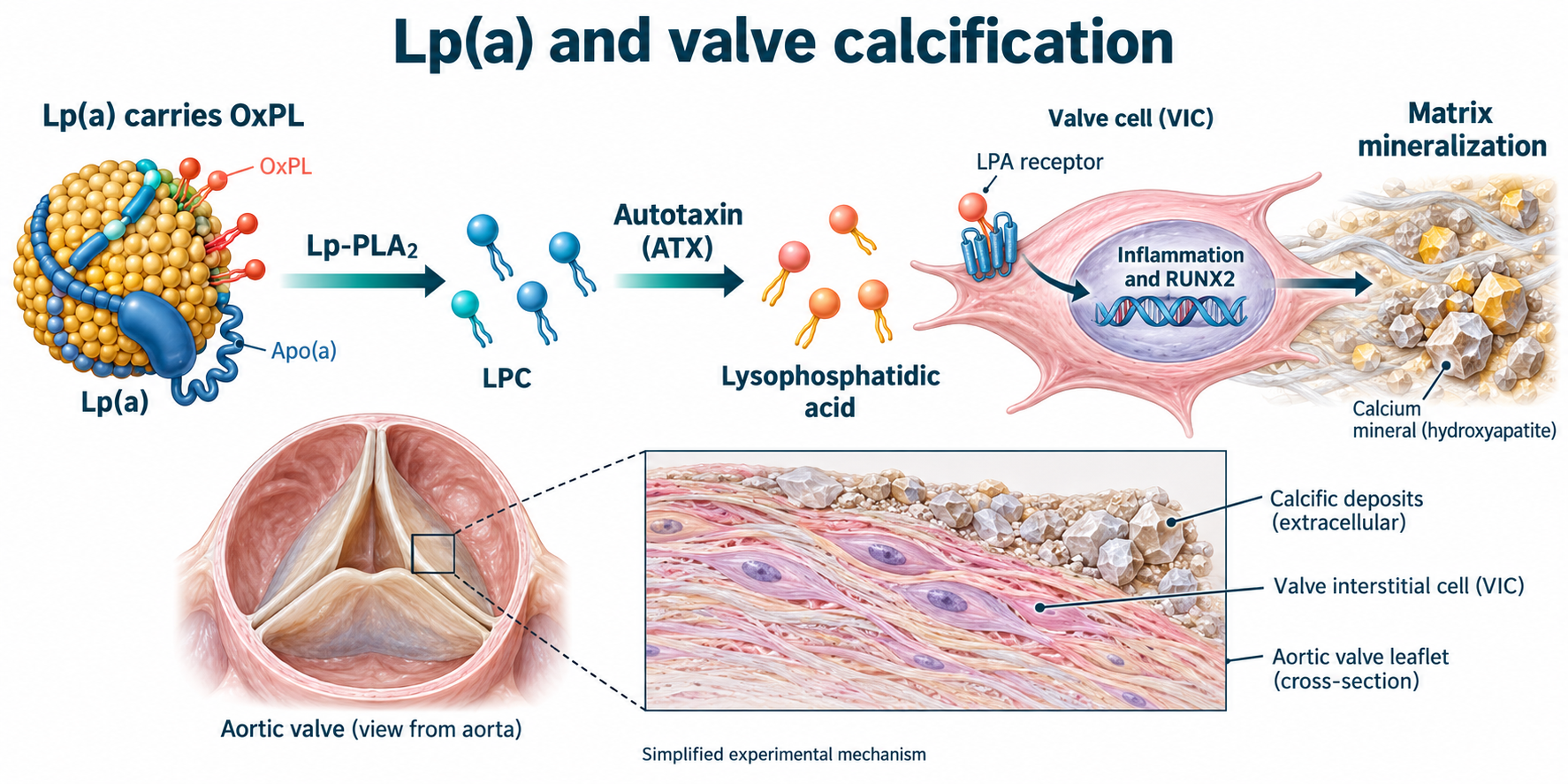
Bouchareb and colleagues (2015) studied valve tissue and cellular models, linking autotaxin carried by lipoproteins and produced by valve cells to inflammation and mineralization. Lp-PLA₂ can hydrolyze oxidized phospholipids to lysophosphatidylcholine, LPC. Autotaxin, ENPP2, has lysophospholipase D activity:
LysoPA denotes lysophosphatidic acid to distinguish it from the LPA gene. Through LPA receptors, including LPAR1, it affects RhoA and NF-κB signaling. Receptor composition and pathway contributions depend on the model. Valvular interstitial cells, VICs, can move from quiescent to myofibroblastic and osteogenic states. BMP2–Smad, RUNX2, MSX2, and Wnt/β-catenin contribute to osteogenic programming; NOTCH1 helps restrain it. These pathways should not be combined into one fully proven linear chain invariably initiated directly by Lp(a).
Tissue-nonspecific alkaline phosphatase, TNAP/ALPL, lowers the pyrophosphate barrier to mineralization:
PPᵢ represents inorganic pyrophosphate and Pᵢ orthophosphate; these symbols simplify pH-dependent ionic forms. Matrix vesicles and local calcium/phosphate availability promote nucleation. Idealized hydroxyapatite stoichiometry is:
Atom counts and net charge balance; this is not a complete kinetic account of tissue deposition. Osteocalcin, osteopontin, and other matrix proteins modulate mineralization rather than necessarily all accelerating it. Symptoms and echocardiography determine clinical severity. Vmax ≥4 m/s or mean gradient ≥40 mmHg characterize severe high-gradient stenosis; low-flow and low-gradient states require additional interpretation.
Copenhagen cohorts linked high concentrations with myocardial infarction and aortic stenosis. Different publications, thresholds, and reference groups cannot be merged into one universal hazard ratio. PROCARDIS, reported by Clarke and colleagues in 2009, examined 3145 cases and 3352 controls, followed by replication samples. Coronary-disease odds ratios were 1.70 for rs10455872 and 1.92 for rs3798220. These are genetic-analysis odds ratios, not an individual's probability of infarction.
Thanassoulis and colleagues (2013) associated rs10455872 with aortic-valve calcification in 6942 participants and examined clinical associations. “The only significant locus in this analysis” does not mean the only gene in valve disease. Capoulade and colleagues (2015) associated Lp(a)/OxPL with faster progression of existing stenosis in ASTRONOMER; this was an observational analysis within a trial, not randomization of Lp(a) reduction.
Mendelian randomization reduces some confounding and reverse causation but depends on instruments, pleiotropy, and assumptions. A lifelong genetic difference is not equivalent to a short pharmacological reduction. Burgess and colleagues' 2018 estimates of a large required absolute reduction are model extrapolations, not a universal therapeutic target or a justification for converting mg/dL to nmol/L.
Statins remain central to LDL-based prevention. They generally do not lower Lp(a), and some analyses found modest increases. Tsimikas and colleagues (2020) analyzed individual data from 5256 patients across six trials, not 29,000. Cellular LPA-expression changes do not establish one mechanism in all people. An increase does not justify discontinuing a statin: its atherosclerotic-risk benefit remains. The distinction between HMG-CoA-reductase inhibition and selective Lp(a) targeting is further illustrated in monacolin K and red yeast rice; a statin-like target does not establish a supplement as Lp(a) therapy.
SALTIRE and ASTRONOMER did not demonstrate slower progression of established aortic stenosis with intensive lipid lowering. Their negative results cannot be attributed exclusively to increased Lp(a): disease stage, mineralization, and other mechanisms matter.
| Approach | Findings | Main limitation |
|---|---|---|
| PCSK9 antibodies | Usually modest Lp(a) reduction, around 20–30%; LDL and event reduction in relevant populations | FOURIER/ODYSSEY post hoc analyses do not fully isolate Lp(a)'s contribution; clearance pathways remain debated |
| Pelacarsen, ASO | GalNAc hepatocyte delivery and RNase H1-mediated RNA degradation; phase II, 286 participants, up to 80% at 20 mg weekly | This is NEJM 2020, not the cited Lancet trial or an 80-mg monthly effect |
| Olpasiran, siRNA | GalNAc and cytoplasmic RISC/AGO2; OCEAN(a)-DOSE, 281 participants, profound reductions | Placebo-adjusted estimates around 100% do not imply physically negative concentrations |
| Lepodisiran, siRNA | ALPACA 2025, 320 participants; pooled 400-mg groups showed 93.9% placebo-adjusted time-averaged reduction on days 60–180 | Durable biochemistry does not establish a beneficial universal annual regimen |
| Zerlasiran, siRNA | Phase II demonstrated substantial durable reductions | Distinct from angiotensinogen-targeting zilebesiran; outcomes and long-term safety need evaluation |
| Muvalaplin | Oral inhibition of apo(a)–apoB assembly; KRAKEN, 233 participants, 12 weeks | Assay-dependent effect: at 240 mg, 85.8% by intact-particle assay versus 68.9% by apo(a) assay, both placebo-adjusted |
| Lipoprotein apheresis | Large acute reductions followed by rebound; used in selected cases | Registry event reductions are not randomized-trial effects; eligibility varies by jurisdiction |
| Niacin | Can lower Lp(a) | AIM-HIGH/HPS2-THRIVE did not establish added clinical benefit on contemporary therapy; adverse effects limit use |
Doses describe studies, not prescriptions. ASO and siRNA suppress expression rather than alter genomic sequence. Muvalaplin measurement requires distinguishing free apo(a) from assembled particles; comparing percentages across platforms without context is misleading.
Update as of 8 October 2026. In its official 4 September announcement, Novartis reported that Lp(a)HORIZON, NCT04023552, involving 8323 participants, did not meet its primary composite cardiovascular-event endpoint although pelacarsen lowered Lp(a). This is a sponsor topline announcement, not a complete peer-reviewed report. It supplies no basis to invent hazard ratios, P values, subgroup findings, or detailed safety results. One readout does not erase inherited-risk evidence, but it directly limits the promise that marker lowering necessarily improves outcomes.
CoQ10, omega-3s, and polyphenols have been tested in heterogeneous studies. Small laboratory changes, including findings in the CoQ10 meta-analysis, do not establish prevention of infarction or valve stenosis. An obligatory antioxidant combination for high Lp(a) is unestablished.
Vitamin C with lysine and proline relies on collagen and binding hypotheses; convincing controlled evidence of plaque regression or slower stenosis is lacking. A necessary tissue lysine concentration cannot be calculated from purified KIV-10 binding without pharmacokinetics and a competition model. Lack of demonstrated clinical benefit is a stronger conclusion than an invented universal 2–5 mmol/L threshold. High ascorbate intake can increase oxalate burden and stone/nephropathy risk, especially with renal disease; it should not become a self-directed vascular protocol.
Practical care means measuring Lp(a) at least once in adulthood, reviewing personal and family history, and optimizing overall risk. Repeat testing can be discussed when clinical status changes, methods are uncertain, or treatment needs monitoring. LDL goals and drug selection follow the risk category; high Lp(a) does not automatically prescribe an LDL target below 1.0 mmol/L, anticoagulation, apheresis, or annual echocardiography for everyone. A murmur, symptoms, or known valve disease provide clinical reasons for echocardiography and individualized follow-up.
This is a narrative scientific review of the original literature with targeted verification of disputed mechanisms, identifiers, and new results on 8 October 2026. Accessible primary publications, abstracts, and publisher pages were used. Some DOI/PMC/PubMed requests returned errors or browser checks, so not every cited full text was read; access refusals were not bypassed. The HORIZON announcement was read on the sponsor's own page. No systematic search, independent GRADE assessment, external peer review, or clinical validation was performed. Molecular plausibility, genetic risk, and intervention effects on actual outcomes were assessed separately.
The value usually changes little, but diet, exercise, and smoking cessation matter for overall cardiovascular risk.
No. A modest increase does not erase the benefit of LDL lowering; treatment changes require clinical discussion.
A fixed factor is unreliable because apo(a) mass and assay behavior vary.
No. It increases risk, but outcomes depend on multiple factors; symptoms, examination, and appropriate investigations guide assessment.
The sponsor’s September 2026 announcement says HORIZON missed its primary endpoint; the complete report needs separate evaluation.