Red yeast rice: monacolin K, CoQ10, and risks — NutriFit
Red yeast rice and monacolin K: mechanism and safety
Monacolin K, HMGCR, and LDLR: fermentation biochemistry, Xuezhikang clinical evidence, muscle risks, CoQ10, citrinin, and current restrictions. Efficacy and safety depend on the particular intervention.
Red yeast rice (RYR, Hongqu) is rice fermented with filamentous Monascus fungi, rather than a single active ingredient. Strain, substrate, cultivation, and processing determine its chemical composition. Monacolin K in its lactone form is chemically identical to lovastatin. Natural origin does not remove pharmacological effects, interactions, or muscle and liver injury risks. A product containing little monacolin, the characterized extract Xuezhikang, and an arbitrary supplement labeled “red rice” represent different interventions.
Fermentation, biosynthesis, and composition
M. purpureus, M. ruber, and M. pilosus form mycelia, break down grain components, and produce secondary metabolites. Rice preparation and sterilization, inoculation, oxygen, temperature, water, and carbon and nitrogen sources affect monacolins, pigments, and contaminants. A manufacturer's particular humidity, temperature, or cultivation schedule is not a universal recipe for safe fermentation.
Polyketide synthases assemble carbon skeletons from acetyl and malonyl units. Monacolin clusters encode formation of the principal skeleton, side chain, and subsequent modifications. Gene names and enzyme functions cannot be transferred indiscriminately between Monascus and Aspergillus. Assigning a specific transesterase or monooxygenase role to every mokA–mokI gene without verified evidence creates false precision; this is a description of biosynthetic organization, not a genetic-engineering protocol.
Monacolins J, L, X and other derivatives coexist with pigments, but their amounts and acid/lactone ratios vary. Chemical relatedness does not establish clinical contribution or cooperative binding to an alternative HMGCR site. Universal nanomolar IC₅₀ values for every monacolin would require comparable primary measurements.
Component
Interpretation
Monacolin K lactone
Lovastatin; C₂₄H₃₆O₅, approximately 404.54 g/mol
Open hydroxy-acid form
Active HMGCR-inhibiting pharmacophore produced by lactone hydrolysis
Minor monacolins
A mixture requiring measurement rather than an invariant composition
Azaphilone pigments
Produce color; cellular effects do not establish prevention of myocardial infarction
Citrinin and unintended metabolites
A separate manufacturing and toxicological issue
Lactone hydrolysis adds water; relactonization can occur. pH, enzymes, storage, and analytical preparation affect the proportions. The lactone is more lipophilic and the acid more polar; absorption, activation, transport, and metabolism affect exposure. These differences cannot prove that every native mixture is several times stronger than pharmaceutical lovastatin or delivers active acid instantaneously to the liver. Alberts and colleagues' 1980 work established mevinolin's competitive action; EFSA evaluations emphasize uncertainty in supplement composition.
HMGCR: catalytic architecture and competitive inhibition
HMG-CoA reductase (HMGCR, EC 1.1.1.34) is located in the endoplasmic-reticulum membrane. Its N-terminal region participates in membrane organization and regulation, while the C-terminal catalytic domain faces the cytosol. The reaction therefore occurs on the cytosolic side of the ER, not in its lumen or inside mitochondria. Human catalytic structures show a dimer-of-dimers arrangement with active sites at subunit interfaces; a crystallized fragment does not describe every state of the full membrane protein in vivo.
HMGCR reduces HMG-CoA to mevalonate using two NADPH molecules. The reaction proceeds through thioester and aldehyde reduction intermediates and releases CoA. A stoichiometric representation for the corresponding reactant forms is:
HMG−CoA+2NADPH+2H+⟶mevalonate+CoA−SH+2NADP+.
The statin's hydroxy-acid moiety occupies part of the HMG-CoA-binding region; polar and hydrophobic contacts support strong binding. Istvan and Deisenhofer (2001) resolved the catalytic portion with six statins. Several catalytically relevant C-terminal residues were disordered in the complexes, correcting the claim that a rigid terminal loop snaps shut around lovastatin. Blocking substrate access explains competitive inhibition. Comparing Kᵢ with Kₘ does not directly measure a 10,000-fold equilibrium-affinity difference, because Kₘ also depends on catalytic rates.
For an idealized competitive model:
v=Km(1+[I]/Ki)+[S]Vmax[S].
Here v is reaction rate, Vₘₐₓ maximum rate, [S] HMG-CoA concentration, [I] active-inhibitor concentration, Kₘ the Michaelis constant, and Kᵢ the inhibition constant. Concentrations require consistent units. Apparent Kₘ increases, whereas Vₘₐₓ is unchanged in this model. Nanomolar inhibition in vitro does not imply complete shutdown of human mevalonate synthesis: exposure, feedback, and compartmentation matter.
From ER sterol sensing to LDL clearance
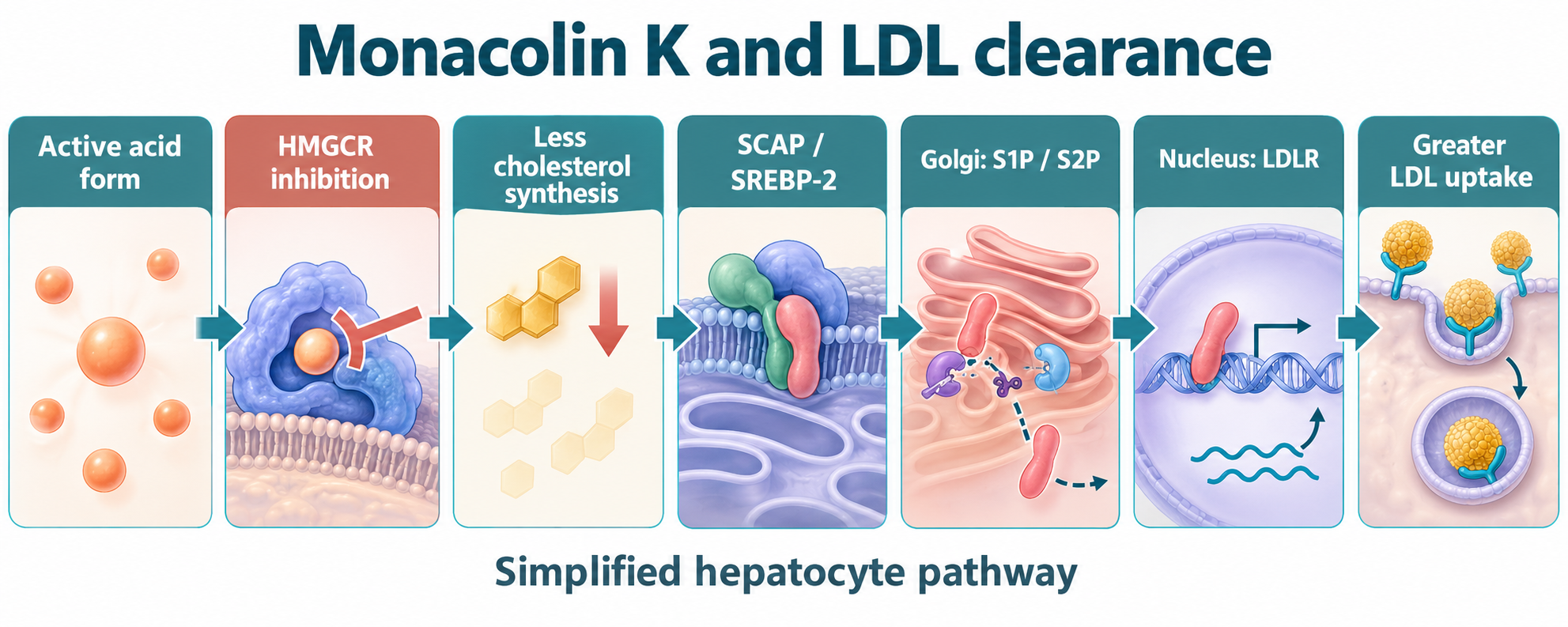
Reduced cholesterol synthesis changes the ER's accessible sterol pool. SCAP binds membrane-bound SREBP-2; with sufficient cholesterol, interaction with Insig retains the complex in the ER. Lower sterol signaling changes SCAP–Insig association, allowing SCAP/SREBP incorporation into COPII vesicles and transport to the Golgi. S1P and S2P sequentially cleave SREBP, releasing its N-terminal transcription factor. Nuclear entry stimulates LDLR and lipid-synthesis genes, so feedback also tries to compensate for reduced biosynthesis.
Additional hepatic LDL receptors increase LDL uptake. Clathrin-mediated internalization leads to an acidic endosome, ligand dissociation, and possible receptor recycling; the particle proceeds to lysosomes for protein and cholesteryl-ester breakdown. ApoB-100 matters for LDL binding, whereas ApoE is important for several remnant particles. It is inaccurate to assign identical uptake of all VLDL to ApoB-100 alone. SREBP-2 also induces PCSK9, promoting LDLR degradation; net clearance reflects the balance (Brown and Goldstein, 1997; Horton et al., 2002).
Why a “microdose paradox” is not an established law
Some trials found substantial LDL-C reductions with relatively small measured monacolin K exposure. Dissolution, acid fraction, other monacolins, and pharmacokinetics are plausible explanations. Comparing percentages across trials with different populations and formulations cannot establish universal three- to fivefold amplification by the rice matrix. Direct comparisons, chemical characterization, and exposure measurements are required.
Plant sterols can reduce intestinal cholesterol absorption through micellar and transport processes. NPC1L1 participates in sterol uptake, while ABCG5/ABCG8 mediate efflux. This does not make phytosterols established direct allosteric NPC1L1 inhibitors equivalent to ezetimibe. Their mere presence in RYR does not establish an effective amount; findings for added gram quantities cannot be applied to trace extract components.
Monascin, ankaflavin, rubropunctatin, monascorubrin, and other azaphilones have been discussed in relation to PPAR, NF-κB, oxidative stress, and eNOS. Cellular or animal observations support hypotheses, not established prevention of foam cells or cardiovascular events in humans. Composition, concentrations, metabolism, and measured endpoints must support the clinical claim.
Mevalonate branches, mitochondria, and CoQ10
Mevalonate supplies IPP and DMAPP. Successive assembly produces GPP (C₁₀), FPP (C₁₅), and GGPP (C₂₀); the sterol branch proceeds through squalene and lanosterol to cholesterol. Nonsterol products support protein prenylation, dolichols, and the CoQ10 side chain. FPP and GGPP donate lipid groups to particular Ras, Rho, Rac, and Rab families. Rab motifs and enzyme specificity cannot be reduced to one universal CaaX motif. Altered prenylation may affect signaling and trafficking without constituting a single proven explanation for every muscle symptom.
PDSS1/PDSS2 participate in synthesis of CoQ10's decaprenyl chain; COQ2 transfers a polyprenyl group to a quinone-ring precursor. In the inner mitochondrial membrane, CoQ10 carries electrons from complexes I and II and other respiratory-chain inputs to complex III, cycling between oxidized and reduced forms. Formulation and exposure are discussed further in ubiquinol and ubiquinone kinetics.
Lower plasma CoQ10 during statin exposure does not establish depleted skeletal-muscle mitochondrial CoQ10: circulating CoQ10 is transported in lipoproteins that also decline. Fixed tissue-depletion percentages, a 30–50% ATP loss, or inevitable “energetic collapse” cannot be claimed without direct evidence. Respiratory dysfunction, reactive oxygen species, cardiolipin, permeability transition, and apoptosis matter in experimental injury models, but the causal sequence in an individual needs independent support.
Taylor and colleagues (2015) studied CoQ10 in blinded-challenge-confirmed statin myalgia. Increased circulating CoQ10 did not establish pain reduction. Other trials have produced heterogeneous findings. The evidence does not justify mandatory ubiquinol 100–200 mg for every RYR user, guaranteed muscle protection, or universal superiority of one redox form irrespective of formulation. CoQ10 does not neutralize citrinin or drug interactions.
Muscle symptoms and pharmacokinetic interactions
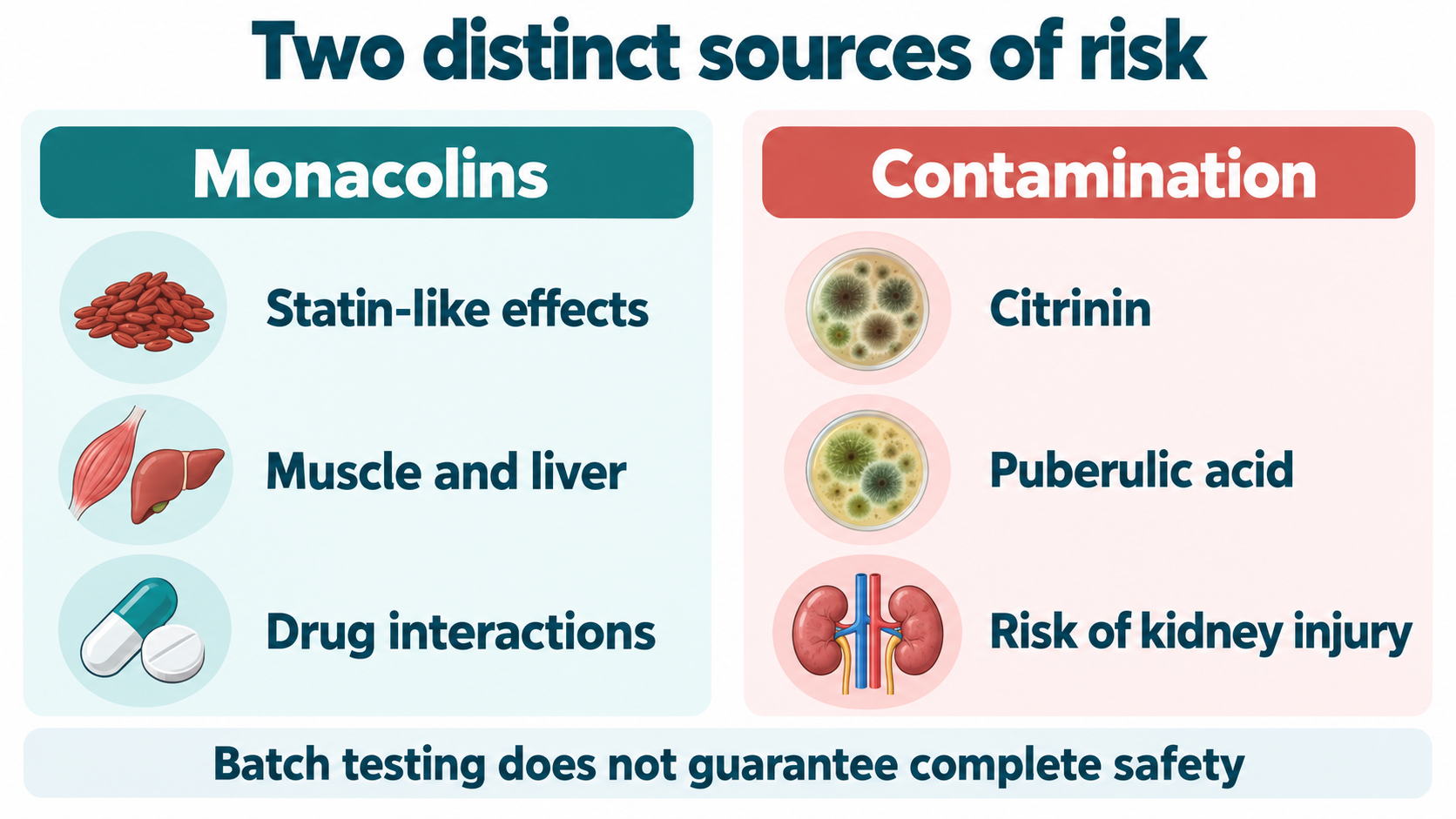
Myalgia can occur without elevated creatine kinase (CK). Myopathy and rhabdomyolysis are more serious conditions, but definitions and CK thresholds differ. Diagnosis requires symptoms, trends, kidney function, and alternative explanations rather than one number. Dark urine, marked weakness, or severe muscle pain warrants urgent medical assessment. SLCO1B1 variants alter transport of some statins; SEARCH (2008) primarily investigated simvastatin, not a universal quantitative genetic model for every RYR supplement.
Lovastatin undergoes extensive first-pass metabolism involving CYP3A4. Formulation, food, intestinal and hepatic enzymes, and transporters affect exposure. Strong CYP3A4 inhibitors, some macrolides and azoles, cyclosporine, certain cardiovascular medicines, and grapefruit may increase risk. Gemfibrozil and combined lipid-lowering agents also warrant attention. Agents differ in interaction mechanisms and strength; the absence of substantial CYP3A4 inhibition, for example with azithromycin, does not prove complete safety. A single AUC multiplier cannot describe every interaction or RYR product.
Assessment includes all medicines and supplements, liver and kidney disease, prior muscle reactions, pregnancy, and breastfeeding. NCCIH advises against RYR during pregnancy and lactation. The obsolete FDA pregnancy category “X” is not the current labeling framework; changes in prescription-statin labeling do not authorize self-directed RYR use in pregnancy. Baseline and follow-up liver enzymes, CK, creatinine, and lipids depend on clinical context. No universal supplement protocol or automatic decision based on one laboratory threshold is established here.
Citrinin: strain selection does not replace batch testing
Citrinin is a separate polyketide mycotoxin, C₁₃H₁₄O₅, approximately 250.25 g/mol. Kidney toxicity is central; mitochondrial disturbance, oxidative stress, and tubular damage have been investigated experimentally. Specific transporters and cellular pathways cannot automatically be treated as proven clinical mechanisms in every consumer.
Shimizu et al. (2005) established a role for pksCT in citrinin biosynthesis. Strain selection and disruption of the relevant cluster can reduce toxin production. Li et al. (2020) combined chromatography with genetic analysis and found differences in pksCT and ctnA among strains. Absence of a gene or an analytical signal in one experiment does not exclude other metabolites, foreign molds, or batch heterogeneity.
Quality control requires strain identity, controlled manufacturing, representative sampling, and validated assays for monacolins and contaminants. LC-MS/MS interpretation includes detection and quantification limits, recovery, and matrix effects; low LOD cannot guarantee absolute safety. Regulation EU 2023/915 lists 100 µg/kg citrinin for the relevant supplements. This is product concentration, not a universal safe daily intake or reassurance about other hazards. A universal pharmacopoeial 20 µg/kg limit is not asserted without a current, specifically identified monograph.
Japan's MHLW linked puberulic acid in the Beni-koji incident to Penicillium adametzioides contamination during fermentation. Experimental testing demonstrated renal injury with puberulic acid; compounds Y and Z did not produce that effect in the reported tests. This separate contamination mechanism must not be attributed automatically to citrinin or monacolin K pharmacology (MHLW, 2024). “Citrinin-free” does not encompass complete microbiological and chemical control.
What clinical trials established
Study
Intervention and finding
Transfer limitation
Lu et al., 2008, CCSPS
Xuezhikang after myocardial infarction; major coronary events 5.7% versus 10.4%, mean follow-up 4.5 years
A specific partially purified extract, Chinese population, and historical background therapy
Becker et al., 2009
62 participants; RYR 1800 mg twice daily, 24 weeks with lifestyle intervention; LDL-C decreased 0.90 mmol/L versus 0.39 with placebo at week 24
Small single-center laboratory-outcome trial, not infarction prevention
Halbert et al., 2010
43 participants; RYR 2400 mg twice daily versus pravastatin 20 mg twice daily for 12 weeks
Limited tolerability sample, not universal safety in statin intolerance
Laffin et al., 2023, SPORT
190 completers; 28 days; rosuvastatin 5 mg outperformed placebo and six supplements for LDL-C; tested RYR did not significantly outperform placebo
One product, short duration; does not negate every characterized extract
CCSPS's primary publication was in American Journal of Cardiology, not JACC. Its reported frequencies give a 4.7-percentage-point absolute difference and about 45% relative reduction. An illustrative calculation is:
ARR=0.104−0.057=0.047,NNT=0.0471≈21.3.
ARR means absolute risk reduction. NNT is the number treated over that follow-up to prevent one additional event; rounding upward gives 22. The calculation uses rounded frequencies and does not replace confidence intervals or time-to-event analysis. It applies to the tested intervention and context, not every RYR bottle.
Meta-analyses combine different products, doses, combinations, and populations. LDL-C or hs-CRP changes do not automatically establish plaque stabilization, lower mortality, or absence of rare adverse reactions. Short randomized trials and pharmacovigilance reports address different questions; lack of a signal in a small sample cannot rule out rare serious toxicity. Assigning the entire supplement category one “I/A” evidence grade is inappropriate.
Regulation and current recommendations
EU Regulation 2022/860 requires less than 3 mg of monacolins from RYR per daily portion, not merely less than 3 mg of individual monacolin K. Mandatory warnings concern people under 18 or over 70, pregnancy and lactation, cholesterol-lowering medicines and other RYR products, and medical advice for health problems. A marketing restriction is not an established safe 2.9-mg dose. Regulation 2024/2041 removed the previously permitted LDL-C maintenance health claim. EFSA's 2025 evaluation did not identify an intake without safety concerns.
On 8 October 2026, the official Legislative Observatory displayed procedure 2026/2821(RPS) concerning monacolins as awaiting Parliament's vote. Further prohibition must not be described as enacted without a published final act. Country and date matter; this review does not certify legal sale of a particular product.
In the United States, FDA considers products with added or enhanced lovastatin ineligible for marketing as dietary supplements; the criterion is not simply whether the label prints milligrams. Variable composition complicates dose assessment (NCCIH, 2022). The ESC/EAS 2025 update recommends against supplements and vitamins lacking documented safety and significant LDL-C-lowering efficacy for ASCVD risk reduction. A blanket claim of class IIa/B support for RYR is not the current wording.
Combinations, timing, and clinical decisions
Berberine has been studied through LDLR mRNA stability and PCSK9 regulation. Kong (2004) and Dong (2015) provide mechanistic experiments; context appears in berberine, AMPK, and PCSK9. Molecular plausibility does not make RYR–berberine a gold standard or establish universal 30–35% LDL-C reductions. A multicomponent trial cannot assign its outcome to one ingredient, and each component adds exposures and interactions.
Artichoke, phytosterols, and CoQ10 are not a mandatory protective stack; their objectives and evidence differ. The original self-directed escalation to ezetimibe, statins, or additional supplements is not a justified treatment algorithm. At high cardiovascular risk, replacing treatments with established outcomes by products of uncertain composition is especially problematic. Suspected statin intolerance requires assessment of causes, symptom reproducibility, and appropriate treatment alternatives.
Cholesterol synthesis has circadian regulation, and timing can matter for short-acting medicines. This does not establish one universal midnight-to-4-a.m. peak or mandatory bedtime dosing for every RYR preparation. A particular medicine's or trial product's regimen cannot be transferred to all mixtures. Decisions consider overall cardiovascular risk, LDL-C, history, product characterization, concurrent agents, and local regulation.
Method and limits
This narrative scientific review preserves the source's justified topics while checking disputed mechanisms, identifiers, trial findings, and official documents on 8 October 2026. Accessible primary-study records and regulator and professional-society publications were used. Not every full study text was read; some publisher and EUR-Lex pages restricted access, so available official records and indexed excerpts were consulted. There was no systematic search, independent GRADE assessment, external peer review, or clinical validation. Unsupported exact numbers and treatment promises were not retained as facts. Monacolin K's mechanism explains possible LDL-C lowering; efficacy and safety remain intervention- and context-specific.
FAQ
Is RYR safer than a statin because it is natural?
Natural origin does not remove monacolin K’s identity with lovastatin, muscle and liver risks, interactions, or contamination concerns.
Does everyone need mandatory ubiquinol?
Universal mandatory supplementation is not established. Findings are heterogeneous; higher plasma CoQ10 does not guarantee pain relief or neutralize contaminants.
Can CCSPS findings apply to any RYR supplement?
No. It tested a particular Xuezhikang extract after myocardial infarction in a specific population with historical background treatment.