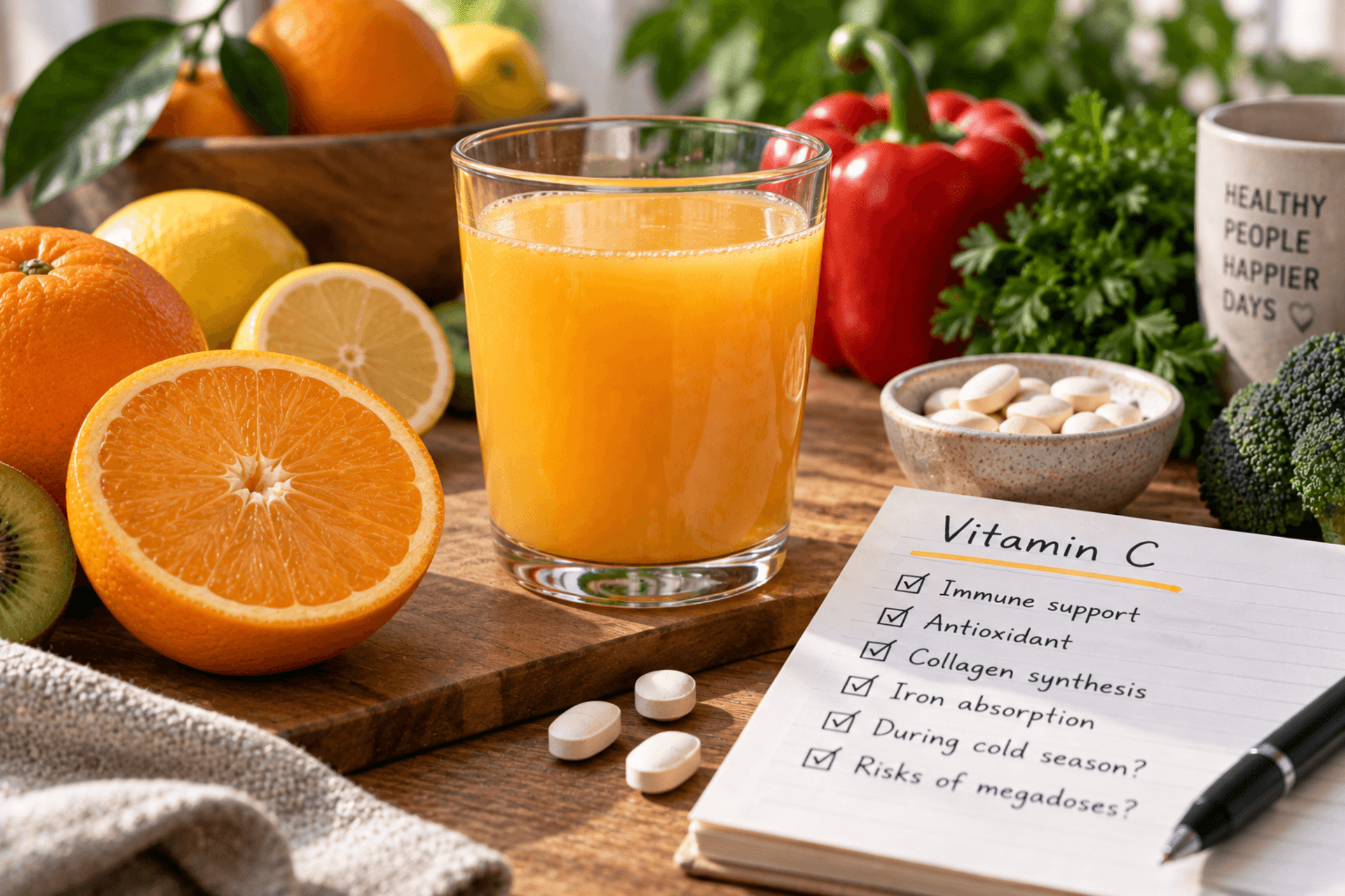
Vitamin C in the Body: Why It Is Needed, Whether It Helps With Colds, and Why Megadoses Can Be Risky
Практическое руководство по источникам витамина C, дозировкам, анализам и рискам добавок.
Практическое руководство по источникам витамина C, дозировкам, анализам и рискам добавок.
Vitamin C, or L-ascorbic acid, is one of the most recognizable micronutrients. People take it “for immunity,” add it to cold remedies, use it in skincare, combine it with iron, and often consume it by the gram, following a simple logic: vitamin C is water-soluble, so anything the body does not need will simply be excreted.
There is some truth in this logic — which is exactly why it is so convincing.
Unlike vitamins A, D, E, and K, vitamin C does not form a large long-term storage depot in fat tissue or the liver. The body regulates its concentration fairly tightly, and excess absorbed ascorbate is excreted through the kidneys. But that does not mean that every amount of vitamin C is equally beneficial or completely harmless.
Ascorbic acid has very specific physiological roles: it is required for collagen and carnitine synthesis, participates in the production of certain neurotransmitters, supports normal immune function, acts as an antioxidant, and significantly affects the absorption of non-heme iron. Severe deficiency causes scurvy — a disease that literally demonstrates how strongly connective tissue depends on vitamin C.
But there is a major difference between preventing deficiency and the idea that “the more ascorbic acid, the healthier the body.” This is where the myths about colds, “boosting immunity,” collagen, anti-aging effects, and gram-level doses begin.
Most animals can synthesize ascorbate on their own. Humans lost this ability during evolution, which is why vitamin C is classified as an essential nutrient.
At the same time, the body does contain some vitamin C stores. According to the NIH, total body vitamin C may range from roughly 300 mg in a state approaching scurvy to around 2 g when vitamin C status is adequate. So saying that the body “does not store vitamin C at all” would be too categorical. A more accurate statement is that humans do not have a large long-term reserve that allows them to go for months without dietary intake.
When intake becomes extremely low — below roughly 10 mg per day — signs of deficiency may begin to appear within a few weeks. Physiologically, therefore, what matters is regular dietary intake rather than occasional massive doses.
For most adults, the recommended daily intake is far more modest than the doses commonly found in supplements: 90 mg per day for men and 75 mg for women. During pregnancy, the reference intake is 85 mg, and during breastfeeding it is 120 mg per day. People who smoke are advised to obtain approximately 35 mg more per day, because vitamin C concentrations in plasma and leukocytes are generally lower in smokers, partly because of greater oxidative stress.
Against this background, a bottle of 1,000 mg tablets looks very different: a single tablet contains not “a little more than the recommended amount,” but roughly 11–13 times the normal physiological requirement of an adult.
The best-known biochemical role of ascorbate is connected with collagen.
Collagen is not just about skin. It is a structural protein found in blood vessel walls, bones, cartilage, tendons, ligaments, dentin, and many other tissues.
For collagen molecules to mature properly, enzymes involved in the hydroxylation of proline and lysine require vitamin C. Ascorbate supports these enzyme systems. When vitamin C becomes critically deficient, the normal structure of connective tissue begins to deteriorate.
That is why severe deficiency causes bleeding around hair follicles, easy bruising, bleeding gums, and poor wound healing. The problem is not that vitamin C somehow directly “strengthens blood vessels,” but that without normal connective tissue synthesis, capillaries and the structures surrounding them become more fragile.
Its role, however, extends well beyond collagen. Vitamin C is required for the synthesis of L-carnitine and participates in the production of certain neurotransmitters. It acts as a physiological antioxidant and can regenerate other antioxidant molecules, including alpha-tocopherol — vitamin E. It also contributes to normal immune function and improves the absorption of non-heme iron.
All of these functions are real. The mistake begins when the statement “vitamin C is necessary for process X” is turned into “the more vitamin C you take, the stronger process X becomes.”
Physiology usually does not work that way.
The marketing logic sounds convincing: vitamin C is required for collagen synthesis, collagen is important for the skin, therefore large doses of vitamin C should make the skin produce more collagen.
But the presence of an essential cofactor and the speed of an entire biological process are not the same thing.
If someone is deficient in vitamin C, restoring normal status genuinely allows ascorbate-dependent enzymes to function properly again. But once requirements are already met, connective tissue synthesis is limited by many other factors: amino acid availability, fibroblast activity, age, hormonal status, chronic disease, smoking, and — especially for the skin — ultraviolet damage.
The body does not convert every additional tablet of ascorbic acid into new collagen.
This is the fundamental difference between correcting a deficiency of an essential nutrient and attempting to pharmacologically enhance a process that is already adequately supplied with that nutrient.
Cosmetic products containing vitamin C are a separate subject. Topical application creates a completely different pharmacokinetic situation, and its effects depend on concentration, chemical form, pH, product stability, and the ability of a particular formulation to penetrate the skin. Evidence supporting certain topical forms cannot simply be transferred to the idea that taking several grams of vitamin C orally will make the skin “younger.”
In popular culture, vitamin C is almost automatically associated with citrus fruit. Oranges are indeed a good source of ascorbate, but they are by no means unique.
For example, according to NIH data, half a cup of raw red bell pepper may contain around 95 mg of vitamin C — already more than the usual daily requirement for an adult woman. A medium orange contains about 70 mg, one kiwi around 64 mg, half a cup of strawberries about 49 mg, and half a cup of cooked broccoli around 51 mg.
Other good sources include green bell peppers, Brussels sprouts, cabbage, cauliflower, tomatoes, potatoes, and many other fruits and vegetables.
Vitamin C is therefore one of those nutrients whose physiological requirement is relatively easy to meet through ordinary food.
The NIH notes that five varied servings of fruits and vegetables per day may provide more than 200 mg of vitamin C, comfortably exceeding the usual recommended daily intake without requiring any special supplements.
So looking for the “most vitamin-rich fruit” is usually less useful than simply eating a varied selection of vegetables, berries, and fruit on a regular basis.
Ascorbic acid is indeed sensitive to storage and cooking conditions.
Vitamin C is water-soluble and can be degraded by heat, so prolonged storage and lengthy cooking may reduce its concentration in food. During boiling, some vitamin C also leaches into the cooking water. The NIH notes that steaming or microwaving may reduce losses compared with some longer cooking methods.
But this should not become another dietary dogma.
There is no need to eat every vegetable exclusively raw in order to preserve every milligram of ascorbate. In a real diet, variety and regularity matter more. Even cooked vegetables can remain good sources of vitamin C, while many foods — fruits, berries, peppers, tomatoes — are commonly eaten without prolonged heating anyway.
Likewise, frozen vegetables should not automatically be considered “devoid of vitamins.” Their actual nutrient content depends on the specific food, processing before freezing, storage time, and cooking method.
The practical principle is simpler: do not boil vitamin C for hours unnecessarily, but do not turn preservation of every molecule of ascorbate into a separate obsession either.
The history of vitamin C is closely tied to scurvy — a disease that affected sailors for centuries during long voyages without access to fresh food.
Today, severe scurvy is rare in countries where varied food is readily available. But it has not disappeared completely.
The earliest signs of substantial depletion may be fairly nonspecific: weakness, fatigue, irritability, malaise, and muscle or joint pain. As deficiency progresses, connective tissue abnormalities become more obvious.
Petechiae, bruising, and perifollicular hemorrhages may appear; hairs may develop a characteristic corkscrew shape; gums may become swollen and bleed easily; and wounds heal more slowly. Joint pain and bleeding may occur as well. In children, severe deficiency can interfere with bone growth.
Anemia can also occur in scurvy. It may result from several mechanisms at once, including blood loss and reduced absorption of non-heme iron when vitamin C is deficient.
It is important, however, not to turn these signs into a home diagnostic test. Bleeding gums are far more commonly caused by periodontal disease, while weakness, bruising, or anemia can have many other causes.
Scurvy is assessed in the context of diet, risk factors, and characteristic clinical findings, with laboratory measurement of ascorbate used when necessary.
For someone who regularly eats fruits and vegetables, clinically significant vitamin C deficiency is unlikely. But there are situations in which the risk becomes higher.
One of the best-known is smoking. People who smoke generally have lower vitamin C concentrations in plasma and leukocytes, which is linked in part to increased oxidative stress. This is why U.S. recommendations advise an additional 35 mg of vitamin C per day for smokers.
Risk also increases with extremely restricted diets. This may occur with severe malnutrition, alcohol or drug dependence, certain psychiatric conditions, unusually strict dietary restrictions, and in some older adults with very monotonous diets.
Another group includes people with severe intestinal malabsorption and certain chronic diseases. Low vitamin C concentrations may also occur in patients with end-stage kidney disease who undergo chronic hemodialysis.
So “everyone needs vitamin C” and “everyone needs vitamin C tablets” are two completely different statements.
Perhaps no claimed effect of vitamin C is as widely known as its supposed ability to prevent and treat colds.
This is also where the difference between a real but modest effect and marketing exaggeration becomes particularly clear.
A major Cochrane review found that regular vitamin C supplementation does not reduce the incidence of colds in the general population. In other words, taking ascorbic acid every day does not create a protective barrier against respiratory viruses.
But the effect is not zero in every respect.
Among people who were already taking vitamin C regularly before they became ill, the average duration of a cold was reduced by approximately 8% in adults and 14% in children. This is a measurable effect, but its magnitude should be understood properly: it means a modest shortening of symptoms, not turning a week-long illness into a one-day cold.
There is also an interesting exception. In studies involving people exposed to short periods of extreme physical exertion or cold — such as marathon runners, skiers, and soldiers training in subarctic conditions — regular vitamin C supplementation roughly halved the incidence of colds. But this result cannot simply be extrapolated to an ordinary person working in an office.
The popular strategy of “my throat is starting to hurt, so I need 1–3 grams of vitamin C immediately” looks considerably weaker. Studies in which supplementation was started only after symptoms appeared did not show a consistent effect on either the duration or severity of colds.
The most accurate formulation is therefore: vitamin C is necessary for normal immune function, regular intake may slightly shorten the duration of a cold, but taking a megadose after a runny nose has already started is not a proven treatment for an acute respiratory infection.
Vitamin C genuinely participates in immune function. It is concentrated in certain immune cells, is associated with their normal activity, and helps limit oxidative damage during inflammatory responses.
But the word “immunity” is often used in advertising as though the immune system were a muscle that could be endlessly “strengthened” by increasing the dose.
That is the wrong model.
When the body is deficient in an essential nutrient, correcting that deficiency allows the relevant systems to function normally again. But once adequate status has been achieved, further increases in dose do not necessarily produce additional clinical benefit.
Vitamin C demonstrates this particularly well through its pharmacokinetics: the body actively limits ascorbate concentrations in plasma and tissues. With normal adequate intake, the system is already approaching saturation, so increasing an oral dose tenfold does not lead to a proportional increase in vitamin C concentrations in the body.
Vitamin C absorption in the intestine is a saturable process.
At moderate intakes of around 30–180 mg per day, the body can absorb approximately 70–90% of the vitamin. But with oral doses above 1 g, the proportion absorbed falls below 50%, while a substantial share of what is absorbed but not used is excreted in the urine.
This is one of the key points that is often lost in the marketing of megadoses.
Increasing a tablet from 100 mg to 1,000 mg does not mean that ten times more vitamin C will reach the tissues.
Plasma ascorbate concentrations are tightly regulated, and as the dose rises, the efficiency of further increases falls. The NIH notes that at intakes of around 100 mg per day, cells are already approaching saturation, while above roughly 200 mg, further increases in plasma concentration become relatively small.
This is why gram-level dosing creates an interesting imbalance: the tablet becomes ten times larger, but the physiological benefit does not.
The intestine, however, definitely notices the unabsorbed portion.
The main adverse effects of high oral doses of vitamin C are gastrointestinal.
Unabsorbed ascorbate increases the osmotic load in the intestine. As a result, people may experience:
In the United States, the tolerable upper intake level for adults is set at 2,000 mg per day. This is not a recommended dose and not a target to aim for. It is an upper boundary above which the likelihood of adverse effects increases.
Again, two concepts need to be distinguished: vitamin C has relatively low toxicity, but “relatively low toxicity” does not mean that dosage is irrelevant.
The supplement market offers many options: pure L-ascorbic acid, sodium ascorbate, calcium ascorbate, various “buffered” mixtures, bioflavonoid complexes, and commercial forms such as Ester-C.
From a biological perspective, ordinary ascorbic acid is not a “bad cheap form.”
The NIH notes that ascorbic acid from standard supplements has bioavailability comparable to ascorbic acid from food. Studies comparing different forms have not demonstrated a convincing advantage for most more expensive alternatives in terms of plasma vitamin C concentrations or excretion. In one comparative study, the authors explicitly concluded that ordinary ascorbic acid remained the preferred source, including because of its low cost.
Buffered ascorbates may make practical sense for people who find the acidic form less comfortable for the stomach. But this is primarily a matter of tolerability rather than fundamentally stronger biological effects.
The mineral component also matters. Sodium ascorbate adds sodium, while calcium ascorbate adds calcium. So the word “buffered” does not automatically make a product universally superior.
One of the most practically important properties of vitamin C is its ability to improve the absorption of non-heme iron, the form found mainly in plant foods and many fortified products.
This is why it makes sense to combine lentils, beans, chickpeas, leafy greens, or other plant sources of iron with bell peppers, tomatoes, broccoli, berries, kiwi, or citrus fruit in the same meal.
The NIH specifically notes that iron from plant sources is absorbed more effectively when consumed together with foods containing vitamin C.
But vitamin C does not treat iron-deficiency anemia on its own.
If the body lacks iron, ascorbate cannot create it out of nothing. It can improve the bioavailability of existing iron, but it cannot replace investigation of the cause of deficiency or necessary treatment.
This matters especially in anemia, because iron deficiency may result not only from diet but also from chronic blood loss, gastrointestinal disease, menstrual disorders, malabsorption, and other conditions.
Some ascorbate can be metabolized into oxalate, which is why there has long been concern that large doses of vitamin C may increase the risk of calcium oxalate kidney stones.
Biochemically, the possibility is real: high vitamin C intake can increase urinary oxalate excretion.
But the statement “anything above 1,000 mg significantly increases kidney-stone risk in everyone” would be too categorical.
The NIH notes that studies using doses ranging from 30 mg to 10 g per day have produced conflicting results, so the precise role of vitamin C in kidney-stone formation in healthy individuals remains incompletely defined. The strongest reasons for caution apply to people with existing hyperoxaluria, and increased caution is also reasonable in people with kidney disease or a history of calcium oxalate stones.
Neither extreme conclusion is justified.
It is incorrect to say that every gram of vitamin C inevitably causes kidney stones.
But it is equally incorrect to assume that a water-soluble vitamin cannot affect the kidneys and is safe to take by the gram regardless of medical history.
For most healthy people, increasing the absorption of non-heme iron is not dangerous.
The situation changes in disorders associated with pathological iron accumulation, particularly hereditary hemochromatosis.
In these conditions, prolonged use of high-dose vitamin C may worsen iron overload and potentially contribute to tissue injury. The NIH specifically advises caution in hereditary hemochromatosis.
Therefore, someone with diagnosed iron overload should not independently start taking gram-level doses of ascorbic acid simply because “it is only a vitamin.”
The same logic applies to complex hematological conditions and situations involving frequent blood transfusions: supplements are best discussed with the treating clinician.
Vitamin C status is generally assessed by measuring plasma ascorbate concentration.
However, this test is used much less often than, for example, ferritin or vitamin B12. The reason is straightforward: in most people, pronounced deficiency is assessed using a combination of characteristic clinical findings, diet, and risk factors.
The Merck Manual states that blood ascorbate concentrations below approximately 0.2 mg/dL, or 11 micromol/L, are consistent with deficiency, while values below 0.6 mg/dL may be considered borderline. Other methods also exist, such as measuring ascorbate in leukocytes, but they are more technically difficult, less standardized, and rarely used.
Therefore, someone who eats fruits and vegetables every day and has no signs of malabsorption or symptoms suggestive of scurvy usually has little reason to routinely test vitamin C “for prevention.”
The situation is different with a severely restricted diet, characteristic hemorrhagic signs, unusual gum bleeding, impaired wound healing, or severe malabsorption. In those circumstances, evaluating vitamin C deficiency becomes a genuine clinical question.
Yes, but it is especially important not to overgeneralize.
Ascorbic acid is a strong reducing agent and can interfere with certain laboratory reactions. However, the direction and magnitude of the error depend on the specific analytical method.
A classic example is the guaiac fecal occult blood test, or gFOBT. High vitamin C intake can suppress the oxidation reaction used by the test and produce a false-negative result. The modern fecal immunochemical test, or FIT, works by a different mechanism and does not have the same dietary interference.
Vitamin C can also affect readings from certain glucose meters and urine test strips. The FDA specifically recommends checking the instructions for the particular device and considering medications and supplements because the type of interference depends on the technology being used.
So the universal rule “stop vitamin C for 72 hours before any laboratory test” is not accurate.
A better approach is to tell the clinician or laboratory staff about high-dose supplements and follow the instructions for the specific test being performed.
The topic of vitamin C in oncology is much more complicated than the popular opposition between “antioxidants are beneficial” and “antioxidants interfere with chemotherapy.”
Both ordinary oral supplements and extremely high intravenous doses of vitamin C have been studied. These are fundamentally different routes of administration: intravenous delivery can produce plasma ascorbate concentrations that cannot be achieved with ordinary tablets. Therefore, results from studies of intravenous pharmacological ascorbate cannot simply be applied to a bottle of vitamin C purchased in a store.
As for antioxidant supplements during chemotherapy and radiation therapy, the evidence remains mixed. There are concerns that some antioxidants may interfere with mechanisms used by anticancer treatments, while other research has explored whether they might protect normal tissue. For this reason, neither the NCI nor the NIH provides a basis for self-prescribing high-dose antioxidants during cancer treatment. Such supplements should be discussed with the oncology team.
The issue is therefore not whether vitamin C is “good” or “bad.” In oncology, the dose, route of administration, cancer type, and treatment regimen can turn an ordinary nutrient into a pharmacologically significant factor.
For most people with a varied diet — not necessarily.
One red bell pepper, several servings of vegetables, a kiwi, some berries, or an ordinary orange can provide a substantial share of the daily requirement. A diet containing a variety of plant foods usually supplies not only ascorbate but also fiber, potassium, folate, carotenoids, and many other compounds that are not present in an isolated tablet.
This does not mean that vitamin C supplements are useless in principle.
They can be convenient with a restricted diet, increased requirements, certain diseases, confirmed deficiency, or situations in which normal eating is temporarily difficult.
But there is a major physiological difference between taking a 100 mg supplement to compensate for insufficient intake and routinely consuming 2–3 g “for immunity.”
If the goal is simply to avoid deficiency, gram-level doses are excessive for most people.
For most healthy adults, the strategy is much simpler than the supplement market might suggest.
The foundation should remain ordinary fruits and vegetables. Red and green bell peppers, kiwi, berries, citrus fruit, broccoli, Brussels sprouts, cabbage, tomatoes, and other plant foods make it easy to obtain the necessary tens of milligrams of vitamin C every day.
There is no need to search for a special “immune protocol,” and certainly no need to begin gram-level dosing at the first sign of a runny nose. Regular adequate intake is more physiological than occasional megadoses, and starting megadoses only after a cold has already developed has no convincingly demonstrated clinical advantage.
On a plant-based diet, vitamin C can be used more intelligently by combining sources of non-heme iron — lentils, beans, chickpeas, leafy greens, and whole grains — with peppers, tomatoes, broccoli, berries, or citrus fruit in the same meal.
If there is a history of calcium oxalate kidney stones, hyperoxaluria, or significant kidney disease, high-dose supplementation should be discussed with a clinician.
The same applies to hereditary hemochromatosis and other conditions involving iron overload: large amounts of ascorbate should not be taken without medical guidance.
During chemotherapy or radiation therapy, any high-dose antioxidant supplement should be discussed with the oncology team.
And before laboratory testing — particularly a guaiac fecal occult blood test or glucose measurement using a method potentially affected by ascorbate — it is worth reporting supplement use and following the instructions for the specific test or device.
Vitamin C is genuinely essential. Without it, connective tissue synthesis is impaired, wound healing suffers, capillaries become fragile, non-heme iron absorption decreases, and eventually scurvy can develop.
But its real importance does not make megadoses automatically beneficial.
The physiological requirement of an adult is measured in tens of milligrams, not grams. The body absorbs moderate amounts of ascorbate efficiently, but as the dose rises, transport systems become saturated, the proportion absorbed falls, and excess vitamin is excreted by the kidneys or remains in the intestine, where it can cause diarrhea and cramping.
Vitamin C does not prevent colds in most people, although regular intake may slightly shorten their duration. It helps with the absorption of plant-based iron but does not replace treatment for iron deficiency. It is essential for collagen synthesis, but that does not mean gram-level doses rejuvenate the skin. And although vitamin C has relatively low toxicity, high doses require caution in kidney disease, hyperoxaluria, and iron-overload disorders.
The central principle is the same as with most micronutrients:
vitamin C is beneficial when the body receives enough of it. The maximum dose is not the maximum benefit.
For most people, this goal is achieved not with a bottle of 1,000 mg tablets, but with an ordinary varied diet that regularly includes vegetables, berries, and fruit.
This material is for educational purposes only and does not replace medical consultation, diagnosis, or individually prescribed treatment.