
Vitamin A in the Body: Why It Is Needed, Where It Is Found, and Why Too Much Can Be Dangerous
A practical guide to retinol and carotenoids, food sources, deficiency clues, testing, pregnancy precautions and overdose risk.
Vitamin A in the Body: Why It Is Needed, Where It Is Found, and Why Too Much Can Be Dangerous
Vitamin A is usually associated with two things: carrots are supposedly “good for your eyesight,” and retinol is found in a huge number of skincare products and supplements. Behind these everyday associations lies much more complex physiology. Vitamin A is involved in the function of the retina, helps maintain the structure of the skin and mucous membranes, affects the immune system, growth, reproduction, and embryonic development. Without it, the body genuinely cannot function normally.
At the same time, vitamin A is a good example of a nutrient for which the intuitive logic of “if a little is useful, more must be even better” does not work.
Its active forms are fat-soluble, can accumulate in the body, and chronic excess of preformed retinol can damage the liver, affect bones, cause neurological symptoms, and pose a particular danger during pregnancy.
Another source of confusion is the term “vitamin A” itself. It is not a single substance. The body can obtain ready-made vitamin A from animal-derived foods or produce it from plant carotenoids. Metabolically, these two pathways are not equivalent, and understanding the difference between them is exactly what helps distinguish normal nutrition from the risk of overdose.
Retinol and Carotenoids — Two Different Pathways to Vitamin A
The general term “vitamin A” includes retinol, retinal, retinoic acid, retinyl esters, and a number of precursor compounds. From a practical point of view, dietary sources are easier to divide into two major groups.
The first is preformed, or ready-made, vitamin A. This includes retinol and retinyl esters. They are found primarily in animal-derived foods: liver, eggs, dairy products, certain types of fish, and fortified foods. The body does not first need to convert them from another substance — these forms are already close to a biologically active state.
The second group is provitamin A carotenoids. The best-known of these is beta-carotene. It is found in carrots, pumpkin, sweet potatoes, spinach, broccoli, leafy greens, red and yellow bell peppers, apricots, mangoes, and many other green, yellow, and orange fruits and vegetables. The body can convert part of the beta-carotene it receives into vitamin A as needed.
This difference is fundamental. When a person consumes large amounts of preformed retinol, the body can store it, primarily in the liver. With systematic excess, this creates a risk of toxicity. Dietary carotenoids behave differently: their conversion into active vitamin A is regulated, which is why carrots or pumpkin are practically incapable of causing classic vitamin A hypervitaminosis.
That is why the phrase “this food contains a lot of vitamin A” by itself says very little. What matters is which form it contains.
How Much Vitamin A Does a Person Actually Need?
Modern recommendations express vitamin A requirements in micrograms of RAE — retinol activity equivalents. This unit is needed because equal amounts of retinol and beta-carotene do not have equal biological activity.
For an adult man, the recommended intake is about 900 mcg RAE per day, and for an adult woman — 700 mcg RAE. During pregnancy, the reference intake increases to 770 mcg RAE, and during breastfeeding — to 1,300 mcg RAE per day.
These figures refer to total intake from food and, if used, supplements. They do not mean that a man should take a 900 mcg retinol capsule every day, or that a woman should take a 700 mcg capsule.
With a varied diet, a substantial part of the requirement can be covered by ordinary food. Moreover, combining moderate amounts of animal-derived foods with vegetables, greens, and fruit is usually more physiologically sensible than trying to cover the entire requirement with a single concentrated supplement.
On older labels, vitamin A is still often listed in international units — IU. For retinol, 1 IU corresponds to about 0.3 mcg RAE, so 10,000 IU of preformed retinol is approximately 3,000 mcg RAE. But beta-carotene uses a different conversion factor, so comparing supplements based only on IU without checking the form of the substance is incorrect.
Why Vitamin A Is So Important for Vision
The connection between vitamin A and vision is real and well established. A vitamin A derivative — retinal — is part of rhodopsin, the visual pigment found in the rod cells of the retina. These cells are especially important in low-light conditions and help the eye adapt to darkness.
That is why one of the earliest characteristic manifestations of pronounced vitamin A deficiency is impaired twilight vision — so-called night blindness, or nyctalopia.
If the deficiency progresses, not only dark adaptation suffers. Dryness of the conjunctiva and cornea, xerophthalmia, Bitot spots, damage to the eye surface, and, in severe cases, keratomalacia and irreversible loss of vision may develop.
But this does not support the popular conclusion that additional vitamin A can “improve eyesight” in anyone.
If vitamin A stores are sufficient, extra retinol will not correct myopia, hyperopia, or astigmatism, will not replace glasses or contact lenses, and will not treat retinal disease. Poor vision in the dark is also not always caused by deficiency: the same complaint can occur with ophthalmic diseases, cataracts, retinal disorders, diabetes, and other conditions.
So vitamin A is indeed necessary for vision, but it is not a way to increase visual acuity in a healthy person.
Skin, Mucous Membranes, and the Immune System
Another important function of vitamin A is associated with epithelial tissues. Retinoic acid is involved in regulating gene activity and cell differentiation, including the cells that form the skin and the mucous membranes of the respiratory tract, intestines, genitourinary system, and the surface of the eye.
These tissues are not merely passive coverings. They are among the body’s first points of contact with the external environment and are part of the protective system.
With severe vitamin A deficiency, the normal structure of the epithelium is disrupted: tissues may become dry, renew less effectively, and undergo abnormal keratinization. At the same time, immune function is impaired, which is why severe deficiency is associated not only with vision problems but also with greater susceptibility to infections.
On this basis, vitamin A is sometimes marketed as a way to “boost immunity.” The phrase sounds convincing, but physiologically it is inaccurate. Vitamin A is necessary for normal immune function — just like protein, zinc, or iron. But if there is no deficiency, increasing the dose does not make the immune system stronger and stronger.
Vitamins have a zone of adequacy, not an endless scale of benefit.
Which Foods Are Best as Sources of Vitamin A?
A varied diet makes it possible to obtain vitamin A from several sources at once and reduces the need for concentrated products.
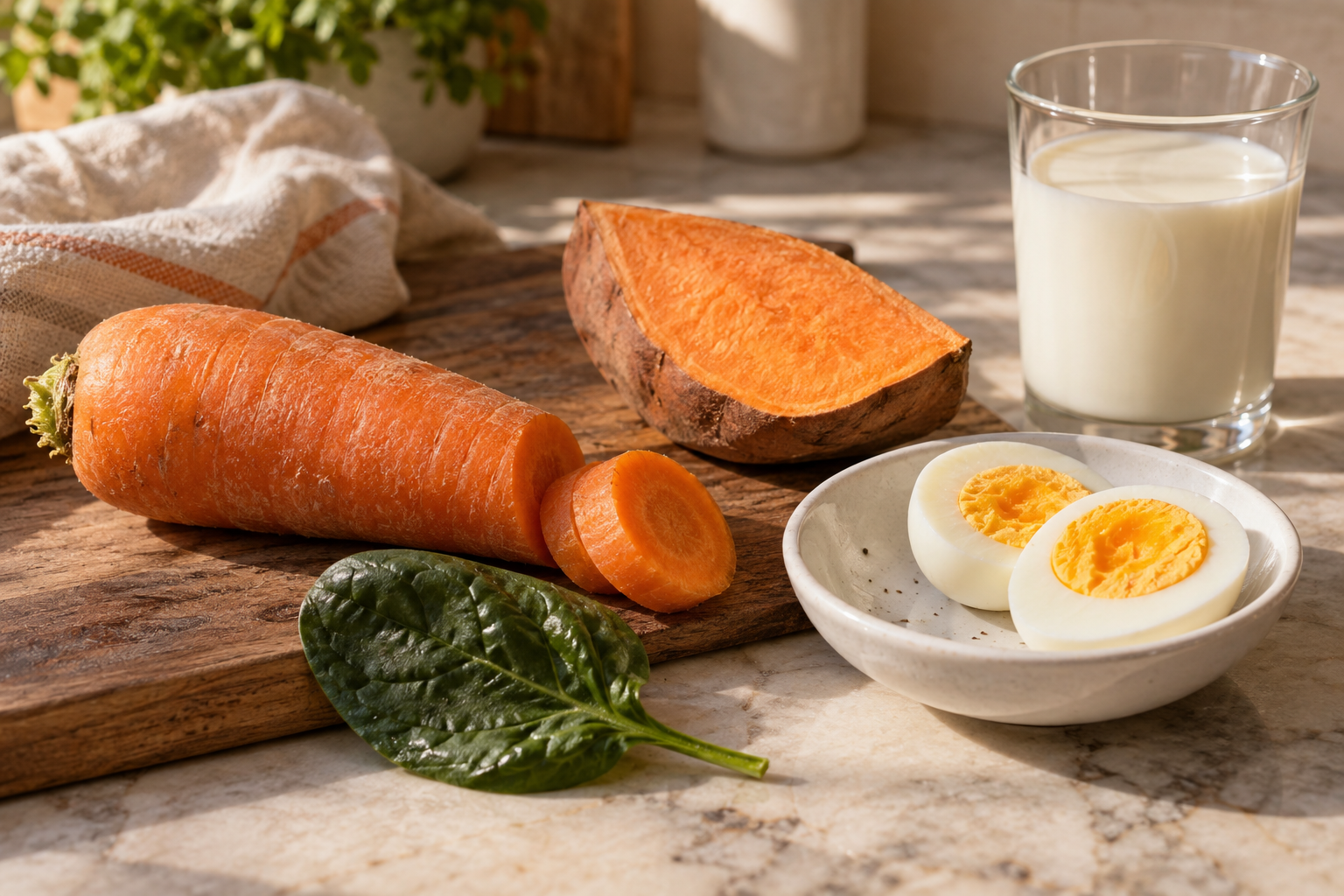
Preformed vitamin A comes primarily from liver, eggs, dairy products, fish, and certain fortified foods. Provitamin A carotenoids are found in carrots, pumpkin, sweet potatoes, spinach, leafy greens, broccoli, bell peppers, apricots, mangoes, and other brightly colored plant foods.
Because carotenoids are fat-soluble compounds, some dietary fat in the meal helps their absorption. This does not mean carrots need to be literally drenched in oil. A normal complete meal containing vegetable oil, nuts, avocado, eggs, cheese, or another source of fat is enough.
Food processing also affects absorption. Chopping and moderate heat treatment of some vegetables disrupt plant cell structures and make carotenoids more accessible for digestion. That is why cooked carrots or slowly cooked pumpkin can, in some cases, provide carotenoids more effectively than a whole raw vegetable.
At the same time, conversion of carotenoids into active vitamin A is not 100% efficient. It is influenced by intestinal health, the amount of fat in the diet, genetic differences, and baseline vitamin A status. That is why a microgram of beta-carotene cannot simply be equated with a microgram of retinol — which is precisely why the RAE system exists.
Liver — A Nutritious Food That Is Easy to Overestimate
Liver occupies a special place among dietary sources of vitamin A. It does not merely contain “a lot of vitamins”; it can contain an extremely high concentration of preformed retinol.
This makes sense: the liver is the main storage site for vitamin A in both animals and humans.
That is why an occasional moderate serving of liver and the habit of eating large portions several times a week as a kind of “natural vitamin complex” are fundamentally different situations.
It is especially easy to exceed a reasonable intake when liver is combined with multivitamins, standalone vitamin A, fish liver oil, or supplements for skin and hair. In such a situation, a person may look at each source separately, while the body receives the total amount of retinol.
For vitamin A, this is especially important because it can accumulate.
Who Is Actually at Risk of Deficiency?
In countries where a varied diet is available, severe vitamin A deficiency is much less common than in regions with pronounced undernutrition and limited access to animal foods and vegetables.
In adults, risk rises not so much because there are no carrots in the diet, but because of diseases that impair fat digestion and absorption.
These conditions include celiac disease, cystic fibrosis, chronic pancreatic disease, impaired bile flow, chronic diarrhea, and certain gastrointestinal surgeries. Risk also rises in severe liver disease and profound protein-energy malnutrition.
This is related to two factors. First, vitamin A is fat-soluble, so severe impairment of fat absorption also reduces its absorption. Second, a substantial part of the body’s vitamin A stores is located in the liver, meaning significant liver disease can also alter retinol metabolism.
A classic manifestation of deficiency is worsening vision in dim light. As stores become further depleted, dry eyes, xerophthalmia, corneal damage, and changes in the skin and mucous membranes may appear. In children, severe deficiency can also impair growth and increase susceptibility to infections.
But nonspecific symptoms such as dry skin, fatigue, or frequent colds are not enough to make a diagnosis on their own. They occur in dozens of other conditions.
Why a Blood Test Does Not Tell the Whole Story
For laboratory assessment of vitamin A status, serum retinol is usually measured. At first glance, it may seem simple: a low result means deficiency, while a normal result means stores are adequate.
In reality, the metabolism is more complicated.
The body regulates the concentration of retinol in the blood quite tightly by using liver stores. Therefore, in the early stages of depletion, the blood test may still remain within the normal range. Serum retinol tends to drop substantially only when deficiency becomes more pronounced.
There is also the opposite problem. During infection or active inflammation, circulating retinol can temporarily fall because of changes in transport proteins, even if liver stores are not fully depleted.
That is why the test cannot be interpreted in isolation. Symptoms, diet, liver function, gastrointestinal diseases, malabsorption, and current inflammatory conditions all matter.
For the same reason, a healthy person with a complete diet usually does not need to routinely “check vitamin A just in case.” Testing becomes much more useful when there is a real clinical reason to suspect deficiency or toxicity.
Where Benefit Ends and Toxicity Begins
The main toxicological problem is not carrots and not ordinary dietary beta-carotene, but preformed vitamin A — retinol and retinyl esters.
Because vitamin A is fat-soluble and can accumulate in the body, its excess is not eliminated as easily as the excess of many water-soluble vitamins.
For adults, the tolerable upper intake level for long-term intake of preformed vitamin A is 3,000 mcg RAE per day, which is approximately equivalent to 10,000 IU of retinol.
It is very important to understand what this number means. It is not a recommended dose and not a target to aim for. It is the upper boundary of chronic intake beyond which the risk of adverse effects increases.
A single very large dose can cause acute poisoning. Possible symptoms include severe headache, nausea, vomiting, dizziness, drowsiness, irritability, impaired coordination, and increased intracranial pressure.
But in practice, chronic toxicity caused by regular excessive intake is no less important. It may present with dry, rough skin, cracked lips, hair loss, nail changes, headaches, weakness, bone and joint pain, liver enlargement, and abnormal liver tests.
Long-term excess has also been associated with adverse changes in bone tissue and an increased risk of fractures.
The paradox is that some signs of excess can easily be mistaken for reasons to take even more vitamins. Dry skin and hair loss can occur in various deficiency states, but also in vitamin A toxicity. That is why choosing retinol based on external symptoms is an especially poor strategy.
Why It Is Almost Impossible to Develop Classic Hypervitaminosis From Carrots
Dietary beta-carotene is different.
The body regulates its conversion into retinol, so even very high amounts of carotenoid-rich foods usually do not cause classic vitamin A toxicity.
If carotenoid intake becomes extremely high, the skin can develop a yellow-orange hue. This condition is called carotenaemia or carotenoderma. The discoloration is often particularly noticeable on the palms and soles.
Unlike jaundice, the whites of the eyes usually do not turn yellow. The condition itself is generally harmless and gradually resolves once carotenoid intake is reduced.
But there is an important exception here: food and concentrated supplements are not the same thing.
Large clinical trials have shown that high-dose beta-carotene supplements in smokers, former smokers, and people exposed to asbestos were associated with an increased risk of lung cancer.
This is not a reason to avoid carrots, pumpkin, or leafy greens. The issue specifically concerns high-dose beta-carotene supplements.
So the statement “beta-carotene is safe, therefore it can be taken in any amount” is also incorrect.
Pregnancy — A Situation Where the Form of Vitamin A Matters Especially
Vitamin A is necessary for embryonic development, organ formation, and normal fetal growth. That is why deficiency during pregnancy is undesirable.
At the same time, high doses of preformed vitamin A are teratogenic — meaning they can disrupt embryonic development and increase the risk of congenital malformations.
For a pregnant woman, the recommended intake is around 770 mcg RAE per day. The tolerable upper intake level for preformed vitamin A remains 3,000 mcg RAE per day.
These figures do not mean that a pregnant woman should aim for the upper limit. On the contrary, this is a period when unnecessary high-dose retinol supplements should be avoided and the composition of several supplements used at the same time should be checked carefully.
Beta-carotene from ordinary vegetables and fruit does not carry the same teratogenic risk. That is why carrots, pumpkin, or spinach should not be placed in the same category as a concentrated retinol capsule.
Liver deserves separate attention. Because it can contain extremely high concentrations of preformed vitamin A, turning it into a regular “natural vitamin treatment” during pregnancy is not a sensible strategy. This is especially true if a prenatal supplement containing vitamin A is already being used.
Retinoids: When Vitamin Chemistry Becomes Drug Therapy
Compounds related to vitamin A are widely used in dermatology. The best-known example is systemic isotretinoin, used to treat severe acne.
But isotretinoin is not “a very strong vitamin A.” It is a full-fledged medication with serious contraindications and monitoring requirements.
The main risk is pronounced teratogenicity. Pregnancy during systemic isotretinoin treatment is unacceptable, so treatment in people who can become pregnant requires strict pregnancy-prevention measures and testing.
Liver function and lipid levels may also be monitored during treatment.
Vitamin A should not be added independently during isotretinoin therapy. Combined use can increase retinoid-related toxicity. Likewise, the treating clinician should be informed about multivitamins and any “skin supplements” if they contain retinol.
There is another important interaction: systemic isotretinoin is generally not combined with tetracycline antibiotics because of the risk of intracranial hypertension.
All of these features clearly show how far retinoid therapy is from the logic of ordinary dietary supplementation.
What About Retinol in Skincare?
Topical retinoids and cosmetic retinol have much lower systemic bioavailability than orally administered drugs. Even so, they are still approached cautiously during pregnancy.
Professional guidance generally recommends avoiding topical retinoids during pregnancy, even though only small amounts are absorbed through the skin.
When planning pregnancy, it is worth checking medicinal and cosmetic products for retinol, retinal, tretinoin, adapalene, tazarotene, and other retinoids, and discussing alternatives with a clinician if necessary.
Why Safety Is Especially Important in Children
A child’s vitamin A requirement is much lower than an adult’s and gradually increases with age.
That is why a concentrated adult supplement in a child’s hands represents a real danger. Just a few capsules can provide a dose completely disproportionate to a child’s physiological requirement.
If a child accidentally swallows an unknown or large amount of concentrated vitamin A, it is more sensible not to wait for symptoms to appear but to contact a poison control service or emergency medical service immediately.
Such products should be stored just as securely as medications.
Why Vitamin A Is Easy to Duplicate Without Noticing
Most cases of unnecessarily high intake do not look like a conscious decision to swallow a massive dose.
More often, a person simultaneously uses a multivitamin, a skin-and-hair complex, fish liver oil, and a separate supplement, eats liver from time to time, and then starts treatment with a retinoid.
Each product on its own may look completely reasonable.
But metabolism does not know that the products have different names. For the body, there is only the total intake of active retinoids.
That is why, when assessing vitamin A intake, the important question is not only “how much is in this capsule?” but also what the person is getting from the entire combination of foods, supplements, and medications.
How to Approach Vitamin A in Practice
For most healthy people, a sensible strategy is quite simple.
The foundation should remain ordinary foods: green and brightly colored vegetables, eggs, dairy products, fish, and other components of a varied diet. Liver can be part of the diet, but it should not become a daily retinol concentrate.
If a supplement is used, it is important to look not only for the words Vitamin A on the label but also for the form: retinol, retinyl palmitate, retinyl acetate, or beta-carotene. When evaluating dosage, it is more useful to look at mcg RAE and remember that the upper limit for preformed vitamin A is not a target for daily intake.
If twilight vision worsens, it is not advisable to start treating yourself with retinol. The symptom can indeed occur with deficiency, but there are many other causes that require an ophthalmic evaluation.
Dry skin, hair loss, and frequent infections are also far too nonspecific for self-diagnosing a vitamin deficiency.
Particular caution is needed during pregnancy, when using systemic or topical retinoids, in liver disease, and in conditions associated with impaired fat absorption.
Smokers and former smokers should not independently use high-dose beta-carotene supplements.
And finally, all concentrated vitamin A products should be kept out of children’s reach.
When Urgent Medical Evaluation Is Needed
A large accidental dose of preformed vitamin A — especially in a child — should be taken seriously.
Reasons to seek urgent medical care after a possible overdose include severe or repeated vomiting, intense headache, drowsiness, confusion, impaired coordination, sudden visual disturbances, or a sharp deterioration in overall condition.
It is not advisable to try to “neutralize” the vitamin with another food or supplement. In situations like this, toxicological assessment is what matters.
Main Takeaway
Vitamin A is an essential nutrient without which normal vision, epithelial tissue renewal, immune system function, growth, and reproduction are impossible. But its physiology is a good illustration of why the concepts of “essential” and “safe in any dose” must not be confused.
Plant carotenoids and preformed retinol are not the same thing. Carrots and pumpkin provide the body with raw material from which it produces vitamin A in a regulated manner. Liver, retinol capsules, and retinyl esters directly provide the ready-made form, which can accumulate when consumed in excess.
That is why the goal of nutrition is not to obtain as much vitamin A as possible, but to ensure adequate intake without chronic excess.
For most people, this goal is achieved not through high-dose supplements, but through a varied diet and attention to the total amount of retinol coming from food, vitamin complexes, and medications.
This material is for educational purposes only and does not replace consultation with a physician, ophthalmologist, dermatologist, or obstetrician-gynecologist, nor does it replace diagnosis or individually prescribed treatment.
Sources
- NIH ODS — Vitamin A Fact Sheet
- National Institutes of Health, Office of Dietary Supplements (NIH ODS). Vitamin A and Carotenoids — Fact Sheet for Consumers
- National Institutes of Health, Office of Dietary Supplements (NIH ODS). Dietary Supplements and Life Stages: Pregnancy — Fact Sheet for Health Professionals
- Merck Manual Professional Edition. Vitamin A Deficiency
- Merck Manual Professional Edition. Vitamin A Toxicity
- American College of Obstetricians and Gynecologists (ACOG). Skin Conditions During Pregnancy
- U.S. Food and Drug Administration (FDA). iPLEDGE Risk Evaluation and Mitigation Strategy (REMS)
- DailyMed. Isotretinoin Capsules — Aurobindo Pharma Limited: prescribing information
- National Institutes of Health, Office of Dietary Supplements (NIH ODS). Dietary Supplements for Immune Function and Infectious Diseases — Vitamin A
- National Institutes of Health, Office of Dietary Supplements (NIH ODS). Multivitamin/Mineral Supplements — Fact Sheet for Consumers
- FDA. Isotretinoin Capsule Information