PERT: pancreatic lipase kinetics, delivery and clinical evidence — NutriFit
Pancreatic enzyme replacement therapy: lipase kinetics and delivery
How pancreatic lipase, colipase, bile salts, intestinal pH and enzyme formulations determine digestion—and what human trials, fecal elastase and fat-absorption tests can establish about PERT.
Pancreatic enzyme replacement therapy (PERT) supplies digestive enzymes to the intestinal lumen when pancreatic secretion or its effective contact with a meal is inadequate. Its central problem is not simply a shortage of lipase molecules. The enzymes must survive gastric transit, mix and empty with food, become available at the appropriate intestinal pH, reach lipid interfaces, and work in an intestine with sufficient bile salts and absorptive capacity. A capsule's stated activity, activity in a laboratory vessel and the patient's nutrient absorption describe different parts of that chain.
This article explains that chain and the evidence supporting treatment of exocrine pancreatic insufficiency (EPI). Dose examples describe particular guidelines, populations and product instructions; they are not a universal regimen or a substitute for an individual prescription.
The pancreatic contribution to digestion
Acinar cells produce pancreatic triglyceride lipase, encoded by PNLIP, its cofactor procolipase (CLPS), carboxyl ester lipase (CEL), phospholipase A2 and pancreatic amylases. They also secrete protease precursors, including trypsinogens, chymotrypsinogens, proelastases and procarboxypeptidases. Enteropeptidase initiates trypsinogen activation at the intestinal surface; trypsin then activates other zymogens. Intrapancreatic control of premature protease activation includes the trypsin inhibitor SPINK1. Lipase and amylase should not be placed in the same obligatory activation scheme as the protease zymogens.
Duct cells supply fluid and bicarbonate. Secretin signaling through cAMP promotes secretion; CFTR and bicarbonate transport pathways, including SLC26 exchangers and basolateral bicarbonate uptake, help create an environment compatible with digestion. Acinar enzyme output and ductal neutralization are related but distinct functions: abundant enzyme protein cannot fully compensate for an unfavorable luminal environment.
Component
Principal role
Relevant limitation
Pancreatic triglyceride lipase and colipase
Hydrolysis of long-chain dietary triacylglycerol at an oil–water interface
Activity depends on access to that interface, bile salts, products and pH
Carboxyl ester lipase
Hydrolysis of a broader range of lipid esters; activity is stimulated by bile salts
It is not the exclusive enzyme for all vitamin-ester digestion, and obligatory dimerization is not assumed
Pancreatic phospholipase A2
Calcium-dependent cleavage of the sn-2 ester bond of phospholipids, producing a lysophospholipid and fatty acid
This substrate specificity differs from triglyceride lipase
Amylase
Starch digestion
Salivary and intestinal processes provide additional carbohydrate digestion
Proteases
Protein digestion after zymogen activation
Gastric and brush-border digestion also contribute
Bicarbonate-rich duct secretion
Neutralization of gastric acid and support of enzyme and bile-salt function
Low bicarbonate can hinder digestion independently of the amount of enzyme secreted
The pancreas has considerable functional reserve. The historical association of overt steatorrhea with very low stimulated enzyme output is often summarized as output falling below roughly one tenth of normal. This is not a rule that exactly 90% of pancreatic tissue must be destroyed, nor a reliable threshold for the onset of every vitamin deficiency. Secretion, meal composition, gastric lipase, anatomy and intestinal function all influence the clinical result. The European recommendations therefore define EPI by inadequate digestion and its consequences, rather than a tissue-volume percentage (Domínguez-Muñoz et al., 2025).
Gastric lipase provides partial compensation. In a human liquid-test-meal study it accounted for about 10% of acyl-chain hydrolysis in the stomach and a further 7.5% in the duodenum. The combined 17.5% belongs to that experiment; it is not a fixed contribution for every meal or every person with EPI. Gastric digestion does not reliably replace pancreatic lipase in severe deficiency (Carrière et al., 1993).
Lipase works at an interface
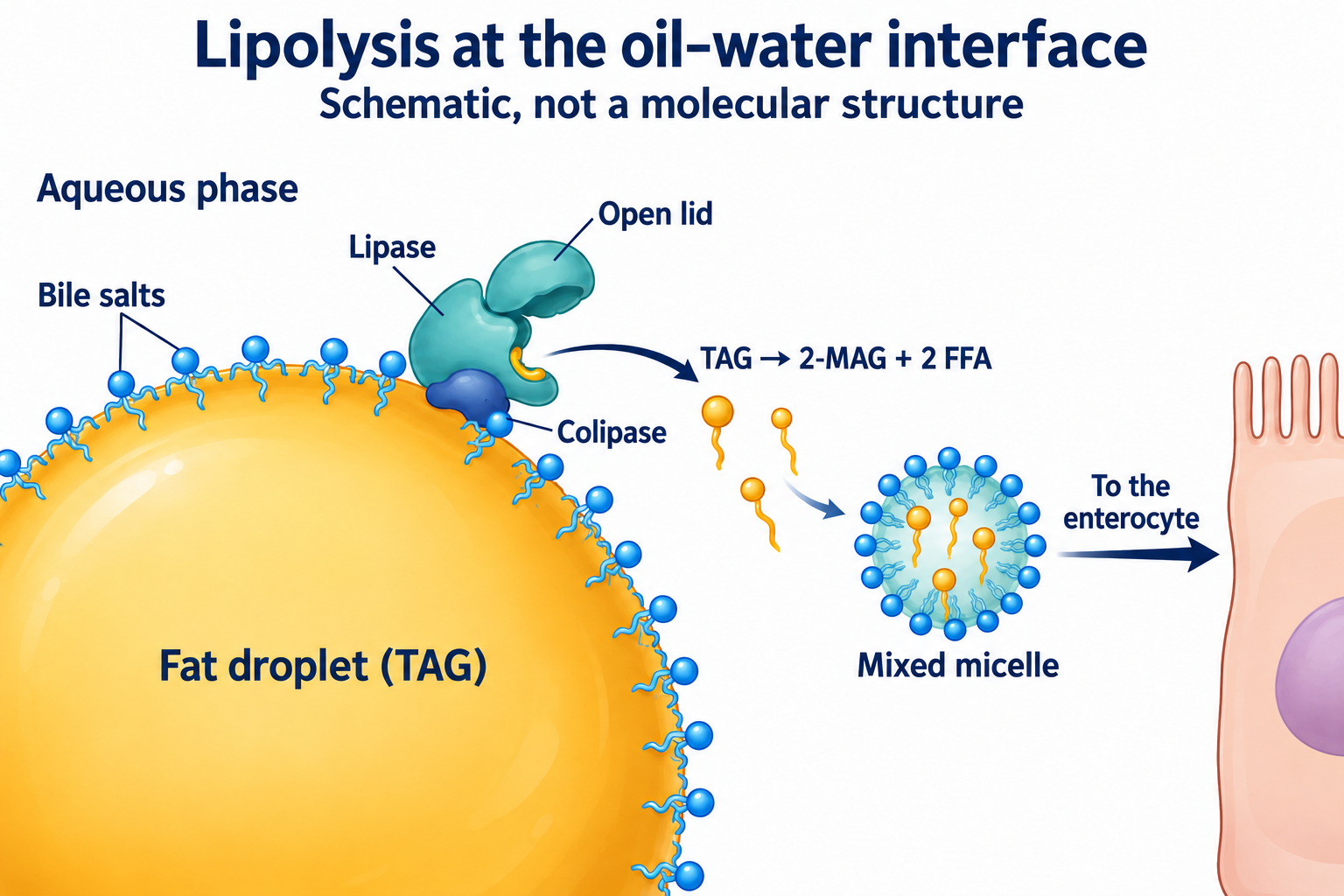
Long-chain triacylglycerol (TAG) forms an oil phase rather than a homogeneous aqueous solution. Pancreatic lipase adsorbs to the oil–water interface and accesses ester bonds there. Its N-terminal catalytic region and C-terminal region involved in colipase interactions perform complementary tasks. Opening of a surface loop, usually called the lid, exposes the active-site region; other loop changes help form the oxyanion hole that stabilizes the tetrahedral reaction intermediate. Crystallographic observations of lipase–procolipase and lipase–colipase complexes support this structural explanation (van Tilbeurgh et al., 1993; Egloff et al., 1995).
The catalytic machinery is a serine–histidine–aspartate triad. Lowe's mutagenesis study identifies Ser153, Asp177 and His264 in that paper's numbering: substitutions could abolish catalysis while preserving interface binding. The PDB 1LPB report uses Ser152 for the corresponding active-site serine. Sequence and structural numbering must therefore be checked before comparing residue numbers across reports (Lowe, 1992; Egloff et al., 1995).
Histidine facilitates activation of the serine hydroxyl, while aspartate helps organize the catalytic system. Serine attacks an ester carbonyl, an oxyanion intermediate forms, and cleavage leaves a transient acyl–enzyme. Water then attacks that intermediate to release the fatty-acid product and regenerate enzyme. A simplified notation is:
E−OH+RCOOR′E−OCO−R+H2O⟶E−OCO−R+R′OH⟶E−OH+RCOOH
Here, E denotes enzyme, RCOOR′ an ester, and E−OCO−R the acyl–enzyme; the formula suppresses the tetrahedral intermediates and shows fatty acid in its protonated notation. Its actual ionization depends on the environment. Lipase preferentially removes the outer sn-1 and sn-3 acyl chains of TAG, yielding predominantly 2-monoacylglycerol (2-MAG) and two free fatty acids (FFA). Further hydrolysis and acyl migration can occur, so this is the principal pathway rather than an assertion that every molecule stops at precisely that product mixture.
Bile salts create a useful but complex interface. They emulsify lipids and support solubilization of digestion products, yet a bile-salt-rich surface can impair lipase adsorption. Colipase binds lipase and helps anchor the complex to that surface. It is a cofactor, not a second triglyceride-hydrolyzing enzyme. Calling procolipase completely inactive until trypsin cleavage is also too strong: the experimentally resolved lipase–procolipase complex already participates in interface activation (van Tilbeurgh et al., 1993).
Figure 1. A conceptual oil–water interface: lipase and colipase remain at the fat droplet, whereas lipid products enter mixed micelles. TAG, 2-MAG and FFA denote triacylglycerol, 2-monoacylglycerol and free fatty acids. Colored glyphs are not chemical structures. The arrow toward the enterocyte means delivery to its brush border: lipids leave the micelle for uptake; the whole micelle is not swallowed by the cell.
What a kinetic model can and cannot describe
Ordinary Michaelis–Menten reasoning assumes that substrate concentration and enzyme exposure are adequately represented by a homogeneous reaction system. For emulsified fat, changing droplet size or the interface coating changes enzyme access even when total TAG concentration is unchanged. A useful conceptual sequence is:
Eaq+IEI+SI⇌EI⇌EIS⟶EI+P
I is an accessible interface, EI interface-bound enzyme, SI accessible surface substrate and P products. At a fixed interface, a conditional saturating-rate approximation is:
v=kcatnE,IKm,I+ΓSΓS
v is the reaction rate in mol/s; kcat has units s⁻¹; nE,I is the amount of catalytically available bound enzyme in mol; and ΓS and Km,I use the same surface-density units, for example mol/m². This model holds interface composition and availability sufficiently stable for the approximation. It does not make a bulk concentration in mmol/L into a surface concentration or identify a universal clinical Km.
Geometry illustrates why emulsification matters. For an ideal population of equal spherical droplets,
A=d6Vlipid
where A is total interface area in m², Vlipid lipid volume in m³ and d droplet diameter in m. The relation follows from sphere geometry, not a human treatment trial. Smaller droplets increase area at constant volume, but actual digestibility also depends on which molecules cover that area and whether enzyme can reach it.
In the intestine, bound enzyme, accessible substrate, bile salts, calcium, pH and product removal change continuously. Fatty acids and MAG can alter the interface; mixed micelles help remove products, and insoluble fatty-acid soaps can form with divalent cations. Numerical turnover rates and apparent Michaelis constants depend on substrate, emulsion, assay definition, temperature, pH and cofactors. Unqualified values are not transferable between experiments. None of these equations converts a meal's fat grams into a patient-specific capsule dose.
Digestion continues beyond the pancreatic enzyme
Mixed micelles contain bile salts and lipid digestion products, with other lipids depending on composition. They help carry poorly water-soluble molecules through the aqueous environment near the intestinal surface. Enterocytes take up available lipid molecules; long-chain fatty acids and MAG are largely re-esterified and incorporated into chylomicrons before lymphatic transport. Micelle formation, uptake and intracellular packaging are successive processes, not synonyms for lipase activity.
Bicarbonate deficiency can couple several problems: reduced lipase stability, a less favorable catalytic environment, delayed dissolution of some enteric coatings and reduced solubility of susceptible bile-acid species. In an acidic environment, protonation can reduce solubility; this is not deprotonation. Glycine and taurine conjugates do not have identical acid–base properties, so a single pH cutoff does not predict precipitation of all bile salts. The broader physiology is explained in bile acids and the gut–liver axis.
This distinction explains why PERT may improve pancreatic maldigestion yet leave another source of malabsorption unresolved. It does not restore an inflamed mucosa, replenish an inadequate bile-salt pool, repair short bowel or reverse cancer-associated inflammation.
When EPI is plausible
Clinical setting
Mechanism relevant to EPI
Interpretation
Chronic pancreatitis
Fibrosis, loss of acinar function and sometimes duct obstruction
Symptoms and nutrition still vary with disease stage and compensation
Cystic fibrosis
CFTR-related duct dysfunction and pancreatic injury
Pancreatic phenotype differs between individuals; CF dosing and nutrition frameworks are specific to this population
Pancreatic cancer
Duct obstruction, loss of functioning tissue and altered intake
Weight loss also includes reduced intake, inflammation and cachexia
Pancreatic resection
Loss of tissue, altered anatomy and meal–enzyme coordination
Total pancreatectomy entails absence of pancreatic enzyme secretion; Whipple procedures also disrupt coordination
Gastric or upper-intestinal surgery
Reduced stimulation, rapid transit or separation of food from pancreatic secretions
Pancreatic secretion can remain present despite inadequate digestion
Diabetes, celiac disease or other intestinal disease
Several possible pancreatic and nonpancreatic mechanisms
A low FE-1 alone does not prove clinically important EPI in every case
AGA guidance identifies chronic pancreatitis, relapsing acute pancreatitis, cystic fibrosis, pancreatic cancer and pancreatic surgery as high-risk settings. Longstanding diabetes and some duodenal disorders warrant consideration according to symptoms and context (Whitcomb et al., 2023). In diabetes, reports of low FE-1 must not be equated with the prevalence of clinically consequential fat maldigestion. Proposed explanations include altered trophic insulin effects, autonomic dysfunction and pancreatic structural changes; the clinical significance and metabolic response to PERT vary (Domínguez-Muñoz et al., 2025).
Consequences can include steatorrhea, bulky stools, diarrhea, bloating, weight loss and deficiencies of vitamins A, D, E and K. Protein and energy deficits can contribute to loss of muscle and bone health problems. Normal body mass index does not exclude nutritional compromise. Stool appearance alone is nonspecific: floating stool, for example, does not establish pancreatic fat maldigestion. Albumin and prealbumin also respond to inflammation and other illness; a low value is not a direct pancreatic absorption measurement.
Testing: secretion, digestion and absorption are different endpoints
Fecal elastase-1 (FE-1) is a useful initial test when interpreted with pretest probability. AGA specifies a semisolid or solid sample: below 100 μg/g provides good evidence of EPI; 100–200 μg/g is indeterminate. Watery stool may dilute the measured concentration. A value of 200 μg/g or more cannot settle every high-risk, mild or postoperative case (Whitcomb et al., 2023; Domínguez-Muñoz et al., 2025).
Human-specific FE-1 assays can be used while a patient takes porcine PERT. Supplementation does not restore the patient's own pancreatic elastase secretion, so FE-1 is not a dose-titration marker and need not normalize with successful treatment. A therapeutic response alone is unreliable as diagnostic proof: symptom relief is nonspecific, and lack of relief can reflect inadequate delivery. European guidance permits a contextual empirical response to support an otherwise difficult assessment, while explicitly noting the weak evidence; it does not turn that response into a stand-alone confirmatory test.
CT, MRI and endoscopic ultrasound identify pancreatic disease and anatomical causes; they do not directly establish functional EPI. Specialized secretin or CCK tests measure stimulated secretion. Secretion is informative but is not identical to the ability to digest an actual meal.
The coefficient of fat absorption (CFA) evaluates fat balance:
CFA(%)=100×FintakeFintake−Fstool
Both quantities are fat amounts in the same units over a matched collection period. A conventional research protocol combines a standardized intake, often 100 g fat/day, with a 72-hour stool collection. Collection completeness and food recording matter. CFA identifies impaired fat absorption but does not uniquely identify its pancreatic cause; bile-related and mucosal disease can also reduce it. Whether and how treatment is withheld belongs to the clinician's testing protocol, not an unsupervised home experiment.
The ¹³C-mixed-triglyceride breath test follows labeled substrate through digestion, absorption and oxidation to exhaled ¹³CO₂. In a commonly used substrate the labeled octanoyl group is at sn-2, with long-chain stearoyl groups at sn-1 and sn-3. The first outer-bond cleavages by pancreatic lipase yield a labeled MAG intermediate; they do not directly free the sn-2 label. Subsequent processing and metabolism produce the breath signal. Gastric emptying, intestinal uptake, metabolism and the protocol therefore influence recovery. An abnormal result is not a pure, direct measurement of lipase catalytic activity and can occur with nonpancreatic malabsorption. Availability varies (Domínguez-Muñoz et al., 2025).
After pancreaticoduodenectomy or some upper gastrointestinal operations, postcibal asynchrony is particularly important: food and enzymes meet at the wrong time or place. FE-1 primarily reflects secretion and may not capture that defect. European guidance specifically cautions against its use as the diagnostic measure after pancreaticoduodenectomy and favors assessment of digestion in the relevant setting.
Formulation changes where active enzyme becomes available
Pancreatin or pancrelipase is a mixture of lipase, protease and amylase, usually of porcine origin. Labeling commonly centers on lipase activity units. Enzyme mass in milligrams does not adequately describe activity, and pharmacopoeial assays must be checked before comparing enzyme-unit claims across preparations. Equal stated units do not guarantee identical delivery in every patient.
Nonporcine enzyme mixtures, including microbial preparations, are a research avenue. In a 2011 randomized-withdrawal CF trial, 138 participants were randomized after open-label liprotamase treatment; the adjusted between-group difference in CFA change was 10.6 percentage points overall versus placebo. This supports activity in that study design, not equivalence to a porcine product (Borowitz et al., 2011). In 2025, a dose-ranging CF study of the microbial lipase/protease/amylase mixture ANG003 reported dose-related improvement in fat absorption using blood-based substrate challenges. Those endpoints differ from a fecal CFA comparison and do not establish long-term nutritional benefit or routine interchangeability (Sathe et al., 2025). Resistance to low pH or proteolysis can be a useful formulation property, but fungal or bacterial origin alone proves neither clinical efficacy nor equivalence. Neither experiment supports replacing prescribed PERT with an arbitrary over-the-counter digestive-enzyme blend.
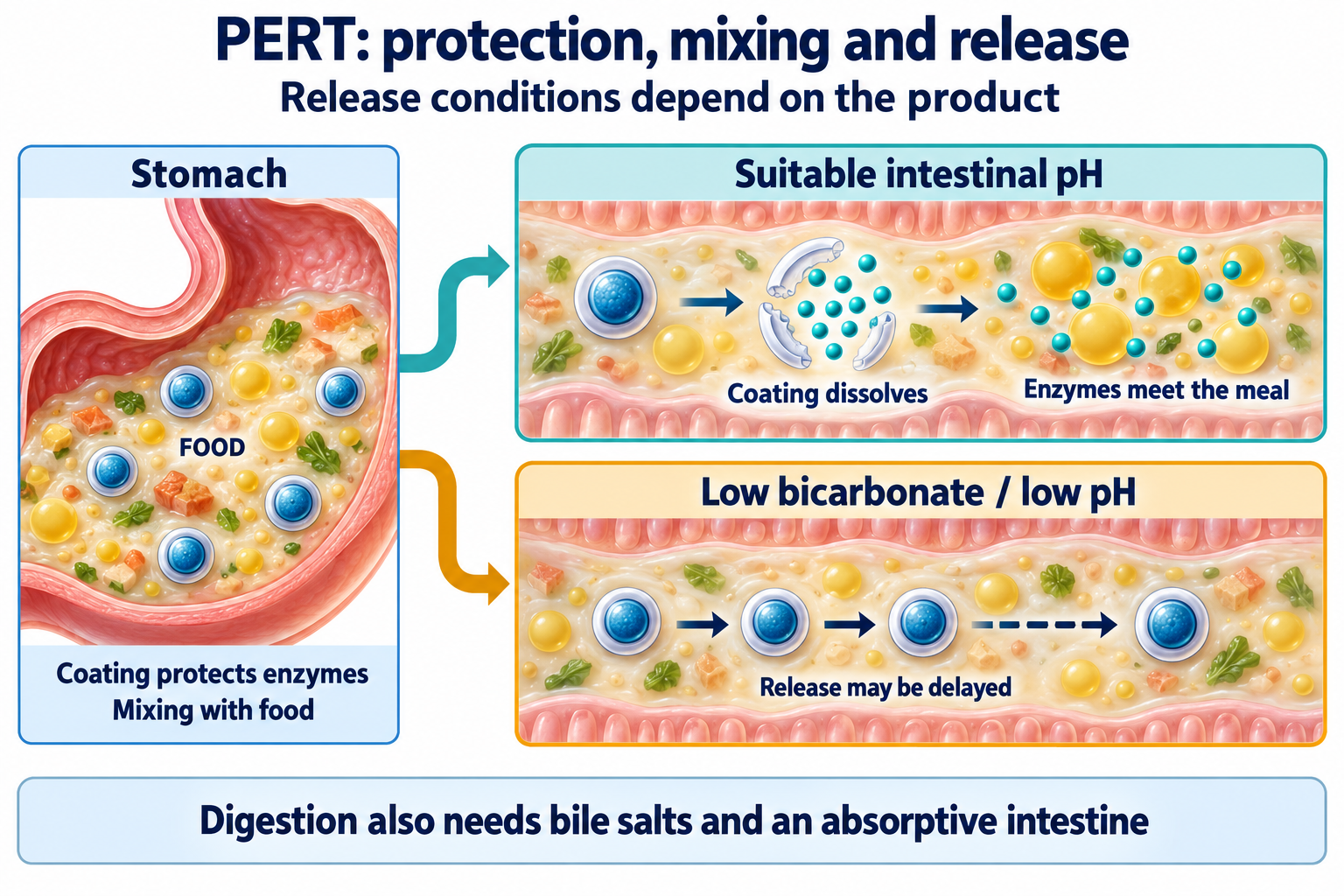
Enteric-coated pellets aim to protect enzymes from gastric acid and release them after reaching an appropriate intestinal environment. For coatings with acidic groups, the conceptual ionization is:
COOH⇌COO−+H+
Increasing ionization can promote hydration and dissolution, but the release threshold also depends on the polymer and formulation. This is not a universal pH switch for all brands. The inspected US CREON label lists hypromellose phthalate among its coating ingredients, reports particles of 0.71–1.60 mm and describes release at approximately pH 5.5 or above. It does not justify assigning Eudragit L30D-55 to every pancrelipase product. Methacrylate coatings and other polymers belong to particular formulations, not a single universal composition (CREON prescribing information, displayed 2024 version).
Small particles favor dispersion through a meal and gastric emptying alongside nutrients. In Meyer's study of 26 healthy participants, 1-mm spheres emptied faster than 2.4- or 3.2-mm spheres under the studied conditions, and a size around 1.4 ± 0.3 mm at the studied density approximated liver emptying. Meal size and density also mattered. This does not establish an absolute pyloric sieve that retains every particle above 2 mm, nor a clinical superiority claim for a product based solely on diameter (Meyer et al., 1988).
Figure 2. An enteric-coated formulation as a delivery example. Protected particles mix with food; suitable intestinal conditions allow coating dissolution and enzyme contact with the meal. Low bicarbonate and low pH may delay release. Uncoated prescribed preparations also exist and require acid suppression; the diagram does not represent every PERT product. Neither pathway guarantees a particular CFA.
Dissolution testing in vitro asks when and how an enzyme is released under an assay's pH, buffer, agitation and sampling conditions. Clinical effectiveness asks how nutrients are digested and absorbed in a person. A fast laboratory release curve cannot establish a universal absorption percentage or rank brands clinically without appropriate comparative trials.
Uncoated pancrelipase is not intrinsically useless: acid suppression is needed to prevent acid-mediated inactivation. For coated products, adding a proton pump inhibitor is an individualized step when response remains inadequate after delivery and dose have been checked; it is not mandatory for every patient (Whitcomb et al., 2023; Domínguez-Muñoz et al., 2025).
Human trial outcomes: clear short-term benefit, bounded inference
Official CREON prescribing information reports randomized trials using CFA rather than just laboratory enzyme activity. These data support improved fat absorption in the studied EPI populations.
Study and population
Design and exposure
Reported result
Boundary of inference
CREON study 1, CF ages 12–43
Crossover, 32 enrolled; 29 analyzed; 5–6 days per treatment
Mean CFA 89% with enzyme versus 49% with placebo; reported treatment difference 41 percentage points, 95% CI 34–47
Short, controlled-diet trial; not a universal individual absorption value
CREON study 2, CF ages 7–11
Crossover, 17 enrolled; 16 analyzed; 5–6 days per treatment
Mean CFA 83% versus 47%; reported difference 35 points, 95% CI 27–44
Population and product-specific; rounded means need not exactly reproduce modeled differences
CREON study 4, chronic pancreatitis or pancreatectomy
54 randomized adults; 52 in final analysis; 7-day double-blind period
End CFA 86% versus 66%; label reports a treatment difference in change of 21 points, 95% CI 14–28
The endpoint and analysis must not be confused with simply subtracting final means; not a long-term survival study
Bruno et al., 1998, selected unresectable pancreatic-head cancer
21 patients, 8 weeks; enzyme or placebo plus dietary counseling
Weight increased 1.2% with enzyme and declined 3.7% with placebo; between-group difference 4.9%, 95% CI 0.9–8.9
Small selected population; the CFA comparison was not statistically significant
Woo et al., 2016, unresectable pancreatic cancer
67 patients randomized in a double-blind trial
No significant improvement in the primary 8-week weight outcome; no significant survival difference
Demonstrates that a weight or survival benefit cannot be promised for every cancer population
The CF trials used 4,000 lipase units per gram of fat per day with controlled high-fat diets. Study 4 used 72,000 units per main meal and 36,000 per snack during its double-blind period. These are trial protocols, not instructions to reproduce them at home. The label's study-4 change scores and reported treatment difference use different statistical summaries; the reported 21-point difference should not be replaced by an arithmetic subtraction of rounded means.
PERT addresses a treatable digestive component of pancreatic cancer-associated malnutrition. It is not anticancer treatment and cannot reliably reverse inflammation-driven cachexia by itself. Observational associations with survival may reflect treatment access, nutrition, disease stage and other confounding. The European recommendations note that sufficiently long randomized trials establishing morbidity or mortality effects are lacking. A fixed extra number of months of survival or a specific cardiovascular mortality reduction in chronic pancreatitis is not supported here (Domínguez-Muñoz et al., 2025).
Dose and meal timing require clinical context
Activity must accompany food. Taking PERT during meals and snacks supports mixing; dividing a prescribed meal dose across a longer meal can maintain contact. The European review describes a small crossover study with normalization proportions of 50% before, 54% after and 63% when distributed through a meal. Its meal and other protocol conditions constrain interpretation. It does not prove an exact timing interval for everyone or that a dose taken just before eating is entirely ineffective.
Reference context
Example starting framework
Qualification
AGA 2023 adult advice
At least 40,000 USP lipase units with a main meal and about half with snacks
Adjust for meal size/fat and the individual's response
European 2025 adult guidance
40,000–50,000 lipase units with main meals; 20,000–25,000 with snacks
Starting framework; some surgery or severe EPI may need a different plan
Inspected CREON US label, adult chronic pancreatitis or pancreatectomy
500–1,000 lipase units/kg/meal initially
Product-specific label; dose depends on symptoms, fat intake and response
CFF guidance for older children and adults with CF
500–2,500 units/kg/meal or 500–4,000 units/g fat; snack amounts are usually lower
CF-specific framework, beginning toward the lower end and titrated by the treating team
Infants and young children have different product and CF-specific instructions. For example, the inspected CREON label uses 3,000 units per 120 mL of formula or per breastfeed for birth to 12 months, whereas CFF guidance describes 2,000–4,000 units per 120 mL or per breastfeed. Such differences make the governing prescription and local product instructions essential; they are not interchangeable universal infant doses.
The inspected CREON label calls for further investigation before exceeding 2,500 units/kg/meal, 10,000 units/kg/day or 4,000 units/g fat. CFF also highlights high meal doses and the association of doses above 6,000 units/kg/meal with fibrosing colonopathy. These are safety and investigation thresholds in their stated contexts, not proof that every lower dose is safe or that an absolute general ceiling has been established for every patient.
Coated granules must not be crushed or chewed. When a product allows opening a capsule, the permitted acidic food and administration method come from that product's instructions. Mixing granules into a feeding bottle or using a feeding tube is not automatically equivalent to swallowing an intact dose; compatibility, clogging, release and clinical effectiveness require a specific protocol. Heat, moisture and expiry can affect enzyme activity. Storage instructions therefore belong to treatment effectiveness as well as convenience.
Persistent symptoms call for an explanation
A practical reassessment first establishes whether prescribed activity accompanies all relevant meals and snacks, whether the product is stored and administered correctly, and whether meal composition or altered anatomy impedes contact. The clinician can then consider individualized dose adjustment, a formulation change or acid suppression when appropriate. Increasing enzymes indefinitely without reassessment can miss another cause.
Bacterial overgrowth can deconjugate bile salts and worsen fat handling. It can also cause bloating or diarrhea independently of EPI; its prevalence cannot be assigned a fixed percentage to every EPI population. See small intestinal bacterial overgrowth and motility for diagnostic limitations. Other explanations include celiac disease, giardiasis, inflammatory or microscopic colitis, bile-acid diarrhea, medication effects and postsurgical transit disorders. Their investigation and treatment are diagnosis-specific, not an automatic antibiotic or bile-acid-binding prescription (Domínguez-Muñoz et al., 2025).
Nutrition and monitoring remain part of treatment
Successful treatment is assessed through symptoms together with weight trajectory, intake, muscle status and correction of deficiencies. Vitamins A, D, E and K, relevant minerals and bone health need attention according to the disease and individual risk. AGA advises nutritional assessment and bone-density evaluation, with follow-up guided by the clinical setting. Symptom relief alone can overlook ongoing nutritional loss.
An adequate, varied diet with sufficient energy, protein and fat is usually preferable to severe fat restriction, which can worsen energy and essential-fatty-acid intake. PERT should be optimized with dietetic support rather than assuming all dietary fat must be removed. CF nutrition recommendations must not be applied unchanged to every adult with EPI; neither should fixed calorie, protein or fat targets replace individualized assessment.
Medium-chain triglycerides (MCT) may help in selected nutrition plans because their fatty-acid products depend less on bile-mediated micellar transport and more readily reach portal circulation. The triglycerides still require hydrolysis; intact MCT is not simply transported directly into portal blood. MCT does not replace essential long-chain fatty acids, fat-soluble vitamins or indicated PERT, and excessive intake can cause gastrointestinal symptoms. Specialized enteral formulas and tube administration require dietetic and clinical planning.
Iron, folate or B12 deficiencies deserve evaluation of intake, inflammation, intestinal disease and the underlying pancreatic condition. Older hypotheses about enzyme-related binding or reduced absorption do not justify a universal instruction to separate iron from every PERT dose. The read European guidance reports no identified drug interactions to date; it is more appropriate to evaluate a real deficiency and the specific products than to prescribe routine spacing rules without evidence.
Safety and long-term expectations
Fibrosing colonopathy is a rare serious concern historically associated with very high enzyme doses, particularly in young children with CF. FitzSimmons and colleagues compared 29 cases with 105 controls and found a strong dose association. This observational study did not establish coating composition, manufacturer or product strength as the cause. Claims that one polymer is proven to cause the condition overstate the evidence (FitzSimmons et al., 1997).
Porcine-derived preparations can cause hypersensitivity, and high purine exposure can matter in hyperuricemia, gout or renal impairment. The inspected product label calls for appropriate caution and assessment; an exact universal allergy frequency or an automatic contraindication for every reported pork-food allergy is not inferred. Abdominal pain, constipation or diarrhea may reflect the disease, treatment or another condition and require contextual review.
PERT commonly remains necessary when the underlying deficit persists, and lifelong replacement is expected after total pancreatectomy. Partial resection, pancreaticoduodenectomy and upper gastrointestinal surgery need individualized reassessment of secretion and digestive coordination. Treatment can improve absorption without restoring damaged pancreatic tissue. Long-term success combines adequate delivery, nutrition and management of the cause; it does not mean a normalized FE-1 or a guaranteed prevention of every complication.
How this material was checked
The editorial evidence check is dated 8 October 2026. The entire supplied manuscript was reviewed, followed by targeted verification of mechanisms, diagnostic interpretations, product claims and numerical human outcomes. The bibliography combines primary structural and human-study reports with official prescribing information and society recommendations. This was a targeted narrative check, not an exhaustive systematic review, formal GRADE assessment or external peer review.
Access was uneven. Full PubMed abstracts were read for the cited clinical and physiological studies; the 1992 mutagenesis abstract was available through indexed author-posted content while direct publisher access was restricted. Primary structure metadata and the linked abstract were read through RCSB. Selected complete diagnostic, therapeutic, nutrition, surgery and diabetes sections of the published 48-page European article were read through an institutional repository; the entire PDF was not read end to end. The official CREON label returned the version displayed as updated 28 February 2024, and the CFF page stated review in July 2021 without an update. These are the versions actually inspected, not a guarantee of identical current instructions in every country.
Some original identifiers led to unrelated articles and were excluded. Quantitative claims without a verified population, assay or endpoint were corrected or removed. Molecular structures, laboratory release, short-term absorption, nutritional outcomes and survival are kept distinct so that an established mechanism is not presented as proof of an untested clinical benefit.
A targeted coverage check on 9 October 2026 additionally inspected indexed primary abstracts on nonporcine PERT and the publisher-indexed ANG003 corrigendum (an author-affiliation correction); full trial manuscripts were not read for this addendum.
FAQ
Does a low fecal elastase result prove EPI?
Interpret it with stool consistency, pancreatic risk and nutrition. Below 100 μg/g is strong evidence in the appropriate setting; 100–200 μg/g is indeterminate. Watery stool and nonpancreatic conditions can complicate the result, and postoperative digestive asynchrony may require other assessment.
Should PERT be stopped for a fecal elastase test?
A human-specific FE-1 assay can be used while taking porcine PERT. The clinician determines the protocol for other digestion tests; stopping treatment independently is not implied.
Does a capsule’s lipase-unit number predict fat absorption?
It describes activity measured in a specified assay. Mixing, gastric transit, coating release, pH, bile salts and intestinal uptake determine how much of that activity becomes effective with a meal.
Does everyone need acid suppression with PERT?
Uncoated preparations require protection from gastric acid. For enteric-coated preparations, acid suppression is considered individually when response remains inadequate after administration and dosing are reviewed.
Can fungal enzymes or MCT replace prescribed pancrelipase?
Their properties and clinical evidence differ. Nonporcine alternatives have not established equivalent efficacy across the settings discussed, and MCT does not supply the full nutritional or digestive replacement. Changes require the treating team.
Does PERT improve survival in pancreatic cancer?
It can treat a digestive contribution to malnutrition, but randomized cancer trials have produced different nutritional results and do not establish a universal survival gain. Observational survival associations can be confounded.