Myo-inositol and DCI: PCOS, 40:1, and the evidence — NutriFit
Myo-inositol and D-chiro-inositol in PCOS: mechanisms and 40:1
MI/DCI stereochemistry, synthesis, transport, IPGs, and ovarian signaling. What 40:1 means, what ovulation, IVF, and pregnancy studies show, and why cellular mechanisms do not establish a universal dose or increased live birth.
The 40:1 ratio has become a familiar label for combinations of myo-inositol (MI) and D-chiro-inositol (DCI). It describes a product's composition but does not, by itself, determine its dose, distribution within the ovary, or the likelihood of a live birth. Transport, synthesis, cellular signaling, and the features of the disorder lie between the free cyclitol in a sachet, a membrane phosphoinositide, and a clinical outcome. Examining those steps is more useful than declaring one ratio a universal “gold standard.”
Most studies informing this discussion use the name polycystic ovary syndrome, PCOS. The Monash international initiative's website reports its renaming on 12 May 2026 to polyendocrine metabolic ovarian syndrome, PMOS, to reflect the condition's endocrine and metabolic complexity. The familiar abbreviation PCOS is retained here to allow comparison with the research; a change of name does not turn older findings into new evidence of efficacy (Monash, 2026).
From stereochemistry to a substrate the cell can access
Inositol is a cyclic six-hydroxyl alcohol, or cyclitol, with the formula and molar mass:
C6H12O6,M≈180.16gmol−1.
It is sometimes called “vitamin B8,” but the human body synthesizes MI, so this historical label does not establish a generally recognized vitamin requirement. Of the nine stereoisomers, seven are meso forms, whereas D- and L-chiro-inositol form an enantiomeric pair. The nine therefore cannot all be described as diastereomers of one another. MI is achiral despite its complex ring configuration; DCI is a distinct stereoisomer, not another name for MI or its phosphorylated form (Larner, 2002).
In MI's predominant chair conformation, five hydroxyl groups are equatorial and one is axial. Chiro forms have a different spatial arrangement, affecting recognition by transporters and enzymes. A chair flip is thermodynamically less favorable, rather than forbidden. The relative populations of two conformations depend on free energy and temperature:
p1p2=exp(−RTΔG2−1).
This expression supplies no numerical ratio without a ΔG measured or calculated for the particular environment. Hydrogen bonding between hydroxyl groups and water explains hydrophilicity and MI's osmotic role without requiring a fixed number of water molecules in a “hydration shell.” Free inositol lacks the carbonyl group of a reducing sugar, so equating it with glucose in the Maillard reaction is incorrect. This chemistry nevertheless cannot establish the absolute safety of every clinical dose.
MI is obtained from food and synthesized endogenously. Some of the inositol backbone in plant foods occurs in phytate, inositol hexakisphosphate, IP6. Its availability depends on food processing, phytase activity, and the microbiota; mineral-cation binding depends on pH and the meal's composition. Phytate is not equivalent to already absorbed free MI, and IP6's charge in a biological environment cannot always be assigned a fixed value of −12. Soaking, fermentation, and germination can alter phytate content without producing an exact supplement-dose equivalent.
Synthesis, recycling, and renal catabolism
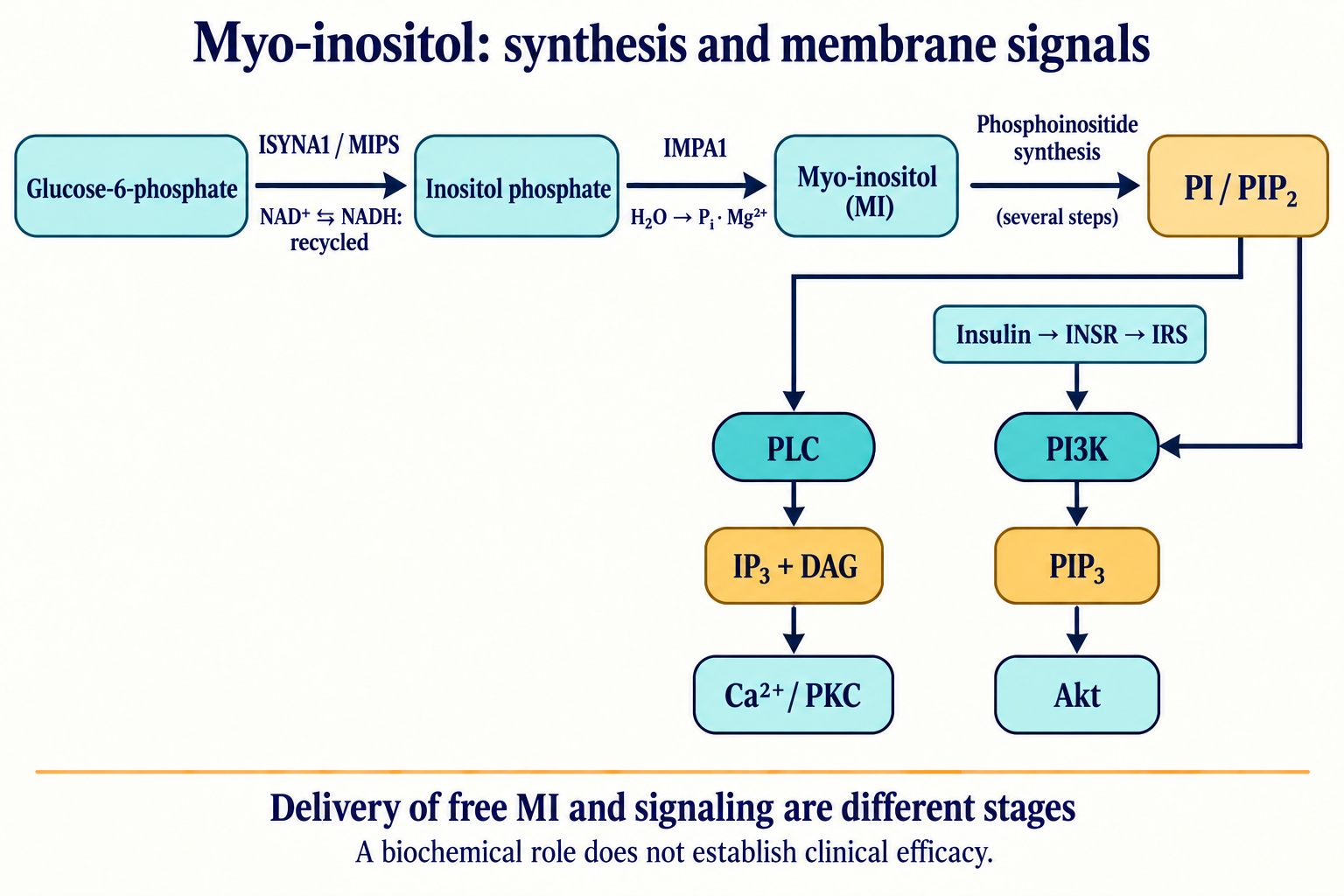
Glucose-6-phosphate is converted into inositol monophosphate by myo-inositol phosphate synthase, MIPS, encoded by ISYNA1. Its catalytic cycle includes NAD⁺/NADH-dependent redox steps, carbon-skeleton cyclization, and cofactor regeneration. NAD⁺ is not consumed as a separate stoichiometric product of the overall reaction; obligatory covalent attachment in the human enzyme should not be asserted either. Partially purified MIPS from human fetal liver operated with glucose-6-phosphate and NAD, but such a preparation does not define universal oligomeric organization or kinetic constants across tissues (2012 study).
Inositol monophosphatase, including IMPA1, hydrolyzes the phosphate ester using water and Mg²⁺. It completes free-MI synthesis and contributes to recycling after the breakdown of phosphorylated derivatives:
The human IMPase structure determined by Bone and colleagues in 1992 at 2.1 Å resolution revealed a dimer of identical subunits and a hydrophilic active site. In 1994 complexes with substrates and inhibitory Gd³⁺, the positions of phosphate, water, and residues Glu70, Thr95, Asp90, Asp93, and Asp220 helped develop a metal-dependent hydrolysis mechanism. Crystal metal content depends on conditions: two or three ions in different complexes do not demonstrate invariant “three Mg²⁺” occupancy in every state of human IMPase. Li⁺ inhibits the enzyme; inositol depletion is one mechanistic hypothesis for lithium's action, rather than a complete explanation of its psychiatric effects or a reason to independently offset it with MI supplementation (Bone et al., 1992, 1994).
The kidney is important for MI synthesis, tubular transport, and catabolism. Myo-inositol oxygenase, MIOX, uses a di-iron center and O₂ to open the ring and generate D-glucuronate; the subsequent glucuronate–xylulose pathway connects this process with carbohydrate metabolism. Brown and colleagues' 2006 structural study examined an MIOX–MI complex at 2.0 Å resolution: four histidines and two aspartates coordinated the di-iron center, while two substrate oxygens bound one iron atom. This informs catalysis but does not measure MI flux through an individual patient's kidneys.
myo−inositol+O2MIOXD−glucuronate+H2O.
Endogenous synthesis, food intake, reabsorption, and excretion form a dynamic balance. A single figure for daily synthesis, bioavailability, or renal recovery should therefore not be presented as constant across ages, disorders, and doses.
Transport: ingested mass is not ovarian concentration
SMIT 1, encoded by SLC5A3, and SMIT 2, encoded by SLC5A11, use the sodium gradient to concentrate inositols. Na⁺/K⁺-ATPase maintains this gradient; transport depends on membrane potential, transporter expression, and substrate availability. For a general Na⁺-coupled transport process, free energy can be written as:
I denotes the transported neutral inositol and n the Na⁺ stoichiometry of the particular transporter. The expression explains the energetic possibility of accumulation without establishing identical stoichiometry or rates in every tissue. Hypertonicity increases SMIT 1 expression through TonE and TonEBP/NFAT5, allowing MI to accumulate as a compatible osmolyte. Rim and colleagues' 1998 primary study identified multiple regulatory elements across an extensive region upstream of the transporter gene. This is cellular adaptation to the environment, not evidence of MI deficiency in everyone with insulin resistance.
HMIT, SLC2A13, represents a different mechanism: H⁺-coupled transport studied predominantly in the nervous system. Uldry and colleagues in 2001 demonstrated increased transport at lower pH in Xenopus oocytes, with a Km of approximately 100 µM. Heterologous expression and acidic experimental conditions cannot be extrapolated to dietary MI absorption or used to designate HMIT the universal principal ovarian transporter.
SMIT 2 provides a useful test of the popular claim that “glucose blocks all inositol.” Expression of human SMIT 2 in L6 cells increased MI and DCI transport but not glucose transport. Glucose nevertheless competitively inhibited DCI uptake: in this system, its Ki was 6.1 mM and the DCI Km was 111 µM. A simple competitive model is:
v=Km(1+[G]/Ki)+[I]Vmax[I].
These are parameters from a particular cell experiment, not a clinical glucose threshold above which a supplement “cannot be absorbed.” They do not establish mandatory fasting administration, a coffee prohibition, or a rigid food–MI interval. Tissue distribution also depends on blood flow, endogenous synthesis, metabolism, and membrane phospholipid availability; a plasma ratio does not automatically reproduce itself within a follicle (SMIT 2 study, 2009).
Two kinds of signaling that should be distinguished
Free MI is a substrate, whereas phosphatidylinositol, PI, and its phosphorylated derivatives are membrane lipids. PI synthesis from CDP-diacylglycerol and MI, subsequent phosphorylations, and membrane turnover generate local pools. Neither blood MI nor total supplement mass directly measures PI(4,5)P₂ in the relevant membrane.
Phospholipase C cleaves PIP₂, generating soluble IP₃ and membrane-associated diacylglycerol, DAG. IP₃ binds endoplasmic-reticulum receptors and alters Ca²⁺ release, while DAG participates in PKC activation; some PKC isoforms also require Ca²⁺. This branch operates in a range of receptor responses:
PI(4,5)P2+H2OPLCIns(1,4,5)P3+DAG.
A different branch begins with insulin-receptor, INSR, activation, its tyrosine-kinase activity, and IRS proteins. PI3K uses PIP₂ as a substrate to generate PIP₃, organizing membrane recruitment of PDK1 and Akt. Akt phosphorylation at Thr308 is associated with PDK1 and at Ser473 with mTORC2. This is neither a single PLC reaction nor the direct conversion of MI into Akt:
PI(4,5)P2+ATPPI3KPI(3,4,5)P3+ADP.
In muscle and adipose tissue, the signaling network regulates GLUT4 translocation. Through GSK3 and glycogen synthase it influences glucose storage, and through PDE3B and cAMP it suppresses lipolysis. These connections depend on cell type and feedback. IRS serine phosphorylation cannot all be classified as pathological: different sites, timing, and species change its consequences. In particular, the same residue number in a mouse and a human does not guarantee the same sequence position.
Inositol phosphoglycans and pyruvate dehydrogenase
A separate historical research strand concerns inositol phosphoglycans, IPGs: heterogeneous molecules discussed as putative insulin mediators and associated with glycosylphosphatidylinositol structures. Free DCI is not an IPG. A cyclitol may be part of a more complex mediator containing sugar and phosphate groups; its oral administration does not establish that the cell has produced a particular IPG of the required structure.
In classical fractions, DCI and galactosamine were associated with activation of pyruvate dehydrogenase phosphatase; MI and glucosamine were associated with inhibition of adenylate cyclase and cAMP-dependent kinase. Activation of phosphoprotein phosphatases, including PP 2C, and changes in glycogen-synthase phosphorylation were also discussed. This is experimental biochemistry of isolated fractions, not a replacement for the complete INSR–IRS–PI3K–Akt network (Larner, 2002).
Asplin and colleagues in 1993 found reduced action of a chiro-containing pH 2 mediator in preparations derived from people with diabetes, whereas the MI-containing pH 1.3 fraction's activity did not change in the same way. These pH values describe fraction separation, not the “isoelectric point” of a nonpeptide inositol phosphoglycan. They cannot establish universal structures, atomic binding pockets, or identical effects of free MI and DCI.
Phosphorylation of the pyruvate dehydrogenase complex's E1 by PDK reduces its activity, while dephosphorylation by PDP favors activation. The complex converts pyruvate into acetyl-CoA:
pyruvate+CoA−SH+NAD+⟶acetyl−CoA+CO2+NADH+H+.
Its operation requires thiamine diphosphate, Mg²⁺, covalently attached lipoamide, FAD, NAD⁺, and CoA. Putative IPG regulation of PDP differs from supplying cofactors to the complex. The distinction between E2's lipoamide arm and a free supplement is explored in the article on R-alpha-lipoic acid and pyruvate dehydrogenase; neither mechanism automatically establishes the effectiveness of combining supplements in PCOS.
Epimerization and the “ovarian paradox”: a useful hypothesis with boundaries
MI and DCI differ in the spatial orientation of a hydroxyl group. This conversion is called epimerization; it has nothing to do with epoxide reductase, because no epoxide ring is involved. Tissue-preparation studies show conversion of MI into chiro-inositol, but the molecular identity, regulation, and universal atomic mechanism of the relevant human enzyme have not been established well enough to confidently specify its gene, Akt-dependent phosphorylation sites, and active-site residues.
Sun and colleagues in 2002 studied diabetic GK rats and control Wistar rats. In the tissues examined, MI-to-chiro conversion was approximately 20–25% in controls and below 5% in GK rats; measured activity in tissue extracts was also reduced. Full activity in the preparation required NADH and NADPH. This supports the involvement of redox steps without demonstrating one particular NAD⁺-dependent mechanism in all human tissues.
MI⇌DCIschematic epimerization, not an established complete human cycle.
Oxidation of an alcohol group to a ketone intermediate followed by reduction from the opposite face provides a chemically plausible model for changing configuration. It cannot be promoted to proof of direct epimerase phosphorylation by Akt, nor can the reaction be declared irreversible simply because its product is a minor species. Measured tissue flux depends on enzymes, cofactors, substrate availability, and product removal.
The “ovarian paradox” arose from attempts to reconcile peripheral insulin resistance with a preserved ovarian steroidogenic response to hyperinsulinemia. Deficiency of chiro-containing mediators had been described in muscle and other tissues. In cultured PCOS theca cells, Heimark and colleagues in 2014 found the opposite direction: higher epimerase activity and a lower MI/chiro-inositol ratio than in control cells. The authors explicitly left the biochemical and genetic mechanisms for further investigation.
This suggests a hypothesis: excessive insulin signaling in some ovarian cells may alter local inositol balance differently from peripheral tissues. It does not establish one concentration throughout the ovary, an obligatory “500-fold” MI reduction in every follicle, or 100% sensitivity of every ovarian signaling branch. PCOS is heterogeneous; obesity amplifies some risks, but insulin resistance and reproductive dysfunction cannot be reduced to one body-weight category.
Theca, granulosa, and the oocyte respond differently
In the two-cell, two-gonadotropin model, LH stimulates theca cells, where cholesterol is converted into steroid precursors and androgens. CYP11A1 initiates steroidogenesis by generating pregnenolone; HSD3B and CYP17A1 contribute to subsequent conversions. Androgens enter granulosa cells, where FSH promotes aromatase, CYP19A1, expression and androgen-to-estrogen conversion. cAMP/PKA has a central role in gonadotropin-receptor responses, while interactions with insulin, IGF, and other pathways depend on follicular stage and cell type.
Hyperinsulinemia can enhance androgen responses and reduce hepatic SHBG production, increasing the free-androgen fraction. In Nestler and Jakubowicz's 1996 study, metformin in 24 women with obesity and PCOS reduced insulin exposure and the stimulated 17-hydroxyprogesterone response. This supports insulin's contribution to ovarian steroidogenic dysregulation; it does not demonstrate direct allosteric binding of free DCI to CYP17A1.
The association between MI, FSH, and oocyte quality likewise requires several intermediate steps. MI supplies substrate for inositol molecules, but the FSH receptor is not directly an “MI-dependent enzyme.” An association between follicular-fluid MI and oocyte maturity does not establish that low MI alone blocks FSH or that an oral supplement necessarily restores a specific membrane pool. Chiu and colleagues' 2002 observational study of 53 IVF patients associated higher follicular-fluid MI with mature, fertilized oocytes and embryo quality. Differences in follicular development and other confounders may contribute.
Inositol signaling participates in oocyte Ca²⁺ dynamics. At fertilization, PLCζ promotes IP₃ generation and calcium oscillations needed for oocyte activation. Maturation from the germinal-vesicle, GV, stage to metaphase II, MII, also involves distinct processes of meiosis, energy supply, and cytoskeletal reorganization. Their biological dependence on calcium signaling is not equivalent to a demonstrated increase in live births after MI.
DCI: early efficacy and limitations of the harm argument
DCI monotherapy cannot be declared inherently ineffective. In Nestler and colleagues' 1999 double-blind trial, 44 women with obesity and PCOS received 1200 mg DCI or placebo for 6–8 weeks, with 22 in each group. Ovulation occurred in 19/22 versus 6/22. Insulin area under the curve decreased within the DCI group, but the between-group comparison of change had P=. 07; glucose tolerance did not significantly improve. This small, short trial supports a possible reproductive effect in that population without establishing an optimal combination or an effect on live birth.
The converse argument—that high-dose DCI causes proven widespread oocyte death—often conflates two different studies. Sacchi and colleagues in 2016 examined primary granulosa-lutein cell cultures from eight regularly cycling women undergoing IVF for male-factor infertility. DCI at 10–20 nM reduced CYP19A1, P450scc, and IGF1R expression and modified responses to insulin and gonadotropins. Viability remained above 95%, with no notable treatment differences. This is transcript regulation in culture, not a demonstration of oocyte apoptosis, theca-cell damage, or toxicity at a particular oral dose.
Isabella and Raffone's 2012 study did describe poorer oocyte parameters with increasing DCI doses up to 2400 mg/day in 54 normoglycemic patients without insulin resistance before stimulation. However, a current editorial Expression of Concern, updated on 23 November 2018, identifies doubts about ethical approval and scientific content; Raffone denied authorship. This should not be relabeled a formal retraction, but its results cannot be treated as uncontested evidence of toxicity.
The appropriate conclusion lies between the extremes: different doses and ratios cannot be assumed interchangeable, while clinical harm from high DCI doses cannot be quantified from one disputed study and a cell experiment. Increasing DCI's proportion without a clear objective is not justified; neither a universal safe nor a toxic fertility threshold has been established.
What 40:1 actually means
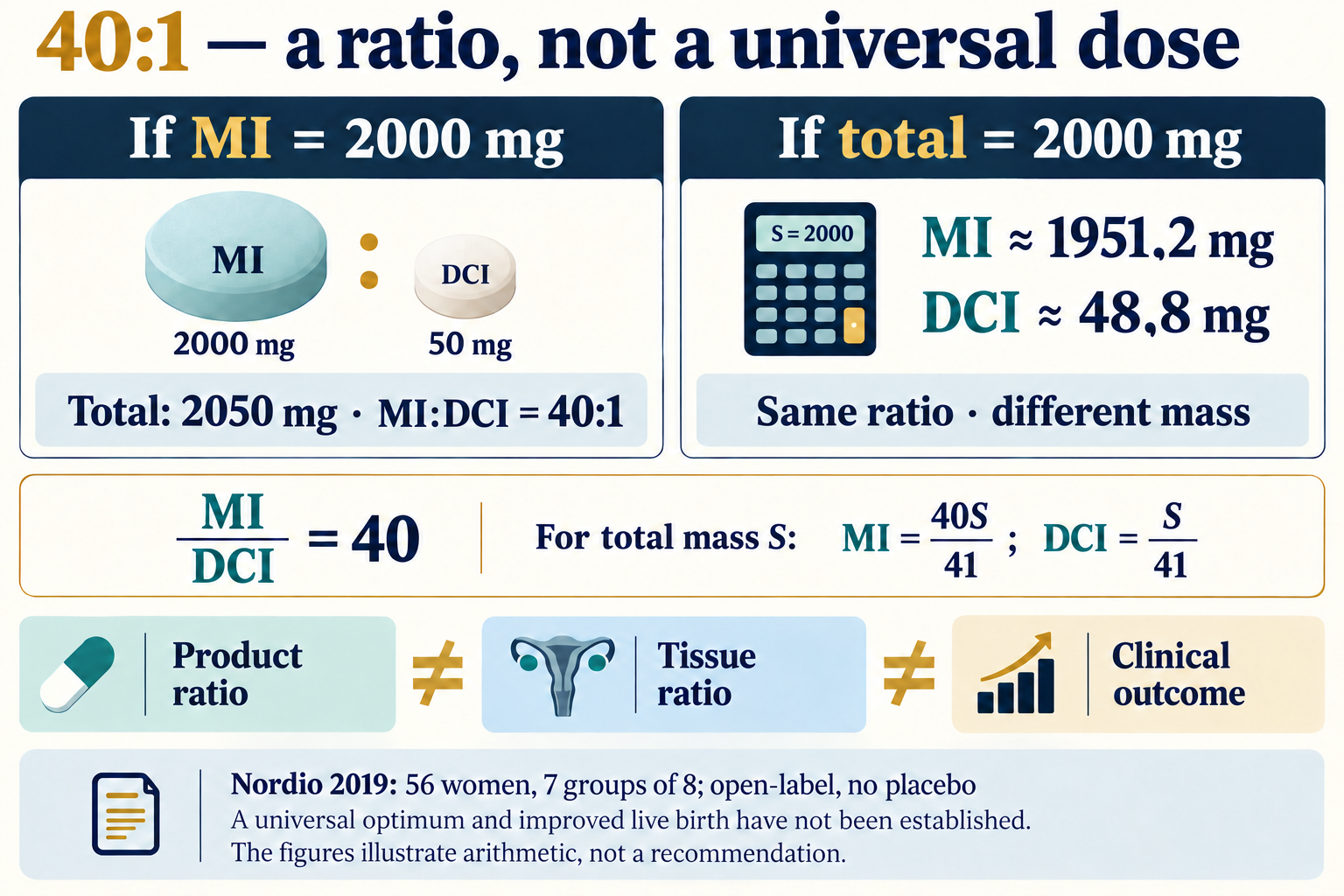
MI and DCI have identical molar masses, so the mass ratio of pure compounds equals their molar ratio. A supplement containing 2000 mg MI and 50 mg DCI, however, contains 2050 mg total inositols, not 2000 mg. If total mass S already includes both components, the calculation differs:
mDCImMI=40,mMI=4140S,mDCI=41S.
For S=2000 mg, this gives approximately 1951.2 mg MI and 48.8 mg DCI. These are composition calculations, not a recommendation to take that dose. A “40:1” label without component amounts and daily frequency does not allow comparison of exposure across trials.
Nordio, Basciani, and Camajani in 2019 compared seven formulations in 56 women with PCOS: DCI alone and combinations of 1:3.5, 2.5:1, 5:1, 20:1, 40:1, and 80:1. Each group contained eight participants; the trial was open-label, without placebo. They administered 2 g of total inositols twice daily for three months. Ovulation was the primary outcome, while laboratory and anthropometric measures were secondary. In this sample, the authors judged 40:1 the most effective formulation.
This design can generate a ratio hypothesis but cannot identify a universal optimum: groups were small, there was no blinding or placebo, BMI above 29.9 was excluded, and numerous secondary comparisons increase the risk of chance findings. The article's reference to a “plasma ratio” does not establish an invariant physiological 40:1 ratio in every tissue. Reproducibility, comparison with appropriate treatment, and patient-important outcomes remain necessary.
The 2023 international guideline explicitly states that insufficient high-quality evidence prevents recommendations for specific inositol types, doses, or combinations in adults or adolescents with PCOS. Considering a supplement according to individual preferences is possible when limited clinical benefits and product quality are discussed. In PCOS with infertility, inositol is considered experimental therapy: evidence for ovulation, clinical pregnancy, and live birth is too uncertain to recommend it as a fertility treatment (Teede et al., 2023, sections 4.7 and 5.8).
Clinical outcomes beyond laboratory improvements
Resumption of bleeding, confirmed ovulation, oocyte maturity, clinical pregnancy, and live birth are distinct outcomes. Lower insulin or testosterone does not establish each subsequent transition. Interpreting a trial requires attention to population, control, duration, concurrent treatment, and the primary endpoint.
Study
Population and intervention
Findings
Main limitation
Nestler, 1999
44 women with obesity and PCOS; DCI 1200 mg/day versus placebo, 6–8 weeks
Ovulation 19/22 versus 6/22
Small trial; neither a 40:1 comparison nor evidence of live birth
Nordio, 2019
56 women, seven open-label groups of eight; 2 g total inositols twice daily for three months
Authors reported the best ovulation result with 40:1
No placebo or blinding; restricted population
Pundir, 2018
Meta-analysis of ten randomized trials
Ovulation RR 2.3; 95% CI 1.1–4.7; I²=75%
Substantial heterogeneity; live birth and miscarriage were not evaluated
Pundir, 2019
18 studies before IVF/ICSI in PCOS
Clinical pregnancy RR 1.16; 95% CI 0.87–1.53; OHSS RR 0.73; 95% CI 0.39–1.37
Very low-quality evidence; significant benefit and OHSS prevention not established
Fitz, 2024
30 trials, 2230 participants; 19 included in quantitative synthesis
Possible benefits for some metabolic measures; MI probably causes fewer gastrointestinal adverse effects than metformin
Overall evidence is limited and inconclusive; formulations and comparisons vary
van der Wel, 2025
464 pregnant individuals with PCOS at 13 hospitals; MI 2 g and folic acid 0.2 mg twice daily versus folic acid alone
Composite gestational diabetes, preeclampsia, or preterm birth: 25.0% versus 26.8%; RR 0.93; 95% CI 0.68–1.28
No reduction in the primary outcome; pregnancy-complication prevention, not infertility treatment
Fitz and colleagues' systematic review, published in 2024 to inform the guideline, searched for studies through August 2022. It distinguished MI, DCI, and combinations; potential effects on some metabolic measures did not resolve the uncertainty about clinical benefit. Fewer gastrointestinal complaints than with metformin are useful information, but do not establish greater overall efficacy or comprehensive supplement safety.
IVF: oocyte and embryo quality do not replace live birth
Small early studies, including Ciotta and colleagues' 2011 trial, reported improved oocyte parameters after MI with folic acid. Sample size, multiple endpoints, stimulation differences, and varying quality criteria limit interpretation. The 2019 meta-analysis could not establish consistent improvements in AMH or antral follicle counts; there was no convincing difference in oocyte numbers, MII oocytes, high-quality embryos, clinical pregnancy, or OHSS. Describing MI as “restoring ovarian reserve” is therefore incorrect. Reserve and quality are different concepts, and a reduction in AMH in PCOS does not mean the egg supply has been replenished.
Raffone and colleagues in 2010 compared metformin 1500 mg/day with MI 4 g/day plus folic acid 400 µg/day in 120 patients; r-FSH was added if pregnancy did not occur. Reported ovulation and pregnancy differences belong to a stepped regimen with subsequent stimulation and cannot be attributed exclusively to MI. This trial does not supersede contemporary recommendations. Letrozole is the recommended first-line pharmacological ovulation-induction treatment for anovulatory infertility with PCOS and no other infertility factors; its regulatory status varies by country.
Pregnancy and gestational diabetes
Early findings for gestational-diabetes prevention often appeared large. D’Anna and colleagues in 2012 retrospectively compared pregnancies achieved after MI with those achieved after metformin, which was discontinued after pregnancy diagnosis in the control group. After excluding miscarriages and multiple pregnancies, 46 and 37 women remained; gestational diabetes occurred in 17.4% and 54%. Differences in selection and prior treatment, lack of randomization, and postconception exclusions restrict causal interpretation. Hypertensive complications, preterm birth, macrosomia, and cesarean delivery did not differ.
The larger double-blind van der Wel trial in 2025 enrolled 464 pregnant individuals with PCOS at 8–16 weeks' gestation. MI 2 g with folic acid 0.2 mg twice daily until birth was compared with matching placebo and the same folic acid. The primary composite of gestational diabetes, preeclampsia, or delivery before 37 weeks occurred in 25.0% and 26.8%, with RR 0.93, 95% CI 0.68–1.28, and P=. 67. Participants were predominantly White, and baseline biochemical hyperandrogenism was more prevalent in the MI group. These limitations matter, but they do not convert a negative primary finding into an established preventive benefit.
These data cannot support promises of a 58–66% gestational-diabetes reduction for all pregnant individuals, extrapolation across populations, or a mandatory MI/DCI combination regimen. Risk assessment, glucose screening, and obstetric follow-up retain independent importance.
Metformin and combinations: compare objectives, not ingredient counts
Inositols and metformin are not interchangeable on the basis of a single biochemical arrow. Metformin affects hepatic metabolism and glucose production, intestinal processes, and cellular energetics; its action cannot be reduced entirely to complex I or equated with IPGs. The 2023 guideline favors metformin over inositol for hirsutism and central adiposity, while acknowledging more gastrointestinal adverse effects. Decisions depend on metabolic impairment, reproductive objectives, contraindications, and tolerability, rather than a “natural” versus “synthetic” distinction.
Question
Inositols
Metformin
What is the intervention?
MI, DCI, or a mixture; doses, purity, and added components vary
A pharmaceutical product with a defined dose and quality requirements
Metabolic role in PCOS
Some measures may change; clinical certainty is limited
A more established guideline role for metabolic manifestations
Gastrointestinal tolerability
MI is probably better in direct comparisons; adverse events are incompletely reported
Gastrointestinal effects are common and often depend on dose and regimen; discuss them with a clinician
Fertility
Experimental therapy; universal 40:1 and improved live birth are unestablished
Used in particular regimens; does not replace infertility assessment or first-line ovulation induction
Long-term follow-up
Product quality and limited evidence warrant discussion
Consider renal function, contraindications, and the risk of lower B12 during prolonged use
Neither column constitutes an individual prescription. Better MI tolerability does not make it an equivalent metformin substitute for every indication. Conversely, a more established pharmaceutical evidence base does not preclude discussing supplemental inositol individually.
Folates: a preventive objective distinct from inositol
Folates participate in one-carbon metabolism, nucleotide synthesis, and homocysteine remethylation. (6S)-5-MTHF bypasses the relevant MTHFR reduction step, but common MTHFR variants do not make folic acid unabsorbable or contraindicated. The CDC emphasizes that people with common variants can process different folates, including folic acid, and retains the recommendation of 400 µg folic acid daily for those who could become pregnant. Higher-risk circumstances require separate clinical prescribing.
Folic acid was a concurrent component, or was also present in the control group, in many MI trials. A favorable finding cannot therefore automatically be attributed to a special methylfolate synergy. It has not been established that an obligatory MI/DCI, 5-MTHF, and B12 combination improves live birth in all women with PCOS. Correcting documented deficiency and preventing neural-tube defects have independent foundations; an MTHFR genotype without context does not create an inositol protocol.
Melatonin: oocyte quality, sleep, and circadian signaling
Melatonin has been studied as an additional component in IVF, but its receptor, circadian, and redox effects should be distinguished. Rizzo and colleagues' 2010 study gave 65 women MI and folic acid with or without melatonin. More mature oocytes and high-quality embryos were reported with melatonin; clinical pregnancy occurred in 13 versus 9 women, a nonsignificant difference, P=. 26. Improved morphological measures cannot establish increased live birth.
Pacchiarotti and colleagues in 2016 randomized 526 women to folic acid 400 µg, MI 4000 mg with folic acid 400 µg, or the same combination plus melatonin 3 mg. This study did not use the sometimes-claimed “stack” of DCI 100 mg and 5-MTHF. The tested mixture and oocyte/embryo outcomes do not establish a universal evening prescription or a guaranteed live-birth benefit. When melatonin is considered, timing relative to the individual's circadian rhythm matters; mechanisms and clinical objectives are distinguished further in the article on melatonin, mitochondria, and circadian receptors.
Alpha-lactalbumin and lack of response to MI
Alpha-lactalbumin, abbreviated α-LA in these studies, is a milk whey protein, not alpha-lipoic acid. Its digestive peptides have been studied as modifiers of intestinal permeability. Monastra and colleagues in 2018 sequentially compared a single MI dose in healthy volunteers with MI plus alpha-lactalbumin after a washout; the combination altered plasma MI exposure. In Caco-2 cells, digested protein increased transport associated with altered tight-junction permeability. Ranaldi and colleagues' 2020 work found a similar reversible increase in paracellular DCI transport and changes in F-actin/ZO-1 in this model.
These findings do not establish an “impermeable intestine” in every woman who fails to ovulate, nor obligatory safe tight-junction opening under all circumstances. Absorption differences are one hypothesis alongside PCOS phenotype, dose, adherence, concurrent disorders, and other causes of infertility.
In Montanino Oliva and colleagues' 2018 open-label sequential series, 37 anovulatory women received MI 2 g twice daily for three months. Twenty-three ovulated, while 14 did not respond. Those same 14 then received MI plus alpha-lactalbumin 50 mg twice daily for another three months; 12/14, or 86%, ovulated. This is not 82%, a placebo-controlled effect, or a criterion for “absolute resistance.” Additional treatment time, selection of nonresponders, and lack of a parallel control prevent separation of the protein's effect from other factors; improved live birth was not demonstrated.
A later 2021 multicenter MI/alpha-lactalbumin study was retracted in 2026 because of unresolved ethical-approval, analytical, and reliability concerns. It cannot support efficacy. This does not automatically refute every other experiment, but strengthens the need for independent replication. Milk protein also requires consideration of allergy and the particular product's composition. Nonresponse to a supplement is better approached as a clinical issue than as a reason to indefinitely expand the mixture.
Dose, timing, and follow-up: what can reasonably be measured
Trials often used MI 2 g twice daily, but a common regimen is not mandatory for everyone. Duration, form, concurrent components, and objectives differed. Individual transport experiments cannot establish a universal half-life, 80–90% bioavailability, obligatory 12-hour dosing intervals, or a coffee prohibition. When supplementation is discussed, it is useful to identify MI and DCI amounts separately, daily frequency, product source, and folate content. “40:1” alone is insufficient.
Monitoring should follow the clinical objective rather than packaging claims. Regular bleeding does not itself confirm ovulation. If evaluation is needed, appropriate methods include progesterone interpreted in relation to expected ovulation: a fixed “day 21” does not suit everyone, particularly with long or irregular cycles. Ultrasound, hyperandrogenism signs, and reproductive history are considered together with exclusion of other causes.
HOMA-IR is a research surrogate calculated from fasting values, sensitive to insulin-assay method, patient state, and population. In the original model (Matthews et al., 1985):
HOMA−IR=22.5Gfasting(mmol/L)×Ifasting(μU/mL).
With glucose expressed in mg/dL, a different denominator is required:
HOMA−IR=405Gfasting(mg/dL)×Ifasting(μU/mL).
Mixing units causes an 18-fold error. One HOMA-IR cutoff cannot be applied to all laboratories, adolescents, and ethnic groups; lowering it is not an independent fertility-treatment goal. International recommendations emphasize the limited clinical relevance of available insulin assays and do not recommend routine use in PCOS. A 75-g oral glucose tolerance test, OGTT, is considered the most accurate glycemic-status assessment in PCOS regardless of BMI; need and timing follow the clinical context, including pregnancy planning.
LH/FSH is not an independent PCOS diagnostic criterion or a universal inositol target. AMH varies with age, assay, hormonal contraception, and other circumstances. The guideline allows it in a particular diagnostic algorithm for adults, not as a sole test or a way to set everyone a target of “3–6 ng/mL.” Translating a laboratory improvement into “restored ovarian reserve” or guaranteed fertility is unjustified.
Monitoring objective
Informative approach
What it does not establish
Ovulatory function
Cycle pattern and confirmation of ovulation when needed
Bleeding alone is not ovulation or pregnancy
Metabolic risk
Glycemic assessment, lipids, blood pressure, and clinical context
One insulin or HOMA value does not describe the whole risk
Fertility
Age, infertility duration, ovulation, male and tubal factors
A hormone improvement does not guarantee live birth
Tolerability and exposure
Product composition and dose, gastrointestinal symptoms, allergy, concurrent agents
No complaints in a short trial do not establish complete safety
IP7 and IP8: promising biology, not an established fertility enhancement
Highly phosphorylated inositols form a separate signaling system. IP6Ks catalyze inositol-pyrophosphate production, including 5-IP7, while PPIP5Ks participate in subsequent phosphorylation and IP8 turnover. Energy-rich diphosphate groups, protein interactions, and phosphate homeostasis connect these molecules with cellular energetics and signal regulation. Free MI, membrane PIP₂, and IP7 cannot be treated as one interchangeable concentration.
Chakraborty and colleagues in 2010 showed in experimental systems that inositol pyrophosphates can inhibit Akt signaling; mice lacking IP6K1 had altered insulin sensitivity and weight gain. This matters because greater precursor availability need not linearly enhance a beneficial signal. Levels depend on synthesis, degradation, compartment, and enzyme regulation, rather than only on ingested MI.
Discussion of protein pyrophosphorylation and chromatin functions does not establish that supplemental MI improves human-oocyte DNA repair through IP8 or an embryo's “epigenetic quality.” Such a clinical claim requires direct measurements of the proposed sequence and meaningful reproductive outcomes. For now, this explains a research direction without justifying a new dose or mandatory multicomponent stack.
How this review was assembled and how to use its conclusions
This is a narrative review of the original literature base, with targeted verification of disputed mechanisms, publication identifiers, and clinical results on 8 October 2026. Primary publications and NCBI abstracts, the available full text of the 2023 guideline, publisher pages, and Monash's official website were used; checks handed over by the previous author are identified in the working log. The large updated 2026 guideline PDF was not read in full. Specific recommendations are therefore linked to the accessible 2023 publication, and the naming update to the Monash page. No systematic search, independent GRADE assessment, formal external peer review, or exhaustive literature audit was conducted.
Chemistry and cell physiology make inositols a plausible research subject in PCOS. Some metabolic and ovulatory effects remain possible clinically, but substantial uncertainty persists about dose, ratios, fertility, and long-term safety. MI/DCI is best discussed in relation to a specific objective and demonstrated outcomes, alongside interventions with more established evidence. Neither 40:1 nor adding folate, melatonin, or alpha-lactalbumin replaces that assessment.
FAQ
Is 40:1 the optimal ratio for everyone with PCOS?
No. A small open-label trial supports a 40:1 hypothesis, but international guidance selects no specific form, dose, or combination because high-quality evidence is insufficient.
Is D-chiro-inositol inherently harmful?
An early short trial improved ovulation in women with obesity and PCOS. High-dose harm evidence has substantial limitations; a universal safe or toxic fertility dose is unestablished.
Does inositol increase live birth after IVF?
Convincing confirmation is lacking. Improvements in particular oocyte or embryo measures do not replace live birth; pooled evidence is low quality and pregnancy estimates uncertain.
Does MI prevent pregnancy complications in PCOS?
A larger 2025 double-blind trial found no reduction in composite gestational diabetes, preeclampsia, or preterm birth. Earlier observational findings do not establish a universal preventive regimen.
Is alpha-lactalbumin the same as lipoic acid?
No. In inositol studies, alpha-lactalbumin is a milk whey protein. Absorption experiments and small open-label series are interesting but do not establish malabsorption in all nonresponders or increased live birth.
Must MI be taken fasting, with coffee avoided?
Cell-transport experiments do not establish such universal rules. Composition, dose, tolerability, and clinical objectives matter more; insulin assays and HOMA-IR are not recommended for routine PCOS monitoring.