Dietary histamine, diamine oxidase, and AOC1: from enzyme reaction to clinical decisions
How DAO and HNMT handle dietary histamine, what AOC1 variants and serum tests show, and what challenge studies and small enzyme-supplement trials can establish.
How DAO and HNMT handle dietary histamine, what AOC1 variants and serum tests show, and what challenge studies and small enzyme-supplement trials can establish.
Facial flushing after wine, abdominal pain after aged cheese, and migraine after a meal may occur close together in time without sharing one mechanism. Histamine can accumulate in food, and an enzyme in the intestinal mucosa can break it down. Between those facts and a diagnosis of “genetic histamine intolerance” lie the amount in a particular serving, intestinal health, other biogenic amines, release of the body’s own histamine, and competing diagnoses. In particular, a serum enzyme concentration should not be mistaken for a direct measure of enzyme activity at the intestinal surface.
This article is a narrative review of work on enzymology, dietary exposure, genetics, and clinical studies. On 9 October 2026, targeted checks were made of primary publications on DAO structure, AOC1 variants, diagnostic tests, challenge studies, and supplement trials. No exhaustive search, formal risk-of-bias assessment, GRADE rating, or external peer review was performed. The evidence is heterogeneous: experimental reactions, observations in people, and tested clinical outcomes are considered separately below.
Histamine is 2-(imidazolyl)ethylamine, formed from L-histidine by removal of its carboxyl group. Human histidine decarboxylase (HDC) uses pyridoxal 5′-phosphate (PLP). The reaction changes the substrate; it does not make vitamin B6 a cofactor for the enzyme that degrades histamine:
Histamine is stored in granules of mast cells and basophils, regulates acid secretion in gastric enterochromaffin-like cells, and acts as a wakefulness mediator in neurons of the tuberomammillary nucleus. These pools cannot be added into one “daily dose.” Dietary histamine arrives in food; microbes can produce it from histidine in food matrices and, under some conditions, in the gut. Release from a person’s own mast cells is another source and can occur independently of the amine in a meal.
The link between exposure and symptoms depends on more than the absolute mass of histamine in a serving. Portion size and eating rate, storage, other amines, alcohol, intestinal permeability, metabolism, and receptor-tissue sensitivity all matter. Scombroid poisoning after improperly stored fish is acute toxicity from a large dietary load and can affect someone without a presumed DAO deficiency. Recurrent symptoms after ordinary meals call for a different evaluation and are not the same diagnosis.
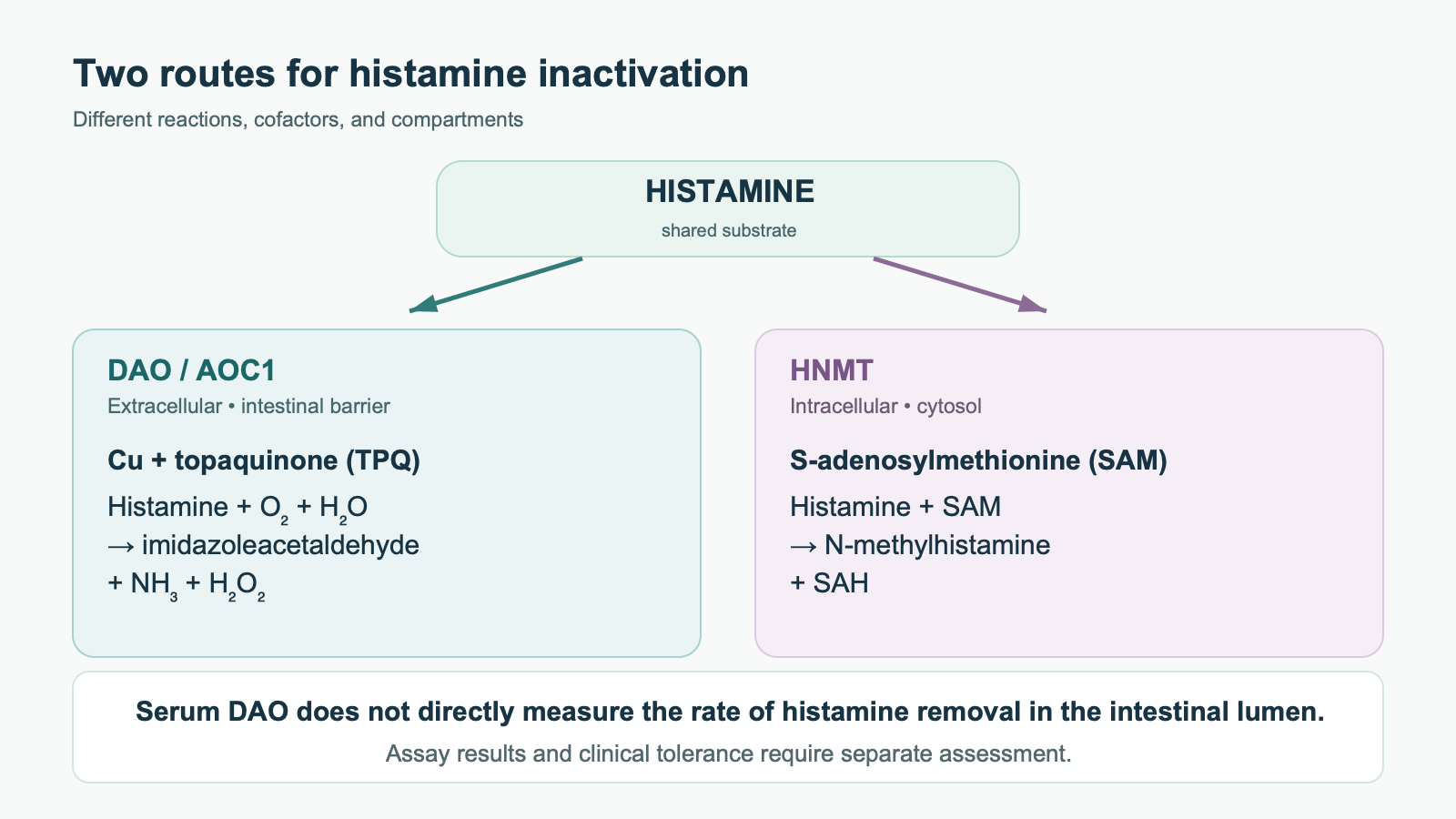
AOC1 encodes human diamine oxidase (DAO), a copper-containing amine oxidase with topaquinone (TPQ) at its active site. It can oxidize primary amino groups in histamine, putrescine, and other suitable substrates. DAO is generally considered an important extracellular route for inactivating dietary histamine in the small intestine; the protein is also found in kidney and placenta. Finding enzyme in enterocytes and in a released fraction does not prove that every molecule of luminal histamine must reach an active site before absorption. Spatial access, contact time, and mucosal condition are central.
Unlike DAO, histamine-N-methyltransferase (HNMT) acts inside cells, transferring a methyl group from S-adenosylmethionine (SAM) to histamine’s imidazole ring. Its product, N-methylhistamine, can undergo further oxidation to N-methylimidazoleacetic acid. DAO produces a different first product, imidazole-4-acetaldehyde, which aldehyde dehydrogenases can oxidize to imidazoleacetic acid. These are different compartments, products, and enzymes; extra SAM is not an established way to “make up for” low intestinal DAO.
| Feature | DAO / AOC1 | HNMT |
|---|---|---|
| Reaction | Oxidative deamination of a primary amine | N-methylation of the imidazole ring |
| Key component | Cu and protein-derived TPQ | SAM as methyl-group donor |
| Operating compartment | Mainly extracellular/intestinal and other tissue fractions | Cytosol of various cells, including in the CNS |
| First histamine product | Imidazoleacetaldehyde, NH₃, H₂O₂ | N-methylhistamine, SAH |
| Interpretive limit | Serum activity is not luminal clearance | HNMT activity does not establish transport of dietary histamine across the blood–brain barrier |
Kinetic values and depend on enzyme species, substrate, pH, oxygen, temperature, ionic environment, and the fraction of protein containing mature TPQ. Even a low for one amine measured with purified DAO does not become a universal food-tolerance threshold. With two substrates, the effective rate of histamine removal depends on their concentrations and their ratios. Putrescine and cadaverine are competing substrates, not necessarily irreversible blockers. The amount of each in a food bolus must be measured before another amine is blamed for an episode.
Crystallography of human DAO shows a homodimer with two catalytic sites. In each site, copper is coordinated by His510, His512, and His675 and interacts with topaquinone. TPQ forms post-translationally from a tyrosine residue with the participation of copper and oxygen; it is part of the protein, not a vitamin in a tablet. The entrance channel and Asp186 help explain the preference for diamines; Asp373 is considered a catalytic base. Structures of complexes with berenil and pentamidine show an inhibitor occupying the channel, but do not establish clinical relevance of these drugs as causes of food-related symptoms. Structural work also cannot yield universal thermodynamic binding constants for all food amines.
In the reductive half-reaction, a primary amine forms a substrate Schiff base with TPQ. After proton transfer and hydrolysis, a carbonyl group replaces the substrate C–N bond in the aldehyde product, while TPQ remains in its reduced amino form. In the oxidative half-reaction, oxygen accepts reducing equivalents, ammonia and hydrogen peroxide are released, and oxidized TPQ is regenerated. The net stoichiometry is shown above. When discussing local H₂O₂, it matters to distinguish its production in a reaction from tissue damage actually measured in an experiment. Details of semiquinone intermediates depend on the copper amine oxidase being studied and do not justify assigning a particular EPR signal to human intestinal DAO without a separate experiment.
Monoamine oxidases MAO-A and MAO-B, spermine oxidase SMOX, and polyamine oxidase PAOX also oxidize amines, but use FAD and different substrate sets and compartments. MAO-A is relevant to tyramine. The dangerous “cheese” pressor response is chiefly associated with tyramine combined with medicinal MAO inhibition, not universal “enzyme depletion” after cheese in a healthy person. SMOX and PAOX participate in polyamine turnover; they should not be treated as backup digestive DAO. H₂O₂ is formed in several amine-oxidase reactions, but membrane damage after an ordinary serving should not be proposed without oxidative-stress measurements.
The AOC1 gene is located at chromosome 7q36.1 and encodes a 751-amino-acid protein. Maturation includes passage through the secretory pathway, glycosylation, dimerization, and TPQ formation. A disturbance at any step could theoretically change measured activity, but the functional effect of each allele must be demonstrated separately. Low activity in a patient can also accompany changes in intestinal epithelium or laboratory variability and need not be congenital.
Maintz and colleagues studied 484 people in Germany: 285 with symptoms attributed to dietary histamine and 199 controls. Several AOC1 variants were associated with serum DAO activity. Minor alleles rs2052129, rs2268999, rs10156191, and rs1049742 were associated with a lower measurement; in a reporter experiment, minor rs2052129 reduced promoter activity. The authors explicitly reported that the variants were not associated with the presumed intolerance phenotype overall, but with activity and a symptomatic subgroup with low activity. This study cannot assign each SNP an exact 25–60% activity loss, establish fixed “H1–H4 haplotypes,” or derive a histamine-dose threshold for a carrier.
| Evidence level | What can be concluded | What cannot be concluded |
|---|---|---|
| AOC1 sequence | A variant is present in DNA and can be studied for an enzyme association | The variant alone proves a food reaction |
| rs2052129 reporter assay | The minor allele reduced promoter activity in the specified cell system | The amount of luminal DAO reduction in each carrier is known |
| SNP association with serum DAO | Some alleles are statistically associated with laboratory activity | One allele establishes a lifelong diagnosis |
| Symptoms after food | There is a clinical problem requiring differential diagnosis | The cause must be in AOC1 |
For rs10156191 and rs1049742, exact genome and transcript nomenclature should be recorded if results are used in research, rather than transferring a casual “risk gene” label between laboratories. The Maintz promoter result merits mention, but for rs1049793 and other variants, spatial mechanism, percentage loss of , and diagnosis cannot be determined without direct functional experiments. The full causal chain “genotype → activity in the intestinal lumen → reproducible reaction to a defined dose” has not been established. Geographic allele frequencies and stories of Neolithic selection require separate population-genetic and ancient-genome evidence; neither follows from food observations.
AOC1 regulation depends on cell type, epithelial differentiation, and expression conditions. Reduced activity with villous injury is biologically plausible, but it does not mean that every case of celiac disease or intestinal inflammation must have a defined “DAO deficiency.” For miR-145/miR-223, HDAC, butyrate, DNMT, and a numerical 60–75% fall in expression, a causal chain specific to human intestinal AOC1 has not been established. Butyrate is useful to study as a general epithelial regulator, but it cannot be prescribed as a proven AOC1 promoter activator.
Work on DAO inhibition raises reasonable questions about alcohol, other amines, and medicines, but lists of “90 inhibitors” combine test-tube findings, treatment concentrations, and clinical reactions. For example, inhibition of purified enzyme by a substance at a specified concentration does not show that its therapeutic dose causes food intolerance in a person with a particular SNP. Alcohol also changes meal composition, vascular responses, and enzyme processes, so its effects cannot be reduced to one type of DAO inhibition. Do not stop an essential medicine yourself based on a list of purported inhibitors; assess a possible medication timeline by dose, start date, alternative explanations, and the safety of a replacement.
Microbial decarboxylases convert amino acids into amines during fermentation and when storage is poor. Bacterial histidine decarboxylase may differ in structure and cofactors from human PLP-dependent HDC; sharing a reaction product does not make all sources equivalent. In fish rich in free histidine, histamine formation after cold-chain failure explains scombroid poisoning. Heating is not a reliable way to remove thermostable histamine that has already formed. Cold storage prevents further accumulation, but freezing does not make spoiled fish safe again.
Aged cheeses, fermented meats, some fermented vegetables, sauces, and fish can contain biogenic amines. Concentrations vary greatly even within a named product; starter strains, substrate, time, temperature, and batch all matter. Universal mg/kg ranges should not be assigned to tomatoes, spinach, wines, or particular cheeses without a traceable analytical method, sample count, and storage conditions.
| Product or context | Why histamine estimates vary | Practical implication |
|---|---|---|
| Fish after a cold-chain failure | Bacterial enzymes decarboxylate free histidine | Acute toxicity is possible without an established intolerance |
| Aged cheese and fermented meat | Starter culture, maturation, free amino acids, time | Content differs by batch; an individual serving matters more than a list |
| Fermented vegetables and sauces | Bacterial species, acidity, process duration | Fermentation merits attention but does not always prove a high dose |
| Freshly prepared and promptly chilled food | Less bacterial growth time when cold-chain practice is sound | Food safety depends on proper storage, not a guarantee of “zero” histamine |
| Product with low measured histamine | Other amines, individual response, or an unrelated cause | A symptom alone does not make a food a histamine “liberator” |
Gut microbes can also synthesize and degrade amines. Possessing an hdc gene is not the same as expressing it and does not show how much histamine reaches a person’s small intestine. Lactobacillus reuteri and some food microorganisms are known to produce histamine under particular strain and condition combinations. That property cannot be generalized to an entire species, much less used to ban all probiotics in the genus. Conversely, a Bifidobacterium or L. plantarum cannot be called a proven histamine degrader in a patient just because it was cultured in a test tube. Schink’s study included only eight participants in the presumed-HIT group among 64 microbiome participants and found differences in microbiota composition; it did not establish causal direction, amine-production rates, or benefit from antibacterial treatment.
Fermented foods and microbiome safety require distinguishing the production process, strain, and clinical context. A probiotic should likewise be described by exact strain, dose, and studied outcome, rather than a genus name; the criteria are discussed in probiotics and safety.
The idea of “histamine liberator” foods, which contain little histamine but supposedly always trigger mast-cell release, is less studied than quantitative amine accumulation during fermentation. Strawberries, tomatoes, citrus, and chocolate should not be assigned a shared MRGPRX2 mechanism without experiments using the substance, physiological concentrations, and a human endpoint. A review of low-histamine diets found substantial disagreement among exclusion lists; many exclusions were not explained by high histamine content. This matters for preventing a prolonged restrictive diet without demonstrated benefit.
Histamine transport across cell membranes complicates the distinction between extracellular and intracellular pools. Organic cation transporters and other systems can carry amines in some tissues, but general OCT/PMAT substrate profiles do not establish the rate of dietary histamine crossing the apical membrane of a healthy enterocyte or link a transporter SNP to presumed HIT. Peripheral histamine usually crosses an intact blood–brain barrier poorly. “Brain fog” does not prove entry into the CNS or H3-receptor overstimulation.
Four receptor families recognize histamine in different tissues and time frames. is mainly coupled to , PLC activation, IP₃/DAG formation, and an increase in intracellular Ca²⁺. In endothelium this can enhance NO-dependent vasodilation and permeability, and in sensitive cells it can cause itch and smooth-muscle contraction. acts through , adenylyl cyclase, and cAMP in gastric acid secretion and some vascular and cardiac responses. is mainly a presynaptic receptor in the nervous system that regulates transmitter release. is expressed in immune cells and participates in chemotaxis and inflammatory signaling. Knowing these pathways does not establish that a particular post-meal symptom was caused by dietary rather than endogenous histamine, or by histamine rather than another cause.
| Receptor | Main pathway | Illustrative effect | Diagnostic limit |
|---|---|---|---|
| H₁ | Itch, vascular permeability, smooth muscle | Itch after eating may be allergic or have another cause | |
| H₂ | Gastric secretion, some vascular responses | Heartburn alone does not identify DAO deficiency | |
| H₃ | , presynaptic regulation | Central neuromodulation | Direct stimulation of brain H₃ by dietary histamine is unproven |
| H₄ | and immune signaling | Chemotaxis, itch, inflammation | Inflammation does not identify food as its cause |
People who suspect a response to dietary histamine report bloating, pain, diarrhea, flushing, headache, itch, and palpitations. These symptoms are varied and nonspecific. Retrospective surveys select people by symptoms and sometimes low serum DAO; symptom frequency in such a group does not estimate the prevalence of causally confirmed HIT in the population. Isolated “brain fog,” insomnia, arrhythmia, or postural tachycardia call for their own assessment. Histamine can alter vascular tone, but the cited clinical studies do not establish that AOC1 deficiency causes POTS, “opens” the blood–brain barrier, or causes Kounis syndrome. Fainting, marked shortness of breath, or chest pain should prompt urgent evaluation, not a diet trial.
Hormonal context is also more complicated than the direct formula “estrogen suppresses AOC1 by 30–50%.” Placental DAO activity rises during pregnancy, but that does not guarantee remission of all food-related symptoms or make unsafe food safe. Menstrual migraine, mast-cell changes, and subjective food tolerance can vary cyclically; causal conclusions need repeated exposure and outcome measurements. Even a many-fold rise in placental activity cannot be used to predict “complete remission in most people.”
IgE-mediated allergy can cause a rapid, reproducible reaction of the skin, airways, or circulation to a particular food protein. In anaphylaxis, the clinical picture and immediate care matter; one should not wait for a DAO test. A negative specific-IgE panel does not exclude every allergy, while sensitization without a matching history does not prove a clinical reaction.
Mast cell activation syndrome (MCAS) requires episodic systemic symptoms, an objective increase in a valid mediator during an event (for serum tryptase, a commonly used criterion is “baseline × 1.2 + 2 ng/mL”), and a response to mediator-directed treatment, while considering alternatives. Systemic mastocytosis is assessed separately by morphological, immunohistochemical, and molecular criteria when clinically appropriate. A single CD117⁺ cell count in mucosa or a KIT variant does not replace the full criteria. Normal baseline tryptase is not a required diagnostic criterion for dietary HIT; negative IgE does not define MCAS; and serum DAO is not a decisive separator.
Scombroid poisoning is usually acute, associated with a particular fish and other people affected by the same batch. Functional and organic gastrointestinal disorders, medication reactions, migraine, chronic urticaria, and an individual response to alcohol also require their own evaluation. These conditions are not mutually exclusive: a person with food allergy can also eat an amine-rich food. Symptoms should not be called “pseudo-anaphylaxis” based on one negative IgE panel, and a person with a history of severe reactions should not perform a home challenge.
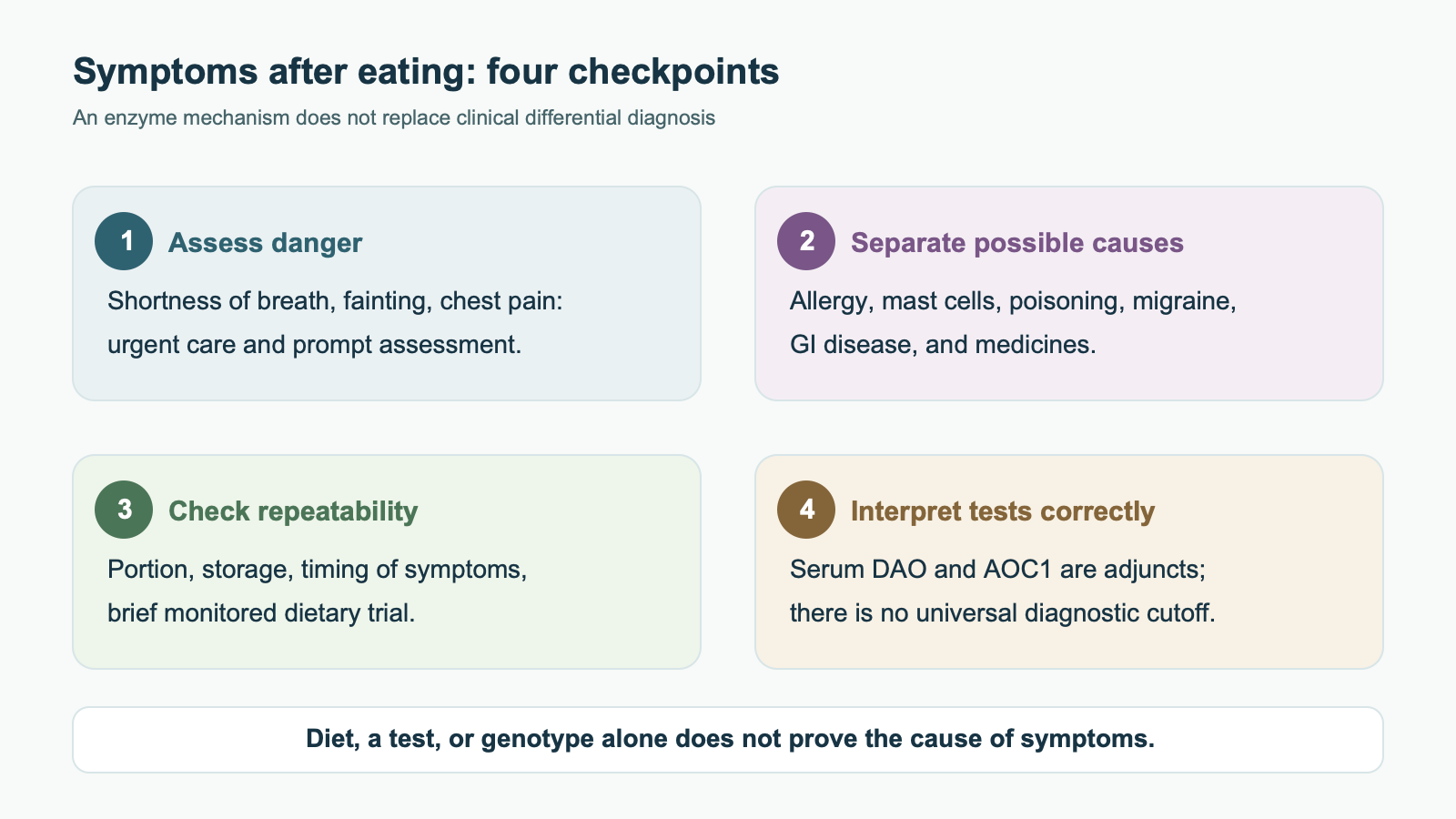
The DAO measurement method substantially changes what a result means. An immunoassay for protein amount, a serum catalytic-activity assay, and an estimate of activity at the enterocyte surface are three different objects. Some studies use U/mL, others HDU/mL; numerical cutoffs are not interchangeable without the method and calibrator. Low serum activity may support a hypothesis when the history fits, but there is no validated universal threshold “<3 proves it, 3–10 makes it likely, >10 rules it out.” Mušič and colleagues found group differences in a study of 316 people suspected of HIT and 55 controls. Then 20 people with very low measurements reported improvement on a diet over 6–12 months and increased activity. Without a blinded control group, that design cannot separate a diet effect from other changes. The study also used its own HDU/mL units.
Urinary N-methylhistamine reflects methylation of endogenous histamine too, not just food-derived histamine. A 50-minute histamine skin-prick test and wheal size do not have established accuracy as stand-alone tests of intestinal DAO. In Wöhrl’s open challenge, five of ten healthy women reported symptoms after 75 mg histamine and five did not; blood DAO in the first 80 minutes did not explain the split. This illustrates variable response, not a diagnostic threshold or safe home dose.
In Komericki’s multicenter study, after an open reaction to 75 mg histamine, 39 participants entered a randomized, double-blind crossover phase with histamine and control drinks, DAO, or placebo. Individual symptoms were not reproducibly elicited, although the total symptom score was lower with DAO than placebo in the relevant comparison. It is misleading to cite only the positive result and omit the lack of reproducibility for individual outcomes. Feeling better on a diet does not “confirm genetic enzymopathy”: alongside histamine, it changes alcohol, fermented foods, storage habits, and expectations. If a challenge is needed, discuss its risks and monitoring with a qualified clinician; it is not a mandatory self-test.
| Tool | What it measures | What it does not prove |
|---|---|---|
| Food, portion, storage, and symptom diary | Timing, repeatability, background factors | A biochemical cause by itself |
| Serum DAO | Protein or activity in a specific assay | Rate of amine clearance in the intestinal lumen |
| AOC1 genotype | An inherited variant | Clinical HIT or need for lifelong DAO |
| IgE testing when history fits | Sensitization to a particular allergen | Any non-IgE reaction or its absence |
| Tryptase during and between episodes | An objective marker of mast-cell activation in the right context | Every cause of post-meal symptoms |
| Controlled food challenge | Reproducibility under a protocol | One universal threshold across foods and people |
Diet, oral DAO, copper, P-5-P, vitamin C, SAMe, quercetin, probiotics, and antibiotics act on different biological targets; they do not form one validated protocol. Diet evidence often comes from open, uncontrolled series. DAO evidence includes a few small trials in different conditions and with different outcomes. Results cannot be compared just because each uses the word “histamine.”
A dietary trial. A short, monitored reduction in foods that are genuinely amine-rich or have been stored unsafely can help test repeatability. A preferred approach preserves enough protein, calories, fiber, and variety, then gradually reintroduces individual foods. A single list of foods to “avoid forever” has weaker support: Sánchez-Pérez and colleagues’ review found that recommendations differ considerably and high histamine was not demonstrated for many excluded foods. If symptoms persist regardless of dietary change, reconsider the hypothesis. If improvement is sustained, try to identify the specific food, portion, and storage conditions instead of expanding restrictions. An overly restrictive diet can itself impair nutrition and quality of life.
Oral DAO. An enzyme supplement is intended to act on dietary histamine in the gastrointestinal lumen. It should not replace anaphylaxis treatment, remove histamine already released in tissues, or correct the AOC1 gene. Protein source, activity in the stated assay, stability in acidic conditions, delivery form, and release timing relative to the food bolus all affect plausibility. HDU or mg labeling does not give a universal conversion between products. One cannot assume every capsule contains exactly 0.3 mg of “purified porcine DAO,” dissolves in 8–12 minutes at pH 6, or keeps the same activity in storage; these parameters depend on the particular product and test. Animal-derived products also raise questions of source, allergy, and dietary restrictions.
Komericki’s study reported a lower total symptom score with DAO during controlled challenge, but individual symptoms were not reproducible in crossover testing. In a randomized, double-blind trial by Izquierdo-Casas, 100 people with episodic migraine and low DAO according to the authors’ assay were assigned to DAO or placebo for one month. In the DAO group, mean attack duration fell from 6.14 to 4.76 hours; in the placebo group it fell from 7.53 to 6.68 hours, not statistically significant within that group. Attack frequency and pain intensity decreased similarly in both groups. This provides a limited signal for duration, not proof of migraine prevention or efficacy for all people with headache. The DAO assay threshold here was <80 HDU/mL, not a universal “<10 U/mL” from another method.
Yacoub and colleagues tested DAO for a different condition: chronic spontaneous urticaria inadequately controlled with an antihistamine. In a double-blind, placebo-controlled crossover study, 22 people participated and 20 completed it; a capsule was taken twice daily before meals for 30 days. In the subgroup with low baseline serum DAO, urticaria activity (UAS-7) fell by a mean 3.8 ± 1.2 points relative to placebo. This is a small subgroup signal for urticaria and antihistamine use, not evidence of “80–90% HIT remission” or an effect on vascular or intestinal symptoms. The different underlying diagnoses and multifactorial symptoms need separate studies.
| Study | Participants and intervention | Observed outcome | Main limit |
|---|---|---|---|
| Komericki | 39 open-challenge responders; blinded crossover with 75 mg histamine and DAO/placebo | Total score was lower with DAO; individual symptoms were not reproducible | Specific challenge model, not ordinary food |
| Izquierdo-Casas | 100 people with episodic migraine and low DAO by the selected assay; one month DAO or placebo | Signal for shorter pain duration; frequency and intensity changed similarly | Not a trial of universal HIT treatment or migraine prevention |
| Yacoub | 22 people with chronic spontaneous urticaria; 20 completed crossover | UAS-7 fell versus placebo in the low-DAO subgroup | Small subgroup, different diagnosis and endpoint |
| Schink | 8 participants with presumed HIT within a microbiome sample of 64 | Associations in microbiota composition | No antibiotic or probiotic trial |
Copper is needed for TPQ maturation and enzyme function biochemically. This does not mean everyone with food complaints has copper deficiency or that a 1–2 mg/day supplement will increase intestinal DAO and remove symptoms. Excess copper can be undesirable; a confirmed deficiency needs its cause established. Vitamin B6 is a cofactor for histamine synthesis through HDC, not a direct DAO cofactor. High-dose P-5-P should not be prescribed as a way to “boost DAO”; long-term excess B6 risks are discussed in vitamin B6 functions and safety. SAM participates in the HNMT reaction, but this does not establish benefit from SAMe for a presumed food reaction. Vitamin C and plant flavonoids have been studied in different systems, including cells; inhibition of degranulation in a test tube is not clinical efficacy of quercetin or luteolin for HIT.
receptor antagonists can reduce some histamine symptoms when the diagnosis warrants them, but do not break down histamine in food and are not a DAO test. An blocker changes acid secretion and is used for its own indication, not automatically for any post-meal tachycardia. Anaphylaxis symptoms require emergency treatment, not a DAO or quercetin capsule. Migraine, urticaria, gastrointestinal disease, and allergy should each be treated according to the established condition.
Presumed HIT plus “SIBO” does not by itself call for 14 days of rifaximin followed by butyrate, zinc carnosine, glutamine, and bans on whole bacterial species. Microbiome-composition differences do not validate that sequence, its doses, or eradication of hdc-positive species. SIBO has its own diagnostic limits, causes, and indications for treatment. Microbial enzymes found in vitro also do not establish a need to “recolonize with histamine degraders” after antibiotics.
When symptoms have a persistent food association, it can help to record the specific food, amount, preparation and storage time, alcohol and medicines taken with it, interval to symptoms, and episodes independent of food. Then assess reaction severity and conditions that should be ruled out first. For some people, a time-limited adjustment to foods that are truly amine-rich or stored unsafely, followed by restoration of variety, is reasonable. If the association is not reproducible or nutritional deficiencies worsen, continuing a broad diet is not neutral. Food safety for fish and other perishables applies whether or not HIT is suspected.
Serum DAO activity, genotype, and metabolites may serve as research or supplementary measures in the appropriate clinical context, provided the assay and units are recorded. None gives a lifelong “personal daily clearance,” establishes a universal serving size in mg, or proves nutraceutical efficacy because one number changes. Symptom course, dietary adequacy, and alternative diagnoses matter more than an invented “HIT Impact Score.” Reintroduction need not follow a rigid scale, a three-month “quarantine” after every complaint, or a universal 30–50 g serving; the choice depends on risk, history, and the question being tested.
Cooking advice should be food-safety advice, not pharmacokinetic speculation. Rapid chilling, proper storage, and thawing in a refrigerator or by another safe, controlled method reduce microbial growth; a microwave is not the only acceptable method. Histamine already formed may persist after heating or freezing. Slow cooking at a safe temperature is not an “ideal incubator” for every decarboxylase; the actual time-temperature profile, starting contamination, and storage matter. A review of food-amine composition cannot honestly support a universal 30–50% histamine reduction from draining broth.
The central connection is this: DAO offers a plausible mechanism for local oxidation of dietary histamine; AOC1 variants alter laboratory activity in some people; symptoms and tolerance remain clinical phenomena with many possible causes. A specialist’s task is to follow all three links without treating one as another or turning small supplement studies into a lifelong protocol.
No. Serum results depend on the method and do not directly measure histamine removal in the intestine. Assessment needs the reaction history, alternatives, and, when appropriate, a controlled check of reproducibility.
No. Some variants are associated with serum DAO activity, but they do not establish a diagnosis or an individual dietary-dose threshold.
Amine amounts change by batch, starter culture, and storage. Portion size, accompanying foods, alcohol, and a person’s condition also matter; symptoms may have another cause.
No. Oral DAO is intended to act on dietary histamine in the gastrointestinal tract; it does not treat anaphylaxis or systemic mast-cell activation.
Small studies found limited signals for migraine duration and chronic urticaria activity in selected groups. They do not establish universal benefit for food-related symptoms.
A universal lifelong exclusion list has weak support. If a food link seems plausible, a time-limited trial with a diary, adequate nutrition, and gradual reintroduction is preferable.