FODMAPs in IBS: carbohydrate chemistry, small-intestinal water, microbial fermentation, and sensitivity to distension
From the chemistry of fructans, GOS, lactose, fructose, and polyols to small-bowel water on MRI, microbial metabolites, sensitivity to distension, and a three-phase dietary strategy.
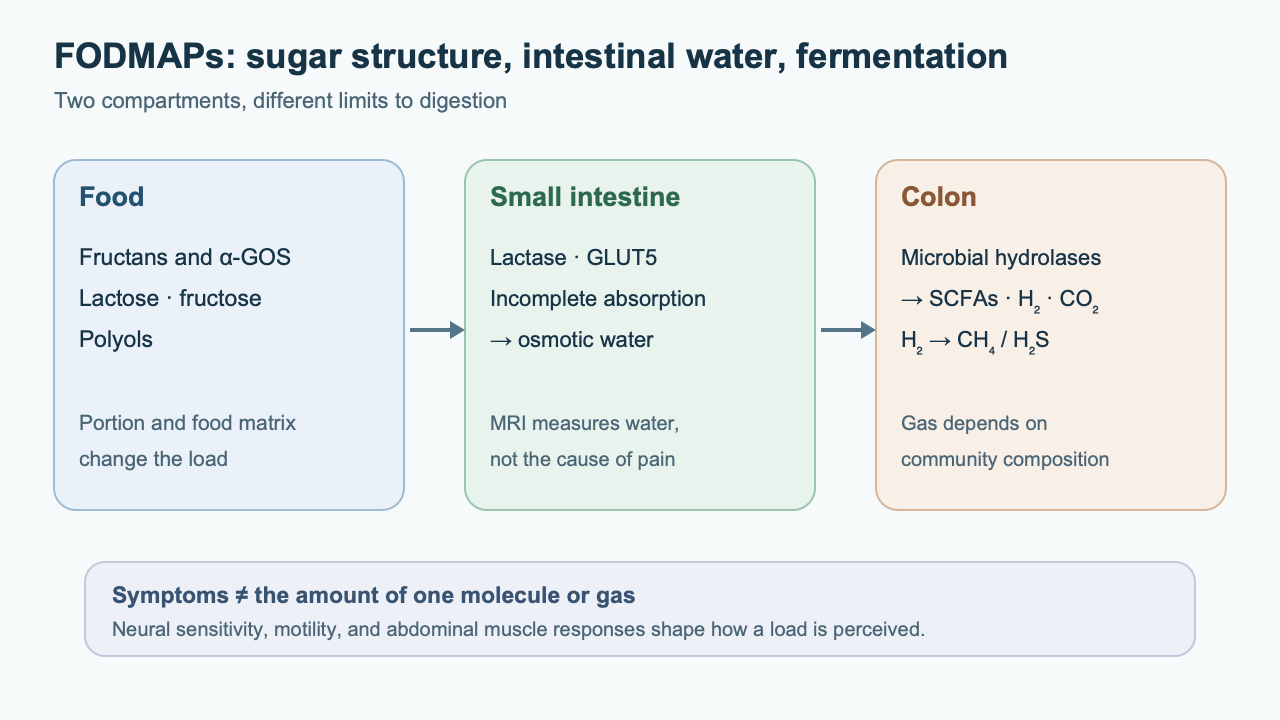
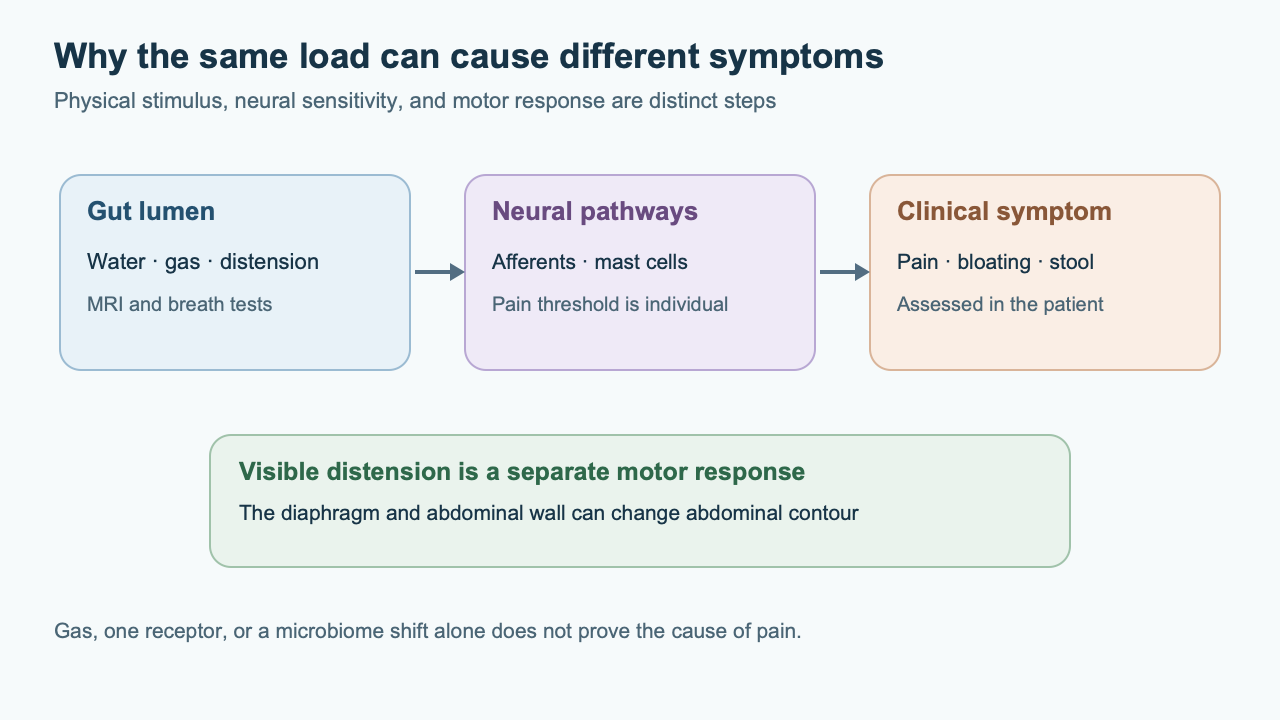
The same meal may cause no discomfort in one person and provoke pain and visible bloating in another. “The amount of gas” alone cannot explain this difference. Several distinct events lie between food and symptoms: cleavage of glycosidic bonds, transport of sugars across the epithelium, movement of water, delivery of substrate to microbes, disposal of microbial gases and acids, neural sensitivity to distension, and the work of the abdominal-wall muscles. The FODMAP concept groups fermentable oligo-, di-, and monosaccharides and polyols that may be poorly absorbed and quickly become microbial substrates. This is a physiological, not toxicological, classification: fermentation is necessary and can produce beneficial short-chain fatty acids (SCFAs); a problem arises when a particular load meets low tolerance or heightened sensitivity.
In irritable bowel syndrome (IBS), a diet that reduces FODMAPs has been studied for symptom control, especially pain, bloating, and changes in stool. It is not a test for “bad microbiota,” does not explain all causes of IBS, and should not become a permanent list of forbidden foods. Here, mechanisms, measurements, and clinical outcomes are kept distinct: fluid on MRI is not the same as pain; a change in bacterial abundance is not the same as lasting damage; and a group response in a trial does not set an individual gram threshold. Information about sources and study designs belongs in the native reference registry, not in the article body.
Chemical groups and enzymatic boundaries
Group
Structure and food sources
Why it reaches microbes
Fructans
Fructose chains with β(2→1) or β(2→6) bonds: wheat, onion, garlic, chicory; short fructooligosaccharides and longer inulin
The human brush border does not cleave internal fructosyl-fructose bonds; the fate of the chains depends on degree of polymerization and microbial enzymes
Raffinose-family α-galactosides
Raffinose, stachyose, and verbascose in legumes contain α(1→6)-galactose residues attached to a sucrose core
Endogenous brush-border α-galactosidase is insufficient to hydrolyze them
Lactose
Galactose-β(1→4)-glucose in milk
Relevant when lactase activity is reduced; with preserved activity, much of it is hydrolyzed and absorbed
Fructose
A free ketohexose in fruit, honey, and sweetened mixtures
Absorption is limited by dose, transport, and food matrix; excess fructose over glucose can increase incomplete absorption
Polyols
Sorbitol, mannitol, xylitol, and maltitol in fruit, mushrooms, and sugar-free products
They are absorbed incompletely and variably; the fraction remaining in the lumen is osmotically active and fermented
Fructans and α-galactosides are structurally different oligosaccharides. Inulin can contain much longer chains than typical short FODMAPs, so one maximum degree of polymerization for the entire group is inaccurate. Sucrase-isomaltase, maltase-glucoamylase, lactase-phlorizin hydrolase, and trehalase each have their own substrate preferences; sucrase’s ability to cleave sucrose does not mean it can break the β-fructosyl-fructose bonds within a fructan. Because humans lack enzymes for these bonds, it is expected that fructans and galactooligosaccharides will be available to the colon, but the fraction actually fermented cannot be fixed at 100% without accounting for matrix, transit, and the microbial community.
Lactase deficiency results either from genetically determined loss of activity after childhood or secondarily from mucosal disease. Lactose then retains water and reaches the colon, where it is fermented. This does not make every dairy product equivalent: portion size, lactose content, prior hydrolysis, combination with other foods, and an individual’s residual enzyme activity all matter. Fructose enters through apical GLUT5 (SLC2A5), while glucose and galactose use sodium-dependent SGLT1; monosaccharides leave the enterocyte mainly through basolateral GLUT2. Transport saturation and adaptation depend on experimental conditions. A high-glucose mixture may improve fructose absorption; apical recruitment of GLUT2 has been proposed as one mechanism, but its contribution in humans in vivo does not justify promising complete absorption at any fructose-to-glucose ratio. A Km value from a single membrane model cannot be translated directly into a patient’s “tolerable food dose.”
Polyols are reduced sugars. Their absorption depends on the molecule, dose, permeability, and contact time; saying that they cross “only paracellularly” is too categorical for a complex epithelium. Sorbitol together with fructose may worsen symptoms, but a clinical result should not be attributed to proven competitive blockade of GLUT5 without direct human confirmation. Xylitol is reduced xylose, not “pentaerythritol.” This chemical correction matters because different polyols have different absorption profiles.
Portion, matrix, and cumulative load
Food tables measure the content of individual FODMAPs in a particular food and portion. They are useful for planning a diet, not universal biological thresholds. Variety, ripeness, preparation, preservation, and serving size change the actual load. Several foods with moderate doses may add up in one meal; a previous meal can matter through gastric emptying and transit. But the source’s universal “critical level of 0.5 g” and fixed 2–3-hour interval do not establish individual causality. A food diary and sequential testing of groups are more informative than one arithmetic rule for every patient.
Bond, enzyme, and product: why groups should not be conflated
The term “undigested carbohydrates” hides different reactions. Brush-border lactase-phlorizin hydrolase catalyzes hydrolysis of lactose’s β(1→4) bond to glucose and galactose: lactose + H₂O → glucose + galactose. With sufficient lactase activity, this reaction occurs before a substantial amount of lactose reaches the colon. For raffinose, bacterial or food-added α-galactosidase successively removes terminal α(1→6)-galactose residues; it is not lactase. Fructan requires hydrolysis of internal β-fructosyl-fructose bonds by microbial fructanase or a corresponding β-fructofuranosidase. Partial cleavage of a long chain can increase the number of osmotically active particles before further absorption or fermentation; therefore, “more hydrolysis means immediately less osmosis” is not universal and depends on where and when the reaction takes place.
Degree of polymerization is another source of variation. Short fructooligosaccharides and long-chain inulin consist of related units but differ in solubility, enzyme accessibility, and rate of microbial use. In dietary contexts, GOS often refers to the α-galactooligosaccharides in legumes, whereas commercial prebiotic β-GOS may have a different structure and composition. A clinical α-galactosidase test against raffinose-type bonds cannot be conflated with evidence for any product labeled GOS. For the same reason, mannitol cannot be substituted for sorbitol as “the same FODMAP”: they differ in molecular structure, degree of absorption, and usual food sources.
Transport and enzymatic hydrolysis are linked by the sequence of compartments. After lactose hydrolysis, galactose and glucose move through SGLT1 together with Na⁺, using the electrochemical gradient maintained by basolateral Na⁺/K⁺-ATPase. This is secondary active transport; ATP is consumed indirectly, not directly for every event in which sugar binds SGLT1. Fructose moves through GLUT5 down its gradient without Na⁺ coupling. Calling both systems “passive sugar absorption” would be biochemically incorrect. When luminal fructose concentration and delivery rate exceed the capacity for removal, the unabsorbed fraction remains available for osmosis and microbes. These reactions provide a coherent mechanistic basis for the diet, but they do not let us calculate an individual symptom from one published Km.
Wheat, gluten, and accurate dietary inference
Some people with IBS attribute symptoms after wheat bread to gluten, although wheat also contains fructans and other potentially relevant components. Improvement on a diet with less wheat therefore does not identify the causal molecule. Celiac disease is assessed through its own diagnostic pathway; removing gluten before testing on one’s own can complicate interpretation of serology and other tests. Food-FODMAP intolerance and IgE-mediated allergy have different mechanisms and require different evaluations. This distinction matters when someone explains any symptom as an “allergy to all carbohydrates” and keeps adding restrictions without confirmation.
Clinical “fructose sensitivity” is also ambiguous. Breath hydrogen after a standardized challenge may indicate an unabsorbed and fermented fraction on that day, but symptoms during ordinary eating need to be considered in relation to amount, combinations of sugars, and reproducibility. Hereditary fructose intolerance, a separate genetic disease, is not the same as typical dose-dependent malabsorption and requires a different clinical approach. These conditions should not be combined under “fructose intolerance” in an IBS algorithm.
Measure response, do not promise a percentage
Clinical studies use composite IBS severity scales, pain, bloating, stool frequency and form, the proportion of participants meeting a prespecified improvement criterion, and quality-of-life measures. These outcomes are not interchangeable: pain may improve while constipation remains unchanged, or stool consistency may improve while subjective bloating persists. For an individual trial, it is useful to record two or three priority symptoms before changing the diet and then assess them consistently, while also noting medications, stress, and menstrual cycle. A reduction in group scores reflects the average effect of an intervention against that comparator; it does not establish which food molecule caused symptoms in each participant. This limitation is particularly relevant in an unblinded diet, where attention and expectations may influence a subjective scale, even though the measured symptom remains real.
Small intestine: hydrolysis, transport, and water
When a molecule remains in the lumen, it contributes to osmotic balance. For an ideal dilute solution, π≈iCRT shows that pressure depends on the number of particles, not their mass. Intestinal solutions are non-ideal; polymers are hydrolyzed, transported, and mixed with secretions. The equation therefore explains the direction of an effect but cannot calculate the volume of water attracted by “every 10 g” of a substance. A monosaccharide of the same mass creates more separate particles than an intact long chain, while fermentation and absorption continually change the luminal composition.
Functional MRI measures free water content in the small bowel (small-bowel water content, SBWC) and gas volume in the colon after a standardized challenge. Studies in healthy volunteers show that individual FODMAPs behave differently: fructose, polyols, and fructans do not produce identical water and gas patterns. Challenge studies and studies in people with IBS can compare changes in volume, breath hydrogen, and symptoms. They do not prove that all pain is caused by one “hydraulic breakthrough” across the ileocecal valve. Loop distension, motility, and symptoms also depend on wall compliance and sensory processing. Milliliter, diameter, and peristaltic-acceleration figures from the source text, when detached from the challenge protocol, are not norms or diagnostic thresholds.
Water crosses the epithelium through transcellular and paracellular routes. Aquaporins and tight-junction proteins contribute to water regulation, but a direct chain of “FODMAP → AQP8 endocytosis → IBS-D” or “FODMAP → MLCK → claudin-2 → diarrhea” has not been established in patients. These may be studied as cellular hypotheses, but they should not automatically explain an individual’s stool pattern. The ileocecal region regulates passage, but the unsupported water-column threshold in centimeters and “avalanche-like discharge” have been removed. Substrate delivery to the colon is already expected from ordinary incomplete absorption, without assuming valve disease.
Carbohydrate malabsorption is not an accepted general explanation for D-lactic acidosis or neurological symptoms in a typical patient with IBS. Clinically significant D-lactic acidosis is described primarily in a different context, such as short bowel syndrome; that model should not be transferred to a typical episode of bloating. The source’s proposed scheme in which fructose binds dietary tryptophan and then lowers brain serotonin is likewise not established as a human IBS mechanism.
Colon: microbial enzymes and metabolic networks
Human-associated bacteria have glycoside hydrolases that the host lacks, but “rapid fermentation” does not mean that all FODMAPs are fermented at the same rate. Different Bifidobacterium species use β-fructofuranosidases and α-galactosidases, while uptake of small oligosaccharides requires suitable transport systems. In Bacteroides, polysaccharide utilization loci (PULs) and Sus-like binding and delivery systems help extract substrate from a complex mixture. Yet the presence of a GH32, GH36, or PUL gene does not guarantee its expression in a particular gut. Rapid primary consumers pass lactate, acetate, and succinate to other species; this is more accurate than imagining that one “gas-producing” species does all the work.
In the bifidobacterial fructose-6-phosphate phosphoketolase pathway, hexose carbon is distributed mainly between acetate and lactate. The often-cited idealized balance for two hexoses—3 acetates + 2 lactates, with carbon conserved—describes one possible balance under specified conditions, not a fixed stoichiometry for the human gut. Anaerostipes and other lactate consumers can combine lactate with acetate and produce butyrate; other taxa may convert succinate to propionate. Butyrate is an important fuel for colonocytes, while acetate and propionate have their own metabolic routes. Fecal SCFA composition is not equivalent to the rate of their production: most are absorbed, and water content and transit affect the measurement.
In other communities, pyruvate yields acetate, CO₂, formate, and H₂; producing propionate or butyrate requires different stoichiometry and electron balances. Actual gas output depends on substrate, pH, and competing routes for hydrogen disposal. The source’s equation “100 moles of hexose → fixed quantities of all SCFAs, H₂, and CO₂” is not a balanced universal law. Nor should liters of gas per 10 g of carbohydrate be presented as a clinically measured consequence. Gas may be absorbed, enter the blood, leave in breath, or be consumed by other microorganisms. Local pH can fall during fermentation, but fixed “critical” values for the human cecum also depend on protocol and sampling.
Three fates of hydrogen
Methanogens, including Methanobrevibacter smithii, use hydrogen and CO₂: CO₂ + 4H₂ → CH₄ + 2H₂O. Their cofactor systems include F₄₂₀ and coenzyme M. This reaction lowers the partial pressure of H₂ and supports metabolic coupling, but breath CH₄ does not measure the full local reaction rate. Methane on breath tests is associated with constipation and slow transit, and experimental models allow for a motility effect. However, methane should not be called a proven stand-alone “pharmacological gasotransmitter” that explains every case of IBS with constipation. Intestinal methanogen overgrowth (IMO) refers to interpretation of a methane phenotype and is not the same as small intestinal bacterial overgrowth (SIBO).
Sulfate-reducing bacteria can reduce sulfate with hydrogen to sulfide: SO₄²⁻ + 4H₂ + 2H⁺ → H₂S + 4H₂O. Sulfide has concentration-dependent signaling and toxic properties; at high concentrations it can interfere with mitochondrial respiration. But finding Desulfovibrio does not establish clinical toxicity, MUC2 destruction, or IBS-D. Epithelial exposure depends on production, oxidation, diffusion, and the spatial layer of mucus. Hydrogen is also consumed in acetogenesis. These pathways compete and coexist, so low breath hydrogen does not necessarily mean fermentation is absent.
The barrier consists of epithelium, tight junctions, and a spatially organized mucus layer, not one MUC2 molecule. Microbial sulfatases and mucinases can alter substrate availability and mucus properties, but the source’s obligatory sequence “FODMAP → H₂ → sulfate reduction → MUC2 disulfide breakage → leaky gut” has not been established clinically in people with IBS. Similarly, reducing prebiotic substrates may lower some bacterial populations, but this does not imply immediate “extinction” of all butyrate producers.
What a breath test can show
Exhaled H₂ and CH₄ reflect part of microbial metabolism after gases enter the blood and lungs. The North American Consensus describes an H₂ rise of at least 20 ppm by 90 minutes for interpreting a SIBO test and CH₄ of at least 10 ppm at any time for a methane phenotype. These operational criteria do not make the test a flawless way to localize bacteria. Lactulose rapidly reaches the colon, and transit time can produce an early H₂ rise without SIBO; glucose may miss a distal event. Substrate dose, preparation, antibiotics, motility, microbial H₂ consumers, and baseline levels all change the result. A fructose or lactose malabsorption test evaluates a specific challenge and symptoms; gas production alone does not prove that the usual diet caused clinical pain. Serologic, inflammatory, and other diagnostic work-up for red flags should not be replaced by a breath test.
Why pain occurs: sensitivity and motor response
A person with IBS may report severe pain during distension that a healthy volunteer tolerates easily. This does not mean gas volume is always the same in all groups; measurements vary across studies and individuals. However, mechanosensitivity and peripheral and central signal processing can amplify the effect of even a modest load. Afferent fibers in the mucosal, muscular, and serosal layers transmit information through spinal ganglia and enteric networks. Piezo2 and TRPV4 channels are studied as participants in mechanotransduction, but the precise contribution of each to human IBS remains uncertain. The source citation for visceral Piezo2 actually concerns lung stretch; it does not support numerical claims about Piezo2 expression in IBS.
Mast cells near nerve endings, their tryptase, PAR2, histamine, and other mediators can sensitize afferents; biopsy studies support this possibility in subgroups of patients. The presence of mast cells or altered neuroimmune contact is not a universal laboratory test for IBS. At spinal and brain levels, synaptic plasticity, descending inhibition, attention to bodily signals, and expectation of pain matter. Functional imaging describes group differences in the processing of visceral stimuli, but this does not mean that the brain “creates” symptoms without an intestinal event. Stress acting through the hypothalamic–pituitary–adrenal axis and CRF may change motility, permeability, and perception, but it does not establish the same three- to five-fold fall in pain threshold in every person.
Enterochromaffin cells synthesize much of peripheral serotonin. Distension and chemical signals can alter 5-HT release; 5-HT₃ and 5-HT₄ receptors participate in sensory transmission and motility. But human evidence does not support a simple chain of “osmotic FODMAP load → excess 5-HT → every case of IBS-D.” SERT expression and 5-HT profiles vary by subtype and method. Subjective bloating and visible abdominal enlargement (distension) must also be distinguished. In the latter, abdominal-phrenic dyssynergia can occur: the diaphragm contracts and descends while the anterior abdominal wall relaxes. Imaging and EMG show that visible enlargement can occur without a proportional increase in intestinal gas volume. This helps explain why limiting fermentation alone does not always remove visible distension.
IBS is diagnosed from the clinical picture using Rome IV, pain pattern, and change in defecation, not from one set of food triggers. IBS with diarrhea, constipation, or mixed stool are descriptive phenotypes, not a rigid assignment of “polyols for diarrhea, fructans for constipation.” Personal tolerance, residual lactase, motility, stress, sleep, medications, and other food components change the response. In constipation, it is especially important to retain enough tolerated fiber and fluid, because excessive elimination can worsen diet quality.
Food bolus and timescale
The concentration in a food is not the concentration next to the epithelium. Between the plate and the ileum, food is diluted by saliva, gastric and pancreatic secretions, mixed, and emptied from the stomach at different rates. Fat and protein alter gastric emptying; fiber and viscosity can change enzyme access to substrate. Therefore, the same fructose portion eaten fasting and as part of a mixed meal are not the same physiological experiment. Lactase capacity is measured at the brush border, while GLUT5 transport also depends on contact time, concentration gradient, and distribution across segments. When the delivery rate exceeds the combined capacity for hydrolysis and transport at a particular moment, some molecules pass onward. This explains dose dependence without inventing one “saturation threshold” for all adults.
The value of the food classification is to predict likely substrate availability, not to declare the substrate harmful. Onions and garlic, for example, provide fructans in aromatic additions, while legumes provide α-galactosides together with protein, minerals, and other fibers. Removing an entire food group changes the diet much more broadly than one osmotic parameter. Canning and rinsing legumes may change their soluble carbohydrate fraction; the exact composition requires data for the specific product. Even when one portion has a low FODMAP load, several portions and accompanying drinks may change total exposure. The opposite error is to treat every episode after eating as proof of a FODMAP effect: caffeine, fat, alcohol, meal size, and learned responses to a previously painful experience can also play a role.
What the gas balance represents
The end products of fermenting bacteria depend not only on carbon substrate but also on the need to regenerate NAD⁺ and dispose of electrons. Acetate production may accompany formation of H₂ or formate; the lactate or succinate branch changes this balance. A neighboring microorganism that consumes H₂ can make some reactions more thermodynamically favorable. Breath H₂ and CH₄ are therefore indirect integrated signals of the whole network, not a simple linear measure of grams of fructans eaten. Methanogenesis uses four molecules of H₂ for each CH₄ molecule, but total intestinal gas volume cannot be calculated from this ratio alone: CO₂ dissolution, absorption, transit, and gas in other compartments matter. Hydrogen from primary fermentation may also be used in sulfate reduction or acetate formation.
Bacterial enzymes GH32 and GH36 identify catalytic families, not the exact rate of reaction in the gut. Estimating a rate requires activity, substrate concentration, pH, chain accessibility, competitors, and density of active cells. 16S taxonomy or metagenomics generally reports an organism or gene; it does not replace transcriptomics, proteomics, or direct measurement of metabolite flux. This methodological boundary also matters when interpreting popular “microbiome tests”: the proportion of Bifidobacterium cannot calculate the amount of H₂ after a particular onion portion. A fall in bifidobacteria after elimination may be a reason to broaden tolerated foods, but not a reason to treat a laboratory value independently of symptoms and diet quality.
Subjective bloating and objective abdominal contour
Visceral sensitivity studies sometimes use controlled balloon distension and record the volume or pressure at which a person first detects a stimulus, feels discomfort, or feels pain. Results depend on bowel compliance, expectations, and instructions, so this is a research phenotype rather than a routine diagnostic test. Sensitivity can be peripheral—for example, after mast-cell mediator exposure—and central, when processing of the incoming signal changes. These levels can exist without each patient having increased density of one particular Piezo or TRPV4 channel.
Visible distension differs from subjective fullness also in what is measured: abdominal circumference, contour on imaging, and the sensation of pressure may not agree. In abdominal-phrenic dyssynergia, diaphragm movement and abdominal-wall relaxation change abdominal shape; this is a motor-postural adaptation that diet may affect indirectly by reducing stimuli but does not have to eliminate completely. Discussing approaches aimed at gut–brain interaction in this setting does not deny the physical symptom. To evaluate a dietary response, choose relevant outcomes in advance—pain, stool frequency, urgency, subjective bloating, or visible distension—instead of combining them under a vague word such as “effect.”
What enzyme and fiber evidence supports
An enzyme preparation acts on a compatible chemical bond only when it meets the food substrate in an active form. It requires overlapping time in the gut, suitable pH, and sufficient activity measured in the units of that preparation. An in-vitro kinetic Km does not uniquely describe efficacy in a complex meal: fiber may be inaccessible to an enzyme within the food matrix, and hydrolysis competes with gastric emptying over time. α-Galactosidase acts on α-galactose bonds in GOS; ordinary lactase acts on lactose’s β(1→4) bond; fructans require other glycosidases. A “multi-enzyme” formula without a specified substrate and clinical trial is not proven pain prevention. In an α-galactosidase study, prior selection of people sensitive to GOS matters; transferring the result to an unselected IBS population would be an error.
Fibers also differ mechanically. Psyllium forms a viscous gel and retains water, whereas partially hydrolyzed guar gum (PHGG) is less viscous and microbially fermentable; they should not be conflated under the label “prebiotic.” For constipation, consider bowel frequency and effort, stool consistency, and bloating; for diarrhea, frequency, urgency, and tolerance of volume. Any form of fiber should be increased at an individual pace. These decisions complement reintroduction of tolerated FODMAPs, because the goal is an adequate and varied diet, not the lowest possible level of any fermentable molecule.
Clinical evidence: diet, comparisons, and limits
A controlled crossover trial by Halmos and colleagues compared a low-FODMAP diet with a typical Australian diet in adults with IBS; overall gastrointestinal symptom severity was lower during FODMAP restriction. Healthy participants did not show a strong symptom effect. The crossover design helps account for individual differences, but follow-up was short, the number of participants was small, and blinding an entire diet is difficult. The Böhn trial compared low FODMAP with traditional dietary advice for IBS: both strategies reduced symptoms, and the result does not prove that strict restriction is absolutely superior to well-delivered usual counseling. The comparator diet, baseline severity, response criterion, and dietitian support determine the meaning of any “responder” proportion. A fixed promise of 70–76% response within 14–21 days should not be transferred to an individual patient.
Evidence type
What is directly measured
What remains open
Challenge and MRI
Small-bowel water, colonic gas, sometimes breath gases and symptoms after a specific substrate
Long-term benefit of a personalized diet; the share of pain caused specifically by water or gas
Short-term dietary RCT
Change in validated scores and individual symptoms in a selected population
Generalizability outside the study, durability after reintroduction, influence of expectations
Microbiome analysis
Relative or absolute abundance of taxa, sometimes fecal metabolites
Lasting ecosystem damage or a clinical outcome from one abundance change
Individual repeat challenge
Symptom threshold and pattern after a particular subgroup and portion
Complete separation of FODMAP, matrix, expectations, accompanying ingredients, and day-to-day effects
ACG guidance suggests a time-limited trial of a low-FODMAP diet to reduce global IBS symptoms; British guidance considers it one of several specialized dietary approaches with support. Professional choice begins by reviewing the diagnosis, nutritional status, other restrictions, and the person’s goals. Not everyone needs this exact protocol: regular meals, adjustment of a few obvious triggers, and fiber work may be enough.
Three phases as a way to broaden the diet
The first phase is a brief reduction of high-FODMAP foods with nutritionally comparable replacements, often for about two to six weeks under specialist guidance. The goal is to establish whether improvement is reproducible, not to reach “zero” fermentation. If a reasonable trial does not help, the diet should not be tightened indefinitely: reconsider diagnosis, other triggers, constipation, medications, disordered eating, and other treatment options. With alarm symptoms, weight loss, blood in stool, anemia, nocturnal diarrhea, or a family history of serious disease, diagnostic evaluation takes priority over a food experiment.
The second phase tests groups in sequence: fructose, sorbitol, mannitol, lactose, fructans, and α-galactosides. Practical protocols use several increasing portions on different days and intervals to return to baseline, but exact doses and days should be selected according to the current product composition, initial tolerance, and the dietitian’s plan. One food may contain more than one group, so a “challenge food” is not always a clean molecular test. The third phase restores all tolerated foods and doses while preserving variety. Personalization, not lifelong strict elimination, is the end goal. In subsequent follow-up of personalized diets, some people maintained symptom control without persistently suppressing bifidobacteria below baseline; long-term data remain more limited than short-term data.
Microbiome and nutritional composition
Fructans and galactooligosaccharides are prebiotic substrates. In a short-term trial by Staudacher and colleagues, FODMAP reduction was accompanied by lower luminal bifidobacteria while symptoms improved. This is a real trade-off that calls for returning tolerated fiber sources; it does not prove permanent “microbiome depletion” or an inevitable fall in butyrate in every patient. Some measurements are relative proportions and depend on the overall community. A shift in one taxon should not automatically be turned into clinical harm. Detailed discussion of choosing and tolerating fiber belongs in the article on dietary fiber and prebiotics. Prolonged, unsupervised restriction of grains, dairy, and legumes may reduce fiber, calcium, and other nutrient intake depending on replacements; assess the actual diet, not the “low-FODMAP” label.
Psyllium is a viscous soluble fiber with its own evidence base in IBS; dose is selected according to tolerance, stool type, and adequate fluid intake. Partially hydrolyzed guar gum (PHGG) has been studied in IBS as a fiber with its own fermentation and potentially better tolerance in some patients. It does not necessarily “restore” all bifidobacteria and butyrate, and is not a necessary supplement for everyone during elimination. Acacia gum and other fibers differ in viscosity, fermentation rate, and evidence; they cannot be substituted for one another just because they share a class label. Probiotics are strain- and indication-specific interventions, and the general label “psychobiotic” does not guarantee an effect on stress or pain; see the article on probiotics.
Enzymes and other ways to reduce symptoms
Lactase helps break down lactose in lactose intolerance when taken with the relevant food. α-Galactosidase hydrolyzes galactooligosaccharide bonds; a randomized trial by Tuck and colleagues found symptom reduction with GOS-rich foods in people sensitive to this group. This does not prove 90% hydrolysis of any portion of legumes or a universal IBS treatment. The primary publication was checked: the identifier in the source refers to a study of adipose tissue and was replaced in the native reference registry. Enzymes marketed for fructans and xylose isomerase for fructose are mechanistically plausible, but clinical outcome evidence is heterogeneous; in-vitro activity does not guarantee activity in food and the gut lumen as pH, contact time, and dose change. Use should match a specific substrate and tolerance, not replace a full reintroduction phase.
Peppermint oil, antispasmodics, medications for stool regulation, and some central neuromodulators may be used for IBS for clinical indications. These are separate symptom strategies; they do not “block FODMAPs” and do not form a mandatory combined regimen. Low-dose tricyclic medication requires discussion of contraindications and prescribing by a clinician; the quercetin doses and promise of mast-cell stabilization in the source are not supported by comparable clinical data. Psychological approaches, including cognitive behavioral therapy and gut-directed hypnotherapy, target symptom processing and related responses; their benefit should not be explained by an unproven obligatory “CRF release” in every patient. Depending on preference and access, they can complement or replace the dietary route, but guidance does not establish that every approach is fully equivalent for every person.
For persistent bloating, consider constipation, evacuation disorders, lactose intolerance, celiac disease when appropriate testing is indicated, medications, diet quality and volume, visible distension, and signs of organic disease. Assess SIBO/IMO in clinical context and in light of breath-test limitations, not from symptoms of fermentation alone. IBS is a diagnosis based on positive clinical criteria with reasonable assessment for red flags, not a result of excluding every possible disease. Food restriction itself can increase anxiety around eating, so periodic quality-of-life assessment is part of successful care, not an afterthought.
Method and limits of inference
This is a narrative analysis of the source material, with biochemical models, human challenge studies, dietary trials, and guidance considered separately. Targeted checking on 9 October 2026 used primary records to resolve specific citation conflicts (including references concerning α-galactosidase and Piezo2) and primary publications for key challenge, breath-test, and dietary-comparison studies where they could be checked. Access to full texts was not uniform; details from works available only as a bibliographic record or abstract were not treated as independently verified. An exhaustive systematic search, independent risk-of-bias assessment, and formal GRADE rating were not performed. The studies therefore clarify the strength and limits of individual conclusions but do not constitute a comprehensive meta-analysis.
The practical principle follows from the mechanisms: briefly reduce a specific, poorly tolerated load, test groups one at a time, and restore the broadest diet that is tolerated. Osmosis and fermentation explain why an intervention may help; sensory and motor physiology explain why responses differ. Clinical decisions should rest on reproducible symptom response and overall nutrition, not “normalizing” one gas, taxon, or gram value.
FAQ
What are FODMAPs?
They are fermentable oligo-, di-, and monosaccharides and polyols. Incomplete absorption and microbial fermentation may cause symptoms in susceptible people.
Why can ordinary fermentation be painful in IBS?
Along with water and gas, sensitivity of neural pathways to distension, motility, and abdominal muscle responses matter. The same food can therefore be tolerated differently.
Should all FODMAPs be avoided forever?
No. After a brief diagnostic phase, groups are tested separately and all tolerated foods and portions are returned.
Can a breath test show the cause of bloating?
It shows part of gas metabolism after a particular substrate, but depends on transit and microbial hydrogen consumers; interpret it together with symptoms and clinical context.
Is a fall in bifidobacteria on the diet dangerous?
A short-term fall has been observed, but it does not prove lasting harm. Long-term eating should remain varied and include tolerated fibers.
When might α-galactosidase help?
For dietary α-galactooligosaccharides, such as those in legumes, in people sensitive to GOS; the effect does not automatically extend to fructans, lactose, or all IBS symptoms.