
Brown and beige adipose tissue: UCP1, cold and capsinoids
Mitochondrial thermogenesis, adrenergic signaling and glucose/lipid uptake. Human cold, capsinoid and mirabegron studies, imaging limitations and the boundaries of clinical inference.
Brown adipose tissue (BAT) and inducible beige adipocytes turn part of the energy of substrate oxidation into heat. They participate in glucose and lipid metabolism, but detecting them, stimulating them and demonstrating an obesity treatment are separate questions. Cold activates human BAT. Small studies also investigate capsinoids and adrenergic drugs; they do not justify guaranteed weight loss or a universal thermogenic supplement stack.
This scientific narrative review connects cell development, mitochondrial biophysics, neural signaling and clinical measurements. Cell experiments, mouse models, observational cohorts and human interventions have different inferential limits.
Cell identity, anatomy and plasticity
White adipocytes (WAT) store triglycerides and secrete hormones including leptin and adiponectin. Brown cells contain numerous small lipid droplets and mitochondria with developed cristae. Capillaries supply oxygen and substrates and distribute heat; sympathetic terminals deliver noradrenaline. Cytochrome-rich mitochondria and perfusion contribute to the tissue's color. Droplet dimensions, mitochondrial volume fraction and vascular density vary with species, depot and activation. Values such as 40–50% mitochondrial volume or fourfold to sixfold capillary enrichment are not universal human reference values. Lipid droplets have a phospholipid monolayer and proteins including PLIN1, PLIN2 and PLIN5, rather than being membrane-bound vacuoles.
Seale and colleagues (2008) linked classical mouse brown adipogenesis to a Myf5-positive lineage shared with skeletal muscle. Pax7 and En1 describe related developmental populations. This does not make a brown adipocyte a mature muscle cell with a new function. The division “all BAT Myf5+, all white/beige cells Myf5−” is too rigid: lineage assignments depend on depot and tracing method. PDGFRα, CD34, Sca-1 and α-SMA identify partly overlapping stromal or perivascular populations in experimental systems. Sca-1 is not a universal human adipocyte precursor marker.
Beige adipocytes can develop from precursors and through reactivation of previously thermogenic cells; the contribution of transitions between mature adipocyte states depends on the model. Wu (2012) distinguished beige cells as a thermogenic cell type. Withdrawal of stimulation can produce a more unilocular phenotype and lower UCP1 while leaving reactivation potential. Classical BAT is also adaptable rather than permanently fixed.
Interscapular, perirenal and perivascular depots are important in newborns. Adult functional depots are frequently found in the neck, supraclavicular regions, along the spine and in the mediastinum, with heterogeneous cellular composition. Cypess, van Marken Lichtenbelt and Virtanen (2009) established active adult BAT using FDG-PET/CT and tissue investigations. ZIC1/LHX8 and TMEM26/TBX1/CITED1/CD137 indicate cellular programs, but a biopsy expression profile does not establish a human embryonic lineage or a strict boundary between deep brown and superficial beige fat. Entire epicardial or mesenteric depots should not be labeled BAT.
PRDM16 is a zinc-finger transcriptional coregulator. Cooperation with C/EBPβ, PPARγ and coactivators supports thermogenic programs, whereas CtBP complexes can repress alternative programs. A PR domain alone does not demonstrate intrinsic histone methyltransferase activity. Loss-of-function effects vary with developmental stage, tissue and compensatory factors; universal complete loss of embryonic BAT is an overstatement.
PGC-1α, encoded by PPARGC1A, does not bind DNA directly. It coactivates PPARs, thyroid hormone receptors and nuclear respiratory factors NRF1/NRF2-GABP, supporting TFAM and mitochondrial gene expression. TFAM organizes mitochondrial DNA and contributes to transcription and maintenance; it is not a DNA replication enzyme. DIO2 locally converts T4 to T3. SIRT1-mediated deacetylation of PPARγ, including Lys268/Lys293 in studied systems, can favor PRDM16 interaction but is not the only obligatory condition for all beiging. The connection between transcription and organelle abundance is explored further in mitochondrial biogenesis and PGC-1α.
Whitening involves reduced thermogenic expression, mitochondrial remodeling and lipid-droplet fusion machinery including CIDEA/CIDEC-FSP27. Autophagy, inflammation, microRNAs, aging and innervation can influence these transitions. PINK1 stabilization follows disturbed mitochondrial import and membrane potential, particularly depolarization; the original sequence “hyperpolarization causes PINK1 and an obligatory fivefold mitochondrial loss” is incorrect. Thermoneutrality depends on clothing, movement, age and experimental setting, rather than a single room-temperature threshold.
| Feature | WAT | Classical BAT | Beige cells |
|---|---|---|---|
| Droplets and mitochondria | Usually one large droplet; functional mitochondria | Many droplets, developed cristae | Remodel with stimulation and its withdrawal |
| UCP1 | Low or undetectable in ordinary white cells | Prominent, regulated by state | Inducible thermogenic program |
| Principal function | Energy storage and endocrine signaling | Heat production and substrate use | Adaptive thermogenic plasticity |
| Origin | Not a single universal lineage | Myf5-linked lineages particularly studied in mice | Multiple precursors and cell states |
| Other energy-consuming pathways | Substrate metabolism and cycles | UCP1 and additional energy expenditure | Creatine and calcium cycles studied experimentally |
UCP1, proton transfer and energy balance
Human UCP1 belongs to the SLC25 carrier family and is encoded at 4q31.1. The canonical protein contains 307 amino acids and weighs approximately 33 kDa. Three repeated domains contribute six transmembrane helices. Salt-bridge networks and the central cavity support discussion of a carrier mechanism, rather than a permanently open water pore.
The original structural bibliography contains mismatches. RCSB 8HBV is nucleotide-free human UCP1 at 2.51 Å, linked to Kang and Chen's 2023 paper “Structural basis for the binding of DNP and purine nucleotides onto UCP1” (DOI 10.1038/s41586-023-06332-w). 8G8W is the GTP-inhibited state at 3.80 Å, reported by Jones and colleagues. 4C9G is a yeast ADP/ATP carrier, not UCP1. These snapshots reveal binding and conformation, not direct proton flux in a living cell.
Respiratory complexes I, III and IV move protons from the matrix to the intermembrane space (IMS); complex II does not pump protons. For one mole of H+ moving from IMS to matrix, define ΔΨ=Ψmatrix−ΨIMS and ΔpH=pHmatrix−pHIMS:
F is the Faraday constant, R the gas constant and T absolute temperature. With a negative matrix potential and positive ΔpH, inward movement is energetically favorable. For ΔΨ=−0.170 V, ΔpH=0.8 and T=310 K, the result is approximately −21.2 kJ/mol H+. This illustrates a defined sign convention rather than a compulsory mitochondrial state.
ATP synthase uses proton return to make ATP from ADP and Pi. UCP1 provides a regulated bypass, reducing coupling between oxidation and ATP synthesis and increasing heat production. ATP synthase is not necessarily blocked: the cell still needs ATP. Respiration accelerates within oxygen, fuel and enzymatic constraints, rather than automatically reaching Vmax. Membrane potential need not fall to a fixed −100 to −120 mV. Equating ΔG with heat Q is also incorrect: heat follows an energy balance, whereas free energy incorporates entropy and the capacity for work.
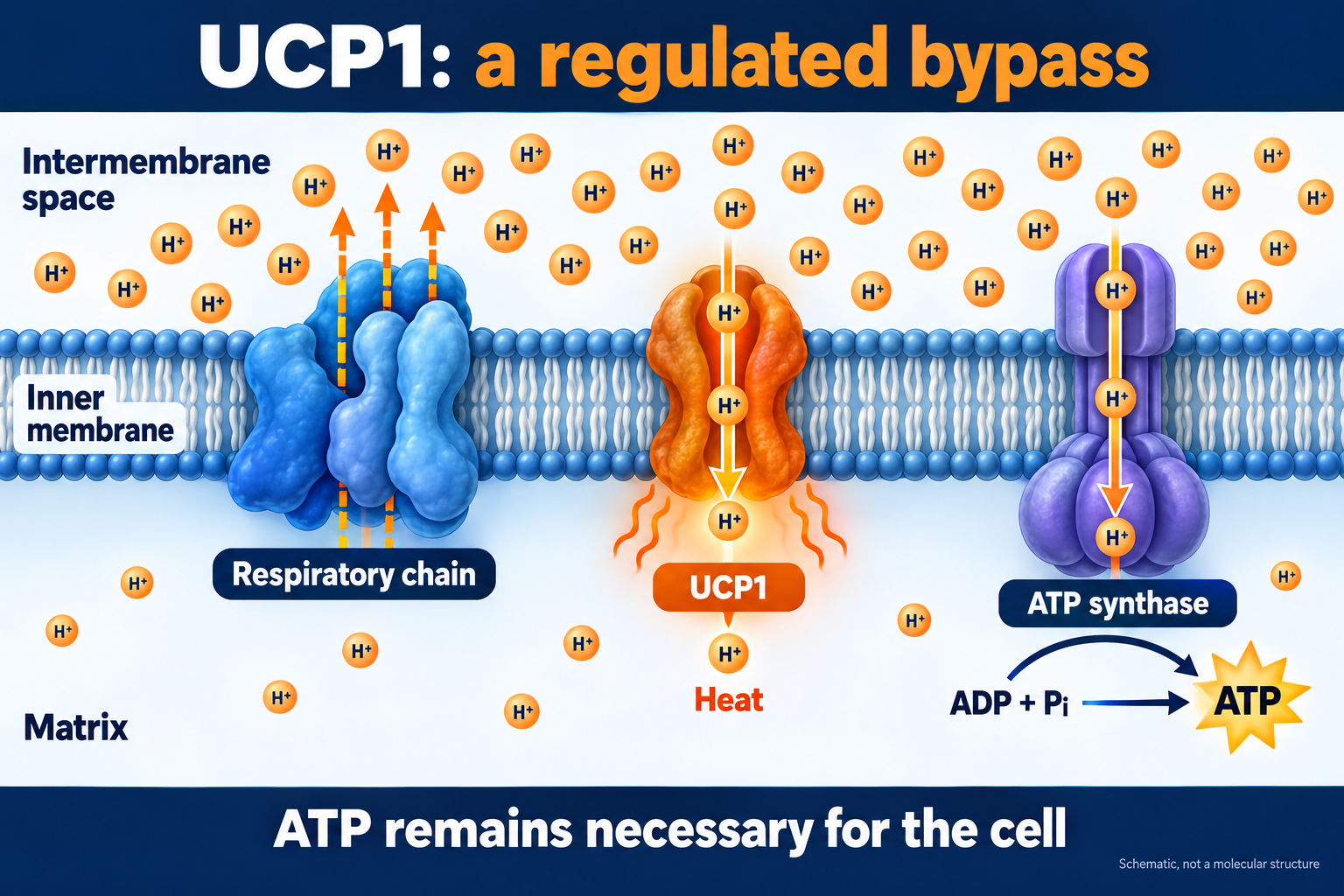
ATP, ADP, GTP and GDP inhibit UCP1. The importance of free versus Mg-bound forms, pH and concentration depends on experimental conditions. Central nucleotide interactions involving basic residues including Arg83/Arg182/Arg276 constrain conformational transitions. A single structure does not establish universal IC50 values or a complete steric lock of an aqueous proton channel.
Long-chain fatty acids (LCFAs) participate in both UCP1 activation and fuel oxidation. Historical fatty-acid cycling models propose bilayer entry of a protonated acid, H+ release in the matrix and outward transport of the anion. Cofactor models connect the fatty-acid carboxyl group with proton transfer within the protein. Fedorenko (2012) measured currents in mitoplasts—mitochondria without their outer membrane, not “mitophages.” Fatty-acid dependence is well supported, but irreversible ATP displacement by an LCFA tail or one definitively established Arg83–Glu190–Lys268 proton relay overstates mechanistic resolution. Regulation is reversible; activation is not restricted to adrenergic stimuli.
Adrenergic signaling, lipolysis and alternative thermogenesis
Sympathetic noradrenaline activates β-adrenoceptors. β3 has a particularly important rodent role; human cells also use β2 and β1, with depot and model differences. Blondin (2020) highlights β2-dependent human thermogenesis. Reduced β3 desensitization does not imply absence of regulation or guaranteed continuous activation.
GDP–GTP exchange activates Gs, which stimulates adenylyl cyclase to convert ATP into cAMP and pyrophosphate. cAMP activates PKA within spatially organized regulatory and catalytic complexes. PKA phosphorylates PLIN1, facilitates ABHD5/CGI-58 activation of ATGL/PNPLA2 and activates and recruits HSL/LIPE. ATGL hydrolyzes TG to DAG, HSL predominantly DAG to MAG, and MGLL completes hydrolysis to glycerol and fatty acid. Rodent phosphorylation-site numbers and fold-activation estimates should not be transferred to humans without verification. ATGL predominantly generates sn-1,3-DAG, rather than the original text's exclusive sn-1,2-DAG.
ACSL1 activates LCFAs to acyl-CoA. CPT1, the carnitine-acylcarnitine translocase SLC25A20 and CPT2 deliver long-chain acyl groups into the matrix. β-oxidation supplies acetyl-CoA and reducing equivalents. NADH feeds complex I; acyl-CoA dehydrogenases transfer electrons through ETF/ETF: QO to ubiquinone, rather than routing their FAD-derived electrons through complex II. Further regulatory detail appears in the carnitine shuttle and CPT1.
Rapid activation differs from tissue recruitment. PKA/p38 MAPK, ATF2/CREB, PGC-1α and PPARγ/RXR modify transcription of UCP1, DIO2 and oxidative enzymes. CBP/p300 and chromatin remodeling contribute to adaptation, but every intermediate is not equally established in humans.
UCP1-independent pathways consume ATP. Kazak (2015) described a creatine cycle in which creatine phosphorylation and phosphocreatine hydrolysis produce net ATP hydrolysis. Subsequent mechanistic work discusses CKB and TNAP/ALPL; assigning the entire cycle exclusively to CKMT1/2 simplifies its organization.
Cr denotes creatine and PCr phosphocreatine. Standard ATP hydrolysis ΔG°′ of about −30.5 kJ/mol differs from cellular ΔG, which depends on concentrations. A thermogenic cycle does not establish clinically meaningful BAT activation from taking creatine supplements.
Ikeda (2017) examined SERCA2b/RyR2-dependent calcium cycling in beige cells. SERCA spends ATP returning Ca2+ to the endoplasmic reticulum; release through channels maintains energy expenditure. Nominal pump stoichiometry is two Ca2+ per ATP, but actual coupling can vary. IP3 receptors and α1 signaling may participate; continuously open RyR2 is not a universal physiological state. Most evidence is experimental. Residual heat production in Ucp1-null mice cannot be assigned a fixed 30–50% contribution in humans. Here ATP is first produced and then consumed, unlike UCP1's bypass of its synthesis.
Substrate uptake and communication between organs
Insulin promotes GLUT4 trafficking through INSR–IRS–PI3K–Akt–TBC1D4. Adrenergic glucose uptake can involve GLUT1, cAMP and additional pathways; it cannot all be represented as AMPK-dependent GLUT4 translocation. Cold and insulin can affect perfusion, glucose uptake and oxidation differently. High uptake per gram does not make a small BAT depot the main whole-body glucose disposal site.
Glucose supports glycolysis, oxidation, lactate production, glycerol-3-phosphate and lipid replenishment. Absolute exclusion of glycogen storage is unwarranted. MPC1/2 transports pyruvate, PDH produces acetyl-CoA, and pyruvate carboxylase produces oxaloacetate. Carboxylation is anaplerotic; PDH does not produce a net increase in TCA-cycle intermediates. These processes support metabolism without requiring all incoming glucose to become heat immediately.
LPL at the capillary luminal surface, organized by GPIHBP1, hydrolyzes chylomicron and VLDL triglycerides. CD36 and FATPs facilitate fatty-acid uptake, while TG-depleted ApoB remnants are subsequently cleared mainly by the liver. GPIHBP1 has a GPI anchor; LPL is held through protein interaction rather than possessing its own covalent GPI anchor. Bartelt (2011) demonstrated strong effects in mice. Atherosclerosis protection depends in part on hepatic ApoE/LDLR remnant clearance: TG hydrolysis is not synonymous with removing an ApoB particle. These mechanisms do not prove prevention of human MASH or myocardial infarction.
Excess DAG and ceramides in liver and muscle can impair insulin pathways involving PKCε, PP2A and Akt. Thermogenic tissue may redistribute substrates, but the effect size and causality in humans require interventions. Becher (2021) analyzed 134529 oncology PET/CT scans from 52487 patients; detectable BAT correlated with lower prevalence of several cardiometabolic conditions. This is a retrospective association with residual confounding, not proven prevention or universal risk reductions of 56/42/35%.
| Signal | Source and pathway | Interpretive limit |
|---|---|---|
| NRG4 | BAT-enriched factor; ErbB signaling and hepatic lipogenesis | Strong mouse mechanisms do not establish human MASH therapy |
| BMP8b | Local adrenergic sensitivity and central regulation | Central administration does not establish free blood–brain barrier passage |
| FGF21 | Often predominantly liver-derived; FGFR/β-Klotho and metabolic adaptation | BAT's source contribution depends on conditions |
| 12,13-diHOME | Linoleate derivative via CYP epoxides and sEH; fatty-acid transport | Cold/exercise responses do not make it universally beneficial |
| Irisin/FNDC5 | Muscle signal, αV integrins and downstream cascades | Human quantitative contribution and measurements remain challenging |
| ANP/BNP | Heart; NPR1/guanylyl cyclase–cGMP–PKG–p38 | Cell thermogenesis is not a reason to provoke cardiac strain |
The Lynes 12,13-diHOME study has a 2026 author correction concerning source data and panels in Figures 2–3; the authors state that interpretation and conclusions are unchanged.
Cold exposure, imaging and energy measurements
Cutaneous cold afferents, including TRPM8 pathways, relay through spinal and lateral parabrachial circuits to preoptic networks. Disinhibition of DMH and rRPa activates sympathetic output through the IML. Detailed circuitry comes mainly from rodents. TRPM8 also responds to menthol and membrane voltage; 15–28 °C is not a hard ambient-air threshold. Cold triggers vasoconstriction and muscle heat production as well. Lack of obvious shivering does not exclude muscle contribution, and the shivering threshold is individual rather than universally 15 °C.
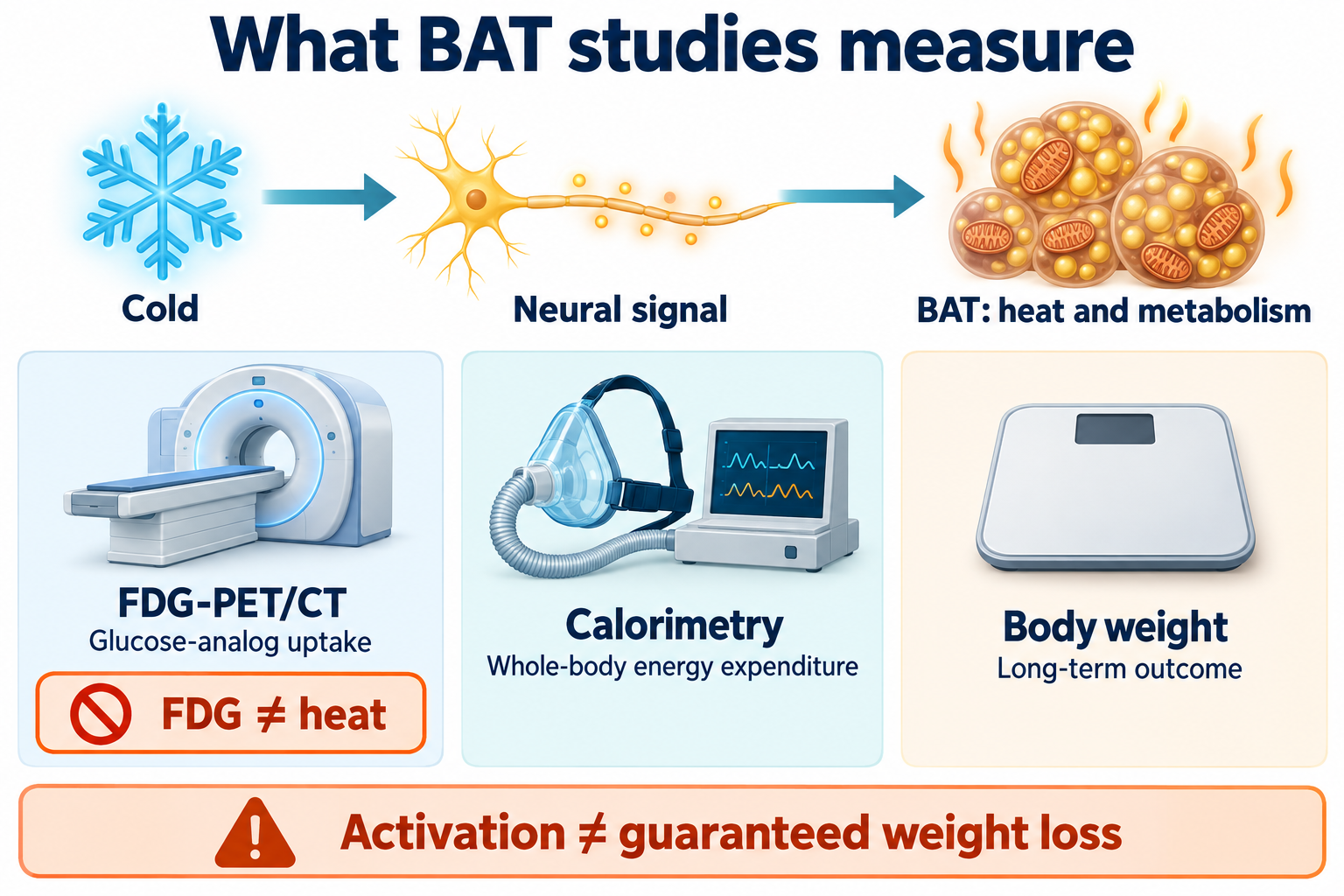
Cold-induced thermogenesis (CIT) is the difference in energy expenditure between cold and a chosen warm comparison, not necessarily a round-the-clock rise in basal metabolism. Yoneshiro (2013): 17 °C, two hours daily for six weeks; a separate capsinoid arm used 9 mg/day in ten participants. These are research conditions, not a general prescription. Van der Lans (2013) used another acclimation schedule. One protocol is not an established gold standard for treating obesity.
If a device reports an additional expenditure rate of 180 kcal/day during a two-hour exposure, a constant-rate arithmetic example gives:
This is a unit-conversion example, not an estimate of a particular trial. Multiplying a short cold response by 365 days to promise 4–6 kg of fat loss ignores exposure duration, appetite, compensation and changes in body composition.
Indirect calorimetry measures RER=VCO2/VO2, the ratio of expired CO2 to consumed O2. In steady state it approximates cellular respiratory quotient RQ. Values around 0.7 indicate predominantly fat oxidation and around 1 carbohydrate oxidation, with qualifications concerning protein and nonsteady conditions. RER cannot localize metabolism to BAT or prove exclusive fat use.
FDG enters through glucose transporters and is phosphorylated, becoming predominantly trapped as FDG-6-phosphate. Its signal reflects uptake and phosphorylation of a glucose analog, not direct UCP1 activity or heat output. Insulin, glycemia, perfusion, cooling, medicines, season and segmentation thresholds change apparent volume. A negative scan does not prove complete absence of thermogenic cells. BARCIST1.0 is Chen's Cell Metabolism 2016 reporting recommendation, not the original Diabetes citation. It considers fat-density HU of −190 to −10 and lean-mass normalization of SUV; a fixed SUVmax of 1.5–2.0 is not the full standard. SUVlean≥1.2 corresponds to SUVbody≥1.2/(LBM/BM), where LBM and BM are lean and total body mass. Methods and metrics must be reported; 50–250 mL is not a universal human BAT volume. Radiation-exposing PET/CT is not a routine supplement-response test.
Capsaicin, capsinoids and other molecules
Capsaicin activates TRPV1, a polymodal nonselective cation channel also sensitive to heat and acidity, rather than simply a voltage-gated channel. Pungent capsaicinoids have an amide linkage; nonpungent capsinoids, including capsiate and dihydrocapsiate from CH-19 Sweet, have an ester linkage. Faster hydrolysis changes distribution and tolerance but does not guarantee freedom from gastrointestinal effects. Enteric sensory and sympathetic mechanisms have experimental support; an exclusive vagal–NTS cascade for every human response has not been established.
Capsinoid trials involve small groups and surrogate outcomes. Snitker (2009) and Yoneshiro studied different doses, durations and endpoints. Combining them into a universal 9–12 mg six-week regimen with an obligatory 100–160 kcal/day effect is incorrect. Initially BAT-negative participants can adapt, contradicting the claim that absent effects in them absolutely prove exclusive BAT mediation. Food peppers and standardized experimental preparations are not equivalent.
Menthol activates TRPM8 and produces a cooling sensation. Cell and animal studies examine Ca2+/CaMKII and thermogenic expression, but perceived coolness does not establish human BAT thermogenesis. A universal 8–12% rise in metabolism or improved insulin sensitivity from 100–150 mg or a skin gel is not an established therapeutic effect.
Resveratrol is investigated through PDE, Epac, AMPK, NAD+/SIRT1, PPARγ deacetylation and PRDM16. It is not a simple universal direct SIRT1/AMPK activator at ordinary oral exposure: effects depend on substrate, concentration and bioavailability. Curcumin, NF-κB and microRNA-mediated inflammation are predominantly experimental beiging hypotheses.
EGCG can inhibit COMT in biochemical systems, but noradrenaline reuptake through NET and intracellular metabolism also terminate signaling. COMT is not the sole principal synaptic clearance mechanism. Human BAT exposure has not been shown to prolong noradrenaline residence threefold to fivefold after an extract. At common exposure, caffeine primarily antagonizes adenosine receptors; substantial direct PDE inhibition requires higher concentrations. A1 is usually Gi-coupled, whereas A2A is Gs-coupled and can support thermogenesis, so blocking both does not uniformly release a brake. Dulloo (1999) found a small acute energy-expenditure effect of green tea extract with caffeine; it does not establish BAT specificity, sustained weight loss or stimulant-combination safety.
| Exposure | Proposed target | Supported interpretation |
|---|---|---|
| Controlled mild cold | Neural sympathetic response | Human BAT activation and adaptation; individual and muscle contributions |
| Capsinoids | TRPV1 sensory pathways | Small human studies; surrogates do not guarantee therapy |
| Menthol | TRPM8 | Sensory pharmacology and experimental data; no established BAT treatment dose |
| EGCG/caffeine | In-vitro COMT, adenosine receptors | Modest expenditure changes do not establish BAT recruitment |
| Resveratrol/curcumin | Multiple signaling and inflammatory pathways | Mechanistic plausibility without an established BAT regimen |
| EPA/DHA | FFA4/GPR120, PPAR and inflammation | Specific drug outcomes cannot be assigned to BAT or every mixture |
| NR/NMN and senolytics | NAD metabolism, aging/SASP | Clinical BAT restoration unproven; dasatinib is not a preventive supplement |
| Exercise | Muscle, hormones and whole-body metabolism | Independent benefits, not a guaranteed irisin/ANP beiging protocol |
The original A/B grades lack a stated appraisal method and are not reproduced. Combining research doses does not create a validated supplement stack. Concentrated green tea extracts, stimulants and drug combinations have their own risks; nonpungency does not establish safety.
Adrenergic drugs and the clinical boundary
Cypess (2015) tested 200 mg mirabegron in twelve men and observed increased FDG signal and measured expenditure. O’Mara (2020): fourteen women, 100 mg/day, four weeks, open-label; weight and composition did not change. These are experimental exposures rather than obesity prescriptions. O’Mara's reference is corrected to JCI131126; the original PMID belongs to Finlin's separate work. That study examined 50 mg/day in an insulin-resistant group and likewise does not establish universal BAT mediation.
Mirabegron is approved for urological indications, not weight reduction simply because it activates BAT. Blood pressure and heart rate, receptor selectivity and other tissue effects constrain translation. Vibegron is another β3 agonist, but the original claim of established safe BAT thermogenesis and metabolic phaseII/III trials was not supported by a verified primary trial. Receptor selectivity is not a substitute for clinical evaluation.
Detectable activity often declines with age or obesity, without fixed population percentages for every age. Innervation, senescence/SASP, inflammation, fibrosis and mitochondrial change are research directions, not grounds for prescribing senolytics, NMN or NR to rejuvenate BAT. Cold tolerance depends on cardiovascular and other conditions. Marked shivering, pain, dizziness or hypothermia are not training targets. Water immersion and cold air differ physiologically.
The practical lesson is to identify what was measured: FDG uptake, respiration rate, CIT, insulin sensitivity and weight change are not interchangeable. Nutrition, activity and metabolic-disease treatment have independent evidence. Cell transplantation, UCP1 editing and small-molecule approaches remain investigational. Systemic uncoupling can be dangerous; DNP used in structural research is not a treatment recommendation.
Review method and limitations
The complete original was read and revised with targeted verification on 8 October 2026. Structural records, selected primary human studies and mismatched BARCIST, O’Mara and Becher references were checked. Some PubMed/PMC pages returned reCAPTCHA or errors; accessible primary pages and author records were used without bypassing refusals. The search was not systematic, and the entire bibliography was not independently exhaustively verified. No GRADE appraisal, external peer review, original experiments or clinical validation were performed. Unconfirmed universal coefficients, protocols and therapeutic promises are not presented as established findings.
Thermogenic fat provides a substantive model connecting mitochondria, neural regulation and systemic metabolism. Its human potential is promising; its causal contribution to long-term clinical outcomes and safe ways of controlling it remain open questions.
FAQ
Does BAT activation equal weight loss?
No. Changes in FDG uptake or energy-expenditure rate do not establish sustained weight change.
Are capsinoids identical to capsaicin?
They are nonpungent ester analogs rather than amide-linked capsaicinoids; food peppers are not equivalent to trial preparations.
Can a two-hour CIT response predict annual fat loss?
No. Duration, appetite compensation and adaptation matter; a rate expressed in kcal/day is not an observed whole-day effect.
Why is mirabegron not a universal BAT therapy?
It has urological indications; metabolic studies are small and experimental doses raise safety and selectivity questions.
Sources
- Identification and importance of brown adipose tissue in adult humans. N Engl J Med. 2009;360(15):1509–1517.
- Cold-activated brown adipose tissue in healthy men. N Engl J Med. 2009;360(15):1500–1508.
- Functional brown adipose tissue in healthy adults. N Engl J Med. 2009;360(15):1518–1525.
- High incidence of metabolically active brown adipose tissue in healthy adult humans: effects of cold exposure and adiposity. Diabetes. 2009;58(7):1526–1531.
- PRDM16 controls a brown fat/skeletal muscle switch. Nature. 2008;454(7207):961–967.
- Brown and beige fat: physiological roles beyond thermogenesis. Cell Metab. 2015;22(4):546–559.
- Beige adipocytes are a distinct type of thermogenic fat cell in healthy adult humans. Cell. 2012;150(2):366–376.
- Structural basis of purine nucleotide inhibition of human uncoupling protein 1. Sci Adv. 2023;9(22):eadh4251.
- Structural basis for the binding of DNP and purine nucleotides onto UCP1. Kang Y, Chen L. Nature. 2023;620:226–231.
- Mechanism of fatty-acid-dependent UCP1 uncoupling in brown fat mitochondria. Cell. 2012;151(2):400–413.
- Brown adipose tissue: function and physiological significance. Physiol Rev. 2004;84(1):277–359.
- A creatine-driven substrate cycle dissipates energy and controls whole-body metabolism. Cell. 2015;163(3):643–655.
- UCP1-independent thermogenesis involving SERCA2b-mediated calcium cycling in beige fat. Nat Med. 2017;23(12):1454–1465.
- Brown adipose tissue activity controls triglyceride clearance. Nat Med. 2011;17(2):200–205.
- Different metabolic responses of human brown adipose tissue to activation by cold and insulin. Orava J et al. Cell Metab. 2011;14:272–279.
- Brown adipose tissue improves whole-body glucose homeostasis and insulin sensitivity in humans. Chondronikola M et al. Diabetes. 2014;63:4089–4099.
- Activation of human brown adipose tissue by a β3-adrenergic receptor agonist. Cell Metab. 2015;21(1):33–38.
- Chronic mirabegron treatment increases human brown fat, HDL cholesterol, and insulin sensitivity. O’Mara AE et al. J Clin Invest. 2020;130:2209–2219.
- Recruited brown adipose tissue as an antiobesity agent in humans. Yoneshiro T et al. J Clin Invest. 2013;123:3404–3408.
- Effects of novel capsinoid treatment on fatness and energy metabolism in humans: possible pharmacogenetic implications. Am J Clin Nutr. 2009;89(1):45–50.
- A PGC1-α-dependent myokine that drives brown-fat-like development of white fat and thermogenesis. Nature. 2012;481(7382):463–468.
- Cardiac natriuretic peptides act via p38 MAPK to induce the brown fat thermogenic program in mouse and human adipocytes. J Clin Invest. 2012;122(3):1022–1036.
- The cold-induced lipokine 12,13-diHOME promotes fatty acid transport into brown adipose tissue. Lynes MD et al. Nat Med. 2017;23:631–637. See 2026 author correction.
- Efficacy of a green tea extract rich in catechin polyphenols and caffeine in increasing 24-h energy expenditure and fat oxidation in humans. Am J Clin Nutr. 1999;70(6):1040–1045.
- Brown Adipose Reporting Criteria in Imaging STudies (BARCIST1.0): Recommendations for Standardized FDG-PET/CT Experiments in Humans. Chen KY et al. Cell Metab.2016;24:210–222.
- Mitochondrial ROS regulate thermogenic energy expenditure and sulfenylation of UCP1. Nature. 2016;532(7598):259–263.
- FGF21 regulates PGC-1α and browning of white adipose tissue in adaptive thermogenesis. Genes Dev. 2012;26(3):271–281.
- The brown fat-enriched secreted factor Nrg4 preserves metabolic health through attenuation of hepatic lipogenesis. Nat Med. 2014;20(12):1436–1443.
- Genetic and functional characterization of clonally derived adult human brown adipocytes. Nat Med. 2015;21(4):389–394.
- Cold acclimation recruits human brown fat and increases nonshivering thermogenesis. J Clin Invest. 2013;123(8):3395–3403.
- Brown adipose tissue is associated with cardiometabolic health. Nat Med. 2021;27(1):58–65.
- RCSB PDB 8HBV: human UCP1 nucleotide-free structure.
- RCSB PDB 8G8W: GTP-inhibited human UCP1.
- RCSB PDB 4C9G: yeast mitochondrial ADP/ATP carrier.
- Human Brown Adipocyte Thermogenesis Is Driven by β2-AR Stimulation. Blondin DP et al. Cell Metab. 2020;32:287–300.e7.
- The β3-adrenergic receptor agonist mirabegron improves glucose homeostasis in obese humans. Finlin BS et al. J Clin Invest. 2020;130:2319–2331.
- DailyMed: Mirabegron extended-release tablets, prescribing information.
- Author Correction: The cold-induced lipokine 12,13-diHOME promotes fatty acid transport into brown adipose tissue. Nat Med. 2026;32:379.