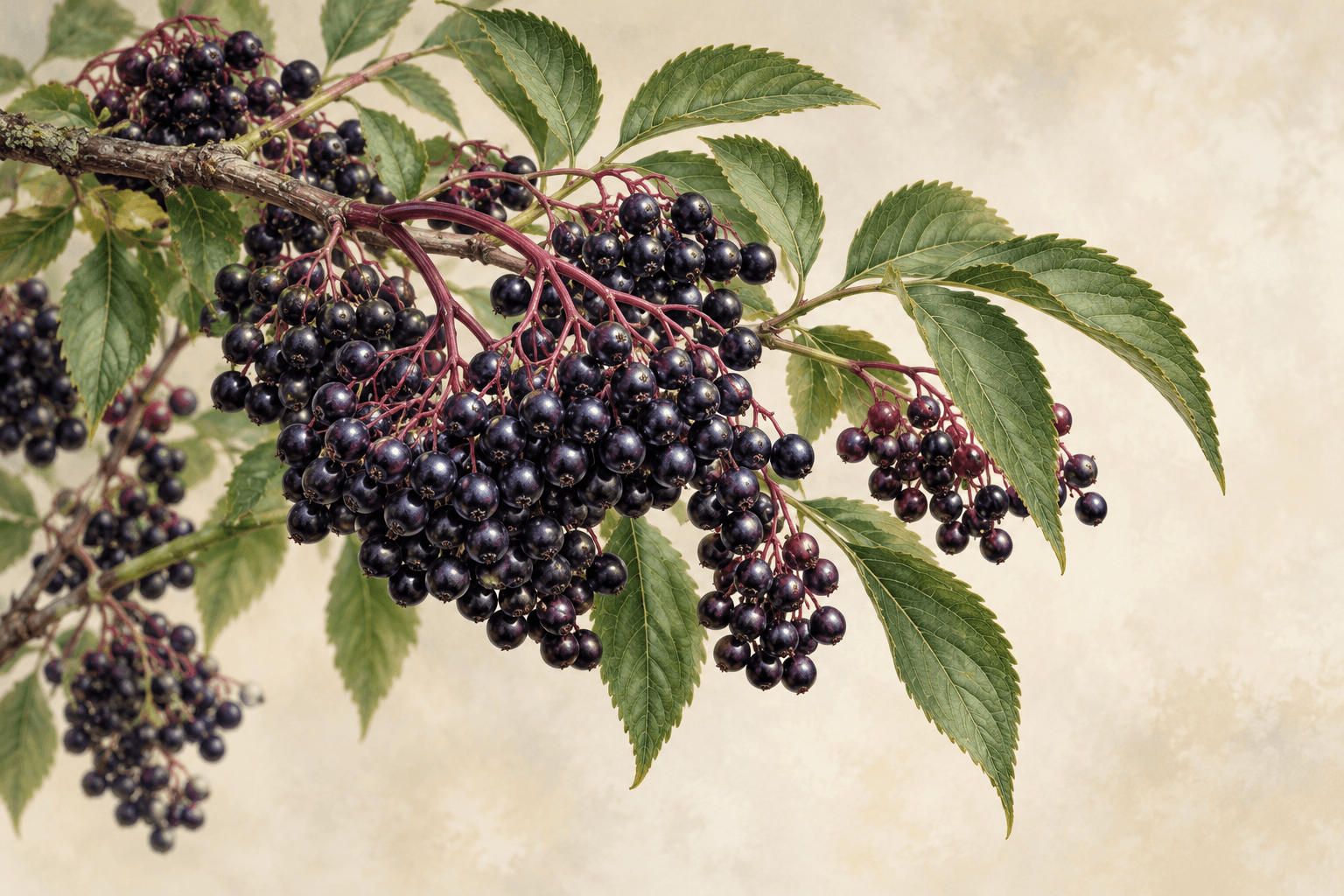
Black Elderberry (Sambucus nigra): Composition, Antiviral Hypotheses, and Clinical Limits
What is known about elderberry cyanidin anthocyanins and neuraminidase, the limits of pharmacokinetic evidence, and why small positive trials coexist with a negative RCT in PCR-confirmed influenza. Raw-material safety and the absence of a universal dose are considered separately.
Dark elderberries contain anthocyanins, and some laboratory experiments show effects of extracts or individual molecules on viral processes. Moving from a test tube to people, however, requires two independent demonstrations: that a specific compound reaches a viral target in tissue after oral intake, and that a standardized product improves a clinically meaningful outcome. The first link has not been established for elderberry, and clinical trials are few and heterogeneous. It is therefore more accurate to discuss elderberry as a food plant and a research extract with preliminary data, not as a proven antiviral treatment.
What the fruit contains, and why a product is not one molecule
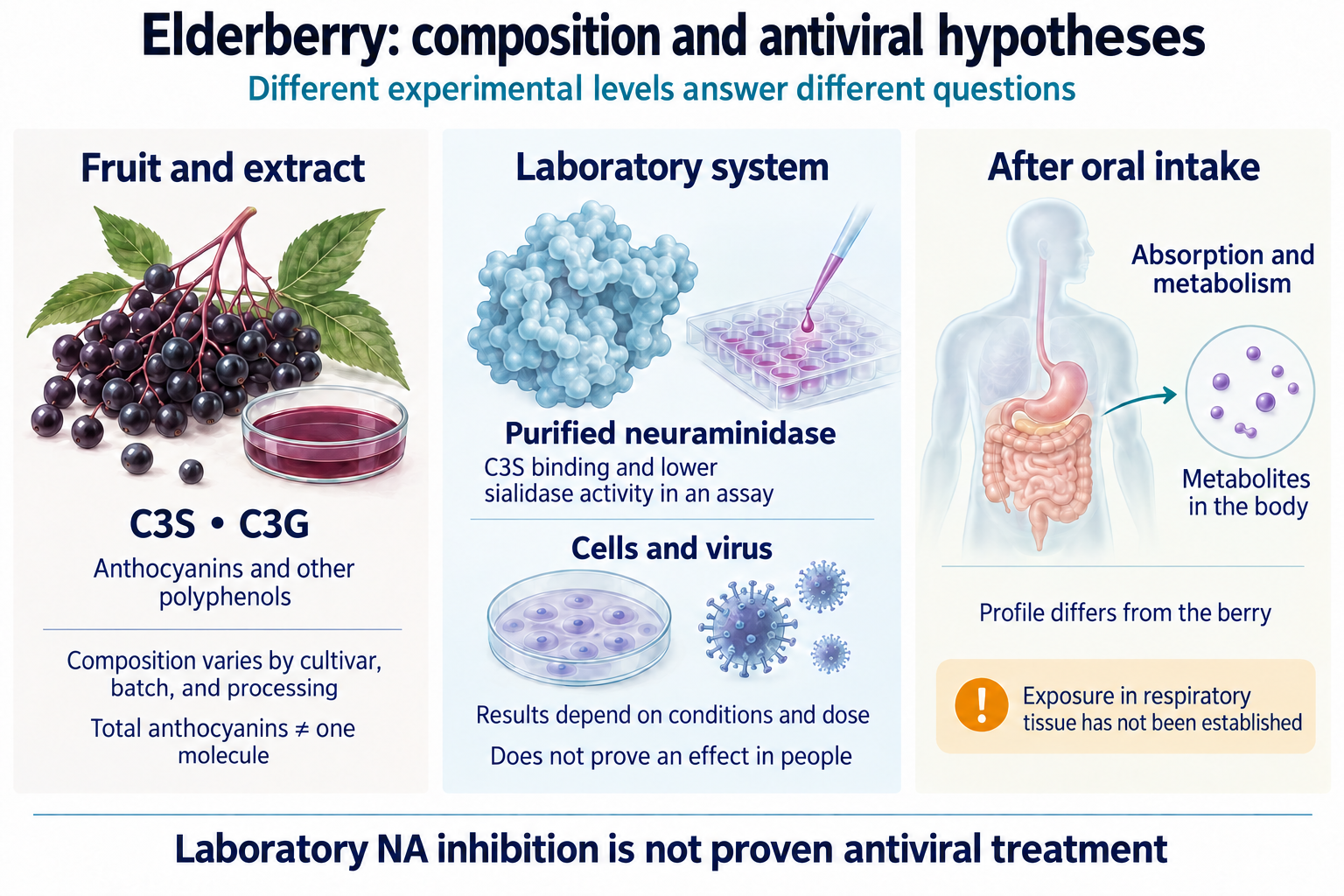
S. nigra is the black elder species; fruit composition varies with cultivar, ripeness, growing location, harvest, and processing. Dark skin and pulp contain anthocyanins, especially cyanidin-3-sambubioside (C3S) and cyanidin-3-glucoside (C3G), along with other cyanidin glycosides. The fruit also contains flavonols, phenolic acids, sugars, organic acids, and other matrix components. Their proportions differ among juice, syrup, powder, and dry extract. The plant name or a total “anthocyanin” value alone does not define the chemical identity or concentration of a finished product.
An anthocyanin is a flavylium pigment in which a sugar is attached to the cyanidin aglycone. This glycosylated form differs from cyanidin and its metabolites in solubility, stability, protein interactions, and metabolism. Acidity, oxygen, temperature, light, and enzyme activity alter the proportion of different forms. A result for one purified pigment therefore cannot automatically be transferred to a multi-component extract, nor can the composition of one commercial product stand for all elderberry products.
How to read an extract’s chemical composition
The fruit contains mainly a mixture of different glycosides and accompanying polyphenols, not free “antiviral anthocyanins.” C3G has one glucose residue attached to cyanidin; C3S has the more complex sambubiose sugar. The distinction matters: sugar hydrolysis changes the molecule, and proteins may recognize glycosides and aglycones differently. Even within one batch, pigment content depends on whether fresh weight, dry weight, juice, or extract is analyzed and how results are expressed—against individual standards or as cyanidin-3-glucoside equivalents.
During storage and processing, anthocyanins may oxidize, hydrolyze, or change structure. Standardization to a total value therefore does not guarantee the same proportions of C3S, C3G, and degradation products. A reproducible clinical study needs botanical identification of the raw material, an analytical profile of the specific batch, product stability, and the actual dose of marker compounds. The same number of milligrams of “elderberry extract” can represent different compositions; the ratio of dry extract to raw fruit does not itself indicate a bioavailable dose.
Influenza: what hemagglutinin and neuraminidase do
In influenza A or B, hemagglutinin (HA) recognizes sialylated structures on susceptible cell surfaces and participates in viral entry. After endocytosis, acidification of the endosome changes HA’s conformation and promotes fusion of the viral envelope with the endosomal membrane. Neuraminidase (NA), by contrast, cleaves terminal sialic acid residues and facilitates release and spread of new virions. These functions complement each other, but knowing the role of a target protein does not show that a food extract suppresses it in the body.
In a 2013 study, Swaminathan and colleagues used mass spectrometry and molecular modeling to examine binding of a natural anthocyanin isolated from black elderberry extract to influenza neuraminidase. They described interaction of cyanidin-3-sambubioside with a site designated the 430-cavity and inhibition of sialidase activity in an experimental system. This is a mechanistic result for a specific compound and assay conditions. It does not show that any elderberry extract acts as a clinical NA inhibitor, that the anthocyanin reaches this target in the respiratory tract after oral intake, or that an oseltamivir-like effect occurs clinically. Cell studies of extract effects on hemagglutination and viral replication also do not attribute an effect to specific HA binding; other components or stages of the viral cycle may be involved.
Docking and structural modeling help generate experiments, but do not by themselves show affinity in a physiological environment, inhibition of intact virus, or therapeutic benefit. A causal conclusion needs orthogonal binding assays, enzymatic kinetics with controls for nonspecific effects, cell models with cytotoxicity assessment, and confirmation that the exposure is achievable. An experiment with purified neuraminidase cannot be transferred to a respiratory virus outside its host, and a result for one strain does not apply to every viral variant.
Why cellular antiviral activity does not mean clinical treatment
Cell systems answer a narrow question: does the tested preparation change viral replication or a selected laboratory measure at a specified contact time, concentration, cell type, and strain? A hemagglutination measurement may reflect particle aggregation or effects on extract components; it does not necessarily show competitive displacement of receptor sialic acid from a specific HA site. Enzyme-signal suppression also needs checks for color interference, nonspecific binding, and cell toxicity. For a complex mixture, the active component must be identified.
High concentrations of plant extracts require particular caution. If an extract reduces viral particle counts only at concentrations that damage host cells, that is not selective antiviral activity. If pre-incubating virus with a compound reduces later infection, direct contact may be involved, but the protocol does not model oral intake and tissue distribution. If a compound acts before cell infection, this does not show it blocks the same step after infection is established.
Viral biology also cannot be reduced to one HA/NA pair. Results depend on strain, HA glycosylation, receptor availability, cell type, and other viral proteins. Even confirmed in vitro NA inhibition does not establish clinical equivalence to licensed neuraminidase inhibitors, whose exposure, doses, virologic outcomes, and clinical outcomes were studied separately.
The concentration problem after oral intake
After consumption, some anthocyanins are absorbed unchanged, but systemic bioavailability is low and intact forms are cleared quickly. Small pharmacokinetic studies of elderberry juice or extract detected unchanged glycosides in plasma and urine, but less than 1% of the oral dose was recovered unchanged in urine; these values depend on the specific product, analytical method, and observation window. Some compounds are transformed in the gut, liver, and microbiota, so the circulating profile does not match the original fruit composition.
These studies did not measure the free active anthocyanin concentration directly in respiratory epithelium or show that it reaches the level that inhibited an enzyme in a separate laboratory assay. The nominal extract dose, the concentration of a purified molecule in a test tube, and presumed tissue exposure cannot be compared without a pharmacokinetic model and direct measurements. This gap limits claims that elderberry directly blocks HA or NA after oral intake. It does not rule out other nutritional or biological effects, but those require separate evidence.
The route from food matrix to respiratory epithelium
An oral dose passes through the stomach and small intestine, where acidity, food, and digestive enzymes affect anthocyanin stability. In the small intestine, limited absorption of parent glycosides and transformation may occur; the unabsorbed portion reaches the colon, where microbial enzymes form smaller phenolic metabolites. Absorbed molecules undergo conjugation in the gut wall and liver. Plasma metabolites may be biologically active in other models, but that does not automatically make them viral NA inhibitors.
Pharmacokinetics in healthy volunteers describes exposure after a particular dose and product; it does not measure local concentration on the mucosal surface during infection. Plasma concentration, total metabolite concentration, and the unbound concentration of the parent compound are different quantities. To test the causal chain, free concentrations in the relevant tissue must be compared with a concentration–effect curve for the same compound, and it must be confirmed that a clinically tolerated dose reaches that level. For elderberry’s direct antiviral hypothesis, these links have not yet been connected.
What clinical trials found
Clinical studies differ in populations, products, treatment timing, diagnosis, and outcomes. A traveler’s self-reported cold is not equivalent to laboratory-confirmed influenza; the number of symptom days does not prove viral neuraminidase inhibition. Even a positive result from a small study primarily applies to its particular product and protocol.
| Study | Population and product | Main result and limitation |
|---|---|---|
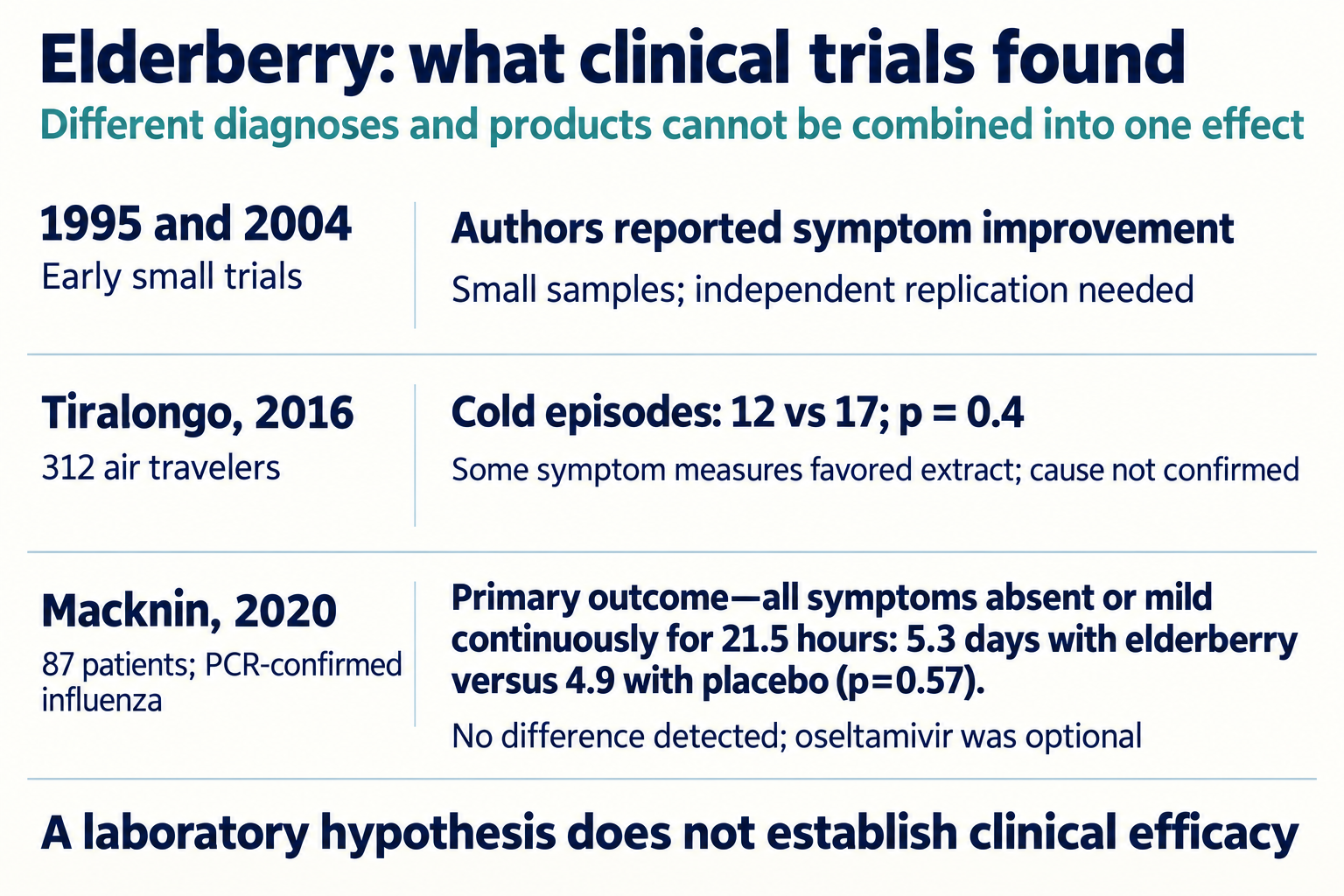
| Zakay-Rones et al., 1995 | 27 participants (15 received extract, 12 placebo) during an influenza B/Panama outbreak; elderberry syrup was compared with placebo, alongside cell experiments | Authors reported earlier symptom improvement with extract. The study was old and small, and took place during a specific outbreak; its clinical component does not identify a molecular target and is difficult to generalize to modern products and diagnostics. |
| Zakay-Rones et al., 2004 | 60 adults aged 18–54 with flu-like symptoms for no more than 48 hours; 15 mL syrup or placebo four times daily for up to 5 days | In this small study, average symptom relief occurred about 4 days earlier in the syrup group. The authors said the result needed confirmation in a larger trial; influenza was not universally confirmed with a modern molecular test. |
| Tiralongo et al., 2016 | 312 air travelers; double-blind RCT of membrane-filtered extract versus placebo; 300 mg capsules: 600 mg/day from day −10 to day −2 before departure, then 900 mg/day from the day before departure until 4–5 days after arrival; cold episodes and symptoms were recorded | Episodes numbered 12 versus 17, a nonsignificant difference (p=0.4). The placebo group had more total episode-days and a higher total symptom score; these outcomes were self-reported during travel and did not confirm influenza in the laboratory. |
| Macknin et al., 2020 | 87 patients aged 5 or older with PCR-confirmed influenza and symptoms for less than 48 hours; double-blind RCT: oral extract 15 mL (5.7 g) or placebo per dose, twice daily at ages 5–12 and four times daily from age 13, for five days; oseltamivir was optional | Primary outcome—all symptoms absent or mild continuously for 21.5 hours: 5.3 days with elderberry versus 4.9 with placebo (p=0.57). Secondary outcome—complete symptom resolution for 24 hours: 8.6 versus 8.7 days (p=0.87). No difference was detected; the small sample limits precision. |
The 1995 RCT combined laboratory work on several influenza strains with clinical observation during an influenza B/Panama outbreak. This does not mean the laboratory mechanism was confirmed in every participant: the clinical outcome was assessed separately, and a positive serum response does not identify the cause of symptom improvement. The 2004 study enrolled only 60 adults whose symptoms had begun no more than 48 hours earlier; participants received one syrup and outcomes were recorded on a subjective symptom scale. This is a useful signal for further testing, but the small sample and lack of independent replication limit confidence in the effect size.
In the air-traveler study, participants took a standardized extract before and during travel. Investigators observed fewer total symptom-days and lower average scores for some measures, whereas the probability of a cold episode itself did not differ significantly. There were few events, symptoms were recorded in diaries, and a specific cause was not established. The result should not be turned into a promise to prevent any respiratory infection or shorten laboratory-confirmed influenza.
In Macknin’s RCT of 87 PCR-positive patients, the primary outcome did not improve. Mean time to sustained reduction of symptoms to mild levels was numerically longer in the elderberry group, but the difference was not statistically significant. The authors noted that the study was designed to detect a two-day difference; its small size still leaves uncertainty about more modest effects and subgroups. An after-the-fact analysis of participants who took elderberry without oseltamivir cannot establish either benefit or interaction with antiviral treatment.
Early positive results should not be hidden, but they coexist with a later negative RCT in laboratory-confirmed influenza. Trials differed in extract composition and context: some participants in the emergency-department study took oseltamivir, and treatment choice was part of the design; subgroup analysis does not make elderberry a proven add-on to an antiviral drug. Each outcome must be read within its assigned protocol, without combining different illnesses and products into one “elderberry effect.”
The Hawkins et al. meta-analysis included 180 participants from a small number of trials and reported a large estimate of effect on upper-respiratory symptoms. However, the small evidence base and heterogeneity make that estimate unstable and sensitive to individual small positive studies. A later systematic review by Wieland et al. included five randomized trials of prevention or treatment of viral respiratory illnesses and concluded that evidence for reducing influenza duration remained uncertain; there was no reliable conclusion for prevention or other infections. Meta-analysis does not repair limitations in the original studies or prove a mechanism.
Colds, influenza, and COVID-19 are different claims
A trial of cold symptoms does not establish treatment of influenza. PCR-positive influenza is a more specific infection, but a result for one product does not automatically apply to other viruses. Preclinical laboratory activity of an extract against SARS-CoV-2 does not mean it prevents or treats COVID-19 in people. No elderberry dose has been clinically established to prevent COVID-19 or reduce its severity. Consider such claims separately from studies of common colds and seasonal influenza.
How to interpret evidence reviews
The Hawkins et al. meta-analysis pooled four small clinical trials with 180 participants and produced a large estimate of symptom benefit. Several methodological issues prevent reading this as a universal treatment: studies included different groups (flu-like symptoms, travelers, cold outcomes), products, timing, and scales; event counts were small; and a later, larger study of laboratory-confirmed influenza did not reproduce the claimed shortening of symptom duration. In a meta-analysis, small positive studies can disproportionately affect the overall estimate.
The Wieland et al. review used stricter selection of randomized trials for prevention and treatment of viral respiratory infections. The authors found only five eligible trials and rated the evidence as uncertain: a possible reduction in influenza duration could not be confidently confirmed, and data for prevention were insufficient. Reviews do not create new observations and inherit limitations of the original trials. Confidence in a mechanistic effect, clinical efficacy, safety, and generalization to other products are separate questions.
Tolerability and raw-material safety
Raw or unripe berries, leaves, and stems may contain cyanogenic glycosides, including sambunigrin. When plant tissue is crushed, enzymatic breakdown of a cyanogenic glycoside can release hydrogen cyanide; reports of improperly prepared material being consumed describe nausea, vomiting, and marked gastrointestinal symptoms. Content varies by plant part, ripeness, cultivar, and processing. This risk is why raw unripe berries, leaves, and stems should not be eaten and why food use relies on properly prepared material.
For cyanogenic compounds, safety depends not only on temperature but also on complete removal of green plant parts, raw-material ripeness, crushing, time, moisture, and removal of breakdown products. Published food data vary by elder species and cultivar and do not support one home-cooking time for every batch. A commercial juice analysis that found no detectable cyanogenic glycosides cannot be generalized to raw fruit, homemade concentrate, or another Sambucus species.
It cannot be promised that any temperature, home-boiling duration, or commercial product guarantees complete removal of toxicologically relevant compounds. A study of one juice batch does not test every supplement. Because raw materials and manufacturing differ, use only products intended for consumption from manufacturers that follow safety and labeling requirements; do not make a home preparation from plant parts not intended as food. Allergic reactions to elderberry products have been reported rarely. Gastrointestinal adverse effects are possible.
Short trials do not justify declaring concentrated extracts safe for long-term use by everyone. Evidence is insufficient to establish safety of medicinal doses during pregnancy or breastfeeding. People with chronic conditions, taking medicines, living with immunodeficiency, or being treated for influenza should discuss supplements with a health professional. This is a precaution under limited evidence, not a claim of a proven interaction with a particular drug.
Assessing a product and a clinical question
When reading a label, distinguish berries, juice, food syrup, and concentrated extract. Check whether the botanical species and plant part, serving mass, amount of actual extract, standardization method, and manufacturer warnings are listed. “Standardized to anthocyanins” alone does not guarantee clinical equivalence to a study product. A trial may use a particular brand, filtered extract, or specific syrup; its result does not transfer to any powder or homemade juice.
If the question concerns symptoms, first consider whether a common cold, influenza, or another infection is likely and whether risk factors for complications are present. For people with severe illness, pregnancy, older age, immunodeficiency, or chronic disease, medical assessment matters more than choosing a botanical supplement. For influenza, a clinician can assess indications for antiviral treatment with an established regulatory evidence base. Symptom improvement while taking a supplement does not replace testing, vaccination, or prescribed treatment.
Practical conclusion
Elderberry is an anthocyanin-containing food plant, and some laboratory findings make its extracts a subject for further research. Binding of cyanidin-3-sambubioside to neuraminidase in a biochemical experiment does not show that an inhibitory concentration reaches the respiratory tract after extract consumption. Clinical trials have produced mixed results: several small early studies were positive, the air-traveler study found some positive symptom outcomes, and an RCT in PCR-confirmed influenza found no reduction in illness duration. These data do not establish a universal treatment protocol or support COVID-19 prevention or treatment.
A universal treatment dose cannot be set: studied products and regimens differed, and the results do not support extrapolating a dose to any juice, syrup, or capsule. Do not use elderberry in place of vaccination, diagnosis, or clinician-recommended treatment. People at high risk of influenza complications need timely medical assessment; discussion of zinc or vitamin C should also account for specific indications and limits of the evidence.
Review method
This is a narrative review of elderberry fruit composition, preclinical work on viral proteins, human anthocyanin pharmacokinetics, randomized trials, and safety material. On October 9, 2026, bibliographic records and available abstracts were specifically checked for the primary Zakay-Rones, Tiralongo, and Macknin trials, the neuraminidase-binding study, pharmacokinetic studies, and the Wieland systematic review. Priority was given to design, population, product, and prespecified clinical outcomes; cell mechanisms were not treated as clinical confirmation. This is not a systematic review or meta-analysis, and exhaustive coverage of all publications is not claimed.
FAQ
Does laboratory binding of C3S to neuraminidase prove that elderberry treats influenza?
No. It shows interaction of one anthocyanin with an enzyme in an experimental system, but not that an active concentration is reached in the respiratory tract after oral intake or that it is clinically effective.
Were all elderberry studies conducted in people with confirmed influenza?
No. The air-traveler trial recorded cold symptoms in diaries, early studies assessed flu-like symptoms, and the Macknin RCT enrolled patients with a positive influenza PCR test.
How convincing are the positive trials?
They provide preliminary signals but were small and used specific products. A later small RCT in PCR-confirmed influenza found no reduction in symptom duration; a systematic review judged the evidence uncertain.
Can elderberry be used to treat COVID-19?
Clinical benefit for COVID-19 prevention or treatment has not been established. Laboratory experiments do not confirm clinical effects in people.
Can raw berries, leaves, or stems be eaten?
Raw or unripe fruit and other elder parts may contain cyanide-producing compounds and cause gastrointestinal symptoms. Use only properly processed food material and products intended for consumption.
Is there a general treatment dose for elderberry extract?
No. Trials used different syrups, extracts, and schedules, so no universal dose can be set for all products.
Sources
- Zakay-Rones Z et al. Inhibition of several strains of influenza virus in vitro and reduction of symptoms by an elderberry extract (Sambucus nigra L.) during an outbreak of influenza B Panama. J Altern Complement Med. 1995;1(4):361–369.
- Zakay-Rones Z et al. Randomized study of the efficacy and safety of oral elderberry extract in the treatment of influenza A and B virus infections. J Int Med Res. 2004;32(2):132–140.
- Tiralongo E et al. Elderberry Supplementation Reduces Cold Duration and Symptoms in Air-Travellers: A Randomized, Double-Blind Placebo-Controlled Clinical Trial. Nutrients. 2016;8(4):182.
- Macknin M et al. Elderberry Extract Outpatient Influenza Treatment for Emergency Room Patients Ages 5 and Above: a Randomized, Double-Blind, Placebo-Controlled Trial. J Gen Intern Med. 2020;35(11):3271–3277.
- Hawkins J et al. Black elderberry (Sambucus nigra) supplementation effectively treats upper respiratory symptoms: A meta-analysis of randomized, controlled clinical trials. Complement Ther Med. 2019;42:361–365.
- Wieland LS et al. Elderberry for prevention and treatment of viral respiratory illnesses: a systematic review. BMC Complement Med Ther. 2021;21:112.
- Swaminathan K et al. Binding of a natural anthocyanin inhibitor to influenza neuraminidase by mass spectrometry. Anal Bioanal Chem. 2013;405(20):6563–6572.
- Frank T et al. Absorption and excretion of elderberry (Sambucus nigra L.) anthocyanins in healthy humans. Methods Find Exp Clin Pharmacol. 2007;29(8):525–533.
- Mülleder U et al. Urinary excretion of cyanidin glycosides. J Biochem Biophys Methods. 2002;53(1–3):61–66.
- Wu X et al. Absorption and metabolism of anthocyanins in elderly women after consumption of elderberry or blueberry. J Nutr. 2002;132(7):1865–1871.
- National Center for Complementary and Integrative Health. Elderberry: Usefulness and Safety. Updated 2024.
- European Medicines Agency, Committee on Herbal Medicinal Products. Assessment report on Sambucus nigra L., fructus. EMA/HMPC/44208/2012.
- Appenteng MK et al. Cyanogenic Glycoside Analysis in American Elderberry. Molecules. 2021;26(5):1384.