Monolaurin: membrane mechanisms, enveloped viruses, and the limits of clinical evidence
How GML amphiphilicity changes membranes, why activity depends on the medium, and what short human topical studies actually found. Covers viral spectrum, cell signaling, hydrolysis, and the absence of an established oral treatment regimen.
Monolaurin is interesting as a small amphiphilic molecule that can alter lipid membranes, rather than as a universal immune booster. In laboratory systems, glycerol monolaurate, or GML, affects some bacteria, fungi, and enveloped viruses; its effects on human cell signaling are investigated separately. Contact between a substance and a virus in a test tube, topical application of an experimental gel, and swallowing a capsule are three different scenarios. Each needs its own evidence of efficacy and safety, and findings from one cannot become a treatment protocol for another.
This topic has a strong mechanistic foundation and a substantially narrower body of human evidence. It helps to follow the entire chain: chemical structure, partitioning between water and lipids, access to a membrane, the measured microbiological effect, enzymatic fate after oral intake, and finally a clinical outcome. The largest gaps appear at the final transitions. They do not invalidate GML research, but they determine what can currently be claimed.
One ester bond changes the properties of lauric acid
GML is a monoester of glycerol and lauric, or dodecanoic, acid. In 1-monolaurin, one primary glycerol hydroxyl is esterified while the other two remain free; in 2-monolaurin, the acyl group occupies the central position. These are positional isomers, and acyl migration can change their ratio during manufacture and storage. The name monolaurin therefore does not automatically specify purity, isomer composition, or the physical state of the experimental preparation.
The lauroyl residue contains twelve carbon atoms, including the carbonyl carbon: CH₃–(CH₂)₁₀–CO–. Two free hydroxyl groups form the polar part of the molecule, while the hydrocarbon chain favors a lipid environment. This combination allows GML to partition at interfaces and into membranes. Free lauric acid has an ionizable carboxyl group, whereas the GML carboxyl is part of a neutral ester bond. Differences in charge, dissolution, and packing explain why the two substances are not interchangeable even with the same carbon count.
A 2018 comparison of lauric acid esters illustrates the importance of the polar moiety: monolaurin, sucrose monolaurate, and erythorbyl laurate differed in activity against Listeria monocytogenes and Staphylococcus aureus. For the particular L. monocytogenes strain, the minimum bactericidal concentration of monolaurin was 0.1 mM, compared with 0.6 and 1.0 mM for the other two esters. These values belong to specified strains and media; they illustrate a structure–activity relationship, not a universal human dose.
Coconut oil, human milk, and purified GML
Much of the lauric acid in coconut or palm kernel oil is incorporated into triacylglycerols. That does not mean the oil contains an equivalent amount of free GML. During digestion, lipases turn complex lipids into a mixture of fatty acids, monoacylglycerols, and other products; the mixture depends on fatty acid positions in the original glyceride and the sequence of hydrolysis. Consuming coconut oil therefore does not reproduce an experiment with purified monolaurin.
Schlievert and colleagues detected GML in human milk and investigated its contribution to the antimicrobial and anti-inflammatory activity of the milk matrix. This identifies a natural biological environment in which the lipid interacts with other constituents. Milk also contains proteins, other lipids, and numerous protective factors, however; a finding in this system neither specifies a supplement dose nor establishes that isolated GML reproduces all the properties of milk.
Industrial synthesis may involve esterification of glycerol with lauric acid or glycerolysis of fats followed by purification. Enzymatic approaches use lipases, but an enzyme name alone does not guarantee the desired positional selectivity: substrate, solvent, water content, and reaction conditions matter. Reproducibility requires information about the actual batch, residual free acid, other glycerides, and vehicle. Chemical specification matters more here than a marketing description such as naturally derived from coconut.
Membranes: partitioning, packing, and permeability
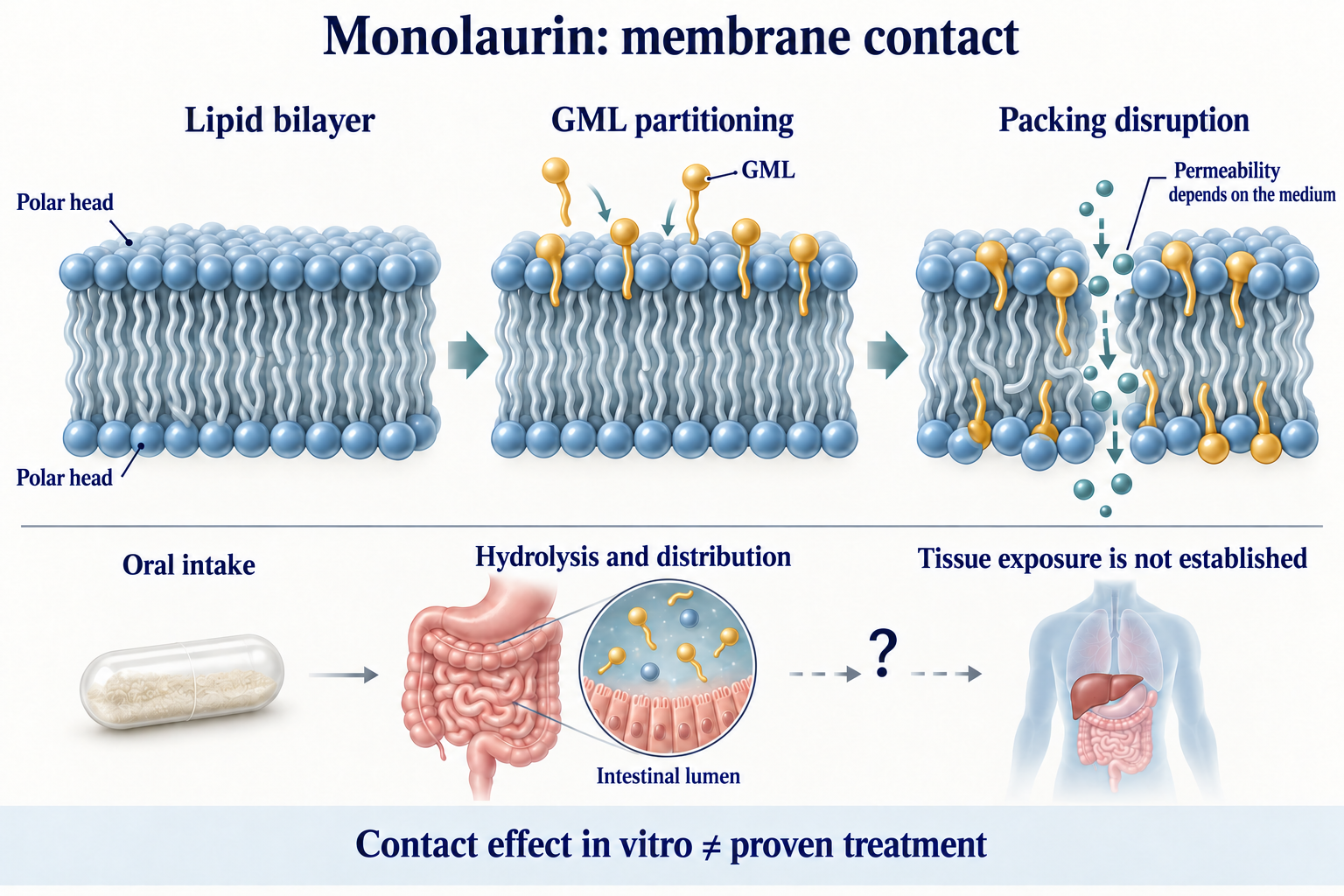
A lipid bilayer is maintained by hydrophobic interactions, hydration of polar heads, and acyl-chain packing. Incorporation of a single-chain amphiphile can change these interactions, local curvature, and membrane protein movement. Sufficient exposure may create packing defects and increase permeability; under other conditions the substance changes signaling without immediately destroying the cell. Solubilization therefore describes one possible regime, rather than an inevitable result of any GML–membrane contact.
Nominal concentration in a vessel is not the same as free concentration at the membrane. Some GML may aggregate, bind proteins, partition into a lipid vehicle, or adsorb onto a surface. Temperature, salts, pH, solvent, and membrane composition affect availability. Consequently, one critical micelle concentration, packing parameter, or antimicrobial range cannot be assigned to every formulation and biological medium.
In bacteria, loss of the membrane barrier can disturb electrical potential and the proton gradient. These components of proton motive force are related by Δp = Δψ − (2.303RT/F)ΔpH when gradient directions are defined consistently. Ion leakage can impair solute transport and membrane-coupled ATP synthase activity. This is a biophysical interpretation of damage; establishing that specific mechanism requires measurements of potential, ion permeability, ATP, and viability, rather than only a change in bacterial shape in a micrograph.
Methods also constrain conclusions. Artificial bilayers help isolate lipid interactions but lack the complete cell wall, proteins, metabolism, and repair machinery. Membrane dyes indicate dye accessibility or changes in potential, not necessarily complete envelope dissolution. Microscopy, killing kinetics, solvent controls, and independent leakage measurements are needed together to distinguish causal membrane damage from a consequence of cell death.
Why Gram-positive bacteria are often more susceptible
Gram-positive bacteria have peptidoglycan surrounding their cytoplasmic membrane, whereas many Gram-negative organisms have an additional outer membrane containing lipopolysaccharide. The latter can limit GML access. This explains part of the spectrum difference, but does not create a simple rule that all Gram-positive bacteria die and all Gram-negative bacteria resist it. Strain, outer-envelope composition, pH, and combinations with other substances change the outcome.
Schlievert and Peterson's 2012 study examined planktonic and biofilm cultures and the dependence of activity on the medium. It supports discussion of contact effects across different conditions, but not direct extrapolation to blood or deep infection sites. Proteins, tissue lipids, and delivery constraints may change active exposure far more than increasing the mass in a capsule.
The spread of values in clinical-isolate studies is particularly instructive. A 2024 study of 115 S. aureus isolates found monolaurin MICs of 250–2000 μg/mL. A separate study of 103 MRSA isolates from wound infections reported 500–2000 μg/mL. These cannot be reconciled with a single promise of activity at 5–20 μg/mL against all staphylococci. Differences in methods and microbial populations are part of the findings.
Toxins, biofilms, and antibiotic combinations
GML is also studied below concentrations that completely inhibit growth. Membrane-dependent bacterial signaling contributes to regulation of virulence factors, so toxin production can fall independently of viable cell numbers. Studies of S. aureus and Bacillus anthracis support that question. They do not mean that GML binds or neutralizes every toxin already released.
TSST-1 is a staphylococcal superantigen that can bridge MHC II and particular T-cell receptor Vβ regions outside ordinary peptide recognition. Its production is therefore relevant to toxic shock. Lower laboratory TSST-1 levels, however, are not evidence of preventing a rare clinical event. Prevention requires a different study size, clinical outcomes, and control of accompanying factors.
Biofilms require separate assessment too. A reduction in stainable attached material, prevention of a new biofilm, and killing cells in an established biofilm are distinct outcomes. The MRSA study assessed new and existing biofilms, microscopic structure, and icaD expression. Those laboratory endpoints do not demonstrate wound healing, clearance of a prosthetic infection, or the safety of administering GML through a catheter.
Combination experiments with β-lactams used fractional inhibitory concentrations and time-kill analysis. Synergy belongs to the selected isolates, concentration ratios, and contact times. It is not a reason to add monolaurin independently to prescribed antibiotics: joint pharmacokinetics, the required ratio at the infection site, toxicity, and improvement in clinical outcomes must be established.
Enveloped viruses: a vulnerable structure and a limited spectrum
A viral lipid envelope derives from host-cell membranes and carries proteins needed for attachment, fusion, and entry. Disturbing its organization can remove infectivity. Similar-looking envelopes are not necessarily equally susceptible, however: lipid composition, membrane origin, protein coverage, and particle maturation differ. Nor can GML automatically affect a hidden viral reservoir or latent genome.
A primary 2020 study found that GML reduced HIV-1 infectivity and that of several other enveloped viruses in cell models. The viruses examined included yellow fever, mumps, and Zika viruses; adenovirus and enterovirus 68 were not inhibited under the corresponding conditions. Comparing enveloped and nonenveloped hepatitis A particles helped relate activity to the envelope. This is an important negative control, not proof of universal antiviral activity.
Preincubating virus with a substance tests contact inactivation. Adding it after infection tests a different stage. Washout, controls for GML carried into the cell culture, and host-cell toxicity testing are needed to distinguish these scenarios. Even convincing results do not show that oral intake creates comparable concentrations in respiratory tissues or a herpes lesion.
Studies of fish herpesviruses, pig viruses, and veterinary lipid mixtures may enrich the mechanistic picture but should identify their host and model. CyHV-2 is not human HSV-1 or HSV-2, and reduced infection in piglets does not measure influenza duration in adults. Human herpes requires a distinction between inactivating extracellular virions, treating an active episode, and preventing latent infection reactivation; the first does not establish the other two.
Host cells also respond to GML
An amphiphilic molecule does not automatically recognize a bad membrane. Zhang and colleagues found that GML altered lipid dynamics and the organization of LAT, PLC-γ, and AKT signaling microclusters in primary human T cells. Certain TCR-dependent signals, the calcium response, and production of several cytokines decreased. These findings describe suppression of specific cellular functions and do not justify the general term immune stimulation.
A subsequent study showed changes in LAT–SLP-76 association, distribution of actin-related complexes, and cell shape. The membrane acts as a platform organizing signaling proteins spatially. GML need not lyse a cell to alter its function, so absence of immediate cytotoxicity does not establish biological neutrality.
At a mucosal surface, reducing IL-8 or CCL20 may limit recruitment of viral target cells, but inflammatory signals also contribute to defense and repair. The direction of the effect depends on infection, tissue, and timing. The article on secretory IgA explores mucosal biology further: reducing one mediator cannot replace assessment of the entire barrier and immune-exclusion system.
What human studies of topical application showed
GML-treated tampons: biomarkers over a few hours
In Strandberg and colleagues' randomized blinded 2009 study, 225 women completed a protocol of ordinary tampon use. On the second menstrual day, their own tampon worn for 2–6 hours was replaced with a study tampon, with or without GML, for 4–6 hours. Researchers measured S. aureus, TSST-1, α-toxin, and IL-8; staphylococci were found in 41 participants. GML was a fiber finish, not an oral supplement or an infection treatment course.
Toxin and IL-8 amounts were lower in GML study tampons than in study tampons without GML. Study tampons without the substance also differed from participants' own tampons, emphasizing the material and comparison conditions. The study did not measure reduced toxic shock incidence, long-term recurrence prevention, or treatment of bacterial vaginosis. It cannot yield a clinical capsule dose; GML loading on fibers must not be replaced by a vaginal gel concentration.
A short vaginal-gel experiment
A small randomized double-blind study enrolled 36 women with colonization or suspected vaginal infection who applied gels every 12 hours for two days. The vehicle-only group included 14 participants, the 0.5% gel group 13, and the 5% gel group 9. Swabs were collected before treatment, after the first administration, and 12 hours after the final administration; Candida, Gardnerella vaginalis, lactobacilli, and GML were measured.
Candida and G. vaginalis counts fell with GML, but the control gel also reduced G. vaginalis. Vaginal pH and lactobacillus counts were not materially disturbed, and participants reported no adverse events during the short observation. This is a preliminary microbiological finding from a small sample over two days. It does not establish long-term safety, clinical cure rates, recurrence prevention, or equivalence to metronidazole; a promise of 82–88% cure in 7–10 days does not follow.
Macaques and SIV: topical prevention, not human treatment
In macaque SIV-transmission studies, GML was applied locally before viral contact. A larger study included 13 animals receiving 5% GML and 13 receiving vehicle. A 1 mL dose was given daily for at least two weeks before the first challenge and one hour before each of two viral exposures on a challenge day, using a high viral load. Researchers assessed infection and searched for occult infection over prolonged follow-up, which is more informative than a single early negative sample.
An earlier small study appeared highly encouraging, but one initially protected animal later developed detectable systemic infection. This limitation must accompany the positive result. The model supports topical microbicide development and the hypothesis of reduced recruitment of susceptible CD4 cells; it does not establish HIV prevention in women, treatment of established infection, or benefit from oral intake. The phrase 100% protection without sample size, observation time, and the delayed finding distorts the evidence.
Dermatology: a patient's isolate is not treatment of the patient
The title of a 2025 study of antibiotic-resistant S. aureus in atopic dermatitis can easily sound like a cream trial. Researchers actually sampled lesional and nonlesional skin and the nose of 30 children and 30 adults, then assessed monolaurin activity against the isolated organisms. Patients were the source of clinical isolates. The result supports further development of a topical agent, but does not show improved SCORAD, less itching, or prevention of flares after applying GML.
The same distinction applies to MRSA wound isolates. Neither laboratory susceptibility nor biofilm changes demonstrate wound healing or superiority to benzoyl peroxide, retinoids, and standard antibacterial treatment. Such claims require a comparative human protocol, a described formulation, duration, a primary clinical outcome, and recording of harms. The studies considered here provide no such comparison.
After oral intake: hydrolysis, absorption, and metabolism
The GML ester bond permits GML + H₂O → glycerol + lauric acid, catalyzed by lipases or esterases. Fat digestion takes place at interfaces, and bile salts alter substrate availability. Pancreatic triacylglycerol lipase preferentially hydrolyzes primary triacylglycerol positions with colipase participation; this knowledge does not automatically determine the hydrolysis rate of purified GML. Other lipolytic enzymes, transport, and re-esterification also influence monoacylglycerol fate.
No redox coenzyme is required for this reaction: water cleaves the ester while the enzyme catalyzes it. Subsequent laurate oxidation is a different process. Activation to acyl-CoA requires ATP and coenzyme A; in β-oxidation, dehydrogenation involves FAD and NAD⁺, and thiolysis involves CoA. These steps follow substrate transport and activation, primarily within mitochondrial metabolism, and do not preserve the original GML structure.
C₁₂ should not be assigned the entire pharmacokinetic profile of C₈ or C₁₀. The contributions of portal and lymphatic transport depend on chain length, lipid form, meals, and enterocyte re-esterification. Laurate can enter complex lipids; acetyl-CoA formation does not automatically imply clinically appreciable ketogenesis from a supplement. Quantitative answers require human studies of distribution and metabolites, not percentages transferred from feed experiments.
The available evidence chain does not establish reliable human values for free GML in plasma and target tissues following gram-level doses recommended by vendors. Claims that 35–50% is hydrolyzed, the rest reaches the distal intestine, or blood reaches 5–15 μM with systemic antiviral activity are therefore unwarranted. Ingested mass does not determine free concentration at an infection site. Even a possible intestinal-lumen contact effect needs its own microbiota and clinical-outcome study; a related barrier-defense mechanism is discussed in the article on intestinal alkaline phosphatase.
Safety: a food function and an investigational medicine
The US regulatory section on mono- and diglycerides concerns food use of glycerol ester mixtures under specified conditions and good manufacturing practice. It does not define absolute safety, approve infection treatment, or authorize arbitrary high doses of purified substance. An emulsifier's food function, prolonged supplement intake, and application to damaged mucosa require different exposure assessments.
Experiments show that host cells can be susceptible. In an oral-cell model, antibacterial effects were investigated at 25–50 μM, while LD₅₀ values for two cell lines were 146 and 69 μM. The proximity of these ranges does not establish a universally wide therapeutic window. Selectivity should be calculated within a consistent experiment using the same contact duration and medium; dividing cytotoxicity in one publication by MIC in another can mislead.
No reported adverse events among a few dozen women over two days does not exclude rare reactions or harm during prolonged use. Pregnancy, childhood, immunodeficiency, and chronic systemic intake have separate unresolved questions. An assertion that worsening symptoms reflect microbial die-off must not explain away every adverse reaction or justify continuing an unproven regimen.
What can be concluded about capsules and treatment promises
A narrative review of monolaurin as a dietary supplement found no human trials of that application within its search coverage. This historical result does not prove that no later study exists, but the more recent isolate, cell, and animal studies specifically considered here do not close the gap. They do not establish an effective oral dose, course duration, or magnitude of clinical benefit for herpes, influenza, or systemic staphylococcal infections.
A convincing future protocol must connect a standardized GML formulation to measured exposure and a prespecified outcome: for example, confirmed recurrence counts, symptom duration, or microbiological and clinical cure. Appropriate controls, sufficient follow-up, and harm assessment are needed. Until that chain exists, advertising doses cannot be presented as evidence-based regimens, and a supplement should not replace diagnosis, vaccination, licensed antivirals, or antibiotics when indicated.
Monolaurin remains a substantial research topic: amphiphile chemistry helps explain contact antimicrobial effects, changes in virulence, and membrane signaling. The most concrete human findings concern short topical experiments and microbiological indicators. Keeping that boundary allows interest in the mechanism without promises the studies did not test.
Methods and limitations
This is a narrative scientific review, not a systematic search or meta-analysis. Primary studies necessary to assess conflicting claims in the original manuscript were compared selectively: topical human experiments, cellular experiments, clinical-isolate studies, and the SIV-transmission model. Numbers were included only when an accessible source described the relevant sample, concentration, time, or endpoint; uncertain parameters were not reconstructed by assumption. Independent medical peer review and a formal GRADE assessment are not claimed.
FAQ
Is coconut oil equivalent to monolaurin?
No. Most lauric acid in the oil is in triacylglycerols; digestion does not reproduce the purified GML dose of a laboratory experiment.
Are capsules proven to treat herpes?
The studies considered establish neither a therapeutic oral dose nor prevention of herpes reactivation. Direct-contact inactivation of extracellular virus is a different outcome.
What did the vaginal-gel study show?
A small two-day experiment with 36 participants showed changes in microbial indicators. It did not establish long-term safety, recurrence prevention, or equivalence to standard treatment.
Does GRAS mean absolute safety?
No. A regulated food function under specified conditions is not approval for infection treatment or safety of arbitrary high doses.
Sources
- Hydrophilic and lipophilic characteristics of non-fatty acid moieties: significant factors affecting antibacterial activity of lauric acid esters
- Schlievert et al. Glycerol Monolaurate Contributes to the Antimicrobial and Anti-inflammatory Activity of Human Milk. Scientific Reports, 2019.
- Schlievert and Peterson. Glycerol Monolaurate Antibacterial Activity in Broth and Biofilm Cultures. PLOS ONE, 2012.
- Ghany et al. Novel synergistic interactions between monolaurin, a mono-acyl glycerol and β lactam antibiotics against Staphylococcus aureus: an in vitro study. BMC Infectious Diseases, 2024.
- Hassan Abd El-Ghany et al. Antimicrobial and Antibiofilm Activity of Monolaurin against Methicillin-Resistant Staphylococcus aureus Isolated from Wound Infections. 2024.
- Welch et al. Glycerol Monolaurate, an Analogue to a Factor Secreted by Lactobacillus, Is Virucidal against Enveloped Viruses, Including HIV-1. 2020.
- Zhang et al. Glycerol Monolaurate (GML) inhibits human T cell signaling and function by disrupting lipid dynamics. Scientific Reports, 2016.
- Zhang et al. Glycerol monolaurate induces filopodia formation by disrupting the association between LAT and SLP-76 microclusters. Science Signaling, 2018.
- Strandberg et al. Reduction in Staphylococcus aureus growth and exotoxin production and in vaginal interleukin 8 levels due to glycerol monolaurate in tampons. Clinical Infectious Diseases, 2009.
- Strandberg et al. Glycerol Monolaurate Inhibits Candida and Gardnerella vaginalis In Vitro and In Vivo but Not Lactobacillus. Antimicrobial Agents and Chemotherapy.
- Li et al. Glycerol monolaurate prevents mucosal SIV transmission. Nature, 2009.
- Glycerol Monolaurate Microbicide Protection against Repeat High-Dose SIV Vaginal Challenge
- Laowansiri et al. Monolaurin inhibits antibiotic-resistant Staphylococcus aureus in patients with atopic dermatitis. Scientific Reports, 2025.
- The Clinical Use of Monolaurin as a Dietary Supplement: A Review of the Literature
- Effects of Monolaurin on Oral Microbe–Host Transcriptome and Metabolome
- US FDA. Mono- and diglycerides: 21 CFR 184.1505
- Vetter and Schlievert. Glycerol monolaurate inhibits virulence factor production in Bacillus anthracis. 2005.
- Intestinal lipid absorption and lipoprotein formation
- Mitochondrial β-oxidation of saturated fatty acids in humans