Lactoferrin binds iron: antimicrobial peptides and clinical evidence
How lactoferrin coordinates Fe³⁺, how lactoferricin and other experimental mechanisms are studied, and what trials show for preterm sepsis, anemia, H. pylori, and respiratory infections.
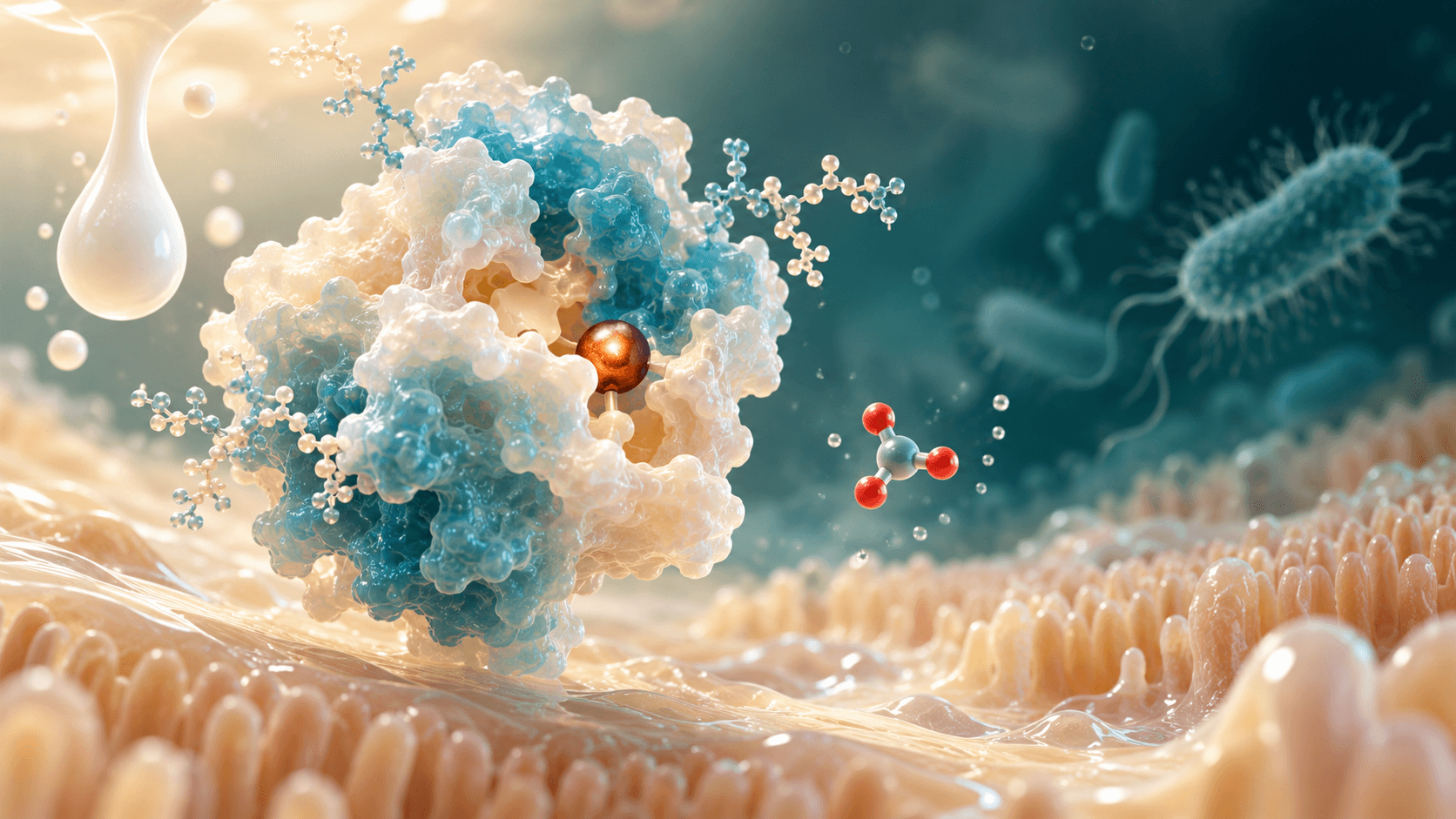
Lactoferrin is a large iron-binding glycoprotein found in milk, mucosal secretions, and neutrophil granules. Its molecular biology helps explain several effects: it can keep iron out of reach of microbes, interact with lipopolysaccharide and cell surfaces, and yield peptides with their own activity after proteolysis. These mechanisms, however, are not equivalent to a clinical effect of a dietary supplement. The protein source, iron saturation, processing, site and extent of digestive cleavage, and the specific study outcome all matter.
This article separates three questions: how lactoferrin coordinates Fe³⁺ and participates in local “competition for iron”; what laboratory experiments show about lactoferricin, lactoferrampin, biofilms, and viral attachment; and what has been tested in patients. Particular attention is paid to the difference between molecular iron binding and iron delivery to the body, and between an early small positive trial and later, larger studies with neutral results.
1. A protein found in different places and forms
Lactoferrin (LTF, lactotransferrin) is a non-heme iron-binding protein in the transferrin family. In humans it is produced by glandular epithelial cells, including those in the mammary gland and mucosa, as well as by neutrophils. Its concentration in milk is especially high in colostrum and declines as milk transitions to the mature form; secretion composition depends on species, lactation stage, and physiological state. In neutrophil secondary granules, the protein is synthesized as the granulocyte matures and is then released by degranulation at sites of inflammation. The neutrophil pool and dietary lactoferrin therefore represent different exposures: in the former, the protein is locally present beside microbes and host cells; in the latter, it first passes through the digestive tract.
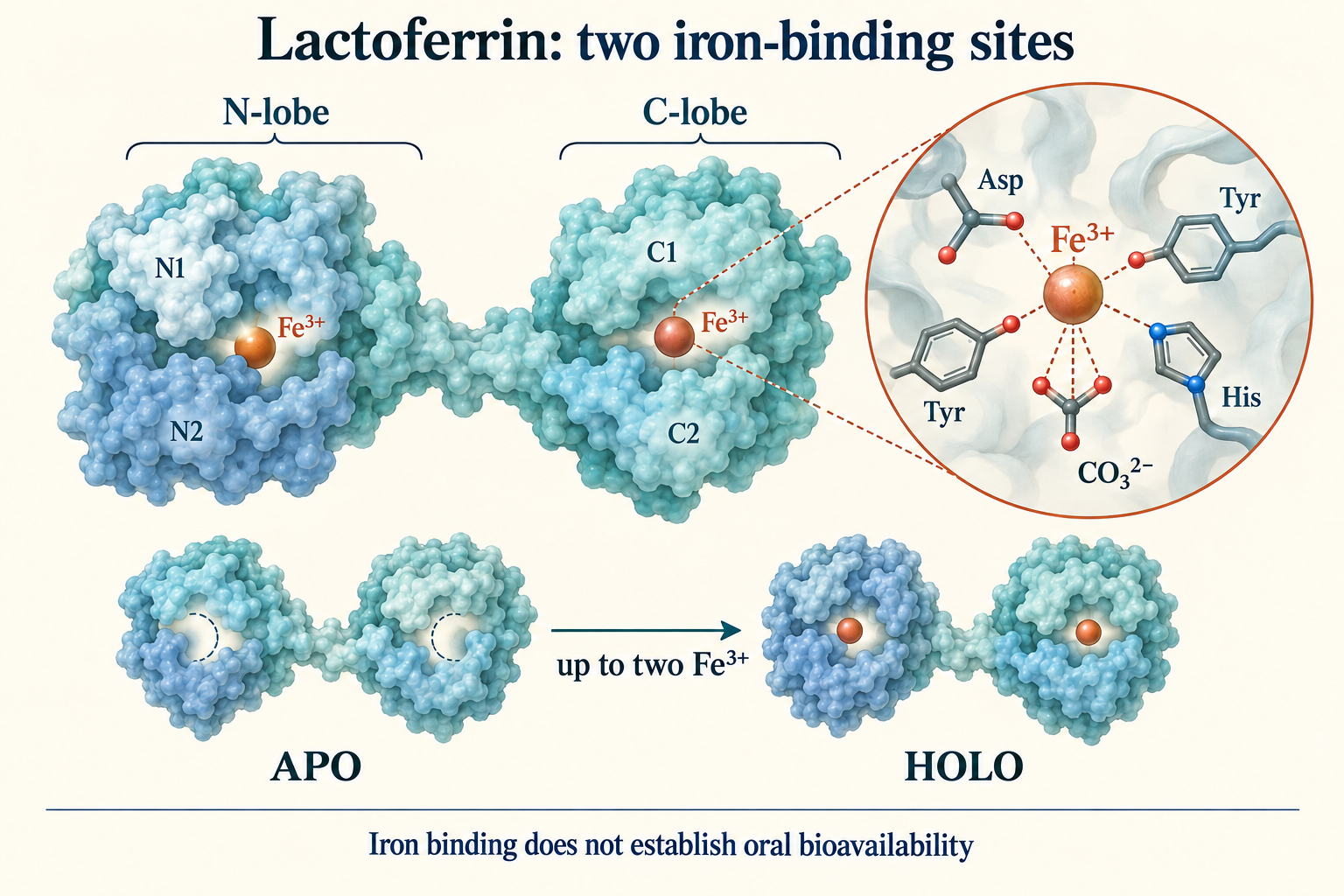
The molecule is glycosylated and has two homologous lobes, N and C, joined by a hinge. Each lobe consists of two domains with a metal-binding cleft between them. An intact molecule can bind up to two Fe³⁺ ions, one in each lobe. This is the maximum stoichiometric capacity, not a description of the saturation state of any commercial product.
This article uses three conventional terms for iron saturation. The apo form has vacant iron-binding clefts; the monoferric form has occupied one of its two clefts; the holo form is close to saturation at both. Real products and biological secretions may contain a mixture of these states. Saturation affects protein conformation, access to binding sites, and its properties in laboratory systems. The mass of a powder or a label that says “lactoferrin” does not reveal how much vacant capacity for Fe³⁺ it contains.
Bovine lactoferrin (bLF) is common in dietary supplements and fortified formulas; human lactoferrin (hLF) is present in breast milk and neutrophil granules. Their architecture is similar, but their sequences, glycosylation, saturation, raw materials, and processing differ. Recombinant protein should also be treated as a separate preparation when its sequence, glycans, or manufacturing characteristics differ. Activity of an isolated peptide from bovine lactoferrin cannot automatically be attributed to orally consumed human or recombinant protein.
2. How the iron-binding site forms
In each lobe, Fe³⁺ lies in the interdomain cleft. In classic structural studies, the ion is coordinated by four protein side chains—one aspartate, two tyrosines, and one histidine—and the oxygen atoms of a synergistic carbonate anion. In bovine lactoferrin these include Asp60, Tyr92, Tyr192, and His253 in the N-lobe; the corresponding C-lobe residues are Asp395, Tyr433, Tyr526, and His595. Numbering depends on species and exact sequence, so these positions should not be assigned to every protein variant without checking.
Carbonate acts as the synergistic anion: it occupies part of Fe³⁺’s coordination sphere and is stabilized by hydrogen bonds, including interactions near a conserved arginine and the end of a helix. In physiological media, carbonate and bicarbonate are in acid–base equilibrium, so experiments may use either term. This does not mean that free bicarbonate always forms an identical complex directly at every pH. By comparison, free Fe³⁺ tends to hydrolyze and precipitate in aqueous media; affinity measurements therefore depend on buffer, pH, competing ligands, and method. A single universal binding constant for all conditions would be misleading.
When iron and the anion bind, the lobe’s domains draw together and the cleft closes. The apo form is generally more open and mobile, whereas the iron-loaded form is more closed; this is the “claw-like” conformational transition. It affects metal accessibility and protein interactions with proteases, but does not make the protein indigestible. A structural transition seen by crystallography or spectroscopy does not by itself show what fraction of an oral dose survives digestion.
Lactoferrin holds iron more strongly in acidic conditions than serum transferrin, which is adapted to release metal in acidic endosomes. However, saying “iron remains bound down to pH 3” would overgeneralize. In an experiment with saturated bovine lactoferrin, retention as pH fell depended on the lobe and conditions: some iron was already lost around pH 5, about one quarter remained at pH 4, and about one tenth of the initial iron remained at pH 2. This describes one measurement system, not a universal curve for human protein, different saturation states, or a stomach containing food.
3. Iron sequestration is part of nutritional immunity, not a simple “starvation threshold”
During inflammation, the host changes how iron is distributed. Transferrin carries it in plasma, ferritin stores it in cells, and lactoferrin binds it in neutrophil granules and secretions. Reducing accessible extracellular iron can restrict the growth of some microorganisms; this is called nutritional immunity. Bacteria need iron not as an abstract cofactor but for specific metalloproteins, including heme cytochromes, iron–sulfur proteins, some enzymes involved in DNA synthesis, and redox reactions.
Sequestration does not mean that all bacteria stop dividing at one shared Fe³⁺ concentration. Requirements depend on species, medium, and oxygen conditions; microbes can obtain iron from heme, use siderophores, or express specialized receptors for host proteins. Iron-acquisition systems that draw iron from transferrin or lactoferrin have been described in several pathogens. High-affinity siderophores help microbes compete for the metal, and some Gram-negative bacteria can “pirate” siderophores that are already bound to iron. Lactoferrin is therefore one participant in a dynamic competition, not an insurmountable iron barrier.
It is also important not to confuse sequestration with iron delivery. Apo-lactoferrin has vacant capacity and can capture Fe³⁺. Holo-lactoferrin already carries iron, but that iron does not automatically become bioavailable to a person simply because the protein was swallowed. Metal transfer requires preservation of the complex, recognition of the protein or release of iron, subsequent transport, and incorporation into iron metabolism. Digestion, saturation, and mucosal condition can change each step.
Inflammatory iron regulation is also linked to hepcidin: IL‑6 and other signals can increase hepatic hepcidin synthesis, which promotes ferroportin internalization and iron retention in enterocytes and macrophages. Some clinical lactoferrin studies in anemia have measured IL‑6, hepcidin or its precursor, and hematologic outcomes. But a change in an inflammatory marker does not prove that lactoferrin itself “opens” ferroportin or replaces iron; blood outcomes and clinical context need to be assessed.
Lactoferrin binding may reduce the participation of free iron in reactions that produce reactive oxygen species. But describing the Fenton reaction should not be turned into a claim that the protein completely blocks oxidative tissue injury. Redox chemistry in the body depends on iron species, local chelators, peroxide, enzymes, and compartment. Lactoferrin binds ions, but it is not a universal antioxidant switch for inflammation.
4. Intact protein, lactoferricin, and lactoferrampin
Beyond its iron-binding clefts, lactoferrin has cationic regions that can interact with microbial envelopes. Human and bovine proteins can bind lipopolysaccharide (LPS); laboratory experiments have shown binding to LPS and lipid A, as well as release of some LPS from the outer membrane of Gram-negative bacteria. The effect depends on concentration, ionic strength, bacterial species and strain, and whether whole protein or peptide is tested. Binding LPS in a tube is not equivalent to clinically neutralizing endotoxin in a patient.
Lactoferricin is a cationic fragment from lactoferrin’s N-terminal region. Classic studies obtained it by controlled pepsin digestion of the protein and then isolated or synthesized the fragment for experiments. The bovine variant often studied is the 25-amino-acid sequence bLfcinB; the human fragment has a different sequence and fold. An intramolecular disulfide bond can close a loop, while arginine, lysine, and aromatic residues contribute charge-based and hydrophobic contacts. Lactoferrampin is a separate proposed antimicrobial segment of the N1 domain, identified by the activity of a synthetic peptide; it should not be treated as a proven product formed unchanged in the intestine after every serving of lactoferrin.
In model systems, cationic peptides can be attracted to negatively charged envelope regions: lipid A phosphates in Gram-negative bacteria or anionic cell-wall components in Gram-positive bacteria. Displacing Mg²⁺ and Ca²⁺ bridges that stabilize LPS can increase outer-membrane permeability. Some peptides then interact with the cytoplasmic membrane, alter its permeability or potential, and thereby disrupt bacterial viability. LPS release and membrane morphology changes have been described for lactoferricin in in vitro experiments; the exact killing model varies by microorganism and is not reducible to a universal pore of fixed diameter.
This effect need not depend on iron: peptide–membrane interactions may persist with saturated protein or with a synthetic fragment. But several steps separate a synthetic peptide in bacterial culture from an oral supplement: an active sequence must be generated, survive in the intestinal lumen, reach the site of action at a sufficient concentration, and not be confused with another product component. Antimicrobial activity of purified bLfcinB therefore does not show that blood or mucosa receives the same dose of active peptide after intact lactoferrin is swallowed.
5. Biofilm: a mechanism of early attachment and the limits of a laboratory result
A biofilm is a microbial community surrounded by an extracellular matrix of polysaccharides, proteins, and extracellular DNA. Its composition and resilience vary by organism and surface conditions. In a classic study of Pseudomonas aeruginosa, a sub-inhibitory concentration of lactoferrin that did not suppress bacterial growth interfered with biofilm formation. By binding available iron, the protein increased surface motility (twitching), so individual bacteria continued moving instead of settling, clustering, and beginning to build a biofilm.
This is an important mechanism at an early formation stage, but the original work cannot be described as evidence that lactoferrin “dissolves mature biofilms in people.” Effects on an established matrix, a particular strain, and a surface model require separate experiments; a laboratory effect also does not establish that an oral supplement reaches a catheter, lung, or dental plaque. Lactoferrin combinations with antibiotics have been studied in different experimental systems, but a lower MIC or in vitro synergy alone does not justify changing antibiotic therapy.
6. Viral attachment: a plausible model is not antiviral treatment
Positively charged regions of lactoferrin can bind negatively charged glycosaminoglycans on cell surfaces, including heparan sulfate. For some viruses, heparan sulfate serves as an initial attachment factor. In cell models, lactoferrin may compete for this site or bind the viral particle; the interaction can differ for other viruses. Even if this step reduces infection in a cell culture, it does not show that the protein retains its structure after ingestion, reaches the epithelium at the required concentration, or prevents infection in people.
In early virus experiments, attachment and entry were studied separately: pretreating cells or particles could change the result, while viruses that did not use heparan sulfate in a given model responded differently. The term “pantropic antiviral action” is therefore inaccurate here. Findings for HSV, influenza, RSV, SARS‑CoV‑2, and enteric viruses come from different models and cannot be combined into one proven mechanism or indication.
The clinical evidence is much smaller than the mechanistic literature. A randomized trial in 209 health-care workers in Peru studied 600 mg/day bovine lactoferrin for 90 days to prevent SARS‑CoV‑2. The trial stopped early after vaccines became available; infection was recorded in 11/104 participants in the lactoferrin group and 9/105 in the placebo group, with no significant difference. In a study of 218 hospitalized adults with moderate or severe COVID‑19, 800 mg/day bLF was added to standard care; no difference was found in death or ICU transfer and early discharge. These data do not support a preventive or therapeutic effect for COVID‑19.
Combination products have also been tested for colds. For example, a randomized study used 600 mg/day for 90 days of a lactoferrin-containing fraction enriched with immunoglobulins from whey. It enrolled 126 adults with frequent colds; 90 completed the 90-day period. During that time, 48 colds were recorded in the mixture group versus 112 in the placebo group (p<0.001); symptom days and severity were also numerically lower, but the difference was not statistically significant. This is a signal for a particular mixture and symptoms, not an isolated evaluation of lactoferrin. In a study of 50 preschool children with recurrent respiratory infections, 400 mg/day bLF was given for four months; the median number of episodes was 1 (IQR 0–2) versus 2 (IQR 1–3) in the control group (p=0.02). The proportion of children with three or more episodes was 4% versus 28%; there was no between-group difference during the next two months after treatment ended. This was a small comparative study in which treatment was open-label, and its signal applies to a particular product and group, not prevention for all children.
7. What happens to lactoferrin after it is swallowed
Lactoferrin is a dietary protein, and its oral fate depends on pH, food matrix, iron saturation, proteases, and transit time. Some molecules may be cleaved by pepsin in the stomach; pancreatic proteases and brush-border peptidases act in the small intestine. The fraction of intact protein and the fragment profile vary with experimental conditions. This contradicts claims that a fixed fraction of every adult dose passes through the stomach unchanged or that lactoferricin must be present in intestinal contents at a pharmacologically active concentration.
In infants, breast milk contains human lactoferrin within a complex matrix; digestive maturity and feeding differ from an adult taking isolated bovine powder. Observations in breastfeeding cannot be directly translated into the bioavailability of a capsule or a formula with a different protein composition.
Cell and animal models have examined lactoferrin binding to receptors and uptake by epithelium. Intelectin-1 (ITLN1) recognizes certain carbohydrate structures and interacts with lactoferrin in experimental systems; LRP1 and other receptors participate in endocytosis in some tissues. But finding a receptor in cell culture does not prove effective transcytosis of intact protein from the human intestine into blood. Circulating dietary protein, its fragments, and endogenous neutrophil lactoferrin must also be distinguished. There is no reliable universal figure for systemic bioavailability of oral lactoferrin in humans.
“Iron delivery” also requires caution. In the gastrointestinal tract, some lactoferrin may bind Fe³⁺, and particular receptor and cellular pathways may transfer iron. But a clinical rise in hemoglobin does not show that the molecule crossed the intestine intact; changes in inflammatory regulation, diet, adherence, or other factors may contribute. The mechanism should be measured rather than inferred from a change in one marker.
8. Clinical evidence: early positive results and larger negative trials
Preterm infants and late-onset sepsis
In the multicenter Italian study by Manzoni et al., 472 very-low-birth-weight infants were assigned to three groups: 100 mg/day bovine lactoferrin, the same lactoferrin plus Lactobacillus rhamnosus GG, or placebo. Treatment continued through day 30 of life, or through day 45 for infants weighing under 1000 g. A first episode of late-onset sepsis was recorded in 9/153 infants in the bLF group (5.9%) and 29/168 in the placebo group (17.3%); the risk ratio was 0.34. This was a notable positive result in a specific population and intensive-care setting, but it needed confirmation in larger studies.
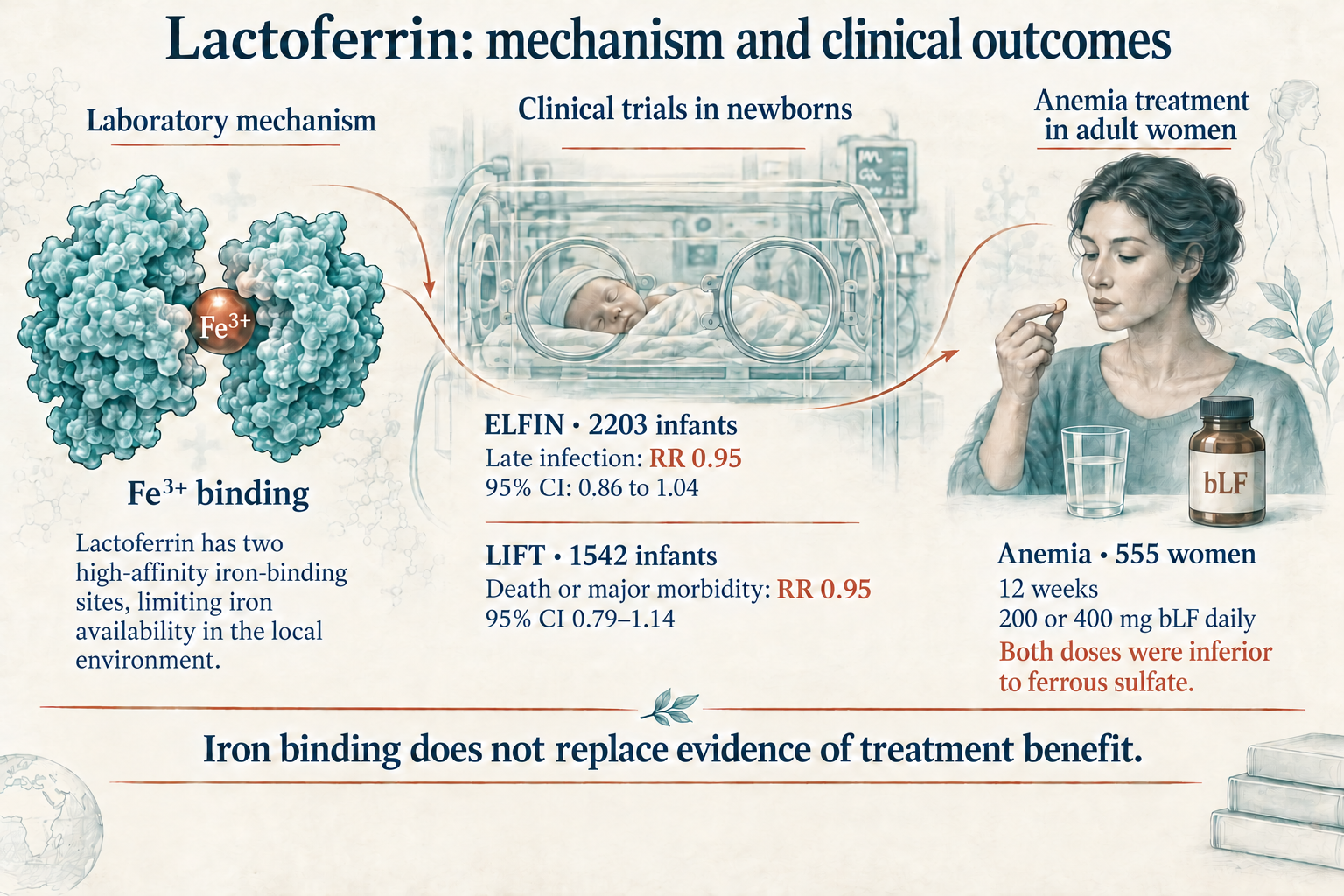
In the UK ELFIN trial, 2203 very preterm infants were randomized to enteral bLF at 150 mg/kg/day (maximum 300 mg/day) or a visually matched placebo; the primary analysis included 2182 infants. Late infection occurred in 316/1093 infants (28.9%) in the lactoferrin group and 334/1089 (30.7%) in controls; the adjusted RR was 0.95 (95% CI 0.86–1.04), with no significant difference. No convincing difference was found in secondary outcomes, including NEC, mortality, and bronchopulmonary dysplasia. The authors’ conclusion did not support routine bLF use to prevent infection in very preterm infants.
In the Australian–New Zealand LIFT trial, 1542 infants with birth weight under 1500 g received 200 mg/kg/day pasteurized bLF or usual feeding without added lactoferrin. The primary outcome was survival to discharge without major morbidity, not sepsis alone. Death or a composite major complication occurred in 162/770 (21%) versus 170/771 (22%); RR 0.95 (95% CI 0.79–1.14), p=0.60. A meta-analysis prespecified by the LIFT investigators and covering 5609 infants from 13 trials found less late-onset sepsis (RR 0.79; 95% CI 0.71–0.88), but no difference in NEC or overall mortality. Cochrane had previously rated the evidence for a reduction in late sepsis as low certainty. These findings cannot be reduced to a promise to prevent sepsis: the large trials did not confirm their main composite clinical outcomes, and the pooled estimate depends on heterogeneous studies.
In ELFIN, supplementation continued until 34 weeks of postmenstrual age. In LIFT, it continued until 34 weeks of postmenstrual age or for at least two weeks, whichever was longer, with earlier discharge ending supplementation. These distinct protocols do not constitute a single treatment regimen.
The 2020 Cochrane review combined 12 randomized trials involving 5425 infants; evidence for a possible reduction in late-onset sepsis was of low certainty, without an established reduction in stage II/III NEC or overall mortality.
Iron deficiency and anemia
Early Italian studies in women reported that 100 mg bLF twice daily could improve hemoglobin and iron markers, sometimes with fewer gastrointestinal complaints than ferrous sulfate. However, some early work used women who declined treatment as controls and was not a modern, rigorously randomized comparison. Two clinical trials by Paesano et al. in 2010 compared 100 mg bLF twice daily with 520 mg/day ferrous sulfate in pregnant and nonpregnant women; differences in hemoglobin, IL‑6, and prohepcidin were reported. A 2017 meta-analysis combined four RCTs (600 pregnant women): the mean difference in hemoglobin increase at four weeks was +0.77 g/dL in favor of bLF (95% CI 0.04–1.55), but the subgroup difference for mild anemia was not statistically significant. The trials differed in anemia severity, dose, and methods, and early results should not replace a larger study.
In 2026, a double-blind randomized noninferiority trial in Dhaka enrolled 555 nonpregnant women aged 18–49 with iron-deficiency anemia. Participants received 60 mg elemental iron as sulfate, 200 mg bLF, or 400 mg bLF per day; all groups also received 400 μg folic acid for 12 weeks. Mean Hb changed by −0.2 ± 0.8 g/dL with 200 mg bLF, 0.0 ± 0.9 with 400 mg bLF, and +1.1 ± 1.3 with ferrous sulfate. Neither bLF dose met the prespecified noninferiority margin, and both performed worse than the active control on Hb. Adverse events were comparable between groups. This is a direct negative result against using bLF as a substitute for ferrous sulfate in a similar population and regimen.
Studies that combine lactoferrin with iron, a probiotic, or another therapy address a different question from bLF monotherapy. Likewise, children with inflammatory bowel disease, pregnant women, people with chronic kidney disease, and nonpregnant women in Bangladesh have different causes of anemia and expected responses. When anemia is confirmed in the laboratory, its type and cause need to be established; molecular iron-binding capacity is not evidence that a supplement replaces treatment for iron deficiency. For more on diagnosis and ferritin interpretation, see iron and ferritin.
Helicobacter pylori and antibiotic therapy
Fixed doses of bLF have also been tested as add-ons to older H. pylori eradication regimens. In a multicenter study of 402 adults, a seven-day course of esomeprazole, clarithromycin, and tinidazole was compared with the same antibiotics plus 200 mg bLF twice daily. In the intention-to-treat analysis, eradication was 77% without lactoferrin and 90% with it; adverse events did not differ substantially. In another randomized study, 133 patients received seven-day triple therapy with amoxicillin, clarithromycin, and esomeprazole, or the same regimen plus 200 mg bLF twice daily: eradication rates were 77.9% and 76.9%, showing no advantage from adding lactoferrin.
A 2009 meta-analysis combined nine RCTs and 1343 participants and reported higher pooled eradication and fewer adverse effects when lactoferrin was added. However, the included trials were small, used different regimens, and were conducted in an era of different antibiotic resistance; a later negative RCT shows the result is not universal. These data do not justify adding lactoferrin to a current eradication regimen or changing prescribed antibiotics without medical advice.
Respiratory infections and inflammatory outcomes
A randomized study in 157 healthy adults (145 entered the full analysis) compared 200 mg bLF daily for 12 weeks with placebo; the primary outcomes were combined respiratory and systemic symptom scores. Mean total scores were lower in the bLF group, and activity markers of plasmacytoid dendritic cells also changed. The trial was not designed to prove a reduction in laboratory-confirmed infections. A SARS‑CoV‑2 prevention trial in health-care workers found no significant effect; a combined Lf/Ig fraction and a small preschool study provide only product- and population-specific signals.
Taken together, human studies do not establish universal lactoferrin use to prevent acute respiratory infections, treat viral disease, or suppress inflammation. A change in cytokine, pDC, or a symptom score is not the same as preventing infection, hospitalization, death, or viral transmission.
9. Safety, product form, and limits of self-directed use
bLF is obtained from milk-derived material; people with cow’s-milk protein allergy may react to the protein itself or residual milk components, so the word “purified” should not be taken as a guarantee that allergens are absent. Lactose intolerance has a different mechanism and is not itself equivalent to milk-protein allergy, but the composition of the specific product still matters. People with milk allergy should avoid self-testing bLF and discuss alternatives with a clinician.
Short studies generally report acceptable tolerability, but small samples cannot rule out rare reactions. Safety of a food ingredient or an FDA GRAS notification applies to the intended food use and quality of the specific source material; it does not establish therapeutic efficacy, safety at every dose, or absence of allergy. Data from pasteurized bLF in preterm infants, adult capsules, fortified formula, and recombinant protein should not be transferred across products.
These data do not establish a universal therapeutic dose. Studies used specific products, saturation states, doses, and durations—from 100 mg/day in preterm infants in one trial to hundreds of mg/day in adults and 150–200 mg/kg/day in neonatal protocols. These are descriptions of research regimens, not instructions for self-treatment. Iron deficiency requires diagnosis and response monitoring; lactoferrin does not replace medical care when infection or a serious condition is suspected.
Review method and limitations
This is a narrative review of lactoferrin iron-binding biochemistry, experimental antimicrobial and viral models, and clinical studies. On 9 October 2026, targeted checks covered primary structural studies of the coordination site; work on lactoferricin, LPS, and biofilm formation; major trials in preterm infants; early lactoferrin studies in anemia; the 2026 randomized noninferiority study; clinical trials in H. pylori; and human respiratory-outcome studies. Numbers are reported for specific trials and are not combined into a personal recommendation. A formal systematic search and independent risk-of-bias assessment across all listed topics were not performed; no single GRADE rating is therefore claimed. Limitations include differences in protein source and form, iron saturation, food matrix, dose, population, and outcome definitions; much mechanistic evidence comes from in vitro or animal studies.
Conclusion
Lactoferrin is a protein with two iron-binding lobes, a synergistic role for carbonate, and several distinct ways of interacting with microbial surfaces. Fe³⁺ sequestration, LPS binding, purified-peptide activity, and effects on early biofilm formation are biologically plausible but have mostly been studied in experimental systems. Laboratory competition for iron or viral attachment does not establish a therapeutic effect of an oral supplement.
Clinical findings are mixed: an early small trial in preterm infants produced a positive signal, while the larger ELFIN and LIFT trials did not confirm key outcomes; early bLF anemia findings differ from a later randomized trial in which bLF performed worse than ferrous sulfate; and H. pylori studies are also inconsistent. Assessment should therefore focus on the specific protein, product, population, dose, and primary outcome, retaining negative findings and not deriving a universal regimen from mechanism alone.
FAQ
How much iron can one lactoferrin molecule bind?
An intact protein has two lobes, each able to occupy one Fe³⁺ site together with a synergistic carbonate anion. This is maximum capacity; saturation in a real product can vary.
Does lactoferrin only deprive bacteria of iron?
No. Iron binding is one mechanism. The protein and its N-terminal peptides can interact with LPS and membranes; in some models lactoferrin also interfered with early biofilm formation. Most such evidence is experimental.
Are lactoferricin and lactoferrampin formed after taking a capsule?
Their activity has been studied after controlled proteolysis and in isolated or synthetic fragments. Reliable active exposure to these peptides after any human supplement is not established.
Does lactoferrin prevent sepsis in preterm infants?
An early small RCT showed a positive signal, but the larger ELFIN and LIFT trials did not confirm key clinical outcomes. Meta-analyses suggest a possible reduction in late sepsis with low certainty, but not NEC or overall mortality.
Can lactoferrin replace ferrous sulfate for iron-deficiency anemia?
In a 2026 randomized trial in nonpregnant women with iron-deficiency anemia, bLF 200 or 400 mg performed worse than 60 mg elemental iron as sulfate for 12-week hemoglobin change. Earlier studies in other groups were more favorable but do not establish a universal substitute.
Is lactoferrin proven to prevent or treat COVID-19?
No. RCTs in health-care workers and studies in hospitalized patients found no significant clinical benefit. Cell findings about heparan-sulfate binding do not replace trials of outcomes in people.
Who should consider allergy risk?
Bovine lactoferrin comes from milk. With confirmed cow’s-milk protein allergy, a purified product should not be assumed safe; consider the source and composition of the specific preparation.
Sources
- Lactoferrin: A Natural Glycoprotein Involved in Iron and Inflammatory Homeostasis. Nutrients. 2017;9:1005.
- Anderson BF et al. Structure of human lactoferrin at 3.2-A resolution. Proc Natl Acad Sci U S A. 1987;84:1769–1773.
- Anderson BF et al. Structure of human lactoferrin: crystallographic structure analysis and refinement at 2.8 A resolution. J Mol Biol. 1989;209:711–734.
- Rastogi N et al. Structure of iron saturated C-lobe of bovine lactoferrin at pH 6.8 indicates a weakening of iron coordination. Proteins. 2016;84:591–599.
- Properties of the iron-binding site of the N-terminal lobe of human and bovine lactotransferrins. Importance of the glycan moiety and non-covalent interactions. Biochem J. 1990;270:401–406.
- Pakdaman R, Petitjean M, El Hage Chahine JM. Transferrins—a mechanism for iron uptake by lactoferrin. Eur J Biochem. 1998;254:144–153.
- Peterson NA et al. “Dilysine trigger” in transferrins probed by mutagenesis of lactoferrin. Biochemistry. 2002;41:14167–14175.
- Rascón-Cruz Q et al. Lactoferrin: A Glycoprotein Involved in Immunomodulation, Anticancer, and Antimicrobial Processes. Molecules. 2021;26:205.
- Bellamy W et al. Identification of the bactericidal domain of lactoferrin. Biochim Biophys Acta. 1992;1121:130–136.
- Hoek KS et al. Antibacterial activity in bovine lactoferrin-derived peptides. Antimicrob Agents Chemother. 1997;41:54–59.
- Arnold RR et al. Antibacterial activity of lactoferrin and a pepsin-derived lactoferrin peptide fragment. Infect Immun. 1993;61:719–728.
- van der Kraan MIA et al. Lactoferrampin: a novel antimicrobial peptide in the N1-domain of bovine lactoferrin. Peptides. 2004;25:177–183.
- Elass-Rochard E et al. Lactoferrin-lipopolysaccharide interaction: involvement of the 28–34 loop region of human lactoferrin in high-affinity binding. Biochem J. 1995;312:839–845.
- Appelmelk BJ et al. Lactoferrin is a lipid A-binding protein. Infect Immun. 1994;62:2628–2632.
- Singh PK et al. A component of innate immunity prevents bacterial biofilm development. Nature. 2002;417:552–555.
- Marchetti M et al. Antiviral activities of lactoferrin. Antiviral Res. 2000;47:1–12.
- Waarts BL et al. Antiviral activity of human lactoferrin: inhibition of alphavirus interaction with heparan sulfate. Virology. 2005;333:284–292.
- Sinopoli A et al. The effects of orally administered lactoferrin in prevention and management of viral infections: a systematic review. Rev Med Virol. 2022;32:e2261.
- Wei YS et al. Oral fate and stabilization technologies of lactoferrin: a systematic review. Crit Rev Food Sci Nutr. 2022;62:6341–6358.
- Manzoni P et al. Bovine lactoferrin supplementation for prevention of late-onset sepsis in very low-birth-weight neonates: a randomized trial. JAMA. 2009;302:1421–1428.
- ELFIN Trial Investigators Group. Enteral lactoferrin supplementation for very preterm infants: a randomised placebo-controlled trial. Lancet. 2019;393:423–433.
- Tarnow-Mordi WO et al. The effect of lactoferrin supplementation on death or major morbidity in very low birthweight infants (LIFT): a randomized controlled trial. Lancet Child Adolesc Health. 2020;4:444–454.
- Pammi M, Suresh G. Enteral lactoferrin supplementation for prevention of sepsis and necrotizing enterocolitis in preterm infants. Cochrane Database Syst Rev. 2020;3:CD007137.
- Paesano R et al. Oral administration of lactoferrin increases hemoglobin and total serum iron in pregnant women. Biochem Cell Biol. 2006;84:377–380.
- Paesano R et al. Lactoferrin efficacy versus ferrous sulfate in curing iron disorders in pregnant and non-pregnant women. Int J Immunopathol Pharmacol. 2010;23:577–587.
- Abu Hashim H et al. Lactoferrin or ferrous salts for iron deficiency anemia in pregnancy: a meta-analysis of randomized trials. Eur J Obstet Gynecol Reprod Biol. 2017;219:45–52.
- Huda TM et al. Bovine lactoferrin compared with ferrous sulfate for treating iron-deficiency anemia in Bangladeshi women: a randomized controlled trial. J Nutr. 2026;156:101672.
- Lepanto MS et al. Efficacy of lactoferrin oral administration in treatment of anemia and anemia of inflammation in pregnant and non-pregnant women. Biochem Cell Biol. 2018;96:396–400.
- Di Mario F et al. Bovine lactoferrin for Helicobacter pylori eradication: an open, randomized, multicentre study. Aliment Pharmacol Ther. 2006;23:1235–1240.
- Dore MP et al. Quadruple therapy with lactoferrin for Helicobacter pylori eradication: a randomized multicentre study. Dig Liver Dis. 2005;37:814–818.
- Zou J et al. Meta-analysis: effect of lactoferrin supplementation on eradication rates and adverse events during H. pylori eradication therapy. Helicobacter. 2009;14:119–127.
- Vitetta L et al. The clinical efficacy of a bovine lactoferrin/whey protein Ig-rich fraction for the common cold: a double-blind randomized study. Complement Ther Med. 2013;21:164–171.
- Oda H et al. Effects of Bovine Lactoferrin on the Maintenance of Respiratory and Systemic Physical Conditions in Healthy Adults—A Randomized, Double-Blind, Placebo-Controlled Trial. Nutrients. 2023;15:3959.
- Pasinato A et al. Lactoferrin in prevention of recurrent respiratory infections in preschool children: a prospective randomized study. Children. 2024;11:249.
- Navarro R et al. Bovine lactoferrin for prevention of COVID-19 infection in health care personnel: a randomized clinical trial. Biometals. 2023;36:463–472.
- Matino E et al. Effect of lactoferrin on clinical outcomes of hospitalized patients with COVID-19: the LAC randomized clinical trial. Nutrients. 2023;15:1060.
- Berthon BS et al. Effect of Lactoferrin Supplementation on Inflammation, Immune Function, and Prevention of Respiratory Tract Infections in Humans: A Systematic Review and Meta-analysis. Adv Nutr. 2022;13:1799–1819.