Iodine in the Body: Why It Matters, How to Recognize Deficiency, and Why Excess Can Be Dangerous
A practical guide to iodine in T4 and T3 synthesis, food sources, deficiency and excess, thyroid testing and safe supplement decisions.
Iodine in the Body: Why It Matters, How to Recognize Deficiency, and Why Excess Can Be Dangerous
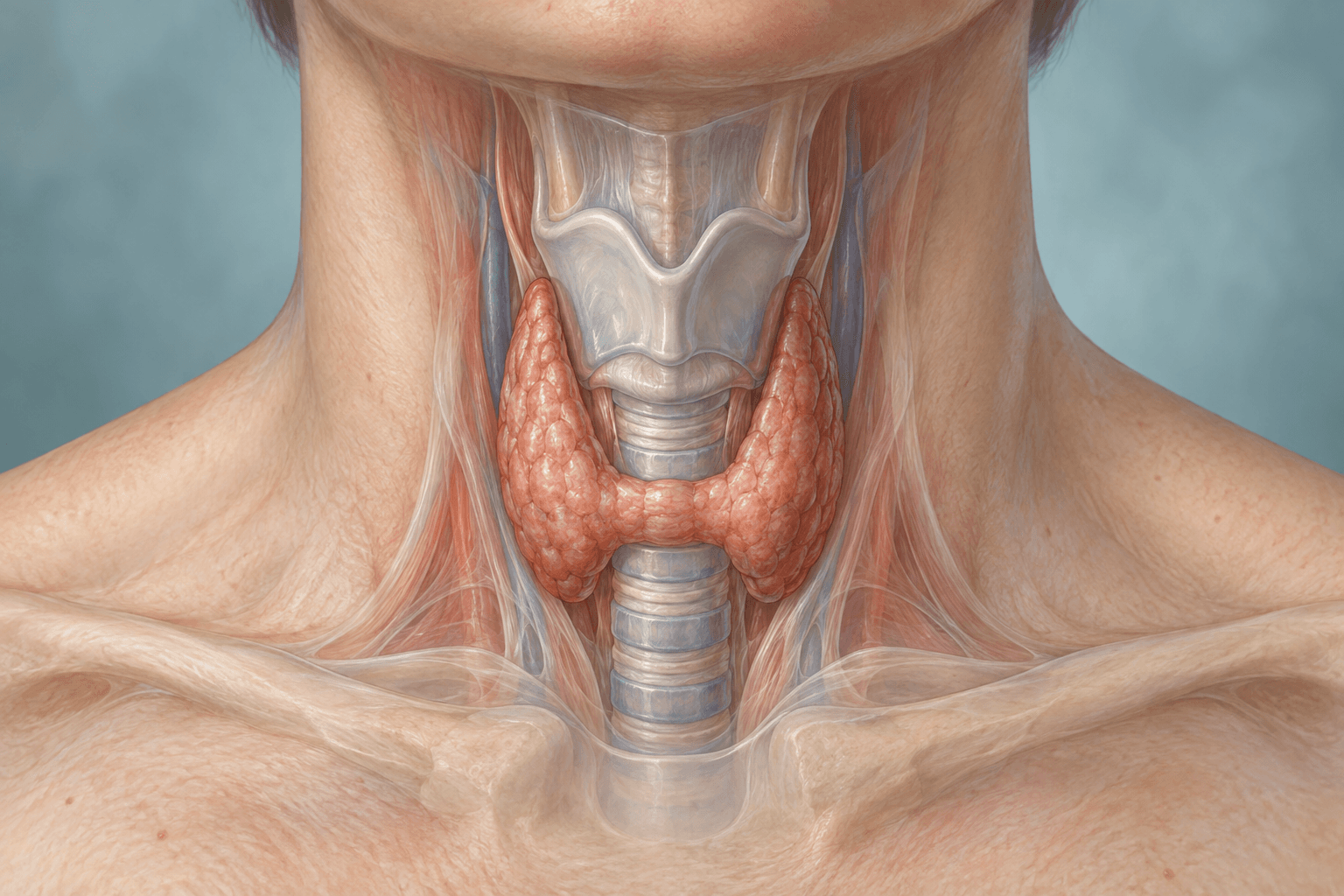
Iodine is an essential trace element primarily needed by the thyroid gland. The body uses it to produce the thyroid hormones thyroxine (T4) and triiodothyronine (T3). These hormones help regulate energy metabolism, heart function, thermoregulation, protein synthesis, growth, and nervous system development.
Adequate iodine intake is especially critical during pregnancy and early childhood, when thyroid hormones are essential for normal brain and nervous system development.
However, when it comes to iodine, the principle “more is better” does not apply. Deficiency can lead to thyroid enlargement and hypothyroidism, while excess iodine can trigger either hypothyroidism or hyperthyroidism in susceptible individuals.
The goal is therefore not to consume as much iodine as possible, but to maintain a stable physiological intake.
Why the Body Needs Iodine
The main biological role of iodine is its participation in thyroid hormone synthesis.
The thyroid gland takes up iodide from the blood and uses it to produce:
- T4 — thyroxine;
- T3 — triiodothyronine.
Thyroid hormones affect nearly every organ and tissue.
They are necessary for:
- normal energy metabolism;
- regulation of heat production;
- cardiovascular function;
- protein synthesis and enzyme activity;
- normal growth;
- bone maturation;
- brain and nervous system development;
- normal function of many organs.
This is why the consequences of severe iodine deficiency can be systemic rather than limited to the thyroid gland itself.
How the Thyroid Regulates Iodine Use
Thyroid function is controlled by the pituitary gland through thyroid-stimulating hormone — TSH.
When the body does not have enough thyroid hormone, the pituitary gland increases TSH secretion. In response, the thyroid gland takes up more iodine and attempts to increase production of T4 and T3.
With prolonged severe iodine deficiency, this compensatory response can cause the thyroid gland to enlarge, producing a goiter.
If iodine intake becomes extremely low, the gland may no longer be able to produce enough thyroid hormone despite TSH stimulation, and hypothyroidism may develop.
It is important to remember that TSH can remain within the normal range when iodine intake is only moderately inadequate. Therefore, TSH is a good marker of thyroid function, but it is not a sensitive test for individual iodine deficiency.
How Much Iodine Does a Person Need?
Requirements depend on age and physiological state.
According to the NIH, recommended daily intake is approximately:
- children ages 1–8 — 90 mcg;
- children ages 9–13 — 120 mcg;
- adolescents age 14 and older and adults — 150 mcg;
- during pregnancy — 220 mcg;
- during breastfeeding — 290 mcg.
These figures refer to total iodine intake from food, beverages, and supplements, not the amount everyone needs to take in tablet form.
For a healthy adult, 150 mcg is a target for total daily intake, not an automatic supplement dose.
Why Iodine Requirements Increase During Pregnancy
During pregnancy, thyroid hormone production increases, the mother’s iodine requirement rises, and iodine must also be supplied to the developing fetus.
During the first half of pregnancy, the fetus is particularly dependent on maternal thyroid hormones. Later, the fetal thyroid begins functioning, but iodine for hormone synthesis still comes from the mother.
Severe iodine deficiency during pregnancy can contribute to:
- impaired brain development;
- growth restriction;
- irreversible neurological impairment;
- increased risk of pregnancy loss;
- severe developmental problems in the child.
This is why pregnancy and early childhood are among the most iodine-sensitive periods of life.
Do All Pregnant Women Need Iodine Supplements?
This depends on the country, diet, salt iodization program, and the person’s thyroid status.
In the United States, recommended total iodine intake during pregnancy is 220 mcg per day, and during breastfeeding 290 mcg per day. The WHO uses a target of around 250 mcg per day for pregnant and breastfeeding women in certain public health programs.
The American Thyroid Association recommends that women planning pregnancy, pregnant women, and breastfeeding women in North America take a supplement containing 150 mcg of iodine as potassium iodide.
However, this does not mean the same regimen should automatically be used in every country or in every person with thyroid disease.
If thyroid disease is already present, supplementation should be discussed with a healthcare professional.
Where Iodine Is Found
Good dietary sources may include:
- marine fish;
- shellfish and other seafood;
- milk and other dairy products;
- eggs;
- iodized salt;
- some seaweeds.
However, iodine content can vary substantially even in natural foods.
For example, iodine levels in dairy products depend on animal feed and production practices, while iodine in plant foods depends partly on iodine levels in soil and water.
This is why estimating intake simply by saying “I eat fish sometimes” can be unreliable.
Iodized Salt Is One of the Most Reliable Prevention Strategies
Salt iodization remains one of the major global strategies for preventing iodine deficiency disorders.

The WHO recommends iodized food-grade salt as an effective way to provide populations with physiological amounts of iodine.
An important principle is:
iodized salt should replace regular salt, not be added on top of it.
There is no need to increase total salt intake in order to obtain more iodine.
Recommendations to reduce sodium intake and programs to prevent iodine deficiency are not contradictory. Iodine concentration in salt can be adjusted so that people receive adequate iodine while still keeping salt consumption moderate.
Sea Salt, Himalayan Salt, and Pink Salt Are Not the Same as Iodized Salt
The words “sea salt” or “natural salt” do not mean that a product is a good source of iodine.
Sea salt, Himalayan salt, kosher salt, fleur de sel, and other specialty salts often contain little iodine or are not iodized at all.
For example, according to NIH data, a quarter teaspoon of iodized salt in the United States contains roughly 75–80 mcg of iodine, while the same amount of non-iodized sea salt contains almost none.
Actual iodine content in iodized salt varies according to national standards.
It is therefore better to look for the word “iodized” on the label rather than relying on the salt’s color or origin.
Should Iodized Salt Be Added Only at the End of Cooking?
The statement that “iodine easily evaporates” is partly true, but the process is more complicated.
Iodine stability depends on:
- chemical form;
- humidity;
- temperature;
- purity of the salt;
- packaging;
- storage time;
- cooking method.
Potassium iodate, which the WHO generally prefers for salt iodization, is more stable than potassium iodide, particularly in warm and humid environments.
Some iodine can be lost during prolonged storage and cooking.
A practical approach is therefore to:
- store iodized salt in a dry, closed container;
- avoid keeping it for years in a humid environment;
- when practical, add at least some of the salt toward the end of cooking.
But regularly using genuine iodized salt is far more important than trying to calculate the perfect moment to add it to a dish.
Why Seaweed Is an Unpredictable Source of Iodine
Seaweed can contain very large amounts of iodine.
The problem is that iodine concentration varies enormously depending on the species, growing conditions, and processing.
NIH data show that iodine content in commercial seaweed can range from roughly 16 to 2,984 mcg per gram.
That is an enormous difference between products.
Some types of kelp and kombu can contain especially high amounts.
For this reason, seaweed is not always a convenient source of a predictable daily iodine dose.
The same concern applies to kelp-based supplements: the word “natural” does not guarantee a physiological or consistent dose.
Who Is at Higher Risk of Iodine Deficiency?
Risk is higher in people who:
- do not use iodized salt;
- rarely or never eat fish and seafood;
- do not consume dairy products or eggs;
- follow a vegan diet;
- live in areas with iodine-poor soil;
- have increased needs during pregnancy or breastfeeding.
Mountainous regions, including parts of the Andes, Himalayas, and Alps, have historically had iodine-poor soils.
Modern salt iodization programs greatly reduce dependence on the iodine content of local soil and water.
Do Cruciferous Vegetables and Soy “Block Iodine”?
Some foods contain substances commonly referred to as goitrogens, which can influence thyroid iodine utilization.
These foods include:
- some cruciferous vegetables;
- soy;
- cassava.
However, in people with adequate iodine intake, normal amounts of broccoli, cabbage, cauliflower, or similar foods are not considered a major problem.
This issue becomes more relevant when iodine intake is already insufficient.
Most people therefore do not need to remove healthy vegetables from their diet “for the thyroid.”
What Happens During Iodine Deficiency?
When iodine intake is too low, the body has increasing difficulty producing enough thyroid hormone.
The thyroid gland attempts to compensate by increasing iodine uptake under stimulation from TSH.
With prolonged deficiency, this can lead to:
- thyroid enlargement — goiter;
- reduced thyroid hormone production;
- hypothyroidism.
Goiter can be one of the first visible signs of longstanding significant iodine deficiency.
What Symptoms Can Hypothyroidism Cause?
When thyroid function decreases, possible symptoms include:
- fatigue;
- sleepiness;
- feeling unusually cold;
- dry skin;
- constipation;
- reduced physical or mental performance;
- slowed thinking or movement;
- unexplained weight gain;
- other symptoms.
However, it is essential to understand that:
these symptoms are not specific to iodine deficiency.
They can occur with iron deficiency anemia, sleep disorders, depression, other thyroid diseases, and many other conditions.
Hypothyroidism cannot be diagnosed from symptoms alone.
Can Iodine Deficiency Be Tested With an “Iodine Patch”?
No.
How quickly iodine disappears from the skin:
- does not indicate the body’s iodine stores;
- does not assess thyroid function;
- does not determine whether a supplement is needed.
The same applies to trying to diagnose iodine deficiency by urine color, how a person feels after taking iodine, or other home methods.
These approaches do not have a reliable scientific diagnostic basis.
Can Iodine Deficiency Be Diagnosed With a Urine Test?
It is important to distinguish population assessment from diagnosis in an individual.
More than 90% of absorbed iodine is excreted in urine, so urinary iodine reflects recent iodine intake reasonably well.
The WHO uses the median urinary iodine concentration in large groups of people to assess iodine status at the population level.
However, a single urine sample from one individual is strongly influenced by what that person has eaten recently.
For this reason, a single urinary iodine measurement is not reliable for diagnosing individual iodine deficiency.
In research or specialized clinical settings, repeated samples or multiple 24-hour urine collections may be used for more precise individual assessment, but that is a different and much more involved approach.
What Do TSH and Free T4 Actually Tell Us?
They answer a different question.
TSH and free T4 assess thyroid function, not iodine stores directly.
Thyroid evaluation commonly begins with TSH. If the result is abnormal or the clinical situation requires it, free T4 and sometimes other markers are added.
For example:
- high TSH with low free T4 may indicate primary hypothyroidism;
- low TSH with elevated thyroid hormones may indicate hyperthyroidism.
But even when hypothyroidism is confirmed, it is incorrect to automatically conclude: “this means the person needs more iodine.”
In many regions, autoimmune thyroid disease is a more common cause of hypothyroidism than iodine deficiency.
Does Everyone Need Thyroid Antibodies and an Ultrasound?
No.
Additional tests are ordered according to the clinical situation.
Antibodies, such as thyroid peroxidase antibodies, may be used when autoimmune thyroid disease is suspected.
Ultrasound helps evaluate thyroid structure and nodules, but it does not determine whether a person is getting enough iodine.
Therefore, a universal package of “TSH + T4 + all antibodies + ultrasound + urinary iodine” is usually unnecessary.
Why Excess Iodine Can Also Be Dangerous
The thyroid can adapt to a fairly wide range of iodine intake.
But this adaptation has limits.
A large iodine load can temporarily suppress thyroid hormone synthesis in susceptible people.
If the thyroid fails to recover from this response normally, hypothyroidism may develop.
In other situations, particularly in people with autonomously functioning nodules or certain thyroid diseases, a large iodine load can instead trigger hyperthyroidism.
Excess iodine can therefore cause either hypothyroidism and goiter or iodine-induced hyperthyroidism.
Who Is Especially Sensitive to Excess Iodine?
Extra caution is warranted in people with:
- autoimmune thyroid disease;
- nodular or multinodular goiter;
- Graves disease;
- a history of severe iodine deficiency;
- already high iodine exposure from medications or supplements.
Some individuals can react to iodine intakes that are well tolerated by most of the population.
This is why starting a self-directed “therapeutic iodine course” is especially undesirable when thyroid disease is already present.
How Much Iodine Is Too Much?
For adults, the NIH sets the tolerable upper intake level at 1,100 mcg per day.
For children, the limits are lower:
- ages 1–3 — 200 mcg;
- ages 4–8 — 300 mcg;
- ages 9–13 — 600 mcg;
- ages 14–18 — 900 mcg.
These amounts include iodine from both food and supplements.
As with other nutrients, the upper limit is not a target.
An adult generally needs around 150 mcg per day, whereas 1,100 mcg represents a long-term upper boundary above which the risk of adverse effects increases.
Why a 1,000 mcg Supplement Is Not “Just a Higher Dose”
One milligram of iodine equals 1,000 mcg.
So a 1 mg iodine supplement alone already comes close to the U.S. adult upper intake level, even before dietary iodine is counted.
The American Thyroid Association specifically advises against routine use of supplements containing more than 500 mcg of iodine per day without a clear medical indication.
Products marketed as “high-dose iodine” therefore should not automatically be considered more effective.
Why Kelp Supplements Require Caution
The main problem is not that kelp is “bad.”
The problem is dose unpredictability.
If iodine concentration in different seaweeds can vary by orders of magnitude, supplements based on them may also be less predictable for delivering a strictly controlled physiological dose.
When supplementation is actually needed, more standardized forms such as potassium iodide with a clearly stated iodine content make the dose easier to control.
This is one reason the American Thyroid Association favors potassium iodide rather than kelp in pregnancy-related recommendations.
Amiodarone and the Thyroid
Amiodarone is an antiarrhythmic medication that contains a very large amount of iodine.
It can significantly affect thyroid function and can cause both hypothyroidism and thyrotoxicosis.
The mechanism of thyrotoxicosis can differ. In some people, a large iodine load increases hormone production in an already abnormal gland. In others, inflammation and damage to thyroid tissue cause release of previously stored hormone.
People taking amiodarone should therefore not independently add high-dose iodine supplements, and thyroid function is usually monitored as part of medical care.
Iodine and Medication Interactions
High doses of iodine can interact with certain medications.
For example:
- combining large doses of iodine with antithyroid drugs can suppress thyroid function excessively;
- potassium iodide combined with some ACE inhibitors may increase the risk of elevated blood potassium;
- a similar risk can occur when potassium iodide is combined with potassium-sparing diuretics.
These interactions are generally not a concern with ordinary physiological iodine intake from food. They are mainly relevant to concentrated iodine preparations.
Iodine and Radiation Emergencies Are a Completely Separate Issue
Iodized salt does not protect the thyroid from radioactive iodine.
In certain nuclear or radiological emergencies, pharmacologic doses of potassium iodide (KI) may be used to temporarily block thyroid uptake of radioactive iodine.
However, KI should not be taken “just in case.”
The WHO recommends using it only when instructed by public health or radiation safety authorities because dosing depends on age, timing, and the type of exposure.
Trying to replace KI by consuming enormous amounts of iodized salt is ineffective and creates additional health risks from excessive sodium intake.
What to Do if Iodine Deficiency Is Suspected
**1. Assess your diet.**Check whether iodized salt, fish, seafood, eggs, and dairy products are regularly included.
**2. Check your salt.**Do not assume sea salt, pink salt, or Himalayan salt is a source of iodine unless the package specifically states that it is iodized.
**3. Consider your life stage.**Iodine requirements increase during pregnancy and breastfeeding.
**4. Do not diagnose deficiency from symptoms alone.**Fatigue, feeling cold, dry skin, and weight gain are not specific to iodine deficiency.
**5. If thyroid dysfunction is suspected, start with appropriate testing.**This usually means TSH and, when indicated, free T4.
**6. Do not use a single urine iodine test as a standalone diagnosis.**A one-time urinary iodine measurement is much more useful in population studies than for deciding whether one individual needs iodine supplements.
**7. Do not use iodine skin patches.**They do not measure iodine status.
**8. Do not increase salt intake to obtain more iodine.**Use iodized salt instead of non-iodized salt while keeping total sodium intake moderate.
**9. Be cautious with seaweed and high-dose supplements.**Their iodine content can greatly exceed physiological requirements.
**10. If you have thyroid disease, do not start high-dose iodine on your own.**This is particularly important with nodular goiter, Graves disease, or autoimmune thyroiditis.
When to See a Doctor
Routine medical assessment is especially important if there is:
- visible thyroid enlargement;
- a new lump or nodule in the neck;
- persistent symptoms of hypo- or hyperthyroidism;
- pregnancy in a person with known thyroid disease;
- amiodarone use;
- prolonged high-dose iodine intake.
More urgent medical assessment is warranted with:
- marked tachycardia;
- severe palpitations or rhythm disturbance;
- chest pain;
- significant shortness of breath;
- profound weakness;
- confusion;
- rapid deterioration.
These symptoms are not specific to iodine, but they can occur with serious thyroid dysfunction and other potentially dangerous conditions.
What Counts as a Good Result
The goal of prevention is not to raise iodine intake to the highest possible level.
A good result means:
- stable physiological iodine intake;
- using iodized salt without increasing total salt consumption;
- normal thyroid function;
- avoiding both chronic deficiency and excessive intake;
- adequate iodine supply during pregnancy and breastfeeding;
- avoiding uncontrolled high-dose supplementation;
- evaluating thyroid disease properly instead of assuming it is always caused by iodine deficiency.
It is especially important to distinguish three different concepts:
iodine intake, iodine status, and thyroid function.
They are related, but they are not interchangeable.
A normal TSH does not precisely show how much iodine a person consumes, and low thyroid function does not automatically mean that additional iodine is the correct treatment.
The main principle is simple: iodine is essential for thyroid hormone synthesis and normal nervous system development, but both deficiency and excess can disrupt thyroid function. The optimal strategy is regular physiological intake, not the highest possible dose.
This material is provided for educational purposes only and does not replace medical consultation, diagnosis, or individualized treatment.
Sources
- NIH Office of Dietary Supplements — Iodine Fact Sheet
- WHO — Iodine deficiency
- National Institutes of Health, Office of Dietary Supplements (NIH ODS). Iodine — Fact Sheet for Consumers
- World Health Organization. Iodine deficiency
- World Health Organization. Iodization of salt for the prevention and control of iodine deficiency disorders
- World Health Organization. Guideline: Fortification of food-grade salt with iodine for the prevention and control of iodine deficiency disorders
- National Institute of Diabetes and Digestive and Kidney Diseases (NIDDK). Thyroid Tests
- American Thyroid Association. ATA Statement on the Potential Risks of Excess Iodine Ingestion and Exposure
- Ross DS et al. 2016 American Thyroid Association Guidelines for Diagnosis and Management of Hyperthyroidism and Other Causes of Thyrotoxicosis
- WHO. Use of potassium iodide for thyroid protection during nuclear or radiological emergencies (2011)
- ATA. Timely and appropriate treatment of amiodarone-induced thyrotoxicosis is important to decrease heart complications
- WHO. Use of potassium iodide for thyroid protection during nuclear or radiological emergencies: Questions and answers