Liver phospholipids: PC, EPL and limits of repair — NutriFit
Essential phospholipids and phosphatidylcholine: liver membranes, lipid remodeling, and the limits of “repair”
DLinPC chemistry, digestion and remodeling, mitochondria, PLA2, fibrosis, VLDL and bile. How model effects differ from MANPOWER, VA and EXCEL outcomes and clinical liver repair.
Phosphatidylcholine (PC) is indispensable to the liver. It contributes to cellular and organelle membranes, forms part of the surface of lipoproteins, and is secreted into bile. Yet physiological necessity does not establish that additional intake repairs every injured liver. Essential phospholipids (EPL) need to be considered at three levels: the normal functions of PC; effects of a particular enriched mixture in cells or animals; and clinical effects of a defined product on a specified outcome.
Polyunsaturated-PC-enriched mixtures have been studied in alcohol-associated liver disease and steatotic liver disease. In 2026, EXCEL found an additional reduction in the ultrasound-derived steatosis measure CAP with EPL, but no significant advantage in liver stiffness. An earlier large Veterans Affairs trial did not confirm slower progression of alcohol-associated fibrosis. Membrane restoration, less liver fat, and prevention of cirrhosis are therefore distinct propositions (Stefan et al., 2026; Lieber et al., 2003).
1. PC, EPL, and dilinoleoylphosphatidylcholine are different terms
1.1. A common headgroup, many molecular species
PC is a class of glycerophospholipids rather than one molecule. Its sn-glycerol backbone carries ester-linked fatty-acyl residues at sn-1 and sn-2 and a phosphocholine headgroup at sn-3. At physiological pH, the phosphodiester contributes a negative charge and the quaternary ammonium of choline a positive charge. PC is consequently zwitterionic, with an overall neutral charge; describing its headgroup as simply doubly negative is incorrect.
PC 18:2/18:2 contains two linoleoyl residues. Each has 18 carbons and two cis double bonds, usually at Δ9 and Δ12. This is 1,2-dilinoleoyl-sn-glycero-3-phosphocholine, called DLinPC here. The notation avoids an important ambiguity: DLPC can also mean dilauroyl-PC 12:0/12:0, with two shorter saturated chains. Its physical and biological properties differ. Dilauroyl-PC, not DLinPC, was studied as an LRH-1 ligand in the widely cited mouse work on glucose metabolism (Lee et al., 2011).
Term
Meaning
Why the distinction matters
PC
A lipid class with a phosphocholine headgroup
Acyl chains, positions, and unsaturation alter behavior
Dietary lecithin
A mixture of phospholipids and other lipids, varying with source and processing
Lecithin mass is not PC mass or DLinPC mass
EPL / PPC
A product or studied mixture enriched in polyunsaturated PC
Results apply to the tested composition, formulation, and exposure
DLinPC 18:2/18:2
Two linoleoyl chains
A species implicated in some experimental PPC effects
Dilauroyl-PC 12:0/12:0
Two saturated lauroyl chains
A different compound; papers using “DLPC” cannot be pooled automatically
Palmitoyl-linoleoyl-PC 16:0/18:2
One saturated and one linoleoyl chain
Present in some mixtures, but not identical to DLinPC
In the mixture studied by Lieber and colleagues, DLinPC comprised approximately 40–52% of PC species and palmitoyl-linoleoyl-PC 23–24%. These figures describe that preparation, not every product labeled phospholipids. Total PC as a proportion of the product, DLinPC as a proportion of PC, and the mass of the whole preparation have different denominators. A dose cannot be transferred to ordinary lecithin or another formulation without composition data (Lieber et al., 1994).
1.2. Packing, phase transitions, and the limits of fluidity explanations
Cis double bonds disrupt close acyl-chain packing and generally lower the transition temperature between an ordered gel and a liquid-crystalline phase. For pure model PC, dipalmitoyl-PC transitions near 41 °C and distearoyl-PC near 55 °C. Dioleoyl-PC transitions around −17 °C, whereas dilinoleoyl-PC is much lower, approximately −57 °C in Avanti's reference table. A value near −16.5 °C should not be assigned to DLinPC as its established characteristic; it is close to that of the different dioleoyl species.
These are properties of pure hydrated model lipids under specified conditions. Cell membranes contain many lipids, cholesterol, and proteins; they do not have a single melting point determined by one added species. Fluidity, chain order, lateral diffusion, thickness, curvature, and permeability are related but separate measurements. More unsaturation is not invariably better: polyunsaturated chains are also susceptible to oxidation.
A packing parameter describes geometric tendencies of lipid aggregates:
P=a0lcv.
Here v is the effective hydrophobic-chain volume, a0 the effective headgroup area, and lc a characteristic chain length. The parameter is dimensionless. It provides a qualitative model of preferred curvature and aggregate formation, not a clinical dose calculation or a percentage of repaired membrane. Two-chain PC is compatible with bilayers; single-chain LPC more readily favors positive curvature and micellar structures. Mixture composition and conditions determine the actual behavior.
2. What happens to oral PC before lipid material reaches the liver
2.1. Digestion and reacylation
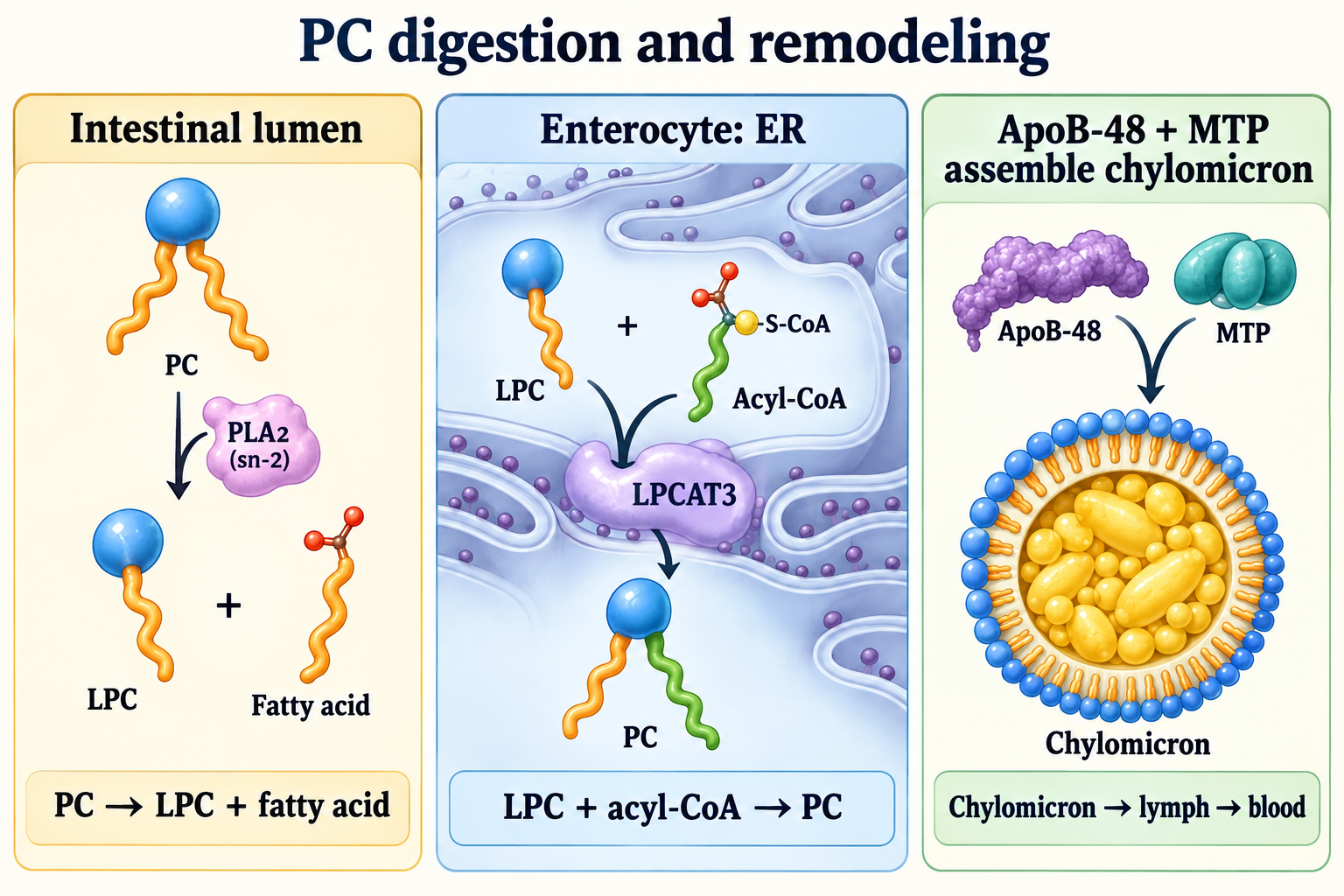
The image of a whole capsule-derived molecule inserting directly into an injured hepatocyte is too literal. Intestinal PC enters mixed aggregates with bile salts and other lipids. Pancreatic phospholipase A₂, including secreted group IB PLA₂, hydrolyzes the sn-2 ester bond. With DLinPC this yields predominantly linoleoyl-LPC and free linoleic acid:
PC+H2OPLA2LPC+FA.
FA denotes a free fatty acid. This stoichiometry describes one reaction rather than all digestive products. Further hydrolysis, acyl exchange, and other routes handle choline-containing material.
Within enterocytes, LPC can be reacylated at endoplasmic-reticulum membranes. LPCAT uses a fatty-acyl-CoA available to the cell:
LPC+acyl−CoALPCATPC+CoA.
Deacylation and reacylation are part of phospholipid remodeling, often called the Lands cycle. The replacement chain need not match the original; regenerated PC need not again be 18:2/18:2. LPCAT3 is important for polyunsaturated membrane species and intestinal lipid transport, but its studies do not establish that 85–90% of ingested DLinPC must reappear as the same molecule. Genetic models show a particularly important contribution to membrane arachidonate and triglyceride transfer. Remodeling thus does not mean exclusive linoleate delivery or elimination of all arachidonate-containing lipids (Hashidate-Yoshida et al., 2015; Li et al., 2015; Kennelly et al., 2018).
MFSD2A transports selected long-chain LPC species, including LPC-DHA, across the blood–brain barrier. That primary evidence concerns brain endothelium. It does not establish MFSD2A as the principal intestinal absorption route for all oral PC (Nguyen et al., 2014).
Schematic PC hydrolysis and LPC reacylation in the ER. Molecular and particle icons are qualitative; MTP participates in assembly rather than forming a circulating structural component of the chylomicron. Protein icon counts do not specify stoichiometry.
2.2. Chylomicrons, lipoproteins, and hepatic uptake
Enterocytes use reacylated and newly synthesized PC for membranes and lipoprotein surfaces. Alongside triglycerides, cholesteryl esters, and apoB-48, PC contributes to chylomicron assembly, which requires microsomal triglyceride transfer protein, MTP. Chylomicrons pass through lymph into systemic blood. This is not an immediate portal stream of unchanged DLinPC directly to the liver.
Lipoprotein lipase removes much of the triglyceride cargo. Surface components can exchange with other lipoproteins, with phospholipid transfer protein, PLTP, contributing to phospholipid transfer. ApoE-rich remnants are taken up by the liver through receptors and proteoglycans, including LDLR, LRP1, and syndecan-1. The liver receives both PC molecules and their metabolic products through several routes. This physiology explains material availability, but does not demonstrate exclusive targeting to damaged hepatocytes.
Human dual-isotope studies illustrate why absorption is not preservation of the original molecule. Labels in the choline moiety and acyl chain can differ in distribution and retention; acyl-derived material also appears in other lipid classes. Galli and colleagues' study in six volunteers found prolonged labeling of plasma and erythrocytes, not a pharmacological half-life specifically of intact DLinPC. It did not establish improved microcirculation, atherosclerosis, or portal hypertension (Galli et al., 1992).
2.3. Intracellular transport is a separately regulated system
PC is synthesized mainly outside mitochondria and must reach the appropriate membranes. Vesicular trafficking, membrane contact sites, and lipid transfer proteins cooperate. PC-TP, or STARD2, binds PC: structural work identifies a pocket for one molecule and recognition of its phosphocholine headgroup. This does not make STARD2 the sole carrier of DLinPC to every organelle (Roderick et al., 2002).
STARD7 is a separate PC-binding protein important for mitochondrial delivery. In cellular models, its loss reduced mitochondrial PC, impaired respiration, and disrupted cristae. The findings establish the importance of intracellular lipid logistics; they do not show that oral EPL automatically reproduces STARD7 restoration or corrects all mitochondrial dysfunction (Horibata and Sugimoto, 2010; Horibata et al., 2016).
3. Membrane integrity: plasma membrane, mitochondria, and ER
3.1. Cholesterol and PC/PE are different ratios
Cholesterol modulates membrane packing. It constrains excessive chain movement under some conditions and prevents tight gel formation under others. Its function cannot therefore be reduced to rigidity, nor PC's function to expelling surplus cholesterol. Cholesterol/phospholipid ratios vary with compartment, method, and disease. Values such as 0.35–0.45 for normal liver and 0.75–0.95 for every diseased liver are not universal clinical boundaries or a way to choose an EPL course.
The separate PC/PE ratio describes the balance of phosphatidylcholine and phosphatidylethanolamine. In choline-deficient mice lacking PEMT, a reduced ratio was linked to loss of membrane integrity and liver failure. Additional deletion of biliary PC export through Mdr2 preserved the ratio and prevented failure despite persistent steatosis. Human steatohepatitis samples also had a lower PC/PE ratio than controls. This is persuasive mechanistic evidence, but not a clinically validated universal supplementation target (Li et al., 2006).
RPC/PE=n(PE)n(PC).
Here n means the molar amount of each lipid class in the same sample or membrane fraction. A mass ratio is not identical to a molar ratio, and comparisons across fractions can mislead.
3.2. Membrane proteins and aminotransferases
The lipid environment affects transport-protein activity, positioning, and stability. Na⁺/K⁺-ATPase maintains ionic gradients; basolateral NTCP uses the sodium gradient to take up bile acids. However, hepatocyte transport is not entirely sodium-dependent: GLUT2 transports glucose by facilitated diffusion. Restoration of one pump cannot explain normalization of all metabolism, and enhanced expression of every transporter has not been demonstrated for every EPL product.
ALT and AST reflect injury, but their concentrations are not direct counts of surviving hepatocytes. AST has cytosolic and mitochondrial components; ALT is not an absolutely specific readout of one microscopic membrane defect. Enzyme release depends on injury type, permeability, cell death, and measurement timing. Lower ALT may accompany improvement, but does not prove closure of all membrane holes, disappearance of steatohepatitis, or fibrosis regression.
3.3. Mitochondrial PC, cardiolipin, and tafazzin
Cardiolipin (CL) is a distinctive four-chain phospholipid of the inner mitochondrial membrane. It contributes to cristae organization and respiratory-chain interactions. PC can donate an acyl residue during CL remodeling by tafazzin. The relevant mechanism is transacylation rather than necessarily a reaction with activated linoleoyl-CoA:
PC+MLCL⇌LPC+CL.
MLCL denotes monolysocardiolipin. One chain is transferred from a phospholipid to a lysophospholipid, and tafazzin catalyzes reversible exchanges. Other enzymes can reacylate CL by different mechanisms, so this reaction does not describe all CL metabolism. Experimental work shows that tafazzin specificity depends on lipid phase and packing (Schlame et al., 2017).
Tetralinoleoyl-CL is particularly prominent in selected highly oxidative tissues. Its high proportion in heart muscle cannot be generalized to the entire liver or every hepatic mitochondrion. A 2026 muscle-specific STARD7 knockout study in mice found reduced PC, CL, and coenzyme Q with impaired respiration and cristae organization. This is additional tissue-specific evidence about lipid trafficking, not a human liver EPL trial (Horibata et al., 2026).
CL oxidation can affect cytochrome-c binding and cell-death signaling. But cytochrome-c dissociation from lipids, BAX/BAK-mediated outer-membrane permeabilization, and opening of the inner-membrane permeability transition pore are different processes. They should not be compressed into “CL oxidation inevitably opens mPTP.” Polyunsaturated chains remain chemically oxidizable; less oxidative injury with PPC in some models does not make DLinPC an intrinsic universal antioxidant.
3.4. ER lipid stress and the adaptive UPR
The ER supports protein synthesis and maturation, lipid metabolism, and calcium homeostasis. Its stress can result from misfolded proteins or altered membrane properties, termed lipid bilayer stress. In experimental systems, IRE1 and PERK respond to increased membrane saturation even without their usual luminal domains. Lipid stress need not produce the same large IRE1 clusters as proteotoxic stress (Volmer et al., 2013; Kitai et al., 2013).
IRE1 regulates XBP1-mRNA splicing and, under particular conditions, degradation of other RNAs through RIDD. PERK phosphorylates eIF2α at Ser51, reducing general translation load while supporting ATF4 programs. ATF6 provides another UPR branch. These responses are initially adaptive; severe or prolonged stress can engage damaging programs, including CHOP. The entire UPR is not simply harmful activity to switch off.
LXR-dependent induction of LPCAT3 changes membrane acyl composition and reduces saturated-fat-induced stress in cell and mouse models. This supports a link between remodeling and ER physiology, but does not demonstrate complete blockade of IRE1/PERK/ATF6 or CHOP by oral EPL in patients. PUFA-containing membranes can also support lipogenesis and lipoprotein assembly, so biological effects are not unidirectional (Rong et al., 2013).
4. PLA₂ and inflammation: substrate composition, not a universal trap
4.1. Different phospholipases have different functions
PLA₂ is an enzyme family, not a single target. Cytosolic cPLA₂α, encoded by PLA2G4A, is approximately 85 kDa and has a pronounced preference for arachidonate-containing substrates. Calcium supports membrane recruitment through its C2 domain; phosphorylation, including MAP-kinase-dependent Ser505 phosphorylation, modulates activity. Localization and catalysis are regulated cooperatively rather than by one switch (Clark et al., 1991; Lin et al., 1993).
Secreted sPLA₂ enzymes, including groups IIA, V, and X, are distinct proteins with their own substrate preferences and extracellular or membrane contexts. Pancreatic group IB sPLA₂ participates in digestion. Calcium-independent enzymes, including group VIA iPLA₂, contribute among other functions to remodeling. Although sn-2 hydrolysis is common, cellular consequences differ.
Family
Example
Important feature
What cannot be assumed about EPL
cPLA₂
cPLA₂α / PLA2G4A
Arachidonate preference; calcium recruitment and phosphorylation
Complete inhibition by linoleoyl-PC in humans
sPLA₂
Groups IB, IIA, V, X
Secretion, different tissues and substrates
Identical responses of digestive and inflammatory enzymes
iPLA₂
Group VIA
Hydrolysis and remodeling without obligatory calcium-dependent catalysis
That all its activity is harmful and should be suppressed
4.2. Arachidonate and linoleate differ without being a harmful/safe binary
Hydrolysis of PC carrying sn-2 arachidonate can release arachidonic acid, AA, 20:4 n-6, for eicosanoid production. Hydrolysis of DLinPC releases linoleic acid, LA, 18:2 n-6. That chemical distinction does not establish universal competitive inhibition of PLA₂. Changes in substrate availability, membrane organization, and signaling must be distinguished from direct inhibition at an enzyme's active site.
PC(sn−2:AA)PLA2LPC+AA,PC(sn−2:LA)PLA2LPC+LA.
Cyclooxygenase and lipoxygenase pathways generate different AA-derived mediators. Thromboxane A₂ contributes to platelet aggregation and vascular tone; LTB₄ recruits and activates leukocytes. However, AA products are not exclusively proinflammatory. PGE₂ effects depend on receptor, cell, and phase of response; other products participate in resolution. LA also yields oxidized metabolites and enters pathways producing longer n-6 fatty acids. Replacing an acyl chain is therefore not an unconditional transition from harmful to safe lipid.
4.3. Kupffer-cell responses depend on model and mediator
Kupffer cells recognize microbial signals such as LPS through CD14, TLR4/MD-2, and intracellular adapters. NF-κB, ERK, and p38 regulate parts of the cytokine response. Experiments with DLinPC examined these pathways and TNF production, but do not show complete macrophage shutdown or suppression of every cytokine.
Oneta and colleagues found lower TNF alongside increased IL-1β under the studied conditions. In another model using Kupffer cells from ethanol-fed animals, Cao and colleagues described reduced LPS-induced TNF and changes involving MAPK/NF-κB. These findings support selective modulation, not clinically established universal suppression of TNF, IL-1β, and IL-6 in every liver disease (Oneta et al., 1999; Cao et al., 2002c).
5. Stellate cells, collagen, and the difference between a mechanism and antifibrotic outcomes
5.1. HSC activation and matrix balance
Quiescent hepatic stellate cells, HSCs, participate in retinoid storage and tissue homeostasis. During chronic injury they can acquire an activated myofibroblast-like phenotype, often with increased α-SMA, collagen synthesis, and other extracellular-matrix components. Injured hepatocytes, immune cells, matrix mechanics, and the metabolic environment influence this dynamic process.
TGF-β signals through receptors and Smad2/3–Smad4 to regulate fibrogenic programs; ROS and MAPK pathways also matter. Their established roles in HSC biology do not demonstrate that DLinPC directly blocks every node. Each claim requires measurements of the particular pathway, model, and exposure.
A conceptual matrix balance is:
dtdC=SC−DC,
where C is collagen-matrix quantity, SC its formation rate, and DC its removal rate. Less accumulation can result from reduced synthesis, enhanced degradation, or both. This is not a formula for calculating cirrhosis regression from ALT.
MMPs degrade matrix components and TIMPs regulate their activity. Human interstitial collagenase MMP-1 and the MMP-13 measured in some rat experiments are different family members, not species-specific names for one gene. Fibrillar collagen cleavage can produce characteristic fragments approximately three quarters and one quarter of its length, but the site and efficiency depend on collagen type, structure, and enzyme.
5.2. What cellular studies actually showed
Li and colleagues found that polyunsaturated lecithin reduced acetaldehyde-induced collagen accumulation in cultured lipocytes and increased collagenase activity, while α1(I)-procollagen mRNA was unchanged. This supports a degradation mechanism in that model, not universal transcriptional induction of MMP-1 (Li et al., 1992).
Poniachik and colleagues observed reduced proliferation, α-SMA, and collagen-related protein measurements with DLinPC. Viability was unaffected and the relevant procollagen mRNA did not change. These findings cannot be reframed as selective apoptotic elimination of activated HSCs (Poniachik et al., 1999).
In TGF-β1-stimulated HSCs, Cao and colleagues found lower collagen I and TIMP-1, while MMP-13 mRNA and protein remained unchanged. The MMP-13/TIMP-1 ratio increased mainly through a reduction in inhibitor. In a different experiment the response involved reduced ROS and p38-dependent collagen induction, with no α-SMA change under those conditions. The differences illustrate model and endpoint dependence rather than a single universal action (Cao et al., 2002a, 2002b).
Study and model
Observation
Boundary of interpretation
Li et al., 1992: cultured lipocytes, acetaldehyde
Less collagen accumulation, more collagenase activity
Not identical transcriptional induction of all MMPs
Poniachik et al., 1999: HSCs
Reduced proliferation and selected activation markers without loss of viability
Not demonstrated apoptotic clearance
Cao et al., 2002a: TGF-β1/HSCs
Lower collagen I and TIMP-1; unchanged MMP-13
A changed balance does not mean MMP-13 induction
Cao et al., 2002b: TGF-β1/HSCs
Reduced ROS/p38-associated collagen response
Not universal blockade of Smad or all HSC markers
Combination studies involving SAMe or antioxidants also require separation of levels. Joint activity in a cellular system does not establish clinical synergy, an optimal combination, or an obligatory patient course. Clinical designs must evaluate the components and their interaction separately.
5.3. Baboons and humans gave different answers
In Lieber and colleagues' long-term experiment, 10 of 12 alcohol-fed baboons without PC developed septal fibrosis or cirrhosis, whereas none of eight receiving alcohol plus PC did. Observation extended to 6.5 years; DLinPC reproduced the mixture's collagenase effect in culture. These are important prevention data from a controlled nonhuman-primate model (Lieber et al., 1994).
The human Veterans Affairs Cooperative Study 391, however, did not confirm the primary antifibrotic effect. It randomized 789 patients, predominantly men; 412 had paired biopsies at two years. Fibrosis progression occurred in 22.8% with PPC and 20.0% with placebo, without a significant advantage. A substantial reduction in alcohol use in both groups complicated detection of an anticipated effect under continued heavy drinking. That explains a design limitation; it does not convert the negative result into a positive one. Biochemical signals in selected subgroups do not replace the primary biopsy outcome (Lieber et al., 2003).
6. Lipid export: VLDL, LCAT, and bile
6.1. Two PC-synthesis pathways and VLDL assembly
The liver synthesizes PC through the CDP-choline, or Kennedy, pathway and through PEMT-dependent PE methylation. In the first pathway, choline becomes phosphocholine; CTP:phosphocholine cytidylyltransferase, including CTα/PCYT1A, forms CDP-choline, and transfer of phosphocholine to diacylglycerol completes PC synthesis. In the second, PE receives three methyl groups from SAM:
PE+3SAMPEMTPC+3SAH.
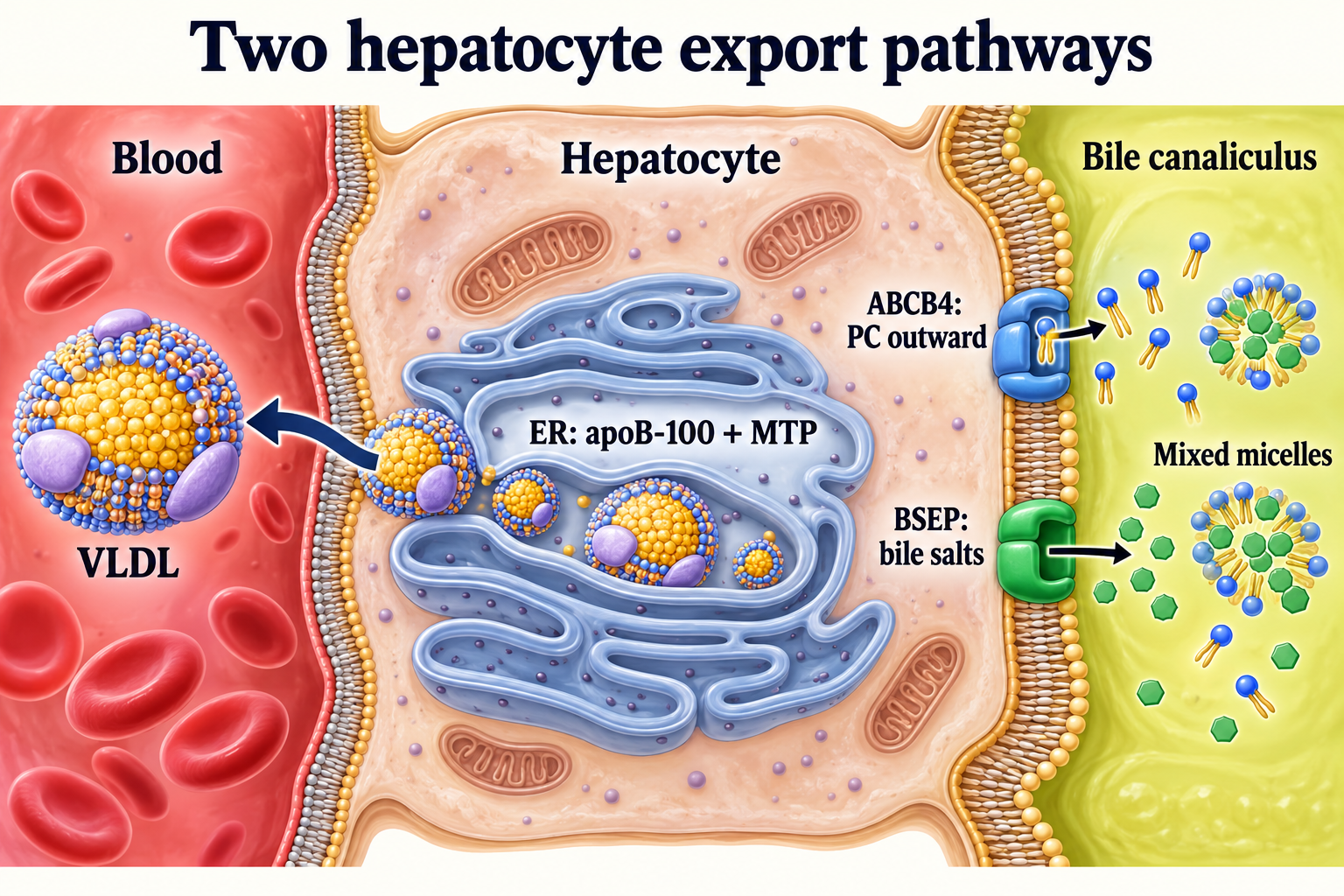
SAM denotes S-adenosylmethionine and SAH S-adenosylhomocysteine. The pathways' contributions depend on physiology, nutrition, and model; approximate estimates are not immutable 70/30 proportions for every patient. PC contributes to the VLDL surface monolayer with other lipids. ApoB-100 and MTP support initial assembly in the ER, followed by further lipidation, trafficking, and secretion.
Genetic experiments involving CTα and PEMT establish the importance of PC synthesis to lipoprotein metabolism. Sufficient PC is not the sole requirement for triglyceride export: apoB, MTP, membrane acyl composition, cargo availability, and ER function also matter. Greater VLDL export can reduce hepatic triglyceride accumulation under some circumstances while increasing delivery to blood. “Lipotropic” activity is not demonstrated cardiovascular-risk reduction (Jacobs et al., 2004; Noga et al., 2002; Hashidate-Yoshida et al., 2015).
The 2003 correction to Noga’s study restored the cropped upper part of the lower gel in Figure 4A; this is an image correction, not additional clinical evidence (Noga et al., 2003).
6.2. LCAT and cholesteryl esters
Lecithin–cholesterol acyltransferase, LCAT, transfers an acyl residue from PC to free cholesterol, producing a cholesteryl ester and LPC:
PC+cholesterolLCATLPC+cholesterylester.
ApoA-I is an important LCAT activator on HDL. This reaction contributes to HDL maturation, but reverse cholesterol transport also requires cellular efflux, exchange between particles, hepatic uptake, and disposal. Improvement in one enzyme measurement or HDL level does not establish fewer myocardial infarctions or less atherosclerosis with EPL. PC also does not provide an exclusively linoleoyl LCAT substrate in every setting. (Gorshkova et al., 2018).
6.3. ABCB4 and BSEP: separate cargoes at the canalicular pole
The hepatocyte canalicular membrane faces the bile canaliculus. Human ABCB4, also called MDR3, translocates PC from the inner to the outer membrane leaflet, appropriately described directionally as a floppase. Bile salts promote its extraction into bile and mixed aggregates. ABCB11/BSEP exports bile salts, whereas ABCC2/MRP2 exports selected conjugated compounds, including conjugated bilirubin. These proteins are not one PC pump.
Mouse Mdr2 deletion, affecting the functional counterpart of human ABCB4, abolished biliary phospholipids and produced liver disease. Human ABCB4 structural studies refine the lipid-export mechanism. Yet absence of a functioning protein in genetic disease cannot be assumed corrected by more oral PC. Nor has every EPL product been shown universally to increase ABCB4, BSEP, and MRP2 expression (Smit et al., 1993; Olsen et al., 2020).
PC and bile salts together reduce the membrane-damaging effects of concentrated amphiphilic compounds on bile ducts; mixed-aggregate composition also influences cholesterol solubility. Concentrations, ratios, aggregate size, and cholesterol saturation vary. A fixed ideal PC/bile-salt ratio or a promise of gallstone dissolution cannot be inferred from general biochemistry. Ursodeoxycholic acid has its own indications and mechanisms; a comparison on one cellular mechanism does not establish EPL's clinical superiority.
The two export directions are separate. ABCB4 transfers PC between canalicular membrane leaflets toward the outer bile-facing leaflet; the arrow summarizes this process, not transport of freely dissolved cytosolic PC. BSEP exports bile salts. Icons do not specify apoB stoichiometry or a clinical effect.
7. What clinical studies show
7.1. Steatosis, inflammation, stiffness, and clinical outcomes are separate levels
MASLD means metabolic dysfunction-associated steatotic liver disease; MASH denotes its steatohepatitis variant. Older publications used NAFLD/NASH. A change of terminology does not make all populations interchangeable. Less fat, lower ALT, changed liver stiffness, and prevention of decompensation require different measurements and study designs.
Conventional ultrasound evaluates steatosis features qualitatively or semiquantitatively and depends on operator and conditions. CAP measures ultrasonic attenuation in dB/m and is used to assess steatosis; it is not a direct percentage of liver fat. MRI-PDFF is a different quantitative measurement. LSM measures stiffness in kPa. Although related to fibrosis, it is also affected by inflammation, cholestasis, congestion, and measurement conditions. Short-term LSM improvement does not establish histological collagen removal.
7.2. MANPOWER: observation without an independent control
MANPOWER included 2,843 Russian patients with NAFLD and cardiometabolic comorbidities. A PC-containing preparation was added to usual management, and ultrasound findings were assessed over 24 weeks. Among patients with ultrasound abnormalities at baseline, echogenicity improved in 81.4% at week 24. The denominator is essential: this is not the proportion of all patients with proven histological cure (Maev et al., 2020).
Without a parallel randomized control group, the product's contribution cannot be separated from lifestyle changes, concomitant treatment, natural fluctuations, or regression to the mean. Ultrasound does not measure disappearance of MASH or fibrosis. Subsequent analyses of the same registry are not independent replications and should not inflate the number of confirmatory trials.
7.3. A small 2025 ordinary-PC trial
Sedhom and colleagues randomized 80 patients; the analysis included 39 receiving PC and 40 controls. The single-blind study compared an ordinary PC-containing supplement plus standard management with standard management alone, without placebo. Follow-up lasted 12 weeks and the studied product mass was 2,400 mg/day. This describes an experimental protocol rather than a universal regimen.
At the end, CAP and stiffness were lower with PC: 304 versus 332 dB/m and 5.3 versus 6.8 kPa, respectively. The positive signal warrants further study, but the small sample, short duration, absence of placebo, and noninvasive surrogates limit interpretation. A so-called fibrosis score measured in kPa is not a biopsy-confirmed stage or proof of scar removal. The ordinary supplement's composition also prevents treating the study as a trial of an identical DLinPC-enriched EPL mixture (Sedhom et al., 2025).
7.4. EXCEL 2026: positive CAP, neutral stiffness
EXCEL was a multicenter double-blind placebo-controlled study in Germany and Poland. It randomized 193 patients with MASLD and metabolic comorbidities; the modified intention-to-treat analysis included 165, with 82 receiving EPL and 83 placebo. That analysis required evaluable CAP at baseline and at least one follow-up measurement, plus intake of at least 80% of the study product planned over six months. This selection is important when judging applicability.
EPL at the studied 1,800 mg/day supplemented standard care for six months. For the primary CAP endpoint, the adjusted between-group difference in change was −14.81 dB/m, with a 95% confidence interval of −27.89 to −1.72; p = 0.0269. This is a modest advantage on a steatosis surrogate. It is not a 2.5-fold reduction in actual liver-fat quantity or a histological MASH measurement.
The LSM difference was −0.06 kPa, 95% confidence interval −0.81 to 0.70; p = 0.8849. An advantage in stiffness was not confirmed. Total quality-of-life score also did not differ significantly. Positive individual subscales and metabolic measurements belong to secondary or exploratory analyses and require caution over multiple comparisons. At least one treatment-emergent adverse event occurred in 56.7% versus 52.1%. No evident new safety signal was identified, but this does not establish unlimited safety of all PC formulations.
The publication discloses manufacturer employees among the authors and industry-supported medical writing. This does not invalidate the randomized finding, but matters for independence and replication. Prevention of cirrhosis, decompensation, or death was not established (Stefan et al., 2026).
Study
Design / preparation
Supported conclusion
Not established
Lieber et al., 1994
Long-term alcohol-fed baboon model, PC mixture
Prevention of fibrosis in that model
Clinical reversal of human cirrhosis
Lieber et al., 2003
789 randomized patients with alcohol-associated injury, PPC/placebo
No significant advantage on the main biopsy outcome
Universal clinical antifibrotic efficacy
Maev et al., 2020
MANPOWER, 2,843 patients, observational registry
Ultrasound improvement during adjunctive treatment
Causality without control or histological cure
Sedhom et al., 2025
Small single-blind ordinary-PC study, 12 weeks
Positive noninvasive signals
EPL equivalence or removal of histological fibrosis
Stefan et al., 2026
EXCEL, 193 randomized, EPL/placebo, six months
Modest additional CAP reduction
Significant LSM benefit or improved clinical events
7.5. Drug-induced injury: an active comparator is not proof of prophylaxis
MANPOWER was not a multinational drug-induced liver injury trial. For DILI, treatment of established injury must be distinguished from prevention during statins, tuberculosis drugs, or other therapies. An NSAID-PC coformulation intended to alter gastrointestinal interactions is also not evidence of hepatic protection by separately administered EPL.
Tang and colleagues' 2022 trial analyzed 241 patients with acute idiosyncratic DILI, comparing two bicyclol doses with PPC as an active control. The primary outcome was ALT change at four weeks, with bicyclol outperforming PPC. Within-arm ALT improvement with PPC, without placebo or standard-care-only control, cannot isolate its contribution from recovery after removal of the injury's cause. This was not a universal DILI-prophylaxis trial and did not demonstrate lower mortality (Tang et al., 2022).
An observational analysis of 6,743 Chinese tuberculosis patients found no significant overall advantage in DILI or mortality from prophylactic use of heterogeneous liver-protective agents. The PC subgroup was small and nonrandomized; it cannot establish obligatory PC prophylaxis with all tuberculosis regimens (Chen et al., 2022). Suspected DILI requires evaluation of the causal drug, severity, and appropriate specific care. EPL does not make continued exposure to every hepatotoxic drug safe.
8. Microcirculation, ischemia, and reperfusion
Sinusoidal endothelium, its fenestrae, Kupffer cells, and HSCs jointly regulate exchange between blood and hepatocytes. Loss of fenestrae, altered NO signaling, and capillarization accompany chronic injury. This is relevant membrane biology, but does not show that oral PC corrects portal hypertension. Changes in erythrocyte lipids or prolonged tracer retention do not demonstrate fewer thromboses or cardiovascular events.
Ischemia and reperfusion combine energy depletion, calcium disturbances, oxidative injury, and inflammatory responses. Cold storage changes membrane properties, but a complex cellular membrane does not necessarily become a uniform gel at 4 °C because of one lipid transition. Temperature effects, lipid composition, and protein processes must be considered together.
Demirbilek and colleagues studied seven days of PPC pretreatment in rats before ischemia/reperfusion. Groups contained 10 controls, 15 I/R animals, and 15 I/R-plus-PPC animals. PPC reduced enzymatic, oxidative, inflammatory, and histological injury signals. This establishes an experimental signal, not prevention of primary graft nonfunction or ischemic biliary strictures in humans. The animal exposure cannot be transferred directly to a patient regimen (Demirbilek et al., 2006).
9. Safety, choline, and the absence of a universal course
PC supplies choline, and choline deficiency can cause hepatic or muscle injury. A controlled depletion/repletion study in 57 adults found responses varying with sex and menopausal status. That supports the significance of nutritional requirements and correction of deficiency; it does not demonstrate that every MASLD case is due to insufficient choline or requires an identical EPL course (Fischer et al., 2007).
Product composition, formulation, impurities, and excipients matter. Gastrointestinal adverse effects and hypersensitivity reactions are possible, including reactions associated with soy-derived ingredients or specific product components. Oral and intravenous formulations are not interchangeable. Short-term trials cannot guarantee safety in pregnancy, indefinite self-administration, or every comorbidity. Claims of absolute freedom from carcinogenic, teratogenic, or other risk exceed the evidence presented.
Some choline-containing material can be metabolized by gut microbes into trimethylamine, followed by hepatic production of TMAO. Tang and colleagues demonstrated microbiota-dependent TMAO production after labeled PC in humans and an association between high TMAO and cardiovascular events in an angiography cohort. This warrants attention to metabolism and individual context, but is not randomized evidence that EPL causes cardiovascular events. Nor does one association make every dietary PC source harmful (Tang et al., 2013).
Studied doses such as 1,800 or 2,400 mg/day belong to specific products and protocols. They do not establish a universal regimen, a necessary intravenous phase, or an obligatory six-to-twelve-month course. Management depends on cause, stage, comorbidities, and evidence for a defined intervention. Metabolic risk management, nutrition, weight, and alcohol exposure have independent significance. PC does not compensate for continued injurious exposure or replace disease staging.
10. Interpreting “liver repair”
PC provides material and physical properties needed by membranes, lipoproteins, and bile. DLinPC-enriched mixtures can alter selected inflammatory and fibrogenic responses in experimental systems. Human steatosis signals exist, including placebo-controlled EXCEL. Evidence for reducing fat is nevertheless stronger than evidence for preventing cirrhosis or clinical events. Ordinary PC, EPL, cellular DLinPC, and different molecules cannot be combined without checking composition.
Four questions clarify any claim: what substance was studied, in which system, which outcome was measured, and against which comparator? PC being necessary for membranes is a physiological finding. Greater CAP reduction than placebo is a specific clinical surrogate result. Less fibrosis or mortality requires different evidence. Keeping these steps distinct allows discussion of potential benefit without converting a plausible mechanism into a treatment guarantee.
Methods and source limitations
This narrative analysis uses targeted primary-source checks updated on 8 October 2026. Chemical terminology, digestion and remodeling, membrane and cellular mechanisms, animal models, and clinical designs were examined separately. Sources were assessed through accessible full text, abstracts, or indexed publisher passages; unavailable full texts limit evaluation of every protocol detail. This is not a systematic review, independent GRADE assessment, or external peer review. Doses describe research exposure rather than an individual prescribing protocol.
FAQ
Are PC and EPL identical?
PC is a molecular class; EPL denotes specific mixtures. Dietary PC and DLinPC-enriched mixtures cannot share efficacy evidence automatically.
Is PC absorbed intact?
Digestion and remodeling alter much of the ingested material. Tracer absorption does not establish intact parent-molecule delivery.
Does lower ALT prove fibrosis reversal?
No. Enzymes, fat, stiffness, biopsy and clinical events are distinct outcomes.
What did EXCEL show?
A modest additional CAP benefit without significant LSM superiority; prevention of cirrhosis or death was not established.
Is there a universal course?
No. Formulation, composition, cause and disease stage require separate assessment.