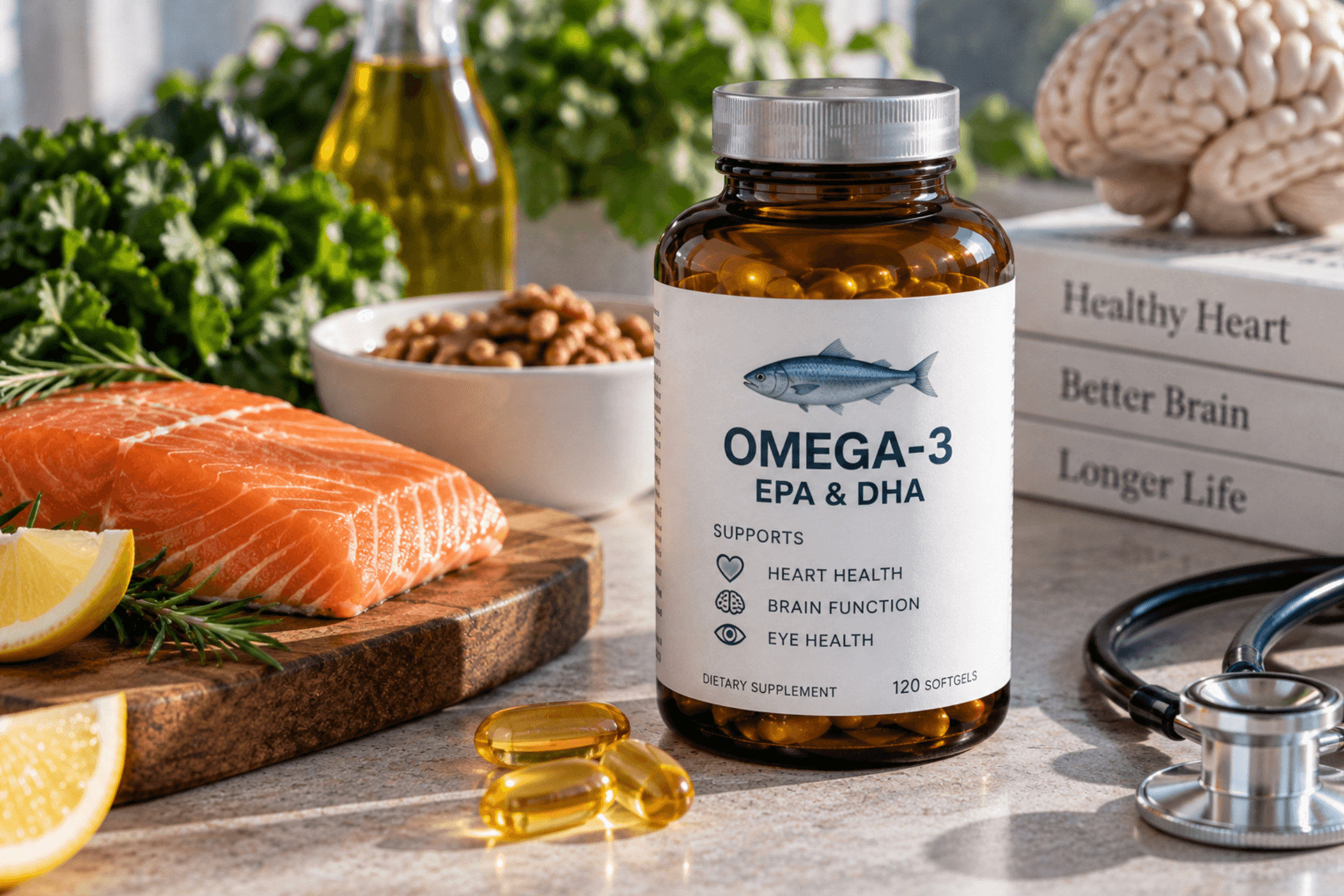
Omega-3 Fatty Acids: EPA and DHA, Heart Health, the Brain, Testing, and Choosing Supplements
Comprehensive guide to omega-3 fatty acids: ALA vs EPA/DHA, cardiovascular protection, triglyceride reduction, Omega-3 Index, and supplement forms.
Omega-3 Fatty Acids: EPA and DHA, Heart Health, the Brain, Testing, and Choosing Supplements
Omega-3 fatty acids belong to a group of nutrients surrounded by both serious biochemical science and an exceptionally active supplement market. They are associated with heart health, brain function, vision, inflammation, pregnancy, cognitive aging, and exercise recovery. Some of these associations are well established, others are supported mainly by convincing physiology, and some popular claims clearly go beyond the available clinical evidence.
The main members of the omega-3 family are the plant-derived alpha-linolenic acid (ALA) and the long-chain marine omega-3 fatty acids eicosapentaenoic acid (EPA) and docosahexaenoic acid (DHA). There is an important terminological detail here: strictly speaking, ALA is the essential omega-3 fatty acid because the human body cannot create an omega-3 double bond in the required position. EPA and DHA can be synthesized from ALA and are therefore not absolutely essential in exactly the same biochemical sense, but this conversion is limited. This is why direct intake of EPA and DHA from fish, seafood, or supplements is much more effective at increasing their concentrations in the body. NIH notes that conversion of ALA into long-chain omega-3 fatty acids is generally limited and usually below 15%, with DHA production being particularly low.
This is the first important boundary between physiology and marketing. Flaxseed oil, chia seeds, and walnuts are valuable sources of ALA, and dismissing them as “useless plant omega-3” would be incorrect. But a tablespoon of flaxseed oil is not physiologically equivalent to a serving of fatty fish either: the final amount of EPA, and especially DHA, reaching tissues will be very different.
One Family, Different Molecules
ALA contains 18 carbon atoms and three double bonds. EPA contains 20 carbon atoms and five double bonds, while DHA contains 22 carbon atoms and six. This chemical structure makes long-chain omega-3 fatty acids highly flexible molecules and allows them to influence the properties of phospholipid membranes.
EPA and DHA are incorporated into cell membranes not as passive “building material,” but as functional parts of the lipid environment surrounding receptors, enzymes, transport proteins, and ion channels. Membrane composition influences its physical properties, the organization of lipid domains, and the types of signaling molecules that can be produced after fatty acids are released by phospholipases.
EPA and DHA are not completely interchangeable, however.
DHA is especially enriched in nervous tissue and the retina. Its long chain with six double bonds gives membranes exceptional structural flexibility, which is particularly important in photoreceptors and neuronal membranes.
EPA is generally present in membranes in smaller amounts but plays an active role in the formation of lipid signaling mediators and competes with arachidonic acid for several enzymatic pathways. EPA has also been studied particularly intensively in pharmacological cardiovascular regimens.
So the question “Which is better, EPA or DHA?” is not especially useful on its own. Their relevance depends on the clinical or nutritional objective, and results from trials of purified EPA cannot automatically be applied to ordinary fish oil containing both EPA and DHA.
ALA Really Can Be Converted Into EPA and DHA — but Only in Limited Amounts
Plant foods generally contain very little long-chain EPA and DHA. Flaxseed, chia, walnuts, soybean oil, and canola oil primarily provide ALA.
In the liver, ALA can undergo sequential elongation and desaturation to form EPA and, through additional steps, DHA. However, the efficiency of this pathway is low and varies substantially between individuals.
It is influenced by sex, genetics, overall dietary composition, linoleic acid intake, hormonal status, and other factors. In metabolic studies, conversion of ALA to EPA is often only a few percent, while conversion to DHA is even lower; efficiency may be somewhat higher in women, possibly in part because of estrogen.
So fixed statements such as “exactly 5–8% becomes EPA and less than 1% becomes DHA” should be treated as approximate findings from particular metabolic studies rather than as universal properties of every human body.
The practical conclusion is simpler: ALA remains an important part of a healthy diet, but if the goal is specifically to increase EPA and DHA status, direct intake is far more effective.
DHA, the Brain, and the Retina
DHA is indeed particularly abundant in the nervous system and photoreceptor membranes. This is one reason it has attracted so much attention in research on pregnancy, brain development, and cognitive aging.
During fetal development, DHA accumulates actively in the nervous system, especially later in pregnancy. Seafood also provides not only DHA but iodine, protein, selenium, choline, vitamin D, and other nutrients, which is why pregnancy recommendations are usually built around safe seafood consumption rather than around a single supplement.
ACOG, the FDA, and the Dietary Guidelines for Americans generally recommend around 8–12 ounces, or approximately 225–340 g, of low-mercury seafood per week during pregnancy. EFSA additionally uses a reference intake of 250 mg EPA+DHA per day for adults plus an extra 100–200 mg DHA during pregnancy; other professional recommendations often use at least 200 mg DHA as a practical target. But there is no single globally accepted mandatory daily DHA requirement.
For vegans and people who do not eat fish, microalgae oils are an important alternative. Biologically, this makes perfect sense: marine microalgae sit at the base of the food chain and are the original source of EPA and DHA that later accumulate in fish.
Does DHA’s Role in the Brain Mean Supplements Prevent Dementia?
No.
This is a classic example of the difference between the physiological necessity of a molecule and the effect of taking more of it.
Observational studies have repeatedly found associations between higher fish consumption or higher long-chain omega-3 status and a lower risk of cognitive decline. Higher DHA status has also been associated with some favorable structural brain characteristics.
But randomized trials in cognitively healthy older adults have not shown convincing improvements in cognition from EPA/DHA supplementation. Likewise, omega-3 supplements have not demonstrated a meaningful ability to slow the progression of established Alzheimer’s disease. There are some more encouraging signals in mild cognitive impairment, but the evidence is still not strong enough to make DHA a standard therapy.
So a formula such as “800–1,200 mg DHA after age 60 to protect against brain atrophy” is not an established universal recommendation.
Omega-3 and Inflammation: The Biology Is More Complex Than the Slogan
One of the most popular simplifications is to describe omega-6 fatty acids as “pro-inflammatory” and omega-3 fatty acids as “anti-inflammatory.”
Human physiology is more complicated.
The omega-6 fatty acid arachidonic acid is indeed a precursor to several eicosanoids involved in inflammation, vascular tone, and platelet function. EPA competes with arachidonic acid for some of the same enzymes and produces a different spectrum of lipid mediators, some of which have less pronounced pro-inflammatory activity.
In addition, EPA and DHA are precursors to specialized pro-resolving mediators, or SPMs. These include E-series resolvins derived from EPA, and D-series resolvins, protectins, and maresins derived from DHA.
The term “pro-resolving” is especially important. The resolution of inflammation is not simply a passive decline in cytokine production. It is an actively regulated process involving reduced recruitment of new neutrophils, macrophage-mediated clearance of cellular debris and apoptotic cells, and restoration of tissue homeostasis.
But even this elegant and well-characterized biology does not mean that fish oil is a universal “anti-inflammatory drug.”
Omega-6 fatty acids are not enemies of the body either. They are also essential, and their metabolites have both inflammatory and regulatory functions. Attempts to reduce healthy nutrition to a battle between “omega-3 versus omega-6” are therefore not especially useful. NIH also notes that an optimal omega-6-to-omega-3 ratio has not been established and that absolute intake of specific fatty acids is more informative than the ratio alone.
Where the Evidence Is Strongest: Triglycerides
The ability of EPA and DHA to lower elevated triglycerides is one of the best-established clinical effects of omega-3 fatty acids.
They reduce hepatic synthesis and secretion of triglyceride-rich lipoproteins, influence fatty acid synthesis, and promote several pathways of fatty acid oxidation. The effect is dose-dependent and becomes especially noticeable when baseline triglycerides are high.
But it is crucial not to confuse ordinary nutritional supplements with pharmacological treatment.
The American Heart Association states that 4 g per day of prescription omega-3 preparations can lower triglycerides by around 20–30%, with reductions of 30% or more possible in severe hypertriglyceridemia.
This is very different from taking one capsule labeled “1,000 mg fish oil.”
First, 1,000 mg of fish oil does not mean 1,000 mg of EPA+DHA.
Second, prescription preparations contain standardized amounts and formulations.
Third, treatment of significant hypertriglyceridemia must also address alcohol intake, body weight, diabetes, hypothyroidism, medications, refined carbohydrate intake, and the overall diet rather than being reduced to omega-3 supplementation alone.
Fish Oil and Heart Attack Prevention Are Not the Same Thing
The cardiovascular history of omega-3 research is a useful reminder that a nutrient cannot be judged solely by its biochemical mechanism.
Regular fish consumption is consistently associated with a more favorable cardiovascular profile, and the American Heart Association recommends at least two servings of fish per week, especially fatty fish.
But a fish-oil capsule does not necessarily reproduce the entire effect of a fish-rich dietary pattern.
The large VITAL trial tested roughly 1 g per day of marine omega-3 fatty acids in more than 25,000 adults who were not selected for high cardiovascular risk. Supplementation did not significantly reduce the primary composite endpoint of major cardiovascular events.
So it is not appropriate to promise a healthy person that taking 1,000 mg of EPA+DHA every day will “reliably protect the heart.”
This does not mean EPA and DHA have no cardiovascular effects. It means that food, an over-the-counter supplement, and a prescription drug are not the same intervention.
Why REDUCE-IT Changed Cardiology but Did Not Prove That Any Fish Oil Prevents Heart Attacks
The REDUCE-IT trial occupies a special place in this field.
More than 8,000 patients who were already taking statins, had elevated triglycerides, and were at high cardiovascular risk received 4 g per day of icosapent ethyl — a highly purified prescription ethyl ester of EPA.
The risk of the primary composite cardiovascular endpoint was reduced by approximately 25%.
This was clinically important.
But it does not justify the conclusion:
“Four grams of any fish oil prevents heart attacks.”
The STRENGTH trial, which included more than 13,000 high-risk patients receiving a high-dose combination of EPA and DHA in another pharmaceutical formulation, did not show a reduction in major cardiovascular events and was stopped early for futility.
Why the results differed remains uncertain. Proposed explanations include the use of pure EPA versus EPA+DHA, achieved EPA concentrations, differences in formulation, placebo choice, patient populations, and other factors.
But the practical conclusion is clear: the cardiovascular benefit demonstrated with prescription icosapent ethyl cannot be extrapolated to every bottle of omega-3 supplements.
Is There a Universal Preventive Dose of EPA+DHA?
In the United States, there is no official RDA or AI established separately for EPA and DHA. The formal Adequate Intake applies primarily to ALA: about 1.6 g per day for adult men and 1.1 g for adult women, with separate values for pregnancy and lactation.
Several international organizations do use a practical reference intake of around 250 mg EPA+DHA per day for adults, while general dietary advice is often expressed more simply as eating fatty fish roughly twice per week.
So a range of 250–500 mg EPA+DHA per day can reasonably be used as a practical nutritional reference for someone who rarely eats fish, but this is not a drug dose proven to prevent myocardial infarction.
Universal supplementation with 1,000 mg EPA+DHA for “the heart, brain, and blood vessels” already goes beyond what can be confidently concluded from modern clinical trials.
Fish or Capsules?
If a person eats fish, the first option usually begins with food.
Fish provides not only EPA and DHA but also high-quality protein, selenium, iodine, vitamin D, and other nutrients. Part of its benefit may also come from replacing less healthy foods in the diet.
This is one reason the evidence supporting regular seafood consumption is stronger in several areas than the evidence supporting indiscriminate use of omega-3 supplements.
Two weekly servings do not have to mean “wild salmon.” Sardines, herring, mackerel, trout, anchovies, and many other fish can provide meaningful amounts of EPA and DHA.
During pregnancy, mercury content becomes especially important, so low-methylmercury species should be prioritized.
If someone does not eat fish because of taste, allergy, ethical preferences, or dietary patterns, supplements are a practical way to obtain EPA and DHA. Algae-derived concentrates are a suitable option for vegetarian and vegan diets.
What the Capsule Label Actually Means
One of the most common mistakes when buying omega-3 supplements is to see a large label saying:
Fish Oil 1000 mg
and assume it means 1,000 mg of EPA+DHA.
In reality, a traditional 1,000 mg fish-oil capsule often contains roughly 180 mg EPA and 120 mg DHA — only about 300 mg of these two fatty acids in total. Concentrated products may contain considerably more.
So when choosing a product, at minimum look for three separate numbers:
EPA — how many milligrams;
DHA — how many milligrams;
EPA + DHA — how many milligrams in the actual serving.
The total weight of fish oil by itself is not very informative.
Supplement Forms: TG, EE, rTG, and Phospholipids
EPA and DHA in supplements can appear in several chemical forms: natural triglycerides, ethyl esters, re-esterified triglycerides, free fatty acids, and phospholipids.
Consumer marketing, however, often turns this into an oversimplified hierarchy:
EE — cheap and inferior;
TG — good;
rTG — premium and best;
krill oil — almost ideal.
Reality is more complicated.
Natural Triglycerides
In ordinary fish oil, EPA and DHA are present mainly as triacylglycerols. This form is familiar to the digestive system, but natural fish oil is relatively unconcentrated, so obtaining a large EPA+DHA dose requires consuming more total oil.
Ethyl Esters
During manufacturing, fatty acids can be converted into ethyl esters, or EE, which allows EPA and DHA to be concentrated efficiently.
EE are indeed hydrolyzed differently from triglycerides, and their absorption is more dependent on digestive conditions and meal composition. Taking them with a meal containing fat can substantially increase bioavailability.
But statements such as “EE are absorbed three to four times worse when fasting and are therefore almost useless” are too categorical. The size of the difference depends on the specific formulation, meal, dose, and study design.
Prescription icosapent ethyl — the product used successfully in REDUCE-IT — is itself an ethyl ester. So the EE chemical form clearly does not make a product clinically inferior by definition.
Re-Esterified Triglycerides
With rTG, concentrated fatty acids are chemically reattached to glycerol.
Studies often do find higher acute bioavailability for rTG compared with EE. A recent pharmacokinetic review described an approximate hierarchy for isolated forms as free fatty acids > phospholipids > rTG > natural TG > EE.
But that same literature highlights an important caveat: differences that are clear after a single dose do not always translate into meaningful differences after months of regular use.
So rTG can be a convenient and well-absorbed form, but there is no evidence that people taking rTG have fewer heart attacks or live longer than people receiving an equally effective amount of EPA/DHA in another formulation.
What About Krill Oil?
In krill oil, a substantial proportion of EPA and DHA is incorporated into phospholipids, particularly phosphatidylcholine.
Some studies and meta-analyses show good bioavailability, especially at relatively low doses. However, studies differ substantially in formulation, dose, and outcome measures, so krill oil cannot simply be declared universally superior.
Krill oil also has a practical limitation: the absolute amount of EPA+DHA per capsule is often relatively low.
If the clinical goal is to obtain several grams of EPA/DHA for treatment of hypertriglyceridemia, trying to reach that dose with ordinary krill-oil capsules may simply be impractical.
There is also no clear evidence that krill oil produces superior lipid effects compared with fish oil when equivalent amounts of omega-3 fatty acids are used.
The “Best Form” Depends on More Than the Molecule
Bioavailability is not determined solely by the letters TG, rTG, or EE.
It also depends on:
- the actual amount of EPA and DHA;
- dose size;
- whether the supplement is taken with food;
- emulsification;
- manufacturing quality;
- oxidative stability;
- individual digestion;
- consistency of use.
A well-manufactured EE product taken correctly and in an effective dose may therefore be considerably more useful than an expensive rTG product with impressive marketing but too little EPA+DHA.
Does “Omega-3 Deficiency” Exist?
Several different concepts need to be separated.
True essential fatty acid deficiency is a serious clinical condition but is rare today. Historically, it was seen in patients receiving parenteral nutrition without enough polyunsaturated fat. Modern enteral and parenteral formulas contain essential fatty acids, so classical deficiency is much less common.
A different issue is low EPA and DHA status in blood or red blood cells.
This can reflect low seafood intake and may be statistically associated with some unfavorable outcomes, but it is not a clinical “deficiency” in the same sense as iron-deficiency anemia or severe vitamin B12 deficiency.
Symptoms such as fatigue, dry skin, poor memory, or “inflammation” should therefore not be used to self-diagnose omega-3 deficiency.
What Does the Omega-3 Index Measure?
The Omega-3 Index is the sum of EPA and DHA in red blood cell membranes, expressed as a percentage of total measured fatty acids.
Unlike plasma fatty acids, which are more strongly influenced by recent meals, red blood cell composition reflects a longer period — roughly several months, corresponding to the lifespan of erythrocytes.
In that sense, the measure is genuinely interesting: it provides a better estimate of longer-term EPA+DHA status than a random plasma measurement after yesterday’s dinner.
But calling the Omega-3 Index the “gold standard of evidence-based medicine” is too strong.
What Is Wrong With the Neat 4%–8%–12% Scale?
The researchers who developed the Omega-3 Index concept proposed values around ≤4% as being associated with higher cardiovascular risk and ≥8% with a more favorable risk profile. Observational studies have indeed found inverse associations between erythrocyte EPA+DHA levels and some cardiovascular outcomes.
But that does not mean:
3.9% = a clinical deficiency;
8.0% = a proven therapeutic target;
12% = even better;
or that raising the index with supplements necessarily reproduces the lower risk observed in people who naturally had higher values.
NIH explicitly notes that experts have not established generally accepted normal ranges for omega-3 status.
So the statement that “8–12% is the official optimal cardioprotective range” is not accurate.
It is a proposed research range, not the equivalent of a guideline-directed LDL target in modern cardiology.
Is It True That an Index Below 4% Raises the Risk of Sudden Death Tenfold?
Numbers like this come from early observational studies that helped establish the Omega-3 Index hypothesis.
They were important scientifically, but they should not be turned into a personal risk calculator.
The modern risk of sudden cardiac death depends on many factors: coronary artery disease, ejection fraction, myocardial scar, arrhythmias, genetics, smoking, blood pressure, diabetes, and other conditions.
A low Omega-3 Index may be an interesting additional biomarker, but telling a patient that 3.8% means a “tenfold risk of sudden death” would be misleading.
Should You Measure the Omega-3 Index at All?
For most healthy people, probably not.
If someone regularly eats fatty fish and is not trying to solve a specific clinical problem, the result will rarely change management.
The Omega-3 Index may be useful in research or as a personal monitoring tool for someone who wants an objective measure of long-term EPA+DHA intake and response to changes in diet or supplementation.
But it is not a mandatory annual screening test, and there is no evidence that adjusting supplement doses solely to reach 8% improves clinical outcomes.
If the index is used for monitoring, reassessment after several months makes more sense than after a few days because red blood cell membranes change gradually.
Omega-3 and Arrhythmias: The Story Became More Complicated
Omega-3 fatty acids were once widely described as having almost universally antiarrhythmic effects. There is indeed an experimental basis for this idea: EPA and DHA can alter cardiomyocyte membrane properties and influence ion channels.
But large modern trials revealed a paradox.
At high pharmacological doses in people with high cardiovascular risk, omega-3 fatty acids can slightly increase the risk of atrial fibrillation.
An updated meta-analysis of 35 randomized trials involving more than 114,000 participants found that the statistically significant increase in risk was concentrated mainly among people at high cardiovascular risk receiving higher doses of EPA/DHA, above roughly 1.5 g per day. The absolute increase was small but real.
So the statement “omega-3 stabilizes heart cell membranes and prevents arrhythmias” is now too one-sided.
For someone with previous atrial fibrillation or a high arrhythmic risk, multi-gram doses should be considered a clinical decision rather than routine nutritional supplementation.
Are 5 Grams of EPA+DHA Safe?
EFSA and the FDA have concluded that combined EPA+DHA intakes of up to roughly 5 g per day are generally not associated with safety concerns in adults with respect to clinically significant bleeding and several other evaluated outcomes.
But the meaning of this number matters.
Five grams is not a recommended preventive dose.
It is an upper level supported by safety data.
Most healthy people have no demonstrated additional benefit from increasing intake from several hundred milligrams to five grams of EPA+DHA per day.
And it is precisely in the high-dose range that the issue of atrial fibrillation becomes more relevant.
What About Bleeding?
EPA and DHA do affect platelet function and thromboxane production. At high doses, laboratory measures of bleeding time can increase.
This led to the widespread belief that fish oil is dangerous when combined with aspirin, clopidogrel, warfarin, or direct oral anticoagulants.
Clinical data are considerably more reassuring.
NIH notes that most studies using roughly 3–6 g of fish oil per day have not shown clinically meaningful changes in warfarin anticoagulation, and reviews have not demonstrated a convincing increase in clinically significant bleeding. FDA safety assessments likewise concluded that EPA+DHA at intakes up to 5 g per day did not increase excessive bleeding in clinical trials.
This does not mean medications can be ignored. If someone is taking warfarin, apixaban, rivaroxaban, dabigatran, clopidogrel, or a complex antithrombotic regimen, multi-gram omega-3 dosing should reasonably be discussed with the treating clinician.
But saying that “omega-3 thins the blood like an anticoagulant” is too crude.
Should Fish Oil Be Stopped 7–10 Days Before Surgery?
There is no strong evidence supporting such a universal recommendation.
In the large randomized OPERA trial, more than 1,500 patients undergoing cardiac surgery received even a high loading dose of EPA+DHA — 8–10 g over several days before surgery, followed by 2 g per day. No increase in perioperative bleeding was found.
So automatically stopping every fish-oil supplement 7–10 days before every operation or dental procedure is not a universal scientific standard.
That said, a surgeon or anesthesiologist may still ask a patient to stop supplements temporarily as part of a local perioperative protocol, especially when anticoagulants or antiplatelet drugs are also being used. In that situation, the coordinated medical plan should take priority over self-directed continuation or discontinuation.
Oxidation: A Real Issue, but Not a Reason for Panic
EPA and DHA contain multiple double bonds and are genuinely susceptible to oxidation when exposed to oxygen, light, and heat.
Industry quality control commonly uses several measures: peroxide value reflects primary oxidation products, anisidine value reflects secondary products, and TOTOX combines the two.
For example, the voluntary GOED standard uses reference limits such as peroxide value ≤5, anisidine value ≤20, and TOTOX ≤26. Market surveys have found that some consumer omega-3 products do not meet these criteria.
But the clinical significance of moderately elevated oxidation values is much less well established than supplement marketing often implies.
There is a strong chemical reason to avoid rancid oils, but we do not have enough evidence to say that a product with a TOTOX of 28 necessarily causes disease while a TOTOX of 20 guarantees clinical benefit. Human studies of oxidized fish oil remain limited and inconsistent.
So quality certification is useful primarily as evidence of manufacturing control, not proof that a particular bottle prevents cardiovascular disease.
IFOS, GOED, and Third-Party Testing
Independent certification can be useful because it may verify the stated amounts of EPA and DHA, oxidation markers, and contaminants.
But IFOS is not a government regulator and is not the only valid quality-control system.
A product without an IFOS logo is not necessarily poor quality, just as the logo itself does not replace evaluation of the formulation.
A more rational approach is to look for a manufacturer that transparently provides:
- exact EPA and DHA amounts;
- chemical form;
- batch information;
- purity testing;
- oxidation control;
- independent laboratory testing or recognized industry standards.
Mercury is generally much less of a concern in purified omega-3 supplements than in the fish itself: NIH notes that methylmercury is typically removed during processing and is generally not found in purified fish-oil supplements.
How to Store Omega-3 Supplements
The basic rule is simple: heat, air, and light accelerate oxidation.
Liquid oils should therefore be stored tightly closed, away from light and heat, according to the manufacturer’s instructions. Refrigeration after opening is indeed recommended for some liquid products.
But the refrigerator should not be turned into a universal rule for every sealed bottle of softgels. Many stable capsules are designed to be stored in a cool, dry place at room temperature.
The product label is the best guide.
A clearly rancid smell or taste is a good reason not to use the product. Ordinary “fishy burps” after taking a capsule, however, do not by themselves prove that the oil has oxidized.
Cod Liver Oil Is a Different Product
Cod liver oil does contain EPA and DHA, but it is also a source of vitamin A and vitamin D.
So it should not automatically be treated as simply a “more natural omega-3 supplement.”
If someone needs a high EPA+DHA dose, trying to reach it with large amounts of cod liver oil can produce excessive intakes of preformed vitamin A and vitamin D.
Vitamin A deserves particular attention during pregnancy.
For systematic EPA+DHA supplementation, purified fish-oil or algae-oil concentrates are often easier to dose accurately than fish liver oils.
What Should Someone Without Cardiovascular Disease Do?
For a healthy adult, the practical strategy is much simpler than supplement advertising makes it seem.
If the diet includes roughly two servings of fatty fish per week, a separate omega-3 supplement may not be necessary.
If fish is largely absent, a moderate EPA+DHA supplement can be a convenient way to fill that nutritional gap. A reference amount around 250 mg EPA+DHA per day, or several hundred milligrams daily, belongs to a nutritional rather than pharmacological range.
There is no reason to move into multi-gram dosing without a clear indication.
There is no need to chase an Omega-3 Index of 8–12% at any cost.
There is no need to choose the most expensive chemical form simply because the label says rTG.
And one fish-oil capsule will not compensate for smoking, high blood pressure, elevated LDL, diabetes, physical inactivity, or a poor overall diet.
What If Triglycerides Are High?
That is a different clinical problem.
In significant hypertriglyceridemia, treatment may involve prescription omega-3 doses around 4 g per day, and the distinction between pure EPA and EPA+DHA matters.
At very high triglyceride levels, EPA+DHA combinations can sometimes raise LDL modestly, whereas pure EPA usually does not have the same effect.
The cause of hypertriglyceridemia should also be addressed: excess body weight, diabetes, alcohol, high sugar intake, medications, and overall dietary pattern may all contribute.
Buying several random fish-oil products and assembling a self-directed “4-gram therapeutic dose” is not equivalent to prescription treatment.
A Practical Approach
Start with the diet, not the supplement aisle. If fatty fish or seafood appears roughly twice a week, a healthy person may have little need for additional supplementation.
If fish is absent, look at the actual amount of EPA+DHA, not the total fish-oil weight.
When choosing a formulation, adequate dose, quality, and tolerability matter more than marketing hierarchies. rTG is well absorbed; EE is best taken with a full meal containing fat; krill oil can be convenient at lower doses; algae oil is a fully valid option for plant-based diets.
The Omega-3 Index can be used as an optional marker of longer-term status, but it should not be treated as a mandatory diagnostic test or as if 8% were an officially approved therapeutic target.
High doses should not be self-prescribed simply to “boost the effect.” In hypertriglyceridemia, established cardiovascular disease, atrial fibrillation, anticoagulant therapy, or pregnancy, clinical context matters much more than the generic recommendation printed on a supplement bottle.
And finally, a supplement should remain a supplement. The cardiovascular evidence for regular fish consumption and overall dietary quality cannot be fully transferred to a concentrate of isolated fatty acids.
What Counts as a Good Outcome?
With omega-3 fatty acids, it is especially useful to separate five different concepts:
the physiological need for essential fatty acids;
the structural and signaling roles of EPA and DHA;
fish and seafood consumption;
ordinary nutritional supplements;
pharmaceutical omega-3 preparations.
EPA and DHA are indeed important components of cell membranes. But that does not mean that higher supplement doses automatically make cells function better.
DHA is genuinely important for the brain and retina. But that does not prove that high-dose DHA prevents dementia in healthy older adults.
EPA and DHA truly lower triglycerides. But the therapeutic effect of prescription 4 g/day regimens cannot be transferred to an ordinary fish-oil capsule.
A higher Omega-3 Index is associated with more favorable cardiovascular outcomes in observational studies. But 8% is not yet a universal therapeutic target, and an index below 4% is not an independent disease diagnosis.
And finally, high-dose EPA/DHA has not turned out to be the powerful “blood thinner” once feared, but modern trials have revealed another concern — a small increase in atrial fibrillation risk in some high-risk patients receiving larger doses.
The central principle is simple: omega-3 fatty acids are fundamental components of normal cell-membrane biology, nervous-system function, and lipid metabolism, but the benefit of a specific supplement depends on dose, formulation, baseline diet, and clinical purpose. For most healthy people, fish and an overall high-quality diet remain the foundation; multi-gram dosing belongs much more to medicine than to routine “health support.”
This material is provided for educational purposes only and does not replace medical consultation, diagnosis, or individualized treatment.
FAQ
Does flaxseed oil replace marine omega-3?
No. Plant ALA has a negligible conversion rate (<1%) into biologically critical DHA.
Sources
- AHA: Omega-3 Fatty Acids and Cardiovascular Disease
- EFSA Tolerable Upper Intake of EPA and DHA
- National Institutes of Health, Office of Dietary Supplements. Omega-3 Fatty Acids — Fact Sheet for Health Professionals
- American Heart Association. Fish and Omega-3 Fatty Acids
- Skulas-Ray AC et al. Omega-3 Fatty Acids for the Management of Hypertriglyceridemia: A Science Advisory From the American Heart Association. Circulation
- Manson JE et al. Marine n−3 Fatty Acids and Prevention of Cardiovascular Disease and Cancer. VITAL Trial. New England Journal of Medicine
- REDUCE-IT. Icosapent ethyl and cardiovascular outcomes
- Nicholls SJ et al. STRENGTH Randomized Clinical Trial. JAMA
- Bioavailability of EPA and DHA in humans — A comprehensive review, 2024
- Pham TPT et al. Comparison of Omega-3 PUFA bioavailability in fish oil and krill oil: Network Meta-analysis, 2024
- Harris W.S., von Schacky C. The Omega-3 Index: a new risk factor for death from coronary heart disease?
- Fish Oil and Perioperative Bleeding — OPERA randomized trial
- Effects of Omega-3 Fatty Acid Treatment on Risk for Atrial Fibrillation: Updated Meta-analysis of 35 Trials, 2026
- FDA. Petition for a Health Claim for Eicosapentaenoic Acid and Docosahexaenoic Acid and Reduction of Blood Pressure in the General Population (Docket No. FDA-2014-Q-1146): response letter (2019)
- NIH/NCCIH. Omega-3 Supplements: What You Need To Know
- Albert B.B. et al. Fish oil supplements in New Zealand are highly oxidised and do not meet label content of n-3 PUFA
- Harris W.S. The omega-3 index as a risk factor for coronary heart disease
- Jackowski S.A. et al. Oxidation levels of North American over-the-counter n-3 (omega-3) supplements and the influence of supplement formulation and delivery form on evaluating oxidative safety