Molecular hydrogen H₂: mechanisms and clinical evidence — NutriFit
Molecular hydrogen: redox mechanisms, delivery and the limits of clinical evidence
H₂ biophysics, Henry's law, competition in radical reactions, Nrf2/Keap1, inflammatory and mitochondrial pathways, and early clinical trials including the negative primary endpoint of HYBRID II.
Molecular hydrogen (H₂) lends itself to a scientific question but resists a hasty clinical conclusion. This small neutral molecule rapidly distributes between the gas phase, water and tissues, and in some cellular and animal models its administration changes measures of oxidative damage, inflammation and protective gene expression. However, detecting H₂ in tissue, linking a biomarker change to a particular chemical reaction and demonstrating improvement in a disease outcome are three different tasks. In this review, physical accessibility does not stand in for an effective concentration at a reaction target, and early study findings do not become a universal treatment protocol.
1. A simple molecule in a complex environment
1.1. Size, bonding and the limits of the permeability argument
H₂ contains two protons and two electrons in the bonding σ₁s orbital. Its molar mass is approximately 2.016 g/mol, its equilibrium H–H bond length is approximately 0.74 Å, and the molecule is electrically neutral with no permanent dipole moment. The strength of the H–H bond helps explain why contact with an oxidant alone does not guarantee a rapid reaction. A small kinetic size and absence of charge favor diffusion through aqueous phases and lipid membranes, but the rate in living tissue also depends on partial pressure, perfusion, distance from the source and pulmonary gas clearance.
Passage through the endothelium and the outer and inner mitochondrial membranes is physically plausible; transport of such a molecule does not require an explanation based on opening the blood–brain barrier's intercellular tight junctions. This does not demonstrate equal exposure of a neuron, hepatocyte and mitochondrial matrix after every route of administration. Intracellular antioxidant networks are compartmentalized: SOD1 acts mainly in the cytosol, SOD2 in the matrix, catalase predominantly in peroxisomes, and GPX4 controls phospholipid hydroperoxides in several membrane contexts. Mitochondrial GSH should not be regarded as isolated from cytosolic GSH: replenishment depends on transport across the inner membrane and the organelle's energetic state. Against this background, widespread H₂ diffusion makes local mechanisms investigable, but does not establish its entry into every organelle at a biologically sufficient dose.
1.2. Henry's law, units and an open container
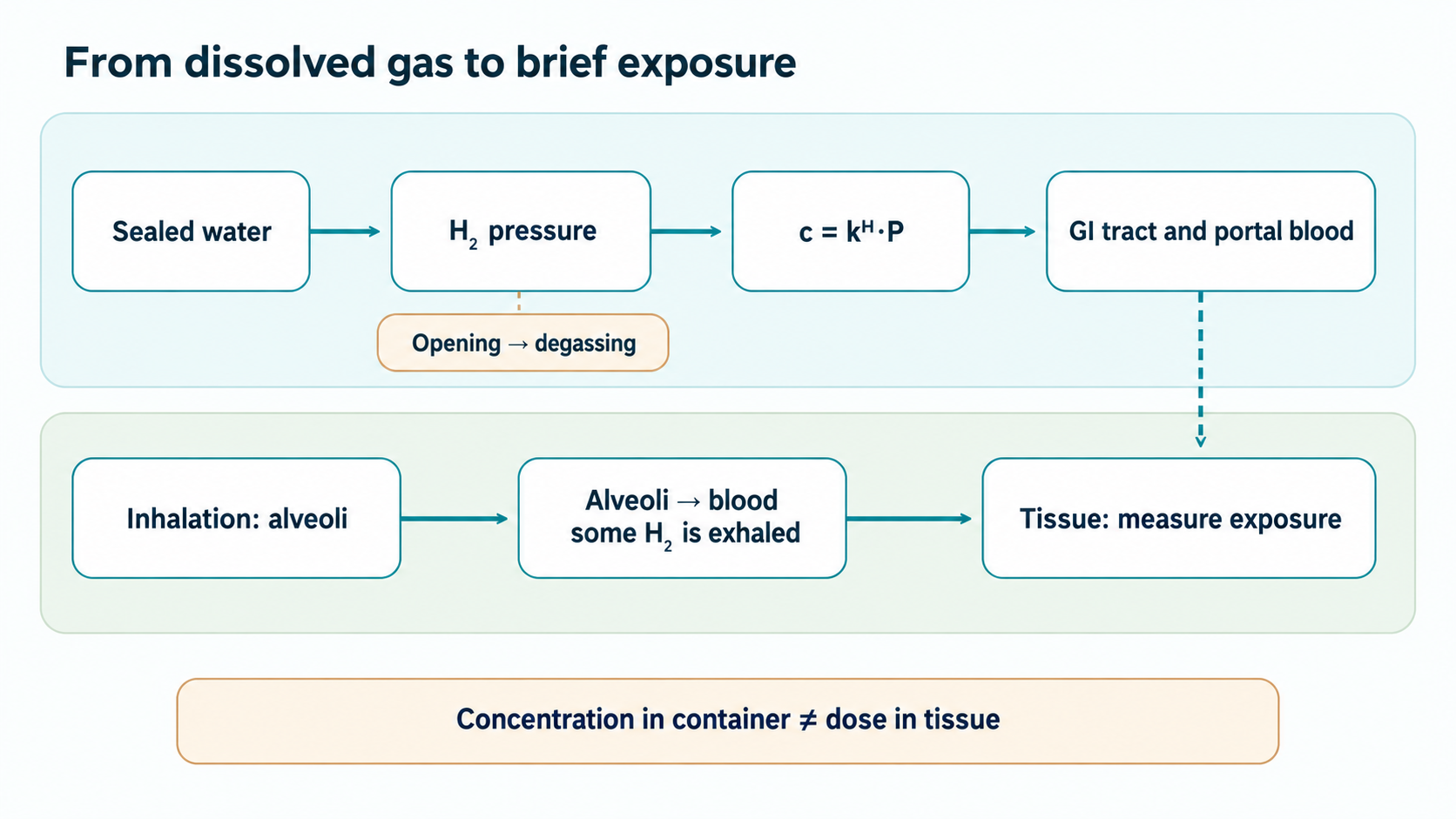
For equilibrium with the gas phase, a useful form of Henry's law is cH2=kHcp(T)PH2. Here kHcp specifically denotes the concentration/pressure coefficient; other tabulated conventions define its reciprocal. At 25 °C and a pure H₂ partial pressure of approximately 1 atm, around 0.8 mmol/L, or 1.6 mg/L, of dissolved gas is expected. This value refers to a particular temperature, salt composition and equilibrium gas phase; “ppm” in water is only approximately equivalent to mg/L at a density near 1 kg/L.
Higher pressure can increase the dissolved fraction; opening the packaging reduces the pressure above the liquid and dissolved H₂ escapes. Thus, the manufacturer's stated concentration, the concentration measured immediately before consumption and the mass actually delivered differ. Gas microbubbles and truly dissolved H₂ likewise cannot be added together without specifying the measurement method and degassing conditions: nanobubble stability is not a universal property of all formulations. Estimating a water-based dose requires at least the mass mH2=cmassV, time since opening, temperature and measurement method, rather than the single word “supersaturated.”
1.3. Gasotransmitters: a useful comparison, not an efficacy category
NO, CO and H₂S interact with different protein and metal centers, have endogenous production pathways and exhibit dose-dependent toxicity. H₂ is also produced by the intestinal microbiota and can rapidly leave the body through exhalation, but it cannot automatically be called a fourth gasotransmitter in the same mechanistic sense: a physiological receptor and a necessary endogenous signaling function in humans have not yet been established. Comparing gas masses and solubilities describes transport conditions alone. It neither ranks anti-inflammatory effects nor demonstrates “absolute nontoxicity” for every delivery route.
Question
Established physics or biology
What still needs to be measured in humans
Water–gas equilibrium
c=kHcpP at a specified temperature and matrix
Concentration at consumption and actual H₂ mass
Membrane passage
A small neutral molecule diffuses without a known obligatory transporter
Time course and concentration in a particular tissue and organelle
Comparison with NO, CO, H₂S
The gases have different reactions and targets
H₂ receptor, exposure and dose–response separately
2. What “selective antioxidant” actually means
2.1. The antioxidant paradox without a false unifying explanation
Oxidative stress is a shift in redox regulation and/or an accumulation of damage; ROS generation itself is physiological. NOX-derived and mitochondrial H₂O₂ can reversibly modify sensitive cysteines in phosphatases and other proteins, while local superoxide participates both in antimicrobial defense and in H₂O₂ formation through the SOD reaction. Exercise-related redox signals contribute to muscle adaptation through PGC-1α and mitochondrial programs. The contextual role of ROS cannot be reduced to “beneficial at low levels” and “harmful at high levels” without specifying location, timing, substrate and reductive capacity.
Large antioxidant supplement trials challenged the simple hypothesis that chemical antioxidant activity ensures disease prevention: β-carotene interventions in ATBC and CARET were accompanied by adverse cancer outcomes in certain high-risk groups; vitamin E increased prostate cancer risk in SELECT and did not confirm the expected vascular protection in HOPE-TOO. These trials do not demonstrate that every vitamin at every dose “suppresses H₂O₂ and therefore increases mortality”; the reasons for the results may differ. Ristow's study showed that high-dose vitamins C/E interfered with some metabolic adaptations to training, but did not establish that every antioxidant completely abolishes endurance gains. These differences between mechanism, population and outcome make H₂ worth testing, without confirming its advantages in advance.
2.2. Radical reactions: a rate constant does not establish dominance
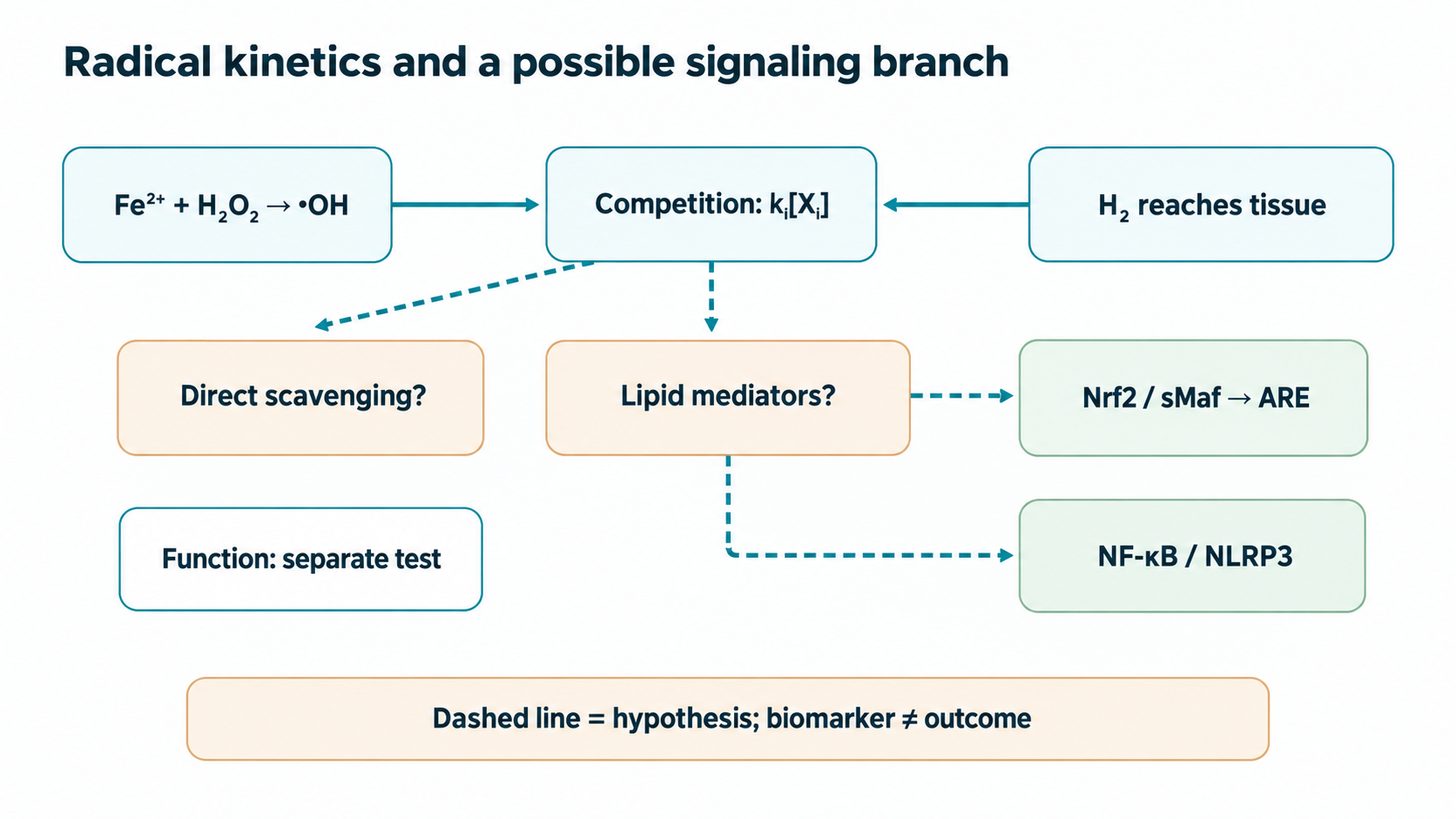
The hydroxyl radical arises, among other processes, from the Fenton reaction: Fe2++H2O2→Fe3++∙OH+OH−. Superoxide can return ferric iron to the ferrous state, sustaining a metal-catalyzed network; the notation “Haber–Weiss reaction” combines steps and does not itself specify the rate inside a cell. •OH reacts almost where it is formed with lipids, proteins, DNA and other solutes. Its extremely short lifetime makes direct scavenging by H₂ face very strong competition.
An individual reaction can be written as H2+∙OH→H2O+H∙; the resulting H• then undergoes further reactions, and the overall notation H2+2∙OH→2H2O does not describe an elementary one-step process. Even accepting an estimate of k∼4,2×10⁷M−1s−1 for H₂ reacting with •OH, the fraction scavenged depends on competing ki[Xi] terms in the same microcompartment. Many biomolecules have high concentrations and react rapidly with •OH, so kinetic feasibility does not establish that this reaction explains tissue protection. Ohsawa's early study demonstrated selective changes in radical damage measures in selected systems and neuroprotection in a rat model, but did not measure a universal fraction of •OH scavenged in human organs.
Peroxynitrite forms from NO• and O₂•⁻, and in the presence of CO₂, nitrosoperoxycarbonate-derived species determine a substantial part of its chemistry; thiol oxidation and tyrosine nitration can occur. A reduction in 3-nitrotyrosine after H₂ cannot distinguish direct chemical reduction of ONOO⁻ from reduced NO/O₂•⁻ generation or an altered inflammatory signal. A direct stoichiometric scheme “H₂ + ONOO⁻ → harmless end products” has not been established as the principal pathway in a complex cellular environment. Likewise, the absence of a rapid uncatalyzed reaction of H₂ with H₂O₂, NO and superoxide does not guarantee that their cellular concentrations remain unchanged: H₂ may indirectly alter enzymes, inflammation and their production.
Reaction node
What determines the result
Interpretation limit
Fe²⁺, H₂O₂, •OH
Available iron, local substrates, ki[Xi]
Thermodynamic feasibility of H₂ + •OH does not establish dominant scavenging
NO• + O₂•⁻ → ONOO⁻
Fluxes of both radicals, CO₂, thiols, reaction site
Lower 3-nitrotyrosine is not a direct test of ONOO⁻ reduction by hydrogen
H₂O₂ and NO• as signals
Source, microdomain, timing and redox enzymes
Absence of a direct reaction does not mean unchanged signaling pathways
2.3. An alternative mediator hypothesis
Iuchi and colleagues investigated the possibility that H₂ modifies a free-radical lipid oxidation chain and thereby the secondary lipid mediator produced, which affects gene expression. This is an experimental hypothesis of indirect signaling, rather than an established human pathway in which “H₂ directly binds Keap1 Cys151.” Testing it requires chemical identification of the mediator, its time course, the required sensor residue and reproduction of the effect at physiological concentrations. Changes in mitochondrial activity, the microbial H₂ source and the inflammatory environment are also possible. All observed phenotypes cannot be attributed to a single radical or protein merely because downstream markers coincide.
3. From Keap1 to inflammation: framework, observations and branches
3.1. Basal Nrf2 turnover and the cysteine sensor
Nrf2, the product of NFE2L2, is a bZIP transcription factor that regulates many genes protecting against electrophiles and oxidative damage. Under basal conditions, a Keap1 dimer captures Nrf2's Neh2 region through two motifs: high-affinity ETGE and weaker DLG. As an adaptor, Keap1 connects the substrate to the Cul3–Rbx1 E3 complex; after polyubiquitination of accessible lysines, Nrf2 is directed to the proteasome. This system gives the protein a short lifetime and allows its accumulation to change rapidly as the cellular environment changes. The exact affinities of the motifs depend on the method and construct; the functional asymmetry of the two contacts matters more than a single universal Kd.
Keap1's BTB domain mediates dimerization and contact with Cul3; IVR and other regions contain redox-sensitive cysteines, while the Kelch propeller holds the Nrf2 motifs. Cys151, Cys273 and Cys288 participate in responses to different electrophiles and oxidants; mutant systems show that sensor profiles depend on the stimulus. Covalent Keap1 modification by sulforaphane is chemically understandable. For the relatively chemically inert H₂, direct Cys151 modification and universal “DLG disengagement” cannot be inferred from changed Nrf2 expression. Possible involvement of secondary oxidized lipids remains a model in which the pathway from H₂ to the sensor thiol must be proven separately. Nrf2 changes may also occur through synthesis, proteasomal degradation, kinase regulation or inflammatory crosstalk.
3.2. The nucleus, ARE and the costs of the protective program
When Keap1-dependent turnover decreases, newly synthesized Nrf2 accumulates, enters the nucleus, interacts with small Maf proteins and binds ARE sequences. Coactivators and chromatin determine which genes respond in a given cell. This transcriptional program is not equivalent to “switching on all enzymes at once”: expression, protein abundance, cofactor availability and enzymatic flux differ in timing. The duration of the cellular response after brief H₂ exposure must be measured in a specific tissue and model; it cannot be deduced from a single gas peak.
HO-1/HMOX1 in the endoplasmic reticulum breaks down heme into biliverdin, CO and Fe²⁺; biliverdin reductase produces bilirubin. This pathway removes excess free heme, but the released iron requires sequestration by ferritin, otherwise iron-dependent oxidation risk rises. NQO1 carries out two-electron quinone reduction using NADH/NADPH and can thereby bypass a semiquinone radical intermediate; the reaction product is not always biologically inert, depending on the substrate. GCLC and its regulatory subunit GCLM determine the first step of GSH synthesis from glutamate and cysteine; glutathione synthetase then adds glycine, with ATP expenditure. GCLC/M expression without cysteine, glycine, ATP and NADPH reducing capacity does not by itself mean GSH replenishment.
GPX4 is a selenoprotein using GSH to reduce phospholipid hydroperoxides: PL−OOH+2GSH→PL−OH+GSSG+H2O. Given sufficient activity, glutathione reductase uses NADPH to return GSSG to GSH; the xCT/SLC7A11 system imports cystine, which must be reduced to cysteine. Together with control of available iron, these processes constrain ferroptosis, but describing ferroptosis does not demonstrate its clinical suppression by H₂. SOD1, SOD2 and SOD3 differ in compartments and metals; catalase and peroxidases remove some H₂O₂. For each gene, the general Nrf2-dependent repertoire must be distinguished from an effect actually measured after H₂ in a particular model. Even demonstrated induction is not evidence of reduced disease in humans.
Node
Reaction or function
Necessary inference limit
Keap1–Cul3–Rbx1
Basal Nrf2 polyubiquitination
Cys151 has not been established as a direct H₂ receptor
Nrf2–sMaf–ARE
Context-dependent transcription of protective genes
mRNA does not equal enzyme activity or a clinical outcome
HO-1 and ferritin
Heme → biliverdin + CO + Fe²⁺; iron sequestration
Increasing HO-1 without iron control can have ambiguous effects
GCL, GSH, GPX4
GSH synthesis and PL-OOH reduction
Substrates, selenium, NADPH and iron control are required
3.3. NF-κB, NLRP3 and HMGB1
On TNFR or TLR activation, the cytoplasmic IKK complex phosphorylates IκBα, after which the inhibitor is ubiquitinated and degraded. Released NF-κB p65/p50 enters the nucleus and regulates many inflammatory genes, including NOS2, PTGS2, TNF and IL6. In cellular models, H₂ was accompanied by lower NO production and altered signal transduction in macrophages; these findings are consistent with NF-κB modulation, but do not establish direct inhibition of IKKβ by H₂ or elimination of inflammation in a patient.
The NLRP3 inflammasome requires priming—including NF-κB-dependent increases in NLRP3 and pro-IL-1β—and an activation signal that may include K⁺ efflux, mitochondrial damage and other stimuli. NLRP3–ASC assembly recruits procaspase-1; active caspase-1 matures IL-1β/IL-18 and cleaves gasdermin D, whose pores support pyroptosis. Mitochondrial DNA and ROS can participate in certain models, but the pathway is not a single obligatory linear ladder. If cytokines or NLRP3 markers fall after H₂, priming, complex assembly, caspase-1 activity and the functional outcome must be tested separately. This cannot be called a complete blockade of both signals.
HMGB1 can leave the nucleus during cellular damage and, in particular redox forms, interact with TLR4/RAGE to amplify inflammation. Its cysteine state matters for receptor activity, but the claim “H₂ reduces HMGB1 thiols and blocks export” is not supported by a fall in serum HMGB1 alone. Distinguishing intracellular localization, cell death, release and redox isoforms prevents a false inference of a direct target.
3.4. Mitochondrial membranes and mPTP
During ischemia and subsequent reperfusion, electron flux, oxygen availability, Ca²⁺ and local radical reactions change sharply. Complexes I and III can generate superoxide, which SOD converts to H₂O₂; •OH arises secondarily when a suitable metal and H₂O₂ are available, rather than being “produced directly by complex I.” Cardiolipin oxidation can alter respiratory supercomplex stability and cytochrome c retention. Excess Ca²⁺, phosphate, pH, ROS and cyclophilin D affect the probability of permeability transition pore opening. The molecular composition of mPTP and the contribution of ANT/ATP synthase remain under investigation, so it cannot be presented as a fully established channel of a specified diameter.
Prolonged mPTP opening depolarizes the inner membrane, impairs ATP synthesis and promotes matrix swelling; subsequent outer membrane disruption can release cytochrome c and other signals. In models, H₂ is sometimes associated with less mitochondrial damage, but the direct sequence “H₂ scavenged •OH → protected cardiolipin → bound CypD → switched off mPTP” has not been proven. Testing it would require tissue gas exposure, independent measurements of lipid oxidation, calcium loading and pore status, and a causal genetic test. Biological links to mitochondrial quality control are explained in more detail in the article on coenzyme Q10 and the mitochondrial chain; a shared organelle does not prove synergy between substances.
4. Delivery: chemical mass is not a tissue dose
4.1. Water: electrolysis, magnesium and measurement quality
Hydrogen-rich water is produced by dissolving gas, separated electrolysis or magnesium–water reactions. In a proton exchange membrane system, anode and cathode are separated: 2H2O→O2+4H++4e− and 4H++4e−→2H2. Actual beverage quality depends on cell design, water, membrane, impurities and packaging; the term SPE/PEM alone does not guarantee a particular purity or concentration. Magnesium can generate H₂ according to the overall scheme Mg+2H2O→Mg(OH)2+H2, but yield in a particular tablet depends on Mg form, pH, additives and reaction time. Magnesium ion release may be a concomitant intervention that must be accounted for in the control group, rather than automatically becoming an identical 60–80 mg dose.
Gas concentration in open water falls through degassing. The time scale of this decline cannot be treated as a universal constant: surface area, agitation, temperature, headspace and container material alter the rate. A study should report measured dissolved H₂ at preparation and consumption, the control water's chemical composition and masking of taste/appearance. For a patient with fluid restriction, water volume has independent importance; replacing physician-set restrictions with “supersaturated” servings on the basis of assumed equivalent H₂ mass has not been tested in a clinical comparison.
4.2. Inhalation and sterile solution are different interventions
During inhalation, gas crosses the alveolar membrane; exposure depends on the inspired fraction, ventilation, blood flow and duration. Hydrogen-containing air is flammable at certain compositions and conditions, so a safe device requires control of the mixture, leaks, oxygen and ignition sources. The figure “2–4%” alone does not guarantee every device's safety, and a high-concentration H₂/O₂ mixture cannot be described as a home or standard regimen. Cardiac resuscitation trials used specialized equipment under medical supervision. Their regimens cannot be extrapolated to preventive inhalation or treatment of respiratory failure.
Hydrogen-rich saline has been administered intravenously in several studies; compared with water and inhalation, this entails additional requirements for sterility, dissolved gas stability, packaging compatibility and infusion safety. Individual rheumatoid arthritis trials do not establish indications for sepsis, pancreatitis, intra-articular injection or ophthalmic instillation. Milliliters per kilogram from an experimental protocol are not a recommended clinical dose.
Route
First measurable compartment
Design strength
Principal uncertainty
Water with H₂
GI lumen, portal blood, exhaled breath
Ease of a masked oral comparison
Degassing, actual mass, possible tablet and water effects
Sterility, H₂ stability, scarcity of reproducible clinical data
4.3. Kinetics and the error of a “long effect after a short peak”
After swallowing, dissolved H₂ can rapidly pass from the stomach and intestine into portal blood, then distribute and be cleared mainly through the lungs. During inhalation, continued delivery produces a different time profile, and partial pressure falls after delivery stops. Cmax, Tmax and AUC depend on blood sampling, gas measurement and the regimen itself, so numerical peaks from one protocol cannot be extended to all patients and devices. The blood-to-exhaled-air gradient explains rapid elimination without a hypothesis of endless accumulation.
A transcriptional response to brief exposure can outlast H₂ if intermediate signals and newly synthesized proteins actually persist. This is a general biological possibility, rather than a proven universal “paradox” involving 24–48 hours of therapeutic protection. Sequential measurements of gas concentration, genes, proteins, enzyme activity and outcome in the same model are required. There is no adequate comparison demonstrating an advantage of drinking water three times daily over continuous inhalation or showing tolerance to H₂ with continuous delivery.
5. What human studies have shown
5.1. Carbohydrate and lipid metabolism
Kajiyama and colleagues studied hydrogen-rich water in a small double-blind crossover study of people with type 2 diabetes or impaired glucose tolerance. Changes in lipid and oxidative markers were reported; six participants with impaired tolerance cannot establish diabetes prevention from a few normalized tests. Even a well-conducted crossover requires attention to intervention order, washout, concomitant treatment and changes in control measures. Nakao's study in people with possible metabolic syndrome was an open-label pilot without a placebo group. Consequently, increased serum SOD, reduced TBARS or altered HDL within this design cannot be causally attributed to H₂ with the same confidence as a between-group difference in an RCT.
LeBaron's 24-week randomized study with 60 participants with metabolic syndrome reported a comparison of high-concentration water against placebo and favorable changes in selected glucose, HbA1c, lipid and inflammatory measures. The intervention used a specific high-concentration formulation; this study did not establish improved vascular function by FMD and did not evaluate reductions in vascular events. The small sample, formulation, multiple biomarkers and absence of vascular events or long-term outcomes limit translation into practice. As in the review of vitamin B3 and NAD⁺, an improved laboratory profile cannot automatically be equated with fewer events.
5.2. Fatty liver disease
Korovljev and colleagues conducted a double-blind placebo-controlled crossover pilot in 12 overweight people with NAFLD, comparing 1 L/day of hydrogen and control water for 28 days. Dual-echo MRI detected a between-group decrease in fat in selected liver regions; the authors also reported an AST change, but its estimated 95% CI included zero. There was no significant between-group difference in body weight or composition. This is a signal for a larger study with prespecified assessment of the entire organ, fibrosis and long-term outcomes, rather than proven steatohepatitis regression. The original text incorrectly stated eight weeks, a 21.4% fat reduction and significant improvements in ALT/AST/GGT and FIB-4; the primary publication does not support these statements.
5.3. Rheumatoid arthritis
In 2012, Ishibashi described an open-label pilot with 20 patients in whom 8-OHdG and DAS28 changed during hydrogen water consumption. The lack of a blinded control makes interpretations of remission in small subgroups and causal medication withdrawal particularly vulnerable. The subsequent placebo-controlled intravenous solution study used a different delivery route. Combining these two designs into a claim of proven prevention of cartilage destruction is unjustified: IL-6/MMP-3 markers, disease activity and structural joint damage are different endpoints. Standard antirheumatic treatment should not be replaced by hydrogen on the basis of these studies.
5.4. Exercise and muscle damage
Aoki and colleagues assessed lactate and peak torque after exercise in a pilot crossover experiment with ten soccer players. A short series of tests supports a hypothesis about recovery of selected laboratory and functional measures, but does not establish a consistent improvement in sporting performance. Mikami examined endurance and psychomotor fatigue in a small sample; its composition and chosen outcomes do not provide a common threshold for training efficacy. Javorac studied damage markers and subjective soreness after intense exercise, which do not equal preservation of muscle tissue or fewer injuries. Redox signals also participate in training adaptation; the idea that “the more oxidation is suppressed, the better” does not follow biologically from these data.
5.5. Post-resuscitation care, stroke and radiotherapy
The strongest clinical argument requires particularly precise attribution. Tamura's first experience in 2016 was an inhalation feasibility study with temperature control in five patients after cardiac arrest, without a randomized control. Tamura's 2020 study examined oxidative markers in this small series, also without a control group. In a separate multicenter RCT, HYBRID II, published in 2023, 73 patients were allocated to 2% H₂ with oxygen or oxygen alone. The prespecified primary outcome—favorable Cerebral Performance Category at day 90—occurred in 22/39 versus 13/34, p=0,15, showing no statistically significant advantage. Secondary outcomes, including survival, appeared more favorable, but the trial stopped early because of recruitment constraints; imbalance in the initial arrest rhythm and the small sample further limit inference. This supports replication, rather than an established resuscitation standard.
Ono's acute ischemic stroke study assessed inhalation safety and neurological/imaging measures. The word “randomized” does not make its results evidence of faster infarct regression in every patient: scale, primary endpoint, background standard therapy and administration timing must inform a clinical conclusion. During radiotherapy for liver tumors, Kang reported quality-of-life measures and oxidative markers with hydrogen water. Failure to detect impaired antitumor effects in a small group does not prove oncological safety of adding H₂; quality of life itself is not equivalent to cancer survival.
Population and study
Design and signal
Decisive limitation
Diabetes/impaired tolerance, Kajiyama
Small blinded crossover; lipid and oxidative markers
No proven reduction in complications or progression to diabetes
No confirmed FMD or clinical events; dose must be read in mmol
NAFLD, Korovljev
Crossover pilot, 12 participants, 28 days; liver MRI regions
Small sample, short duration; AST and weight changes do not establish treatment
Rheumatoid arthritis, Ishibashi
Open-label water and a separate controlled infusion study
Markers and disease activity do not equal structural remission
Sport, Aoki/Mikami/Javorac
Small interventions; lactate, fatigue, torque, muscle markers
Different doses/protocols; few robust functional outcomes
After cardiac arrest, HYBRID II
RCT, 73 patients, 2% H₂; primary CPC 22/39 versus 13/34
p=0,15 for the primary endpoint; secondary signals need confirmation
Stroke/radiotherapy, Ono/Kang
Early clinical trials
Insufficient for a treatment standard or protection from oncological risk
6. Practical interpretation and safety
6.1. Why tested regimens do not establish a universal dose
Studies differed in water concentration and volume, the chemical means of H₂ formation, inhaled mixture, exposure time, control composition and population. No minimum daily “Nrf2 induction” threshold of 1.5–3 mg in adults, equivalence of 300–500 mL of saturated water to two liters of ordinary hydrogen water, or relationship between gas mass and disease outcome has been established. The term “therapeutic dose” would imply a demonstrated efficacy and risk range for a specific indication; these parameters have not been established for H₂. In patient care, a regimen published in one trial should not be turned into instructions for use on an empty stomach, before training or before sleep.
Circadian clocks (CLOCK/BMAL1) and peroxiredoxins are linked to redox biology, but no comparative clinical trial has shown superiority of “pulsed” morning, daytime and evening H₂ intake or prevention of tolerance. Consumption timing may change the rate of degassing or dietary context, but this requires direct comparison. Likewise, short exhalation kinetics do not establish a need for repeated procedures.
6.2. Combined interventions: mechanistic compatibility does not equal synergy
Combinations of H₂ with NAC/glutathione, coenzyme Q10/PQQ, urolithin A with NR/NMN and sulforaphane/curcumin have been discussed. Each combination joins different levels of the model: NAC can supply cysteine for GSH synthesis; coenzyme Q10 participates in electron transport; mitophagy and NAD⁺ pathways support organelle renewal and function; sulforaphane acts as an electrophilic Nrf2 activator. However, separate studies of each component do not establish additive action or safety of an arbitrary combination dose. Products differ in bioavailability, contraindications, composition and drug interactions; underlying liver/kidney disease and treatment are particularly important. A comparison of dietary polyphenols and cellular signals shows why a similar biomarker does not prove an identical mechanism. A detailed clinical discussion of membrane redox context is also provided in the vitamin E review. H₂ combinations require separate factorial or other controlled studies with prespecified outcomes.
6.3. Assessing risk by administration route rather than the word “endogenous”
The intestinal microbiota does produce H₂, and water with dissolved gas has generally been well tolerated in the regimens studied. However, endogenous origin does not establish an absence of contraindications, drug interactions, impurities or long-term effects for every commercial system. Failure to find events in small trials means limited statistical power to detect rare harm. Drug interactions, genotoxicity and reproductive safety require dedicated studies; small clinical series cannot establish zero risk.
GRAS applies to a particular substance, specification and intended food use, rather than FDA approval of inhaled or intravenous therapy or disease treatment. In inhalation, the physical risks of the mixture and device are separate from the gas's biological tolerability; intravenous solution adds infusion risks. Additional water or an experimental replacement of water with inhalation cannot be recommended to patients with heart or kidney failure solely on the basis of a general article. In acute conditions, H₂ should not delay established treatment.
7. How the review was prepared and what remains unknown
This is a narrative review of the available literature base, prepared on October 4, 2026, without a systematic search, formal GRADE assessment or independent peer review. Targeted checks covered primary publications on clinical studies of metabolic syndrome, fatty liver disease, post-resuscitation care and an early signaling hypothesis. This approach helps distinguish mechanism, biomarker and clinical outcome carefully, but does not cover every reaction, every numerical value or all subsequent studies.
Uncertainty centers on several linked transitions: what H₂ concentration actually reaches a particular tissue; which primary chemical or indirect mediator changes the cellular response; whether that response is reproduced at physiological exposure; and whether it improves a prespecified important outcome in humans. Measuring exhaled breath, transcripts, 8-OHdG or fat in one MRI region answers only the corresponding narrow question. HYBRID II particularly clearly illustrates the need to report a negative primary outcome alongside attractive secondary signals. Molecular hydrogen remains a subject of biophysical and clinical research; the supplied evidence base does not establish a general proven treatment regimen for the diseases listed.
FAQ
Has H₂ been shown to modify Keap1 directly and activate Nrf2?
Changes in Nrf2-dependent measures have been described in experimental models, but direct chemical modification of Keap1 by H₂ and its role in humans have not been established.
Can hydrogen water be considered a treatment for diabetes or fatty liver disease?
Small studies reported changes in selected metabolic and MRI measures; they did not prove fewer complications, fibrosis regression or long-term clinical outcomes.
Did H₂ improve the main outcome of HYBRID II?
No: the difference in prespecified favorable CPC at day 90 was not statistically significant. Secondary survival signals require larger replication.
What H₂ dose is considered therapeutic?
No universal therapeutic threshold has been established. Exposure depends on delivery route, concentration at application and the specific clinical protocol.