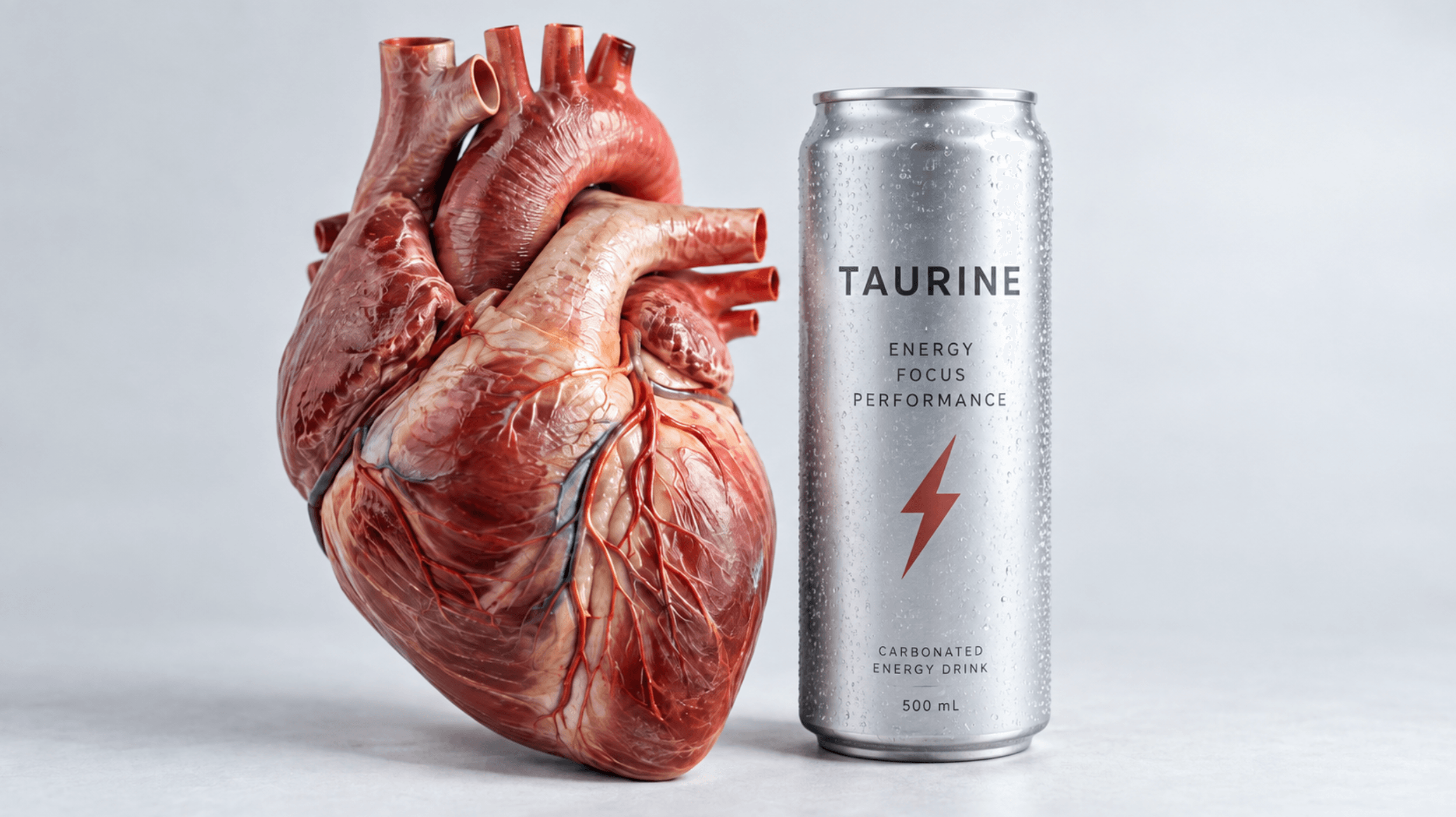
Taurine: Why the Heart and Bile Need It, Whether It Affects GABA Receptors, and Whether It Really Helps With Cramps
Taurine has become the victim of a rather unusual reputation. Most people first encounter its name on a can of an energy drink and therefore automatically place it alongside caffeine, guarana, and other stimulants. This creates an almost intuitive assumption: if a substance is present in an “energy drink,” it must increase arousal, accelerate the heart rate, and somehow force the body to work harder.
Biochemically, the situation is almost the opposite.
Taurine is not a classic central nervous system stimulant. It is not incorporated into proteins, muscles do not use it as an energy source, and it does not raise ATP levels in the way an energy substrate would. It is a small sulfur-containing molecule that exists mainly in free form and participates in very different processes: it helps cells regulate volume and ion concentrations, forms part of conjugated bile acids, influences calcium homeostasis, participates in mitochondrial function, and interacts with inhibitory receptor systems in nervous tissue. Particularly high concentrations of taurine are found in the retina, heart, skeletal muscle, and nervous system — tissues in which membrane stability, ion gradients, and precise control of cellular excitability are critically important.
This versatility has made taurine an attractive subject of research. Cardioprotective, anti-inflammatory, metabolic, neuroprotective, and sports-related effects have all been attributed to it. Some of these effects have elegant biochemical explanations. Some are supported by small clinical trials. But there is a considerable distance between “this molecule participates in a mechanism” and “this supplement has been proven to treat a disease.”
Taurine is a good example of a substance whose genuine physiological functions have gradually become surrounded by much stronger therapeutic claims than the current clinical evidence can support.
Taurine is called an amino acid even though its chemistry is different
The full chemical name of taurine is 2-aminoethanesulfonic acid.
It differs fundamentally from ordinary proteinogenic amino acids. Instead of a carboxyl group, taurine contains a sulfonic acid group, and its amino group is located in the beta position.
This difference has an important physiological consequence: ribosomes do not incorporate taurine into growing protein chains.
It cannot be used to build muscle protein in the way leucine, lysine, or valine can. The body uses taurine primarily as a free intracellular molecule.
And it is not a rare metabolite.
Taurine is one of the most abundant free amino-acid-like compounds in mammalian tissues. It is particularly concentrated in tissues with high electrical and metabolic activity — the heart, skeletal muscle, retina, and nervous system. Its intracellular concentration can be far higher than its concentration in blood plasma. Maintaining this gradient depends in part on the specialized sodium- and chloride-dependent taurine transporter TauT, encoded by the SLC6A6 gene.
This high concentration has a functional purpose. Taurine acts as an organic osmolyte: cells can alter their intracellular taurine content to regulate volume without having to make large changes in sodium, potassium, or other inorganic ion concentrations. At the same time, taurine interacts with membrane proteins, ion transport, and intracellular signaling systems.
Its role is therefore better understood not as participation in one isolated reaction, but as part of the machinery that maintains cellular homeostasis.
The body can synthesize taurine, but it also obtains it from food
Humans can produce taurine from sulfur-containing amino acids.
One of the main pathways begins with cysteine. Cysteine dioxygenase converts it into cysteine sulfinic acid, after which cysteine sulfinic acid decarboxylase participates in the formation of hypotaurine, which is then converted into taurine. Pyridoxal 5'-phosphate — the active form of vitamin B6 — is involved in this pathway.
But endogenous synthesis is not the only source.
Taurine is obtained mainly from animal-derived foods. Seafood, fish, meat, and organ meats are particularly rich sources. Plants contain virtually none.
For this reason, dietary taurine intake in vegans is close to zero. Classic studies have indeed found lower plasma taurine concentrations and markedly lower urinary taurine excretion in vegans compared with omnivores. However, the body adapts quite effectively through endogenous synthesis and increased renal conservation.
An important distinction follows from this.
The absence of taurine from plant foods does not mean that every vegan has a clinical taurine deficiency or that everyone following a plant-based diet necessarily requires supplementation. There is no established daily dietary requirement for taurine in healthy adults comparable to those for vitamins or essential amino acids.
A contemporary 2026 review frames the issue cautiously: physiological synthesis and an ordinary diet are generally sufficient to support basic health, although additional taurine intake may have metabolic effects in selected conditions.
One of taurine’s most firmly established functions is found not in muscle, but in bile
One of taurine’s most fundamental roles is its participation in the formation of conjugated bile acids.
Primary bile acids are synthesized in the liver from cholesterol. But before they are secreted into bile, a large proportion are conjugated with one of two amino-acid-like molecules — glycine or taurine.
First, the bile acid is activated by formation of a CoA derivative. Then the enzyme bile acid-CoA:amino acid N-acyltransferase attaches either glycine or taurine. In the case of cholic acid, this produces compounds such as glycocholate and taurocholate.
This is not merely a decorative chemical modification.
Free bile acids are relatively weak acids. Conjugation sharply lowers their pKa. Glycine conjugates have a pKa of roughly 4, whereas taurine conjugates have values below 2. As a result, taurine-conjugated bile acids remain almost completely ionized across the physiological pH range and retain high solubility in aqueous environments.
These properties allow bile acids to function as natural detergents.
They form mixed micelles with lipids, participate in the emulsification of dietary fat, and allow the products of fat digestion to interact efficiently with the intestinal surface. Through this mechanism, bile acids are essential for the normal absorption of fats and the fat-soluble vitamins A, D, E, and K.
In humans, however, taurine is not the only — or even the dominant — substrate for bile acid conjugation. A substantial proportion of bile acids are conjugated with glycine, and the approximate ratio between glycine and taurine conjugates varies with diet, metabolic state, and the intestinal microbiota.
So the physiological role of taurine in bile salt formation does not mean that a healthy person needs to take taurine before eating a fatty meal.
Nor is there currently a strong basis for recommending ordinary taurine supplementation as a proven method for preventing biliary sludge.
The biochemical role is very well established. The clinical effect of taking extra taurine for gallbladder disease is a separate question, and the evidence there is much weaker.
Why taurine concentration is so high in the heart
The myocardium is one of the tissues in which taurine is genuinely present at high concentrations.
This makes physiological sense: cardiomyocytes depend continuously on extremely precise movements of sodium, potassium, and especially calcium across the cell membrane and sarcoplasmic reticulum.
Every heartbeat begins with an electrical signal followed by an increase in cytoplasmic Ca²⁺.
Calcium must then be removed quickly so that the cardiomyocyte can relax and prepare for the next contraction.
Experimental studies indicate that taurine can influence several components of this process, including calcium transport systems, the calcium sensitivity of the contractile apparatus, membrane stability, and cell volume. In models of taurine deficiency, cardiomyopathy can develop, supporting the idea that taurine is physiologically important for normal cardiac function.
This provides a convincing mechanistic basis for studying taurine in heart failure.
And such studies do exist.
A small double-blind crossover trial published in 1985 reported improvement in some clinical signs and functional class in 14 patients with congestive heart failure when taurine was added to standard therapy.
Other small studies followed.
But the limitation becomes obvious when the evidence is considered as a whole.
A systematic review of taurine in heart failure identified only 11 eligible studies. Doses ranged from 500 mg to 6 g per day, treatment periods from two to 48 weeks, and overall study quality was mostly low. Only one study was rated as high quality. Pooled analysis did not demonstrate a convincing statistically significant improvement in ejection fraction or stroke volume.
In addition, one small 2017 study that had often been cited as evidence for improved functional capacity and electrical cardiac activity was formally retracted in 2026.
The wording therefore needs to remain cautious.
Taurine is physiologically important to the myocardium, and small clinical trials provide interesting signals. But it is not currently a proven substitute for standard heart-failure therapy and should not be presented as a treatment that reliably “improves NYHA class” on its own.
The effects on blood pressure and metabolic markers are nevertheless interesting
Taurine’s cardiovascular story is not limited to heart failure.
A 2024 meta-analysis combined 25 randomized trials involving 1,024 participants. Doses ranged from 0.5 to 6 g per day, with interventions lasting from several days to one year.
On average, taurine was associated with a reduction in systolic blood pressure of roughly 4 mmHg, diastolic pressure of about 1.5 mmHg, as well as small reductions in fasting glucose and triglycerides.
These are human data, but they also need to be interpreted without exaggeration.
The studies were heterogeneous, included different patient populations, and used different protocols. A reduction of several millimeters of mercury may be physiologically interesting, but it does not mean taurine should be used instead of antihypertensive medication.
Rather, this is an area in which the molecule deserves further large, well-designed clinical trials.
One of taurine’s most unusual mechanisms is hidden inside mitochondrial tRNA
Taurine is important to mitochondria for reasons that extend beyond calcium or membrane processes.
It participates in post-transcriptional modification of mitochondrial transfer RNA.
In particular, taurine is incorporated into a modified uridine in the anticodon region of mitochondrial leucine tRNA. These chemical modifications help the mitochondrial translation machinery correctly recognize specific codons.
This biology has been studied particularly well in certain mitochondrial disorders, including MELAS.
When taurine-dependent tRNA modification is impaired, synthesis of selected respiratory-chain subunits can be disrupted, along with Complex I function. Experimentally, this is associated with lower ATP production and increased formation of reactive oxygen species.
So the statement that taurine is connected with mitochondrial function has a real molecular basis.
But again, the simple logic “more taurine means more mitochondrial energy” does not follow.
Taurine-dependent tRNA modification is a necessary part of normal mitochondrial biology. In someone without an impairment in this pathway, taking extra taurine does not turn mitochondrial translation into a super-efficient system.
Taurine is genuinely connected with antioxidant defense, but not in the same way as vitamin C
Another common description is that “taurine is an antioxidant.”
This is partly true, but it needs clarification.
Taurine is not a classic universal scavenger of free radicals.
One of its best-studied antioxidant-related mechanisms involves neutrophils.
During inflammation, the enzyme myeloperoxidase produces hypochlorous acid, or HOCl. This is a powerful oxidizing agent that helps kill microorganisms but can also damage host tissues.
Taurine reacts with HOCl to form taurine chloramine, a much less reactive compound that also participates in regulation of the inflammatory response.
In addition, taurine’s effects on mitochondrial electron transport, membranes, and calcium homeostasis may indirectly reduce the formation of reactive oxygen species.
A more accurate formulation is therefore that taurine participates in cellular redox regulation and the limitation of oxidative stress, rather than simply “neutralizing free radicals.”
In the brain, taurine resembles an inhibitory neurotransmitter — but that does not make it a sedative drug
One of taurine’s most interesting properties is its ability to interact with receptors belonging to inhibitory neurotransmitter systems.
Its structure and charge share certain similarities with GABA and glycine.
Experimental studies show that taurine can activate some variants of GABA-A receptors and glycine receptors. The magnitude of the response depends on receptor subunit composition and the specific region of the nervous system.
Activation of these receptors alters chloride conductance and, in the mature nervous system, generally reduces the probability of neuronal excitation.
Taurine has therefore long been studied as an endogenous neuromodulator.
But there is a fundamental difference between an experiment on neurons and an oral taurine supplement.
It remains unclear whether physiological extracellular taurine concentrations in the human brain reach levels sufficient to activate the same receptors to a clinically meaningful extent. Transport across the blood-brain barrier is also tightly regulated. Earlier reviews already emphasized that the physiological significance of taurine’s interactions with GABA and glycine receptors is much more complicated than the simple statement “taurine is a GABA agonist.”
This distinction becomes particularly important when anxiety, sleep, or epilepsy enter the discussion.
Preclinical evidence supports inhibitory and anticonvulsant effects, but taurine is not a proven antiepileptic medication and should not be used as a substitute for prescribed therapy.
A recent systematic review of human studies in healthy participants found that single doses of 1–3 g produced, at most, small and inconsistent cognitive effects.
So the phrase “taurine calms the brain through GABA” is far too simple for the actual neuropharmacology.
Does taurine actually help with muscle cramps?
This is a case in which a plausible mechanism has generated far more confidence than the clinical evidence itself.
Taurine does influence cell volume, membrane processes, and calcium homeostasis in skeletal muscle. It is therefore reasonable to hypothesize that low taurine availability might contribute to increased neuromuscular excitability.
But ordinary muscle cramps are themselves highly heterogeneous.
Exercise-associated cramps cannot be reduced simply to magnesium deficiency, water loss, sodium depletion, or taurine deficiency. Their development may involve neuromuscular fatigue, altered reflex control of motor neurons, the specific type of load, electrolyte disturbances, medications, and various diseases.
The most interesting clinical evidence for taurine does not come from athletes, but from patients with chronic liver disease.
In a double-blind randomized crossover study, patients with chronic liver disease and frequent painful cramps received taurine or placebo. At a dose of 2 g per day, participants who completed the study experienced reductions in cramp frequency, duration, and severity compared with placebo.
The result is interesting, but the study was small: 49 patients were enrolled and only 30 completed the full protocol.
A 2024 systematic review of non-pharmacological interventions for muscle cramps in cirrhosis also identified a positive signal for taurine, but overall evidence quality was rated as moderate to low, with moderate or high risk of bias.
These results cannot simply be generalized to every healthy person who develops a calf cramp at night or experiences cramps after a marathon.
There is even less basis for automatically prescribing a combination of “2–3 g taurine plus 400 mg magnesium” as a universal cramp protocol.
The cause of the cramps should be considered first.
It is also worth abandoning the myth of taurine as an “antidote” to stimulants
In fitness circles, one sometimes encounters the claim that certain β2-agonists “deplete taurine” and that supplementation can eliminate the resulting cramps.
Most such recommendations originate not from high-quality clinical trials but from bodybuilding forums, anecdotal practice, and mechanistic extrapolation.
This is especially problematic with clenbuterol — a substance with significant cardiovascular risks that should not be made to seem safer by adding taurine or electrolytes.
Taurine does not make hazardous stimulant use safe.
Why taurine ended up in energy drinks in the first place
Energy drinks usually contain taurine in amounts ranging from hundreds of milligrams to several grams per serving.
Its proximity to caffeine created one of the main myths: that taurine itself must also be a stimulant.
It is not.
Caffeine works primarily through blockade of adenosine receptors, increasing wakefulness and producing several sympathetic effects.
Taurine has a completely different physiology.
There is even a hypothesis that some of its actions could potentially oppose certain cardiovascular effects of excessive caffeine. This possibility has been discussed in reviews and by European experts for many years. But the authors themselves have emphasized that caffeine-taurine interactions in humans remain inadequately studied.
It would therefore be too strong to claim that taurine is added to energy drinks specifically “to protect the heart from caffeine.”
An energy drink is a mixture of substances, not an experiment with pure taurine.
A modern systematic review of 37 energy-drink studies found increases in heart rate, blood pressure, and QTc duration in some trials after consumption. The authors identified caffeine and combinations of ingredients as the main areas of concern, but such studies make it difficult to isolate the contribution of each individual compound.
A more accurate statement is:
taurine itself is not a typical stimulant, but the safety profile of pure taurine cannot automatically be transferred to an energy drink as a multi-ingredient product.
And conversely, adverse effects associated with energy drinks cannot automatically be blamed on taurine alone.
How safe is pure taurine?
Based on available evidence, its safety profile appears very favorable.
Many clinical studies have used doses ranging from 1 to 6 g per day, and some have used even higher amounts, without a consistent pattern of serious adverse events.
However, the figure of 3 g per day is surrounded by an important misunderstanding.
It is often described as “the maximum safe dose established by EFSA.”
That is not correct.
In 2008, Shao and Hathcock performed a quantitative risk assessment of several amino acids. Because a classic adverse-effect threshold could not be identified for taurine, they used the concept of an Observed Safe Level — OSL.
Based on the available human data, they concluded that there was strong evidence supporting the safety of supplemental taurine intake up to 3 g per day in healthy adults. They also specifically noted that higher doses had been studied without obvious toxicity, but there were insufficient data to establish long-term safety above this level with the same confidence.
So 3 g is not the “threshold above which toxicity begins.”
It is better understood as a conservative level for which a reasonably substantial body of human safety data had accumulated.
EFSA conducted a different assessment in 2009 — the safety of taurine as an ingredient in energy drinks. The panel reviewed toxicological studies, estimated exposure, and potential interactions with other ingredients and did not identify the studied levels of taurine exposure as a safety concern. But EFSA did not establish a classical UL for taurine.
The statement “EFSA allows 3 g of taurine every day for life” should therefore be avoided.
It conflates two different approaches to risk assessment.
Should we worry about the kidneys and liver?
In healthy people, clinical trials have not produced a convincing signal of liver or kidney toxicity at the usual studied doses of taurine.
The molecule is water-soluble, and the kidneys actively regulate its balance.
When intake is low, tubular reabsorption increases and the body attempts to conserve taurine. When intake rises, urinary excretion increases.
This is one reason why the body’s taurine pool can adapt relatively flexibly to dietary intake.
But the phrase “anything extra just comes out in the urine” should not be turned into a universal guarantee that any dose is safe.
Very high chronic doses are much less well studied than doses in the range of a few grams per day.
Data are also more limited in pregnancy, severe kidney disease, and several other special populations.
Does taurine have dangerous drug interactions?
Popular sources sometimes state that taurine necessarily interacts with digoxin, ACE inhibitors, angiotensin receptor blockers, and other cardiovascular medications.
Here, the evidence is much weaker than the wording often suggests.
Taurine can modestly lower blood pressure in some studies, so in theory it could add to the blood-pressure-lowering effect of antihypertensive medications. But current evidence is not strong enough to produce a strict list of clinically meaningful interactions or to calculate how medication doses should be adjusted.
The same applies to digoxin.
Mechanisms involving calcium handling make an interaction biologically conceivable, but that is not equivalent to a well-established clinical drug interaction.
People taking medications for heart failure, arrhythmias, or hypertension should therefore discuss taurine supplementation with their clinician rather than changing medication doses on their own.
Does a healthy person need to take taurine at all?
For most healthy people, there is no obligatory need.
Taurine is a normal human metabolite, and the body can synthesize it.
There is no official RDA or other mandatory daily intake target for healthy adults.
A diet containing fish, seafood, or meat provides additional dietary taurine. On a fully plant-based diet, taurine intake is almost absent, but the body adapts through endogenous synthesis and reduced renal losses.
At the same time, supplementation studies have found some interesting effects.
In sports physiology, doses of roughly 1–6 g have been studied both acutely and over longer periods. A 2025 meta-analysis of 23 randomized trials found a small overall effect of a single taurine dose on physical performance, but results differed substantially between studies and prediction intervals often included no effect.
That means taurine may be an interesting sports supplement, but it is not a foundational ergogenic aid on the level of creatine.
The data on blood pressure and some metabolic markers are also promising, but not yet strong enough to justify viewing taurine as a stand-alone treatment.
For muscle cramps, the most convincing clinical signal comes from patients with chronic liver disease, not healthy athletes.
For heart failure, small positive trials exist, but systematic evaluation has not yet confirmed a robust clinical benefit.
In other words, the range of taurine’s biological functions is much broader than the range of its proven medical indications.
How to interpret taurine doses in practice
For a healthy adult using taurine as an ordinary dietary supplement, clinical studies most commonly fall within the range of approximately 1–3 g per day.
A substantial amount of tolerability data exists for this range, and 3 g per day has the strongest historical safety basis as an OSL.
That does not mean everyone needs 3 g or that 3 g is more effective than 1 g.
For some sports-related purposes, single doses of 1–6 g have been studied, and a modern meta-analysis did not find a convincing linear relationship in which “more dose” consistently produced “more effect.”
For specific diseases, dosing should be based on evidence for that particular condition rather than on popular dosage charts.
For example, 2 g per day has been studied for muscle cramps in patients with chronic liver disease. That is not a universal protocol for muscle spasms.
Likewise, 1.5–3 g per day was used in older heart-failure trials, but this does not make such doses standard cardiological therapy.
Main takeaway
Taurine is far more interesting than the role assigned to it by energy-drink culture.
It is not a stimulant and not an “energy amino acid” in the literal sense.
Taurine is a small sulfur-containing molecule found at high concentrations in electrically active and metabolically demanding tissues, where it participates in maintaining cell volume, ion gradients, calcium homeostasis, and membrane stability.
In the liver, it is a genuine substrate for bile acid conjugation, producing highly soluble, ionized bile salts.
In the myocardium, taurine deficiency disrupts normal cardiomyocyte function, and experimental physiology clearly demonstrates its connection with calcium handling and contractility.
In mitochondria, it participates in chemical modification of tRNA and is therefore connected with normal translation of selected respiratory-chain proteins.
In immune cells, taurine reacts with hypochlorous acid to form taurine chloramine, linking taurine metabolism with regulation of the inflammatory response.
In the nervous system, it can interact with GABA-A and glycine receptors, but this does not yet justify calling ordinary oral taurine a proven anxiolytic, hypnotic, or anticonvulsant drug.
The situation with muscle cramps is similar: there is a plausible mechanism and a positive small trial in patients with chronic liver disease, but there is no universally proven protocol for exercise-associated cramps.
Its association with energy drinks also requires separating the molecule from the product. Taurine itself is not a caffeine-like stimulant, but that does not mean it can reliably neutralize the risks of a beverage containing high doses of caffeine and other ingredients.
From a safety perspective, taurine appears to be one of the relatively well-tolerated dietary supplements. For healthy adults, the strongest safety data extend to approximately 3 g of supplemental taurine per day, but this is an Observed Safe Level rather than a toxicological threshold or a recommended dose.
The most accurate conclusion is therefore much calmer than the marketing:
taurine is a physiologically important molecule with several well-established biochemical functions and a number of promising clinical applications, but most of these functions do not require healthy people to take taurine supplements routinely.
This material is for educational purposes only and does not replace medical consultation, diagnosis, or individually prescribed treatment.