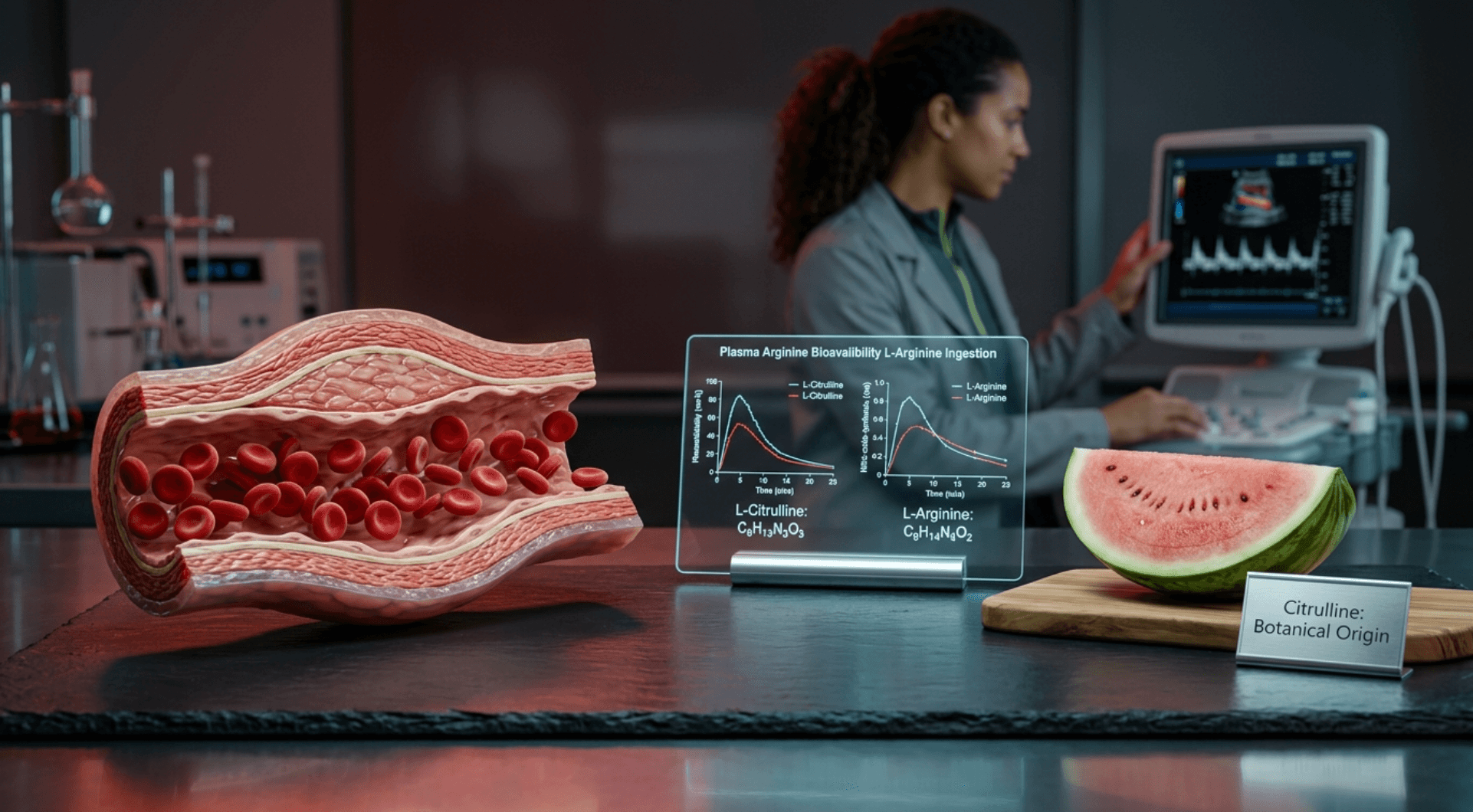
L-Citrulline: Why It Raises Arginine More Effectively Than Arginine Itself, and What We Know About NO, Blood Flow, and Endurance
L-citrulline occupies an unusual position. Formally, it is an amino acid that the body does not use to build proteins. It is not classified as an essential nutrient, there is no established recommended daily intake for it, and much of the citrulline circulating in the body is produced endogenously.
And yet, in sports supplements, citrulline has become one of the main ingredients associated with “pump,” blood flow, and endurance. In cardiovascular research, it is studied as a way to increase arginine availability and nitric oxide production. In urology, it has been investigated as a potential adjunct for erectile dysfunction. And in clinical nutrition, blood citrulline concentration is also used as a marker of functional enterocyte mass.
The reason for this versatility lies in the unusual metabolic geography of the molecule.
L-citrulline is indeed part of the urea cycle, but circulating citrulline lives a very different metabolic life from citrulline inside hepatocytes. Most systemic citrulline is produced in the small intestine, passes through the liver with very little uptake, and then travels primarily to the kidneys, where it is converted into L-arginine. This intestinal–renal axis explains the main pharmacokinetic paradox of citrulline: if the goal is to raise blood arginine, it can sometimes be more effective to give the body not arginine itself, but its precursor.
But this elegant mechanism has also led to several overly strong conclusions. That citrulline is supposedly always superior to arginine. That it reliably increases athletic endurance. That citrulline malate necessarily boosts ATP production. That supplementation actively “clears ammonia and lactate” after exercise. Or that it should be used as a proven treatment for hypertension and erectile dysfunction.
The actual evidence is more interesting — and considerably more cautious.
Citrulline does not build proteins, but it occupies an important position between the intestine, kidneys, and arginine
L-citrulline is a non-proteinogenic α-amino acid.
That means there is no dedicated codon for it in the genetic code, and ribosomes do not insert free citrulline into protein chains in the same way they insert leucine, valine, or arginine.
There is, however, an interesting nuance. Citrulline can still be found within proteins, but it appears there through a different process — citrullination, a post-translational conversion of arginine residues into citrulline. This is a separate biochemical process associated, among other things, with immunology and certain inflammatory diseases, and it should not be confused with the metabolism of free L-citrulline.
Free citrulline itself plays several roles.
In the liver, it is an internal intermediate of the urea cycle. In endothelial cells and some other tissues, it is formed as a byproduct of nitric oxide synthesis from arginine and can be recycled back into arginine. And in systemic metabolism in adults, a third pathway is especially important — the interaction between the small intestine and the kidneys.
This pathway largely determines the pharmacology of citrulline supplementation.
The main source of circulating citrulline is the intestine, and the main consumer is the kidney
A substantial portion of circulating citrulline is produced in enterocytes of the small intestine.
Glutamine, glutamate, proline, and ornithine can all serve as precursors. Once synthesized, citrulline is released into portal blood.
And then something unusual happens.
Most amino acids leaving the intestine enter the liver, where part of them is immediately metabolized. Citrulline, by contrast, is taken up by the liver only to a very small extent. It passes through the splanchnic circulation and becomes available to the systemic bloodstream.
A substantial fraction of circulating citrulline is then taken up by the renal cortex.
Two key enzymes operate in proximal tubular cells: argininosuccinate synthetase — ASS1 and argininosuccinate lyase — ASL.
First, citrulline combines with aspartate to form argininosuccinate. Then argininosuccinate is cleaved to produce fumarate and L-arginine.
The resulting arginine leaves the kidney and enters the systemic circulation.
So in adults, de novo arginine synthesis is to a large extent an inter-organ process:
the intestine produces citrulline → blood carries it to the kidneys → the kidneys produce arginine.
And this pathway explains why oral citrulline has become so interesting as a way to increase systemic arginine availability.
Why it can sometimes be more effective to take citrulline than arginine itself
At first glance, the idea seems illogical.
If nitric oxide requires arginine, why not simply take arginine?
The problem is pharmacokinetics.
Oral L-arginine begins to be metabolized before it ever reaches systemic circulation. Arginase enzymes in the intestine and liver convert arginine into ornithine and urea. A substantial proportion of ingested arginine is therefore lost during presystemic metabolism.
The exact percentages depend on dose, measurement technique, and physiological state, so the commonly repeated statement that “60–70% of oral arginine is always destroyed during first-pass metabolism” should not be treated as a universal constant. Metabolic studies clearly show substantial presystemic utilization, but the magnitude varies.
Citrulline behaves differently.
It is not a substrate for arginase and undergoes much less metabolism in the intestine and liver. As a result, a larger fraction of ingested citrulline reaches systemic circulation and is subsequently converted into arginine by the kidneys.
In a classic randomized crossover study in healthy participants, citrulline dose-dependently increased the area under the curve and peak plasma concentration of arginine more effectively than the tested oral arginine formulations. At a dose of 3 g twice daily, it also increased the arginine/ADMA ratio and markers of NO-dependent signaling.
This is where the phrase “citrulline is better than arginine” has a sound scientific basis.
But the statement needs to be precise:
oral L-citrulline, under many conditions, raises systemic arginine concentrations more effectively than oral L-arginine.
That is not the same as saying citrulline is clinically superior to arginine for every disease, every sports outcome, and every dose.
Why does the body use such a complicated pathway at all?
At first glance, the intestinal–renal pathway looks unnecessarily complex.
Why does the intestine not simply synthesize arginine directly?
Why produce citrulline first, send it through the bloodstream to the kidneys, and only then make arginine?
One possible advantage is that this pathway protects newly synthesized nitrogen from hepatic arginase.
Citrulline is barely taken up by the liver and can therefore pass through it without being immediately diverted into the urea cycle. The kidney then converts it into arginine and releases arginine directly into the systemic circulation, where it becomes available to peripheral tissues.
This is an efficient inter-organ strategy for maintaining the arginine pool.
But it is important not to confuse circulating citrulline with citrulline inside the liver itself.
Citrulline is part of the urea cycle — but oral citrulline does not simply “enter the liver and bind ammonia”
Inside the hepatocyte, the urea cycle is essential for converting toxic nitrogen into urea.
Within mitochondria, carbamoyl phosphate and ornithine are converted by ornithine transcarbamylase into citrulline. Citrulline then enters the cytosol, where it is sequentially converted into argininosuccinate and arginine, after which arginase splits arginine into ornithine and urea.
So citrulline is indeed an obligatory intermediate of the urea cycle.
But systemic citrulline is a different metabolic story.
Orally ingested citrulline is barely extracted by the liver from portal blood. Therefore, the common sports-supplement explanation that ingested citrulline “enters hepatocytes, accelerates the urea cycle, and rapidly clears ammonia from the blood” is too simplistic.
The link between citrulline and nitrogen metabolism is real, but the effects of supplementation on exercise-induced ammonia remain much less established than the biochemistry of the urea cycle itself.
This is an important distinction between a metabolic mechanism and a proven ergogenic effect.
Nitric oxide is produced from arginine, not from citrulline
The second major role of citrulline is related to the vascular endothelium.
But here too, citrulline works indirectly.
The substrate for endothelial nitric oxide synthase, eNOS/NOS3, is L-arginine.
The enzyme converts arginine into nitric oxide while simultaneously producing L-citrulline. The reaction also requires oxygen, NADPH, tetrahydrobiopterin, FAD, FMN, and other components of the enzyme complex.
The NO produced — a small gaseous signaling molecule — rapidly diffuses from the endothelial cell into vascular smooth muscle.
There, it activates soluble guanylate cyclase, increases cyclic GMP production, and through protein kinase G reduces smooth-muscle contractile tone.
The result is vasodilation.
The sequence can therefore be summarized as:
citrulline → arginine → eNOS → NO → sGC → cGMP → vascular smooth-muscle relaxation.
In addition, the citrulline generated during the eNOS reaction is not necessarily wasted. Endothelial cells contain ASS and ASL and can recycle some citrulline back into arginine, creating a local arginine–citrulline cycle.
Why does extra arginine affect NO if cells already contain plenty of it?
This creates another well-known biochemical paradox.
Intracellular arginine concentrations are usually far higher than what would theoretically be required to saturate eNOS.
If one looks only at the kinetics of the purified enzyme, adding even more arginine should not make much difference.
And yet, in experiments and some clinical settings, increasing arginine availability does improve NO-dependent function.
This is known as the arginine paradox.
Several mechanisms have been proposed: intracellular compartmentalization of arginine, local coupling of eNOS with transporters and arginine-recycling enzymes, competition with arginase, and the action of the endogenous NOS inhibitor asymmetric dimethylarginine, or ADMA.
So what matters is not only the absolute concentration of arginine, but also its availability in the right cellular compartment and its ratio to competing inhibitors.
Citrulline is interesting in this context because it can raise systemic arginine efficiently without undergoing the same presystemic degradation as free oral arginine.
Does this mean citrulline improves vascular function?
Here, the evidence moves from biochemistry into clinical measurement.
One of the most widely used markers of endothelial function is flow-mediated dilation — FMD of the brachial artery.
It measures how well an artery dilates in response to increased blood flow and shear stress, which stimulate endothelial NO release.
A meta-analysis of randomized trials found that longer-term L-citrulline supplementation improved FMD by about 0.9 percentage points.
A more recent 2025 meta-analysis in middle-aged and older adults, including eight randomized trials and 176 participants, found an increase in FMD of about 1.81 percentage points. At the same time, the authors did not find a convincing overall improvement in pulse-wave velocity.
This is an interesting result.
It supports the idea that regular citrulline intake can improve some markers of endothelial function.
But FMD is a surrogate vascular marker.
Improved FMD does not automatically mean a lower risk of myocardial infarction or stroke, and it certainly does not turn citrulline into a treatment for atherosclerosis.
Does citrulline lower blood pressure?
There is no completely honest one-word answer.
Different meta-analyses have reached different conclusions.
One analysis of clinical trials found no statistically significant effect of L-citrulline on either brachial or central blood pressure. Another, including a larger number of datasets, found a reduction in systolic blood pressure of roughly 4 mmHg and a small effect on diastolic pressure.
A 2025 meta-analysis focused on middle-aged and older adults and including 15 randomized trials with 415 participants reported an average reduction in systolic pressure of about 4.0 mmHg and diastolic pressure of roughly 2.5 mmHg. However, the analysis combined L-citrulline, watermelon, and some combination interventions, which makes it harder to isolate the effect of pure citrulline.
A 2024 review of registered clinical trial designs also emphasized major heterogeneity among studies and the lack of a sufficiently robust evidence base to confidently claim a chronic antihypertensive effect in the general population.
So the most accurate formulation is:
L-citrulline can modestly reduce blood pressure in some groups, especially in people with elevated baseline pressure or higher vascular load, but the effect is inconsistent and not predictable enough to replace standard antihypertensive therapy.
What happens to blood flow in working muscle?
This is where sports marketing usually takes the next step.
If citrulline raises arginine, arginine raises NO, and NO dilates vessels, then muscles should receive much more blood, oxygen, and glucose — and the athlete should automatically become more enduring.
The physiological chain is plausible.
But blood flow during exercise is regulated far more complexly.
Working muscle already produces powerful local vasodilation through NO, adenosine, potassium, ATP metabolites, prostaglandins, and several other mechanisms. So increasing arginine availability does not necessarily produce a proportional increase in muscle blood flow that is already strongly activated.
In selected populations, however, effects have been observed.
For example, in a study of postmenopausal women with hypertension, 10 g of L-citrulline per day for four weeks improved FMD, forearm blood flow, and muscle oxygenation during exercise.
But this result cannot simply be generalized to all young, healthy athletes.
A person with endothelial dysfunction has more room for improvement than a young trained individual whose vascular function is already close to normal.
The “pump” is real as a subjective effect, but it is not the same thing as muscle growth
In bodybuilding, citrulline is most often used for the so-called pump — a pronounced sensation of blood filling the working muscle during training.
Mechanistically, this is plausible.
Increasing arginine availability and NO may contribute to vasodilation and increase blood filling of active tissue.
But several concepts are often mixed together here.
A pump is not a direct measurement of muscle protein synthesis.
Greater blood filling does not mean the muscle has received proportionally more amino acids and immediately begun growing faster.
And a stronger subjective pump does not by itself prove greater long-term hypertrophy.
Citrulline may affect training performance, and higher-quality training could theoretically support muscle growth over time. But the simple chain “more NO → more pump → more muscle” is an oversimplification of hypertrophy physiology.
Does citrulline improve muscular endurance?
Here the evidence looks somewhat more interesting, although the effect is small.
A 2021 meta-analysis of resistance-training studies included eight placebo-controlled trials and 137 participants.
Taking 6–8 g of citrulline malate roughly 40–60 minutes before training increased the total number of repetitions performed by about three repetitions on average, or roughly 6%, compared with placebo.
The standardized effect size was small.
So citrulline malate may provide a modest increase in total work volume in some multi-set resistance-training protocols.
But the effect is nothing like that of a stimulant.
Athletes generally do not experience a dramatic change in nervous-system activation or one-repetition maximum after citrulline. The potential benefit tends to appear closer to the end of repeated-set work, where the difference may amount to a few extra repetitions.
And even this effect is not seen in every study.
What does the newest meta-analysis of citrulline malate show?
By 2026, substantially more data had accumulated.
A new three-level meta-analysis included 30 randomized trials, 644 participants, and 138 individual effect sizes.
Overall, citrulline malate was associated with a small improvement in exercise performance: Hedges’ g was about 0.16.
But there is an important caveat behind this statistically significant number.
Prediction intervals were broad, results depended on exercise type, and GRADE certainty ranged from low to very low. The authors did not identify a convincing relationship between outcomes and sex, training status, dose, or timing of supplementation.
So in 2026 it is more accurate to say not that “citrulline malate is proven to improve athletic performance,” but rather:
it may provide a small ergogenic effect in certain high-intensity training scenarios, but the magnitude and reproducibility of that effect remain uncertain.
The story is even more complicated for traditional aerobic endurance
The idea is particularly attractive for running or cycling.
More NO → more blood flow → more oxygen → greater endurance.
But meta-analyses of aerobic studies have not confirmed this simple chain.
A 2022 systematic review and meta-analysis found that citrulline did not produce a statistically significant improvement in aerobic performance, VO₂ kinetics, blood lactate, or perceived exertion.
A 2023 meta-analysis focused specifically on endurance in young healthy adults likewise described a highly heterogeneous and limited evidence base.
The newest analysis of citrulline malate allows for a small effect in certain aerobic protocols, but the authors explicitly emphasize low confidence and instability of the findings in sensitivity analyses.
So a runner or cyclist should not expect an effect from citrulline comparable to that of well-designed carbohydrate fueling, endurance training, or caffeine.
What about ammonia — does citrulline really “clean the muscles”?
This idea is frequently repeated in sports descriptions.
During intense exercise, purine nucleotide turnover does increase, and AMP deamination can increase ammonia production.
Ammonia contributes to the overall metabolic picture of fatigue.
Citrulline is also biochemically connected to the urea cycle.
These two facts are often combined into a third claim: that pre-workout citrulline supposedly enters the liver, accelerates the urea cycle, and directly “detoxifies” exercise-derived ammonia.
But this transition is much less well established.
Circulating citrulline is barely taken up by the liver. It travels primarily to the kidneys, where it is converted into arginine. So explaining the ergogenic effect of supplementation by direct stimulation of the hepatic urea cycle is inaccurate.
The hypothesis that citrulline malate may improve ammonia homeostasis is biochemically interesting, but critical reviews of the sports literature emphasize that this mechanism cannot yet be considered an established cause of improved performance in humans.
And no, lactate is not a “toxin that needs to be flushed out”
Lactate deserves a separate clarification.
Older sports models often portrayed it as a harmful waste product that accumulates in muscle and causes fatigue and delayed soreness.
Modern physiology views it very differently.
Lactate is a normal intermediate metabolite that is actively transported between tissues and can be reused as an energy substrate.
It is not the main cause of delayed-onset muscle soreness the day after exercise.
So it is incorrect to explain the possible effects of citrulline by saying it “accelerates capillary clearance of lactate and hydrogen ions and therefore prevents DOMS.”
In fact, a meta-analysis of sports studies found no convincing effect of citrulline on post-exercise lactate concentrations.
But there is an interesting signal for muscle soreness
Despite the weakness of the popular “lactate clearance” explanation, some studies do show less subjective soreness after exercise.
A meta-analysis of 13 studies involving 206 participants found a small reduction in perceived exertion and muscle soreness at 24 hours after exercise.
At 48 hours, the effect was no longer statistically significant.
So the statement that “citrulline is proven to reduce soreness for 24–48 hours” is too strong.
A more accurate version is:
there is evidence for a small reduction in muscle soreness roughly one day after exercise, but the effect is inconsistent and the mechanism remains uncertain.
Pure L-citrulline and citrulline malate are not the same thing
Two main forms are sold.
The first is pure L-citrulline.
Here the dose is straightforward: 5 g of powder should mean approximately 5 g of citrulline itself, assuming the product actually matches the label.
The second is citrulline malate, in which citrulline is combined with malic acid or malate.
A 2:1 ratio is common — theoretically two parts citrulline to one part malate. In that case, 8 g of the mixture would provide about 5.3 g of citrulline and 2.7 g of malate.
But the commercial reality is more complicated.
Critical reviews have highlighted quality-control issues: the actual citrulline-to-malate ratio in commercial products does not always match the label, and the term “citrulline malate 2:1” has not always been used consistently across studies.
So 8 g of one product and 8 g of another may provide different amounts of actual L-citrulline.
Does malate provide an additional energy benefit?
The theory is attractive.
Malate is an intermediate of the tricarboxylic acid cycle and participates in the malate–aspartate shuttle.
This has led to the hypothesis that adding malate to citrulline could support oxidative metabolism and ATP production during exercise.
But the fact that malate is part of the Krebs cycle does not itself prove that ingesting several grams of malate substantially accelerates mitochondrial ATP production in working muscle.
Critical reviews of citrulline malate explicitly describe the contribution of malate to the ergogenic effect as uncertain. It is not even clear whether any performance benefit of the mixture depends on malate at all or whether citrulline is doing most of the work.
So the claim that “malate accelerates ATP resynthesis and converts lactate back into pyruvate” sounds far more certain than the human evidence allows.
For now, citrulline malate is better viewed as a studied sports formulation of citrulline, not as a proven synergistic combination of two active ingredients.
What do we know about erectile function?
The link between citrulline and erection is physiologically plausible.
Relaxation of the smooth muscle in the corpora cavernosa depends substantially on the NO–cGMP signaling pathway.
PDE5 inhibitors act on this pathway indirectly: they do not create NO themselves, but slow the breakdown of cGMP.
Citrulline acts higher up the pathway by increasing arginine availability for NO synthesis.
The best-known small study included 24 men with mild erectile dysfunction. They received 1.5 g of L-citrulline per day for one month.
Improvement in erection hardness score from 3 to the normal level of 4 occurred in 12 of 24 participants during citrulline treatment compared with 2 of 24 on placebo.
The authors explicitly noted, however, that citrulline was less effective, at least in the short term, than PDE5 inhibitors.
It is an interesting signal, but the study was small and single-blind.
So citrulline should not be considered a proven replacement for sildenafil or tadalafil, and the often-recommended “5–6 g per day for erectile dysfunction” does not have the same clinical evidence base as registered medications.
Should we be afraid of combining it with sildenafil or tadalafil?
Here, popular recommendations often make another overly strong claim.
Because citrulline increases NO and PDE5 inhibitors amplify cGMP signaling, it is sometimes stated that taking them together is contraindicated because of the risk of “uncontrolled vasodilation.”
That is not supported by the available clinical evidence.
There is even a small placebo-controlled study in which men continued using PDE5 inhibitors as needed while also receiving a combination of L-citrulline and trans-resveratrol. Among those who completed the study, no serious adverse effects were reported. The study was very small and used a combination product, so it does not prove complete safety for all doses.
In other words, L-citrulline plus a PDE5 inhibitor is not the same pharmacological combination as a PDE5 inhibitor plus a nitrate.
The latter is truly contraindicated because nitrates are direct potent NO donors and, when combined with PDE5 blockade, can cause dangerous hypotension.
Citrulline acts much more mildly and indirectly.
Even so, caution is reasonable in people with low baseline blood pressure, with high doses of citrulline, or when several blood-pressure-lowering agents are combined.
What about nitroglycerin and antihypertensive drugs?
Here too, it is important not to transfer the sildenafil–nitrate contraindication automatically to citrulline.
For combinations of L-citrulline with organic nitrates, there is no comparable evidence base showing that the combination is “strictly contraindicated” in the same way as nitrates plus PDE5 inhibitors.
But there is a pharmacodynamic reason for caution.
Nitrates dilate vessels through the NO–cGMP pathway. Citrulline can potentially increase endogenous NO production. So in a sensitive individual, their effects on blood pressure could theoretically add together.
The same principle applies to antihypertensive drugs.
This does not mean that someone taking an ACE inhibitor or an angiotensin receptor blocker automatically cannot take citrulline.
But if blood pressure is already being controlled with medication, it is reasonable to monitor it after starting a high-dose supplement and to discuss its use with a clinician, especially if there is a tendency toward dizziness or orthostatic hypotension.
How safe is citrulline?
Based on available data, it is generally very well tolerated.
In an early pharmacokinetic study, healthy men received single doses of 2, 5, 10, and 15 g of L-citrulline. Even at the highest dose, no meaningful adverse effects were observed.
The study also revealed an interesting detail: as the dose increased, plasma citrulline continued to rise, whereas the increase in arginine became less pronounced, suggesting that renal conversion of citrulline into arginine may begin to saturate at higher doses.
A more recent safety study went much further.
Healthy men sequentially received 6, 12, 18, and 24 g of citrulline per day for four weeks at each dose level. The investigators found no treatment-related serious adverse events and identified 24 g/day as the NOAEL under the specific conditions of that four-week study.
These are strong short-term tolerability data.
But they do not mean that 24 g per day should be recommended for years.
There is no universally established official UL for citrulline, and long-term safety of very high doses is much less well studied.
And “all the excess simply comes out in the urine” is not quite true either
This phrase is often used as an argument for safety.
But pharmacokinetic studies tell a more interesting story.
After single doses of up to 15 g, urinary excretion of unchanged citrulline remained low — less than about 5% of the administered dose.
So the body does not simply pass most ingested citrulline through the kidneys and discard it.
Citrulline is actively used metabolically, primarily as an arginine precursor. At very high doses, the kidneys’ ability to convert it into arginine appears to begin saturating, which is why plasma citrulline itself rises more sharply.
This is another example of why the phrase “it is water-soluble, therefore all excess is safely excreted” is too simplistic.
What dose actually makes sense?
There is no official recommended daily intake for L-citrulline in healthy people.
If the goal is simply to raise arginine concentrations and influence the NO-dependent vascular system, many studies use approximately 3–6 g of pure L-citrulline per day.
In the classic pharmacokinetic study, 6 g/day — 3 g twice daily — effectively increased arginine and markers of NO-dependent signaling.
But this does not mean 6 g is a universal “therapeutic dose.”
Vascular studies have used various protocols, from a few grams to around 10 g per day, and outcomes depend substantially on the baseline characteristics of the participants.
For sports use, the most commonly studied historical protocol is 6–8 g of citrulline malate approximately 40–60 minutes before training.
That is a reasonable starting point if the goal is to reproduce common research protocols.
But the newest meta-analysis was unable to show that this exact dose or timing was statistically superior to other regimens.
So the apparent precision of the common advice “exactly 8 g exactly 60 minutes before training” is greater than the precision of the science itself.
Pure citrulline may be the more predictable option
If the main interest is specifically arginine and NO, pure L-citrulline has a practical advantage: the amount of active amino acid being consumed is clear.
With citrulline malate, the amount of actual citrulline depends on the composition of the product.
In a 2:1 mixture, 8 g should theoretically provide about 5.3 g of L-citrulline.
But not every product uses a 2:1 ratio, and reviews of the sports literature have identified discrepancies between commercial labels and actual composition.
So for someone who wants predictable citrulline intake rather than a specific sports blend, the pure form is often easier to dose.
That does not mean pure citrulline is proven to outperform malate for exercise performance: there are too few high-quality direct comparisons.
Does citrulline need to be taken every day?
It depends on the goal.
For an acute sports effect, single pre-exercise dosing has been studied most often.
For effects on vascular function and blood pressure, studies typically use regular daily supplementation for several weeks.
From a pharmacokinetic standpoint, citrulline does not require a long “loading phase” before it starts doing anything: plasma citrulline and arginine levels rise after a single dose.
But structural or functional vascular outcomes in clinical trials are naturally assessed after longer-term use.
So “take it every day” and “take it only before training” are not competing protocols — they are answers to two different research questions.
Does a healthy person need citrulline at all?
There is no obligatory requirement.
The human body synthesizes citrulline on its own, primarily in the intestine, and uses it to support endogenous arginine production.
There is no established dietary requirement for citrulline in healthy people.
The best-known food source is watermelon — the amino acid’s name itself comes from the Latin Citrullus. But the amount obtained from ordinary food is very different from the doses used in most supplementation studies.
So citrulline should be viewed not as a vitamin that must be replenished every day, but rather as a nutraceutical tool with specific pharmacological effects at doses substantially above normal dietary intake.
In this sense, it is more similar to creatine in sports nutrition than to an essential micronutrient.
But even here there is an important difference: the evidence base for creatine in strength, power, and lean-mass gain is far stronger and more consistent.
Main takeaway
L-citrulline is one of the clearest examples of how the anatomy of metabolism can matter more than obvious chemical logic.
If the body needs arginine, it seems natural to give arginine.
But oral arginine is partially metabolized in the intestine and liver before it ever reaches systemic circulation.
Citrulline takes a different route.
It is well absorbed, barely extracted by the liver, reaches the systemic circulation, and is taken up primarily by the kidneys, where ASS1 and ASL convert it into arginine.
So L-citrulline really can raise systemic arginine more effectively than some forms of oral L-arginine. This is its most convincing “advantage.”
By increasing arginine availability, it may support nitric oxide synthesis and NO–cGMP signaling in the vascular wall.
Regular supplementation improves flow-mediated dilation in some studies and may modestly reduce blood pressure in selected populations.
In mild erectile dysfunction, there is one small positive human trial, but the evidence is nowhere near strong enough to place citrulline alongside PDE5 inhibitors.
In sports, the picture is even more cautious.
Citrulline malate may slightly increase high-intensity training volume and perhaps reduce muscle soreness about a day after exercise. But the effect is small, findings are heterogeneous, and the newest meta-analysis rates certainty of evidence as low or very low.
For aerobic endurance, there is still no convincing stable effect.
The hypotheses about accelerated ammonia disposal and extra ATP generation from malate are biochemically interesting, but much less established in humans than sports-supplement marketing often implies.
And citrulline’s safety profile does look very favorable: short-term studies have used even very high doses without serious toxicity signals. But absence of detectable toxicity over a few weeks should not be turned into a claim of proven lifelong safety at any dose.
So the central idea of this molecule is fairly simple:
citrulline is interesting not because it is itself a powerful vasodilator, but because the body can use it as an efficient systemic source of arginine.
And from there, the usual rule of nutrition science applies:
a strong biochemical mechanism does not guarantee a strong clinical effect.
This material is for educational purposes only and does not replace medical consultation, diagnosis, or individually prescribed treatment.