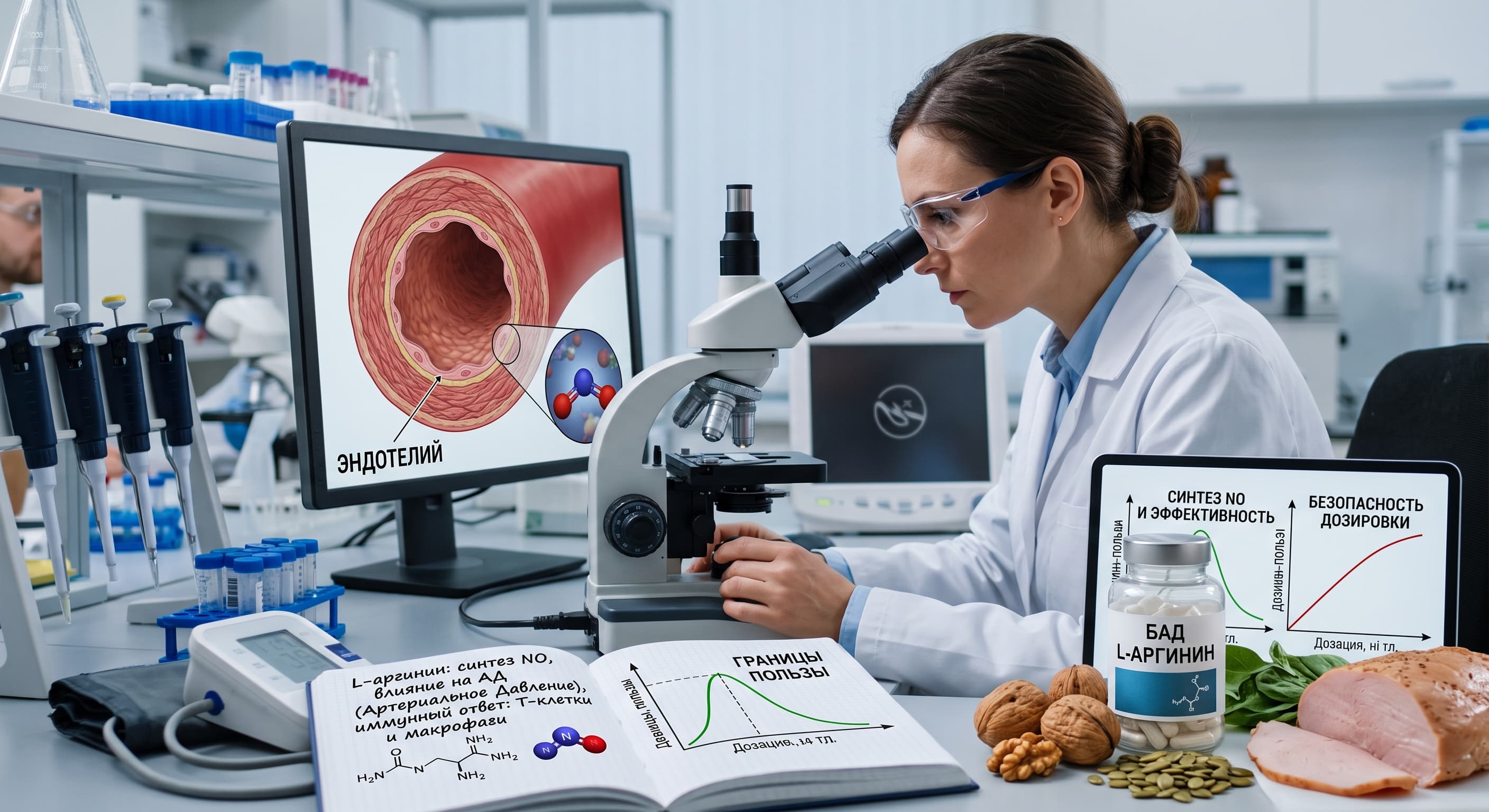
L-Arginine in the Human Body: Nitric Oxide, Endothelium, Blood Pressure, Immunity, and the Limits of Supplementation
L-arginine occupies an unusual position among amino acids. The body uses it for protein synthesis, but its role goes far beyond that: the same molecule can serve as a precursor for nitric oxide, ornithine, polyamines, proline, creatine, and components of the urea cycle. Through these pathways, arginine becomes simultaneously linked to vascular tone, nitrogen metabolism, immune function, cell growth, and tissue repair.
Chemically, arginine belongs to the basic amino acids. Its guanidinium side chain has a pKa of about 12.5 and therefore remains positively charged at physiological pH. This allows arginine residues to participate in electrostatic interactions within proteins, bind negatively charged molecules, and contribute to the active sites of numerous enzymes.
In nutrition, arginine is usually described as a conditionally essential amino acid. In healthy adults, the body can synthesize a substantial proportion of what it needs, and under ordinary dietary conditions there is no requirement to obtain a precisely defined amount of arginine from supplements. A typical diet itself provides roughly 4–5 g of arginine per day, while additional amounts are produced endogenously.
However, the phrase “conditionally essential” has an important second half. During growth, major trauma, burns, extensive surgery, and some other catabolic states, arginine utilization and demand may increase faster than the body can maintain normal metabolic balance. This is the reason arginine has attracted interest not only as a dietary amino acid but also as a potential pharmaconutrient.
Yet this is also where the main problem begins. The biochemical importance of arginine is unquestionable. The clinical benefit of taking extra arginine is far less universal.
From the Intestine to the Kidneys: How the Body Produces Arginine
Endogenous arginine synthesis in adults is closely tied to the so-called intestinal-renal axis.
Cells of the intestine use mainly glutamine, glutamate, and proline to produce ornithine and then citrulline. A substantial portion of this citrulline leaves the gut and enters the systemic circulation. Unlike many other amino acids, citrulline undergoes relatively little hepatic uptake during its first pass.
A large proportion of circulating citrulline then reaches the kidneys. In proximal tubular cells, argininosuccinate synthetase and argininosuccinate lyase sequentially convert it into arginine. This pathway provides a meaningful fraction of newly synthesized endogenous arginine in adults. Stable-isotope studies also show that proline can indeed serve as one of the dietary precursors of newly synthesized arginine.
This system helps explain why citrulline has become a separate focus of sports and clinical nutrition. If arginine itself is taken orally, a significant portion is metabolized in the intestine and splanchnic tissues. Citrulline crosses this barrier differently and is converted into arginine only after entering the systemic circulation.
But this does not mean citrulline is automatically a “better version of arginine” for every clinical purpose. It is primarily a pharmacokinetic difference.
Four Major Pathways That Compete for Arginine
Arginine metabolism is best understood as a crossroads of several competing pathways.
The first and best known is nitric oxide synthesis. Enzymes of the nitric oxide synthase family—NOS—convert L-arginine into citrulline and nitric oxide. This reaction requires molecular oxygen, NADPH, tetrahydrobiopterin BH4, FAD, FMN, and other elements of the enzyme system. There are three principal NOS isoforms: neuronal NOS1, inducible NOS2, and endothelial NOS3. They use the same substrate but operate in different tissues and physiological settings.
The second pathway involves arginase. Arginase breaks arginine down into ornithine and urea. Hepatic arginase I is a key component of the urea cycle, which converts toxic nitrogen into urea for renal excretion. Arginase II is more widely distributed outside the liver and participates in the local regulation of arginine availability for other pathways.
Ornithine, in turn, becomes the precursor for polyamines—putrescine, spermidine, and spermine. These compounds participate in nucleic acid stabilization, regulation of translation, cell proliferation, and differentiation. Through ornithine, arginine is also linked to proline synthesis, and proline is one of the amino acid building blocks of collagen.
The third major direction is creatine synthesis. Arginine-glycine amidinotransferase transfers an amidino group from arginine to glycine, generating guanidinoacetate. After methylation, this is converted into creatine, and the creatine-phosphocreatine system functions as a rapid ATP-buffering mechanism in skeletal muscle, the brain, and other tissues with fluctuating energy demands.
Thus, ingested arginine does not automatically flow “into nitric oxide.” Several pathways compete for it, and its metabolic fate depends on tissue type, enzyme expression, hormonal state, inflammation, and the availability of other substrates.
This is one reason why the formula “more arginine = more NO = better circulation” is overly simplistic.
Nitric Oxide and the Endothelium: Where Vascular Physiology Begins
In healthy vascular endothelium, eNOS continuously produces small amounts of nitric oxide. NO rapidly diffuses into the underlying vascular smooth muscle cells and activates soluble guanylate cyclase. Cyclic GMP levels rise, protein kinase G is activated, contractile activity decreases, and the vessel relaxes.
This is one of the key mechanisms controlling vascular tone.
But the role of NO extends far beyond vasodilation. Normal endothelial NO signaling contributes to limiting platelet activation, leukocyte adhesion to the vessel wall, smooth muscle cell proliferation, and other processes involved in vascular homeostasis.
In diabetes, hypertension, smoking, dyslipidemia, aging, and chronic vascular inflammation, NO bioavailability is often reduced. This is why endothelial dysfunction became one of the main areas of arginine research.
That raises an obvious question: if arginine is the substrate for eNOS, why not simply provide more of it?
The answer turned out to be more complicated than expected.
The “Arginine Paradox”: Why Extra Substrate Can Sometimes Work Even When the Enzyme Should Already Be Saturated
The so-called L-arginine paradox has been known for decades.
Intracellular arginine concentrations are usually much higher than the Km of eNOS. From the standpoint of simple enzyme kinetics, this means the enzyme should already be nearly saturated with substrate, and adding more arginine should not meaningfully increase nitric oxide production.
Yet some experimental and clinical studies have shown that supplemental arginine can improve endothelium-dependent vasodilation.
Several mechanisms have been proposed to explain this.
One involves ADMA— asymmetric dimethylarginine, an endogenous competitive inhibitor of NOS. When ADMA concentrations rise, the functionally available arginine for NOS may decline even when total intracellular arginine appears high.
Arginase activity also matters because it competes with NOS for the same substrate. In addition, arginine is not distributed uniformly inside the cell. Local metabolic pools, membrane transporters, and protein complexes mean that the total intracellular concentration does not necessarily reflect how much substrate is available to a particular eNOS molecule at a given moment.
However, another important correction is needed. A low arginine-to-ADMA ratio can contribute to impaired eNOS function, but eNOS uncoupling cannot be reduced solely to arginine deficiency or excess ADMA. Oxidation or deficiency of BH4 is one of the major mechanisms; eNOS S-glutathionylation and broader oxidative stress also matter. When eNOS becomes uncoupled, the enzyme shifts away from normal NO production and increasingly reduces oxygen to superoxide.
Therefore, the statement that supplemental arginine simply “restores eNOS and stops superoxide production” in anyone with metabolic syndrome would be too strong. In some settings, extra substrate may improve availability. But if the dominant problem is oxidized BH4 or severe redox imbalance, simply increasing arginine may not correct the system.
Does Arginine Improve Endothelial Function in Humans?
This is where fundamental biochemistry meets inconsistent clinical evidence.
An early meta-analysis of randomized trials suggested that short courses of L-arginine could improve flow-mediated dilation—FMD—by about 2 percentage points, with the effect seen mainly in people whose endothelial function was impaired at baseline. When baseline FMD was already relatively high, there was little or no clear benefit.
A later systematic review in patients with cardiovascular and metabolic disorders was much less convincing: the main analysis found no significant improvement in selected measures of endothelial function, nitric oxide metabolites, or ADMA, and results varied substantially across individual studies.
Another meta-analysis reported a small mean increase in FMD of roughly 0.5 percentage points with doses ranging from 3 to 21 g of arginine per day, but the heterogeneity between trials was very high.
Taken together, the evidence supports neither “arginine does not work” nor “arginine restores the endothelium.” A more accurate conclusion is that supplemental L-arginine can improve endothelial function in some people, especially when dysfunction is already present, but the effect is inconsistent and highly dependent on clinical context.
And most importantly, improvement in FMD is an intermediate vascular marker. It is not equivalent to a proven reduction in myocardial infarction or stroke risk.
Blood Pressure: There Is an Effect, but It Should Not Be Turned Into a Treatment Protocol
The evidence on blood pressure is somewhat more convincing.
In a systematic review and dose-response meta-analysis of 22 randomized trials, oral L-arginine was associated with an average reduction in systolic blood pressure of about 6.4 mmHg and diastolic pressure of about 2.6 mmHg. The authors observed a reduction in systolic pressure beginning at doses of roughly 4 g per day. Interestingly, doses above 9 g per day did not produce additional significant blood-pressure lowering.
This is clinically interesting, but it needs to be interpreted correctly.
The included studies were generally small, populations varied considerably, and many trials were relatively short. A meta-analysis can answer whether average blood pressure changes during an intervention. It does not show that arginine can replace standard antihypertensive treatment, nor does it prove fewer strokes, heart attacks, cases of heart failure, or deaths.
The blood-pressure-lowering effect itself also creates a potential interaction with medication. If someone is already taking antihypertensive drugs, additional vasodilation may be undesirable.
A reasonable formulation is therefore: L-arginine has a measurable hypotensive effect in a number of short-term studies, but it is not a standard first-line treatment for arterial hypertension.
For people with high blood pressure, the evidence base for lifestyle interventions and approved antihypertensive medications is substantially stronger.
Why Lower Blood Pressure Does Not Automatically Mean Protection From Heart Attack
The history of arginine is a particularly good example of how dangerous it can be to extrapolate improvement in a physiological marker to clinical outcomes.
In 2006, the VINTAGE MI trial evaluated L-arginine in patients after acute myocardial infarction. Participants received 3 g three times daily—a total of 9 g per day—in addition to standard therapy.
The expectation was that increasing NO availability would improve vascular properties and cardiac function.
It did not.
Over six months, the study found no significant improvement in ejection fraction or measured vascular stiffness. Meanwhile, six participants in the arginine group died—8.6%—compared with none in the placebo group. Recruitment was stopped early because of this difference. The authors concluded that L-arginine should not be recommended after acute myocardial infarction.
It is important not to interpret this result more broadly than the data allow. VINTAGE MI does not prove that arginine is dangerous for everyone with cardiovascular disease. But it did undermine the idea that “more substrate for NO must be beneficial for the injured heart.”
The exact mechanism behind the mortality signal was never definitively established. Hypotheses involving excessive NO signaling, oxidative stress, and peroxynitrite generation in injured myocardium are biologically plausible, but they should not be presented as proven explanations for the deaths observed in the trial.
The practical conclusion is much simpler: high-dose L-arginine after a recent myocardial infarction is a poor idea, and modern clinical references continue to warn specifically about this situation.
The Immune System Really Does Depend on Arginine, but That Does Not Make It a Universal “Immune Booster”
In immunology, arginine is viewed not merely as protein building material but as part of the metabolic regulation of immune responses.
The dependence of T lymphocytes on extracellular arginine availability is particularly well studied. When arginine becomes severely depleted, cell proliferation is impaired, expression of components of the T-cell receptor complex—including the CD3ζ chain—changes, and full T-cell activation is suppressed.
This mechanism is especially evident in the tumor microenvironment. Myeloid-derived suppressor cells—MDSCs—can express large amounts of arginase-1 and thereby reduce local arginine concentrations around T cells. This is one of several mechanisms through which tumors suppress antitumor immunity. Modern reviews of MDSC metabolism continue to describe arginine depletion as an important pathway of immunosuppression.
But the following popular conclusion does not logically follow: “If T cells need arginine, then extra arginine boosts immunity.”
Physiology is not that linear.
In a well-nourished person, systemic arginine availability is usually not the primary limiting factor for T-cell responses. Moreover, during inflammation, different immune cells can compete for arginine and direct it into very different metabolic pathways.
So the statement “arginine is necessary for immunity” is correct. The statement “arginine supplements enhance immunity in healthy people” requires separate clinical proof—and no universal proof exists.
M1, M2, and Why Macrophages Are More Complicated Than a Neat Diagram
One of the most familiar examples of arginine metabolism involves macrophages.
In the classical teaching model, pro-inflammatory M1-like macrophages preferentially use inducible nitric oxide synthase—NOS2—and direct arginine toward NO production. This can contribute to antimicrobial activity.
By contrast, M2-like macrophages are associated with higher arginase activity, formation of ornithine, polyamines, and metabolites involved in tissue repair.
This model is useful for understanding the general logic.
But modern immunology considers the rigid M1/M2 split an oversimplification. Real macrophages, especially in human tissues, exist across a spectrum of states. They may simultaneously use several metabolic programs, and the expression of NOS2 and arginases depends on tissue type, local signaling, species, and the stage of inflammation.
Therefore, the idea that extra arginine simply “switches on M2 macrophages, raises proline, and builds proper collagen” is too mechanistic.
Arginine is indeed part of reparative metabolism. But wound healing depends at the same time on blood flow, energy and protein intake, infection control, tissue off-loading, glucose control, vitamin C, zinc, local inflammatory responses, and many other factors.
Arginine and Wound Healing: Where the Evidence Is Promising and Where Uncertainty Remains
From a mechanistic standpoint, arginine use in wound healing makes sense. Through ornithine and proline it is linked to collagen metabolism; through polyamines it is linked to cell proliferation; through NO it participates in vascular and immune responses.
Some clinical trials of specialized nutritional formulas have indeed shown faster reductions in pressure-ulcer area. For example, in malnourished patients, a formula enriched with arginine, zinc, and antioxidants produced a greater reduction in ulcer area over eight weeks than control nutrition.
But there is a fundamental methodological problem: these products contain more than arginine alone. Patients also receive protein, additional calories, zinc, antioxidants, and other nutrients. Therefore, the entire benefit cannot confidently be attributed to arginine.
This becomes clear in more rigorous systematic reviews. A 2024 Cochrane review rated the evidence for many nutritional interventions in pressure ulcers as uncertain or of very low certainty, including studies using different arginine-containing formulas.
A 2026 review of randomized trials also found generally promising results for specialized high-protein formulas containing arginine, zinc, antioxidants, and other nutrients, but noted small sample sizes, heterogeneous interventions, and limitations in study quality.
The most accurate conclusion lies in the middle: arginine-containing nutritional support may help selected patients with impaired wound healing, particularly when malnutrition is present, but arginine alone is not a proven universal treatment for all wounds.
Surgery: Why “Arginine-Containing Immunonutrition” and “Taking Arginine” Are Not the Same Thing
This distinction is especially clear in the updated 2025 ESPEN guideline on clinical nutrition in surgery.
The expert group explicitly stated that there is currently insufficient evidence to recommend for or against intravenous or enteral arginine as a single substance.
At the same time, ESPEN recommends considering specialized immunonutrition containing arginine together with omega-3 fatty acids and nucleotides in selected patients, particularly those undergoing major oncologic surgery. In gastrointestinal cancer surgery, such formulas may be given for approximately five to seven days before surgery as part of medical nutrition.
This is an important example of proper interpretation.
If a clinical benefit was demonstrated with a specialized multi-nutrient formula, it cannot automatically be converted into the recommendation “take 6 g of pure arginine.”
A component of a formula and the formula itself are not the same intervention.
Critical Illness and Sepsis: “Conditionally Essential” Does Not Mean “Give More”
One of the most controversial areas of arginine use is critical illness.
During sepsis and severe systemic inflammation, plasma arginine levels can fall. Protein catabolism increases, citrulline production changes, and arginase and NOS pathways are altered. From a metabolic perspective, this can resemble a state of relative arginine deficiency.
That led to a simple hypothesis: if arginine becomes low, it should be replaced.
But sepsis is far more complicated. Inducible NOS can also become highly activated, and nitric oxide has mixed effects on microcirculation, host defense, and hemodynamics. Providing more substrate could theoretically produce either beneficial or harmful effects.
Historically, this is why arginine-containing immunonutrition in severe sepsis became so controversial: human data were sparse, results were inconsistent, and extrapolation from experimental models led to opposing conclusions.
By 2026, the picture still had not become simple. A new systematic review and meta-analysis of 23 studies involving 2,311 critically ill patients found no reduction in infection rates with arginine-enriched enteral nutrition: the pooled relative risk was 0.98 with a 95% confidence interval of 0.63–1.54. No significant improvement in other major outcomes was found either; the certainty of evidence was mostly low and studies were highly heterogeneous. The authors also emphasized that the trials evaluated arginine-containing formulas rather than pure arginine monotherapy.
Therefore, severe sepsis should not be placed on a consumer-style list of “indications for arginine.”
This is an area of specialized clinical nutrition, not self-directed supplementation.
What Happens to Arginine After Oral Intake
The oral pharmacokinetics of arginine are also more complex than the popular statement that “half of it is destroyed by intestinal arginase, so bioavailability is 30%.”
Splanchnic extraction is indeed substantial. In isotope studies, roughly one-third of dietary arginine could be extracted by splanchnic tissues during first-pass metabolism.
However, the exact absolute bioavailability depends on dose and study design. In one small experiment, bioavailability after 6 g of oral arginine averaged about 68%, while in another study after a single 10 g dose it was estimated at roughly 20%.
There is therefore no universal “30–40%” figure.
The differences cannot be explained by intestinal arginase alone. Dose, intestinal and hepatic extraction, membrane transport, metabolic rate, meal composition, and pharmacokinetic methodology all influence the result.
This is an important practical point: the bioavailability of an amino acid cannot be reduced to one fixed number independent of dose and conditions.
Why Citrulline Often Raises Plasma Arginine More Effectively
L-citrulline is not a substrate for arginase in the same way as arginine and undergoes much less presystemic hepatic metabolism. After absorption, it circulates in the blood and is then converted predominantly in the kidneys into arginine.
For this reason, pharmacokinetic studies often show that oral citrulline increases systemic arginine availability more efficiently than comparable strategies using arginine itself.
But the statement that “citrulline has nearly 100% bioavailability” is too confident. Its pharmacokinetic profile is indeed favorable, but absolute bioavailability and conversion efficiency depend on dose, health status, and the specific experimental model.
A more accurate statement is: citrulline avoids presystemic metabolism more effectively and often raises plasma arginine concentrations more efficiently.
That makes it interesting for studies of NO metabolism and exercise physiology, but it does not automatically mean superior clinical outcomes in hypertension, vascular disease, or wound healing.
Why Large Single Doses Cause Gastrointestinal Problems
The main limitation of oral arginine is well known: as the dose rises, so does the likelihood of nausea, abdominal discomfort, bloating, and diarrhea.
The NIH notes that doses up to approximately 9 g per day were generally well tolerated in short-term studies, while gastrointestinal adverse effects were more frequent at 9–30 g per day. Long-term safety at high doses is much less well established.
However, the rigid rule “never take more than 3 g at once or the transporter becomes saturated and osmotic diarrhea begins” is not supported as a universal physiological threshold.
Tolerance varies widely, and gastrointestinal reactions depend on total dose, formulation, solution concentration, food intake, and individual sensitivity.
A fixed 3 g cutoff should therefore not be presented as a biological law.
Herpes and Arginine: A Popular Warning With a Weaker Evidence Base Than It Appears
The relationship between arginine and herpes simplex virus is often described very categorically: HSV supposedly “feeds on arginine,” so several grams of arginine can trigger recurrence, while lysine blocks the process.
This idea does have an experimental basis. Arginine metabolism is important for viral biology and the infected host cell, and early lysine studies prompted investigation of the lysine-to-arginine balance in recurrent herpes.
But human evidence turned out to be far less consistent.
Randomized trials of lysine have produced conflicting findings. One controlled trial of 1,000 mg of lysine per day found no overall reduction in recurrence frequency, although some individuals may have benefited. Later reviews concluded that the evidence supporting lysine for herpes prevention remains insufficient.
Even more interestingly, in one cell-culture model, high concentrations of arginine actually suppressed HSV-1 replication, illustrating that the simple formula “more arginine = faster virus” does not capture the real biology.
Some modern clinical references still advise caution with L-arginine in people with recurrent oral or genital herpes.
But the claim that “doses above 3–5 g reliably trigger HSV recurrence” is much stronger than the available evidence.
A more defensible position is: people with frequent herpes recurrences may reasonably be cautious, but no well-established arginine dose threshold is known to trigger HSV reactivation.
Drug Interactions: Where Caution Is Actually Justified
Because arginine can influence vascular tone, the most obvious interactions are with other agents that lower blood pressure.
Combining arginine with antihypertensive drugs may potentially enhance hypotensive effects. Similar caution is reasonable with nitrates and PDE5 inhibitors such as sildenafil, since clinical references list these combinations as potentially capable of lowering blood pressure too much.
But the phrase “arginine is a nitric oxide donor and together with sildenafil causes uncontrolled cGMP accumulation and vascular collapse” is unnecessarily dramatic.
Arginine is a substrate for NOS, not a pharmacological NO donor in the same sense as nitroglycerin. Nitric oxide production remains enzymatically regulated. The concern is additive vasodilation and possible symptomatic hypotension, not guaranteed “uncontrolled” cGMP accumulation.
Additional caution is warranted in kidney disease and when combining arginine with medications that influence potassium. Modern clinical references specifically note a potential risk of hyperkalemia when L-arginine is used together with potassium-sparing diuretics such as spironolactone, amiloride, or triamterene.
For this reason, chronic kidney disease, complex antihypertensive therapy, or multiple vasoactive medications are poor contexts for unsupervised experimentation with high-dose arginine.
How Safe Is Arginine Overall?
Oral L-arginine generally has a reasonably favorable short-term safety profile.
The most common adverse effects are nausea, abdominal discomfort or pain, bloating, and diarrhea. Some people may also experience lower blood pressure. The NIH notes that doses up to roughly 9 g per day were generally well tolerated in studies lasting from several days to several weeks, but emphasizes that long-term safety at higher doses is less well characterized.
There are experiments in which much larger quantities were used. But the fact that a research group could administer 15–30 g of arginine to a carefully selected population under controlled conditions does not mean those doses are optimal or appropriate for long-term self-use.
This distinction matters: the highest studied or tolerated dose is not the same as a beneficial dose.
Should a Healthy Person Take Arginine “for Blood Vessels”?
For most healthy people, there is no strong reason to do so.
The body obtains arginine from dietary protein and also synthesizes it internally. If endothelial function is normal, eNOS has sufficient substrate, and the person is not in a specific catabolic state, supplemental arginine does not have to increase NO production.
This is also evident in sports nutrition. Despite the appealing chain “arginine → NO → blood flow → more oxygen and nutrients to muscle,” clinical trials in healthy and trained people generally do not show consistent improvements in strength, endurance, or recovery. The NIH considers the evidence for arginine as an ergogenic supplement limited and inconsistent.
Once again, the basic physiology is completely correct: arginine is required for nitric oxide synthesis.
But this does not mean an extra dose of arginine will increase NO to a beneficial level in someone whose substrate supply is already adequate.
Can 4–6 g Be Considered a Universal “Therapeutic Dose”?
No.
Trials have used very different amounts—from a few grams to more than 20 g per day—and the clinical goals, baseline characteristics of participants, and duration of treatment have varied considerably.
For blood pressure, the meta-analysis did observe an effect beginning at about 4 g per day and no additional benefit above 9 g. But this is a statistical finding from pooled trials, not a ready-made rule that “every hypertensive patient should take 4–6 g.”
Wound-healing studies used other doses and often multi-nutrient formulas. Surgical immunonutrition uses specialized medical products. After myocardial infarction, 9 g per day produced a concerning safety signal. In sports research, even much higher doses often fail to produce the expected benefit.
There is therefore no single universal therapeutic dose of arginine that can be mechanically transferred between vascular disease, wound healing, sports, and immune support.
What Makes Practical Sense
L-arginine has very real biological functions. It is a substrate for nitric oxide synthesis, participates in the urea cycle and creatine production, provides metabolic material for polyamines and proline, and plays an important role in immune cell metabolism.
There are also clinical signals of benefit. Oral arginine can modestly reduce blood pressure. In some people with endothelial dysfunction, it may improve FMD. Arginine-containing medical nutrition formulas are used in selected surgical populations, and specialized nutrition may help some malnourished patients with pressure ulcers.
But almost every one of these statements has an important limitation.
Lower blood pressure does not make arginine a standard antihypertensive drug. Better FMD does not prove prevention of myocardial infarction. The result of a multi-nutrient immunonutrition formula cannot be attributed to arginine alone. T-cell biology does not prove that supplements “boost immunity” in healthy people. And the phrase “conditionally essential amino acid during critical illness” does not mean it should be self-administered in sepsis.
The VINTAGE MI trial provides a particularly important lesson: a biologically attractive theory can not only fail in the clinic but also produce an unexpected safety signal.
That is why discussions of arginine should continually distinguish four levels: biochemical necessity, changes in laboratory or physiological markers, improvement in clinical symptoms, and effects on outcomes that truly matter—myocardial infarction, stroke, wound healing, complications, or mortality.
These levels are not interchangeable.
L-arginine is a fundamentally important conditionally essential amino acid that connects nitrogen metabolism with nitric oxide, creatine, polyamines, and components of the extracellular matrix. Supplemental intake can influence vascular tone and certain intermediate markers, but clinical benefit depends heavily on the person’s baseline condition. The most defensible position today is not universal supplementation “for circulation” or “for immunity,” but targeted use only where the specific clinical goal and patient population have actually been studied.
This material is for educational purposes only and does not replace medical diagnosis, treatment, or individualized medical advice.