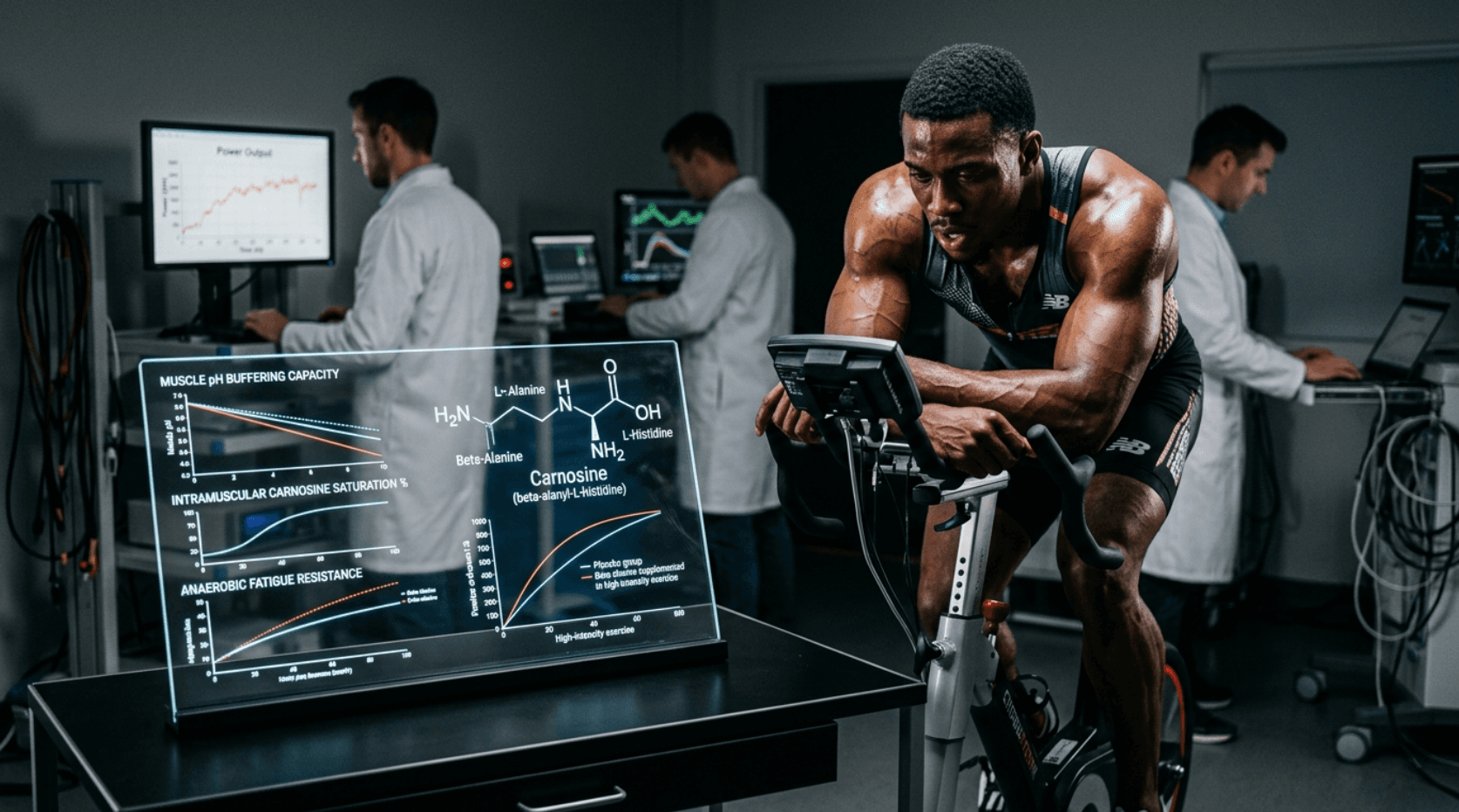
Beta-Alanine in the Body: Carnosine, Muscle Buffering, Fatigue, and Athletic Performance
Beta-alanine belongs to a relatively small group of sports supplements for which there is simultaneously a clear biochemical mechanism, a measurable change directly within muscle tissue, and an ergogenic effect confirmed in controlled studies. Its action is not related to stimulation of the central nervous system, a rapid increase in ATP synthesis, or a direct increase in muscle strength. Beta-alanine works much more slowly: it increases the concentration of carnosine in skeletal muscle, and carnosine then influences the intracellular environment of the working muscle fiber.
This is precisely why beta-alanine is so easy to misunderstand. Skin tingling can appear almost immediately after ingestion, whereas the athletic effect develops over weeks. The supplement is often included in pre-workout formulas even though taking it immediately before exercise is not necessary. Carnosine does participate in proton buffering, but muscle fatigue cannot be reduced to “acidification” alone. Finally, beta-alanine really can help in certain types of exercise, but the average effect is far more modest than popular claims of a 10–20% improvement in performance.
Beta-alanine is therefore most interesting as an example of how important context is. It works well not because it is a universal enhancer of physical performance, but because it targets a relatively specific physiological limitation — maintaining intramuscular homeostasis during high-intensity work.
What Beta-Alanine Is and Why the Body Does Not Use It to Build Proteins
Beta-alanine, or 3-aminopropanoic acid, is an endogenous non-proteinogenic amino acid. In ordinary α-amino acids, which are used to build human proteins, the amino group is attached to the α-carbon atom immediately adjacent to the carboxyl group. In beta-alanine, it is located on the next carbon atom, the β-carbon.
This small chemical difference has major biological consequences. Beta-alanine is not part of the standard genetic code and is not incorporated by ribosomes into growing protein chains. The body does not use it as a structural component of muscle protein in the way it uses leucine, valine, or other proteinogenic amino acids.
The main reason beta-alanine is of interest lies elsewhere: together with L-histidine, it forms the dipeptide carnosine — β-alanyl-L-histidine.
The reaction is catalyzed by the ATP-dependent enzyme carnosine synthase, encoded by the CARNS1 gene. Histidine is usually present in muscle cells in sufficient amounts, whereas the concentration of free beta-alanine is relatively low. For this reason, beta-alanine availability under normal conditions is considered the main limiting factor in muscle carnosine synthesis. Supplementation can overcome this limitation and substantially increase intramuscular carnosine concentrations.
This is the central mechanism of the supplement. Beta-alanine itself does not need to be present in the blood during exercise. Its role is to increase the muscle’s carnosine reserve in advance.
Where the Body Gets Beta-Alanine
Some beta-alanine is synthesized endogenously. One pathway is associated with pyrimidine degradation, especially the breakdown of uracil. It can also be generated through other metabolic pathways, including polyamine metabolism.
Humans also obtain beta-alanine from food — mainly not in free form, but as part of histidine-containing dipeptides such as carnosine and anserine. The main dietary sources are therefore meat, poultry, and certain types of fish.
During digestion, these compounds provide beta-alanine, which can then be reused for carnosine synthesis in tissues. Plant foods contain essentially no meaningful amount of carnosine, so dietary pattern does influence the muscle carnosine pool.
However, the claim that “vegans have 40–50% less carnosine” is too categorical.
In a large study of 149 healthy individuals, carnosine content in the calf muscle of vegetarians was approximately 26% lower than in omnivores. Other studies and physiological reviews also confirm lower values in people who do not consume meat, but the magnitude of the difference depends on the muscle studied, sex, age, and measurement method.
At the same time, switching to a vegetarian diet does not necessarily cause a rapid fall in muscle carnosine. In a six-month experiment in women, no pronounced reduction was found. The muscle carnosine pool is relatively inert and changes slowly.
Thus, people who avoid meat may have lower average muscle carnosine concentrations, but it would be incorrect to turn this into a diagnosis of “beta-alanine deficiency.” There is no established RDA for beta-alanine and no recognized classical dietary deficiency syndrome.
Why So Much Carnosine Is Found in Muscle
Carnosine is present in several human tissues, including skeletal muscle and the nervous system, but it reaches particularly high concentrations in muscle. Typical values in human skeletal muscle are measured in millimoles — a substantial intracellular pool for a compound that is not a primary energy substrate.
Its distribution is also not random.
Fast-twitch type II fibers generally contain more carnosine than slow oxidative type I fibers. Particularly high levels are found in sprinters and athletes whose disciplines regularly require very high-intensity muscular work.
From a physiological perspective, this makes sense. Fast fibers are able to generate greater power, consume ATP rapidly, and create conditions in which intracellular acid-base balance changes especially quickly.
But carnosine is not merely an “anti-acid sponge.” Several potentially important functions have been described for it: H⁺ buffering, modulation of contractile protein sensitivity to calcium, participation in excitation-contraction regulation, interaction with reactive oxygen and carbonyl compounds, and anti-glycation properties.
Which of these functions contributes most to the ergogenic effect of beta-alanine has not been definitively established. The buffering hypothesis remains the principal and best-supported explanation, but modern carnosine physiology goes beyond the simple formula of “less acid, less fatigue.”
Why the “Lactic Acid” Explanation Is Outdated
One of the most persistent misconceptions in exercise physiology needs to be corrected here.
During intense muscular work, several processes occur at the same time: ATP turnover increases sharply, glycolysis accelerates, lactate concentration rises, H⁺ concentration changes, inorganic phosphate accumulates, and intracellular and extracellular ion distributions shift.
But lactate itself is not the substance that “acidifies the muscle.”
Modern biochemical models show that lactate formation and proton generation cannot be treated as a single reaction in which “lactic acid → lactate + H⁺” directly causes muscle acidosis. During high-intensity activity, much of the increase in free protons is associated with rapid ATP turnover when the rate of ATP hydrolysis exceeds the capacity of oxidative metabolism to handle the associated acid equivalents. Lactate formation itself can actually consume H⁺.
This does not mean that a fall in intramuscular pH is irrelevant.
During very intense exercise, the pH of active muscle fibers can indeed fall from approximately 7.0–7.1 toward 6.5 or even lower in the most heavily recruited fast fibers. A 2025 review shows that severe acidosis can reduce maximal force, contraction velocity, and power, alter myofilament sensitivity to calcium, and contribute to fatigue together with other metabolites.
The key word is “contribute,” not “fully determine.”
Muscle Fatigue Is Much More Complex Than a Single pH Value
Trying to identify one single “culprit” behind muscular failure is convenient for marketing but poorly reflects physiology.
During high-intensity exercise, concentrations of inorganic phosphate, ADP, H⁺, K⁺, and other ions change simultaneously. Substrate availability, calcium handling by the sarcoplasmic reticulum, membrane excitability, and contractile protein function are also altered. During longer efforts, glycogen depletion, central fatigue mechanisms, thermoregulation, and cardiovascular limitations become increasingly important.
Experimental studies show that acidosis can impair contractile function, but it does not explain the entire fatigue process. In particular, impaired Ca²⁺ release from the sarcoplasmic reticulum and accumulation of inorganic phosphate may be at least as important.
Thus, saying that “the true cause of muscle failure is hydrogen ions” is just as oversimplified as the older claim that lactate is to blame.
A more accurate modern formulation is:
under certain high-intensity exercise conditions, a pronounced fall in intramuscular pH is one factor limiting contractile capacity, so increasing intracellular buffering capacity may improve performance.
This is precisely the physiological niche in which carnosine operates.
Why Carnosine Is Well Suited to Act as an Intramuscular Buffer
The buffering capacity of carnosine is determined by the imidazole ring of its histidine residue.
The pKa of carnosine is approximately 6.83, placing it directly within the pH range through which muscle cells pass during intense contraction. This allows the same molecule to accept or release a proton during physiologically meaningful changes in acidity.
In this sense, carnosine is very well “tuned” to the working muscle.
The higher its intracellular concentration, the more H⁺ the muscle can temporarily buffer before changes in pH become large enough to meaningfully affect contractile and metabolic processes.
Even here, however, it is important not to overstate the mechanism. Carnosine is only one part of the muscle buffering system. Phosphate compounds, proteins, and the transport of protons and lactate across the cell membrane all contribute to acid-base regulation, while the blood has its own buffering systems, including bicarbonate.
Beta-alanine does not create an entirely new protective system. It increases the capacity of an existing intracellular system by raising the muscle carnosine pool.
Carnosine May Affect Contraction Through More Than pH Alone
One particularly interesting finding is that carnosine may directly modify the function of the contractile apparatus.
In experiments using human muscle fibers, physiologically achievable concentrations of carnosine increased the sensitivity of contractile proteins to Ca²⁺. This means that at the same calcium concentration, the muscle fiber may potentially preserve somewhat greater contractile capacity.
There are also data suggesting possible effects of carnosine on Ca²⁺ handling between the cytoplasm and the sarcoplasmic reticulum.
In addition, experimental systems show that carnosine interacts with reactive oxygen and carbonyl compounds and can bind certain products of oxidative stress. These properties are biochemically reproducible, although their quantitative importance for human athletic performance remains considerably less certain than the role of beta-alanine in increasing muscle carnosine itself.
For this reason, describing beta-alanine solely as an “acid buffer” is now somewhat outdated. But turning carnosine into a universal intracellular antioxidant and anti-aging agent would also be premature.
How Much Does Beta-Alanine Increase Muscle Carnosine?
Here the effect is considerably more reliable than many other claims made for sports supplements.
In the classic study by Harris and colleagues, 3.2 g of beta-alanine per day for four weeks increased muscle carnosine by approximately 42%, while 6.4 g/day increased it by around 64%. Longer use can produce an even greater rise.
This is not an isolated finding.
A 2020 systematic analysis demonstrated a large and consistent effect of beta-alanine on muscle carnosine content. Nearly all participants for whom individual data were available showed an increase. Moreover, modern models suggest that the common protocol of four weeks at 6.4 g/day probably does not fully saturate muscle carnosine stores.
This is an important difference compared with some other supplements.
For beta-alanine, it is difficult to draw a single clear line such as “take it for six weeks and the muscle is fully saturated.” The increase in carnosine depends on cumulative dose, and accumulation may continue for many weeks.
That is why the rigid formula “you need exactly 120–180 g in total and then saturation occurs” is not sufficiently accurate.
A cumulative intake of 130–180 g corresponds to many classic experiments and can already produce a substantial increase in carnosine, but it does not represent the maximal storage capacity of the muscle. In the 2020 modeling study, the estimated cumulative dose required to reach half of the theoretical maximal response was much higher — around 377 g — although such mathematical estimates should not be turned into mandatory practical targets.
Why Beta-Alanine Needs to Be Taken for Weeks
This leads to one of the most important practical conclusions.
Beta-alanine is not an acute pre-workout stimulant.
A serving consumed 30 minutes before exercise may cause pronounced skin tingling, but it will not meaningfully increase muscle carnosine before that workout begins.
Carnosine is synthesized gradually. For this reason, the ISSN recommends approximately 4–6 g of beta-alanine daily for at least 2–4 weeks to produce a meaningful increase in muscle carnosine and a potential performance effect, while longer loading periods allow further accumulation.
The Australian Institute of Sport classifies beta-alanine as a Group A supplement — meaning it has strong scientific support for specific sports situations. One practical AIS protocol is 1.6 g four times per day with meals, for a total of 6.4 g/day.
What matters is consistent daily intake, not the exact minute relative to training.
A dose can be taken in the morning, afternoon, and evening. The workout can occur several hours after the last serving. Beta-alanine can also be taken on rest days.
As long as regular cumulative loading is maintained, the physiological logic of the protocol remains the same.
Does It Make Sense to Take Beta-Alanine With Food?
Some evidence suggests that it may.
In a study by Stegen and colleagues, beta-alanine taken with meals produced a greater increase in carnosine in the soleus muscle than beta-alanine taken between meals. The authors proposed a possible role of insulin in beta-alanine uptake or subsequent carnosine synthesis.
But it would be easy to take the next step too far and claim that beta-alanine is poorly absorbed without carbohydrate and protein.
That is not correct.
In the same study, whole-body retention of slow-release beta-alanine was approximately 97–98% and was essentially independent of simultaneous macronutrient intake. The difference appears to relate more to the efficiency of long-term loading in certain muscles than to simple “absorption versus no absorption.”
Taking beta-alanine with food is therefore reasonable — and convenient for splitting the dose — but elaborate protocols designed to create mandatory insulin spikes are unnecessary.
Which Types of Exercise Benefit Most From Beta-Alanine?
Beta-alanine has a relatively specific ergogenic profile.
If an effort lasts only a few seconds, the muscle relies heavily on existing ATP and the phosphocreatine system. Significant acid-base disturbance may simply not have enough time to develop.
At the other extreme, if exercise lasts a very long time and is performed well below maximal intensity, the relative importance of intramuscular buffering also decreases.
The greatest effect would therefore be expected somewhere between these extremes.
This is largely what the studies show.
A 2012 meta-analysis found the most pronounced effect for exercise lasting 60–240 seconds, whereas tests shorter than 60 seconds showed no convincing statistically significant benefit. Across the full dataset, the average improvement was around 2.85%, not 10–20%.
A larger 2017 meta-analysis included 40 studies, 1,461 participants, and 70 performance outcomes. The overall effect was statistically significant but small, with a standardized effect size of approximately 0.18. Benefits were particularly evident in exercise-capacity tests lasting roughly 30 seconds to 10 minutes.
Thus, 1–4 minutes remains the classic range in which beta-alanine is most relevant, but the modern picture is somewhat broader: some intense exercise lasting up to 10 minutes, repeated intervals, and situations involving a hard finishing effort under accumulated metabolic stress may also benefit.
Does That Mean Performance Improves by 10–20%?
No.
This is one of the claims in the original material that needs to be removed.
In some time-to-exhaustion studies, relatively large percentage changes are indeed possible. But a test of “how long someone can continue until failure” is not equivalent to improving actual competitive performance by the same amount.
Suppose an athlete can cycle to exhaustion for 180 seconds before supplementation and 200 seconds afterward. That is an improvement of more than 11%. It does not mean that race time will improve by 11%.
This is why systematic reviews distinguish between exercise capacity and exercise performance.
In the 2017 meta-analysis, beta-alanine produced considerably more convincing improvements in capacity tests in which participants exercised until failure than in fixed performance tasks resembling competition.
For a real athlete, the effect is usually relatively small. But in elite sport, even one percent can be practically important.
What Did More Recent Research in Trained Athletes Show?
In 2024, a separate systematic review and meta-analysis focused specifically on trained young men.
It included 18 studies and 331 participants performing maximal or supramaximal exercise lasting 30 seconds to 10 minutes. The overall effect favored beta-alanine, with a standardized effect size of 0.39. The strongest results were seen with approximately four weeks of supplementation, doses around 5.6–6.4 g/day, and exercise lasting 4–10 minutes.
This slightly shifts the older idea of a “magic 60–240 second window.”
It is more accurate to think in terms of a physiological continuum rather than a rigid cutoff.
The more the limiting factors in a given exercise depend on high glycolytic flux, intramuscular pH changes, and associated metabolic stress, the more likely it is that increasing muscle carnosine will produce a measurable benefit.
Where the Effect Is Likely to Be Small
The opposite end of the spectrum is also relatively clear.
Beta-alanine should not be expected to substantially improve a single 1RM attempt, one maximal Olympic weightlifting lift, or another maximal effort lasting only a few seconds. In such tasks, neuromuscular coordination, maximal force production, and the phosphagen system matter far more.
There is also little reason to expect a meaningful direct increase in classical VO₂max.
During prolonged aerobic exercise, beta-alanine may still be useful in specific situations — for example, if a race ends with an intense finishing effort or contains repeated hard climbs and accelerations. But these are more specialized scenarios.
So the statement “beta-alanine is useless for marathon runners” is also somewhat too broad.
It is indeed not a key supplement for the main multi-hour aerobic portion of a marathon. But if the outcome depends on the ability to perform a high-intensity segment late in prolonged exercise, improved muscle buffering capacity may theoretically, and sometimes experimentally, matter. The AIS therefore includes such scenarios among potential uses for beta-alanine.
What About Strength Training?
Much depends on what is meant by “strength training.”
If the task is a single heavy repetition with long recovery between sets, the physiological rationale for a strong beta-alanine effect is weak.
But bodybuilding, CrossFit, and many hypertrophy-oriented programs look very different: a set may last 30–90 seconds, followed by incomplete recovery and another set, while metabolic stress gradually accumulates in the muscle.
Under these conditions, carnosine buffering becomes much more relevant.
Even so, beta-alanine should not be placed in the same category as creatine as a supplement for increasing maximal strength. Modern evidence for strength and power outcomes remains considerably less consistent than the evidence for high-intensity exercise capacity.
Athletes should therefore expect not “more strength,” but rather the possibility of being able to maintain high intensity slightly longer, especially in metabolically demanding sets and repeated efforts.
Team Sports: The Mechanism Makes Sense, but the Outcome Is Harder to Measure
Football, hockey, rugby, basketball, and racket sports are special cases.
A match lasts much longer than ten minutes, but the physical work within it consists of many short accelerations, sprints, decelerations, physical contacts, and periods of partial recovery.
Total match duration therefore poorly describes the metabolic load on an individual muscle fiber.
Theoretically, increased carnosine may help repeated high-intensity efforts, especially later in a game. But real match performance also depends on tactics, central nervous system function, technical skill, aerobic conditioning, glycogen status, and many other factors, making the effect of a supplement harder to detect.
The ISSN and AIS consider repeated high-intensity activity one of the situations in which beta-alanine use may be justified, but this does not mean that every performance metric in team sports will necessarily improve.
Why Beta-Alanine Causes Skin Tingling
The most recognizable feature of beta-alanine is actually unrelated to its athletic effect.
After a sufficiently large single dose of free beta-alanine, people may experience tingling, itching, “pins and needles,” warmth, or crawling sensations. These are often felt around the face, scalp, neck, and hands.
This phenomenon is known as paresthesia.
And it is not a sign that the supplement has “started working in the muscles.”
Research points to the involvement of the sensory receptor MrgprD, which is expressed on a specific population of peripheral sensory neurons. In experimental work, beta-alanine activated MrgprD-dependent neural pathways in animals; in humans, intradermal administration produced itching and tingling without the typical histamine-mediated wheal-and-flare response.
This provides reasonably strong evidence that typical beta-alanine paresthesia is a histamine-independent sensory phenomenon, not a conventional allergic reaction.
However, there is an important clinical caveat.
If a new supplement causes hives, pronounced swelling of the lips or tongue, difficulty breathing, or other signs of an allergic reaction, these symptoms should not automatically be dismissed as “normal beta-alanine tingling.” Supplements may contain additional ingredients.
Is the Tingling Dangerous?
At studied doses, available evidence suggests that it is not.
Paresthesia is considered transient and benign. It is primarily related to the magnitude and speed of the rise in free beta-alanine concentration in the blood.
The ISSN notes that it is particularly common with single doses of ordinary immediate-release beta-alanine around 800 mg or more, although individual sensitivity varies substantially. Symptoms usually resolve within approximately 60–90 minutes.
This is another reason why consuming the entire daily dose at once is unnecessary.
A person using 6.4 g per day does not need to swallow all 6.4 g in one serving and tolerate intense tingling.
The daily dose can be divided into multiple smaller servings or taken in a sustained-release form.
Immediate-Release or Slow-Release?
The main purpose of slow-release beta-alanine is to reduce the plasma concentration peak and thereby reduce paresthesia.
This can be especially useful when relatively high total daily doses are used.
However, slow-release formulations are not required for effective carnosine loading. Both ordinary powder and sustained-release preparations can increase muscle carnosine.
The choice is therefore mostly practical.
If small servings of regular powder are well tolerated, there is no need to switch.
If even 1–1.6 g causes unpleasant tingling, a slow-release formulation may be considerably more comfortable.
What Does a Reasonable Loading Protocol Look Like?
For sports use, the most extensively studied range is approximately 3.2–6.4 g of beta-alanine per day.
The ISSN traditionally recommends 4–6 g/day for at least 2–4 weeks. The AIS describes two practical approaches: around 3.2 g/day over a longer period or 6.4 g/day for at least four weeks.
One of the simplest options is approximately:
1.6 g × 4 times per day = 6.4 g/day.
Smaller individual doses can be used in people who are highly sensitive to paresthesia.
It is important to understand that this is not a “therapeutic dose” and not a mandatory requirement for everyone. These are sports-nutrition protocols studied for increasing muscle carnosine.
A lower dose can also be used, especially when tolerability matters more than the speed of loading.
Do You Need to “Cycle” Beta-Alanine and Then Stop?
Unlike substances that produce an acute pharmacological response, the concept of a strict “cycle” is somewhat artificial for beta-alanine.
Muscles gradually accumulate carnosine. After supplementation is stopped, carnosine also declines gradually.
In one study, eight weeks of 6.4 g/day increased muscle carnosine by approximately 91%. Four weeks after stopping, levels were still about 59% above baseline; after eight weeks, about 35% above baseline; and a return toward baseline occurred over approximately 12–16 weeks.
So the effect does not disappear two days after the last dose.
This has several practical implications.
There is no reason to worry about missing a single day. Beta-alanine does not necessarily need to be taken on competition day if loading has already been completed. An athlete can also raise muscle carnosine in advance and retain part of the increase for many weeks afterward.
Is There a Maintenance Dose?
Yes, this approach has been studied.
After a loading phase of around 3.2 g/day for 46 days, researchers compared maintenance intakes of 0.4, 0.8, and 1.2 g/day. Approximately 1.2 g/day was the most effective of these doses for maintaining muscle carnosine roughly 30–50% above baseline.
This does not mean that 1.2 g is a universal ideal maintenance dose for everyone.
Washout rates vary between individuals, as do baseline carnosine levels and the goals of the supplementation protocol.
Nevertheless, the concept of “loading followed by a lower maintenance dose” does have experimental support.
Can Beta-Alanine Be Taken Continuously?
Available safety data in healthy adults are generally reassuring, but it is important not to go beyond the periods actually studied.
A 2019 systematic safety assessment included 101 human studies and 50 animal studies. In human trials, paresthesia was the only consistently identified adverse effect. The authors found no evidence of clinically meaningful liver, kidney, or other organ-system toxicity at the studied doses.
The best-supported safety range extends to approximately 6.4 g/day for 24 weeks.
Short-term protocols using 12 g/day have also been studied, but only for one or two weeks, so the authors of the safety assessment explicitly cautioned against extrapolating such doses to routine long-term use.
It would therefore be incorrect to say that safety has been “proven for years of continuous use.”
A more accurate formulation is:
3.2–6.4 g/day has been reasonably well studied over weeks and months in healthy adults, while data on uninterrupted multi-year use remain much more limited.
What About the Liver and Kidneys?
Systematic assessments have not found clinically meaningful changes in standard markers of kidney and liver function.
One meta-analysis did observe a small statistical increase in ALT, equivalent to roughly 3 U/L, but mean values remained comfortably within the normal laboratory range. The authors did not interpret this as evidence of liver injury.
This does not mean, however, that dosing studied in healthy athletes can automatically be applied to someone with advanced kidney or liver disease.
The main safety database comes from healthy individuals.
Beta-Alanine and Taurine: Real Competition or Mostly a Theoretical Concern?
This question arises because beta-alanine and taurine share related transport systems, including the TauT transporter.
In some animal experiments, extremely high doses of beta-alanine did reduce tissue taurine concentrations. This led to the idea that anyone taking beta-alanine should automatically supplement taurine as well.
Human data do not currently support that necessity.
Systematic analyses have not found a meaningful reduction in muscle taurine in people taking beta-alanine. The effects seen in animals occurred at doses that, when adjusted for body weight, were many times higher than typical human sports-supplement doses.
Even with 6.4 g/day for 24 weeks, no clinically meaningful depletion of muscle taurine was identified.
Thus, there is no scientific basis for a mandatory rule that “every beta-alanine user must also take taurine.”
Taurine may of course be used independently for other reasons. But prevention of an inevitable “taurine deficiency caused by beta-alanine” is not currently one of them.
What Happens to Histidine?
This issue is somewhat more interesting.
Because carnosine synthesis requires both beta-alanine and histidine, accelerated carnosine production could theoretically reduce the free histidine pool to some extent.
Individual studies have indeed reported reductions in free plasma or muscle histidine with high-dose beta-alanine. The AIS specifically notes this question. However, meta-analysis of available human data has not shown a convincing overall reduction in muscle histidine.
There is therefore no basis for routinely adding several grams of L-histidine for every beta-alanine user.
A normal protein-containing diet generally provides sufficient histidine.
Beta-Alanine Plus Creatine: A Beautiful Theory Does Not Guarantee Synergy
At the level of physiology, the combination looks almost ideal.
Creatine increases phosphocreatine availability and is especially useful for short powerful efforts and repeated bouts of high-intensity work.
Beta-alanine increases carnosine and potentially becomes more useful when a series of intense efforts lasts long enough for substantial metabolic stress to develop.
The two supplements therefore act on different physiological limitations.
But this does not automatically mean that the combination is always superior to either supplement alone.
A 2025 systematic review of seven randomized trials found a possible advantage of the combination for some forms of repeated high-intensity exercise, but no additional improvement in maximal strength compared with creatine alone, while findings for body composition and aerobic outcomes were inconsistent.
The practical conclusion is straightforward:
creatine and beta-alanine can be used together quite rationally, but having two different mechanisms does not prove universal synergistic effects.
For most strength athletes, the evidence base for creatine remains substantially broader.
What About Combining Beta-Alanine With Sodium Bicarbonate?
Here the physiological concept is even more interesting.
Carnosine is located inside the muscle cell and increases intracellular buffering capacity.
Sodium bicarbonate increases the extracellular buffering capacity of the blood, helping create a gradient that facilitates movement of acid equivalents out of the muscle.
Thus, the two strategies act on different sides of the cell membrane.
The 2017 meta-analysis already suggested a particularly strong effect when beta-alanine was combined with sodium bicarbonate.
A newer 2024 systematic review and meta-analysis of ten studies involving 243 participants also found a small statistically significant positive effect of the combination on exercise performance. However, the number of studies remains limited, and sodium bicarbonate itself can cause substantial gastrointestinal side effects.
So the combination has a scientific rationale, but it is better viewed as a specialized protocol for a specific competitive task rather than a universal recommendation for the average gym-goer.
Should You Judge the Supplement by How Much It Makes You Tingle?
No.
Paresthesia tells you nothing about how much muscle carnosine has increased.
It is an acute response to a high concentration of free beta-alanine in the blood.
Someone can take a large dose on the first day, experience intense tingling, and still barely alter muscle carnosine levels.
Another person can take small slow-release doses for four weeks, experience almost no sensations, and substantially increase the muscle carnosine pool.
Judging beta-alanine by the rule “the stronger the tingling, the better it works” therefore makes no sense.
In fact, manufacturers of pre-workout formulas may deliberately include a large single dose precisely because the strong sensation gives the consumer a psychologically convincing impression that the product is “working.”
That sensation is not the same thing as effective carnosine loading.
Do You Need to Take Beta-Alanine Immediately Before the Gym?
Again, no.
There is nothing wrong with taking it in a pre-workout formula. But timing relative to exercise is not the main determinant of its effect.
For caffeine, the concentration of the active substance in the blood during exercise matters.
For beta-alanine, what matters is the carnosine concentration that has accumulated in the muscle over the previous weeks.
So someone taking 6.4 g/day may simply use 1.6 g with breakfast, lunch, another meal, and dinner, even if the workout takes place only in the evening.
This is consistent with modern sports-nutrition recommendations.
Can Beta-Alanine Help Older Adults?
This is an interesting research area, but it is important not to turn a sports supplement into a treatment for sarcopenia.
Muscle carnosine may decline with age, while the ability to resist local muscular fatigue becomes functionally important even for everyday activity.
A systematic review published online in 2024 and in print in 2025 identified only five eligible studies involving a total of 163 older participants. The average dose was approximately 2.7 g/day and the average duration around 12 weeks.
The studies suggested a possible improvement in exercise capacity, but did not show convincing improvements in maximal strength or functional measures of daily living.
Beta-alanine therefore cannot currently be recommended as an established treatment for preventing sarcopenia.
For maintaining muscle mass and function in older adults, resistance training, adequate protein intake, and treatment of specific causes of functional decline remain much more important.
Beta-alanine remains a potential supplementary tool, not a primary therapy.
Should Vegans Take Beta-Alanine?
Avoiding meat is not, by itself, a medical indication for beta-alanine supplementation.
Yes, vegetarians and vegans tend to have lower muscle carnosine concentrations. But low carnosine is not classified as a disease and there is no established diagnostic threshold requiring supplementation.
The situation is different for a vegan athlete whose discipline matches the physiological mechanism of beta-alanine particularly well.
In that setting, a lower baseline carnosine level provides a reasonable physiological rationale for supplementation. But there is not enough evidence to claim that vegans necessarily respond twice as strongly to beta-alanine.
A modern meta-analysis of carnosine loading did not find a convincing relationship between baseline carnosine concentration and the magnitude of the supplementation response.
Is There Any Point in Measuring Carnosine Before Supplementing?
In ordinary practice, almost none.
Muscle carnosine can be assessed using proton magnetic resonance spectroscopy or muscle biopsy, but these methods are used mainly in research.
There is no routine blood test that reliably reflects intramuscular carnosine stores and allows an individualized sports dose of beta-alanine to be calculated.
Supplementation decisions are therefore based mainly on the type of exercise, the athlete’s goals, tolerability, and the use of evidence-based dosing protocols.
Do Liver and Kidney Tests Need to Be Monitored?
For a healthy adult taking a standard sports dose for several weeks, there is no established requirement for routine laboratory monitoring.
This is fundamentally different from treatment with medications known to cause liver or kidney toxicity.
However, saying that “monitoring is never needed” would also be too broad.
If a person already has chronic kidney or liver disease, takes multiple medications, or plans to use unusually high doses over a long period, the results of studies in healthy athletes cannot automatically be extrapolated to that situation.
Why Beta-Alanine Can Be Considered One of the Sports Supplements That Actually Works
In the sports-nutrition world, many compounds get only through the first two levels of evidence:
there is a plausible biochemical mechanism;
and a nice effect can be demonstrated in vitro or in animals.
The evidence chain for beta-alanine is considerably longer.
We know the limiting substrate for carnosine synthesis. We can give that substrate to a human. We can then perform a biopsy or magnetic resonance spectroscopy and show that muscle carnosine actually increased. We can relate that increase to greater muscle buffering capacity. Finally, randomized trials and meta-analyses show a small but reproducible benefit for certain forms of high-intensity exercise.
That is why beta-alanine belongs to the relatively short list of sports supplements with a fairly strong evidence base for specific purposes.
But the same evidence also allows its limits to be defined quite precisely.
Who Is Most Likely to Benefit From Beta-Alanine?
Beta-alanine makes the most sense when an athlete regularly performs high-intensity work lasting from tens of seconds to several minutes, or repeats such efforts with incomplete recovery.
This may include middle-distance running, swimming, rowing, track cycling, some CrossFit formats, HIIT, certain resistance-training protocols, and parts of team-sport performance.
Its potential value is much lower for a single maximal-strength attempt and for low-intensity prolonged aerobic work.
But instead of simply asking “what sport does the person do?”, it is more useful to ask:
what physiological process actually limits performance during the key competitive effort?
For a marathon runner, it might be the ability to execute the final hard climb or finishing kick.
For a powerlifter, it may not be the 1RM itself, but heavy high-repetition training.
For a football player, it may be a sequence of sprints in the final minutes of a match.
This way of thinking fits the actual physiology of beta-alanine much better.
A Practical Protocol Without Unnecessary Complexity
If a healthy adult athlete chooses to use beta-alanine for an appropriate type of exercise, the most rational protocol is considerably simpler than most commercial recommendations suggest.
A practical range is approximately 3.2–6.4 g/day, every day.
For relatively rapid carnosine accumulation, approximately 6.4 g/day for at least four weeks is commonly used, divided for example into four 1.6 g servings.
Smaller servings can be used in people who are highly sensitive to paresthesia, or a slow-release product can be selected.
The supplement can be taken with regular meals. Timing relative to exercise is secondary.
After a loading phase, the same dose may be continued or reduced to a smaller maintenance intake; approximately 1.2 g/day has experimental support for maintaining a moderately elevated carnosine pool.
After discontinuation, the effect declines slowly over several months.
And most importantly: tingling is not the goal of the protocol and does not reflect the degree of muscle saturation.
What Is Actually Known in the End
Beta-alanine is an endogenous non-proteinogenic amino acid, and its main physiological importance in sports is related not to the molecule itself, but to the fact that it is the limiting precursor for muscle carnosine synthesis.
Beta-alanine supplementation can reliably and substantially increase carnosine concentrations in skeletal muscle. This is one of the most consistently reproducible effects of the supplement.
Carnosine is genuinely an intracellular buffer, with a pKa well suited to the pH range encountered by intensely working muscle.
But muscle fatigue should not be reduced to H⁺ alone. Falling pH interacts with changes in phosphate, calcium handling, ion gradients, energy supply, and other processes.
Beta-alanine can produce a small improvement in high-intensity exercise performance, especially in tasks lasting roughly 30 seconds to 10 minutes, with the classic range around 1–4 minutes.
But the average effect is better described as a few percent, not a universal 10–20%.
Beta-alanine is not an effective acute stimulant. Its effect develops over weeks as muscle carnosine accumulates, so the timing of an individual dose before a workout is of little practical importance.
The characteristic skin tingling is paresthesia, probably mediated through the MrgprD sensory system. It is not a marker of carnosine accumulation and, when presenting in its typical form, is considered benign.
Doses around 3.2–6.4 g/day are the best-studied sports protocols. Safety data exist for 6.4 g/day for up to 24 weeks, but this does not automatically prove the safety of uninterrupted multi-year use.
Theoretical competition with taurine is clearly visible in animal experiments using extreme doses, but human studies using standard sports doses have not demonstrated convincing depletion of muscle taurine.
Finally, beta-alanine is not a substitute for creatine. Creatine primarily affects the phosphagen system and has a much broader evidence base for strength and repeated high-power efforts. Beta-alanine targets a different part of exercise physiology — the muscle’s ability to preserve homeostasis during high-intensity work. They can be combined, but universal synergy has not been proven.
The central principle can be summarized as follows:
beta-alanine is not a “pre-workout” that needs to be felt within twenty minutes, but a tool for gradually increasing muscle carnosine. Its mechanism is strongly supported biochemically and its athletic effects are moderately supported by clinical sports research, but it becomes practically meaningful mainly when performance is genuinely limited by the ability to sustain or repeatedly reproduce high-intensity work.
This material is for educational purposes only and does not replace medical consultation, diagnosis, or individually prescribed treatment.