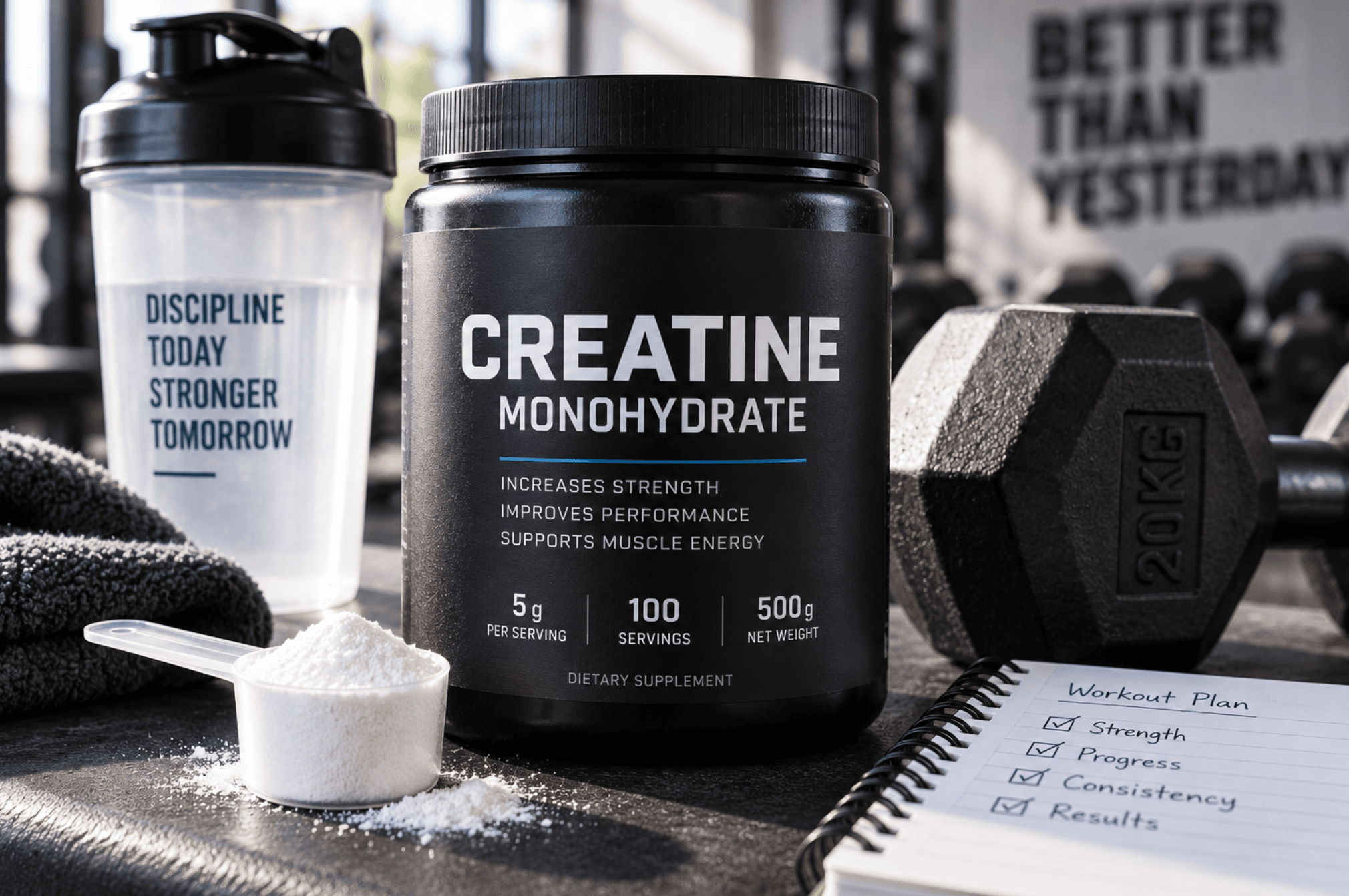
Creatine: How the Muscle Energy Buffer Works, What We Know About the Brain, Kidneys, and Supplementation
Clinical review of creatine monohydrate: ATP resynthesis, muscle power, cognitive benefits, the creatine vs creatinine distinction, and renal safety evidence.
Updated: . An update is not evidence of expert review.
Creatine: How the Muscle Energy Buffer Works, What We Know About the Brain, Kidneys, and Supplementation
Creatine occupies a rather unusual place among sports supplements. Much of the sports nutrition industry is built around compounds supported by limited research, effects hovering near the threshold of statistical significance, or marketing that runs far ahead of the science. With creatine, the situation is almost the opposite: it has been used for decades, its mechanism of action is well understood, and the number of studies runs into the hundreds.
Yet the same concerns still surround it. Does it damage the kidneys? Do you need to drink much more water? Is a loading phase necessary? Does it turn into creatinine? Does it cause water retention? Should it be taken with sugar? And finally, does it really affect not only muscle but the brain as well?
Some of the answers are simpler than the supplement industry makes them seem.
Creatine does increase the muscle’s ability to regenerate ATP rapidly and is therefore particularly useful during short, high-intensity efforts: heavy resistance-training sets, sprints, jumps, and repeated bursts of acceleration. Over time, when combined with training, this can translate into slightly more training volume, greater strength gains, and a somewhat larger increase in fat-free mass.
But creatine is not an anabolic steroid, it does not force muscle to grow on its own, and it does not turn an ordinary training program into a pharmacological cycle.
The story becomes even more interesting when the brain is considered. Creatine participates in cerebral energy metabolism just as it does in muscle, and research does suggest possible cognitive effects. But the evidence here is much weaker than in sports physiology: the most interesting findings tend to appear under conditions of metabolic stress — such as sleep deprivation — whereas the claim that “5 grams of creatine per day makes every healthy person smarter” is not supported by current science.
That is what makes creatine interesting not merely as another “sports supplement,” but as a useful example of a compound where biochemical mechanism, real-world clinical effects, and marketing myths can be separated relatively clearly.
Creatine is not a foreign supplement but part of normal human metabolism
Creatine is a nitrogen-containing organic compound that the human body can synthesize on its own.
Its synthesis occurs in several stages and involves arginine, glycine, and methionine. In the first stage, guanidinoacetate is produced from arginine and glycine; the enzyme AGAT plays an important role here, with especially relevant activity in the kidneys and certain other tissues. Guanidinoacetate is then methylated by the enzyme GAMT, with a substantial part of this process occurring in the liver. The resulting creatine enters the bloodstream and is transported to tissues with high and rapidly changing energy demands.
The main storage site is skeletal muscle.
About 95% of the body’s total creatine pool is found in muscle tissue. Roughly two-thirds of intramuscular creatine exists as phosphocreatine, while the remainder is present as free creatine. Smaller amounts are also found in the brain, heart, and other metabolically active tissues.
A portion of creatine is irreversibly converted to creatinine every day and eliminated from the body. These losses must be continuously replaced.
In people eating a mixed diet, some creatine comes from food, especially meat and fish, while the remainder is synthesized endogenously. Vegans receive virtually no dietary creatine, so nearly the entire requirement must be met through internal synthesis. This is one reason why baseline muscle creatine stores may, on average, be lower in vegetarians.
This leads to an important principle: when a person takes creatine monohydrate, they are not introducing some completely foreign metabolic compound into the body. They are increasing the availability of a substance that is already continuously synthesized, transported between tissues, phosphorylated, and broken down.
Why creatine helps specifically during a heavy set
For a muscle to contract, it needs ATP — adenosine triphosphate.
This molecule is often described as the energy currency of the cell, and in this case the analogy is fairly accurate. ATP breakdown provides the energy required for muscle proteins to work, and during intense contraction ATP demand rises sharply.
But the amount of ready-to-use ATP stored directly inside muscle is very small. It is enough for only the first few seconds of maximal effort.
The body therefore needs to regenerate ATP almost instantly — faster than slower energy-producing systems can fully respond.
This is where phosphocreatine comes in.
Creatine kinase transfers a high-energy phosphate group from phosphocreatine to ADP:
ADP + phosphocreatine ⇄ ATP + creatine.
In effect, the phosphocreatine system acts as an energy buffer.
When ATP demand suddenly rises, it allows ATP to be regenerated from ADP almost immediately. This system is particularly important during the first seconds of a sprint, a heavy resistance-training set, a jump, or another brief high-intensity effort.
When the effort ends, the reverse process occurs: using ATP generated mainly through mitochondrial metabolism, the muscle converts some free creatine back into phosphocreatine and prepares for the next bout.
This is why creatine’s effects make the most sense not during hours of steady-state exercise, but in activities where a person must repeatedly produce high power with relatively short recovery periods.
Creatine supplementation can increase the total intramuscular pool of creatine and phosphocreatine. The degree of increase depends on baseline stores and the supplementation protocol, but after saturation the increase in total muscle creatine often falls somewhere around 10–30%.
It is this relatively modest biochemical difference that gradually translates into a measurable performance effect.
Creatine does not give an athlete a “new engine” — it slightly enlarges the available rapid-energy buffer
Marketing descriptions sometimes create the impression that after taking five grams of creatine a person should suddenly become dramatically stronger.
That is not what happens.
Creatine does not double power output and does not turn a beginner into a professional athlete. Its effect is much less dramatic, but it is also much more consistently observed in research.
Modern meta-analyses show that creatine combined with resistance training provides additional strength gains compared with the same training without creatine. A 2024 meta-analysis in adults under 50 found that adding creatine to resistance training produced greater gains in both upper- and lower-body strength. Another large analysis found small but statistically significant benefits for bench press, squat, vertical jump, and peak Wingate power.
But the mechanism behind this advantage matters more than the headline result.
Creatine usually does not make one isolated repetition spectacularly more powerful. Rather, it can help maintain power slightly better across repeated intense efforts, restore phosphocreatine more efficiently between sets, and sometimes allow a little more total work to be completed.
In a single workout, the difference may seem almost trivial.
But if someone trains three or four times per week for several months, many small advantages begin to accumulate. Slightly more total volume, slightly better final repetitions, a little more weight — and after dozens of sessions, the difference may become measurable in training adaptation.
For that reason, creatine is more accurately described not as a direct “muscle builder,” but as an enhancer of the ability to perform training work.
Why body weight increases on creatine — and how much of that is actual muscle
One of the most noticeable changes after starting creatine is an increase in body weight.
This is especially obvious during a loading phase.
But it would be a mistake to interpret every additional kilogram as newly synthesized muscle protein.
Creatine is osmotically active. As creatine concentration inside muscle increases, water distribution changes as well. During the first days or weeks, part of the increase in body mass reflects greater water content within muscle tissue.
This is not the same as pathological subcutaneous edema.
At the same time, the popular phrase “creatine retains water exclusively inside muscle cells and nowhere else” is also overly categorical. Studies frequently show increases in total and intracellular body water, particularly early in supplementation, but actual fluid dynamics are more complex than the simple claim that “all the water goes only into the sarcoplasm.”
Over the longer term, however, another component appears.
When creatine is combined with resistance training, gains in fat-free mass exceed those seen with training alone. A 2024 meta-analysis found approximately 1.14 kg of additional fat-free mass in adults under 50 compared with resistance training without creatine. A larger 2025 analysis also found an additional increase in fat-free mass.
Even here, however, it would be incorrect to assume that all of this difference represents pure contractile protein.
Fat-free mass includes water, glycogen, proteins, and other components. Studies using direct imaging of specific muscles tend to show a more modest effect on actual hypertrophy than one might infer from changes in whole-body lean mass.
So creatine really can support muscle gain, but not because the supplement itself simply “switches on muscle synthesis.” Much of the long-term benefit likely comes from being able to train more effectively.
The brain uses creatine too — but the evidence is much more complicated
Skeletal muscle is not the only tissue that must maintain energy balance rapidly.
The brain is extraordinarily energy demanding. Neurons continuously use ATP to power ion pumps, maintain membrane potential, transmit signals, and restore electrochemical gradients after activation.
The creatine-phosphocreatine system therefore exists in nervous tissue as well.
Creatine can enter the central nervous system through the SLC6A8 transporter, but its movement across the blood-brain barrier is limited. In addition, the brain can synthesize part of its creatine locally. As a result, increasing creatine levels in the brain is considerably more difficult than saturating skeletal muscle.
This is where interest in cognitive effects comes from.
A 2024 meta-analysis of 16 randomized trials found a small positive effect on memory, along with possible improvements in some measures of attention and processing speed. However, confidence in the evidence was low or moderate across much of the cognitive literature.
In the same year, another systematic review reached a more cautious conclusion: findings on cognitive function remain inconsistent and do not yet support a simple model in which increasing brain creatine automatically improves mental performance.
The European Food Safety Authority went even further. After evaluating the available intervention studies, EFSA concluded in 2024 that a cause-and-effect relationship between creatine supplementation and general improvement in cognitive function had not yet been established.
The picture is therefore quite interesting: there is a plausible biological mechanism, there are individual positive studies, and there is a meta-analytic signal — but the evidence is not yet stable enough to call creatine a proven nootropic.
Sleep deprivation is one of the most interesting areas of creatine research
The picture changes when the brain is operating not under normal conditions but under increased energetic stress.
Sleep deprivation is one example.
In a 2024 study, a high single dose of creatine — 0.35 g/kg — administered during a 21-hour period of sleep deprivation affected markers of cerebral energy metabolism and partially reduced the deterioration in cognitive performance. A later study using a lower dose of 0.2 g/kg also suggested a degree of protection during sleep deprivation.
A 2026 systematic review concluded that the early findings in this field are promising, but the number of studies remains small and protocols are too heterogeneous to justify treating creatine as a standard countermeasure for sleep loss.
In other words, creatine should not be used as a way to “compensate for sleep.”
But the fact that its effect may become more noticeable under energetic stress fits its basic biochemistry quite well: creatine is not a stimulant like caffeine; it is part of the cellular energy-buffering system.
Why vegetarians and vegans may respond differently
The main dietary sources of creatine are animal foods, particularly meat and fish.
People who completely avoid such foods therefore consume virtually no preformed creatine.
The body compensates through endogenous synthesis, so a healthy vegan does not develop “creatine deficiency” in the classic medical sense. But muscle creatine concentrations in vegetarians may, on average, be lower than in people eating mixed diets.
That means their potential reserve for increasing tissue creatine through supplementation may sometimes be greater.
A systematic review of studies in vegetarians found a pronounced increase in muscle creatine after supplementation and positive changes in some physical and cognitive outcomes. However, the authors also noted a moderate or high risk of bias in many of the included studies, and the claim that vegetarians always experience much greater performance benefits remains insufficiently established.
A more accurate formulation is therefore: people with low baseline dietary creatine intake may sometimes show a larger physiological response to supplementation, but individual response still varies considerably.
Why creatine is so often blamed for kidney damage
No myth surrounding creatine has been as persistent as the claim that it “destroys the kidneys.”
The origin of this myth is understandable.
Some creatine and phosphocreatine in the body is continuously and spontaneously converted into creatinine. Creatinine enters the bloodstream, is filtered by the kidneys, and is widely used in clinical practice as one of the main markers for estimating glomerular filtration rate.
When someone begins taking creatine, the body’s total creatine pool may increase.
As a result, serum creatinine can sometimes rise slightly.
If a laboratory then enters that creatinine value into the CKD-EPI equation, estimated GFR may appear lower.
This creates a diagnostic trap:
the equation sees more creatinine and interprets it as potentially worse filtration, even though the reason for the increase may be altered creatine metabolism rather than damage to kidney tissue.
Recent data illustrate this quite clearly.
A 2025 meta-analysis found a small increase in serum creatinine after creatine supplementation but no significant deterioration in actual glomerular filtration. A 2026 meta-analysis of randomized trials also found an increase in creatinine of roughly 0.13 mg/dL without significant differences in blood urea or estimated GFR between groups.
Another 2026 meta-analysis produced an especially illustrative result: creatinine-based estimated GFR could appear lower, yet when filtration was assessed using the exogenous marker Cr-EDTA, no significant impairment was found. Proteinuria and albuminuria were not increased either.
This distinction is essential.
Elevated creatinine is a laboratory marker. Kidney damage is a pathological process. They are not synonymous.
Does that mean creatine is absolutely safe for every kidney?
No — and there is no reason to replace one extreme with another.
For healthy adults, current research does not support the idea that standard doses of creatine monohydrate are nephrotoxic. Large bodies of data also do not show a systematic increase in renal, hepatic, gastrointestinal, or other serious adverse effects compared with placebo. A structured analysis published in 2026 examined data from more than 12,800 participants across 684 randomized trials and found no clinically meaningful dose- or duration-related increase in adverse effects.
But that does not mean these results can automatically be extrapolated to someone who already has severe chronic kidney disease.
Such patients are far less represented in sports nutrition trials.
Therefore, in people with confirmed chronic kidney disease, significant proteinuria, reduced GFR, or another serious renal disorder, the question of creatine should be addressed individually with a clinician rather than by applying general recommendations designed for healthy athletes.
Modern safety reviews make the same distinction: the amount of evidence is much smaller in people who already have kidney disease.
So the correct conclusion is neither “creatine can never affect the kidneys” nor “creatine destroys the kidneys.”
A more accurate statement is: in people with healthy kidneys, recommended doses of creatine monohydrate have not demonstrated nephrotoxic effects, but pre-existing kidney disease requires individualized medical assessment.
Should cystatin C always replace creatinine?
Cystatin C can indeed be very useful in someone with high muscle mass or someone taking creatine.
But the popular statement “creatinine is useless — use cystatin C because it shows the true GFR” is also too simplistic.
Creatinine depends not only on filtration but also on muscle mass and creatine metabolism. Its interpretation can therefore be more difficult in highly muscular people or when creatine metabolism is altered.
Cystatin C is much less dependent on muscle mass and can therefore provide another perspective.
But it is not a perfect direct measure of filtration either.
NIDDK emphasizes that both creatinine and cystatin C are influenced by non-filtration factors. When greater precision is needed, current recommendations favor a combined CKD-EPI equation using both creatinine and cystatin C, which is generally more accurate than either marker alone.
And in the relatively rare situations where highly precise GFR assessment is essential for a clinical decision, filtration can be measured directly using exogenous markers.
The practical conclusion is simple: if someone is taking creatine and sees an isolated, unexpected increase in creatinine, they should not automatically diagnose themselves with kidney disease. The result should be interpreted in context, considering previous laboratory values, muscle mass, urine albumin, cystatin C, and the overall clinical picture.
What about hair loss?
The idea that creatine causes baldness has been around for years.
It arose mainly from a small study in which a short creatine-loading phase was associated with a change in dihydrotestosterone, or DHT. Because DHT is involved in androgenetic alopecia in genetically susceptible individuals, a chain of reasoning gradually emerged:
creatine → DHT → hair loss.
The major problem was that the original study never measured hair loss.
In 2025, the first randomized controlled trial specifically designed to examine this question was published. Resistance-trained men received either 5 g of creatine monohydrate or placebo daily for 12 weeks. Researchers measured testosterone, free testosterone, DHT, hair density, follicular unit count, and hair thickness.
No significant differences were found between creatine and placebo in either DHT or hair-related outcomes.
One 12-week study obviously cannot prove that there is absolutely no effect in every person over decades of use.
But at present there is no direct evidence that standard creatine supplementation causes baldness, and the first trial that actually measured hair outcomes did not support the claim.
Why monohydrate remains the standard despite dozens of “improved” forms
Creatine monohydrate is so simple and inexpensive that an entire industry of “upgraded” versions was almost inevitable.
This is how creatine HCl, creatine ethyl ester, buffered creatine, citrate, malate, nitrate, magnesium chelates, and dozens of other versions appeared.
The marketing narrative is usually the same:
ordinary monohydrate is supposedly poorly absorbed, degraded in the stomach, responsible for water retention, or requires too large a dose, while the new form promises to solve these problems.
Comparative research does not support these claims.
A critical review published in 2022 concluded that creatine monohydrate remains the form with the strongest evidence for bioavailability, efficacy, and safety, and that there is no convincing evidence that alternative forms outperform it. A separate systematic review from the same period likewise found no consistent superiority of alternative formulations over monohydrate.
The economics are revealing as well: a market analysis found that alternative forms were substantially more expensive on average, even though approximately 88% of the alternatives studied had limited or absent evidence for efficacy and safety.
Creatine ethyl ester is a particularly poor example. It was marketed on the idea that esterification would improve membrane penetration, but in practice it was less effective at increasing muscle creatine and was more rapidly converted into creatinine.
So for someone who simply wants the evidence-based effect, the choice is surprisingly boring:
plain creatine monohydrate remains the optimal option.
Micronization may improve mixing and reduce sediment in a drink, but it does not transform creatine into a pharmacologically more effective compound.
Creapure is a well-known manufacturing and quality-control standard, but it is a brand, not a separate pharmacological form. For effectiveness, what matters much more is that the product actually contains high-quality creatine monohydrate at the stated purity.
Is a loading phase necessary?
There are two classic ways to saturate muscle with creatine.
The first is rapid loading.
The conventional protocol is approximately 0.3 g/kg of body weight per day for 5–7 days, which for a person weighing around 70 kg works out to roughly 20 g per day. This amount is usually divided into several smaller doses. After saturation, intake is reduced to a maintenance dose of around 3–5 g per day.
This brings muscle stores close to maximal saturation relatively quickly.
The second option is much simpler: take 3–5 g every day without a loading phase.
The final level of saturation will be approximately the same; it simply takes several weeks instead of several days.
So loading does not create a unique effect — it only gets you more quickly to a state that can also be reached with ordinary daily dosing.
For most people who are not in a hurry, 3–5 g per day is the easiest approach.
Loading may make sense if an athlete has a specific reason to increase muscle creatine stores as quickly as possible. However, larger doses are more likely to cause gastrointestinal discomfort, which is why loading doses are usually divided across the day.
Is there an “ideal time” to take creatine?
The sports nutrition industry loves timing windows.
Before training. Fifteen minutes after. Only with fast carbohydrates. Only in the morning. Only in the evening.
For creatine, this precision is generally unnecessary.
Its primary effect depends not on a brief spike in blood concentration after one dose, but on gradual saturation of tissue stores.
That makes regularity much more important than the exact minute of intake.
Current reviews do not provide convincing evidence that taking creatine immediately before or after exercise is fundamentally superior for most people.
If it is convenient to take creatine with breakfast, that is fine.
If it is easier to mix it into a drink after training, that is also fine.
If a person constantly forgets to take it after workouts but reliably remembers it with dinner, dinner is going to be much more effective than a theoretically “perfect” timing strategy that is rarely followed.
Does it need to be taken with sugar?
Insulin can indeed influence creatine transport and retention.
Classic studies showed that large amounts of carbohydrate, or a combination of carbohydrate and protein, can increase creatine retention in the body. In some experiments the effect was fairly substantial.
This is where the recommendation to take every creatine dose with sweet juice came from.
But for most people, this is a solution to a problem that barely exists.
If someone takes 3–5 g of creatine every day, muscle stores will eventually become saturated anyway. Adding 50–100 g of fast carbohydrate merely to accelerate creatine accumulation slightly is rarely a rational trade-off, especially if those calories are not otherwise needed.
An ordinary mixed meal containing protein and carbohydrate is perfectly adequate.
Creatine can also simply be taken on its own.
So the insulin effect exists biochemically, but it does not need to become a ritual.
Do you need to drink an extra half-liter of water every day?
Another common recommendation says: “if you start creatine, you must add 500–1000 mL of water per day or you will become dehydrated and cramp.”
There is no strong scientific basis for this rule.
Creatine does alter water distribution in muscle tissue and, particularly early in supplementation, can increase total body water.
But controlled studies do not show impaired hydration or thermoregulation during exercise. Systematic reviews of studies performed in the heat have likewise not found worse exercise tolerance or hydration status.
Modern safety reviews consider claims that creatine causes dehydration and muscle cramps to be largely unsupported.
So there is no universal magic number such as “600 mL of extra water because you take creatine.”
People should maintain appropriate hydration according to temperature, exercise load, sweating, diet, and thirst — whether or not they use creatine.
Do you need to cycle creatine and give the body a “break”?
There is no convincing physiological reason to cycle creatine according to a pattern such as “two months on, one month off.”
During supplementation, endogenous creatine synthesis can indeed decrease — the body has no reason to produce the same amount when more is arriving from outside.
But this is a normal metabolic adaptation, not a permanent “shutdown” of creatine production.
After supplementation is stopped, muscle stores gradually return toward baseline over several weeks and endogenous synthesis resumes.
There is no creatine dependence syndrome and no need for any kind of “post-cycle therapy.”
So a person can take 3–5 g daily over the long term if they have a reason to use it and no relevant medical contraindications.
Creatine and caffeine: do they cancel each other out?
Another popular myth claims that caffeine “cancels” creatine.
The debate began with several early studies that raised the possibility that simultaneous high-dose caffeine use might reduce certain ergogenic effects of creatine or increase gastrointestinal discomfort.
But current reviews do not support the idea that ordinary coffee or caffeine consumption makes long-term creatine supplementation ineffective. The question may matter for specific acute protocols and individual tolerance, but there is no general rule that “creatine and coffee are incompatible.”
A person who drinks coffee in the morning and takes creatine daily does not need to choose between the two.
Who should still be more cautious
For a healthy adult, creatine monohydrate in standard doses has a very strong safety profile.
But a strong safety profile does not make individual medical context irrelevant.
If someone already has diagnosed kidney disease, especially with reduced GFR or significant albuminuria, supplementation should be discussed with a nephrologist.
During pregnancy and breastfeeding, evidence for routine long-term supplementation is insufficient to make recommendations as confidently as we can for healthy nonpregnant adults.
If a person takes medications that require very precise assessment of kidney function, it is important to remember that creatine-related changes in creatinine can complicate interpretation of laboratory results.
And finally, if unusual symptoms appear after starting a product, they should not automatically be dismissed as “adaptation to creatine.” The cause may be contamination, another ingredient in a multi-component supplement, an unrelated illness, or something else entirely.
This is one reason a plain single-ingredient creatine monohydrate product with independent quality control is often a more rational choice than a complex “anabolic blend” containing numerous poorly characterized ingredients.
How to use creatine in practice
For most healthy adults involved in resistance training or sports requiring repeated high-intensity efforts, the practical approach can be extremely simple.
Choose plain, pure creatine monohydrate.
Take 3–5 g every day, regardless of whether you train that day.
A loading phase is optional. If rapid saturation is desired, around 0.3 g/kg per day for 5–7 days can be used, divided into several doses, followed by the usual maintenance intake.
Time of day is largely unimportant. There is no need to consume large amounts of sugar to “open creatine transport.” There is no need to drink a fixed additional 500 mL of water. There is no need to take monthly breaks so that the body “does not forget how to synthesize creatine.”
If kidney-related laboratory tests are performed during long-term supplementation, the clinician should be told that creatine is being used. An isolated increase in creatinine should be interpreted in the context of muscle mass and supplementation; if needed, cystatin C can be added and a combined eGFR calculated, while more precise filtration measurements can be used in clinically important situations.
And most importantly: creatine does not replace training.
Without progressive overload, adequate protein intake, sufficient energy, and proper recovery, the supplement will not create meaningful muscular adaptation on its own.
It makes a good training system slightly more effective — but it does not create that system for you.
Main takeaway
Creatine is a rare example of a supplement surrounded by plenty of marketing, yet the real science is even more interesting than the marketing.
It is a natural component of human energy metabolism. Most of the body’s creatine is stored in skeletal muscle, where the creatine-phosphocreatine system helps regenerate ATP almost instantly during brief, intense work.
Increasing the muscle creatine pool does not transform the body into a different energy system. It simply increases the availability of the rapid-energy buffer by a modest amount. But in resistance training, that small advantage can be repeated hundreds of times, gradually translating into more training volume, additional strength gains, and somewhat greater fat-free mass.
The brain story remains less certain. Creatine clearly participates in cerebral bioenergetics, and some studies suggest benefits for memory and performance, particularly during sleep deprivation or other forms of metabolic stress. But it is still too early to call creatine a proven universal nootropic.
Concerns about kidney damage arose largely from confusion between creatine, creatinine, and filtration. Supplementation can modestly raise creatinine and thereby influence estimated GFR, but modern meta-analyses do not show corresponding deterioration in actual kidney function in healthy people.
The hair-loss myth also remains unconfirmed: the first randomized trial that directly measured hair-related outcomes found no adverse effect.
And the many “advanced” creatine forms have still failed to convincingly outperform the simplest option.
So after decades of research, the practical recommendation sounds almost anti-commercial:
plain creatine monohydrate, 3–5 grams every day, no mandatory loading, no cycling, no sugar rituals, and no need to buy an exotic formulation.
In sports nutrition, it is rare for the oldest, simplest, and one of the least expensive products to remain the best studied at the same time.
Creatine is one of those rare cases.
This material is for educational purposes only and does not replace consultation with a physician, sports medicine specialist, or nephrologist, nor does it replace diagnosis or individually prescribed treatment.
FAQ
Does creatine damage kidneys?
No. Clinical trials confirm that creatine does not harm kidney function in healthy individuals.
Sources
- ISSN Position Stand: Creatine Supplementation
- International Society of Sports Nutrition. Common Questions and Misconceptions About Creatine Supplementation: What Does the Scientific Evidence Really Show?
- Kreider R.B., Jäger R., Purpura M. Bioavailability, Efficacy, Safety, and Regulatory Status of Creatine and Related Compounds: A Critical Review
- Effect of Creatine Supplementation on Kidney Function: A Systematic Review and Meta-analysis
- The Effect of Creatine Supplementation on Kidney Function: A Systematic Review and Meta-analysis of Randomized Controlled Trials
- NIDDK. Clinical Measurements & eGFR Accuracy
- Effects of Creatine Supplementation and Resistance Training on Muscle Strength Gains in Adults <50 Years of Age: A Systematic Review and Meta-Analysis
- The Effect of Creatine Supplementation on Resistance Training-Based Changes to Body Composition: A Systematic Review and Meta-analysis
- The Effects of Creatine Supplementation on Cognitive Function in Adults: A Systematic Review and Meta-analysis
- European Food Safety Authority. Creatine and Improvement in Cognitive Function
- Does Creatine Cause Hair Loss? A 12-Week Randomized Controlled Trial
- Creatine Supplementation and Acute Sleep Deprivation: A Systematic Review of Cognitive, Psychomotor, and Mood Outcomes
- Efficacy of Alternative Forms of Creatine Supplementation on Improving Performance and Body Composition in Healthy Subjects: A Systematic Review
- NIDDK. eGFR Equations for Adults